
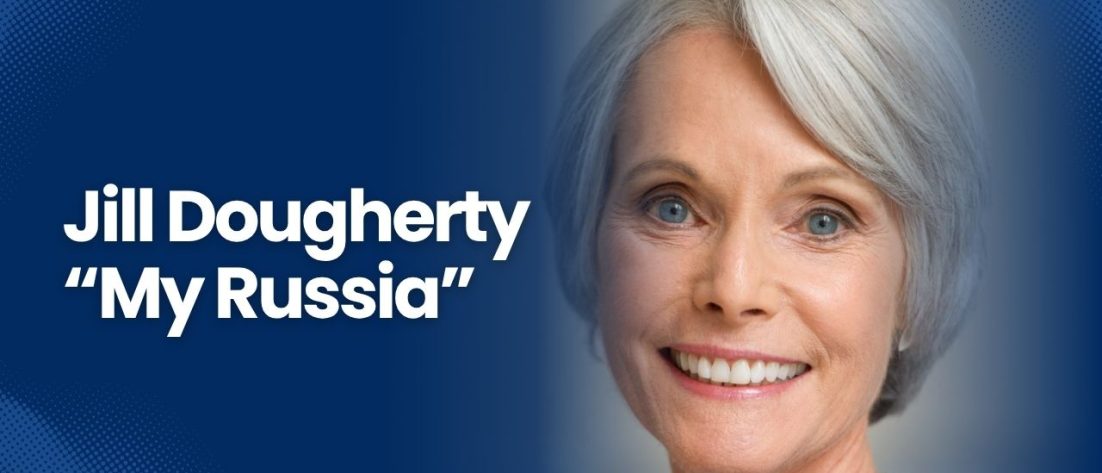
Unlock the secrets of the Kremlin and understand Vladimir Putin through the eyes of someone who was there: Jill Dougherty, a seasoned journalist with 30 years at CNN, including eight years as Moscow bureau chief. Blaine DeSantis on Books and Looks sits down with Jill to go inside the Kremlin and discuss her book, “My Russia: What I Saw Inside the Kremlin”.
Jill Dougherty didn’t just parachute in; her connection to Russia began in high school. She covered Gorbachev, Yeltsin, and has covered Vladimir Putin**ince he was prime minister in 1999. Witnessing his transformation from a disciplined bureaucrat to a consequential leader. She offers unique insights, possessing access almost no one else had.
In this fascinating conversation, Jill shares:
- The story of the time Vladimir Putin kissed her and her analysis of the possible reasons behind it.
- How she overcame personal challenges like mic fright during her extensive career.
- The meaning behind the old Soviet phrase, “there’s no news in the truth and no truth in the news”.
- Common misconceptions about Putin and the true nature of the “power vertical” structure in Russia.
- The gradual shift towards authoritarianism and when key crackdowns on media and political life began under Putin.
- A comparison of the operations in Crimea (2014) vs. the full-scale Ukraine invasion (2022).
- Putin’s use of “Russkiy Mir” (Russian world) and “traditional values” propaganda to justify actions and depict the West negatively.
- Experiences covering the brutal Chechen wars and the horrific **Beslan school attack.
- Her perspective on the current state of the Ukraine war, negotiations, and the potential future landscape, emphasizing the need for a long-term approach.
- Future plans to explore the transformation of life in Russia’s western border neighborhood.
This interview draws directly from Jill Dougherty’s firsthand experience and deep knowledge of Russia. It offers crucial context for understanding the current conflict and the man who reshaped Russia.
To learn more about these pivotal moments and get Jill’s full account, read “My Russia: What I Saw Inside the Kremlin”.
Links:
Transcript
Blaine DeSantis: [0:00] What if I told you that one American journalist had a front-row seat to Vladimir Putin’s entire rise to power, from an unknown KGB officer to the man who would reshape Russia and challenge the West? I’m Blaine DeSantis, and today on Books and Looks, we’re going inside the Kremlin with someone who didn’t just report on Putin. She watched him transform from a quiet, disciplined bureaucrat into one of the world’s most consequential leaders. And as Russian tanks rolled toward Ukraine, she was there to witness what she calls the tragic culmination of a story three decades in the making. Now, most analysts will approach Vladimir Putin from the outside, but Jill Dougherty has something almost no one else has possessed: access. For over two decades, she didn’t just interview Putin. She watched him evolve from the man who once spoke of partnership with the West to someone who now considers America as his greatest enemy. My guest today is Jill Dougherty, who spent 30 years as a correspondent with CNN, including eight years as the Moscow bureau chief during some of the most pivotal moments in Russian history. But here’s what makes her different. She didn’t just parachute into Russia as a foreign correspondent. Her love affair with the country began in high school when she chose to study Russian.
Blaine DeSantis: [1:16] Led her to Leningrad as an exchange student in 1969, and shaped her entire career trajectory from working for the Voice of America to the White House, to the Kremlin itself. Her book is My Russia: What I Saw Inside the Kremlin.
Blaine DeSantis: [1:31] Jill Dougherty, welcome to Books and Looks.
Jill Dougherty: [1:34] Thank you very much, Blaine. I’m really glad to be here.
Blaine DeSantis: [1:37] It’s great having you on and a TV star. And I’ll tell you why, we don’t get this all every day here on the show, but wow, I’m so glad you wrote this book. So timely, so amazing. Wow. I’m so glad, Jill, why did you do it now as opposed to maybe a few years ago?
Jill Dougherty: [1:53] You know, I think, Blaine, that it was a process because I kind of had the idea that a book was in me. I mean, you know, since I’d been involved in Russia for a very long time, Russian studies, etc. But I actually was kind of fearful, I have to be honest, about writing a book because I thought, number one, what do I have to say? And I really did wonder, what did I have to say? And then how would I say it? Because what I wanted to do was encompass like half a century, literally 50 years of my life dealing since high school all the way up to today. And then also just that process of writing a book, you know, it’s very different from doing a two minute or even one and a half minute TV spot or even, you know, podcasts. It’s very different. So it was a challenge. But then I started thinking, you know, I better just sit down and get going.
Blaine DeSantis: [2:52] Right. You had the inside track on everybody. So what you gave is fantastic stuff. Now, I think I’ll begin with something that actually happens around the middle of the book. You got kissed by Vladimir Putin. Not everybody has that.
Jill Dougherty: [3:06] Not everybody.
Blaine DeSantis: [3:07] Tell us about that.
Jill Dougherty: [3:09] Well, we wonder, Blaine, if they did, did they live to tell the tale? But in any case, no, you know, it’s funny because I have covered Putin ever since. Well, actually, I covered, you know, two presidents before that, Gorbachev, as we refer to him, Gorby, and Yeltsin, and then Putin. And I’ve covered Putin ever since the beginning. So that goes back to 1999 when he was prime minister. And then he’s elected in 2000 and to today. So he’s been in power. We have to remember a quarter century, which is really amazing. I mean, there was that little brief period with his prime minister, you know, Dmitry Medvedev. Yeah, they kind of switched chairs, but basically a quarter century. So I was at a conference, and this conference is kind of a big conference. You know, talk fest that happens every year. And in the old days, before the full-scale invasion of Ukraine in 2022, a lot of Americans went to it, but no Americans that I know of go to it right now. So I’m at this conference and I thought, wow, this is 2014.
Jill Dougherty: [4:25] And I thought, you know, I should just make a direct pitch to Putin for an interview for CNN. And at that point, I didn’t care. Do I do it? Does somebody else do it? But I thought, you know, the more the merrier, because he’s not that easy to get an interview with.
Jill Dougherty: [4:41] So they had a cocktail party and I scoot over to the cocktail party after this thing and kind of sneak my way, you know, through these armed guards and everything, go up to him.
Jill Dougherty: [4:53] And I said, hello, Mr. President, you know, Jill Dougherty, CNN. And he knew me because I’d covered him for a long time. And I said, you know, I wanted to make this pitch for CNN anytime, anyplace. Very glad to talk with you. And he said, well, you know, the person who’s in charge of my schedule is right here. And he points to his press secretary, who is Dmitry Peskov, a guy I knew quite well. I’d worked with him for a long time. So I turn like, you know, to the side and all of a sudden, smack, I feel this kiss on my cheek. And I thought, you know, I actually was kind of, I don’t know, set back on my heels because I thought, what just happened? You know, did he actually kiss me? Because I wasn’t used, I’d never, you know, kissed him. It wasn’t that type of relationship, you know, in kind of a personal thing. And then I thought, wait a minute, he actually kissed me. What is going on here? So in the meantime, and this gets into why he did it, I was kind of, as you say, gobsmacked. So I kind of lost my train of thought. And within a second, he’s on to bigger and better things. And he drifts away. And I talked to Peskov, but it was basically over. So I went back to my hotel at that time.
Jill Dougherty: [6:19] And I talked to a friend of mine who is a Russian journalist, a woman, and I said, you’re not going to believe what happened. And she said, what? And I said, Putin kissed me. And she said, oh, he kissed me too. And I went, what? You know, so we just, we started in kind of a joking way, but then we kind of went, and I have this in the book, which is, I call the exegesis of a kiss. And we tried to analyze why he would kiss me, because Putin, at least in my estimation, does not do things, at least in public, just for the fun of it. You know, there’s a purpose. So what was he trying to do? And we kind of went through, I don’t know, four or five different reasons. It could be, hi, glad to see you, because I actually did have a pretty good relationship with the Kremlin back, you know, way before the invasion.
Jill Dougherty: [7:15] It could be he is trying to discombobulate me, entirely possible, because that gives him a leg up, you know. It could be this one friend of mine who is Russian, a guy, said, oh, it’s kind of like the mafia. You get the omerta kiss, you know, and then you’re a member of the family. And, you know, there were. Oh, and then the other thing, of course, is misogyny. You know, like, nice little girl, that kind of dismissive thing, that he is a total male chauvinist. I’m sorry, but he really is. So there were several reasons, but it was interesting to think, like, maybe it was just an innocent, hello, how are you? But to me, it was different. And I think it did have a purpose.
Blaine DeSantis: [8:05] I can understand that. You know, one thing we did, I didn’t even think I’d bring up. You talked about having mic fright. You don’t have any mic fright now. Look at you, you answer, you’re talking. That must have been difficult to overcome while you’re on the air.
Jill Dougherty: [8:20] You know, I’m glad you’re asking that. You’re actually the first person in doing some interviews who’s asked me about that. Because to me, it’s a recurring theme in the book. But, you know, I did. And when I started out, I actually left a job, an early job in TV. Well, actually going back even further to the Voice of America. That was my very first job. And I was broadcasting in Russian to the Soviet Union. And I remember sitting there, and I recount this as, you know, you read, I’m sitting in the studio and I thought I was going to have a heart attack. And I was just fearful. I think what was going on was, and then I’ll tell you kind of how I got over it. And mic fright is not that uncommon. I’ve known a lot of people, oddly enough, in this business or actors, you know, and Barbra Streisand famously didn’t perform for years and she was a big star. She didn’t perform because she had, you know, mic fright, stage fright. So I think what it is, is I was insecure. I was young.
Jill Dougherty: [9:34] I was speaking in a foreign language, and, you know, that’s a little bit hard. So that was my first introduction to public speaking. And then I think I’m, I hate to say, kind of a perfectionist type A personality. And I just thought, this has to be right. This has to be perfect. You know, that type of thing, which really threw me. So that VOA experience, and then even with CNN, well, even local news in Chicago.
Jill Dougherty: [10:06] My first TV job, and then into CNN. The thing that stopped it, though, was when I went to Moscow, and this is a long way into my career in TV, I go to Moscow, and I am the bureau chief and the correspondent, and there is nobody else. Eventually, we had a couple of kind of fledgling correspondents. They were producers who became correspondents, but they were not going to be doing the stuff that I was doing. So there was no option. I either did it or it didn’t get done, at which point I would probably be fired. So I and then so the more I did it, then the more I thought I’m going to concentrate on just that person who’s out there like think of it in a very personal way like I’m looking at you right I’m talking with you and that’s kind of how I looked at these live shots there was nobody you know I couldn’t see the audience but I knew that there were people out there who were listening and I it was kind of a mental trick in a way but I started thinking what do you want to tell them forget about how you look or whatever and and that really helped me and now I actually enjoy it as you can see I can talk a lot because I think maybe it’s Irish I don’t know Blaine but the.
Blaine DeSantis: [11:28] Other thing is you go from a script to spontaneity.
Jill Dougherty: [11:31] And when you’re spontaneous.
Blaine DeSantis: [11:33] It’s easier to talk than say Oh, I got to read what that person wrote and everything.
Jill Dougherty: [11:38] Very, very true. In fact, when I started at the White House to report from the White House, I remember saying to another reporter that, you know, you go to a news conference and whoever the president is, it lasts usually for a long time, at least a half an hour, let’s say. So then you have to pop up with a microphone and say, what just happened? And I asked this guy who’d been in the business for a long time, like, how do I compress a half hour, let alone an hour, into two minutes on camera? And he said, you cannot tell everything. You simply cannot cover everything. You can give the highlights. So I actually began to do it differently. I would kind of take running notes like, I don’t know, Europe, war, all of this. But then I kept another little piece of paper on which I would keep the three or four biggest takeaways. And then I would talk, then I would talk about the three or four biggest takeaways and the rest you know it gets reported eventually but that helped me too it was it was less exactly what you’re saying it was less stress yeah.
Blaine DeSantis: [12:53] Yeah when I went to argue cases in the appellate court I’m an attorney former attorney I you’d go and people would have their they’d have their yellow pads and they’re reading and they’re stumbling and bumbling I just winged it you know because I knew the case, go boom, boom, boom, and then get your points out.
Jill Dougherty: [13:07] And you’re probably a lot more effective.
Blaine DeSantis: [13:10] And when the judge asks you a question, forget your yellow pad because you’ve got to be able to think off the top of your head. And same thing with you, with correspondents. Things happen.
Jill Dougherty: [13:18] Yeah, sure.
Blaine DeSantis: [13:19] Well, this has been fascinating. You know, one of the other things early on in the book, and I’ve got to go back early on, there’s this phrase in Russia, there’s no news in the truth and no truth in the news. Tell us what that’s all about, please.
Jill Dougherty: [13:33] Oh, wow. Well, that’s the good old Soviet days. So, there were two main outlets for information. There was Pravda, and I’m sure that people have heard of that, Pravda. Pravda means truth, and Izvestia, which means news. And so even though it was a repressive communist, you know, control, people had jokes. They’d make fun behind the scenes. Sometimes, of course, they were sent to the gulag for it. But, you know, people basically kind of made fun of things. It was their way of just having, you know, reality check. And so there was that joke that there is no Pravda in Izvestia and no Izvestia in Pravda. So there’s no truth in the news and no news in the truth.
Blaine DeSantis: [14:24] There you were stumbling around blindly trying to figure out what’s going on. Wow.
Jill Dougherty: [14:28] Yeah, yeah.
Blaine DeSantis: [14:29] What is our biggest misconception about Vladimir Putin? Do we have something we’re getting wrong as a country, as people?
Jill Dougherty: [14:36] I think so. I mean, I think a lot of people think of him as a super strong leader, you know, just ruthless, etc. I agree he is ruthless, but I don’t think that he is as strong as we may come out to be. I mean, he has a very big, physically big country to deal with. And I’ve been in many parts of Russia. And if you go out to like the Far East, which is almost getting into like Japan, China, and I mean, really all the way to the Pacific. I remember talking to a businessman and he said, Moscow is far away. It’s kind of like, you know, Washington, D.C. is far away. And he meant it politically as well as geographically. So Putin has to control this. And then, you know, how you control things, it is a top-down control, what he, in the beginning, called the power vertical. So what he did is, let’s think of our society. A Russian friend actually described it. So I am, you know, creating a pyramid, right? Okay, so on the bottom of the pyramid is civil society. It’s parties, political parties. It is.
Jill Dougherty: [16:00] Civilian organizations, civil society. It’s the Boy Scouts. It’s, you know, business people. It’s all of that on the bottom. And then on the top of that pyramid is the president, right? Okay. In Russia, it’s reversed. So there’s very little civil society. I mean, it exists, but it’s not allowed to have any national implications. So, you know, it’s like this. So you’ve got a little tiny civil society down here, and this huge presidency with all the power, you know, intelligence agencies, police, repression, the army, propaganda, you name it, and a very compliant parliament, you know, called the Duma, basically. So, and what my friend said, who is Russian, and an expert in their government, she said, it’s very unstable.
Jill Dougherty: [16:58] It looks stable. It looks really strong, but it’s not. And so right now, I don’t want to date this, but a couple of days ago, you had a massive attack by the Ukrainians on Russia. And some of the destruction is not as great as they said, but it was a real blow to Putin. And there are people in Russia who were looking at this and saying, how did he get us into this again? And they may be, let’s say, complying with him because financially it makes sense or whatever, but there are some people who are not happy and there’s some Russians who are not happy. And I think Putin looks over his back a lot and wonders, can I keep it under control? So that’s why you’re getting an increased repression and militarization of that society. It is just, I’ll tell you, it is so different from three years ago when I was there for the full-scale invasion. I can’t go back. So, you know, physically I haven’t been there for three years. It is a very different place. It is much more like the novel 1984. A lot of control.
Blaine DeSantis: [18:14] Did this become, did this happen gradually? Because at one time he was making overtures, being pro-Western and, you know, cooperating. When did this actually start happening, this authoritarian streak?
Jill Dougherty: [18:28] You know, that’s a fantastic question. It’s really the question that a lot of Russia experts, so-called, you know, but academic and other think tank people ask this all the time. Like, was he always this way? Because right now he is pretty bad. You know, he has sent, by the way, a million, an estimated million Russians to either death or real injury and destruction in Ukraine. A million of his own people, not to mention at least a half million Ukrainians. So we’re talking about huge numbers and, you know, just destruction of cities and villages, etc. So you remember, and you just referred to that, the early days, like when he came in, we have to go back to Yeltsin. So Boris Yeltsin is kind of like the destroyer. He was the destroyer of the communist party and the communist system, but he wasn’t much of a builder. So, you know, he tears everything down and now it’s kind of a free for all. And on one level, it was great because people could read what they wanted to read and form political parties, etc. But it was pretty chaotic. So Putin comes in when Yeltsin, who was also an alcoholic, as we know.
Jill Dougherty: [19:50] Yeltsin almost like he sounded like he was going to die, but right at the end, New Year’s Eve of 2000, he steps down unexpectedly. And you can see this on YouTube, and then Putin is his heir apparent. So, Putin at that point said many of the right things. I believe in democracy. I believe in freedom of the press. You know, all of this stuff that sounded great to an American or to a Westerner. And after the chaos of Yeltsin, it looked pretty good. And he even did things like he had economic reform. He had some economic reformers in his government. But at the same time, as soon as he became president, that very first year, he began to crack down on the media and to take over. There was one, I was there when it happened, NTV, it would be like the NBC of Russia, really respected, very good outfit, you know, media outfit. He took it over. And then he began slowly but surely and inexorably taking over the media and then controlling things. Like there were governmental things that he did. He subdued the parliament very quickly.
Jill Dougherty: [21:12] And so they became rubber stamps for what he wanted to do. He told businessmen, he actually had a big meeting in the Kremlin, which I will never forget. And he said, if you want to be involved in politics, I’m sorry, it’s not going to work. If you want to do business, you can do business, but you can’t get involved in politics. So he subdued the business community. So, you know, parliament, he’s got the government, he’s got business and then and he’s got the media propaganda. So that’s, I think, how it happened. I would say, I just talked with some other people about this who really know the country, and we’re saying it took him, you know, he started quickly, but I would say about 10 years to totally, totally consolidate. And then in February 2022, big change. I mean, that was it.
Blaine DeSantis: [22:08] I was amazed. No, I wasn’t amazed. Okay. Because they’re going to say, oh, they’re troops. There’s troops. There’s tanks. And I’m saying, nothing’s not going to happen. Not going to happen. They say to me, Blaine, why is it going to happen? I said, because the Olympics are on. He’s going to wait till after the Olympics to do it. Just like he did with Crimea. Did the Crimea after the Olympics too. No, but people forget that. You see? And, you know, Crimea, he does the same thing. And we don’t respond. What’s the difference, Jill, do you think? I need your opinion here. What’s the difference between Crimea versus the total Ukraine situation?
Jill Dougherty: [22:44] You know, I covered both of them. So if you go back to Crimea, it was a little more murky. Crimea is an area that was given to Ukraine. So this is in the Soviet days. So it’s got a lot of different nationalities. And some Russian speakers, some Tatars, Crimean Tatars. It’s a complex area. So it’s different than Ukraine as a whole. So that’s number one. It’s smaller. So what Putin does there is he sends in what were referred to as little green men. He sends in guys who have, they’re dressed, they have military uniforms.
Jill Dougherty: [23:32] They have military kit, they come in, but they don’t have any insignia. So you don’t know where they’re from. They could be from outer space, but they’re dressed in camouflage and they take over and they are not shooting people. They’re basically just poof, you know, they kind of appear. And when people, when reporters were saying, hey, they look like Russians. And then the Kremlin was saying, oh, no, we have nothing to do with this. So it was a very, people, I think, obviously, the U.S. knew what was going on, but it was so hybrid, you know, it was really hybrid war that nobody really did much of anything. And then the Russians, and that includes, you know, the president of the United States at that point. So then they have basically fake elections. They say, we are going to become independent. And at gunpoint, they hold these elections. So again, these guys are there with guns. They’re not shooting anyone necessarily, but they are controlling the situation. And then you had partisans and people who were not military, who were hired by the FSB, the former KGB, etc. So it’s a real Soviet operation. You know, the Soviet Union did this and Russia is really good at it too. So all of a sudden, Crimea…
Jill Dougherty: [25:00] Is supposedly part of Russia. So that’s that. Now, with the invasion, as you pointed out, the United States was saying, Russia is going to invade. We have the intelligence. And Russia, and I was in Moscow at the time, and Russia is saying, invade? Never heard of it. We’re never going to do that. Forget it. We’re the people who get invaded. Remember Germany. I mean, really, it was almost ludicrous. They kept saying, no, we’re not going to. And meanwhile, the tanks are at the border. And then, of course, on the 24th of February, they come over the border. So this was an obvious full-scale invasion. It’s very different from that hybrid operation. And this time, the West looked at it and said, I think we’ve seen this before. This is an invasion. It’s a different type. It’s major. And Putin, I think is really important to point out, in more than three years, has not been able to do what he wanted to do in Ukraine. And he has a much bigger country, much bigger army, and a lot more equipment. But he has not been able to do it. And Ukraine is still hanging in there.
Blaine DeSantis: [26:18] Yep, they are. And what’s fascinating is and we look at that region and I know you know you’ve seen my wife you met her she’s from Romania you’re going to Romania and I am October you know part of the Ukraine used to be Romania and Moldova used to be Romania all thanks to the Ribbentrop agreement but I don’t want people to talk about that anymore but it’s all there and so the fear, in Romania, the fear in Moldova, and everything else is, if he’s not stopped here, he’s going to march in and use that old, history says this is ours, never was, but now he’s making it his. Yeah.
Jill Dougherty: [26:57] You know, that’s an important thing, Blaine, because a lot of people look at Putin and say, does he have an ideology? And that would be fun to talk about maybe in a minute, but He does, he’s used this idea, it’s in Russian, it’s called Russkiy Mir.
Jill Dougherty: [27:16] Russian world. So the Russian world is the Russian speaking world and places that used to be, let’s say, part of the Soviet Union who have ethnically Russian people living there. That could be Estonia, you know, it could be the Baltics. It could be Kazakhstan has a lot of Russians and Russian speakers. So what Putin says is it’s a Russian world and we are responsible for our brethren in other countries. So he uses this, you’re a lawyer, so he uses this as kind of the justification for what he’s doing. So in Ukraine, his excuse, one of the excuses for invading, was to protect the Russian speakers in the eastern part of the country. Now, this is a complicated neighborhood, and there are issues. There have been language issues and, you know, some repression of different groups. But this is the excuse he uses. So it is a threat. It’s a threat to any place that has sizable Russian populations. But it’s also like in Romania and Moldova, there are other ways that you can invade or take over a country, as you and I’m sure your wife know very well. You know, you can use corruption. You can use big level of corruption. You can use assassination.
Jill Dougherty: [28:40] You can use sabotage. You can use propaganda. And Putin is using all of those in both of those countries and many others right now.
Blaine DeSantis: [28:51] Which is why they annulled the election back in November when this guy who no one heard of, Georgescu, all of a sudden, he wins. But finally, they say you can’t run. Now he’s bringing his flunky, Simion. And again, he came in first, but on the runoff, he loses to the mayor of Bucharest, Nicusor Dan. And that’s an interesting thing because he projects a traditional value that these countries really appreciate because they’re very strong church-wise. I don’t care if you’re Polish, whether you’re Catholic, I don’t care if you’re Hungarian, if you’re Romanian with the Orthodox churches, they’re very strong religious countries. And then he says, oh, we’re trying to protect you and you want to do this. Everything that he says about Russia is coming to Eastern Europe again. And I just worry they’re going to follow this.
Jill Dougherty: [29:44] Well, you know, and that’s the danger because you do have what Putin will call traditional values. You know, he’s using that, as in many countries, Hungary, here in the United States, you know, so-called traditional values, which mean essentially eliminating minorities, the rights of minorities. You know, I know there are a lot of conservative countries, etc. I’m going to Georgia, by the way, in just about 10 days, and the debate is there. And there can be a legitimate debate over, you know, religion and values and all that. But I will tell you that in all of these countries, and Russia, totally, they use it for political purposes. I mean, I do not think that Putin is morally offended by a lot of this stuff. Maybe he is at this point. Who knows? But I think I know darn well that what they are doing is using traditional values as a way of, you know, rallying around the flag, getting people to reject the West because they, for instance, they depict, and you know this, they depict Europe as debauched, sinful, you know, overrun by gays type of place. And so this is the image that they create.
Jill Dougherty: [31:05] I think the United States and Europe have some moral people, but you’d never know it in this propaganda world of Putin. But there is a purpose to it. Because then they become the enemy, and they become a dangerous enemy that wants to destroy the traditions of Russia. So that gives you justification for invading.
Blaine DeSantis: [31:29] I go off topic here. Sure. I don’t know if you get PBS Passport or stream PBS.
Jill Dougherty: [31:36] I do stream PBS, but usually I watch it on TV mostly and then occasionally stream.
Blaine DeSantis: [31:42] Let me bring up the show Madam K. It’s on now. It is an Estonian TV show yes they make TV shows in Estonia yes and it is set back in 1939 and then the second season begins in 41 Madam K oh my goodness situation German to Russian back to German again what went on in the Baltic fascinating the repression in one year of the Russian it all takes place in a brothel okay but nothing you don’t know sex lives or anything like But these women’s lives, how they actually become spies and espionage and some go for the Russians. But it’s a fascinating show. And I think I wish everybody could see it because this is what’s going to happen, the back and forth.
Jill Dougherty: [32:26] Oh, wow. Thank you so much for telling me about that, Blaine, because I actually didn’t know. And Estonia is one of the places that I go to a lot. And that sounds very, very interesting. I’m sure it’s well done. Oh, my.
Blaine DeSantis: [32:39] Very well done. Yeah.
Jill Dougherty: [32:40] Yeah.
Blaine DeSantis: [32:41] Madam K. So anyway, you never know what’s going to happen when you come on my show. Wow. Anyway, you know, talk just a little bit about Chechnya. Those two wars in Chechnya. And what was it called? Is it Beslan or Beslan? Or how did they pronounce that? The school killing?
Jill Dougherty: [32:58] Beslan. B-E-S-L-A-N. Beslan, yeah.
Blaine DeSantis: [33:01] Okay. Tell us a little about having to cover that. That must have been tough.
Jill Dougherty: [33:04] Oh, boy. Well, I mean, let’s set the stage just briefly. Okay. So Chechnya is in the south of Russia. It’s in the Caucasus Mountains. And it is ethnically very different from Russia, but it is part of Russia. So back in the 90s, when the Soviet Union falls apart and we have modern Russia, you begin to get these groups that wanted the whole country. There were a lot of smaller groups that wanted to be independent. So in the early 90s, there’s a, I would call it, Islamic independence movement that starts in Chechnya. And then that kind of morphs into Islamic terrorism, because the way that they decided they would get the message across was they carried out, legitimately, really did carry out terrorist attacks all over Russia. So Boris Yeltsin tried to subdue them in the first Chechen war. And he did not succeed. It ended, but it was kind of a stalemate. And it was a dangerous place. I mean, you know, kidnappings and murders. It was very difficult for Americans or Western journalists to go there.
Jill Dougherty: [34:21] Really dangerous. And I mean, kidnappings and beheadings. It was that type of place. So then Putin comes in. So this is 99 into 2000. And we have the beginning of the second Chechen war. So Putin, and this is exactly what he’s doing in Ukraine. He has a bomb and destroy campaign. He basically levels Grozny. I was there after they had done that in Grozny. It looked like Dresden in World War II. So he does, basically, he subdues Chechnya physically by attacking it. And then he, I would say, buys off or funds the son of the, who’s now like, at that point, he was probably 30. The son of the former leader of Chechnya, who was dead, who was killed. Of course, everyone was killed.
Blaine DeSantis: [35:20] Oh, my.
Jill Dougherty: [35:21] And so the son takes over, highly corrupt, brutal guy whose name is Kadyrov, and Putin funds him, rebuilds Grozny, and basically just pays him off to run the place. This is a layman’s version, but that really is exactly what happened. So high level of corruption. Kadyrov then goes after his own people. Anyone who was opposed to Kadyrov is rounded up, arrested, killed, disappeared, etc. So that’s kind of Chechnya. And, you know, I guess to take it up to today and then Beslan, I think that was back in, what was that, 2004? I should know this. I should look it up quickly.
Blaine DeSantis: [36:11] Yeah.
Jill Dougherty: [36:13] Around the time of September. Yeah. We’ll check that in a second. But I should remember this, but I remember covering that story. So Islamic terrorists take over a school on the first day of September 1, the first day of school, take over the school.
Jill Dougherty: [36:30] Herd mothers, some fathers, and all the kids into the gym, do not allow them to go anywhere. So they were there for, I think it was a total of three days, almost no water, no bathroom, no nothing, in a stifling auditorium. So what is terrible about this was the terrorists were eventually subdued. And so just the event itself was horrendous. But what was almost more horrendous was the Russian government comes in with its troops to subdue the terrorists and.
Jill Dougherty: [37:09] On purpose, by accident. It was all very confusing. They lob, they use military-style weapons to attack that building. So they’re lobbing missiles and grenades and all sorts of things. They set the roof on fire. The roof collapses onto these innocent people. They are running. At this point, it’s chaos. Children are running from the building. They’re being shot in the back. I mean, it was horrible. It was really horrible. And so I’ve always thought about that. It was one of the worst stories I ever covered, quite honestly. But I’ve thought of it in terms of terrorism, because, of course, we’ve had terrorism as well. But I’ve also thought of it in terms of what the Russian government did to its own people, just by brutality, not thinking about the civilians inside, just brute force, you know, go after the terrorists, kill them, and you kill civilians at the same time. It was terrible.
Blaine DeSantis: [38:15] Absolutely. Absolutely. He’s got his economy down to a wartime economy. There’s not much else going on. His situation in the Arctic is disastrous, what he’s trying to do stuff militarily, but the towns are shrinking. His population is aging everywhere, you know, and he’s propping this up by this invasion into Ukraine and, you know, rally around the flag and everything else. I mean, I was in Vladivostok. I saw those statues of motherhood and everything else that they have up there in the top of the hills there. So I know what they were doing, but it is just a fascinating time I don’t I Jill we can go on and on but I know you’ve got another thing to do and I can’t keep you much longer I really can’t I I wish we could go another hour it’s a fascinating conversation it is just wonderful chatting with you about this what what’s going to eventually happen do you think over there what’s going to happen with the Ukraine everybody’s.
Jill Dougherty: [39:10] Thinking about that right now. You know, you have these negotiations ongoing, but they’re not getting anywhere. And I really do think that President Trump and his administration, although there’s some people, I’m sure, in the State Department who understand that part of the world, but I don’t think they understand it. But I think they look at it as a deal, a deal almost like a business deal. I give you this, you give me that, and you can solve it. But this is an area that history really matters.
Jill Dougherty: [39:46] Past history, language, the rights of certain people, old grievances. And when old, I mean hundreds of years old. You know what it’s like in that part of the world. Parts of it belong to Poland. It’s very complicated. And so to think that you can just kind of like maneuver both sides to come to some sort of deal and then walk away, that is what I’m concerned about. Because I don’t know, obviously nobody knows exactly what will happen, but I do know that Ukraine is crucial to security in Europe. And if we don’t have security in Europe, then we have instability, which is going to involve us eventually. We can’t just say, yeah, solved, problem solved. So we have to solve it or help to solve in a way that is long term. And unless Ukraine has some type of guarantee of security that Russia won’t do this again, then there’s not going to be any security. So that’s what kind of worries me. I think they’re looking at the administration is looking at it very simplistically and also does, I hate to say, just kind of want to walk away and wash their hands of it and go on to bigger and better things. But you can’t.
Jill Dougherty: [41:12] And so I don’t know. That’s where I am.
Blaine DeSantis: [41:16] I always thought when they signed that mineral rights deal, I thought that was the beginning, because I thought we’re going to have Americans in there. And if we have Americans in there, he’s not going to attack.
Jill Dougherty: [41:27] But, you know, like that deal is probably, you and I probably won’t be around by the time that deal gets. No, because it takes 20 years, 10, 20 years to do that type of deal. This is minerals that are mostly in the ground. And you have to build these mines. Who in his right mind is going to go in the middle of a war, you know, to build a mine? So to me, it doesn’t make sense. We don’t even know how many minerals are there, what minerals. It was old Soviet studies. So it may be great. It may not be. But I think, you know, Trump wanted something tangible, something that he, you know, a deal. It looked like a deal.
Blaine DeSantis: [42:07] But it did. What’s next for Jill Dougherty? You’re going to write another book or you’re just going to lecture?
Jill Dougherty: [42:12] I’m thinking of it. I will be lecturing. Yeah, definitely. And I continue to teach. I will be this semester in the fall. I’ll take off because of the book. I want to talk about the book and travel. But I’m thinking of a book. And I don’t know even, you know, title, you know, not a very well-formed idea. But I’m going to go to what I refer to as the neighborhood, which would be, if you look at a map, it’s the west border, western border of Russia. So I’ll start in the Baltics, Latvia, Lithuania, Estonia. Then I’ll come down to Poland. Then I hope to go into Ukraine. Then I would go just on my own. It wouldn’t be official. And then Moldova, Romania. And next week, Georgia is not exactly part of that, but Georgia is in the crosshairs of Russia. So I will have some from that. And just ask people, you know.
Jill Dougherty: [43:11] Like, your life is transformed. We’re not going back. Whatever this is, however we name this, period, it has changed. It’s not the Cold War, and I don’t know what we name it, but the world is really transformed, and Europe is transformed. So what are you that my question will be, but how is your life transformed and what are you going to do about it? And there’s, of course, the question, what do you think Putin is going to try to do to you and what are you going to do about it? So that’s I’m fiddling around with these ideas right now, but I’m really looking forward to that.
Blaine DeSantis: [43:50] You think it’ll take someone to take out Putin before anything happens? Would somebody take him out?
Jill Dougherty: [43:55] I don’t think at this point it’s possible. I mean, he looks pretty good. He looks pretty good. But a million deaths. Yeah, exactly. But, I mean, Putin himself, he does work out. He does, I guess, I’m sure he must eat well. And he doesn’t really drink. And right now, this actually is true, there’s a lot of research being done on biochemistry, how to live long. and that’s been done in Russia. So I’m sure the results of their research they’ll probably hand over to the Kremlin to see if he could stick around. He was born in 1952. So he’s like…
Blaine DeSantis: [44:37] My age. 72?
Jill Dougherty: [44:40] Yeah, 72. So I think he’ll be 73 this year. And he looks pretty good. Statistically, he is an anomaly in Russia because men don’t live that long in Russia.
Blaine DeSantis: [44:53] No, no.
Jill Dougherty: [44:54] Yeah.
Blaine DeSantis: [44:54] For one reason or the other.
Jill Dougherty: [44:56] Yeah.
Blaine DeSantis: [44:56] Anyway, Jill, thanks so much for being with us today on Books and Looks.
Jill Dougherty: [45:01] You’re more than welcome, Blaine. This was a lot of fun. You asked great questions because obviously you know the neighborhood.
Blaine DeSantis: [45:07] If there’s one thing I hope that you take away from this conversation, it’s that understanding Vladimir Putin requires understanding the man, not just the politician. He was shaped by humiliation, driven by a vision of restoring Russian greatness, convinced that the West had betrayed Russia after the Cold War had ended. If you’re curious about these pivotal moments, do you want to witness, like his reaction to September 11th, the oligarchs’ influence during the Yeltsin years, what it was really like inside the Kremlin during major crises? You’ll definitely want to read her full account in the book, My Russia: What I Saw Inside the Kremlin. And you can find it wherever books are sold. It’s available in hardcover, e-book, and audiobook formats. I’d love to know what your thoughts are about Vladimir Putin and Russia. Does Jill’s book change how you think about the current conflict? Send me a message or leave a review telling me what you thought of today’s interview. Until next time, keep reading, keep learning, and I’ll see you in two weeks on the next edition of Books and Looks.