
Welcome to Books and Looks! In this fascinating deep dive, Blaine DeSantis sits down with Sara Winokur, author of the gripping historical fiction murder mystery, “Ivory Bones: The Lewis Chessmen Murders“. Prepare to question everything you thought you knew as ancient artifacts and cutting-edge DNA forensics collide in a most unexpected way. Discover how a chess piece buried for hundreds of years could trigger a murder spree in modern-day Reykjavik, Iceland, connecting centuries-old family secrets to a young woman’s diary from 1627. This interview promises to excite and surprise as we uncover the true, little-known history of the Turkish pirate raid on Iceland in 1627, a pivotal historical event that forms the backbone of this thrilling narrative.
Sara Winokur brings a truly unique perspective to her writing. For 25 years, she was a distinguished molecular geneticist at the University of California, identifying DNA mutations that cause human genetic diseases. After making significant discoveries in her previous career, a major health scare led her to reinvent herself and pursue her passion for writing fiction. “Ivory Bones” is her second book, showcasing her remarkable ability to blend rigorous scientific background with compelling storytelling. Adding another layer of intrigue, Sara reveals her surprising personal connection: she is a direct descendant of the Dutch mastermind behind the very Barbary pirate raid on Iceland featured in her book. This blend of personal history, scientific insight, and historical research makes her work amazingly believable.
Set against the eerie and resilient landscapes of Iceland, this novel offers a fresh take on the Nordic mystery genre. Unlike many gruesome Nordic Noirs, “Ivory Bones” focuses more on the unraveling of the mystery and the deep character development of its protagonists. You’ll follow Brinja, a forensic geneticist who uses her scientific prowess to solve modern-day murders, and Anna, a 17th-century diarist, as their lives parallel across time. This dual timeline structure allows for a rich exploration of history, culture, and the enduring human spirit.
Join us to learn how DNA can unlock deep historical secrets and delve into the fascinating true history that inspired “Ivory Bones.” This conversation is packed with insights for anyone who loves a well-crafted mystery that blends historical fact with captivating fiction.
Transcript
Blaine DeSantis: Welcome to Books and Looks, where we do a deep dive with authors to help you discover your next great read. Now, what if I told you that a chess piece buried for hundreds of years could trigger a murder spree in modern day Iceland? I’m Blaine De Santis, and today we’re diving into a story where ancient artifacts and cutting edge DNA forensics collide in a most unexpected way.
Blaine DeSantis: Our guest is Sara Winokur, and she has crafted some truly remarkable books here, a mystery that will make you question everything you thought you knew about how the past and the present connect. You know, in our age of instant information and global connectivity, we’re more disconnected from our historical roots than ever before. But Sara Winokur discovered something different when she encountered the real life mystery of the Lewis Chessmen. These are iconic medieval chess pieces carved from walrus ivory and are worth millions of dollars.
Blaine DeSantis: With four pieces still being missing after 800 years. In her book Ivory Bones: The Lewis Chessmen Murders, she reveals a forensic scientist’s investigation into these mysterious bones found in Manhattan, which leads to modern day murders in Iceland. And they’re all connected to one young woman’s diary from 1627. Today we’re going to learn how DNA can unlock centuries old family secrets and discover the fascinating true history of the Turkish raid on Iceland.
Blaine DeSantis: My guest is Sara Winokur, and she’s the author of Ivory Bones: The Lewis Chessmen Murders. Sara Winokur, welcome to Books and Looks.
Sara Winokur: Well, thank you. It’s great to be here.
Blaine DeSantis: I am so happy to have you on this show today. I mean, friends, followers, listeners, we’ve had everybody. You know that. We’ve had lawyers who are writers. We’ve had doctors, we’ve had geologists. We’ve even had a bridal shop owner. Boy, did she write a nice book. But today, yeah, she wrote a wonderful book, The Rhino Keeper. But today we have got a molecular geneticist. I can say the words, but what is a molecular geneticist, Sara?
Sara Winokur: What do they do?
Blaine DeSantis: Yeah.
Sara Winokur: So, for 25 years I worked at the University of California and we studied human genetic diseases. So it was essentially, at least in the beginning, identifying the DNA mutations that cause different diseases like Huntington’s disease and muscular dystrophy. And so we did identify those, the genes that were involved. And then it sort of progressed into figuring out, okay, now that we know what the problem is with the DNA, how does it cause the problem in the body? So that was my previous career.
Blaine DeSantis: Yeah, but you made some pretty big discoveries if I’m not mistaken, in those fields. You were part of a group that studied a lot of things and made a lot of great advancements in that. Yeah.
Sara Winokur: Yeah, it was a very exciting time.
Blaine DeSantis: And then you said I want to be bored by myself. I’m going to write by myself. I can’t believe that. How did you become a writer? How did that happen?
Sara Winokur: Well, it was sort of a circuitous story there. I naturally had written a lot of scientific articles in my career. And I really do enjoy writing. So about 15, well, 12 years ago or so, I had a pretty major health scare. I had ovarian cancer. Totally fine now. But at the time, I was a little bit freaked out, shall we say. And so I took early retirement and got healthy, thank goodness.
Sara Winokur: And then I thought, well, do I go back to the lab or should I just reinvent myself and try to do something new? And I’ve always loved a challenge, so I thought, well, I think I’m just going to write a couple works of fiction. And it turns out it was completely different than writing a scientific article.
Blaine DeSantis: Wow. That is.
Sara Winokur: But I enjoyed the challenge.
Blaine DeSantis: That’s marvelous. That’s just.
Sara Winokur: So this is my second book.
Blaine DeSantis: I know. I liked your second book so much I went out and bought the first book. So, even though I sort of know what it’s going to be about, but I had to have it. I just have to have it. I love to read the progressions, book one to two to three. And they always say, well, you don’t have to. Yeah, I know, but I like to see where you start with your characters and where they go. And you got some very fascinating characters, very interesting people.
Blaine DeSantis: Well now, I don’t want to get into too many details here. We’ll get in a little later, but tell us a brief overview, what the book is about and who are some of those main characters we’ll come across when we read the book?
Sara Winokur: Sure. So it is a historical fiction/murder mystery. It is a dual timeline story. So it follows the life adventures of a captive of the pirate raid on Iceland in 1627, and she had written a diary. She was also in possession of these Lewis Chessmen, which I’m sure we’ll talk about. And in there, in that diary are clues as to where some of the missing Lewis Chessmen are.
Sara Winokur: These chessmen are extremely valuable. And so in the present day, people are trying to get their hands on this diary because there were clues as to where these pieces are. And not everyone had the most honorable motives for finding the chess pieces. So thus the murders.
Sara Winokur: So the diarist’s name is Anna. She was a young woman in her, actually she was only 17 or so at the time of the capture. And then in the present day is a forensic scientist, geneticist named Brinja, who is the one to essentially solve the mystery.
Blaine DeSantis: Wow. Now, you know, it’s a dual timeline, but these chessmen go back 800 years. Now, the Lewis Chessmen were carved in whale ivory if I’m not mistaken.
Sara Winokur: In walrus.
Blaine DeSantis: Walrus ivory. Okay. All right. Now.
Sara Winokur: Close.
Blaine DeSantis: In the same neighborhood. Tell me, have they been carbon dated? How do we know it goes back 800 years? How do we get that?
Sara Winokur: Yeah, they have, they have been carbon dated. They did take because you know, you sort of hate to sort of fiddle with anything that’s that precious and that old. But people really did want to know, you know, their origin, which is still sort of up in the air, and then how old they are. But we do know now that they’re from the 12th century.
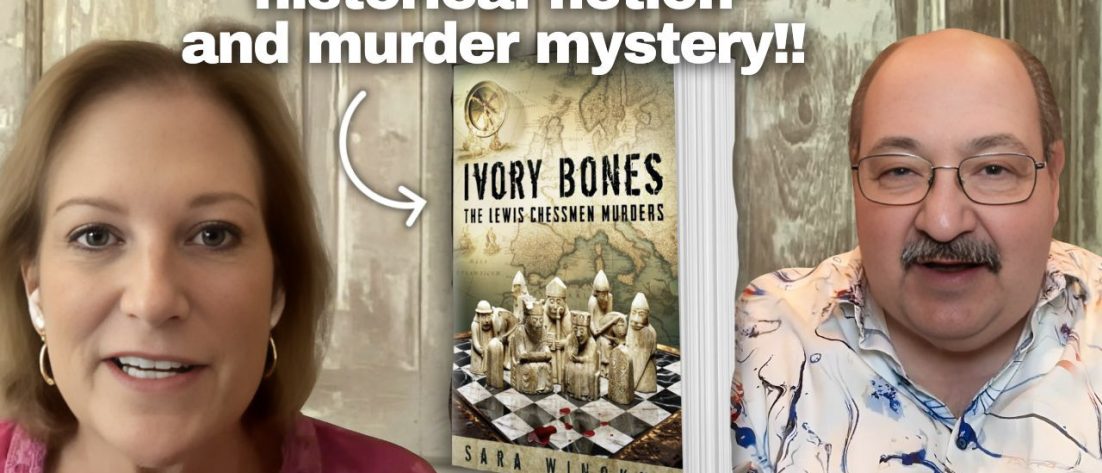
Blaine DeSantis: They are fantastic. Now, they’re on the cover of your book and friends, you can go out and look. Yeah, you can go. You have the cover there? You have it with you?
Sara Winokur: I actually have it. So, you know, I think it’s important.
Blaine DeSantis: Yeah, look at that.
Sara Winokur: I think it’s important for people to actually see those chess pieces because they’re not sort of your generic chess pieces. They’re carved of ivory and they have, you know, human expressions and they’re really quite something.
Blaine DeSantis: They’re marvelous. They truly are marvelous pieces of art. And to be carved that long ago and the detail, friends, you can go out and you can look at the not only the front cover, you can go on the internet, you can find these. I was fascinated by this. That’s wonderful stuff. Wow. Just wonderful. But you know, this is set in Iceland. There’s no Lewis in Iceland, is there? Where did Lewis come in? The Lewis Chessmen. How do we get? Where’s Lewis?
Sara Winokur: Okay. Good question. So these pieces were carved in the 12th century. It’s still somewhat, well, not somewhat, it’s unclear as to whether they were carved in Iceland or if they were carved in Norway. But regardless, they ended up being discovered 600 years after they were carved on the Isle of Lewis off of Scotland. And it was most likely they were most likely being carried on a ship that had met a poor fate and ended up on a beach on the Isle of Lewis. So whether it was like a merchant ship or like a gift to some aristocrat or something.
Blaine DeSantis: Okay. And this is real stuff. This really happened. This is nothing you made up. This is all.
Sara Winokur: Absolutely.
Blaine DeSantis: Okay. So now we got maybe Norway, Iceland, Scotland. Who’s got the stronger claim and is Scotland saying, hey, they’re ours.
Sara Winokur: Well, Scotland does have a few of the pieces in the university or not university, the Edinburgh Museum. But most of them are in the British Museum, regardless. So, you know, many people think that they were carved in Norway because Iceland was sort of very, very isolated and people looked down on them as being just sort of a bunch of farmers and they couldn’t possibly create anything that intricate. However, there was a very famous ivory carver in Iceland at the time, and in the Icelandic National Museum, you can see some of her work. And it’s quite remarkable. There’s also some of the Icelandic sagas which were written in the 13th century do refer to her as a master carver of ivory. So.
Blaine DeSantis: All right.
Sara Winokur: My book has them being carved in Iceland.
Blaine DeSantis: I like that idea. I go for that, you know.
Sara Winokur: I can do whatever I want.
Blaine DeSantis: Yeah, that’s correct. Yeah. Wow.
Sara Winokur: So it’s really unknown.
Blaine DeSantis: The Scots aren’t making claim that they did it though. They never said that we carved this, did they?
Sara Winokur: No.
Blaine DeSantis: No. Okay. That’s what I thought, but I just want to make sure.
Sara Winokur: Yeah.
Blaine DeSantis: Well, now, you know, you mentioned something, this historical event that few people are aware of happened back in 1627. And that forms sort of the basis of this. Tell us about this, the Turkish pirate raid. What is this all about?
Sara Winokur: Yeah. So this is a little known piece of history. Well, not to everyone, of course, but to many people, including myself when I started to write the book and had visited Iceland a number of times. In the early 1600s, the Barbary pirates, which were pirates from North Africa, raided the coastlines of many, what we now know as countries, along the North Atlantic Sea. So Ireland, England, and Iceland. So in 1627, there was a raid or several raids on Iceland that were conducted or masterminded by these Barbary pirates from North Africa that captured something like 400 slaves or 400 villagers from Iceland and took them back to Algeria and to Morocco to be sold as slaves. So, you can just imagine the trauma they must have suffered since they had probably never seen an outsider ever. And then being taken from this very cold sort of desolate environment in Iceland and having to somehow survive under the hot sun and terrible conditions as a slave in North Africa.
Blaine DeSantis: I was aware of the Barbary pirates and everything else, but I never knew they got up that high. I just.
Sara Winokur: No. Yeah.
Blaine DeSantis: Yeah. And again, when we think of.
Sara Winokur: You know, I’m just as a side note, most of these mastermind pirates were actually European. So they were privateers for the government, like for Holland or the Netherlands. And then they themselves were captured and taken back to North Africa and then they became pirates.
Blaine DeSantis: Okay.
Sara Winokur: So they sort of knew the area.
Blaine DeSantis: Yeah, they knew the area.
Sara Winokur: How to navigate.
Blaine DeSantis: Right. Okay, because most of us know about these raids, we’re all expecting the Vikings. Here come the Vikings, you know, and they’re going to take. And this isn’t the Viking.
Sara Winokur: No. Not at all.
Blaine DeSantis: Well, that’s. How did you find this out?
Sara Winokur: Well, so when I wrote my first book, I wanted to get the Icelandic, you know, culture and history and landscape. I wanted to get it right because here I am some Southern California trying to write about Iceland. So I went to Iceland, I don’t know, I must have been there six or seven times now. And while I was there, I did learn about this what they called Turkish raid. They’re not from Turkey, but since at that time they thought everyone with darker skin was from Turkey, they just called it the Turkish raid.
Blaine DeSantis: I see. Okay.
Sara Winokur: So I had known about it.
Blaine DeSantis: All right. Wow. But then, then your research comes up with these Lewis Chessmen. When did that immediately strike you as a plot point? Oh, I can use this and make a great mystery out of this or was it just sitting there percolating for a while?
Sara Winokur: I was definitely tied into somehow this murder mystery in my brain. I have that captive being in possession of the Lewis Chessmen and on her voyage to, you know, North Africa, there’s a shipwreck and they get, you know, they end up on the Isle of Lewis. The reason I thought it would make a good murder mystery is because the pieces are so valuable that there could well be people that are willing to kill to get their hands on them. In fact, well, there haven’t been any murders so far in real life. But in 2019, a piece was found in Edinburgh, Scotland, and some old lady had passed away and her son was going through her belongings and in her bureau, he found this like little odd looking chess piece. And so he had the archaeology send the museum look at it and they determined that it was one of the missing chess pieces. There were only four, and it was sold at auction for almost a million dollars. That one piece.
Blaine DeSantis: One piece went for a million dollars.
Sara Winokur: So, so they are, these are real artifacts and they are quite valuable.
Blaine DeSantis: Wow. That’s a great plot point then. That’s great to tie everything together with that. Yeah.
Sara Winokur: Yeah.
Blaine DeSantis: Yeah.
Sara Winokur: I had fun with it.
Blaine DeSantis: But, but now you take this chess piece in 1627 and it’s with this girl who I think is Anna, is Anna or Anna, her name?
Sara Winokur: Yeah, it’s Anna.
Blaine DeSantis: Anna. And she keeps one. She’s managed to hold on to it. And goes to Algeria and next thing we know she’s over in America, or what will become America, North America. How did that happen?
Sara Winokur: Right. Yeah. So she sort of had quite a journey. So she was a slave in North Africa. Her master’s son was sent to New Amsterdam, which is now New York, obviously. And he wanted to take one of the slaves with him to help him sort of do all the work, household work. So she went with him and his family, you know, reluctantly, but I suppose it was a better life than it was in North Africa. So she goes with him on a ship to New Amsterdam.
Blaine DeSantis: And while she’s there, she creates a diary if I’m not mistaken.
Sara Winokur: That’s right. So, yes, she actually writes, she had had her diary in her sort of skirt pocket, just this little book, at the time that she was captured. So she does write in the diary all along. And I wrote the diary in the first person so that it wasn’t sort of like, well, yesterday I, you know, ate these figs or something. It’s sort of like, oh my God, there’s these ships that are descending upon our like island and. So I have it in the first person so that the reader can sort of experience it as it’s happening to her.
Blaine DeSantis: Now, in reality, in historical reality, if there’s such a thing, what did a Barbary pirate come over to New Amsterdam and settle there?
Sara Winokur: Yes. Not the son of a Barbary pirate. Okay. So there’s a little bit more history that actually is even linked to my family history, unfortunately. So, it turns out that the mastermind of the Barbary pirate raid on Iceland, this mastermind pirate who was originally Dutch, is my ancestor. So I am a direct descendant of this Barbary pirate. You know, it was 400 years ago, so I don’t think I really carry too much of his DNA. But anyway, so he is my ancestor. And then he had a son, and these are real people in historical fact. It is fact. And his son, Anthony, was sent to New Amsterdam as part of the Dutch East India company there early, early on. And so he is my direct ancestor as well.
Blaine DeSantis: Now, you’re not going to whip out with an arr, matey. I want some, I want some. That’s a marvelous. That’s a marvelous family history. My God.
Sara Winokur: Yeah.
Blaine DeSantis: Now, you knew this before you started the book?
Sara Winokur: So I sort of hate to admit it. No. I started to write it. I knew about this pirate raid. I knew about the Lewis Chessmen. I thought, oh, this could be a really cool, you know, murder mystery, set in Iceland and then also in North Africa and. And then my sister, who is sort of the family genealogist, called me one day and said, you know, we’re actually related to this pirate. And it’s my parents after they retired had spent lots of years compiling all this genealogy and yep, we’re he’s in there. We’re in there.
Blaine DeSantis: And did he bring a slave with him? Was that true also?
Sara Winokur: No.
Blaine DeSantis: No. Okay. I didn’t know that.
Sara Winokur: Not that I know of.
Blaine DeSantis: Okay.
Sara Winokur: He, no, I don’t think so.
Blaine DeSantis: But you also have him becoming one of the largest land owners here in North America at the time.
Sara Winokur: Yeah. He was, he was sort of a ruffian, you know. But I think he was well suited for survival in that kind of environment because, you know, he was a businessman, like he caused a lot of problems with, he was actually not Christian. He was Muslim because these Barbary pirates had to become Muslim in order for them to be set free. So he was raised as a Muslim, goes to North America and he refused to join the Dutch Reformed Church and he had a lot of skirmishes with his neighbors and caused all kinds of upheaval. But on the other hand, he was a very savvy, smart businessman. So he controlled or bought basically all of what we now know is Coney Island and a big part of Brooklyn. And too bad he sold it because, you know, I’d be pretty well off.
Blaine DeSantis: Wow, I’ll tell you. Well, you know, and that friends, that’s one of the things here we had with this book friends, is that we this is actual history. Now, yes, it’s been embellished just a little bit for the good historical fiction, but this is real stuff that really happened in Sara’s family. And that’s what makes this book so amazingly believable, amazingly believable.
Sara Winokur: Yeah, I did. I was pretty shocked to be when I first heard that, but then I thought, well, it’s 400 years ago.
Blaine DeSantis: You set your books in Iceland. Why Iceland?
Sara Winokur: Another good question. I have always really enjoyed Nordic Noir. Most of them are set in Norway, Sweden, and so forth. I initially went to Iceland because they have a DNA database. So this is went back in my previous career. I went to Iceland because Iceland has a DNA database of the majority of its citizens and they use this database not as a criminal database, but they use it to identify gene mutations because Iceland is like at least up until recently, everybody was sort of related to one another and so it was sort of easy to tease out what genes cause what diseases. So I went to visit this company that developed and utilized this database. And while I was there, I toured the entire country and just thought, well, this is a great place to set a murder mystery because it’s like you have all these eerie landscapes and isolated farmsteads and, you know, complete darkness in the winter and it was, I just thought this would be a fun place to set a novel.
Blaine DeSantis: Now, a lot of people, a lot of my followers are not necessarily Nordic Noir or Nordic thriller families and fans. Why should we start with your book? Why if a person wants to say, I want to dip my toes in Nordic stuff, I want to start with Sara Winokur’s stuff.
Sara Winokur: Right. Well, I think first of all, it is set in Iceland, which is not your sort of typical setting. People are very interested in Iceland as, you know, received millions of tourists over the past few years. And just beautiful natural landscapes. And I was intrigued by their history. And so it was established a thousand years ago where the first Vikings to come to Iceland. And you can just imagine having to carve a life out of this barren, you know, wind swept, freezing cold, unable to grow any kind of crop, environment. And so Icelanders as a result, I think have this resilience and this perseverance in their DNA. They are, you know, extremely creative, resourceful, and honestly, kind of quirky because they’ve been isolated for so long. And so I just I found it was like a fascinating and then their whole naming system and they have the oldest, still existing parliament in the entire world. And there were just so many interesting historical and present day aspects of Iceland that I thought would be interesting to read about and write about.
Blaine DeSantis: It is. And that’s what’s different. Also, I don’t find it, well, there are murders, but I don’t find them gruesome.
Sara Winokur: Yes. That, yeah, I sort of lost my train of thought there. Thank you. And that is true. I a lot of quite a number of these Nordic Noirs, I wouldn’t really classify my book as a Nordic Noir because that is really kind of, as you say, you know, gruesome, very descriptive murders. And mine, yes, there are several murders that occur, but it’s more about trying to solve who committed those murders. And then I also delve into the character arc a lot more than a lot of Nordic fictions books do. And the main protagonist in the present, this forensic geneticist, sees parallels to herself, to her life, as regards to the diarist in the 1600s. And she actually learns a lot about like how to approach her own life by reading this diary. And so I sort of develop her. It’s also about relationships and character development.
Blaine DeSantis: It’s much more rounded. Not just we’re going to kill people and we can’t.
Sara Winokur: Yeah.
Blaine DeSantis: Well, now that brings me to your lead character, Brinja. How much of Brinja is you?
Sara Winokur: Kind of a lot, actually.
Blaine DeSantis: I thought so.
Sara Winokur: Don’t tell anyone.
Blaine DeSantis: No, you won’t.
Sara Winokur: But she’s a fascinating character. No, well, you know, she is a, well, she is a forensic geneticist. She’s very analytical, which she learns to kind of loosen up with time. She has this false belief, and I don’t have this belief, but she has this false belief that in her DNA lurks these evil genes because her father in the first book turns out to be a serial killer. And so she is worried that, you know, oh, I can’t have a relationship, I can’t have kids because I’m going to pass on these genes. And so she forgoes all these wonderful choices in her life, but she comes to realize it’s not by any means all embedded in your DNA. If it was, I’d be a pirate myself, you know.
Blaine DeSantis: Yeah. Wow.
Sara Winokur: So she kind of follows, you know, is able to has a lot of introspection throughout the novel.
Blaine DeSantis: And so we have people who have died. For instance, you begin the first murder is somebody in a museum who’s not supposed to be at the museum. But thanks to the DNA and thanks to all this, the forensics, she’s able to identify who this is.
Sara Winokur: Right, because Iceland does have this DNA database and they have less than 400,000 people, citizens in Iceland. And so, as I mentioned previously, it’s pretty easy to track relationships, genetic relationships within Iceland. And so by taking like samples of her DNA, they’re able to figure out who she is.
Blaine DeSantis: Now, how many, and again, I read this a while ago, so excuse me for being stupid on this. How many murders were there? Two or three? I can’t remember.
Sara Winokur: Oh, three, I believe. Yeah. All right. There were two and no, three.
Blaine DeSantis: Three. Okay.
Sara Winokur: I don’t want to give away the third one, but yeah.
Blaine DeSantis: No, no, no. But okay, so there are these and they’re all related to these Lewis Chessmen.
Sara Winokur: Yes. And Brinja does suspect this from the beginning because people are trying to get their hands on this diary because the diary has clues in it as to where the Lewis Chessmen are. So immediately, I mean, she’s kind of figures out that it’s not unlikely that whoever is committed these murders. And the first one was actually committed in a museum, as you say, that had not one of the Lewis Chessmen, but another kind of similar piece that was carved in Iceland.
Blaine DeSantis: And of course, as in so many times, the police chief has no idea. He was clueless into the whole thing. He doesn’t put those two and two together. What else is new, you know? But, you know, yeah, but so, but he was, he came to the party late, but there were some others who did. She’s got some good friends.
Sara Winokur: He did. Yeah, he did. Got there, you know.
Blaine DeSantis: Yeah. Good friends.
Sara Winokur: Yeah. And then, you know, she’s there there’s quite a cast of characters, you know, her assistant is this sort of Gen Z kind of, she’s very sharp herself, but she’s also very, she’s kind of a free spirit, shall we say. And she’s actually Danish, but she’s working for Brinja in the lab and she’s just kind of a hoot. I had a lot of fun writing about her because she’s just the way she dresses and all the things that she says and so forth. And she’s going to be the main character in my next novel.
Blaine DeSantis: Okay. Well, you even have people coming over from America in this book.
Sara Winokur: Yes.
Blaine DeSantis: Not just people in Iceland. Now we have some characters who are joining us from America.
Sara Winokur: Why not? It’s a party. No. So what happened is that they’re construction workers that are digging the foundation for a new office building and they find the skeleton along with a metal box that contains a diary and one of the Lewis Chessmen. Well, this diary is written in Icelandic. So who knows Icelandic? Not a lot of people. So, Brinja’s colleague, who she knew because she had trained for a bit in the United States, immediately thought of, oh, well, I’m just going to send the diary to Brinja in Iceland to translate and figure out. So, so this woman is also a detective and her name is Claire from New York. And yes, she does come to Iceland.
Blaine DeSantis: Yeah. Okay. Had you always thought this was going to be a dual timeline book?
Sara Winokur: Yes, I did because I wanted to tell the story of really what happened during these Barbary pirate raids and the life that they suffered in North Africa. I was fascinated by it. It’s sort of a little known piece of history and slavery. I wanted to get that history right. And so I contacted a professor at University of Maryland, Adam Nichols, who is like the world renowned expert on these pirate raids in Iceland. And he was really just extremely helpful in giving me a lot of detail about accurate detail about what had happened.
Blaine DeSantis: Okay. All right. Wow. Well, there you go. That’s fascinating that because what you did was you brought us all together. I mean, this is so believable. And I think you touched on it earlier. You didn’t write it in like the diary in like, you know, current time, you wrote it like back then. It was.
Sara Winokur: Yeah. Well done. Very well done. Thank you. I do intersperse the diary throughout the book.
Blaine DeSantis: Did that take. Yeah. In the first person. Did that take a lot of doing? You know, was that harder to do than writing the other stuff?
Sara Winokur: I found no. For some reason, I just kind of put myself back there and saw it, well, of course, okay, I didn’t experience it as these captives really did. But, I just found the history so fascinating that it really, I just kind of, it’s not written in sort of the old, you know, 400 years ago style of language. And I chose not to do that because I didn’t want to distract or pull the reader out of the story. So it’s very, I think, readable.
Blaine DeSantis: Okay. I think so too. I think it’s extremely readable and. It’s, as I said, two days, I was done with it. It was that good. Now, it’s interesting that you use historical slavery.
Sara Winokur: Yeah.
Blaine DeSantis: Because a lot of people sort of shy away from that. That had always been part of what you had wanted to do with that?
Sara Winokur: Well, since I knew about this pirate raid on Iceland in the 1620s, in 1627, yeah, I did want to incorporate that aspect because it was really something that I had been unaware of myself. Now, any slavery is horrible, as we know, and it has occurred throughout human history. But I was not very aware of this particular aspect of slavery.
Blaine DeSantis: That’s right.
Sara Winokur: And I personally always like to learn, I’m sorry. Go ahead.
Blaine DeSantis: No, go ahead. No, you like to learn stuff. That’s right.
Sara Winokur: Yeah, I personally like to learn something as I’m reading and so I thought, well, maybe other people would be interested too.
Blaine DeSantis: It is. And I why I’m looking down as I’m talking to you is I have started another book, a non-fiction book called White Gold. All right. The extraordinary story of Thomas Pellow. Have you read that book?
Sara Winokur: White Gold by Giles Milton? No, I haven’t, but I’m writing it down.
Blaine DeSantis: White Gold, yeah. It is about white slavery. And it’s fantastic. I, you know, and I started this, you know, I don’t want to say how long ago, but then the podcast came on and I didn’t have time to finish it. I’m going to finish that one now because it’s a fantastic book.
Sara Winokur: I mean, the pyramids were built.
Blaine DeSantis: And we weren’t they weren’t talking about the Barbary.
Sara Winokur: Yeah. I you know, there’s been slavery from the get go with humans with Sumeria and Egypt and that’s how the pyramids were built and. So, but I just had not been aware of this particular aspect of slavery.
Blaine DeSantis: Yeah. Now, I just told people about White Gold, which is it’s a good non-fiction book, but where else would you people go to find out about the Lewis Chessmen? Is there a website or something that you can go to?
Sara Winokur: So, a couple sources. The British Museum, as I think I mentioned earlier, has most of the pieces on display in their museum. And if you find your way to the bookstore, there are, they have written their own book about them. So so that’s interesting. There’s also another book, which I highly recommend. It’s called Ivory Vikings because it is about this woman who I believe, and this other author believes, carved the Lewis Chessmen. And she goes into incredible depth of, you know, the history of these pieces and how they were carved and what their symbolism meant and. So it’s called Ivory Vikings, something about and the woman who carved them or something like that. By Nancy Marie Brown.
Blaine DeSantis: Okay. Wow. Was there one rabbit hole in particular you started researching and kept going down that hole and couldn’t stop for a while on this?
Sara Winokur: There’s so many great historical things here. Yeah, I don’t know that I really got into a rabbit hole. I just kind of enjoyed the whole journey. What can I say?
Blaine DeSantis: Yeah, that’s okay. That’s all right, you know.
Sara Winokur: I did, I should say that the way I approached both of my books was completely different. With the first book, I started out with an idea, a concept, and a mystery in mind, and I just started writing. And, I learned that for me at least, that was not the best way to approach writing a book because especially a book involving a mystery and murders and so forth because everything has to really link together like pieces of the puzzle. And I would get to like chapter, you know, 15 and then have this other idea and then think, oh, but it doesn’t make sense with chapter three and so I had to go back and forth and back and forth. So, but with this book, I decided, okay, I’m going to write an outline, just two, three pages so that I know what’s happening when. I probably just went totally off topic there, sorry.
Blaine DeSantis: That’s okay. No, we the whole writing process is fantastic to know what’s goes on here. And that brings me to probably the final question. And you hinted at this, how many more books are we going to have about Iceland and Brinja and her group?
Sara Winokur: So, I do want to write a trilogy. So I am currently writing the third in the series. Now, as you say, many authors say, oh, you don’t have to read the first one, and you really don’t in order to understand what’s going on in the second book. And the same will be true of the third book. I am going to set or I am setting this third book in Greenland, not in Iceland. Because I think I’ve pretty much covered Iceland, its history, its culture, and so forth and so on. And, I am going to have the main character be Brinja’s. So Brinja will be involved because she’s got, she’s being sent samples from this murder in Greenland, but she does send her assistant, who is Danish and speaks Danish to Greenland to, you know, be the boots on the ground, so to speak, because she speaks Danish. And she’s a fun character to write.
Blaine DeSantis: So this is the third book I. Yeah. And you’ve started this already?
Sara Winokur: I have, I sort of have all these ideas percolating. So I’m sort of, okay, want to get that set entirely in my head. I’m writing the outline now and yeah, I’ve got some.
Blaine DeSantis: Do you envision more books after three? Not necessarily Iceland, but do you envision writing more books?
Sara Winokur: Yes. But I think after this third of the trilogy, I’m going to switch gears and maybe write an entirely different genre. Or a children’s book. I’ve got a great idea for a children’s book. I want to I want to challenge myself to write in a different genre altogether.
Blaine DeSantis: Okay. So, for those of us who are really enjoying Brinja and your books, just one more. But I can’t wait to get it. I can’t I’m looking forward to it. But anything you do, I think it’s going to be tremendous. It’s going to be absolutely tremendous.
Sara Winokur: Thank you so much. Thank you so much, Blaine.
Blaine DeSantis: Wow. But this, this is really a fine book. This is a really great book. I really enjoyed it and I’m so happy you took time out from your busy schedule to be with us today and I can say, thank you, Sara Winokur for being with us today on Books and Looks.
Sara Winokur: Well, thank you so much. It’s been like a lovely conversation. I’ve really enjoyed it.
Blaine DeSantis: You know, if there’s one thing I hope you take away from this conversation with Sara Winokur, it’s how the stories we tell ourselves about the past are constantly being rewritten by new discoveries. And if you’re curious about what really happened to those four missing Lewis Chessmen or how a Turkish pirate raid in Iceland in 1627 connects to a murder mystery in modern day Reykjavik, you’ll definitely want to check out Sara’s book, Ivory Bones: The Lewis Chessmen Murders. You can find it wherever books are sold.
Blaine DeSantis: And with that, another episode of Books and Looks is in the books. Hey, thanks for letting me be part of your reading journey. And remember, sometimes the most compelling stories are the ones where the past and the present refuse to stay in their proper timelines. I’ll be back in two weeks with another edition of Books and Looks.