
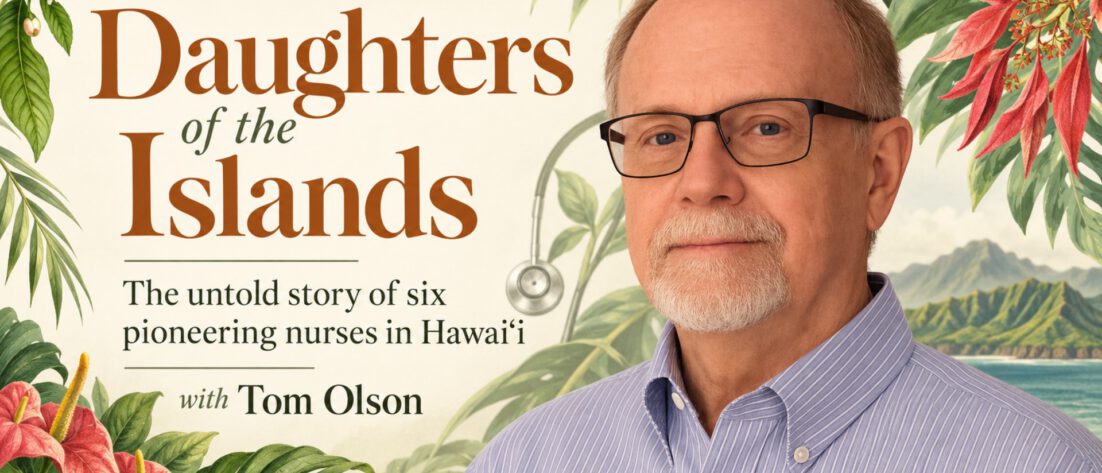
Tom Olson’s Daughters of the Islands tells how six island-born nurses shaped health care in Hawaii before statehood, in their own words. Olson interviewed the women 25 years ago and promised not to tell their stories until they had passed away. On Books and Looks, he talks with host Blaine DeSantis about the women and why he waited.
Tom Olson is a psychiatric nurse who spent much of his career as a nursing faculty member and university administrator, with roles at the University of Hawaii and California State University San Marcos. He lived in Hawaii for 15 years, and his earlier book, Handling the Sick, is an award-winning history of nursing.
The conversation covers Chiyo Miyabara, on duty at Honolulu’s Japanese Hospital (now Kuakini) the morning of Pearl Harbor, who kept speaking Japanese to her patients after the U.S. military took the hospital over and banned it; Eleanor Silva, who went to nurse at the Kalaupapa leprosy settlement on Molokai at 18; and Josephine Duvauchelle, denied tenure a month after winning a University of Hawaii teaching award, who earned a master’s degree, came back and won it. Olson also explains why “talk story” made the interviews possible and what today’s nurses can take from these women.
Resources:
Connect with us:
Six nurses from pre-statehood Hawaii
Blaine DeSantis: Hi, I’m Blaine DeSantis, and welcome to Books and Looks, where we do a deep dive with authors to help you discover your next great read. And today, we’re going to hear about one of the most overlooked professions when it comes to nonfiction, and that’s nursing. That’s right, nursing. You know, nurses are vital and instrumental in our society, and today we are going to Hawaii to learn how six native Hawaiian women, all of different ethnicities, helped transform the medical profession. It is one of the most inspiring books that I have read in years. I’m Blaine DeSantis. This is Books and Looks. And today we’re chatting with Tom Olson about his remarkable book, Daughters of the Islands.
Tom Olson, welcome to Books and Looks.
Tom Olson: Thank you. I’m delighted to be here, Blaine. Thank you.
Blaine DeSantis: Tom, absolutely loved your book, Daughters of the Islands. Friends, I’m gonna put it up here for everybody to see. There it is. Well, I love this cover. Daughters of the Islands by Tom Olson. Very nice. Great book. I think it comes in at around what, 340, 350 pages. An easy yet spectacular read. Great job, Tom.
Tom Olson: Thank you so much. I mean, it was a labor of love, so it was absolutely wonderful to do it, and although I had to wait a long time, I kept those stories a very long time before actually recording them.
Blaine DeSantis: Yeah. We’ll get into that in just a little bit. But before that, tell us a little bit about this book and you. What’s the premise of the book? And how long ago did you do these interviews that are part of this book?
Tom Olson: Well, this year, it’s actually 25 years ago that I did the interviews. And so the women were just a little bit younger than I am right now, and they really were at kind of the forefront of a pioneering age in nursing in Hawaii. So it was before Hawaii was a state, of course, and within memory of the overthrow of the monarchy, and a lot of health care at that time was done in plantation hospitals because the plantation economy was center stage in Hawaii and all of the major islands. And it’s called Daughters of the Islands because they were really born and raised in the islands. So many things written about Hawaii have often been written about people who came to Hawaii, people who came from the mainland, who came from Europe.
But all of these women were born and raised in the islands. They all were raised in immigrant families. Although one of the women, Genevieve, Auntie Genevieve, is a native Hawaiian. But she was gifted, in a local usage, hanai is the actual Hawaiian, to a family that only had one other child. And so gifting a child was considered, you know, an incredible, precious gift, kind of a pre-adoption sort of thing.
Blaine DeSantis: Oh my. Okay. Wow. Well, that’s really great. So you have this book about all these women. They’ve done all this stuff for the nursing profession. And I don’t want to get into each one too long, but tell us, just to introduce these women, what’s their first name, what’s their ethnicity, and what was their niche that they worked on?
Tom Olson: Sure. They did a lot for nursing, but part of the purpose of this was to allow them to also tell their lives, kind of in the full spectrum of their lives, not only limited just to the nursing part. But the first nurse that I interviewed was Chiyo, which was short for Chiyoko Kasai. And then when she married, Chiyoko Kasai Miyabara. She was primarily a surgical nurse, and she was the daughter of Japanese immigrants to the Big Island. And the next nurse I interviewed was Rosie, Rosie Kim. She was the daughter of Korean immigrants to Oahu. And she did all kinds. Chiyoko was such grace, but she was incredibly adept at moving mountains in a very uniquely Korean cultural and gendered kind of way.
And the woman that I previously mentioned, Auntie Genevieve, she was Genevieve Leualnani Oquilauea-Goncalves, kind of a long name, and then she was hanai into the family called Freitas. Her birth mother was native Hawaiian, and she grew up kind of in between both her hanai, or adopted, family and another Hawaiian family. And she did a realm of nursing, but primarily in the surgical area, medical area, and then she developed an innovative curriculum when she founded the school of nursing on the Big Island. The next person I interviewed was Eleanor Silva. She was the daughter of immigrants from Madeira. And her forte, and her love, her passion, was really public health nursing.
And then the next person was Mrs. Duvauchelle. She’s the only one who really, it felt I needed to call her Mrs. Duvauchelle rather than by her first name. But she was Josephine Gray Abaya Cortezan. She was the daughter of Filipino immigrants to Kauai. Her father was a stowaway street preacher, and her mother was a nurse in the Philippines who was brought to Kauai to nurse to the plantation workers. And the last nurse was Faith Hisako Yonamine. She was born of Japanese immigrants, Okinawan immigrants, and they came first to the Big Island before she ended up settling on Oahu. And her real area, she kind of did the spectrum.
She did burn nursing to medical-surgical nursing and…
Blaine DeSantis: Bye. I see. Wow.
Tom Olson: Amazingly, she was 66 years at Shriners of Hawaii, at the same facility.
Keeping promises and learning to talk story
Blaine DeSantis: That’s amazing. That’s amazing. Well, I’ll tell you what, I so appreciated these women and what they did to help the medical profession, the nursing profession. Again, things were not like they are now. We’re talking back in the ’20s, ’30s, ’40s. It was the plantation hospitals are moving from there, and so this was a wonderful, wonderful bit, filled in a lot of history for those of us who like the history of the island. But one of the things that you started out by saying, you made two promises to these women, okay? So what were the promises? And then how difficult was it for you to carry these stories for all these years before you published them?
Tom Olson: Yeah, there are two very simple promises, but I promised each of them that I would eventually write their stories, so they knew that. But the second promise was probably the most difficult of the two. That was that I wouldn’t tell their stories until they passed away. The women were surprisingly frank as we continued very long interviews. Some were basically full-day interviews. And in return, kind of, for that frankness, they were reassured that, look, I was going to tell their stories, I would use their words for their stories, their words would always be at the fore. But that I would wait until they passed along.
That was especially at a request of Mrs. Duvauchelle, Josephine Cortezan Duvauchelle. She passed away in 2024. She was 96, in Koloa, Hawaii.
Blaine DeSantis: Wow. It’s a long time to wait on and for something like this. Did you start writing it, or had you had the book basically written, just waiting to be published?
Tom Olson: I had all of the transcribed interviews, but, you know, I set it aside, always knowing that I would want to do this. But much of my life was as both a faculty member and a university administrator. And so it was very easy to just focus on those reports that were due week after week after week. So when I finished my last job at California State San Marcos, I promised myself, okay, now I can write those stories, these stories in particular, and some of the other stories that I had collected, particularly in those 15 years that I lived in Hawaii.
Blaine DeSantis: Well, one of the things you talk about, and is a concept which I never heard of, is this thing called talk story. Now, what is talk story? And then, how did you almost not get your interview with Chiyo? What was that whole thing about?
Tom Olson: It was really familiar to me, especially people who are coming right away from the mainland. My area of nursing is psychiatric nursing. And so in the hospitals, when I was with patients, I could see the patients just almost closed down when we’d have a mainland resident or something come in with their list of questions that they were going to ask. And I knew all of that. I knew that in Hawaii, you needed to talk story. You needed to establish some kind of connection. Some kind of, you know, if you’re from there, the questions were usually about your ethnic background, about what high school you went to. But even if you weren’t from Hawaii, there you had to have that personal connection before people would open up.
If you didn’t have that personal connection, it really is considered, the Hawaiian word is niele, which is kind of nosy, or you’re really there for no good purpose. So with that first interview with Chiyo, who was in some ways the most reluctant interviewee, she almost ended it before we even got started.
Blaine DeSantis: Okay. I see. Oh my.
Tom Olson: Well, first off, she thought I should be interviewing her husband, which I understand based on her age and her background. But once we got through that and I wanted to start into the questions, it was like she had that same shutting down that I’ve seen patients do. So I needed to back up and tell her a little bit about myself. Let her share a little bit about herself. Share how I found my way into nursing. A little bit about her finding her way into nursing. And once we had that rapport, which is a really, really important thing in Hawaii, then she said, “Okay, you can turn the recorder on.”
But not until then.
Chiyo at Kuakini Hospital during Pearl Harbor
Blaine DeSantis: Good. That’s good. I enjoyed her chapter, which was the first chapter, maybe the shortest chapter. I enjoyed it the most. I really enjoyed that lady, and I wish I could have met her at some time. But let’s talk a bit about her. She was of Japanese ancestry. She worked at the Kuakini Hospital, and she was there before, during, and after Pearl Harbor. Tell us all about that, please.
Tom Olson: She was indeed. She was a really, you know, a young woman from the Big Island. Never, of course, had left the Big Island, as most people in those days really stayed within their community. But her sister-in-law had been interested in nursing. It was during the Great Depression. Chiyo had a really good education. Japanese young men and young women both usually learned in both Japanese school and English school, which she did. So she had a good background, and she felt really stifled just to be as a secretary. So she went ahead on her own, got her an interview at Kuakini, what was then called the Japanese Hospital, and had her doctor attest to that she was strong and capable of being a nurse.
And she went with her sister-in-law to Honolulu. At that time, you know, the Aloha Tower was still relatively new. It was the tallest building in Oahu. And she would have traveled overnight on the boat to get there and stayed with a relative. And then the next morning went for the interview and was accepted into the Japanese Hospital. I asked her if she considered any other place, and she said no, as a Japanese woman, only the Japanese Hospital. She was Japanese American, but she, you know, considered that background really important. She spoke Japanese at home. It’s what she had learned in school and in the hospital. The nurses were from Japan, largely. The physicians and surgeons all had been trained in Japan.
They wore traditional Japanese garb. And so yes, she happened to be on duty that morning, on December 7th. And they started hearing, she wasn’t sure, artillery shots or what was going on. And then eventually they saw the clouds from the bombs. And she said she thought it was still practice. She said, “Why are they not letting us off on a Sunday?” They had been having maneuvers before this. They sent a young woman, went up to the roof, and there she saw the red emblem of the rising sun of Japan and said, “Oh, this is not a maneuver.” So the head nurse told them to go and calm the patients, you know, to continue to go about their work.
And she said within days, but it was really within hours, that the Japanese Hospital was taken over by the U.S. military. It’s the first and only U.S. hospital and training school that was ever occupied by the U.S. military. They came in and they forbid them from wearing traditional Japanese dress. They forbid them from speaking Japanese, which was difficult because most of their patients were Issei, first generation, so they only spoke Japanese.
Blaine DeSantis: Yeah, right. My shame. I see. Yes.
Tom Olson: And she broke the rules by speaking Japanese with her patients. The military took down the plaques that marked it as the Japanese Hospital. It had been gifted by the Emperor and Empress of Japan. And it was the second-largest medical facility in Hawaii at that time. And so, you know, they soldiered on. The Japanese quality for that is something called gaman. And you just endure. And it was difficult because as they’re soldiering on, caring for patients, doctors that she worked with, the hospital administrator, they were all sent to internment camps. Her father was sent to an internment camp. So putting myself back in there, it’s almost difficult to imagine how someone just kept going on.
She was worried about her family, but of course her family on the Big Island had no telephone, so there was no way of being in touch.
Eleanor, Kalaupapa and a lesson about prejudice
Blaine DeSantis: Yeah. Yeah. Yeah. Mhm. Wow. Well, she soldiers on, no doubt, and it’s interesting that she was allowed to remain there and remain as a nurse, which tells a little bit about how good she was. Yeah, it’s a fascinating story that she was there during that time, could see that takeover and what it was like. Now, I’ve got to move on to another lady here. I could talk about Chiyo for a long time, just so you know that. But I want to get to Eleanor. Now, Eleanor was 18 years old when she ended up going to Molokai. Now, what was the situation on Molokai? Tell us a little bit about Eleanor.
Tom Olson: Sure. Thanks. Eleanor was just this wonderfully interesting woman. She really saw life as a long run, not a sprint, but really a very long kind of run. And Eleanor, just coming out of high school, knew that she wanted to be a nurse. But as she described herself, she was a bit of a kolohe. A kolohe in Hawaiian means kind of a rascal. Not somebody who got into real terrible trouble, but a rascal. And Eleanor’s mother knew that she wanted to be a nurse and knew that if she just stayed in Hawaii in this kind of pre-war period, this really unsettled period, that Eleanor was probably going to get into a bit of trouble.
So she had some connections, and Eleanor’s mother knew that one of the nuns at Kalaupapa who cared for the lepers, or the patients with Hansen’s disease, was on leave because of an illness. And she said, “They need a nurse.” And Eleanor said, “I don’t know anything about taking care of patients with leprosy.” But her mother said, “Look, they will teach you everything that you need to know.” So she was kind of torn. Eleanor loved adventure through her whole life. And she loved nursing. So that kind of went out, and she said, “Okay.” So Eleanor packed up. She went there with one other being, I guess. She went there with her bird, Harriet.
So Eleanor and her clothes and packages and Harriet climbed into an airplane at that time, which is a bit unusual because most of the time, inter-island was going on steamships, steamers. But at that time they were trying out an airplane to Kalaupapa. She sat a single person in the front. The pilot at that time sat up in back, up higher from the rider, and was in the open air. And so they landed on the field down against those massive sea cliffs in Hawaii. Some people say they’re the highest sea cliffs in the world. And there, what isolated the colony, really made it a place of separation, because patients or people on the top of Molokai really could not get down to that bottom.
So they landed on a dirt field, waited under a bush until the two nuns came to pick her up. And then they brought her around, showed her the camp. They were very, very firm about the rules because it wasn’t known how leprosy was contracted.
Blaine DeSantis: Okay. Yeah. Yes. Uh-huh.
Tom Olson: Although they did know that it was primarily a disease of native Hawaiians, Kanaka Maoli, but because they didn’t really know, they really had a very strict… She lived in a separate compound with the other people who worked in the area. And only really was with the patients when she was in the hospital. So even, they had a movie, but the patients even knew about the segregation. So when they went to the movie, staff or any other workers in the area sat on one side, and the patients sat on the other side. Similarly, when she went to church, they sat in one area and she sat in another area. And yeah, because of that fear, that was, you know, that was her point in story as she was leaving, because she became very attached to patients, and particularly one patient, and she had many, many limits on, and had leis, many, many, one particularly patient, she… that they gave her after her eight months at Kalaupapa.
But she wasn’t able to take a single lei with her. But she did take her money with her, and they were paid in silver coins. And the silver had to be washed in a disinfectant before she could take them with her. So…
Blaine DeSantis: Okay. Wow. Can’t take anything with you, you know, you came, you worked, and you went back with what you had and no more. So, wow. Interesting, for a little 18-year-old girl, that’s a heck of a wake-up call to the nursing profession. Now, one of the things that I found interesting was a self-revelation that you made, you thought you made a mistake. You chose a fair-skinned lady, and you thought, oops, she doesn’t fit the criteria. Well, first of all, what’s that tell us about that? And what did you learn yourself about this classification slash prejudice about that?
Tom Olson: Yep, exactly. It was. Sure, sure. I had thought that I was there long enough to have gotten beyond it. I was in Hawaii over 10 years by that time, that I wasn’t simply looking at somebody for the, by the color of their skin or by their features. But when I first went to meet Eleanor, honestly, she looked like she could have been one of my relatives right out of the Midwest, of Minnesota. And so I said, “Oh my, I’ve made a mistake,” because I was really focused on interviewing people who had been born and raised in the islands. Was kind of a unique thing. And she could almost see it. I could still see the twinkle in her eyes.
She could see that I was making a mistake. You know, and I kicked myself that I didn’t look beyond that. But she played with me a little bit, and then she started speaking in pidgin. And she said yes. And she’s been here forever. And she was the daughter of immigrants. And fortunately, she was understanding of my misunderstanding and kind of took it in stride. But it was a real lesson to me not simply to judge people by the color of their skin, by how they spoke. So I learned a lot, and she was a wonderful teacher in that way.
Mrs. Duvauchelle’s fight for nursing tenure
Blaine DeSantis: Yeah. Yeah. Yeah. Yep. Like I said, I thought that was a really cute story to put in about that whole thing, and you didn’t have to put that in. See, that’s the beauty of it. But by putting that in, it humanizes you as the interviewer, and we see this, and again, we come to all different ethnicities were living on Hawaii, were born in Hawaii, were living there. Amazing, really is. Well, now I gotta go next to one of the other amazing ladies, Mrs. Duvauchelle, I think it is. And she went and she received the University of Hawaii Excellence in Teaching Award. And a month later she was told she wasn’t gonna get tenure, which is sort of shocking back at that time when she got that award.
But what’s even more shocking, Tom, she never told anybody about this. But there you are, you and your tape recorder, and you were able to get this story from her and maybe other hidden stories. Tell us what that was like.
Tom Olson: Sure. Yeah. Sure. I think in some ways, talking to people at the age when I was talking to, around 80, they were ready to tell stories that they had kept inside. I think she felt that it was a bit embarrassing, but she also realized that it was an important story from a nursing standpoint as well. Because part of the reason she didn’t get tenure was a surreal tension at the time when she was building a department of nursing on Kauai. A tension between: does nursing really belong on a college campus, or does it belong only in a trade school or only in a hospital, really? Which at that time, the choice was either a hospital or… And interestingly, she loved learning.
Mrs. Duvauchelle absolutely loved learning, and her parents encouraged learning. They were the stowaway preacher and the nurse, so they both had a background in learning. And so when she decided she wasn’t sure about what she was going to do, they sent her to the University of Cincinnati to study nursing, which was really unusual at that time. It was one of the first schools of nursing in a university. But that was her background. That was her mindset when she came back to her home island of Kauai. That nursing really did belong in a university. She was still surprised when she got that resistance among her colleagues and said, “Hey, you’re not going to be tenured here.”
And so rather than giving up, and she really hadn’t planned to stay in the college at all. She wanted to return to public health nursing, which is what her mother had done. But rather than giving up, she went to Oahu, and she enrolled in the University of Hawaii, and she said, “I’m going to get a graduate degree in nursing. I’m going to get a master’s degree in nursing, and then I’ll come back, and then I’ll get tenure.” So she actually was roommates with her two sons. One son was in law school at the time on Oahu, and the other son was in medicine. She came back, she got her master’s degree, came back, and she got tenure also.
Blaine DeSantis: Oh. Good, good.
Tom Olson: And she went on to develop, which was unique at the time, she developed a career ladder in nursing, realizing that the students that she was working with, some of them were not going to go on to become a registered nurse. So she made it so that after a semester, they could become a nursing assistant if that worked best. After a year, they could become a practical nurse. And if they went the full two years, they could become a registered nurse.
Jenny’s stories and Faith’s lacquer box
Blaine DeSantis: No, that’s great. That’s great that you started that whole thing. That’s wonderful. Well, I wanna talk to a minute about Jenny, because she was not a linear storyteller, okay. She goes a circuitous routes, she goes from A to Z to get to B, right? So tell us a little bit about her.
Tom Olson: Fortunately, she came in the middle of my interviews. So I was understanding the need to follow the direction of the interviewing so that I could really get their full story. But she was indeed. No, in fact, she started our interview with a story, and I wasn’t quite sure where she was going, but it was a story about telling stories. She wanted to say this is the Hawaiian way of teaching, which is to tell stories, to illustrate things rather than simply to list out facts. And that it humanized nursing and humanized patients. And so she began with the story. And yes, I wasn’t exactly sure where we were headed, but she got right exactly to where she wanted to be.
And wanted me to understand. And in many ways, her entire life was that same kind of a bit circular, but always ending up where she was meant to end up. So she is one who was the tough girl on the sands of Waikiki. The word for that is a tita. She was a tita of the Waikiki. She was never going to leave there, but then she ended up doing nursing in California. She told her parents that the only way they would let her stay in California, she said, “Well, I’m going to become a nun.” And they were a strict Portuguese Catholics, and they said, “Okay.” But she really wasn’t going to become a nun.
She instead went into military nursing. And she tangled many times throughout her nursing career because she was really a stickler about things. And so she started out in Phoenix at Williams Air Force Base, tangled with her nurse there. And her head nurse, doing what head nurses do at that time because she had that power, she assigned this, what Jenny would describe herself as, a little small woman from the Big Island. She assigned her to the Thule Air Force Base in Greenland, at the top of the world. So she ended up coming back to the Big Island, making this amazing curriculum, its incredible connections with people. So following her story, it was a little bit challenging, but it was so, so very rewarding.
And I think the fact that she told that story underneath this massive banyan tree on the Big Island of Hilo, and we sat there listening to the waves, and it was perfectly timed. At the end of the story, a friend of hers came by, and she said, “Here, meet Shigeko,” who comes up at different times in the book too.
Blaine DeSantis: Okay. Yeah. Huh. Oh boy. Yeah. Mm-hmm. That’s great. And there you go, it’s time to wrap it all up. So that was good. Now, there’s one lady by name of Faith. Now, she gave you a lacquer box, and she said, “It’s in your hands now.” Now, that’s fascinating. Yeah. It had to be a little bit intimidating, wasn’t it? And what did she mean by that?
Tom Olson: Yes. A little bit. Yeah. Faith also taught me about some preconceptions, in the same way that assuming somebody was not of the island when they looked a certain way. Faith, I just assumed, had gone to a hospital school like the other nurses. But in fact, she was a practical nurse. She cut her teeth in nursing actually just immediately post the bombing of Pearl Harbor, taking care of the most seriously burned men, the ones who were not going to live.
Blaine DeSantis: Right. Yes. I see. “I’m not gonna make it,” yeah.
Tom Olson: Yeah, they weren’t going to make it. But then she went from there for 66 years at Shriners Hospital, and she was really considered somewhat of a treasure, so it was a bit of a maze to get to her, but when I got to her, her story was amazing, and she thanked me. You know, I was feeling tremendously grateful to her, who gave me an amazing life story, but she was thanking me with this wonderful box that her husband made. Urushi boxes are very special boxes that are heavily lacquered boxes. And she gave me this box, and it was symbolic, to say, as I understood it, that she was giving me this box to say, this is also, I’m giving you my story.
I’m trusting you with this, and I’m expecting you to do your best.
Blaine DeSantis: Yeah. Yeah. Yeah.
Tom Olson: It’s a bit of a burden. And it’s the one thing that I keep coming back to as I think about all of these stories, is I sure hope, Faith, that I did your story justice, that your words shine as you intended. But she was just an amazing woman. She trained in the hundreds of surgeons at Shriners Hospital. This little girl who, when she was very small, her family didn’t have enough even to buy shoes. So she went barefoot to school. Her biggest treat was when she was given a penny so she could buy a sweet pickle. And she said she never tasted anything so good in her life.
And she went on to train surgeons and to teach me.
Rule-breaking nurses and lessons for today
Blaine DeSantis: Yeah. Yeah. Well, this, again, these are some of the wonderful people and the stories we get from this book. I just have one or two more quick things I want to go over with you. Many of these ladies broke rules. They were rule breakers. And they did that in order to help their patients. Can there be rule breakers nowadays in nursing?
Tom Olson: Oh, that’s such a good question. It’s become so bureaucratic and so proceduralized. I think there are many rule breakers in nursing, but I think it’s very difficult, for instance, within the institution of a hospital. But yeah, and I think many of the women, although they did break rules, you’re right. Chiyo broke rules by speaking to her patients in Japanese, by confronting the surgeon. Rosie broke rules by letting patients wander and getting blankets and kind of redoing, even sending her staff to become LPNs without the approval of the… I think it’s a little bit more difficult today. But one of the things that I think nurses are good at, and these nurses were amazing at that, was in convincing the people in power that…
Blaine DeSantis: Right. Right. Mm-hmm. Yeah.
Tom Olson: …these were their ideas, that these are things that need to be done. So I think it’s possible in that way.
Blaine DeSantis: Yep. Yep. Yep. Absolutely. Tom, that you shine a light on that in this book, and that was great. I was amazed how determined these women were. They knew a need, they knew a problem, they knew they could solve it, and they had to convince the men or the powers that be that they could do this, and it was difficult, but eventually they did. Now I gotta ask you, I think I heard that there’s another book coming out. You’re writing another book, if I’m not mistaken.
Tom Olson: Yes. Yeah. This one, I am. And I’m in search of a publisher and agents at the time. It’s finished. It’s called The Breath of Havaiki. It is based on research around the same period that I was funded by the University of Hawaii, research into the Kalihi asylum, which was the main asylum in Hawaii. It is, however, a book that would be difficult to tell as nonfiction. And so it’s historical fiction, and it takes place in 1910. The protagonist, his name is Koahale, and he’s the first alienist, or psychiatrist, in Hawaii. And there’s some mystery, some romance and lots of history. Thanks for asking.
Blaine DeSantis: Right. Okay. Good. God love you. Keep writing that. That’s great. Hey, before we go, I hear of nursing shortages, we hear of burnout by the nurses. What lessons do you think today’s nurses or nursing students can take from this book? Because I think there’s something in here for everybody.
Tom Olson: Thank you for saying that. I agree. I mean, their lessons are incredible. I think in today’s world, which is not an easy world for nursing, but those qualities of always keeping the patient front and center, really making sure that you’re here for the right reasons, that you’re here because you love patients and you love people. I think that would be something that the nurses would say. And certain qualities, like that quality of gaman, that ability to endure some of the most difficult things, knowing that what you’re doing is helping people. It’s those kind of qualities, more than anything else, that I think can help nurses through this challenging period today.
Blaine DeSantis: No. Mm-hmm. Mm-hmm. As I read part of your book to my wife, as I do with all the books that I feature here, my wife said that very same thing. She said they’re so lucky they’re living today and not back then. What these women had to go through, even in terms of transportation or not having shoes or not having any money, boom, boom, boom, boom. We’re so fortunate, and we don’t quite realize it, but you know, there’s a lot you can take out of this. And I want to just say, before we wrap this, I want to say thank you again to you, Tom Olson. You’ve done a wonderful, wonderful…
Tom Olson: Yeah. Sure.
Blaine DeSantis: …job. The book is called Daughters of the Islands. You see, we have a stethoscope hanging from the tree there. I love that little feature there. That’s great. And I’ll tell you what, it has just been a pleasure to spend some time with you and chatting about these women from the island, and best of luck with this book, best of luck getting an editor or publisher for the next book. And you know what, thanks again for coming on Books and Looks.
Tom Olson: It’s my pleasure. Thank you so much, Blaine. I really appreciate it.
Blaine DeSantis: Friends, we’ll be right back in a moment. And friends, I hope you enjoyed our interview with Tom. It is a wonderful book, I’m telling you why. I learned so much about nursing and these women, what they did out there, what they had to endure. You really need to read this book to get all the stories and everything behind it, because they went through so much to help, how should I say it, transform the medical profession. They did so much, and it was really great, thanks to Tom, that he would be able to write all this down for us so we could look back at things the way it was, and let’s hope things are always gonna get better in the future.
So anyway, on behalf of my friends at BookTrib.com, this is Blaine DeSantis for Books and Looks, saying may all your leaves be pages in a book.