
Discover how seemingly ordinary annual updates reveal extraordinary stories in “A Perfect Year” by Ruth Foster. In this Books and Looks interview, author Ruth Foster joins Blaine DeSantis to discuss her unique novel structured entirely through annual family Christmas newsletters spanning three decades. Learn about the book’s origin, inspired by real newsletters, and the iterative process of writing it.
Dive into the lives of the three main families: the status-obsessed Wrights, the chaotic librarian Alison and Chilean artist Antonio, and the genuine Robert caring for his family. Explore their interconnected lives in the traditional British commuter town of Upley Rising, home to the ancient and evolving Wellspring Festival.
Ruth shares insights into developing these characters through their distinct voices, highlighting social dynamics, neighbor conflicts over things like kitchen extensions and a hilarious Royal Visit, and balancing comedy with poignant moments. Discover how the book weaves in national and international events through the lens of personal experience, from Princess Diana’s death to 9/11 and even the weather.
Learn about the significant role of the children as they grow up and the dramatic element of the “murder house”. Ruth also discusses the complex character of Antonio, an artist whose past is expressed through his work, and the understated strength of Robert. Find out why the book concludes in 2007. This conversation reveals the vulnerabilities behind public personas and the rich tapestry of suburban life captured in these annual updates.
Transcript
Blaine DeSantis: [0:00] Welcome to Books and Looks, where we do a deep dive with authors to help you discover your next great read. Have you ever wondered what really goes on behind closed doors in seemingly quiet communities? Or how secrets, family dramas, and unexpected turns of fate shape lives over decades? Well, today, we’re pulling back the curtain in a unique book that explores just that. I’m Blaine DeSantis, and if you love immersing yourself into intricately woven narratives of human experience, you’re in for a real treat today on Books and Looks.
Blaine DeSantis: [0:33] Here’s what we’re dealing with. The fascinating tapestry of lives lived out in annual letters, capturing moments of ambition, crisis, art, and suburban life over 20 years. Now, most books are going to tell a story from one perspective or in a traditional narrative. Here, Ruth Foster has discovered something different by weaving together these distinct yet connected voices. In her new novel, A Perfect Year, she reveals how seemingly small moments in personal histories can have a profound impact and how communication, even through annual updates, shapes our understanding of others. We’ll discover how diverse experiences like running an events business, navigating the art world, or working in a library intersect in surprising ways and walk away with a new appreciation for the stories that are actually hidden in plain sight. My guest today is Ruth Foster, the author of A Perfect Year, and she’s going to offer us a unique lens on modern life by masterfully using the format of the annual family Christmas newsletter. She builds a rich, evolving picture of interconnected lives to individual and authentic voices. Ruth Foster, welcome to Books and Looks.
Ruth Foster: [1:47] Thank you, Blaine. Very good to meet you and great to be on Books and Looks.
Blaine DeSantis: [1:51] Well, we’re so happy to have you. You’ve got a unique book. It’s a wonderful read, and I’m so excited to chat about it with you. And, you know, part of this, what makes this book so, to me, fascinating is that you structured this through annual Christmas newsletters. It spans three decades. Where did you get that idea? That’s a fantastic idea.
Ruth Foster: [2:16] It is a unique book. I will tell you where I got the idea from. It dates back to the very first newsletters that I remember receiving. And I can remember the first two very clearly. They weren’t particularly typical of the kind that most people think of. They were both in the late 1980s. One was from a distant colleague of my husband—he wasn’t my husband then—but it was from a distant colleague that he barely knew, and it was describing in—and I don’t want to kick off with something sad but it will move on from that in a moment—it was describing in very, very honest detail the problems she was having having children. And we both thought… There’s a happy ending because the following year her newsletter was talking about her new son. But we were both really struck by what it took for somebody to set that out in their annual newsletter. The other one that I remember receiving, which was around the same time, was also from someone that I barely knew. It was somebody I’d met once on holiday, swapped addresses, as you do, and then probably never expected to see again. And it was talking, again, in great, great detail about how she had renovated her kitchen. Everything from wrestling with the U-bend pipe under the sink to the shape of the bevels on the tiles she was choosing.
Ruth Foster: [3:43] And again, I thought, why is somebody sending all of this to me? Anyway, after that, the letters started coming in thick and fast into the early 90s, which is, I think, when they really started taking off. And by then we had a family. We used to sit around the kitchen table every year in the holidays reading these letters that had come and we’d laugh at the funny bits and we’d reflect on the sad bits, and they’d be a bit of a sort of focus for the family, really. And then one year, probably mid-1990s, I found myself saying, hmm, I wonder if you could make a book out of these. And everybody said, yeah, great idea. So I didn’t do anything about it, except for one thing. Every year, I’d chuck out the seasonal greetings cards into the recycling, but I started to save the letters. And they all went into a big box file. And the box file sat in a cupboard, and I topped it up every year and then pushed it to the back of my mind. Then about five years ago, I was doing a bit of a clear-out. I came across the box file in the middle of the year, and I thought, well, if I’m not going to do this, I’d better get on with it. Otherwise, it’ll be too late. That is how A Perfect Year came into being.
Blaine DeSantis: [4:57] Now, did you have a hard time giving, how should I say, giving voices to all these different characters? Was that a challenge as a writer?
Ruth Foster: [5:06] It took a lot of thinking through to begin with. The first thing I had to work out is how many characters there would be. And my initial idea was actually to just place the book over maybe three or four years, but with lots of people writing. But I realized fairly quickly that that wouldn’t work because there would be too many voices, it would be too muddled, and there wouldn’t be any sense of narrative. So I settled on three main characters. There is a fourth that comes in, but three main characters spread over a number of years which would allow their characters to develop and a plot to develop. And they had to be very different. They had to have very different voices. So I had looked through the Christmas newsletters that I received and… I had settled on the main types that you tend to see in these newsletters, which I should think we’ll come on to a bit later. But that was how I coined the idea and settled on having three very different voices.
Blaine DeSantis: [6:11] Now, you go through 20 years with all the different people. Did you write that concurrently or did you do, okay, here’s one family. I’m going to write maybe five years of their newsletters, then go back, put another family and do five. How did you do that?
Ruth Foster: [6:27] The book is divided into parts, and I really wrote just what you suggested. I found it was easier to write two or three years of one family’s letters in one go, then go back and do another family, and so do the whole of that part in that way. It kind of settles into fairly obvious phases in their lives. So yeah, I’d do one family at a time within that part, and then go back and do the other family. And then I had to do quite a lot of revisiting later on. I did spend probably the best part of six months writing the first section of a draft. And then I went back, re-read it, and decided it was just not good enough. And I went back and rewrote it, which took some time. So yeah, it was a very iterative process, I would say.
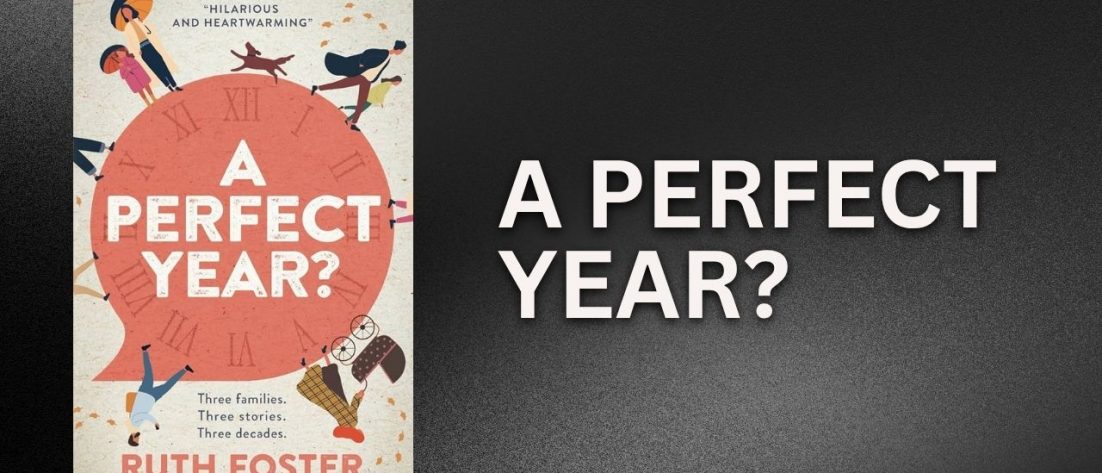
Blaine DeSantis: [7:15] Wow. Well, now this book, basically talks about three families and what I love about—I’m going to show the everywhere the cover here—there it is okay—A Perfect Year with a question mark okay and it says here beneath it “three families three stories three decades” which I love. I absolutely love that. Well, who are these families? Tell us a little bit, just a little bit about each of the families. Who are they?
Ruth Foster: [7:38] I’ll tell you and I very much hope that everybody will recognize these families from their own annual, the Christmas newsletters that they receive.
Ruth Foster: [7:48] First of all, we have the Wrights, spelt with a W, W-R-I-G-H-T, but they are right by name and right by nature because they always think they’re right. Caroline, the wife, is an events organizer. Her husband, Charles, is an advertising executive. He has a succession of amazing names as the book goes on. I think one of his job titles is Global Roving Client Activator. And believe it or not, that is based on a real job title that I came across. But the idea is that the job titles reflect his inflated salary. And Caroline, his wife, is obsessed with social status. Her aim in life is to become a member of the posh local tennis club, all this kind of thing. Next door, we have a completely different family. We have Alison and Antonio. Now, Alison is a librarian, but she’s not the sort of librarian that maybe people think of as the stereotype. She’s not organized. She’s not meticulous. She’s not very much of a detailed person. In fact, her life is fairly chaotic. But she loves libraries, and she loves her work. And she lives with her partner, Antonio, who is a…
Ruth Foster: [9:09] He’s an artist and sculptor from Chile, and he’s come over to the UK from Chile following the political upheaval that was going on in the 1980s. And he is just as disorganized as she is. And as the book proceeds, they have more and more children, less and less money.
Ruth Foster: [9:31] They constantly try and do new things to make it all work. But, of course, life never turns out as they want it to. Then there is a third main character, who is Robert. Robert is a lawyer, a solicitor, we say in England, but an attorney. He has clearly been, he’s clearly a very bright, efficient, meticulous city of London lawyer, but he’s chosen to downsize, to go back to the town where A Perfect Year is set. And he wants to go back home to look after his mother, who is becoming quite frail, and in particular, his brother, Colin, who has some kind of disability, mental health disability, that is never made completely clear, but cannot live independently. So Robert goes back and he, to begin with, has what I would call inherited status in the sense that he sees himself as following in the footsteps of his father, who was clearly quite a well-known figure in the town. But Robert’s life does not follow that of his father and whereas he might have seen for himself a period of respectability and his life continuing along a fairly predictable track, in fact his life turns out quite differently. So those are the three main characters.
Blaine DeSantis: [11:00] Well, there’s actually a fourth main character. It’s called the Wellspring Festival. Tell us what is the Wellspring Festival, and you moved it from a tradition to a commercialized event. Tell us all about this. That’s fascinating.
Ruth Foster: [11:15] I’ll just, yes, I’ll just tell you briefly about the setting for the book, because I think that’s very relevant. The book is set in a town called Upley Rising. Now, Upley Rising would have been a small village about maybe 60 miles outside of London a couple of centuries ago. Just like in many places, the arrival of the railways turned it into a commuter town where aspiring middle-class people would live because there was fresh air, there were lovely homes, gardens, but they could commute into London to work and earn a decent salary. So Upley Rising is terribly traditionally British. It has a church. It has a Gothic clock tower. It has public gardens. It has some very sort of chi-chi little shops. At the beginning of the book, one of the shops mentioned is a doll’s house and miniature shops. And that’s actually based on a shop that existed where I used to live. It was a shop in a major part of the high street actually selling tiny pieces of doll’s house furniture. So that’s the kind of place Upley Rising is.
Ruth Foster: [12:21] But in the middle of all this middle-class respectability, it has the Wellspring Festival, which goes back hundreds of years. Now, in Britain, there are a number of towns with festivals like this. We have something just up the road from where I live in Devon. We have something called the Ottery Tar Barrels Festival which involves rolling barrels of flaming tar along the street pushed by young men but with crowds cheering them on. There’s another festival called the Gloucestershire Cheese Rolling Contest and that involves, believe it or not, it’s set in a town with a very steep hill. It involves rolling lethally heavy cheeses down a very steep hill. So what all these have in common is they are a combination of lethally dangerous activities combined with all the townspeople coming along to have a great day out. And I decided that Upley Rising needed its own festival. So the Wellspring involves choosing a young girl who I’ve called the Upley Maiden, and lowering her down the well, which is sited in the middle of the marketplace once a year, surrounded by crowds. And the idea is she has to bring up a bucket of water. And it’s all symbolic, going back centuries, of water needed for the harvests.
Ruth Foster: [13:43] So it has probably fairly pagan roots. But as you say, quite rightly, at the start of the book, it’s a fairly relaxed traditional affair. But people like to spot an opportunity, don’t they? And it becomes more and more commercial. The committee that have run the festival for ages eventually get undermined. I won’t give too much detail, but it changes direction. People come in and try and make a lot of money out of the festival. I will say, without going into detail, that at the end of the book, an event occurs, which kind of takes it back to its rebellious roots. So I like to think that the Wellspring does a full circle and returns to the kind of tradition it is meant to represent.
Blaine DeSantis: [14:28] And friends, you know, when you read this, we’re finding out about all these things, again, through a Christmas newsletter. And it’s remarkable how Ruth takes us there, and we feel like we are eyewitnesses to this through these newsletters. And one, Caroline sees it one way and Allison sees it another way. And, you know, it’s very, it’s fascinating to see how everybody looks at the same thing, which is what I love that contrast. You know, you see A, I see B, who’s right, who’s wrong, what’s three, I don’t know, but we’re seeing it through their eyes. Wonderful, wonderful stuff. Well, now, Caroline and Alison. Caroline Wright and Alison Pickthwaite. Am I saying that correctly? Pickthwaite, is that her name?
Ruth Foster: [15:14] Yeah. She’s from Yorkshire. It’s a good Yorkshire. Actually, it’s invented, but it’s the… Thwaite is a suffix, which is very common in the north of England. So that’s where the Thwaite comes from.
Blaine DeSantis: [15:24] We’ve learned another fact here. Okay, Thwaite. Okay, Pickthwaite. Now, how do you end up developing these characters so that you will illuminate those social dynamics and suburban life? I mean, they’re very well drafted, even though all we have is a newsletter.
Ruth Foster: [15:37] I think, in a way, they develop themselves. They do say that if you really think about your characters when you’re writing, they kind of develop themselves because you know so much about them that life unrolls for them, in a way. So Caroline is always very, very aspiring. Alison appears to be less aspiring. In fact they have more in common than you might think because, Alison really would love to be a head librarian. She just drops it into the odd newsletter as the years go on. She has ideals for herself as well. And Caroline actually has a vulnerable side, which also emerges a little bit as the book goes on. But we see them mainly through the stereotypes, I think. So at the beginning, one family, and you can guess which, sends their children to a really posh, super duper preschool. Preschool is the word it is, isn’t it? Preschool in the town, while the other family send their children to the other preschool, which people are less bothered about. That develops into more concerns later on about getting the right school places for the children.
Ruth Foster: [16:57] The real focus, I guess, is around the fact that they are neighbours, they’re close neighbours. So the book and the conflict and the development around them centers upon the fact that they live next door to each other, but they just fall out over so many things.
Ruth Foster: [17:13] For example, kitchen extensions, which are a sort of fairly notable aspect of life in a town like this. Everybody wants to make their house bigger and better. Everybody builds a new extension and then the person next door wants an even bigger and better extension. So there’s quite a lot of comedy, I hope, around this in the book and you get the conflict between the two of them playing out over that. And the other area where you see them develop and come together in conflict is the royal visit, I should say. Can I go back and do that a bit again? Yeah, I’ll just say the other area where they both come into conflict is the royal visit, which is celebrated at the time of Queen Elizabeth’s Golden Jubilee, which was in 2002. And that is a very central event in the life of the town and one of the characters wants to make it really very much all about her and a vehicle for her to be seen as doing something wonderful. The other character who is anti-monarchist has completely different ideas so we really see the build-up of the two different types of character come together and it all.
Ruth Foster: [18:39] Either cuts together or falls apart, depending on which way you look at it over this royal visit.
Blaine DeSantis: [18:44] It is one of the funniest chapters in the entire book. I love that chapter. And when they said one of the royal family, this is like somebody way down the line who marries into something. And it’s like, okay. Because I think that one person thought the queen herself was going to cover somebody very clear. It didn’t happen that way. But it was all hilariously done, again, written in each newsletter different points of view wonderfully done wonderfully done because see this is what happens you write about you know the class inequality the family struggles you talk about personal identity all how do you decide I want to be serious for this part lighter for this part did you balance one versus the other or how were you doing that?
Ruth Foster: [19:26] I wanted the whole book to make people smile but you can’t just have relentless comedy because after a while, in fact after a short while, it’s not funny anymore, is it? So life is a mixture of poignancy, sadness, and comedy. And they say that comedy and tragedy are very, very closely related. So I suppose as far as the humor was concerned, the comedy, I just felt in some ways it was almost enough to let events speak to themselves and to tell it like it is because the detail of life in a small town is as it is and we should all be able to see the funny side of things, shouldn’t we? I did also try and juxtapose small things, comic events with larger events in history. For example, Alison is very pregnant. She goes to a major demonstration against the poll tax, which is genuine. The demonstrations described actually took place in London’s Trafalgar Square. She goes into labor in the middle of this demonstration and it turns into a great drama. I put those two together.
Ruth Foster: [20:37] Robert gets involved in a major flood that occurs in Upley Rising. It’s actually in Lower Rising, which is the sort of less posh neighbourhood next door to Upley Rising. So we have visions of him kind of wading through the mud in his suits, trying to rescue bits and pieces. So that sort of straddles a bit of comedy and a bit of tragedy.
Ruth Foster: [20:59] So there are events like that. Also, the only other one that springs to mind is Alison is involved in a major property transaction, but it gets tangled up with the death of Kurt Cobain in 1995. So she mentions them both in her letter because they both matter to her just as much. So it was about trying to put these things together and also in terms of comedy, to give a bit of context. So for example, we have a letter from the pet and people do get annual newsletters written by the pet and we have letters from the children and people do get annual newsletters written from the children. So they were attempts to try and vary the narrative, but also to provide a bit of light reading.
Blaine DeSantis: [21:46] Very good. Very good. By the way, one of the greatest lines was at that protest when Allison screams out, “I’m in labor.” And the guy next to her says, “Yeah, I’m in Labor too.” You know, assuming she’s talking about the Labor party.
Ruth Foster: [22:01] I’m glad you enjoyed it.
Blaine DeSantis: [22:03] I like that a heck of a lot, you know. Oh, boy, that was wonderful. Hey, well, then you brought in the murder house. Now, was the murder house always going to be part of this book or did that develop?
Ruth Foster: [22:14] It developed. It developed fairly early on. I was trying to think, how am I going to propel this narrative? What makes a narrative more exciting? Of course, it has to be a murder. Everybody loves a good murder mystery, whether it’s Richard Osman, who’s currently selling a lot of murder books in this country, Agatha Christie, you name it, there’s a murderer author for it. So I decided on a murder. But I decided what makes it different in this book is it’s not really so much about the murderer, it’s more about the house, the house where the murderer lives, which is almost a character of itself, isn’t it? And I chose this because I wanted it to play upon the British obsession with owning property. And so what people found in Upley Rising, the real concern about the murder house was less about the fact, there had been terrible tragedies in that house and in the street, and people had lost their lives. It was horrific. But people were less concerned about that than about the fact that having the house had an impact on property prices. And so that was partly the function of the murder house. And it, of course, plays a role later on as well in the Royal Visit chapter.
Blaine DeSantis: [23:38] Very good stuff. Very good.
Ruth Foster: [23:40] It’s set in a road called Paradise View, because everybody wants the road to be paradise.
Blaine DeSantis: [23:46] I get a kick out of this book. I love this book from beginning to end. Hey, you had the children in there. Now the children develop over the years obviously, and more keep popping out. Poor Allison, every time she thinks she’s getting ready to set up, here comes a set of twins. We’ve overcome this, they’re getting ready for school, here comes another set of twins. How do you decide to bring all these kids in and develop their characters also?
Ruth Foster: [24:10] I told you that she wasn’t the typical librarian.
Blaine DeSantis: [24:12] Although I’m sure.
Ruth Foster: [24:13] There are librarians out there with having multiple children unexpectedly. Well, the children obviously had to be a part of the book. I have to tell you, Blaine, that what I needed was a very detailed spreadsheet, apart from anything else, for the fact that I needed to get the school years right.
Ruth Foster: [24:37] School years start in September. People write their annual newsletters in December. There were a lot of children and I became quite obsessed at one point with the fact that somebody might spot that I’d said a child had started grade three, say for example, whereas in fact if you checked against the year they were born they couldn’t possibly have been in grade three yet. So I spent a lot of time making sure the children were at the right stage of education in the right year. So that was the framework, if you like, that that underpinned it.
Ruth Foster: [25:10] The children develop in the way that children do, and they have all the disasters and adventures that children have. So we see them at the beginning as babies, teething, crying, having birthday parties that go wrong. One family has a nanny, one family just has the husband, Antonio, who kind of muddles through. And you really don’t know how the children manage to survive that childhood. Then the children’s characters emerge as they become a bit older. We start to see letters written by them. They’re pivotal in the chapter that takes place over the millennium because for one family they are writing all the letters for that year. In other chapters they’re writing their own little bits of newsletters as they get older. They play a very important role at royal visit and then after that they start to enter their teens and we get more adventures. We get more of the things that kids do in their teens, whether they’re experimenting with drinking things they shouldn’t be drinking, going to parties, wearing clothes that their parents don’t want them to be wearing, all that kind of thing. And in fact, at the end of the book, two of the children, again, are quite crucial to the way the plot comes together.
Blaine DeSantis: [26:26] Right. Yep. It is absolutely fantastic. And then, if my memory stands correct, don’t we even have a situation where the two kids who were going to go to this posh school couldn’t because it changed the boundary lines. And now all of a sudden something else changes here.
Ruth Foster: [26:44] Yes, that will strike a chord with a lot of parents, getting the right school placed. Can depend—it varies all over the country—but it depends on the catch, what they call the catchment area. And if your house happens to be two feet outside of the catchment area, your kids don’t get in. So there, yeah, there was quite a lot about that in it because I knew that it would make people grind their teeth and say, “Yes, I remember that happening” and waiting for the local authority to announce whether my children would be in one school or the other school.
Blaine DeSantis: [27:20] Right, and all of a sudden, Carolyn wants to be a little bit friendlier with Alison when it turned out to where her kids are going to be on at school. I loved it. That was great.
Ruth Foster: [27:29] Yeah, the husband comes around with a bottle of wine, doesn’t he?
Blaine DeSantis: [27:34] Good stuff, I tell you. Top-notch work. Oh, my. Hey, one of the characters here who is going through a real, real difficult time, transformation, is Antonio. Now, Antonio is an artist who, as you said, came from Chile under the time of Pinochet and all that killings and murders down there. And he’s, tell us about and how you eventually developed and had him move past that. That was fascinating.
Ruth Foster: [27:59] Well, the Chilean diaspora, if I want a better word, was quite big in the UK in the 1980s into the 90s. There’s a film called Truly, Madly, Deeply with Alan Rickman in it, which is quite well known, which features some of the characters. There was a lot of awareness around what was going on in Chile, but it wasn’t so much about Chile. He really represents what it’s like to have left your country for a mixture of political and other reasons. And he sort of represents the global change that is going on.
Ruth Foster: [28:39] I wanted to show that it goes right back to that time and to give an example of somebody. But in particular, I wanted to show that things are not black and white. He has a backstory, Antonio. He’s quite an angry character. And in fact, he becomes more angry as the book goes on. And then later into the book, it becomes apparent why he’s angry. It’s because he has a very nuanced, dark past, evolving his family, and he expresses it through his art. So it’s probably no coincidence he’s become an artist, although he has the talent as well. So, and the other thing, I guess, is that he is quite a contrast in the town of Upley Rising. The British middle-class people living there can’t quite get their heads around the arrival of Antonio, and you see them thinking he must be from India, he must be from a completely different country. They are—it’s a vehicle for showing off how uneducated some of them are. But yes, he, you know, he does his best, Antonio, and he loves his art and he loves his children.
Blaine DeSantis: [29:51] That’s what comes through. That’s definitely—he loves his kids without a doubt. Wow. Well, now you know you deal with some national or international events. You talk about Lady Diana’s death, that falls into the thing, the newsletter, September 11th, the Queen’s Jubilee. How did you decide what to include in the newsletter?
Ruth Foster: [30:10] Most people barely mention global events in their newsletters. I did quite a lot of rereading of old newsletters when I got my box file out to start the book. And I realized that although the news had to underpin the narrative because over 21 years you have to get a sense of where the country is going and where the world is going. At the same time, most people see the news through their own local association with it. I decided that you had to include some really major events and you’re quite right, you singled out the death of Princess Diana which had massive impact. The other major events that appear in the book are the turn of the millennium, 9-11, the Iraq war, and the weather, because it’s not quite a global news event, but it is in the country where I live. What I tried to do was relate them through the eyes of the families writing their newsletters. So, for example, during the death of Princess Diana, what we see is how it affects the birthday party of one of the children. And in true Upley Rising style, one of the neighbours sneaks out and takes down the balloons that the family had pinned on the gate because they obviously felt it was disrespectful.
Ruth Foster: [31:31] And Roberts, the more serious character, his mother has a strange reaction when Tony Blair is elected prime minister. She obviously doesn’t approve of him. The other thing that is related is there was a two-minute silence in Britain following 9-11, and Alison happens to be in the supermarket with two toddlers in a trolley, and they have a massive tantrum in this trolley in the middle of the supermarket. That was also based on something I experienced. So it’s trying to see these events through the small things that happen in people’s lives and the kind of stories that people try and put into their newsletters to give some color to their year.
Blaine DeSantis: [32:12] Great. And when we talk about the weather, friends, it also goes back to that Wellspring Festival because there’s some issues there when we come to the weather and rain or maybe lack of rain or what’s going on. But It’s wonderfully done, woven, intertwined, just so wonderful. You know, you do public and private lives. We see you as a public, but then we also have private, and we really get into that with Carolyn. I really, we see a difference in her private life to what she exudes publicly. Always wanted to do that, or is that hard to do that?
Ruth Foster: [32:45] She was so stereotypical with her newsletters. They were quite relentlessly smug. And I kind of felt I was being a bit unfair to her. And it made me think quite hard about the reasons why people write these newsletters. And clearly, people do not sit down to demonstrate hubris or to tell the world that they are better than anyone else. And the more you think about it, I realized that people just want to make the most of a rare opportunity to have a platform to tell people what they want to tell people. If it’s a two-way conversation, that is obviously, it’s often not possible. But when you’re writing a newsletter, it may or may not be read by the recipient, but it is your chance to set out your life as you see it. And of course, they vary according to the personality of the writer. In Caroline’s case, she is mostly trying so hard to tell people how wonderful she is and how successful she is that eventually, as I say, I relented and some of her vulnerable side comes through. And it’s also seen through Alison, who comments once or twice, that she’s seen with dark rings under her eyes.
Ruth Foster: [34:10] Looking tragic because she suffered a bereavement, which is quite a major event in the book.
Ruth Foster: [34:16] There’s following the Royal Visit chapter, she appears with a bruise on her forehead. So you start to see these little vulnerabilities creep in. And I suppose they are representative of the vulnerabilities that lie behind the news that people put into their newsletters.
Blaine DeSantis: [34:33] Well, you know, you take us up to the year 2007. And at 2007, we think everything’s getting to be pretty much, as we can say, hunky-dory peachy here, going to be pretty stable. And then we know in 2008, the financial crisis is going to hit. Did you end specifically at 2007 because of that major change that was happening in the world?
Ruth Foster: [34:56] I did. It kind of fell naturally into place when I decided, I mean, the natural span of most round robins has been from the late 80s to the mid 2000s. Apart from the edge of the financial crash, 2007 was the year of the first iPhone and that kind of signaled the introduction of social media and people texting and led to WhatsApp and all the Telegram, all the other platforms that people now use that have kind of superseded, not completely, but you know, very much superseded annual newsletters. So the other thing, as far as the characters in the book were concerned, is that the children were all starting to grow up. They were reaching the age of going to college. And it just felt like a natural stopping point for the book. And if the book was to carry on, it would really be picking up with a new plot, a new narrative direction.
Blaine DeSantis: [35:54] Now, let me ask you a question. Do you have a favorite character or a favorite family?
Ruth Foster: [35:58] I don’t have a favorite family. Well, maybe I like Robert a bit because he’s so genuine, isn’t he? I have bits of all of them that I empathise with. People often ask whether a character in a book is based on the author. My experience of writing A Perfect Year is that there are elements of all the characters in me and elements of me in all the characters. So I empathise with all of them. And I wouldn’t have any standout favourite, no, but I do like Robert.
Blaine DeSantis: [36:39] Robert is very understated. You know, we don’t even talk about him basically as we’re discussing things, but he’s there. And he’s helping. I always consider his brother to be autistic or something in that range, something like that. And he gives up his work in town to stay with his brother and everything else. He’s a greatly, greatly drawn character. I love his character. And what he then does to help the community also. He then, you know, they start doing pro bono stuff. Again, this all comes out in these newsletters, and it’s as if you have captured those people and brought them directly into our lives, which I really appreciated.
Ruth Foster: [37:16] I should tell you that I have a friend, another old work colleague, who Robert’s letters were partially based on because her annual newsletters are very thoughtful, quite philosophical, extremely observant, and beautifully written. And about four years ago, I got a card from her on December, but I didn’t get a newsletter. And I was quite upset about this. But after several days, I sent her an email saying, is anything wrong? And a few days later, I got an email back from her saying that she had decided to stop sending the newsletters because she didn’t think people would be interested in them anymore. But she’d had a flood of emails similar to mine from all the people she was sending them to saying, please start writing them again. And I just think that’s a lovely story. And it was quite recent, just in an era where we think people have given up writing or reading these newsletters. So they can be very beautifully written and very engaging.
Blaine DeSantis: [38:19] It was great. Now, what is next for Ruth Foster? And are we going to have any more newsletter books?
Ruth Foster: [38:26] I am not sure. What I will tell you is that I live in a small village in the countryside now where there is an awful lot of material for another book. There are sheep that escape. There is the annual flower and produce show where people get unbelievably competitive.
Blaine DeSantis: [38:43] About each other’s onions.
Ruth Foster: [38:46] There may well be something along those lines but you’ll have to watch this space.
Blaine DeSantis: [38:51] Got a keen eye for these details and these observations. I’ll tell you it’s just wonderful. You know, we could go on and on here but you know you’ve got a schedule, I got a schedule and I don’t want to take you all day but you have just been wonderful. Your book is, you know, a breath of fresh air and I really have enjoyed having you on. Friends, I gotta tell you what, this is a wonderful book from beginning to end. I don’t know how she did it. This is her first published book, correct, if I’m not mistaken?
Ruth Foster: [39:18] That’s correct. I’ve written comic plays and other bits and pieces, but it’s my first full-length novel.
Blaine DeSantis: [39:23] I’ll tell you what, this is number one. Wow, it can only get better from there. I’ll tell you, great stuff. Hey, Ruth Foster, thank you for being with us today on Books and Looks.
Ruth Foster: [39:32] Thank you, Blaine, very much. It’s been an absolute pleasure.
Blaine DeSantis: [39:34] Well, if there’s one thing I hope you take away from this conversation is how exploring different perspectives, even seemingly ordinary ones shared through annual updates can reveal extraordinary stories about the human experience and resilience. If you’re curious about the fates of these characters, like the ambitious Caroline, the artistic Antonio, or various members of their families, you’ll definitely want to check out Ruth’s book, A Perfect Year. It’s available wherever books are sold. And as always, we’ve included links to the book and to Ruth’s website in the show notes. I’d love to know what resonated with you from this conversation about A Perfect Year? What scenes from the book sparked your interest? Or what character’s story did you find most compelling? Write a comment, leave a review. But until next time, keep reading, keep learning, and I’ll see you on the next Books and Looks.