
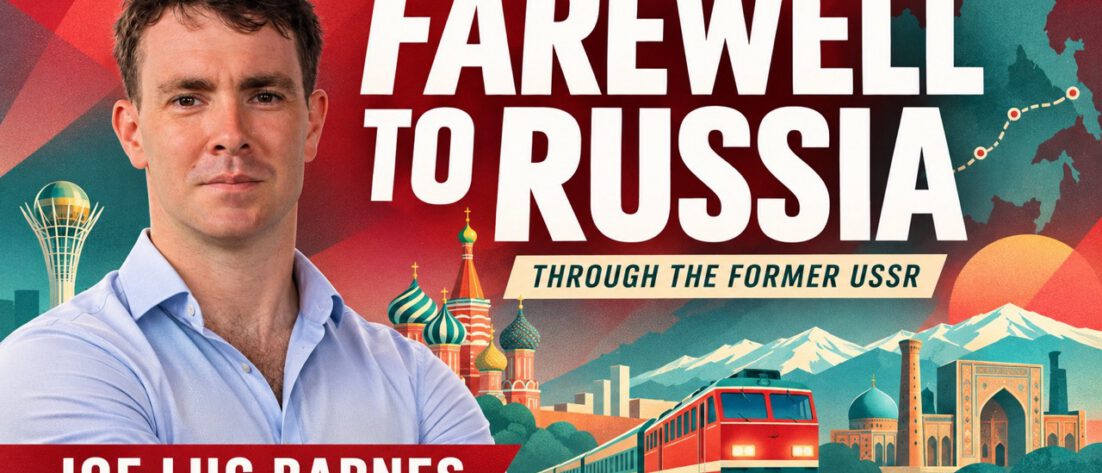
What happened to the 14 countries that broke away from the USSR? Blaine talks with author Joe Luc Barnes about Farewell to Russia, his journey through every one of them.
Joe Luc Barnes is a British journalist and travel writer who moved to Russia in 2014 as a private tutor, studied Russian at university and now lives in Kazakhstan. He set out to travel the former Soviet Union in Moscow in February 2022, the month Russia launched its full-scale invasion of Ukraine, and talked to ordinary people in bars, tea houses and taxis along the way.
They cover a lightning round of favorite and least favorite countries, then go country by country: Armenia’s wars and chess cafes, Azerbaijan’s oil dynasty, Kazakhstan’s purpose-built capital, the torpedo tests on Kyrgyzstan’s Issyk-Kul, Uzbekistan’s sea of white Chevrolets, Turkmenistan’s blocked internet, Belarus, the Baltics and Moldova. Joe also explains why China’s growing reach is the bigger danger to Russia’s own economy, and what it was like to live through air raids in Kyiv.
Resources:
- Farewell to Russia (Elliott & Thompson): https://eandtbooks.com/books/farewell-to-russia/
- BookTrib: https://booktrib.com/
Welcome to Books & Looks
Blaine DeSantis: Hi, everybody. This is Blaine DeSantis, and I welcome you to Books & Looks, where we do a deep dive with the authors to help you discover your next great read. You know, we have all heard about the USSR. That’s a transcontinental country that was formed back in 1922 and was governed by the Communist Party until it collapsed in 1991. Now, in addition to Russia, there are now 14 other independent countries that were part of the USSR. Now, most of us cannot even name these countries, and we’re not even sure of their geographic location. More importantly, how have these countries done since this separation, since this collapse? And how have their people fared in the last 35 years of freedoms? I’m Blaine DeSantis. This is Books & Looks. And today we’re going to be taking a look at these 14 countries with author Joe Luc Barnes as we discuss his new book, Farewell to Russia. And let me tell you, friends, this is a long interview because there’s a lot we gotta learn about some very interesting countries.
Why the collapse of the USSR became a book
Blaine DeSantis: Joe Luc Barnes, welcome to Books & Looks.
Joe Luc Barnes: Thank you very much for having me, Blaine.
Blaine DeSantis: Well, you know what, in honor of you today, we’re doing a first time ever. We’re doing this recording in front of a live studio audience. What do you think about that, fans? Yeah, you have people here that, friends, family have come to see this because they’re all interested in your book.
Joe Luc Barnes: It’s great to know I can draw a crowd.
Blaine DeSantis: Yep, there you go. This is the book out there, everybody. It’s called Farewell to Russia by Joe Luc Barnes. This is one of the absolute best books I have read this year. Great book, great effort by Joe, and I’ll tell you why. It’s taught me a lot of stuff, and with my daughter being over in that area a little bit, it helped her out too. What gave you the idea to do this book, first of all, Joe?
Joe Luc Barnes: Oh, well, that’s a long story. So I lived in Russia. I started living there in 2014. I got a job as a private tutor. I was just looking for a job anywhere outside of England once I finished university, and I got a job as a private tutor for a rich Russian family and kind of didn’t really know what to expect when I first arrived in Russia. It was quite an intimidating time, as the Russian army had just taken over Crimea in Ukraine, and for the first six months or so, it was difficult to get to grips with the country. But then I just found myself really becoming increasingly fascinated by it, and the USSR as well, so I ended up writing about it, studying it, doing a Master’s in Russian at university. Then, as life does, it sort of takes you in another direction, and I ended up moving to China. And in China, when people discussed the fact I’d been to Russia, they would always say, “Oh, you’re in the former Soviet Union.”
“It was such a tragedy that that country collapsed.” I thought that’s a very interesting way of putting it, because when I had been at school and at university in England, I’m sure in the United States as well, we’re not taught that the collapse of the USSR was this great tragedy. We’re told it was one of the high points of human history. And this was an attitude I also encountered in Russia as well, and sometimes in some of the other republics that the USSR broke into. And some people thought that they had lost their country. Some people would talk about the poverty that had arisen from the collapse of communism. Some people bemoaned the sort of loss of identity because there were, well, we’ll come to this, but there were 15 countries that broke into, but there were more than 15 different peoples in the USSR.
So a lot of people found themselves a minority in their new country. So there were so many issues that stemmed from it. And as Chinese people would put it to me, they would say, “Well, look what we’ve done in China in the last 30 years, whereas look what’s happened in the Soviet Union in the last 30 years.” And the Chinese would make the point that when they had the protests for democracy in Tiananmen Square and they heavily cracked down, killing thousands of people, many Chinese don’t know about this. It’s quite a censored topic. But those who do justify it by saying, “Well, in the long term, the political stability was the most important thing.” So this issue of independence, of political stability, of communism, imperial collapse, these were all different issues that were bubbling inside me. And so I planned in 2020 to travel through these countries in time to write it up in 2021, which would have been the 30th anniversary of the collapse of the Soviet Union. However, as many of us know, traveling in 2020 was quite difficult due to the coronavirus.
So the book had to be delayed slightly, and I ended up starting the book in Moscow in February in 2022, which, as many of the listeners being students of history, I’m sure will remember, that was the month where Vladimir Putin decided to launch his full-scale invasion of Ukraine. So it ends up being quite a chaotic first chapter, but I think that just underlines how important it was to study the collapse of the Soviet Union and what’s come after it, because so many of the issues that led to that Ukraine conflict lie in the Soviet Union collapsing. So that was the genesis of the project.
The 14 countries and a lightning round
Blaine DeSantis: Wow. Yeah. Because a lot of people don’t know the names of all 14 of these republics. I do, because I used to play trivia and I got to know all the names of those places. What are the, other than Russia, what are the other 14 countries that broke away?
Joe Luc Barnes: I’ll group them geographically, so I can get people to picture a map in their head. So if we go west from Russia, so we’ve got the European countries. So this is what generally is called Eastern Europe. So we’ve got the three Baltic states of Estonia, Latvia and Lithuania, sort of the north part. And going south from there, you have Belarus, Ukraine and Moldova. So those are the European republics of the USSR. Then to the south of Russia, north of Iran and to the east of Turkey, you have the South Caucasus, which have Armenia, Azerbaijan and Georgia lying amongst them in this very mountainous area. Then heading further east across the Caspian Sea in the direction of China, before you get to China, you get Central Asia, and that is Kazakhstan, Kyrgyzstan, Tajikistan, Turkmenistan and Uzbekistan.
So those are your 14 countries, and then Russia is, well, they’re on all sides of Russia, essentially.
Blaine DeSantis: And as I said to you before we got on air here, we’re not gonna even attempt to figure out what the capitals are. I’d still flail at that. Other, I think I know Tbilisi is the capital of Georgia. That’s, I think, all I know. We’re doing something different this time, friends. We’re gonna do a lightning round of questions with Joe. It’s gonna be a one-word, basically answer, country answer, and I think you’re gonna really enjoy this. What was the favorite country for you?
Joe Luc Barnes: Belarus.
Blaine DeSantis: Least favorite country.
Joe Luc Barnes: Lithuania.
Blaine DeSantis: Most tourist, travel-friendly country.
Joe Luc Barnes: Georgia or Uzbekistan.
Blaine DeSantis: The least friendly travel country.
Joe Luc Barnes: Due to the current situation, probably Russia and Ukraine.
Blaine DeSantis: Which country had the best food?
Joe Luc Barnes: You’ve got me there. I’m gonna, the easy answer is Georgia.
Blaine DeSantis: Which country had the least desirable food?
Joe Luc Barnes: Maybe Kazakhstan.
Blaine DeSantis: You didn’t like the old sheep’s head up there that they serve, huh? And camel.
Joe Luc Barnes: I actually live in Kazakhstan, so I should probably say that very quietly, but it’s quite plain.
Blaine DeSantis: That’s, my daughter was there. My daughter was eating all those things. I think she has videos about that, good Lord.
Joe Luc Barnes: Isn’t that fantastic?
Blaine DeSantis: Which country now has the best infrastructure?
Joe Luc Barnes: Probably Estonia, or Russia.
Blaine DeSantis: And which has the worst infrastructure?
Joe Luc Barnes: Turkmenistan. The roads would just disappear outside the capital.
Blaine DeSantis: So in your travels, who were the friendliest people?
Joe Luc Barnes: Tajikistan.
Blaine DeSantis: And who were the least friendly?
Joe Luc Barnes: Probably Estonia.
Blaine DeSantis: Estonia is high up there on a lot of the least things, I tell you. They’re okay. Now…
Joe Luc Barnes: And it had the best infrastructure. Good infrastructure, unfriendly people.
Blaine DeSantis: Oh, that’s true, that’s true. Which country do you feel wish they were back in the USSR?
Joe Luc Barnes: Russia.
Blaine DeSantis: How about of the republics? Which, of the other 14, what would want to be in the USSR?
Joe Luc Barnes: Probably, it’s a value judgment, I guess, but probably places like Tajikistan and Kyrgyzstan have become a lot poorer since the USSR collapsed, and many workers now work in Russia, Tajikistan.
Blaine DeSantis: So what is the happiest country to be out of the USSR?
Joe Luc Barnes: Any of the Baltic states.
Blaine DeSantis: Any of the Baltics. What is the number one country that you would recommend to visit?
Joe Luc Barnes: Uzbekistan.
Blaine DeSantis: And which is the least country you would recommend to visit?
Joe Luc Barnes: I think that would be unfair to answer. I think I wouldn’t put any of them in a category. They’ve all got something to offer.
Blaine DeSantis: Don’t worry, you can say anything you want, because I’m sure those people will probably be blocked, as a matter of fact, in certain countries, but that’s okay. Did any country surprise you the most?
Joe Luc Barnes: Belarus, definitely.
Blaine DeSantis: And what country didn’t surprise you? You got what you were going for.
Joe Luc Barnes: Latvia. We haven’t said Latvia yet.
Blaine DeSantis: All right. There you go, friends. There’s a very short questions and answers about places up there, and I think that’s pretty interesting.
Joe Luc Barnes: I feel my answers have led to more questions. I feel people will be listening and thinking, he needs to justify himself there. That’s the nature of the lightning round.
Researching in bars and coffee shops
Blaine DeSantis: Maybe we’ll say that here eventually. I love your research. You’re in a country, you go into a bar, and or coffee shop or something, you start talking to people, and…
Joe Luc Barnes: I think, I mean, going to a bar isn’t my only research method, but I think if you want to try to find a decent sample of population, I think what a lot of people do is they start in the capital city and they ask the people who speak English, or they ask people with a platform or a voice, or the other ways you can do it, you might go on X or find people from that country, or you might find local journalists, people of note, activists. And from what I can tell, they do represent a section of the population, and they express their views pretty well, but it tends to be quite a sort of urbane, metropolitan view of the world.
It’s, for example, going to the United States and just going to New York and asking famous people in New York, or the same in Britain, going to London. And I thought that you can’t just go to the most obvious place and just talk to English people, because they’re obviously likely to have done better out of the collapse of the Soviet Union. Their life experience has probably been slightly more privileged than people from, say, rural areas. So what I would try to do is do things like hitchhiking, do things like, like you said, often I go to a bar, because, I mean, drink is famously a culture that is associated with the Soviet Union, especially Russia, but not just Russia. And with alcohol in particular, I think people tend to tell better stories after three or four beers. And yes, so that’s my thinking behind how I do research.
Obviously, I would talk to people in museums or get tours and talk to journalists and civil society actors. But I think just to broaden the sample of population that you’re talking to, I think it’s important to try and talk to as many normal people as possible.
Blaine DeSantis: And let me tell you what, Joe, I think that’s important, because it’s those type of people you get the unguarded opinions of, and you hear what that guy, the average guy is going through. He might not feel comfortable to say that out on the streets. But in a bar, he knows people, you know, you get a little bit more unguarded answers. And I really commend you for that. Friends, this is a great book for that. You’re gonna hear it all in this book, and it’s wonderful.
Armenia: war, chess and the night train
Blaine DeSantis: So let’s start, though, if we could, with trying to do a little bit on these countries. Could we talk a little bit about Armenia?
Joe Luc Barnes: Of course, yeah. Armenia was the first country I went to after I left Moscow. So this war in Ukraine started. I stayed in Moscow for about a week, then flew to Armenia. And I remember getting in the taxi going to the city center from the airport, and the taxi driver said, “Oh, where have you come from?” And I was like, “Oh, I’ve just come from Russia.” I mean, I was saying it’s a relief to be away from the war. And he was like, “Oh, well, you’ve come to the wrong place, because Armenia, we’re at war as well.” And Armenia, basically since its independence in 1991, has been on and off fighting a war with Azerbaijan over a territory called Nagorno-Karabakh, which was a part of the Republic of Azerbaijan in the Soviet Union, but the vast majority of its population was Armenian, and they tried to leave Azerbaijan and sort of secede and be annexed by Armenia.
So they had this long conflict, which Armenia initially won, and then Azerbaijan, which is very close to Turkey, both culturally, linguistically, they got a lot of support from Turkey. It’s also a mainly gas but also oil power, and this had allowed them to massively vamp up their military. And then, first, there was a conflict in 2016, and then a couple more in 2020 and then 2023, which saw Armenia slowly pushed out of the Karabakh region. I just come there in 2022, which is a couple of years after this big conflict in 2020, and it was still a society in shock, still getting used to the fact that what it saw as its territory had just been taken away from it, and had lots of refugees in the capital, Yerevan. And on top of this, if you know your history, you’ll know that the Armenian people suffered a terrible genocide during the First World War. They were seen by the Turks as a sort of fifth column, a Christian fifth column in a Muslim Turkish state.
And this they saw as a danger to them, because Turkey, or the Ottoman Empire at the time, was fighting Russia in the First World War. And they sort of went through this policy of forcing Armenians to, or either shooting them, forcing them into the desert. And so Armenia has this long sort of historical memory of this genocide, which Turkey has never apologized for. They’ve never had normal relations with Turkey. So, yeah, it has Turkey to its west, Azerbaijan to its east, so it’s got enemies, I guess, on both sides, and then to the south is Iran, which has okay relations, and north is Georgia. So there’s Armenia and the situation.
Blaine DeSantis: But one of the facts that you brought up here in this book, which I found fascinating, you have to study chess in school. It’s the only place that chess is a compulsory subject?
Joe Luc Barnes: Yeah, they study chess in schools, and you would see, it’s a wonderful sight. Russia and many other countries in the former Soviet Union are also famous for chess. Uzbekistan currently has a chess grandmaster as well. But Armenians, as part of their society, would often, see these, like, coffee shops with people playing chess, and it was great. You would walk in somewhere and someone would say, “Oh, do you wanna get the chessboard out?” And what was a sort of quiet cup of tea or a morning coffee turns into quite a competitive game that ends up going into the afternoon quite a lot of the time.
Blaine DeSantis: One of the things I found fascinating early on with Armenia is how difficult it was to go from Armenia to Azerbaijan. You had to take that midnight train to Georgia, I think, if I’m not mistaken, didn’t you?
Joe Luc Barnes: I did, yeah. So one of the consequences of this 30-year conflict with Azerbaijan is that Armenia has had its borders with both Azerbaijan and Turkey closed for the last 30 years or so. And so it only has two land borders, one with Iran, which was this sort of mountain pass of a road, and it was full of Iranian trucks, often with whose drivers were stopping by the roadside to pick up Coca-Cola bottles full of a suspiciously red liquid, which I can only suspect was wine, to bring back into a dry country. And then, yeah, to the north is Georgia. So a lot of the land travel into Armenia, lots of its supplies, come through Georgia, which was an opportunity to do one of the best things about traveling in this part of the world, which is to get a night train. And it was, it left at about 11:30 p.m.
Which I think is about as close as you can get to the midnight train to Georgia. You’ll know all about that in South Carolina. Does Amtrak have a service?
Blaine DeSantis: No, but Gladys Knight and the Pips had that big hit, taking that midnight train to Georgia. Whoo-whoo! But you had to go to Georgia, and from Georgia, can you get into Azerbaijan?
Joe Luc Barnes: You can fly. At the time, Azerbaijan has COVID restrictions, which has been very slow to relax. I think currently Georgians and Azeris can cross each other’s borders, but third nationals cannot.
Azerbaijan’s oil wealth and the Aliyev family
Blaine DeSantis: Well, if we go over to Azerbaijan, here’s a fascinating thing. Said oil, gas, whatever, they have it. Back in the days, the streets of Azerbaijan, of Baku, were so filled with oil, you could strike a match, you’d get a flame if the match hit the street. It is, people don’t realize, it is huge down there, and it’s given them massive wealth. So what have they done with all that money? Is it getting to everybody, or is it just concentrated in one area?
Joe Luc Barnes: It’s very much the latter, I’m afraid. And you’re right, it’s been noted for centuries. Even Marco Polo noted the presence of oil in Azerbaijan. But yes, unfortunately, much of the wealth of the country is concentrated in the ruling family, which is the Aliyev family. Heydar Aliyev was the Communist Party boss of Azerbaijan from about the late 1960s until 1986. He was also, before that, he was a corporal in the KGB. Then during the independence periods, he was ousted for a bit and then returned in 1993, just after Azerbaijan had lost the initial war with Armenia. And yeah, Heydar Aliyev was president for about seven years.
When Vladimir Putin came to visit, he brought Heydar Aliyev’s graduation certificate from the Leningrad KGB Academy as a sort of present. And yeah, so Heydar Aliyev died in 2003, and his son took over and has been in power ever since. So his son, Ilham Aliyev, has been in power 23 years now, which is, yeah, quite remarkable.
Blaine DeSantis: Do they have elections?
Joe Luc Barnes: They do. Pretty much the first one was the only one that was even semi-contested, but even then, the ground was very heavily shaped to make sure that the son would succeed. But yeah, it’s not a country that does democracy.
Blaine DeSantis: Yeah, we who are F1 fans are familiar with the street racing in Formula One over in Baku. But it seems like if you get outside the first couple of miles of Baku, there’s nothing there. Just dirt roads and nothing.
Joe Luc Barnes: I mean, there are many people, and there are, I think a fair way to put it would be that it’s a lot less developed and a lot poorer, and much of the money, pretty much all of the money, has been invested in Baku. Yeah, I went to a city called Ganja, which was the site, or the hometown, of a very famous Persian poet called Nizami Ganjavi. But yeah, you could see, like, a significant difference in wealth and also tastes and things like that. You wouldn’t see a coffee shop, for example, in Ganja, maybe one or two, whereas in Baku it was a lot more common. And it was much more of a conservative society outside of the capital as well. If you go to a tea house, chaikhana, it’s called, this is something in both Azerbaijan and across Central Asia, it was an almost entirely male affair.
It would be incredibly odd to see a woman in a tea house.
Kazakhstan’s new capital and horse meat
Blaine DeSantis: Can we move on to the stans? There are five of them. I’d like to start with the one that I’m most familiar with, because my daughter visited there for a month: Kazakhstan. And Kazakhstan moved their capital from Almaty to, is it pronounced Astana or Astania? How do you pronounce that?
Joe Luc Barnes: There are many ways to pronounce it. Astana is the way Kazakhs would pronounce it, but it sounds a bit odd in English, so I’d say Astana normally.
Blaine DeSantis: And that word actually means capital, if I’m not mistaken.
Joe Luc Barnes: It does, correct. You’re quite good at naming these capitals, considering you said you couldn’t name them. I think you’re on four out of four so far.
Blaine DeSantis: Well, it’s gonna end very shortly. But why did they move it?
Joe Luc Barnes: Yes. So I think an important thing to understand about Kazakhstan from the start is that when it became independent, only about 40% of the population was Kazakh. This was due to a variety of factors. When it was part of the Russian Empire, there was lots of Russian settlement there. During the Stalinist period, they tried to, you must have heard of the process of collectivization, where the state took over all of the farms in the country. And this was a bad enough process in sort of the western Soviet Union, in Russia and Ukraine, where there was a big famine. But it was potentially even worse in Kazakhstan, because they tried to collectivize and force nomadic people to basically behave like settled people, and it led to a complete disaster, and about 30 to 40% of the Kazakh population was wiped out. And in the Soviet period, Kazakhstan became this sort of repository for any people who were deemed suspicious or disloyal.
So anyone who was near a border, really. So you had the Korean population of the Soviet Union deported to Kazakhstan, the Chechen population deported to Kazakhstan, the German population to Kazakhstan. Anyone who ended up in the Gulag system, many of them, the political prisoners, were sent to Kazakhstan. So Alexander Solzhenitsyn, for example, did his time there. And so by the end of this period, Kazakhs ended up being a minority in their own country. So when the USSR collapsed, most of the Kazakhs were in the south of the country, and the north of the country was primarily ethnic Russians and almost all Russian-speaking. And so the president who inherited this country was the Communist Party boss who became the president, Nursultan Nazarbayev.
One of the first things he did was said, “Right, well, we need to Kazakhify the north of the country.” What better way to do that than moving the entire government apparatus there, or the civil service? That brings with it everything from, I don’t know, eventually your think tank people, be it journalists, your media, your lobbyists, anyone who works for the government. And they basically built this city from scratch, and it was very much a top-down project. It was monuments first, then housing, and then now, just in the last, I don’t know, 10 years or so, they’ve started to work out how to connect it all. It was only last year that they finally opened the public transit system, which, when I went there for the book, had been just this stalled project, which nothing had happened there for about 10, 15 years. There were lots of accusations of corruption.
Yeah, but Kazakhstan, a bit like Azerbaijan, has been able to do this because it’s got a huge amount of oil wealth. So it did this, what’s called the deal of the century, with Chevron in 1992, which sort of supercharged its economy.
Blaine DeSantis: Mm-hmm. My daughter’s been there, and she tried all these unique cuisine. She tried lamb’s head, or matter of fact, she made it on Kazakh TV eating lamb’s head, camel, a camel hump, and they had horse. Did you get to try all these delicacies up in Kazakhstan?
Joe Luc Barnes: So the ones I’ve tried include, it’s a horse. They’re very much into horse meat, and that’s like beef to Kazakhs. They’ve got this, their national dish is called beshbarmak, which is, it’s better than it sounds, but it’s basically horse meat with noodles and potatoes, like double, going double on the carbohydrates, with some onion. Then there’s a lot of camel produce, milk especially. Kumis is camel’s milk, which is very nice. And yeah, you get, I don’t know, I wouldn’t say I’ve gone as far as the sort of lamb’s head and things like that, but, I mean, fair play to your daughter for going. I was going to say the whole hog, not the kind of whole hog, but…
Blaine DeSantis: Joe, she called to make a reservation. The people at the restaurant were so impressed that my daughter was coming, they called the TV station. The TV station comes out to record the fact that here’s an American eating lamb’s head. You just never know what’s gonna happen, but okay.
Joe Luc Barnes: Fantastic, fantastic.
Kyrgyzstan’s torpedoes and Uzbekistan’s white Chevrolets
Blaine DeSantis: It’s Kyrgyzstan. Now, one of the things in the book that amazed me was they used to test, let me get this right, torpedoes. It’s a landlocked country, but they were testing torpedoes. What’s that all about?
Joe Luc Barnes: Yeah, I mean, it’s shrouded in secrecy, but I think they still do. So essentially, there is a mountain lake called Issyk-Kul in Kyrgyzstan, which is high enough above sea level that it maintains quite a high level of salinity. So even though it’s a lake, it’s quite salty water, which means that the Soviet military-industrial complex at the time, it’s like, “Right, we’ve got a salty lake here. This is a perfect place where we can, miles from any of our borders, where we can test our weapons, and we won’t be spied upon or anything like that.” So this obviously made sense, and at the time was a part of the economy.
There was also a big, it was called the Lenin Arms Factory, in the capital, Bishkek. But all around the Soviet Union were lots of parts of the military-industrial complex. It was a huge part of the economy. But I raised it in Kyrgyzstan because when the Soviet Union collapsed, all of this interlinked economy that made sense when it was one country suddenly made no sense. The space program was in Bishkek, and again, they didn’t have any space ambitions when they became a new country. And generally, Kyrgyzstan did very, very badly for the first 20 or maybe even 30 years after independence, because it was getting heavily subsidized from Moscow. If you were to plan the terrain for a country, it wouldn’t be your ideal plan.
It’s basically, the north side of the country is very, very flat, and you have these 20,000-foot mountains in the center of the country, and then the rest of the population in the south of the country, and it’s reasonably difficult to travel between the two. And often you would travel to the Uzbek Republic in the Soviet Union and then through there to the bottom part of the country.
Blaine DeSantis: You gotta go out of the country to get into the other part of your country.
Joe Luc Barnes: Initially, yeah. Obviously, these are things that over time can be repaired, and they’ve since started building roads through the mountains, especially since Chinese money started pouring in. But yeah, when they became independent, and suddenly what was easy travel across a sort of nominal border, it’s like going from South to North Carolina, it’s the border, but imagine there was suddenly a border there, and yeah, it just doesn’t make sense.
Blaine DeSantis: Well, I wanna go to Uzbekistan, ’cause one of the most fascinating things I found in that country was, you write that 87 out of 100 cars that you saw were Chevrolets. Why is Chevrolet so big over there?
Joe Luc Barnes: It’s less that Chevrolet are big, it’s that the Uzbek state is very pushy, let’s say. They wanted to maintain or start a car industry in Uzbekistan when they became independent. And so the Uzbek state originally did a deal. Do you remember a car, an auto manufacturer called Daewoo?
Blaine DeSantis: Oh, sure, yeah. It was Korean, if I’m not mistaken.
Joe Luc Barnes: Yeah, this is a big South Korean carmaker. And then in 1998, the whole company collapsed, and Chevrolet bought it. So that’s the connection between Daewoo and Chevrolet. But Daewoo did a deal with the Uzbek state in the ’90s that said, “We will establish a factory in your country, but we’d like a proper market share here.” And the Uzbek state said, “Well, let’s do a joint venture.” Half state, half Daewoo, which became Chevrolet. They produced cars in Uzbekistan, and they just put these insane tariffs on any other cars coming into the country. So it’s maybe 200% of the cost of what it would be in a neighboring country. And so it was the only show in town, really, and they tended to make sure all of them were white as well.
So if you ever used the post-Soviet equivalent of Uber, which is Yandex, when you order a taxi and it would say, “Oh, your car is coming. It is a white Chevrolet.” And you’re looking on the street, and all you can see is a white Chevrolet. So you have to get rid of, identify specific numbers on the number plates to work out which car is yours.
Blaine DeSantis: If you’re writing a spy novel, that’d be perfect. You get the person in the wrong white Chevrolet and boom, off they go.
Joe Luc Barnes: And a long white Chevrolet. Yeah, exactly.
Turkmenistan, Tajikistan and Belarus
Blaine DeSantis: One of the countries I considered the worst, okay, you might not, but I did, was Turkmenistan, okay. It is a police state, and is this true they block three times as many websites as China does?
Joe Luc Barnes: Yeah, it was crazy. I remember it took me a while to get a visa to go there, and to go there at the time, you could only go on an organized tour. So basically they’ve got you, they’re following you around all the time, they’re chivvying you to different places, showing you what they want you to see. But I remember trying to find any website that I could open, and Hotmail.com worked, so email you could just about do. But anything, even if it was, I don’t know, just, I tried to look up my local town in England, Newcastle, like the Northern Echo is the paper there. There’s no Northern Echo.
It wasn’t just, like, big websites on there, say, the Wall Street Journal, the New York Times. They just blocked whole domain names. They would just block .com. Anything with a .com, blocked. And then they would make exceptions for things that were necessary, like Hotmail or Gmail. But there were so few websites that you could use there, and even with a VPN… So I would travel to, so Turkmenistan isn’t unique in blocking certain websites. And in Kazakhstan or Uzbekistan, sometimes I would need a VPN to access certain sites. And yeah, here, even the VPN didn’t work. It was remarkably closed. And similar state of affairs as I described in Azerbaijan, in that it was a sparkling capital, a bizarre capital with loads of odd monuments. Every building was mandated to be white. All the cars had to be white.
It turned out that the president was a dentist, so this sort of kind of made sense.
Blaine DeSantis: Oh, that’s right, he’s a dentist, that’s right.
Joe Luc Barnes: Was a former dentist, yeah. But then you would leave the city, and you would go on these roads, which for maybe 10 miles were drivable, and then they just became sort of lunar landscape. It didn’t matter which side of the road you were driving on, because there were just crater-like potholes in the middle of the road that you had to be avoiding. And it’s just mad seeing this country that was so developed in its capital, and they spent so much money. I think it had, like, more fountains per capita than anywhere else in the world, in a desert country, and then it can’t even connect its capital to its other cities. And you would see children doing forced labor in the fields, be forced to pick cotton and things like that.
And it was kind of funny and then also very sad.
Blaine DeSantis: The last one is Tajikistan. What were your thoughts about Tajikistan?
Joe Luc Barnes: A bit like Kyrgyzstan, in that its geography didn’t help it. Also flat land in the north, huge mountains, probably even taller than Kyrgyzstan, in the middle, and then flat land in the south. So not very well connected. Within a couple of years after independence, it had a civil war, which lasted for about five to seven years or so. And since then, it’s just so isolated. It’s got this huge wall of mountains separating it from China. It’s got Uzbekistan and Kyrgyzstan, and then to the south, it’s got Afghanistan, which at that time also had just been invaded by the Soviet Union and was recovering from its own war, and then the Taliban took over. So it’s not the best neighborhood to be in. Very isolated.
And it’s just ended up, even now, about 50% of Tajikistan’s economy is people working in Russia and sending money back to Tajikistan. So you sort of think, well, how independent is this country when most of its income is still coming from Russia, from people working there?
Blaine DeSantis: We mentioned that everything was white in the one country because the president, or the leader, was a former dentist. If I go to Belarus, we have a former pig farmer who’s now the leader of that country. Who is he, and how long has he been there ruling?
Joe Luc Barnes: He is Alexander Lukashenko. He was from a pig farmer. The leader of Tajikistan was also a collective farm boss, so it’s interesting, these things come in pairs. But he’s been around, I think, 32 years now. Belarus became independent like everyone else in late 1991, quickly moved to reform and adopt the Belarusian language, lots of new, like, a new flag, a new currency, things like that. And then a lot of people started feeling rather a lot of regret for the Soviet Union having collapsed. This independence wasn’t what they thought it would be, and Lukashenko sort of capitalized on this and slowly dragged the country back towards Russia. So Russian is by far the most spoken language there. The signs in the street are in Belarusian, but most people speak Russian. The flag has changed back to the old Soviet flag that it had.
All the streets, you still have your Lenin Street, your Karl Marx Street, the Communist Street, things like that. And yeah, it’s a country that, I think, a lot of the people, they were the nicest people. I was expecting a police state, essentially. That’s the reputation it has in Europe. Lukashenko has long been known as Europe’s last dictator, been in power for a long time, has a very, very powerful police state. And I was expecting them to sort of be harassed everywhere, people scared to talk to me. But no, they were the most welcoming, friendly people, would like to not necessarily join the European Union, but at least have more of a relationship with Europe and be closer to Europe.
The Baltic states and Moldova
Blaine DeSantis: Now I gotta go to the A countries, which you lump them together: Estonia, Lithuania and Latvia. And they feel like they have a different story as opposed to all those other countries. Why is that?
Joe Luc Barnes: They tell a different story. I mean, they’ve all experienced similar-ish things, but the three Baltic states were independent from 1918 to 1940, and this has given them a sense of statehood. And then when the Second World War started, they were annexed by the Soviet Union, then taken over by Germany and then taken over again by the Soviet Union. But all through that period, the local people in the Baltic states perceived themselves as being under occupation, even though it’s a 50-year occupation, rather than being part of another country. And even so, the United States or many European countries didn’t recognize them as part of the Soviet Union. And they also had, or many of them had, a diaspora outside of these Baltic states, which was working to be like a government in waiting and that sort of thing. So when they became independent, which was slightly earlier than the other countries, they effectively became independent in 1990, as opposed to 1991, when the other countries became independent.
They had more of a plan of what they wanted to do. And what they wanted to do was to move as close to Europe as they could, as quickly as they could. This eventually led to all three of them joining the European Union, joining NATO, joining the euro. And so in an institutional sense, they have sort of a bond, which is why I sort of grouped them together in the chapter. There’s some, I don’t know, more sobering lessons that we can learn from it, because there was a minority population in Latvia and Estonia especially. There were a lot of ethnic Russians who moved there during the Soviet period.
But they were not allowed citizenship, which some people say is very exclusionary, almost like creating some sort of apartheid state, whereas Estonians and Latvians would argue it was a necessary thing to do, because they would have had instability in the same way that, in the next two countries we’re going to talk about, Moldova and Ukraine, the sort of Russian-speaking population is perceived to have created. So they said, “We needed to exclude those people so we can institutionally prepare ourselves to go into Europe.” And now they’ve made it a bit more possible for those people to get citizenship.
Blaine DeSantis: Okay, for a while they were a people without a country, in effect, ’cause they weren’t on citizenship there, and no passports, and you’re sort of stuck.
Joe Luc Barnes: Yeah, I mean, a lot of them, Russia has always offered them, it offered passports of convenience to many people from the former Soviet Union. But yeah, it was something like, I think even now, maybe, like, 10% of Estonia and Latvia don’t have passports.
Blaine DeSantis: You mentioned Moldova. Well, that’s one near and dear to me, because my wife is Romanian. And when you’re in eastern Romania, you see on bridges there, they spray-painted “Return Bessarabia,” which is what that was called before it became Moldova. It’s not a big country, but it was a corrupt country for the longest time. What’s the status of that right now?
Joe Luc Barnes: Well, I wouldn’t say it’s unique in this part of the world for having corruption. Yeah, so essentially, in the same way that the two parts of Germany reunited in 1990, it was thought that the same process was going to happen in Moldova, which, as you say, much of it had been part of the sort of Kingdom of Romania in the pre-war period. Then Romania made the mistake of joining the wrong side in that conflict, and the Soviet Union sort of expanded a little bit more than it previously had been, which happens in much of Europe. Anyway, when Moldova became independent, it was thought it was going to sort of rejoin with Romania, but there was quite a significant population, again, of ethnic Russians, ethnic Ukrainians, living beyond the Dniester River.
And beyond the Dniester is Trans-Dniestria. So you have this region called Trans-Dniestria, which essentially tried to, and was reasonably successful in, seceding from Moldova, and has sort of been sustained by a mixture of Russian and mainly Ukrainian corruption. So Russian state support and sort of Ukrainian mafia support, which has kept that region going and just about being independent from Moldova. And so, yes, it’s a sort of a shadow state, Transnistria. But Moldova itself, when I went there, it had been heavily affected by the war in Ukraine, because Ukraine had supplied much of its power, and Ukraine was suffering its own power problems. But over the last three, four years, they sort of connected to the Romanian electricity grid and have started just taking steps to move towards the European Union. They’ve got a very pro-Western president in Maia Sandu, who’s currently their president.
And it looks like they’re potential candidates for the European Union in the future.
China’s rise in Central Asia
Blaine DeSantis: I know there are a lot of people in Romania who are saying, “We’d like to have them back.” A lot of people in Moldova say, “We’d like to become part of Romania.” It appears to me that China has now become a real major player, at least in Central Asia, those stan countries, okay. Do you see that happening? Is that a threat to Russia and a threat to the EU or America?
Joe Luc Barnes: I think there’s two separate questions there. I think China has become a massive economic partner of, well, pretty much the whole world. But because Central Asia is on its doorstep, it’s now by far their biggest trading partner. I think last year, sort of bilateral trade between China and Central Asia is over $100 billion, whereas with Russia, it’s about 60 or so. So it’s easily eclipsed Russia economically. It doesn’t necessarily have to be a bad thing for Russia, and it might be good for both countries to have a more economically developed region between them. I think what you’re getting at is, it’s perceived, at least historically, Russia has sort of perceived it as their backyard, and this is one of the effects of this war in Ukraine.
Lots of places where Russia used to have influence, Central Asia, the Caucasus, it’s sort of taking its eye off the ball a bit. It hasn’t been able to intervene in the conflict between Armenia and Azerbaijan as it used to. It used to act as the peacemaker. It used to be the place, or the country, with whom Central Asian countries would consult about their borders and how to resolve their border issues and stuff like that. And Russia has sort of been bypassed. The war in Ukraine has also been very helpful for Central Asia and the Caucasus as well, in that, indirectly, Russia has been trading a lot more with them, because European and American sanctions on Russia have meant that, let’s say, you have French wine, suddenly there are huge orders of French wine coming from Kazakhstan or Armenia, for example.
It’s not that the Kazakhs have suddenly got a taste for the dolce vita or something like that. It’s maybe been sort of rerouted through there to Russia. But also, the wine’s the less nefarious part of it. Sort of dual-use technologies, which you use for weapons, for warfare and stuff like that, that’s the bigger concern. But yeah, going back to China, you see it everywhere in Kazakhstan, like Chinese cars everywhere, Chinese infrastructure, roads, cameras, technology. It’s really common. Uzbekistan earlier this year caused a stir by buying Chinese fighter jets, whereas they used to buy the old MiGs from Russia. But Russia itself has been forced to do way more trade with China. Suddenly it didn’t have the European gas market, so it’s trying to sell more oil and gas to China and India. It doesn’t have Ford and Nissan investing in its car factories. It’s now got Chinese cars coming onto its roads.
So that’s the bigger danger for Russia. It isn’t losing Central Asia, it’s losing parts of its own economy, or getting them dominated by China.
Air raids in Kyiv and a book about China
Blaine DeSantis: That’s right. You know, Joe, you’re a student and a scholar of the region and the world. And one of the things I don’t think people really understand is that, by what’s going on with Russia and Ukraine and what’s going on with the United States, with Iran and everything else, there’s one country that’s not spending any of their resources really on military or fighting, and that’s China. And there they sit, just building up and building up. You were living at one time in the Ukraine? Are you there now, or are you in England?
Joe Luc Barnes: No, I mean, I’ve spent a bit of time in Ukraine during the last couple of years, but I spent most of my time in Kazakhstan. So I’m probably going to have to go out and face the music of all the people whose food I’ve just insulted over the last hour or so.
Blaine DeSantis: Yeah, you were there during bombing in the Ukraine. You survived some pretty hairy bombing situations.
Joe Luc Barnes: I wouldn’t romanticize it and go so far as saying I survived, but yeah, I was in Kyiv during air raids and things like that, and it’s not a pleasant experience. And, like, I still remember the sort of, your stomach dropping every time you hear that air raid siren, which is exactly like it sounded in all those World War II films that I watched when I was young, and you hear the sort of air raid sirens during bombings of London. It’s that exact same noise, and it’s that noise that just says bad things are gonna happen very soon. Find shelter.
Blaine DeSantis: While you’re there, what’s your next project gonna be?
Joe Luc Barnes: Well, I’m doing sort of two things at the same time, but the main one is going to be writing a similar book to this, but in China. So travels through China, essentially. I guess it’s a companion to this book in a way. I started this conversation by talking about how in China they look at the USSR as a sort of cautionary tale, this empire that’s collapsed. And I think people underestimate the fact that China is also an empire. It’s not just Han Chinese people. You’ve got Mongols, Tibetans, lots of minority Muslim peoples in the west of the country. They’re the major groups, but there’s those different groups and linguistic groups, like the Cantonese, in the south of the country. And basically, it’s going to be a book sort of looking at what’s holding China together and what’s been holding it together all these millennia.
Blaine DeSantis: Wow. Can I recommend a book to you?
Joe Luc Barnes: You can.
Blaine DeSantis: I don’t know, you probably read it. Peter Hessler’s book, Country Driving. Have you read Country Driving by Peter Hessler?
Joe Luc Barnes: I haven’t. I’ve read Two Rivers, a Chinese education, by Peter Hessler. But he’s a brilliant writer. Country Driving.
Blaine DeSantis: Well, this is dated, because this is back in the day before we’ve had the real massive industrial thing the last 20 years. But it’s a fascinating look at China, and how, remember, I’ll never forget that when they wanted to do what they had to do to the wheat, they didn’t have machines to do it. So what they would do, they put the wheat out in the middle of the road and wait for the trucks to run over it. That’s how they thresh the wheat, you know. It’s a fascinating look at China. Well, listen, I know there are a lot more questions. We have hours we could go, but we’re not going to do that. I want to say thank you so much to Joe Luc Barnes for two things. A, writing this book. Fantastic book, telling us so much about this. And I want to thank you so much for taking your time with being us here on Books & Looks. I’ve been really appreciate our chat.
Joe Luc Barnes: No, thank you. I really, really enjoyed it. And yeah, thank you, Blaine, for one, the endorsement of the book, but two, taking such an interest and such a lively question. So thank you very much.
Blaine DeSantis: Friends, we’re gonna be right back in a moment.
Farewell from Books & Looks
Blaine DeSantis: Well, Joe, thank you so much for being with us on Books & Looks and taking time from your schedule. You know, Joe is in Kazakhstan, and you know, it’s one of those former countries that were part of the USSR. And you know, his book Farewell to Russia is just an absolute must-read. It is one of the best books that I have read this entire year. You don’t wanna miss it. So anyway, on behalf of our good friends at BookTrib.com, this is Blaine DeSantis for Books & Looks, saying may all your leaves be pages in a book.