
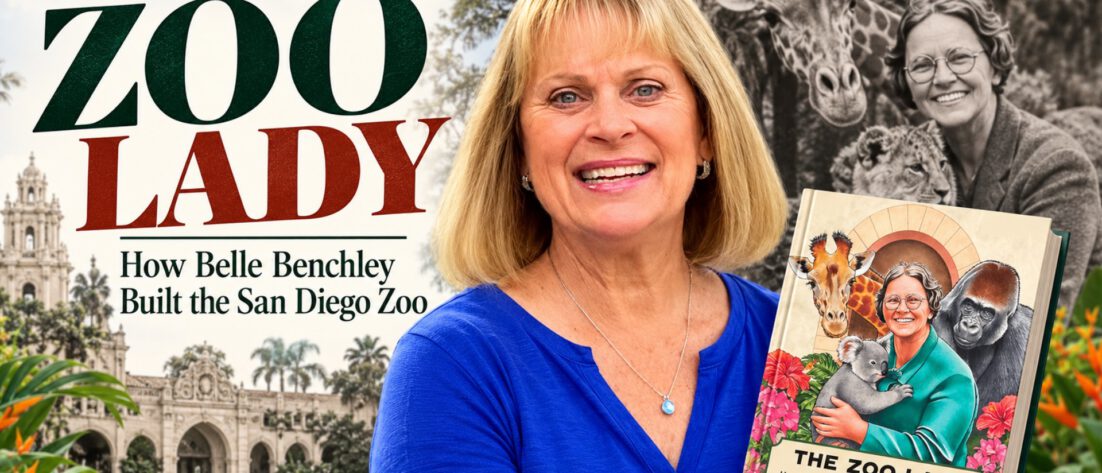
Belle Benchley took a two-week bookkeeping job at a struggling San Diego Zoo and stayed nearly three decades, becoming the world’s first female zoo director. On Books & Looks, host Blaine DeSantis talks with historian Dr. Sandra E. Bonura about her new biography, The Zoo Lady: How Belle Benchley Built the San Diego Zoo, and why the woman who built the zoo has been all but forgotten.
Dr. Sandra E. Bonura is a historian, lecturer and retired professor of education whose award-winning books, published by University of Nebraska Press, bring forgotten Californians out of the shadows, among them The Sugar King of California: The Life of Claus Spreckels and Empire Builder: John D. Spreckels and the Making of San Diego. Denied access to the zoo’s archives, she built The Zoo Lady from Benchley’s scrapbooks and personal correspondence, shared by her granddaughter, and the collections of the San Diego History Center.
Bonura explains how Benchley, with no biology or science degree, kept every animal alive through the Depression and World War II after losing 44 men to the draft; how she won the gorillas Mbongo and Ngagi at half the price, brought west the 1938 hurricane giraffes that inspired West with Giraffes, and broke a 25-year Australian embargo on koalas; and how she became the first woman elected president of what is now the Association of Zoos and Aquariums. She also recounts why the zoo objected to the word “built” in her title, and previews her next book, San Diego Rising, on Henry G. Fenton, due in May 2027.
Resources:
– The Zoo Lady (University of Nebraska Press)
– Dr. Sandra E. Bonura’s website
– Bonura on The Sugar King of California, an earlier Books & Looks episode
– West with Giraffes by Lynda Rutledge
Connect with us:
– Website: https://booksandlookspodcast.com/
– YouTube: https://www.youtube.com/@booksandlookspodcast
– Apple Podcasts: https://podcasts.apple.com/us/podcast/books-looks/id1514324351
– Spotify: https://open.spotify.com/show/154FztkUJ5HHRvi8bA5HDa
Belle Benchley, the forgotten zoo lady
Blaine DeSantis: Hi, I’m Blaine DeSantis, and welcome to Books & Looks. We do a deep dive with authors to help you discover your next great read. And today, we’re taking a journey to San Diego, and we’re going to shine a spotlight on the San Diego Zoo. While we talk about the animals, more importantly, we’re gonna be focusing on a school teacher who became a temporary worker at the zoo and stayed for almost 30 years. With no biology or science degree, she was responsible for developing that zoo. And yet today, she’s forgotten and not even acknowledged by the zoo. Today, we’re joined by friend of the podcast, Dr. Sandra Bonura, to discuss her nonfiction biography of Belle Benchley.
It’s called The Zoo Lady. Sandy Bonura, welcome back to Books & Looks.
Dr. Sandra E. Bonura: Woohoo! Glad to be here!
Blaine DeSantis: Always happy to have you on, and I know we’re in a bit of a rush today. We gotta get you to exercise class pretty soon, so because there’s a lot of stress in this new book because it is doing so well. And friends, we’re here to talk about Sandy’s new book. And by the way, one of the greatest covers you’re gonna see. Look at this. The Zoo Lady. There it is. Belle Benchley, three of the most famous animals at the San Diego Zoo. And there is Sandy’s name, Sandra Bonura. You wanna get this one. Get it just for the cover. Get it for some lovely photos. What a great job.
Dr. Sandra E. Bonura: Yeah. Ah, that’s such a great intro.
Blaine DeSantis: For you, anything. Tell us a bit about this book.
Dr. Sandra E. Bonura: Well, this book, it’s been out for one week. One week. I’ve done a little bit. I have been inundated with requests. I’ve done four engagements almost virtually back to back. I did not anticipate the zoo lovers in our city. The San Diego Zoo has 1,000 volunteers. They wear these red jackets and they are the heart and soul of the zoo. Well, one comes to one, then they tell the next group, hey, you ought to go see it. We’re getting the history about our zoo. So anyways, and then also there’s this incredible book called West with Giraffes that was a nationwide bestseller and which made Benchley, you know, a little like, who’s that at the San Diego Zoo?
Anyway, this book brings everyone the story of a forgotten woman named Belle Benchley. And when she started out as a temporary bookkeeper in 1925 and ended up as the world’s first female zoo director. And she led our zoo for almost 28 years, almost, that’s almost three decades. And I mean, that’s incredible. And her legacy is that she reshaped how people in her era viewed wildlife. Is before Dian Fossey. She is before Jane Goodall. In fact, I would die
Blaine DeSantis: Alright. See. See? Yes. Yep.
Dr. Sandra E. Bonura: I’m telling you, I think this is true. She inspired both those women. Belle didn’t, you know, march through the jungles like them, but they inspired her to, for their fame in state animal behavior. So, you know, like, Jane Goodall is so famed for showing all of us everyday people that animals, in her case primates, have feelings and thoughts and complex emotional lives. But Belle did that way, way before her. As a matter of fact, Blaine, I was two weeks from getting Jane Goodall to give an endorsement for my Zoo Lady, but she passed away.
Blaine DeSantis: Yeah. Yeah. Oh, that’s a shame.
Dr. Sandra E. Bonura: I know.
Forgotten Californians and Belle’s early life
Blaine DeSantis: Oh, well, I endorse it heartily. So there you go. Now, tell me, you have gotten a niche. You have got this ability to write about these famous Californians that none of us have heard of. They’re now obscure, they’re forgotten. How did you get involved in that?
Dr. Sandra E. Bonura: Well, once I retired from teaching, I decided, well, I sort of happened into this one book. My very first book was back in 2007, I think. It was Carrie Winter’s love letters to her fiancé. And they were discovered in an attic in Berkeley. And just by happenstance, the archivist let me read those letters. That became my first book. And then it just invigorated me because I’ve always loved telling stories. And this, I learned so much reading that book that I thought, you know, this is floating my boat. This is putting gas in my tank, you know, those horrible clichés I’m giving you. But I love finding these forgotten people.
And then the books just kept coming. So I’ve written, I think, almost eight books now. But mainstream history, they love celebrities and politicians, don’t they? Especially if they’re male, no offense, Blaine. But the real fabric of California, and in this case San Diego, was woven by an unsung hero like Belle Benchley. So she didn’t ask for fame, she just did it.
Blaine DeSantis: Yeah. That’s right. Mm-hmm. Yeah.
Dr. Sandra E. Bonura: That’s why I do what I do, to pull these incredible forgotten figures out of the shadows.
Blaine DeSantis: Yeah. Well, your books are tremendous. Your books are great. You were on previously for The Sugar King of California, Claus Spreckels. We recommended that to everybody. It’s great. We’re gonna do the same thing with The Zoo Lady, another great book. So let’s talk a little bit about Belle Benchley. Now, she was a teacher by training. Why did she end up leaving that profession?
Dr. Sandra E. Bonura: Well, she became a teacher in an era when, and if, and this I have it in the book, if you get married, you have to give up your teaching position. So, I mean, if you think about it, in 1902 when she earned her teaching credential, that’s rare. That’s so rare for a woman to get an education. And by the way, then she went up to Fullerton, which is just north of San Diego, and she became the first woman elected to the local school board there. So she was making, I mean, she just didn’t go into teaching. She started changing things dramatically. But when she had to give up her job, she committed the most unforgivable sin.
She fell in love. Yep. So she couldn’t teach. But unfortunately, Blaine, she fell in love with the wrong man. In 1906, she had a little boy named Edward. But her husband, Will Benchley, they were the famous Benchleys. I mean, on paper, looked like Belle married up, but she married down. He was a philanderer and a drunk, and she had a horrible, horrible life. And so when it unraveled in a real scandal during 1922, she filed for divorce because he abandoned the family and she was a public figure. She was a public figure, so it was really hard for her. So here she’s got a single son, she’s got to raise and pay for his tuition, so she came back to San Diego and moved in with her parents at around 43 years of age.
Blaine DeSantis: Oh, there you go. No, mine. Mm-hmm. Wow. Well, she eventually decides she wants to get a job. She has a friend of hers who, I think, at the Harbor Commission, he says, I’d love to hire you, but you gotta take a civil service exam. What happened with that?
Dr. Sandra E. Bonura: Yeah. Yeah. Thanks for reading that. She wanted to go with Jill Brennan and work at the harbor, you know, and smell the cigars and be with her old buddy and at least have something familiar. But civil service required, once you pass the test, you have to take the first job that comes up. And there was a brand-new zoo just opened. Now, the zoo was not even two years old, and she was sent there to manage the books. Don’t worry, Mrs. Benchley, it’ll only be two weeks. Don’t worry, two weeks. So off she went.
From temporary bookkeeper to zoo director
Blaine DeSantis: Well now, she went to the zoo and was hired as a temporary person. How long was that supposed to be, and then how long did she end up staying there?
Dr. Sandra E. Bonura: Well, she’s only supposed to be there two weeks after taking a civil service exam. I mean, we got a highly qualified woman with a teaching credential, an admin background, ran a family business, but now she just needed a job. She was a single divorced mother. So she went there for two weeks to the San Diego Zoo to be a bookkeeper, and there was no way she was gonna leave after those two weeks. She started looking around at a zoo that was in crisis. Animals were not being kept properly. There was the smell of neglect everywhere. Keepers were feeding the animals. There was, like, about 2,000 animals at one point. Keepers are feeding them out of their own money.
The zoo was in crisis and she just went all in. And she took her background in teaching and applied it directly. She taught herself wildlife diets, habitat design, and international trade laws simply by doing the work and researching it. So Harry Wegeforth, the founder, who was never really on site at the zoo, he was a working physician, he’d already cycled through four different directors, said, look, woman, just stay, just do the job. And within two years, they made her the director. She became the world’s first zoo director. This was a man’s world. So it’s pretty remarkable. However, Blaine, they wouldn’t give her the title because she was a woman, or the salary.
So the San Diego Zoological Society made her executive secretary, but she fulfilled all the duties as if director.
Blaine DeSantis: Yeah. My. Because the gentleman who started the zoo, Mr. Wegeforth, he was never around to do that type of work. He was out either operating or buying animals or things like that. Yeah.
Dr. Sandra E. Bonura: No. That’s right. San Diego had a lot of seals and San Diego had a lot of rattlesnakes. And those were our, that’s what he went around trading, those two things for animals. He liked to live the life of a collector, especially after his heart attack in 1931. So Belle was alone. She was alone. First saved the zoo, then built the zoo.
Blaine DeSantis: Yeah. No. Wow. Well now, obviously she had a lot of abilities. Well, what training did she have for all this work she did for the zoo? Her zoology degrees, biology degrees, anything?
Dr. Sandra E. Bonura: Nope, and she was unapologetic about it too. However, across the country, all the zoos were like going, look at Betty Crocker running a zoo. You know, that they really disparaged her name because she was a woman and she could not get the respect because of that, and they downgraded, I mean, we have a highly qualified, she was five foot, very, she was tough and loving at the same time. She could cuss out a zookeeper and bake cookies in the same breath and give him a hug. So what a character. And then all the while, she’s training the keepers on their animals because she’s researching every species.
She actually wrote four bestseller books on animals in our zoo. I mean, she put our city on the world’s map.
Blaine DeSantis: Oh my. Yeah, absolutely. Well, see, and that she is the one, as a matter of fact, if I’m not mistaken, who came up with the designation the world-famous San Diego Zoo.
Dr. Sandra E. Bonura: Yes! Now, when I started writing the book, I thought that was just in my lifetime. I thought that the zoo, what do they call it, Wildlife Alliance, coined that, or before that coined it. And then I found a speech where Belle wrote and said, yay! It was Belle who coined it. So yes, she did. That’s her, that’s all Belle.
Blaine DeSantis: Yeah. Wow. You know, she was a people person. She was also an animal person. And you think all that combined to help her get the fame for the zoo and help her get the animals and get people to working with her?
Dr. Sandra E. Bonura: Oh, good question. Well, you know, Belle had both sides covered. She truly understood animals on a personal, emotional level, which is why she pushed so hard for them to have friends with them in their cages. Either, if it couldn’t be one of their own species, they should never be alone. They should have another animal that gets along with them. They should have natural exhibits instead of cages. And if an animal wants to escape from the public, they should be entitled to do that. So everything had to have an escape place where the animals could, you know, I just don’t want to look at people today, and they could escape. So she, but she was very brilliant as an administrator and a communicator.
She started doing radio broadcasts telling the public about, you know, zoo animals and why they should come to the zoo and see them. She did 150 to 200 talks a year sometimes to do fundraising because you have to, San Diego Zoo was not a municipal zoo. The land is owned by the city, the animals are owned by the city, all operations are run by a private entity, which meant Belle had to fundraise. And we already established this was a middle-aged woman. I’m like, how did she get this energy to be an author? I’m looking at myself going, girlfriend, how did you do all that? So she’s writing books, she’s doing amazing things at the zoo.
She’s now world famous, world famous after writing her books. In fact, during World War II, her memoir called My Life in a Man-Made Jungle, the government said that needs to keep printing. When books were not allowed to be printed during World War II, keep that one going because it’s good for morale.
World War II and the gorillas Mbongo and Ngagi
Blaine DeSantis: Wow. Yeah. See? Wow. That’s really something. When you bring up World War II, she was in charge and she was getting rolling here during the Depression, during World War II, she kept her zoo going, she kept her animals fed, unlike other zoos. How did she manage to do that?
Dr. Sandra E. Bonura: Well, let me just say at the outset, when Pearl Harbor hit, the California was turned, well, if the Japanese hit Pearl Harbor, California’s next, right? So San Francisco Zoo shut down. Los Angeles Zoo shut down. San Diego Zoo, oh no, we’re staying open. If I shut my zoo, who’s gonna feed my animals? So she kept it open, and when the draft happened, she lost 44 men immediately. Either they enlisted or they were drafted or they went to work at places like Consolidated, who built planes for the war effort. So Belle had, guess who cleaned those cages? Guess who got the food? It was all our Belle with her cronies and her friends. And she planted gardens.
Look at: one gorilla can eat 40 pounds of produce a day. 40 pounds! Now, with rationing during World War II and no food during the Depression, she begged down at the harbor for fish scraps for her seals and sea lions. She got produce from neighborhoods. She grew them in patches in our Mission Valley and on the zoo grounds. She got in her car and went to bakeries: give me day-old bread, give me old produce. She begged, I mean, she kept every single animal alive, and they were breeding. They were happy the whole time when other zoos were closed down, or in Europe. Europe, we don’t even want to talk about what happened to those animals.
They were decimated, whole zoos. It’s so sad.
Blaine DeSantis: Yes. Right. Yeah. Wow. Well. Yeah. No. Yeah, absolutely. No, I think that’s very true. She did a great job in getting them fed, keeping them going, and with a much diminished staff. But she did it and she used kids, she used volunteers, she used everybody for the zoo. But we have to talk about the animals because, you know, everyone knows the San Diego Zoo and the animals. And by the way, in preparation for this, I’ve been watching clips of Joan Embery on the Johnny Carson show with all the animals, okay? So that’s a classic. But here, again, I’m going to show all this that we’re going to talk about, these specific animals, okay?
There they are, looking over her shoulder, there is the gorilla. Now, who is that? How did he get there?
Dr. Sandra E. Bonura: Oh. Well, in 1931, there were these gorillas that, I’ll just say, they were captured by these wildlife explorers, very famed, by the way, a husband and wife team, from Africa. And they came back and there, across our country, was a bidding war for those gorillas. Belle was obsessed with raising those gorillas at her zoo. She didn’t think they would survive at any other zoo, and this was 1931. So she got these two young gorillas, and back then they didn’t know if they were a breeding pair or not. She hoped they were, but they weren’t. They were two boys, renamed them Ngagi and Mbongo. And nobody had seen gorillas in this era. You think about it.
I mean, in 1933 we had the movie King Kong. That didn’t do a whole lot for the poor gorilla’s image. But anyways, she, I mean, all the men across our country that were running the zoos, including the Washington Smithsonian Zoo, they were trying to overbid her, knowing we didn’t have any money here. Belle had no money. But she wrote letters and letters, which she called Tim and Persistence. Look, they’re only going to survive in San Diego with our climate and with the way I mother these animals. And not only did she get them half the price, she convinced those people to throw in the money for the habitat that she envisioned for these two gorillas.
And the stories about these gorillas, they were Belle’s boys. She called them my boys. She loved those gorillas like her own flesh and blood. If one wasn’t feeling well, they would sometimes find her laying outside their sleeping quarters with her hand through the cage, holding the hand. I mean, the heartbreaking things is, it’s so much. You know, she’s just devoted her whole life to those animals, especially primates were her favorites.
Blaine DeSantis: Yes. No. Wow. Yeah. Wow. Well, the one gorilla, as he was dying, she knew that and she was there with him, and he had his finger through the gate, the grate, whatever it would be, and she’s holding it the whole time.
Dr. Sandra E. Bonura: The whole time. And that wasn’t the first time. The keepers had a memoir. He had his oral history, and I found that during my research. And he said, oh my gosh, we’d find her there. We’d come in. She’d been there all night. Just, you know. Then he said, you’re gonna be better. Do a good job. That’s a fellow. That’s a good boy. I’m right here. And she brought them all sorts of goodies from her garden and home. But yeah, it’s really sweet. As a matter of fact, if you walk into our zoo today, there are two huge busts of Mbongo and Ngagi. And nowhere on the plaques of those gorillas is her name there.
That’s ridiculous.
Blaine DeSantis: Yeah. Yeah. Isn’t that some? Yes. Mm-hmm. Mm-hmm. But there’s a one incident that I thought was absolutely hilarious, where she used to wear a hat and the hat blew into or somehow got into the cage and the one ripped it up. Tell us that story of what was going on there.
Dr. Sandra E. Bonura: Well, let me try and remember, because that was a while ago and there’s a lot of stories. But I think that was the time when you took the hat, when Belle’s hat got in the cage, Mbongo shredded it, and I think it was Ngagi who said, oh my gosh, you’ve ripped up our mother ape! And tried to put the hat back together and shove it through the wires, the gate, back at her. It was so cute. She said oftentimes Mbongo or Ngagi would reach through and pat her. They would want to examine her shoes or her stockings, you know. It was very sweet, very gentle with her, but not that time.
Blaine DeSantis: Yeah. Yeah. Yeah. Yeah. Yeah. It is. Yeah, yeah. Right. No. Well, that time, if I’m not mistaken, Ngagi still was upset when they passed her all the pieces of her hat, until she put it on her head, then things calmed down. So there she was with shreds of her hat.
Dr. Sandra E. Bonura: Yeah, that’s right. Yeah, and she put those little pieces on her head: look, I’m just fine.
The Andean condor and the hurricane giraffes
Blaine DeSantis: Yep. Yep. Well, you know, we talked about her closeness to the gorilla and the fact that it was holding his finger. But, you know, there’s another animal which you had written about, an Andean condor. I never known this. She would actually stroke this condor and the condor held her finger in his beak. Am I remembering that correctly?
Dr. Sandra E. Bonura: And there are photos to prove it. Lots of photos. It’s mind-blowing because an Andean condor has a 10-foot wingspan and a beak built to crush bone. Yet Belle would sit with Bob, stroke his head, and he would gently hold her finger within his little beak without applying a single pound of pressure. I’ve never heard of anyone else having that kind of connection with this massive scavenger bird. Have you?
Blaine DeSantis: Wow. Oh my. Wow. That’s. No. Wow. No, not at all. That’s an amazing thing. That’s one of the most amazing stories in the whole book, yeah.
Dr. Sandra E. Bonura: And by the way, one more, well, I need to make one more point, in that under her watch in, that I think was 1942, San Diego became the first zoo in the world to successfully hatch an Andean condor in captivity. And this paved the way for future species conservation, that every zoo knows about the Andean condor in San Diego, but you don’t read Belle’s name attached to it.
Blaine DeSantis: Again, never. No. Well, I gotta go back to the cover. Now, there’s another animal who’s peering. There you go, there you go, see it there, the giraffe is now peering over her other shoulder. Tell us about the giraffe, and is this a giraffe that learned how to eat onions?
Dr. Sandra E. Bonura: Loved onions. He didn’t have to learn it. He apparently loved onions, which we now know aren’t good for giraffes. Well, in 1938, Belle organized a cross-country transport for two giraffes. Ultimately, they’d be named Lofty and Patches. Right after these two giraffes survived a hurricane, they had been, they were, Belle heard that they needed a home. They were in Africa. And when they set sail, I think it was a Robin Goodfellow, set sail with these two giraffes for Belle Benchley, plus a rhinoceros, they encountered a category five hurricane. And these giraffes and the rhinoceros were caught in the center, and this ship spun around and around and around. The unfortunate thing was we lost the rhinoceros. He went overboard.
The two giraffes, their crates were rolled and rolled. One was severely damaged. Everyone thought she was dead, but there was life in it. The crew got some, all their goodies were washed overboard, but they revived them with flour and water mix, anything to keep them. But anyways, watching these towering animals navigate American highways was national news. And this was during the Depression, when everyone’s bummed out, everyone’s sad and stressed. So this was a national phenomenon. For instance, when, and Belle had planned the whole route, she even designed their transportation. When a little town in Texas would say they’re coming through the next town, all the schools would let out to wave to the giraffes. It’d all be lined up.
It was a big, big deal. Now, and, you know, this incredible road trip, it was so unforgettable it actually inspired the famous novel West with Giraffes. Blaine, yesterday I was in a theater giving a presentation on Belle Benchley, and I asked the audience, there was over 100 people, I said, who’s here because of the book West with Giraffes? Almost 75% of those people. That’s how much of an impact Lynda Rutledge had on my book, so I’m really grateful for that, and she was quite a bit of help for me as well when I started the research.
Blaine DeSantis: Wow. Yeah. Yeah. Mm-hmm. Yeah. Mm-hmm. Yeah. Mm-hmm. I read that book, so I know what’s going on. It was a tremendous book. Oh, sure, sure. What don’t I read? You see behind me books, books, books everywhere, you know. I got books the whole way.
Dr. Sandra E. Bonura: Oh, did you? Yeah. I wished I could read books.
Blaine DeSantis: No, no, no, you do the hard part. You do the writing. I do the reading. So anyway, but yeah, that’s, they get there and after a while they’re going to loan out the one giraffe. And they have to go under the freeways and under the bridges to get from San Diego to L.A. And the
Dr. Sandra E. Bonura: Yep. Ohh, you’re thinking of the baby of one of the hurricane giraffes.
Blaine DeSantis: That’s it, the baby, that’s right, okay. He know that was a major production. That was like, they had a huge cordon, yeah.
Dr. Sandra E. Bonura: Little Rusty. Yes. I know. I was amazed, but here’s the kind of influence Belle had. She had the police escort from the different cities up to Long Beach Harbor. She had electrical companies taking down wires so they would not take off the neck of her giraffe. I mean, if Rusty would have raised his head at any horrible point under a bridge, he would have broke his neck. So it took great skill and a lot of onions to get Rusty out of Hawaii.
Blaine DeSantis: Mm-hmm. Yeah, lots of onion.
Dr. Sandra E. Bonura: You know what, but that’s a great story, and that really speaks to the fact that those hurricane giraffes loved San Diego. They had seven calves. So which means that we didn’t need to go out to the wild anymore. Leave the wild giraffes home. She created a breeding empire. And that particular giraffe went to Honolulu, where Belle founded the Honolulu Zoo with one of those young boys. That’s a story nobody knows.
Blaine DeSantis: Yes. Yep. No, that’s a wonderful story. That’s in the book too, friends. You’re gonna wanna read this. It’s a great story, a wonderful story. Uplifting.
Dr. Sandra E. Bonura: That’s so kind of you. Thank you.
How Belle broke the koala embargo
Blaine DeSantis: Well, I’m gonna move on from the giraffes because the third animal we’ve got here is pretty unique. You can go see giraffes in zoos now, you can see gorillas, but you’re not gonna see, unless you go out there, is this little guy in our lap, the koala. Tell us about the koala. That’s a whole amazing story.
Dr. Sandra E. Bonura: That’s right. Oh boy. And actually, koala’s not a bear, it’s a marsupial. So, but Belle called them koala bears because she likes, it sounded cuter. Anyway, and they’re the prototype for the teddy bear. So Belle did the impossible. She broke a 25-year Australian embargo to get those koalas in 1952. Australia wasn’t letting them out of their country. They didn’t trust anywhere because it doesn’t take just one type of eucalyptus to nourish a koala. It takes multiple. And we didn’t have, so anyway, she had done her research. Wegeforth had done his research. They had planted for, I think, 13 years, well, she did, trying to get this established. And she worked a loophole to get them loaned for a special movie in Hollywood.
And it was all, I mean, it was all orchestrated where they would just be on loan. You’ve read it. But oh, what a surprise, they got to stay here in San Diego. And she made the zoo world jealous. 25 years nobody has seen a koala in America, and she got the first ones again, start a breeding colony. And she then talked Australia into loaning them first and then, oops, we got to keep them, which was the plan all along. I’m not sure what Australia’s gonna think about when they read my book, but we kind of got them underhand, but we did a good job, because those gorillas, they made every zoo in America jealous and hopeful that if she broke the embargo, if they let, they’ll eventually have some. Maybe we in Minneapolis
Blaine DeSantis: Huh. Yeah. Yeah. Yep.
Dr. Sandra E. Bonura: Can have some. Maybe we at the Lincoln Park Zoo. Maybe we at the Bronx Zoo. We’re established, we’re huge. Why can’t we have them? Belle, Belle’s got what others could not.
Trading dog-pound fleas for rare reptiles
Blaine DeSantis: Yep. That’s an amazing story. Well, there’s also one other thing that Belle got that others couldn’t get, because she got involved in a barter exchange. She was bartering fleas. She, what, a fleas for reptiles? What is that all about?
Dr. Sandra E. Bonura: Mm-hmm. Oh, yeah. Well, Belle was the queen of promotion. She made sure the San Diego Zoo was in the newspaper. She didn’t care what it was, as long as it was good and she went through her first. But first of all, Belle was a master of informal trade networks. If cash was tight, and it was always, and she wanted, like, a rare reptile, she’d look what she had an abundance of, including specialized specimen samples. San Diego got a lot of rattlesnakes, by the way. So, or she would trade duplicate wildlife throughout her network to get what she needed. But in this instance, this character in New England had a flea circus. I didn’t think that was a real thing, but they were.
They dressed up these little fleas in clothes and people stood in line to see them. And the fleas were out of season when he needed some desperately. So he said, well, there’s that famous Belle Benchley in the San Diego Zoo. She’s undoubtedly has got some fat fleas there. Wrote her a letter. There were no fleas at the zoo. So she orchestrated a trip to the San Diego Dog Pound, where they combed these dogs for the best fleas and shipped them off back east. And then they sent her rare reptiles that she needed for her fleas. And then other cities are going, what’s the deal with San Diego’s fleas? How come, why are they better than our fleas?
And it became just a cute story across the country. And she says, because our fleas are fat off these tourists that come here. And they’re just prime fleas. So everybody had a big laugh about it. But this went on for some time, and she got a lot of currency, if you will, from shipping those fleas off, until the postmaster caught wind of it and put an end to it. You’re not shipping fleas
Why the San Diego Zoo forgot Belle Benchley
Blaine DeSantis: Well, I’ll tell you what, this is one of the many stories we have. I mean, there are so many fabulous stories about so many people and animals and what Belle did and how she did it, and we could go on for two hours, okay? But one of the things we must touch upon is what I consider to be the shameful, shameful behavior of the San Diego Zoo. They’ve eliminated any reference to Belle Benchley. They even had a plaza there in the zoo named after her. They took that away. They don’t acknowledge this woman existed. Was it that she was a woman, or was it she too damn good for the zoo?
What was it?
Dr. Sandra E. Bonura: Wow. Well, I’ll have to walk that back a little bit. There’s this wall at one part of the zoo. It’s like a history wall, and she is included on that, in small, small way she’s included. And there was a Belle Benchley Plaza, and it’s still on record as a Belle Benchley Plaza, but now they call it Treetops. You know, Treetops and not Belle Benchley. In San Diego, there was a Belle Benchley Primary School. That’s no longer. But the zoo would not let me have access for research because I wasn’t, quote, a, when I started the book, because I was not an employee or a, excuse me, a volunteer.
And I said, but I’m a local researcher. I’ve done many books on histories of San Diego. I really would like to get into these archives. You know, I’m writing a biography. Why the zoo didn’t have a biography long before this, I don’t know. But the zoo didn’t participate in it, but other places did. I was very successful getting Belle’s granddaughter to give me a treasure trove for this book. I got to have all her scrapbooks, personal correspondence, so much more, you just can’t believe how grateful I am for that. And I was very grateful to San Diego History Center, who said, the zoo won’t let you in, come on over.
And so I was given access. And then Lynda Rutledge, who was the author of West with Giraffes, she had written the centennial of the zoo back in 2016 using their archives, so I was able to cite her to get information and context. Of course, that book has no references, and I’m an academic publisher, so I had to go find the source or quote her old newspapers,
Blaine DeSantis: Yes. Yeah. Yes. What?
Dr. Sandra E. Bonura: Belle’s own memoir. It became rich and full, but at first I thought, gosh darn it, the zoo won’t let me in. And why haven’t they written this biography before? Because there’s a lot, they have lots of on the men. And oh, I did hear that they were not happy with my title of my book. It’s The Zoo Lady: How Belle Benchley Built the Zoo. They preferred I take the word built out because it did not honor those who came after Belle. And I said to the person who called me, no, it stays. Belle built the foundation with which those later directors built upon from scratch. I’m not changing it. This is not a commission book. Thank you.
So it’s really sad, but I got endorsements from WAZA, W-A-Z-A, which is the world accreditation agency, for the book jacket, from AZA. Belle was the first elected female president of AZA.
Blaine DeSantis: Yeah. The Zoo Lady? Yeah. Right. Wow. Yes.
Dr. Sandra E. Bonura: Belle, in 1949, with no scientific degree, became the boss of every male director in America. It’s so cool. She broke the glass, she shattered the glass ceiling, and the zoo, in my opinion, should have done something a long time ago. It’s a shame.
Blaine DeSantis: It is. I don’t believe it. I just don’t believe it. It’s just something. Now, I’ll tell you what, similar story. That, okay, when we edit this, I hope they keep this story in, you know, Nathaniel. We went to see the Last Supper up in Milan, okay? And of course that was after, you know, what’s it, The Da Vinci Code, and well, we got there and they pooh-poohed that whole thing about that. Oh no, that’s terrible, not like that. But when you go out into the gift shop, there were stacks upon stacks of The Da Vinci Code for you to buy. They’ll make a buck off of it, they might not like it.
So I’m assuming if I go to the San Diego Zoo, I’m going to see this right at the checkout counter, aren’t I?
Dr. Sandra E. Bonura: I don’t either. No, you will not.
Blaine DeSantis: No. Isn’t that, friends, isn’t that just petty and ridiculous, because of the word built? Oh my God, who knows what their problem was. Do they recognize Mrs. Scripps at all, who gave all her money for the zoo? Do they talk about that?
Dr. Sandra E. Bonura: Well, she happens to be on the plaque under the gorillas as being the financial benefactor.
Blaine DeSantis: Oh, okay. Okay. Well, she is there a little bit.
Dr. Sandra E. Bonura: Yeah, but here’s my point. Scripps has done a lot for San Diego. She was loaded with money. She gave money. She didn’t do anything. She just gave money. She was very wealthy. I’m more in awe of those who rolled up their sleeves and did something, like
Sandra Bonura’s next book, San Diego Rising
Blaine DeSantis: Right, right. And that brings me to my last question of the day. Those people who do something, that there’s gotta be another book coming because you just can’t sit still. You gotta do something. What’s your next book? Tell us all about that.
Dr. Sandra E. Bonura: Belle Benchley. Oh, dear me. Well, I actually have one more book. Actually wrote it before Zoo Lady, but it was when, anyway, but through a bunch of twists and turns, it’s now coming out in May of 2027. And it’s called San Diego Rising, the Henry G. Fenton story. And that’s an unknown story for San Diegans. They’re going to be pretty blown away when they realize what this little mule skinner guy did. Mule skinner is not literally a mule skinner, right? It’s a skin mule. He built San Diego with teams of mules. And it’s a quite a special story. It’s a unique story. And that story’s been kept under wraps for 100 years by the family.
So here at
Blaine DeSantis: No. Wow. You, but you find them out, Sandy, you find them out. Okay, so now that one’s written and that’s gonna come out. Again, with our friends at University of Nebraska Press, I’m assuming, right? Okay. Now, what’s the next one you’re writing? There’s gotta be another one in the pipeline.
Dr. Sandra E. Bonura: Yes. I just taking a rest. It’s going to have to be such a unique, special person. It’s gonna have to be a San Diegan. I’ve done the Hawaii. I’ve done the California. But now I need to focus on who’s left out in San Diego. And so it will just have to show itself up to me in a sort of a miraculous way. I’m sort of just trusting God to show me, because just how Belle Benchley came to me. I said I was done before I did hers. I said, that’s it, I’m done. And then someone, my friend said, you know, you ought to look into this lady. And so it’s going to be something like that, I’m sure, but I just need to take some time right now and celebrate the Zoo Lady book and go out there, and this is my joy time.
I am meeting so many people who love our zoo and our animals and who are amazed there’s been no book about her, and they’re showing up. I did not expect it. I walked in yesterday, there was a line out the door to this building down to the parking lot. I’m going, what are they in line for? Then I saw my book. Oh my gosh, they’re here for Zoo Lady book. This is how this is going. So I’m just having a good time. I’m not thinking about writing. It’s time for me to party with my people.
Blaine DeSantis: Taking a rest, not for long. See? Great. Wonderful. Sandy, you deserve all the success you get here because, like I said, these are wonderful books. I love them all. I learned so doggone much about them, and I thank you for spending your time today. I think we’ve gone over. You might not make that exercise class, but I’ll tell you why. I hope you don’t mind, because I had such a good time talking with you. Friends, take care. Thanks so much to Dr. Sandra Bonura for showing and being with us today here on Books & Looks. We appreciate it.
Dr. Sandra E. Bonura: Doesn’t look good. And you have to know that authors love you. Authors would give up any gym time, any time at all, because you’re our friend. You are so special and unique in your field. Thank you so much for having me. I consider it a real honor.
Blaine DeSantis: Yeah, well, thank you. Well, friends, with that, we’ll be right back in one minute. Friends, I hope you enjoyed this interview and chat with Sandy Bonura as much as I have. She’s a wonderful writer and wonderful author, and this book about the Zoo Lady is just spectacular. I really encourage all of you to go out and take a chance to get this book. It’ll, so many heartwarming stories. This is a great time, a great book, and we thank Sandy so much for her efforts in uncovering all this, because as she told us, the San Diego Zoo did not participate in any way with this book. Anyway, on behalf of our good friends at BookTrib.com, this is Blaine DeSantis for Books & Looks, saying may all your leaves be pages in a book.