
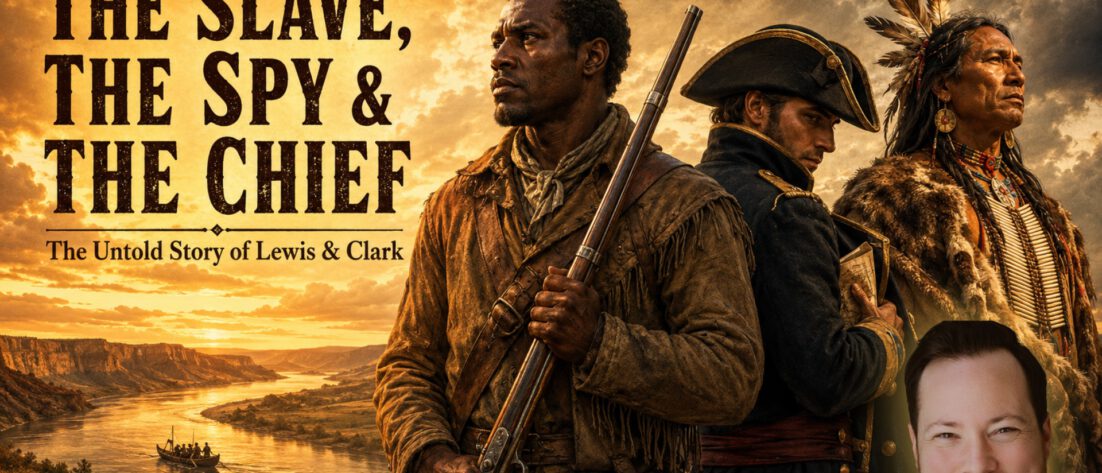
What if the Lewis and Clark story you learned in school got almost everything wrong? On this episode of Books and Looks, Blaine DeSantis sits down with Craig Fehrman, author of the bestselling book This Vast Enterprise, to reexamine one of the greatest journeys in American history. Fehrman reveals that the expedition began before the Louisiana Purchase was even finalized, that the famous $15 million price tag hides a true cost of more than $400 million, and that the journey itself ran over $100,000, the equivalent of NASA’s budget in its day.
Fehrman’s book tells the story as an ensemble, rotating between ten points of view. Listeners will meet York, the enslaved man whose skill and diplomacy proved essential yet who was denied his freedom after the journey. They will meet Sacagawea as she truly was, a teenage mother navigating enslavement with remarkable resolve. And they will meet Black Buffalo, the Lakota leader who prevented a war on the banks of the Missouri while pursuing his own political strategy against a rival chief.
The conversation is full of surprises: an arrest warrant issued from Santa Fe, more than a thousand Spanish soldiers dispatched to capture the expedition, an American general secretly spying for Spain, a heroic Newfoundland dog named Seaman, and the media frenzy that made Lewis and Clark the Artemis mission of 1804. Perfect listening as America celebrates its 250th birthday, this episode will change how you see a story you thought you already knew.
📖 Get the book: “This Vast Enterprise: A New History of Lewis & Clark” by Craig Fehrman is available now wherever books are sold. Buy it here: https://a.co/d/0iP0BnAg
🎧 Enjoyed this episode? Subscribe, share, and leave us a review. And as always — may all your leaves be pages in a book.
Introduction to This Vast Enterprise
Blaine DeSantis: Welcome to Books and Looks, where we do a deep dive with authors to help you discover your next great read. Today, we are going on a journey, and not just any journey. We’re going on what has been considered one of the 70 greatest journeys in history.
The Lewis and Clark Expedition is part of America’s iconic history. It’s a story that’s been told for over 250 years, and yet, until recently, other voices from this journey have not been heard. But today, we’re going to hear from some of those voices.
We’ll hear from Lewis, Clark, soldiers, a slave, and numerous Native Americans whose words have only recently been discovered. And by the way, what did we really buy with the Louisiana Purchase? I’m Blaine DeSantis. This is Books and Looks. Today, we’re chatting with Craig Fehrman about his runaway best-selling book, This Vast Enterprise. Craig Fehrman, welcome to Books and Looks.
Craig Fehrman: Hey, thanks for having me.
Blaine DeSantis: I’m very happy to have you here. You have got a story that has been told and yet hasn’t been told, and that’s what we’re going to do today. We’re here to talk about your book, This Vast Enterprise, and I’m very excited to chat with you about this.
The Origins of the Expedition
People have heard of Lewis and Clark. They’ve heard of the Louisiana Purchase, yet they’re not quite sure what they really know about everything. So just set the scene for us, if you would, please. Who were Lewis? Who was Clark? And when did all this take place?
Craig Fehrman: This is actually one of the first places where I think people tend to go a bit astray. People tend to think Thomas Jefferson made the Louisiana Purchase, and then he picked Lewis and Clark to go explore it. Really, none of that happened. It was almost the opposite.
Jefferson was interested in exploring the West and eventually in America expanding into the West. He’d been interested in this for decades. We know that in 1802, that interest got put to the front burner because Napoleon was getting ready to bring soldiers into the Louisiana territory. Jefferson worried that either Napoleon would launch his own version of the Lewis and Clark expedition or block any American attempts.
Lewis was Jefferson’s chief of staff. They were living in the White House together, and they started talking about this and making plans in 1802. Lewis sets out in early 1803. After he’s gone, news officially gets to Washington that the Louisiana Purchase has actually happened.
The expedition was already well underway. Although the Louisiana Purchase changed it and made the expedition even more important, they were two separate processes. Lewis and Clark were both soldiers and elites from Virginia. They had served in the army together and were really good friends.
Jefferson picked Lewis. Lewis, and I think this is one of his best decisions, decided he needed somebody to do it with him, and he picked Clark. Together they went on this mission that, even before the Louisiana Purchase was a possibility, was intended to explore America’s trade routes, do some scientific investigations, and start the forward-facing process of America claiming some of the territories closer to the Pacific Ocean.
The Reality of the Louisiana Purchase
Blaine DeSantis: You mentioned the word Louisiana Purchase. What did we really buy from France? And there’s a word that you use, I never heard it before, called preemption. What did we buy?
Craig Fehrman: It’s something I had to learn while I was working on this book too, because once again, the story we think we know isn’t quite true. If you think back to your school lessons, the Louisiana Purchase is the best real estate deal in American history. We pay $15 million, we double the size of the country. None of that unfortunately turns out to be true.
This word preemption is not my word; it’s Thomas Jefferson’s word, and it’s the word of philosophers and politicians from hundreds of years before him as well. This was how power actually worked in the 18th and the 19th centuries.
There’s this idea called preemption rights, which means that different empires, whether that’s America, which was a very new empire, or older empires like Britain or Spain or France, they owned the rights to the land, but they did not own the land itself. They were able to preempt those other empires.
They were able to have the exclusive negotiating rights with the native people who lived there, but they still had to make a deal with the native people themselves. Historians recently have gone back and looked not just at how much Jefferson paid for the Louisiana Purchase, but how much America actually paid for the lands included in the Louisiana Purchase.
If you do that, the price tag goes from $15 million to more than $400 million. What the Louisiana Purchase bought is basically it made America the imperial power in the Louisiana Territory, but it did not turn that land into American soil. Jefferson and Lewis and Clark were part of the process that made that happen, but it took a lot of money, some wars, and a lot of negotiations between powerful Native nations and America.
Blaine DeSantis: Wow. And obviously, those Native nations never heard of the right of preemption, did they?
Craig Fehrman: It’s funny. If you look closely in the transcripts, sometimes this will come up and they sort of make fun of the Americans or the British. Somebody will say, “Actually, sir, if you pay attention to preemption,” and the Native people will be like, “We never gave you preemption rights. We live in this land.”
Preemption was a fiction. It was a way for empires to have an intramural fight. What really mattered back then, just like what really matters today, is power and people on the ground. It’s who controls the rivers and the land. During the time of the Lewis and Clark expedition, native people were the ones who did that in Louisiana territory.
Geopolitics and Napoleon’s Dilemma
Blaine DeSantis: France was the power down there in Louisiana and the Mississippi River. Did they actually have the rights to the Missouri River and all these other rivers that were going to be explored?
Craig Fehrman: The rivers were if you could make it on a boat, then the river was open. What France had that was important, though, was New Orleans. They had the place where the river flowed into the ocean.
If you’re a farmer in Kentucky and you’re trying to send your goods down the river, you might be able to make it down, but if you can’t make it into the ocean, then you have no way to get it around to the Atlantic coast or anywhere else. The choke point was New Orleans itself.
Jefferson’s first idea, when New Orleans closed late in 1802, turned a very tense geopolitical situation into a real disaster. His first idea was to buy New Orleans so American farmers and merchants could use the river. Then obviously they ended up getting the entire territory, the preemption rights to the entire territory.
Blaine DeSantis: So Napoleon got $15 million. It didn’t do too well for Napoleon, did it? He invaded Russia and lost everything. What did he get?
Craig Fehrman: He was already in a pickle because he had ideas to use North America to expand his empire, but then he ran into real problems in Haiti, in part because of Louverture and other people in Haiti who were fighting back against him. Napoleon was, as usual, biting off more than he could chew. America and Jefferson were the ones to benefit from that.
An Ensemble Narrative: New Voices and Perspectives
Blaine DeSantis: Fascinating stuff. Well, this book, This Vast Enterprise, how did you come up with that name?
Craig Fehrman: It’s a quote from Clark. I think the thing that makes my book new is that I reflect the latest research—this preemption rights and the idea that the expedition started before the Louisiana Purchase. But the other thing that makes my book new is the way I tell the story.
I really try to tell it as an ensemble. Yes, Lewis and Clark are important, and I found new things about both. But I think they would tell you that this would have never worked if they didn’t have so many people collaborating and working together. This took a lot of people.
That’s why I came up with the title, This Vast Enterprise. It’s a line from one of Clark’s letters, and it really speaks to the way that even the captains knew they were doing something vast. Not just vast in terms of crossing a continent, but vast in terms of how many people would have to sacrifice and give everything they had to make this work.
Blaine DeSantis: You give all these voices their own chapter. That’s unique. How did you decide to go with that format?
Craig Fehrman: I decided to have each chapter rotate points of view. Chapter one is from Lewis’s point of view, and he gets a couple chapters. Clark gets a couple chapters too. But chapter two moves to York’s point of view. York was an enslaved man who was Clark’s body servant. He was helping Clark get dressed, helping him get food, and taking very intimate and personal care of him.
I decided whether it was writing about York or Sacagawea or some of the other native people, it wasn’t enough to say these people were an important part of the story. I wanted readers to see the world as they saw it. I feel like biography is a superpower. If you read a biography of Thomas Jefferson, you automatically see the world the way he sees it.
It wasn’t enough to say York was an important part of the expedition. I wanted readers to feel like they could see the world the way that York saw it, just like they could see the world the way Lewis saw it. When the camera moves around and you get these different points of view, I hope that truth of the expedition—that it was always a team effort—you’ll feel that in the storytelling, too.
The Dangers of the Early Journey
Blaine DeSantis: You begin this story about three miles into this journey and they nearly kill a woman with an air rifle. Why did you decide to start the story like that?
Craig Fehrman: I feel like with Lewis and Clark, it’s very easy for us with our modern lives and air conditioning to remember the highlights and think what it would have been like to be the first Americans to cross through that part of the Rocky Mountains. I have those moments in the book.
But the reality of their life was that it was very hard. Anything they wanted to do, they had to do it by hand and at great risk while they were worried about grizzlies and disease. I started the book with this little mishap because I wanted readers to know right from the first page that the past was a different and dangerous place.
There’s also a secret reason I wanted to do it. Most books about the expedition will talk about Lewis’s air rifle. He’s showing off his air rifle to somebody outside of Pittsburgh, and this person accidentally fires it. The bullet hits a woman and knocks her over. She has blood shooting out, and Lewis thinks, “Oh, no, my grand expedition has started off with the accidental murder of an American citizen.”
It turns out she’s okay, but in that moment, you can imagine the panic Lewis felt. Most books mention the air rifle, but they always talk about native people and say these native nations were so impressed by it, that it was like magic to them. That’s true. But I wanted to remind people that white people and Americans were impressed by it too. The reason Lewis had the air rifle out is because so many Americans were excited and amazed by it. I thought it was important to show that the things that amazed Native people were sometimes the same things that amazed American people.
Blaine DeSantis: It also was a fantastic beginning because they weren’t making too much progress. I think they had to have oxen tow them up the river for a while back then.
Craig Fehrman: That’s right. This is when they were on the Ohio River. The Ohio River of 1804 looks a lot different than the Ohio River of today because there weren’t all the modern dams to keep the water levels high. In some places, you could just walk across the Ohio River.
Because the water was so low, it was very grueling. Sometimes they would need oxen to tow the boat. It was just a hard expedition. Even on the Ohio river, when they had Americans on both sides of the river who could help them out, everything was hard in 1804. Writing a book like this makes you appreciate how much easier life is today.
National Interest and the Media of 1804
Blaine DeSantis: One of the things I really liked about the book was how much publicity this actually had. I never knew that. I just thought, here they go, but papers were following them. People were following them. Did you know about this before you started writing?
Craig Fehrman: I knew it was a big national story, but I had no idea how big it was. Writing from today’s vantage point, I can use newer technology. There are wonderful databases now where old newspapers are scanned. I would find a mention of Lewis and Clark in a newspaper from a small Kentucky town by searching terms like Captain Lewis.
I was able to really show that. I worked on this book for five years, so I was just trying to accurately represent what the historical record showed. Now that the book has come out, it’s not hard to explain to people what it was like because we all just lived through Artemis II.
The way we were all getting on social media and looking for pictures and keeping up on the astronauts, Americans in 1804 were doing the same version of that with Lewis and Clark. At a certain point, Lewis and Clark did go on the dark side of the moon, so to speak, where they could no longer communicate.
Americans continued to speculate. That’s where some of what we would today call fake news started to seep in. There were rumors that Lewis and Clark were imprisoned in Spanish mines, or that Lewis and Clark were actually in China. All kinds of crazy stuff was circulating, but that just shows how much people cared.
Funding and Native Diplomacy
Blaine DeSantis: We knew the government allotted $2,500 for this journey. But they spent a lot more, and this number has not come out for over two centuries. Why is that? How much did they really spend?
Craig Fehrman: A certain story gets set in place, and then even historians follow that story. Sometimes you have to go back and stop and just say something really basic, like, let’s just make a timeline or get a spreadsheet and add up the numbers. I tried to check every basic assumption in this book because I knew I was getting a chance to retell a really important story.
The figure I came up with is more than $100,000. As an aside, if you compare it to the size of the federal budget back then, Lewis and Clark cost as much then as NASA costs today. It shows what a big undertaking this was for Jefferson.
The reason that number is so much bigger is that previous accounts have skipped Lewis and Clark’s work to send native leaders back to Washington. Jefferson was obsessed with this. In his instructions to Lewis, he was constantly saying, “Whenever you meet important Native leaders, please send them to Washington so I can meet with them. Taxpayers will cover everything.”
Dozens of Native leaders did exactly this. Some would turn Lewis and Clark down, but some were curious explorers too. At the same time Lewis and Clark were heading thousands of miles west, different Native leaders were heading thousands of miles east. We know some met with Jefferson in the White House. It was diplomacy and politics, but it was also expensive. That’s where that bigger price figure comes from.
19th-Century Medicine and Preparation
Blaine DeSantis: One of the boats was loaded with medicine. I never even considered that. How much medicine did they have to buy before they got started?
Craig Fehrman: That’s right. A lot of that was on Lewis. During that first chapter in Lewis’s point of view, he’s in Philadelphia and Harper’s Ferry, which are some of the most important places the American army keeps its supplies. He made sure they were outfitted very carefully.
Clark made sure to spread this stuff around. If one canoe tipped over and it had medicine in it, it wasn’t all the medicine. They had thousands of doses of different kinds of medicine. When we read about the medicines today, it’s not what we would want to use.
Their general solution was to make a person throw up, have an explosive bowel movement, or cut them so they could bleed. It was always about expunging fluids and forcing the sickness out of the body. Oftentimes their treatments made the problem worse, but they were doing the best they knew. Lewis actually studied with the best doctor in America. It shows how much he and Jefferson tried to prepare according to the science of their time.
Blaine DeSantis: I never thought of the practicality of these things.
Craig Fehrman: You really got to think about it as the NASA of 1804. Jefferson had very clear ideas. He trained Lewis carefully. Lewis trained other people. They were keeping careful records, had scripts, and had protocols. Lewis and Clark were big government. It was really America’s first attempt to project its power into foreign nations. Things we still see and understand today about America first happened through Lewis and Clark.
De-mythologizing Sacagawea
Blaine DeSantis: This journey has been mythologized. What are some of the other large myths that have come out of this that are not true?
Craig Fehrman: Another example of a myth is Sacagawea. She is many people’s favorite part of the expedition. So many people think of her as this cheerful tour guide. There is truth to that, but one thing I try to show in my book through careful research is that Sacagawea was a slave. Her life was very hard before she met Lewis and Clark.
The man, Charbonneau, who some people say was her husband—I think the better way to think of him is that he was her owner. This is not me projecting a modern idea backwards. Clark used the word slave when he described Sacagawea.
She was a young native woman who was enslaved and had a very difficult life. That sort of makes her tour guide side feel different. During the expedition, Charbonneau starts to beat Sacagawea and Clark stops him and says, “You can’t do that here.” That’s a story that tells us something nice about Clark, but it also tells us something about Sacagawea. Despite having overwhelming, dark, and difficult problems, she was able to figure out a plan to get herself home.
Blaine DeSantis: How old was she when they met her?
Craig Fehrman: 15 or 16. And she had a one-year-old baby who would turn one during the expedition too. She wasn’t just having to protect herself, she was having to protect her newborn child.
The Spanish Arrest Warrant and Agent 13
Blaine DeSantis: We’re going up the rivers, and all of a sudden the Spanish are not too happy. Apparently there was an arrest warrant out. What’s that all about?
Craig Fehrman: Lewis and Clark leave St. Louis in the spring of 1804. Their goal is to go up the Missouri River, cross the Rocky Mountains—which they think are just going to be a few small mountains—and then take the Columbia River down to the Pacific Ocean.
Even though the Louisiana Purchase had happened, Spain was still contesting it. They couldn’t stop the sale, but they could argue about the boundaries. This is all a very live political issue. Spain ended up dispatching more than a thousand soldiers between 1804 and 1806 to hunt down Lewis and Clark.
They did this with the help of a spy, Agent 13, who was actually James Wilkinson, the top general in America’s army. Wilkinson was feeding them information about Lewis and Clark, saying to get Spanish cavalry to hunt these guys down.
The arrest warrant said to stop Lewis and Clark, arrest them, and seize their papers and maps because that scientific information was part of any imperial argument. Wilkinson warned his Spanish sources that the Americans wanted to build cities on the Pacific coast. The Spanish took this threat very seriously. At least one time, they came within 100 miles of Lewis and Clark. We might have had an international war break out in the middle of the expedition.
Blaine DeSantis: And they came out of Santa Fe, if I’m not mistaken.
Craig Fehrman: That’s right. They had an overland route and would sometimes join rivers. The Spanish made these trips between Santa Fe and St. Louis all the time. They had relationships with Native nations, so there was a lot of conversation and rumors flowing around.
Blaine DeSantis: Every time you mentioned that they are coming, they never get there. It’s like the gang who couldn’t shoot straight. One time they took 600 soldiers and 200 mutinied right away.
Craig Fehrman: I tried to have some fun with that in the book. Lewis was somebody who had a great sense of humor, as did York. If these people living the expedition could laugh about it, I thought we as readers and me as a writer should laugh about it too.
But there’s a serious point behind the humor. The Spanish failures remind us that Lewis and Clark were excellent leaders. Any success on this scale involves good luck, but when the Spanish would make mistakes and lose control of their men, Lewis and Clark were always able to preserve their hierarchy of command and military protocols despite some close calls with mutiny. That says something admirable about the American effort.
Blaine DeSantis: This spy, Agent 13—why would an American general spy on America for Spain?
Craig Fehrman: Probably the same reason people do it today: money. Wilkinson is a hard guy to understand. Parts of his life story make it seem like he maybe wanted to create a broader war and get some of the inner American territories to form their own nation. Maybe he wanted Spain to win, or maybe he wanted his own country.
One thing we know for sure is he wanted money. He collected tens of thousands of dollars, which in this time period was almost enough to fund an expedition of his own. He played the two sides against each other for decades. He was an important officer even when Lewis and Clark were young men.
Jefferson didn’t love him, but he was also the general that Jefferson had. It’s wild that somebody could have such power on the American side and be betraying his country at the same time.
Blaine DeSantis: I read somewhere that Teddy Roosevelt considered this man to be the most treasonous person in American history.
Craig Fehrman: I think that’s a fair assessment. You’ve got Benedict Arnold and a few other candidates, but Teddy Roosevelt was a patriot who was not afraid to make harsh judgments.
Blaine DeSantis: Teddy studied the Lewis and Clark journals closely. He was an amazing nature writer himself and he complimented Lewis especially.
Craig Fehrman: Roosevelt said that the best American nature writing we’ve ever had is in the Lewis and Clark journals. For Teddy to say that speaks to how closely he read the journals and how much he admired Lewis and Clark as kindred spirits.
Seaman: The Heroic Newfoundland Dog
Blaine DeSantis: There’s one character named Seaman. Who is Seaman, and why didn’t you give him his own chapter because of his exploits?
Craig Fehrman: Seaman was a Newfoundland dog that Lewis bought while he was planning the expedition. He definitely could have had his own chapter because he did some really important things.
The best example happened one night after they made camp. This lone buffalo starts trampling through camp and comes within a couple inches of crushing the men’s skulls. The buffalo runs through camp while everyone’s groggily waking up. It turns and heads straight for a big teepee where Lewis, Clark, Sacagawea, and her baby are sleeping.
If that buffalo trampled the teepee, those people might have died. But here comes Seaman hobbling out of the tent, barking and getting the buffalo to change its course. That’s just one of many episodes where Lewis’s dog was valuable, not just for his companionship, but for his bravery.
Blaine DeSantis: And this dog made the whole thing, all 8,000 miles.
Craig Fehrman: He was a good dog. When they would have to do a lot of horseback riding, they might leave the dog with the boat, but he was there and he was a valuable member. Maybe I should have given him a chapter.
Encounters with Grizzly Bears
Blaine DeSantis: They came upon grizzly bears. That’s some of the funniest and scariest stuff.
Craig Fehrman: They probably should have known what to expect because they spent that winter at Fort Mandan in what is now North Dakota. They talked to Native people who had necklaces made out of grizzly bear claws, each like five inches long.
Lewis and Clark knew how tough these bears were, but in a very American way, they were confident. They thought, “We have better rifles. We have our courage. We’re going to be fine.” At first they were excited to meet the grizzly bears, but after a couple of close calls, Lewis said his curiosity had been satisfied. He had his measurements and could steer clear of grizzly bears from here on out because they were more violent and tenacious than any animal the Americans had previously encountered.
Blaine DeSantis: They kept shooting them in the lungs and it didn’t stop them.
Craig Fehrman: No, the grizzly was like a zombie. You had to hit it in the head or you’re out of luck.
Native Leadership: Black Buffalo and the Lakota
Blaine DeSantis: I want to go to one of the most important people in the book, a gentleman named Black Buffalo. Who was Black Buffalo and what was his importance in this journey?
Craig Fehrman: Black Buffalo was the leader of the Lakota. This is where the rotating story points of view really pay off. If you’ve read books about the expedition before, you know they have a tense standoff with the Lakota.
I switch the point of view. That’s not a Lewis or Clark chapter; it’s a Black Buffalo chapter. If you understand Black Buffalo’s life, his actions start to make sense. Through very careful research, I was able to find what his life and values were like.
He prevented an international war on the banks of the Missouri. Black Buffalo was trying to use the Americans. It’s important to remember that Native people wanted things from the Americans, too. Black Buffalo wasn’t just wondering how the Americans were going to use him. He was a powerful man and he saw these outsiders and said, “How can I use them to get what I want?”
Blaine DeSantis: He basically used them against his co-Lakota chief, the Partisan.
Craig Fehrman: That’s right. They had a big rivalry that predated Lewis and Clark. We know this from the journals of other fur traders moving through. You could see that years before Lewis and Clark showed up, the Partisan and Black Buffalo were going back and forth over who would be the main leader of the Lakota.
That tug of war was still happening when Lewis and Clark showed up. Black Buffalo realized he could use Lewis and Clark to win this. In the years after Lewis and Clark passed through, the Southern Lakota formed a friendly relationship with the Americans that helped both nations during the War of 1812.
Blaine DeSantis: Isn’t there a teepee over in Paris that has Black Buffalo on it?
Craig Fehrman: The Lakota have these important ceremonial teepees that they would use for extending kinship. One of the tents the Lakota had ended up in Europe. It has since been destroyed, but before it was, somebody made a replica.
In my book talks, I show this teepee, and you can see in a very important spot there is a black buffalo. The documents I’ve looked at suggest that was added because of him. If we take Native history seriously, there’s more to learn than we realize. Black Buffalo didn’t write a journal, but on this teepee, there’s documentation of how important he was to his people.
Biahito, Coboway, and Wolf Calf
Blaine DeSantis: There are three other major people here: Coboway, Wolf Calf, and Biahito. Tell us a little bit about them.
Craig Fehrman: Biahito was an Arikara leader who lived in what is South Dakota today. I gave him a chapter because he’s an example of those delegations. Biahito went all the way down the Missouri River to St. Louis, then switched to a horse and rode to Washington, D.C. He met with Jefferson in the White House. I used him to show what those journeys east were like for Native people.
Coboway was a member of the Clatsop nation near the Pacific Northwest. If you’ve heard of Fort Clatsop today, you can visit a wonderful replica of the winter quarters. By the time the expedition gets to the Pacific Northwest, I didn’t want to describe building winter quarters again. I moved to Coboway’s point of view to talk about the people who were already there.
Coboway was a brilliant trader. He’s somebody who could have been on Shark Tank as a shark. He was very savvy in business dealings, which frustrated Lewis and Clark sometimes.
The last name is Wolf Calf, who was a member of the Blackfoot Nation. He was a teenager. These other leaders were older, wealthy, powerful men. Wolf Calf was much more like one of the young soldiers on the expedition—someone who hadn’t made a name for himself yet and was excited for adventure. Telling Wolf Calf’s story gives a different perspective. There have always been two sides to this story; it was just important for me to tell both.
Blaine DeSantis: Was Biahito the gentleman who brought the huge map to Washington?
Craig Fehrman: That’s right. He made this map for his meetings with Jefferson. This map was only discovered two or three years ago. Like the teepee, it ended up in France. I reproduced Biahito’s map in the book.
If you look at the front of the book, you can see Clark’s map, which is very famous. If you look at the back, you can see Biahito’s map, which is also of the Missouri and the Rockies. Biahito’s map is a lot different than Clark’s, but they both tell us something interesting. To tell the full story, you need both maps.
Blaine DeSantis: And Coboway out there in the Pacific—they were getting upset with Lewis and Clark because they were killing all the elk.
Craig Fehrman: Today we would call it over-hunting. I tried to track the seasonal migrations and saw that the elk were gone months before they were supposed to be. From the American perspective, Lewis and Clark would have said they needed clothes and moccasins to get home. But the Clatsop had a different perspective. That clash of two different value systems and only so many elk is drama.
The Search for the Northwest Passage
Blaine DeSantis: They almost didn’t make it there. They were stuck 20 miles away and couldn’t figure out how to get down to the Pacific Ocean.
Craig Fehrman: The Columbia River is a river, but as you get close to the ocean, it starts to feel and look like an ocean because it’s so wide. Dealing with the wind, waves, tide, and rain was absolutely miserable. After making it 4,000 miles, being stuck 20 miles from the goal must have been frustrating.
Blaine DeSantis: Everybody was sure there was a waterway. There really isn’t, is there?
Craig Fehrman: What happened was the Rocky Mountains. In that time period, they were working off guesses. The theories that Jefferson and Lewis held were that the Rockies were just like the mountains on the eastern part of the continent—still mountains, but not a mountainous region on that scale.
What Lewis and Clark found is that there were hundreds of miles of mountains. They thought they would have to walk a few miles over one range and then hop back in a boat. That was not the case at all. Even the rivers on the other side were often too treacherous to use. There was not that direct water route they wanted to find. They were the ones who finally proved that.
Blaine DeSantis: They kept finding range upon range. That was in the wintertime they were trying to cross.
Craig Fehrman: The mountains were so tall that even though it wasn’t winter yet, there was still sometimes 10 or 12 feet of snow. It felt like winter. Then they would get down in the valleys and be sweating with mosquitoes tormenting their horses. It shows how extreme their journey was.
York: Service and Injustice
Blaine DeSantis: Let’s go to York, the slave on the trip. Tell us about his background and how he was important with regard to the Native Americans.
Craig Fehrman: York’s job was to be Clark’s body servant, but he was more than that. Clark and York had grown up together. Lewis did not tell Clark to bring an enslaved person; it was an unusual choice for Clark to make. But it ended up being a good choice because York was valuable.
He was good at building and he was a great hunter. He was the fifth person to bring down a buffalo, and Clark let him carry a rifle. Once they were out on the expedition, York had his own rifle. He was very important in terms of interacting with Native people because many nations in the middle of the continent had never met a Black person before.
They were impressed by York and his dark-colored skin. York embraced this. He would play games with Native children where he would tell them, “I’m not a person, I’m a bear and I like to eat people.” Then he would roar and the children would laugh and run away.
That’s a fun and very human story, but it also helped the expedition. Jefferson said to make a friendly impression, and York helped America make that impression because of the games he would play. In some ways, he was an important American diplomat too.
Blaine DeSantis: Diplomacy was one of the things Jefferson was trying to see. Let’s see if we can get all these tribes to stop warring and cooperate. It seemed to work on the way up, but what happened when they came back down?
Craig Fehrman: Biahito has the best line on this. When he was talking to Lewis and Clark, all the other Arikara leaders were telling them, “Oh yeah, we’ll be peaceful. Stop fighting. Just give us some of your supplies.” Biahito said, “Maybe we’re telling the truth as we tell the truth to a child.”
I think that’s a great joke because any parent knows that sometimes when you’re talking to a child, you say what you need to say in that moment to allow the child to hear what they want to hear. What the Native people were doing was looking at Lewis and Clark like children and realizing if they told them what they wanted to hear, they’d get some stuff and then be left alone.
On the way back, Lewis and Clark started to realize their agreements weren’t holding. They probably should have seen that all along because the Missouri River had people living and trading on it for thousands of years. For Lewis and Clark to assume they could just show up and declare the Americans are in charge was a very American way to do foreign policy. When we try to do regime change as a nation, it often causes more problems than solutions.
Blaine DeSantis: Clark was never officially promoted to the position of captain. Lewis considered him a captain, but the government never promoted him, which made him very upset. But you pointed out a poetic justice because Clark wouldn’t free York after all he did on this trip.
Craig Fehrman: Clark was somebody who was very aware of the society around him. One of the new things I found in my book is that Clark went to college. Most people write about him as this folksy Kentucky guy, but I found his college notebook.
Whether it was in college, the army, or in terms of a white person owning a black person, Clark was obsessed with hierarchy. Lewis would focus on his thoughts and withdraw, but Clark was obsessed with the people around him and his standing.
We have to give Clark credit—he didn’t make a big deal about the captain rank on the mission because he cared about his men. But Clark did not treat York fairly. When they got back, York said, “I’ve done immense services. I’ve earned my freedom.” York was right. If you calculate what the regular soldiers were paid, York did more than many of them. He absolutely earned his freedom, but Clark declined to grant it. In America in 1806, the owner’s word was law.
Missing Journals and Meriwether Lewis’s Final Years
Blaine DeSantis: Is there any one document that has not been discovered that you would like to find?
Craig Fehrman: I would really like to get the Lewis journals that are missing. Lewis and Clark scholars have argued for a long time: Did Lewis lose journals, or did he just stop keeping them because he was depressed?
I think the journals are probably missing. A historian found a letter from Lewis a few years ago that quotes exactly a letter he wrote months later. If Lewis has two letters written months apart that are verbatim copies, he was probably copying off some other document that is now missing.
I think many Lewis journals got lost, perhaps when a canoe tipped over. Frustratingly, it’s often from times when you would most want to hear what he thought—like when they realized the Rockies were just beginning. I wish we had Lewis’s journal entry to see if he was depressed, angry, or trying to cheer everyone up. Lewis is such a wonderful writer. You can put his nature writing up with any of America’s greats.
Blaine DeSantis: Lewis only lived two years after he got back and then died mysteriously.
Craig Fehrman: I don’t think it’s that mysterious, honestly. I found a letter from John Quincy Adams, who knew Lewis. When Lewis got back from the expedition, they had dinner in the White House. John Quincy Adams said, “I didn’t even recognize this guy. It looks like he’s aged 15 years.”
The expedition was just under three years. For it to age Lewis that dramatically shows how much it wore on him. I think the evidence is overwhelming that Lewis killed himself. The most telling thing of all is that Jefferson and Clark—the two people who knew Lewis the best—both said that makes sense and is probably what happened.
Future Projects and Conclusion
Blaine DeSantis: What’s next for Craig Fehrman? Are you still living Lewis and Clark?
Craig Fehrman: I’m still living Lewis and Clark right now. It’s so much fun to meet people at book events and hear their stories. But at some point, I will get to write again. I don’t have a specific topic lined up, but whenever I write a new book, I try to find a new challenge.
I want my books to be human page-turners where you feel like you’re there. This book was an ensemble with rotating points of view. I think I’d like to write a book about one person. I have to find the right person and zoom in on that point of view. Maybe a soldier or something like that is where I’ll head next.
Blaine DeSantis: Craig, thank you so much for spending this time with us. What a great book. Friends, if you get a chance, buy it, rent it, take it out of the library, or listen to it. This is a book you do not want to miss. It’s perfect for this year, celebrating America’s 250th birthday.
On behalf of our partners at Booktrib.com, this is Blaine DeSantis for Books and Looks, saying may all your leaves be pages in a book.