

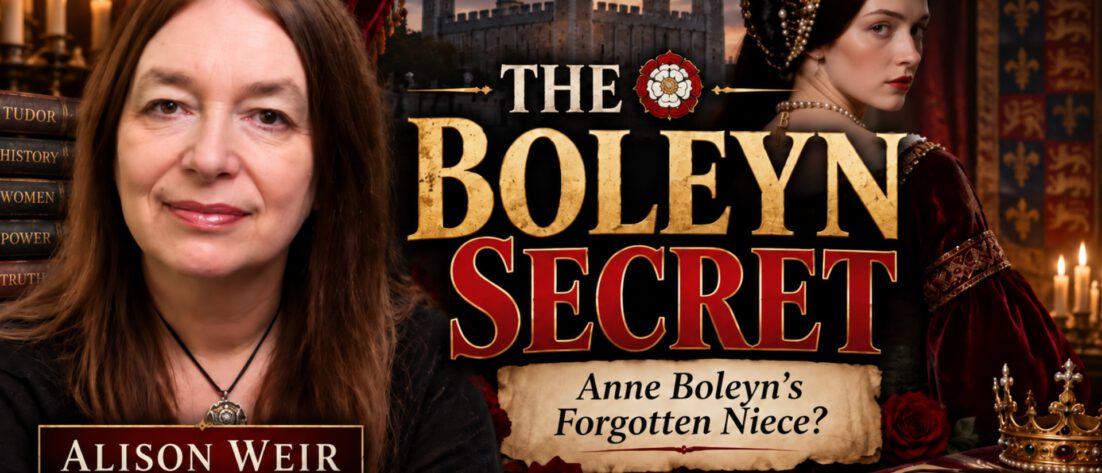
Step inside the Tudor court with bestselling historian and novelist Alison Weir as she joins Blaine DeSantis to discuss her new historical novel, The Boleyn Secret. The story follows Catherine Carey, niece of Anne Boleyn, from the shadow of her aunt’s execution through years of service, marriage, motherhood, religious upheaval, exile, and her complicated bond with her cousin, Elizabeth I. Weir explains how Catherine’s life offers a fresh way to experience one of the most dramatic eras in English history.
The conversation explores the research behind the novel and the thin line between documented history and informed imagination. Weir discusses the legend that Catherine attended Anne Boleyn in the Tower, the Knollys family Latin dictionary that records the births of Catherine’s children, and the evidence behind a portrait believed to depict her. She also examines Elizabeth I’s demanding friendship with Catherine, the Knollys family’s Protestant exile under Mary I, and the court scandals surrounding Lettice Knollys and Robert Dudley.
Weir also reflects on Anne Boleyn’s enduring fascination, Henry VIII’s relationship with Jane Seymour, the cultural influence of the Renaissance in Tudor England, and the books she is working on next. Rich with history, personality, and behind-the-scenes insight into how historical fiction is built, this episode is a lively conversation for readers who want to understand the people behind the famous Tudor names.
📖 Get the book: “The Boleyn Secret” by Alison Weir is available now wherever books are sold.
Introduction to The Boleyn Secret
Blaine DeSantis:
Welcome to Books and Looks, where we do a deep dive with authors to help you discover your next great read. Today we are going on a journey. We’re going back to the Tudor period in England and the days of Henry VIII.
This was one of the most tumultuous times in British history that was dominated by the scandals involving the six wives of Henry VIII. We’re going to take a peek into all that intrigue through the eyes of the historical figure Catherine Carey, who lived through all of Henry’s wives, Henry’s death, the rise of Queen Mary, who we know as Bloody Mary, and finally Queen Elizabeth I, who was her cousin.
Fascinating stuff, and we’re only going to do it today here on Books and Looks. I’m Blaine DeSantis, this is Books and Looks, and today we’re chatting with the preeminent British historical author Alison Weir about her newest novel, The Boleyn Secret. Alison Weir, welcome to Books and Looks.
Alison Weir:
Hi there, delighted to be here.
Blaine DeSantis:
I’m so happy to have you join us this week to talk about your brand new book, The Boleyn Secret. Friends, I’m holding this up for everybody to see it. This is the cover. Alison Weir, there you see, The Boleyn Secret, very fine book, hefty, very good book. You’re going to get a lot of history in this historical fiction book.
Alison, tell us a little bit about The Boleyn Secret. What is your book all about?
Alison Weir:
My book is about Catherine Carey, who was the niece of Queen Anne Boleyn, Henry VIII’s second wife. She was beheaded for treason in 1536. Legend has it that Catherine attended her in the tower when she was 12 years old—Catherine, that was, not Anne Boleyn.
Catherine came to court later on. She served Anne of Cleves, Henry VIII’s fourth wife. And she made a very good marriage to a rising courtier called Sir Francis Knollys. They turned Protestant. They sought exile in Mary I’s reign.
Then they came back to England when Elizabeth I came to the throne. Catherine had grown up with Elizabeth I. They were very, very close. They were cousins, and she served Elizabeth.
She had 14 children, I should add. And the queen was very selfish. She wanted Catherine in attendance at all times. Catherine wanted time with her husband and children. She was kept apart from her husband, so sadly the book ends in a very tragic ending. That’s a very short resume of a life story.
Alison Weir’s Early Career and Path to Writing
Blaine DeSantis:
It was an amazing life story. And that’s fascinating. But you had a great life story, too. Because before you were a writer, you were something else. What was your original profession?
Alison Weir:
I was a civil servant for many years. And then I was in civil service management and staff training. So it was a rather different career.
But I gave that up in 1983 to have a family. And then I began writing full time with my children at nursery school.
Blaine DeSantis:
So while they were there you were working, and when they came home you had to put it down for a while?
Alison Weir:
Oh yes, I did. But it’s an ideal career, a great career to fit in with motherhood. When the children are in bed in the evening you can go back to it, or you can go to it in the day when they’re at nursery or at school. So it was a good career for me then.
Blaine DeSantis:
I’ve heard a lot of the female authors that I’ve spoken to do that exact same thing. When the kids are in school that’s the time to get the writing done, and when they’re in bed.
Alison Weir:
You do a bit more, because when they’re older and they’re teenagers, they want to do their own things in the evenings, so I would retreat to the computer.
Balancing Fiction and Nonfiction Disciplines
Blaine DeSantis:
There you go. All right. Now, you have written both fiction and nonfiction books. Do you prefer one type of book versus the other, or are there certain topics that are better in nonfiction than fiction?
Alison Weir:
Yes, there are. On certain subjects I’ve written about, there probably wouldn’t be enough evidence to merit a biography. But for fiction, you can use your creative imagination and infer things from the source material. So I enjoy doing both.
At one time, I would have said history is my favorite because I love the research. But I’ve grown into the fiction now. I’ve forgotten how many fiction titles I’ve published, but I’ve certainly relaxed into it and I enjoy it now, much more than I did to start with.
Blaine DeSantis:
According to what I’ve read, 17 nonfiction books.
Alison Weir:
That sounds about right. It’s 40 books in total, but the 40th hasn’t been published.
Blaine DeSantis:
Now, you’re doing something right now—before we started, you told me this. You have one of the most unique ways of writing fiction and nonfiction. How do you do that at the same time?
Alison Weir:
Well, the morning is devoted to fiction, and I try to get two hours in in the morning, during which time I can write five pages. I can do more, it depends. But then I can get a rough idea of how long it will take to write the book.
In the afternoons, I spend about three and a half hours doing nonfiction. So I divide my time quite strictly. But I’m snowed under a lot with emails and admin because I do a large program of events.
For example, in the UK, I’ve got a 28-day book tour for this book we’re discussing today. And I also run historical tours. We do one or two a year. Fortunately, it’s just one this year. But I’m gearing up with that. I’m in the process of preparing 16 talks for it. So it’s busy.
Blaine DeSantis:
My word. Michelle, and you don’t have any trouble keeping them separate, the fiction and the nonfiction?
Alison Weir:
No, I don’t. It’s two different disciplines. You switch from one to the other.
Blaine DeSantis:
You have a whole series, I think they’re historical fiction on all the wives of Henry VIII, if I’m not mistaken.
Alison Weir:
Yes, six books. And it’s a box set. You can get it as a box set here. Six long books, so it’s a big box set. I was amazed when they did it. I didn’t think they would.
Blaine DeSantis:
I’ll tell you, that’s a weighty thing when you take that home.
Alison Weir:
Even in paperback, it’s weighty, yes.
The Research Process for Historical Fiction
Blaine DeSantis:
Well, I’ll tell you what, your work is just fantastic. A lot of people poo-poo historical fiction because I see a lot of what they’re calling Regency historical fiction or what I call bodice rippers. Yours are not like that, not at all. You have a lot of historical work into this. How much history goes into these historical fiction books?
Alison Weir:
As much as I can find. Basically, I fictionalize a historical narrative.
Because each book is written from the sole viewpoint of the heroine or hero, you only get their perspective. So it gives you a different slant on the subject because they won’t know everything that’s going on behind the scenes. They won’t know what other people are doing.
Blaine DeSantis:
That’s true. It allows you to do a little bit of expansion yourself.
Alison Weir:
And I do a lot of things now.
Blaine DeSantis:
On a book such as this, and I’m assuming this has to do with all the other ones, how long does it take for you to research a book like this?
Alison Weir:
To research a book like that? I’d researched the subject on and off; I touched upon it over many years. But to actually research it, it took me about three months to update the research.
Blaine DeSantis:
Normally longer.
Alison Weir:
But I was repeating it.
Blaine DeSantis:
Must you go to a library to get this, or can you get this stuff online?
Alison Weir:
I have my own library at home, as you can see. I’m sitting in just a corner of it now. It’s a very large room, and we converted it when we moved here.
I’ve got a very good library here, but a lot of it is online now. A lot of the source material you can get online.
The Life of Catherine Carey
Blaine DeSantis:
Well, now, let’s talk about Catherine Carey, C-A-R-E-Y, or Carey. Carey, okay. You start following her when she’s 12. By that time, has Elizabeth been born?
Alison Weir:
Elizabeth, yes, she’s three years old. Nearly.
Blaine DeSantis:
And the rumor, the legend is that Catherine actually was in the Tower of London with Anne Boleyn?
Alison Weir:
It comes from a source written by Augustus Hare, writing about Westminster Abbey in 1878. He mentions Catherine’s tomb, and he said that she was one of the four young ladies who attended Anne Boleyn in the Tower.
Now, I can’t find any contemporary reference to this. But I have made creative use of it in this book, as you can see.
Blaine DeSantis:
Well…
Alison Weir:
What if she was old enough to be married at 12 and Anne Boleyn may have asked for her own kinswoman?
Blaine DeSantis:
It had to be very difficult. That relationship and all that comes out of it, it’s all shaded because of what happened in the tower.
Friends, all over here in America, we all know Anne Boleyn and you get your head chopped off. Alison, you start with that.
Alison Weir:
I finished another book with it. I finished the novel on Anne Boleyn with it, but this is the starting point and we need to see the impact on Catherine of her aunt’s execution.
Blaine DeSantis:
That’s fascinating. But then things happen. She goes back to taking care of Elizabeth after that?
Alison Weir:
She does. She’s sent to Elizabeth’s household to be a companion for her.
Blaine DeSantis:
But they call her something different. Elizabeth no longer is called…
Alison Weir:
When her mother is in the tower, Anne Boleyn’s marriage to Henry VIII is dissolved. It’s declared null and void. Elizabeth is declared a bastard.
And so she is no longer called Princess Elizabeth; she’s called My Lady Elizabeth, the Lady Elizabeth. She’s demoted in status and the child is aware of it.
Even at two years and eight months old, she is aware of it. That’s a historical fact. And Catherine is there to buffer her against this and to comfort her really.
Blaine DeSantis:
She comes off as knowledgeable and intelligent at a very young age. Did you just make this up?
Alison Weir:
No, Elizabeth was a very sharp-witted, intelligent child, formidably so. Children were more rigorously educated early on in those days. And she did have a great classical education.
She had a very sharp wit, and that was cultivated early on. Two days after her mother’s execution, when she was two years and eight months old, she turned around to her governor and said, “How hath it, governor? Yesterday my lady princess, and today my lady Elizabeth?” She picked up on it immediately.
Blaine DeSantis:
Picked it up. And didn’t they move her to a new location, a new castle?
Alison Weir:
The royal children moved around among the nursery palaces of the Thames, as we call them, the Thames Valley near London. Her household would have been itinerant because the houses in those days, the sewage wasn’t brilliant and they had to be cleansed.
So they moved on. Depending on where the king was, if he wanted to visit his children, he’d move them to a house near where he was.
The Knollys Family Latin Dictionary
Blaine DeSantis:
One of the historical documents that you come across and discuss in the book is this Latin dictionary. I think this has a huge part to play in this entire story. Tell us about that dictionary. What’s its significance? Who did it belong to?
Alison Weir:
It belonged to Catherine’s husband, Sir Francis Knollys. In it he recorded in order the dates of birth of their children—only 14 of them; he doesn’t mention two, one probably died young.
And he mentions the last one, Dudley, who was killed a month after her birth. We don’t know how, and she was much mourned. She was born in May 1562.
That helps us to date a portrait of a pregnant Elizabethan lady as Catherine Carey. The portrait was in the possession of her descendants until it was sold at Sotheby’s with other Carey portraits in 1974. It’s dated 1562. It’s almost certainly Catherine Carey, so it helps us to date it.
Blaine DeSantis:
I was going to say, this really moves the story along because these pregnancies and her relationship with her cousin, Elizabeth, really affect her whole life and her whole life story.
Alison Weir:
It does. It dominates her life in the end. And there’s a downside, a very distinct downside to it, because while she enjoys the queen’s favor and she’s favored above all other female courtiers, she has no freedom.
Elizabeth’s love for her is selfish. She wants her with her.
The Complex Nature of Queen Elizabeth I
Blaine DeSantis:
That led me to my next question I wanted to ask. Elizabeth comes across petty and cruel and selfish, and this is a different picture of an English icon. Were you surprised at that?
Alison Weir:
No, I think she could be. I also think there is an inner need in her. I think she had a very difficult childhood.
Obviously she did, losing her mother when she was very young, being declared a bastard, and then suffered the injuries of stepmothers, lost two stepmothers to childbirth. I think she had lots of hangups, put it like that.
And I think she needed the stability of Catherine’s friendship. So I don’t think she’s being entirely nasty. It’s coming from a deep-seated need inside her. But yes, she was imperious. She could be demanding and she could be difficult.
Blaine DeSantis:
And she didn’t consider Catherine’s desire to be with her children and to be with her husband at times.
Alison Weir:
She didn’t desire marriage and children herself; she made that quite clear. And she couldn’t understand how other women felt about it.
The demands of a very large family and the Queen pulling her in the other direction often made Catherine, as it was recorded, weep for unkindness.
Blaine DeSantis:
The other thing that comes across in the book is that Elizabeth could be a little bit of a flirt. She liked the…
Alison Weir:
Oh, she was indeed. She wasn’t her mother’s daughter for nothing. She perfected the art of flirtation.
She had all these suitors at court fawning over her, and foreign princes too. She kept two of them dangling on a string, each in each case for 13 years, in the hope they might marry her.
She played what was called the marriage game with consummate ability, dangling her marriageability as a political asset. She was very good at it.
Of course, all the courtiers colluded in showing her as the Gloriana, this Virgin Queen. She’s almost a representation of a cross between the Virgin Mary and the Madonna, and a sex symbol.
Religious Turmoil and Exile Under Bloody Mary
Blaine DeSantis:
This is fascinating, really, to see the two sides of Elizabeth.
One of the things that also we get into here, in addition to all the wives, because she’s in the court during all this, is the Protestant-Catholicism, what’s going on, who’s in charge. I think you said they became Protestants, she and her husband. Tell us about it.
Alison Weir:
They did. Henry VIII broke with the Church of Rome. He founded the Church of England with himself as its supreme head instead of the Pope, but his church remained Catholic.
Under his son, Edward VI, when he reigned for six years, England turned Protestant. Various people who’d embraced the cause of religious reform under Henry VIII came out as Protestants, and Catherine and her husband were two of them.
Then, in 1553, Henry’s daughter Mary came to the throne after Edward died. Mary was a staunch Catholic. She outlawed the Protestant religion, brought back the mass, reconciled England to Rome, and then she revived the heresy laws. Those who continued to be Protestants were burnt at the stake if they didn’t recant.
So a lot of English Protestants went into exile, and among them was Sir Francis Knollys. Catherine and five of their children followed him later on, and they stayed in exile during Mary’s reign.
I’ve imagined what their life must have been like because Mary’s agents were in Europe searching out high-profile Protestants to make an example of them. One, Sir John Cheke, Elizabeth’s former tutor, was abducted and bundled back to England and the Tower and threatened with the stake if he didn’t recant. So you can imagine the terror in which they lived in Frankfurt and Basel and Strasbourg where they took up residence in turn.
Blaine DeSantis:
Now, you said five of the children came with her. How many had she had by that time? Did she have to leave some behind?
Alison Weir:
About 10 or 11 by that time. She had them over a long period, over 20 years, from 1542 to 1562. So that’s quite a long time.
Probably the others were left with relatives or may even have been in Elizabeth’s household.
Blaine DeSantis:
When they left, they lost everything, if I’m not mistaken. If you were a Protestant, you went into exile.
Alison Weir:
They almost lost everything, yes, because the government was sequestering the property of Protestants. But they managed to leave someone in charge of Greys Court, their house in Oxfordshire, who gave it back to them.
When they came home, they had their old home waiting for them. They had loyal friends at home.
Blaine DeSantis:
That did come through. The people who were taking care of everything were very loyal, very good people, even though Catherine and her husband were not there all the time.
It is fascinating. In my understanding, they were basically forced to move from city to city.
Alison Weir:
That’s a dreadful thing.
Blaine DeSantis:
How many times did they have to relocate after they left England?
Alison Weir:
Three times. They went to Basel, and they went to Strasbourg, and they went to, I think, Geneva initially, Basel, Strasbourg, Frankfurt.
Blaine DeSantis:
My British history is not as bad as it used to be, but Mary, Queen Mary, didn’t they help take care of Elizabeth? Weren’t they friends at one time?
Alison Weir:
What do you mean, Elizabeth and Mary, or Catherine and Mary?
Blaine DeSantis:
Catherine and Mary.
Alison Weir:
Catherine had very little to do with Mary.
Blaine DeSantis:
Ah, okay.
Alison Weir:
It was Elizabeth to whom she was close. They wouldn’t have been in Queen Mary’s good books because they were staunchly Protestant and everyone knew it.
Blaine DeSantis:
And they were Protestant when they were not supposed to be Protestant at one time. They were in secrecy. I can’t imagine this.
Alison Weir:
In the last years of Henry VIII’s reign, they may not have been staunch Protestants; they might have been out to reform the church from within. Under Edward, of course, it was fine because Protestantism was the official religion of England.
Under Mary, although she said at the beginning that she would be tolerant about worship, she soon retracted that and soon passed these heresy laws. That’s when there was a mass exodus of Protestants to the continent.
Blaine DeSantis:
That’s amazing. Now, you talk about this portrait by an artist named Steven van der Meulen. Is that his name?
Alison Weir:
Steven van der Meulen, yes.
Blaine DeSantis:
And we definitely pinned down that that’s Catherine in that painting?
Alison Weir:
Almost. I would say 95% certain it’s Catherine in that painting, given its provenance amongst the Knollys family and the date and the pregnancy that chimes with the birth of Dudley.
Lettice Knollys and Court Scandals
Blaine DeSantis:
Now, she also had a daughter, I think her oldest daughter, who became part of the court also, Lettice Knollys?
Alison Weir:
Yes. She was one of Queen Elizabeth’s favorites, one of her maids of honor. She married the Earl of Essex. He died, and then Lettice came back to court.
At the time, Elizabeth was very deeply involved with her favorite, Robert Dudley, Earl of Leicester. There had been a time when people thought she would marry him. His wife was then found dead at the foot of a flight of stairs, and people pointed the finger and accused him of murdering her.
He was cleared by the inquest. Of course, after that, the Queen would not allow herself to be tainted by association. She kept on flirting with him. He was close to her, but she never married him, despite the ongoing speculation.
Anyway, when Lettice Knollys came back to court, he started pursuing her. Much to the queen’s fury, as you can imagine, she was very jealous, and she wouldn’t have that woman at court. And she was absolutely devastated when later he married her in secret. There’s a story she was sent to the Tower, but it’s not true.
The Enduring Allure of Anne Boleyn
Blaine DeSantis:
These legends, you never know. What is it about the name Boleyn? That seems to be a name that just comes out through British history, and we all get fascinated by it.
Alison Weir:
It does. That’s why publishers always want to use it for metadata on Amazon to sell books—put the name Boleyn on the book itself.
Anne Boleyn has become a modern celebrity 500 years after her death, almost. There’s a fascination there. If you look at her, she is a romanticized figure in the widest sense. It’s hard to get beyond that brave and tragic figure on the scaffold.
This woman had been the scandal of Christendom, the other woman, so to speak. She was a queen who broke the mold. She was unique. She wasn’t in the mold of medieval queens; she wasn’t like any queen who came after. She wielded a lot of power with Henry VIII, which he allowed, of course.
A lot of young women nowadays see her as a feminist prototype. She wasn’t a feminist herself, but in her youth, she served in the courts of Margaret of Austria and Marguerite of Valois, both of whom on the continent embraced this movement then called the Querelle des Femmes, the woman question, which pushed for women to have more autonomy, more power, more equality.
It was a radical concept, but hanging around in Europe for about a century before then. Anne Boleyn didn’t promote this at the English court, but it gave her the confidence to pursue the career she did. In that sense, early feminism had an impact on her.
Her story is dramatic and there are many unanswered questions about her. Did she love Henry VIII? It’s sad we haven’t got her love letters to him; we’ve got a lot of his to her.
People can endlessly speculate, and she’s become all things to all people, a Tudor icon. She’s the Princess Diana of her day, and you can see all these different aspects of her. I think this accounts for treating her as a modern celebrity.
Blaine DeSantis:
She has gotten more popular here because we’ve all seen the Wolf Hall TV series. Did you watch Wolf Hall? Did you get to see the series?
Alison Weir:
Yes, I did.
Blaine DeSantis:
What did you think?
Alison Weir:
I thought it was excellently done, apart from the female costumes in the first series. They were a distraction for me, but otherwise it was very well done, and I thought the acting performances were excellent.
Blaine DeSantis:
It was a heck of a series. That brought Anne Boleyn back into our lives here in America, and we saw what she went through.
It had to be hard for Catherine. That shaded her entire understanding of Henry VIII, and yet Henry VIII kept coming around.
Alison Weir:
Yes, that’s right. And she hated Henry VIII as a result.
Henry VIII and Jane Seymour
Blaine DeSantis:
She hated him, no doubt.
Now, we talk about speculative things. This is really out of left field. I got the feeling that Jane Seymour was actually the love of Henry’s life, and had she not died, he might not have had wives four, five, and six. What’s your thought on that?
Alison Weir:
I think that’s very true. Henry would have told people after that Jane Seymour was the love of his life, but there isn’t evidence that it was anything like the passion, the obsession he had with Anne Boleyn for all those years, which went sour after they married and she didn’t come up with the son that he desperately needed.
So yes, I think Henry loved Jane Seymour. I think she was a complete antithesis to Anne Boleyn and probably quite relaxing after that.
New research has been done on her, and I think she was quite a formidable lady. But I don’t think it was a grand passion.
The Renaissance in Tudor England
Blaine DeSantis:
In your writing, you dig into this Tudor era. This is your wheelhouse.
What I found fascinating is that it parallels the Renaissance over in Italy, but we don’t hear—wasn’t there a renaissance going on in England at that same time?
Alison Weir:
Later on. What we call the English Renaissance is late Elizabethan, so it’s decades later. But the influence of the Renaissance was being felt at the English court.
We get Italian architectural pattern books being circulated in Europe. A lot of it is the Italians influence the French and the French influence the English in style and culture.
You get Italian works like Castiglione’s The Courtier being circulated at court in England, Renaissance-style poetry being written at the English court, and there’s a flowering of the arts and culture. Henry VIII was a great patron of it. You get Italian architects working at Hampton Court and other places in England, and Henry’s buying Italian paintings. So there is some influence.
Blaine DeSantis:
I’ve been very fortunate. I digress, friends. I’ve got Anne Weir here, who is, I think, the queen of writing this historical fiction, this Tudor time period.
Last year, we were also able to talk to another lady, I’m not sure if you’re aware of her name, Sarah Dunant, who does the Italian Renaissance.
Alison Weir:
She writes wonderful books.
Blaine DeSantis:
Just wonderful stuff. I’m so happy I’ve been able to chat with both of you about these time periods because it’s fascinating. We don’t hear anything about court, the paintings, the architecture, what’s being read, et cetera, and you were able to fill this in to us. That’s fascinating. I really enjoyed learning about that.
Alison Weir:
And it does give context to these people.
Forthcoming Projects and New Research
Blaine DeSantis:
Yes, absolutely. Now, I know you are a prolific author. It seems like every time I write you, I’m getting a note back saying, “I’m editing. I’m writing. Can’t talk. Deadlines.” What’s going on now?
Alison Weir:
That’s the trouble, it’s just so busy. My publishers wanted the novel a month early, ahead of contract, and I don’t know how I did it. I was flat out. I was doing this book tour, and for the previous book I was planning a tour. It was just horrendous.
Just this week I completed the edits, a very big edit I had for this book. I have a great editor and she asked me to write more and more to flesh out the book. I finished that yesterday.
So I’m feeling in a holiday mood today because all I’ve got to do now is prepare six books, but I’m enjoying doing that.
Blaine DeSantis:
What topic is this next book coming out? What is that going to be talking about?
Alison Weir:
It’s called The Pretender’s Wife. It’s out next May, and it’s about Lady Catherine Gordon, the wife of Perkin Warbeck, the pretender who emerged in Henry VII’s reign and claimed to be Richard, Duke of York, the younger of the princes in the tower.
He claimed to be Richard IV, the rightful king, and he plagued Henry with this claim for several years. He was received in the courts of Europe, and in Scotland, King James IV gave him his kinswoman, Catherine Gordon, to marry.
It all ended in tears, of course, and she had three or four other husbands. Her story is a very interesting one. She may even have been the mistress of Henry VII.
Blaine DeSantis:
My word. Now this is historical fiction, correct?
Alison Weir:
It is based on a lot of research, absolutely.
Blaine DeSantis:
But you’re also writing a regular nonfiction book right now as well.
Alison Weir:
I am. It’s about Mary Tudor, Henry VIII’s sister, who in 1515 made a scandalous marriage to Charles Brandon, the Duke of Suffolk, without Henry’s sanction.
It caused a scandal, and you could have heard the explosion across the channel because she was in Paris when she did it. Suffolk was nearly sent to the block. In the end, a large fine was imposed on the couple as a token of Henry’s forgiveness.
I’m looking at the circumstances of this marriage because she was in love with him beforehand, before she’d been forced to marry the King of France when she didn’t want to because he was old and ailing. She was 18, and the ambassadors called her a paradise, she was so beautiful. And she was in love with Charles Brandon.
At the quayside, when Henry VIII bade goodbye to her when she sailed to France, she wrested a promise out of him: “Can I choose my next husband?” He said yes, and she did. It’s a more involved tale than that, but those are the bare bones of it.
Blaine DeSantis:
Will that be coming out next year also?
Alison Weir:
I’m delivering it in May next year, and hopefully it’ll be the year after.
And then I’ve been commissioned to write a completely new version of The Six Wives of Henry VIII, because I’d re-researched for those novels I was telling you about.
Blaine DeSantis:
One on each wife?
Alison Weir:
No pressure here.
Blaine DeSantis:
Will that be six new books, Alison?
Alison Weir:
No, it’ll be one book. The original version was about 660 pages. A few years ago, when it was first mooted that I would do another one, they said I could have 800. Now I’ve got to get it in fewer pages.
So I’ve got to tell these six stories with the new research. Believe me, there is so much evidence, it’s going to be a challenge.
Blaine DeSantis:
Just tell them you want to do a Ken Follett-sized book and come in with those 1,500 pages.
Alison Weir:
Publishers have a thing about it; they worry about putting up the price point. If you do a bigger book, they’ve got to charge more for it, and they worry about the impact on sales.
Images of Henry VIII and Closing Remarks
Blaine DeSantis:
Isn’t that sad?
I just found out something this morning I didn’t know. King Henry III was the longest-reigning king in England. I never knew that.
Alison Weir:
Yes, he was, from 1216 to 1272. He succeeded to the throne at the age of nine.
Blaine DeSantis:
That’s fascinating. That portrait we have of Henry, Henry’s the bad guy—Henry VIII. But as a young man, he was good-looking, he was gallant, he was athletic. But we don’t see pictures or hear much about that. Why do you think that is?
Alison Weir:
There are lots of portraits of Henry when he was younger. I actually wanted to use one that’s in Denver for the cover of my book Henry VIII: King and Court 20-odd years ago, and my publisher said no because no one would recognize him.
Even though it’s got Henry VIII on the cover, they wouldn’t recognize him. He’s got long hair and no beard and thin-faced, and he doesn’t look at all like the image we have of Henry.
Blaine DeSantis:
That’s been ingrained in our brain, and so that’s what Henry looked like.
Well, Alison, I don’t want to take up any more of your time. You have been a delightful guest.
Alison Weir:
Thank you so much. You’ve been a great host.
Blaine DeSantis:
I’ve learned so much history, and we haven’t even gotten to the secret, friends. There are no secrets revealed here. We’re not going to tell you about it; you’ve got to read this book.
Alison Weir:
Thank you for that.
Blaine DeSantis:
Alison Weir, thank you so much for joining us today on Books and Looks.
Alison Weir:
Thank you, Blaine. It’s been a great pleasure.
Blaine DeSantis:
Friends, I hope you enjoyed this as much as I did. I’ve learned so much about British history, the Tudor time period, and what was going on. It is a fascinating period of time, and if there’s ever a historian who writes about it you want to read, it’s Alison Weir.
Her new book, The Boleyn Secret, is tremendous. It’s a wonderful book, and I highly recommend it to everybody.
On behalf of our friends at booktrib.com, this is Blaine DeSantis for Books and Looks, saying may all your leaves be pages in a book.