
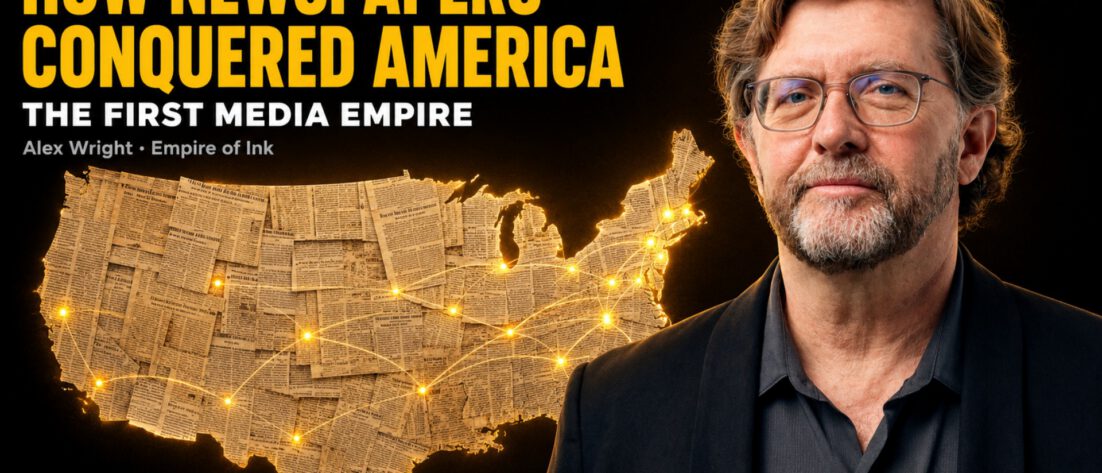
Before the Hearsts and the Pulitzers, before the front page as we know it, the American newspaper was built by teenagers covered in soot, women who risked hanging, and editors who settled arguments with pistols. Alex Wright joins Blaine DeSantis to talk about Empire of Ink, his sweeping history of how a young republic printed itself into existence between the 1700s and the close of the 1800s. It’s a project that started as a personal search into Wright’s own family of country newspaper publishers in Georgia and turned into fifteen years of research.
The conversation moves fast and covers ground most newspaper histories skip entirely. Wright explains what a printer’s devil actually was and why the job cut a man’s life expectancy in half. He tells the story of the entrepreneur who imported Egyptian mummies by the boatload because their wrappings were cheaper than American rags, and the French naturalist who watched wasps chew wood into pulp and wondered whether people could do the same thing. There’s Mary Katherine Goddard, whose name appears at the bottom of the first Declaration of Independence to carry the signers’ names, an act she knew could be read as treason. There’s the Vicksburg Sentinel, which burned through eight editors in roughly a dozen years, several of whom died in the line of duty.
Wright also takes us to the corners of the story that shaped whole communities. The Cherokee Phoenix, published in an alphabet invented from scratch by Sequoyah, became a political voice for the Cherokee people until their press was taken from them. In San Francisco, Yee Gen hand-built a workaround for printing thousands of Chinese characters and launched the first Chinese American paper. Union soldiers carried portable presses into camp and printed papers with blank pages so the men could write home on the other side. And a young Samuel Clemens swept floors as a print shop apprentice before he ever thought to call himself Mark Twain. If you have ever suspected that today’s media chaos is something new, this episode is a useful corrective.
📖 Get the book: Empire of Ink: The Printers, Rogues, and Radicals Who Invented the American Newspaper by Alex Wright is available now wherever books are sold. Buy it here: https://a.co/d/0e52u7jO
🎧 Enjoyed this episode? Subscribe, share, and leave us a review. And as always — may all your leaves be pages in a book.
Introduction: A History of the American Newspaper
Blaine DeSantis: Hi, I’m Blaine DeSantis and welcome to Books and Looks, where we do a deep dive with authors to help you discover your next great read. Growing up in Temple, Pennsylvania, the first thing I used to do was come downstairs, open the front door, and bring in the morning newspaper.
I got the comics and the sports. My paper had the opinion and the business section. This happened each and every day. I went to college and got the paper delivered to my dorm room.
At law school, the LA Times was delivered to my apartment. The newspaper was a part of our daily lives. We took it for granted. But how did the newspaper develop to become so omnipresent throughout America?
Well, today we’re going to trace this development from the 1700s until the end of the 1800s. My name is Blaine DeSantis. This is Books and Looks, and today we’re chatting with Alex Wright about his runaway best-selling book, Empire of Ink: The Printers, Rogues and Radicals Who Invented the American Newspaper.
Alex Wright, welcome to Books and Looks.
Alex Wright: Great hi Blaine, thanks so much for having me.
Blaine DeSantis: Well, I’m very happy to have you. Friends, this gentleman has written a wonderful book about the Empire of Ink. It’s about newspapers and is number one on the Amazon “to be published” list, which means everybody’s ready to go. They all want to buy this. And congratulations, Alex. Great book.
Alex Wright: Thank you so much.
The Inspiration Behind Empire of Ink
Blaine DeSantis: First of all, we’re talking about newspapers. What inspires you to write something about the beginning of the newspaper era in the 1700s and take it all the way to the end of the nineteenth century?
Alex Wright: For me, this book really started as a personal project. I come from a family of country newspaper people going back to the 1800s. My great-grandfather was an editor and publisher of a little bitty paper in Georgia called the Liberty County Herald, and then his sister started a paper called the Ludowici News.
Between them, they ran country weekly newspapers for almost a hundred years. I think my family just kind of got the bug. My mom worked in newspapers for a while. One of my first jobs was working at a TV news station.
I worked in and out of the news world over the years, both in tech and for news organizations. It really started for me as a journey to try to understand a little bit about that history. Even though my ancestors were publishing these papers for many years, somehow nobody in the family had ever saved a copy of any of them.
They haven’t been digitized. So I just started investigating this a little bit. The more I got into it, the more interested I became in understanding what that world was like beginning in the 1890s.
As I started going down that rabbit hole, I just got more and more interested in how the newspaper business evolved before the turn of the century. The version of newspaper history that most people know something about is after you have the Hearsts and the Pulitzers.
Blaine DeSantis: I had spoken with a friend who said, “Well, I had the book all about the development of newspapers.” And I started questioning. I said, “Do you have this? Do you have that?” I didn’t know that. They talk about the twentieth century but don’t really delve into the nineteenth and early nineteenth century either.
The Life of a Printer’s Devil
So fast, and you begin with something I find fascinating: print devils. What the dickens are print devils?
Alex Wright: The printer’s devil was a name that was used for printers’ apprentices in the early history of printing. Really for the first three or four hundred years of the printing press, print shops would hire them. This is very traditional, as with many crafts.
If you wanted to get into a trade, you would apprentice yourself to a master or practitioner of that craft. That was true in the printing world as well. Print shops would bring in apprentices, usually around the age of thirteen or fourteen, who would then work for a period of six or seven years.
They worked essentially for no pay, but for room and board, and they worked them pretty hard. It was a tough gig. You were basically sweeping the floors, cleaning up the type, and cleaning the ink balls that they used to press the ink onto the letters.
They worked pretty long hours in pretty dreary conditions. For the first few hundred years, these print shops meant you’re basically working in a dark room, breathing lead fumes the whole day, six days a week.
The life expectancy of printers was, according to one statistic I found, about half the life expectancy of a merchant. It was really pretty tough sledding. They had all kinds of health problems. A lot of them turned to drink and alcoholism was prevalent.
At the same time, printing was actually considered a fairly high-status trade because printers tend to sit close to the levers of power. A lot of people who would commission a print job would be in government or the church. So it was considered a pretty high-status trade, nonetheless a pretty tough business.
Why they were called printers’ devils is open for debate. Some people think it’s because these adolescent kids were covered in soot and ink and just looked kind of devilish. Other people say there’s all kinds of printers’ lore about how there’s a devil in every print shop.
Some people trace it back to the Dr. Faustus myth. There’s all kinds of other explanations for it. For whatever the reason, that was the term that a printer’s apprentice was called.
The Scarcity and Evolution of Paper
Blaine DeSantis: Well, there are a lot of inventions that obviously helped the spread of the paper. But probably the most important is that second part of the word newspaper: Paper. But that was something that was pretty scarce. You tell a story about mummy wraps and about paper wasps. Tell us about that and how they developed.
Alex Wright: I think we take paper for granted today as a raw material. What a lot of people don’t realize is the introduction of wood pulp paper is a relatively recent invention. It was really only in the late 19th century that it became commercially viable.
Before then, certainly back to the age of Gutenberg, most paper was made from rags, like extra cloth. It was a way of recycling your rags. They would have rag collectors, rag and bone men, who would go around and collect this stuff. That was how most paper was made for the first few hundred years.
As more and more material was being printed, they started to run into rag shortages. There are many examples in the 1700s of newspapers putting out calls for rags so they could keep printing. It got worse as we get into the 1800s and more paper is being produced while the supply of rags is finite.
People started to look around for alternatives. People experimented with making paper out of straw or different kinds of plants. Most of it was pretty sketchy, but probably the strangest experiment that I write about in the book was this guy who figured out a way to make paper from an unexpected source of rags: Egyptian mummies.
He literally started to import Egyptian mummies by the boatload to America to start making rag paper. It sounds implausible today, but the reality is there was actually a surplus of mummies. We think of them as these museum specimens now, but for thousands of years the Egyptians had been mummifying people and pets, cats and dogs and all kinds of things.
There was just a huge supply of these things. They were actually using them as locomotive fuel in Egypt. They would power the trains by burning the mummies. So there was a lot of that material.
This guy figured out the economics. It was cheaper to import the mummies from Egypt than to find locally sourced rags. He started that experiment. Unfortunately, it came to an end when the workers in one of the factories all caught consumption and died within a few days.
It turns out that it’s maybe not the most sanitary raw material to work with, or maybe it was the mummy’s curse, who knows?
Blaine DeSantis: But somebody examined the wasp, the paper wasp, and figured something out with that.
Alex Wright: Yeah, it’s interesting. The whole concept of wood pulp paper was inspired by this French naturalist René de Réaumur, who in the 1700s observed the behavior of these wasps that came to be called paper wasps. It’s a particular kind of wasp where they actually make their nests out of wood.
They chew up wood and masticate it, and then it creates this pulpy material that they then make into these beautifully crafted geometric shapes that become their nests. It’s a behavior specific to that kind of wasp. Other wasps make their nests out of mud or other things.
He observed this and he thought, “Oh that’s interesting. I wonder if we could do that.” He never really tried to pursue or commercialize that idea, but it was on the books. Decades later, people found that insight and thought maybe there’s something there.
People started to experiment with figuring out how to make paper out of wood. But it took a long time to get the economics of that right. It was actually a pretty expensive process. Now we’ve figured it out, but it was a long journey. For the middle of the century, paper was a precious commodity.
Mary Catherine Goddard: A Forgotten Patriot
Blaine DeSantis: That’s fascinating. Absolutely fascinating. Hey, I want to talk about a lady, Mary Catherine Goddard. She was a printer, and from what I gather, a very good printer. Tell us a little bit about Mary Catherine Goddard and when she was around.
Alex Wright: Goddard is a fascinating figure. She was a printer in colonial times and, like many printers of that era, wore several different hats. She ran a print shop and would take on job printing from the local government or businesses.
She also ran a newspaper, and this was more the norm during the colonial era as newspapers were often a side hustle for people who owned print shops. But she published a newspaper called the Maryland Journal that actually had the largest circulation in all of the colonies at that time.
She had learned the trade from her family. Her brother was a printer and her mother helped her run the shop. There were actually quite a lot of women in the printing trades in the colonial era. In addition to publishing her paper, she had developed a reputation as a supporter of the independence movement.
In fact, the Maryland Journal often editorialized in favor of independence. She had republished a lot of Thomas Paine’s essays. When the time came for the Continental Congress to publish the Declaration of Independence, they commissioned her to produce the first edition that included the names of the signers.
There was a previous edition of the declaration published by another printer, but it was published anonymously with no names on it. This was the first time the founders decided to put their names to paper and take responsibility.
Interestingly, on that edition of the Declaration of Independence, there is one additional name that appears at the very bottom. It says “printed by M. K. Goddard.” So Mary Catherine’s name is on that version of the Declaration of Independence.
It was considered an act of treason at the time. In fact, many of them, the signers and Goddard, expected they were possibly signing their death warrant by doing this. But she was a big believer in the Patriot movement and she put her name out there.
Blaine DeSantis: Why do you think we don’t know about her? We know about Betsy Ross, but we don’t know about this woman who was very big and printed the first one and she’s sort of lost in history.
Alex Wright: It’s a good question. I think she is somewhat known in print history circles, but she’s certainly not a household name. Part of it is that in many cases the contributions of women in this era were somewhat overshadowed. It was a bit of a man’s world.
But she also was a little bit caught up in some political controversy. She was at one point the postmaster general of Baltimore, which was a pretty powerful position in the colonial era. Then she ran afoul of somebody and lost that position.
She got caught up in some politics and one thing led to another. Anyway, she’s not a particularly well-known figure, but she played a pretty pivotal role in the independence movement.
The Expansion West and Scissors Editors
Blaine DeSantis: Absolutely. Wow. Well, now we’re going to be moving. The papers are starting to move west. We have something called scissors editors. What is a scissors editor?
Alex Wright: One of the interesting characteristics of these early American newspapers is how much of the material was actually copied from somewhere else. There were a couple of reasons for this.
One was that from the founding of the country, the new federal government made a conscious decision to subsidize newspapers. In the Post Office Act of 1792, they encoded all of these subsidies into the law where newspapers were able to mail their product for a drastically reduced rate.
More than half of the material being sent through the mail during this era was newspapers. So they benefited enormously from this distribution subsidy. Additionally, newspaper publishers could exchange copies of their papers with each other completely free of charge.
You could basically send your newspaper to every other newspaper publisher in the country and not pay a dime for that. Another critical part of the equation was that newspapers were exempt from copyright. This was another conscious decision the government made.
They felt that news was a public good and that it was in the interests of the country for news to flow freely everywhere so that you could have informed citizens to sustain the democracy. As a result, newspapers had this constant stream of raw material from each other to draw on.
They could reproduce things free of charge. About half of what was published in a given paper was material that was copied from other papers. Over time, this role evolved of somebody whose job it was basically to read all the papers and find things to publish.
That was what came to be called a scissors editor who would literally sit there with scissors and a pot of paste and read papers and cut out interesting stories and put them in the next week’s paper.
Feuds, Duels, and the Dangers of Editing
Blaine DeSantis: Well, it worked. It spread the news and got people knowing what’s going on in other parts of the country. So I thought it’s a good thing. Now, one of the things that happened with newspapers is these guys got into feuds. These editors got into feuds with each other.
There were threats being made and sometimes they got into fisticuffs. But something was strange in the water down in Vicksburg, Mississippi. What was going on with the Vicksburg Sentinel? Because that’s a bizarre story.
Alex Wright: Being a newspaper editor was a dangerous job in the 1800s. We think we have problems today with people getting into flame wars on the internet, but back then people had the equivalent of flame wars too. Editors were often beefing with each other in the pages of their papers and sometimes publishing unkind things about each other or local politicians.
Sometimes those arguments would come to a head and spill out of the pages of the paper and into the streets. It was really not that uncommon for newspaper editors to find themselves in duels with either other newspaper editors or with local politicians who were offended.
A famous example would be the Alexander Hamilton-Aaron Burr duel, which started in the pages of a newspaper. Especially as the century went on, dueling was eventually outlawed and fell out of favor in the north, but in the south, there was still this very vibrant honor culture.
If your reputation was damaged in a newspaper, you felt it was incumbent on you to defend your honor on the dueling field. It went to an extreme in Vicksburg where over a period of about twelve years they had eight different editors for the Vicksburg Sentinel. At least five of them died in the line of duty.
Either picking a fight with somebody, getting shot, or getting into some kind of violent altercation with people. That was a particularly dangerous place to be a newspaper editor, but that wasn’t the only place. It happened all over the South.
Another great story is there was an editor in Richmond, Virginia, my hometown, who got into an altercation with Edgar Allan Poe, who was living in Richmond at the time. Poe was incensed by something he had read in the paper where the editor had implied that he was having an affair with a married woman or a widow.
It basically sullied his reputation. Poe was so upset that he stormed into the editor’s office and demanded justice. But unfortunately, Poe had so much to drink that he could barely stand up and wasn’t really able to carry through on the threat.
He and the editor ended up going out instead and having some more drinks. Poe ended up reading poetry in a pub or something and then he and the editor became lifelong friends after that. That duel had a happy ending.
Specialty Papers: The Cherokee Phoenix and The Oriental
Blaine DeSantis: It did. Wow. That’s great. As we keep going west, we start getting into specialty papers. That was a huge part of what expanded this growth of the newspaper. One I want to talk about is something called the Cherokee Phoenix, which was basically a Native American newspaper.
The Cherokee language only existed for around 10 years, but they had a newspaper. Can you tell us about how that developed?
Alex Wright: This was such an interesting story to learn about. Obviously, the Cherokee language had been around for a long time, but the written language was a very recent invention.
There was this really interesting character named Sequoyah who was a Cherokee fellow, apparently a genius polymath, who decided to invent an alphabet for the Cherokee language, which nobody had ever done before. I believe it was the first time any Native American language had been written down.
In fact, that alphabet was then adapted by other Native American languages. Sequoyah had created this alphabet, and it was so well done and easy to learn that in a very short period of time, a huge percentage of Cherokee people became literate. It was a very learnable alphabet that he came up with.
Pretty soon, within 10 years or so, they started publishing their own newspaper, the Cherokee Phoenix. It was the first Native American newspaper written by and for Native Americans. It became a powerful force for the Cherokee people in Georgia as they were negotiating their position with the local government.
The Cherokee chief recognized the printing press as an essential piece of civic infrastructure that enabled them to plead their cause. They ended up realizing that a lot of the audience for what they were writing was actually people outside of the Cherokee community.
They started publishing a bilingual version of it. It became hugely influential until the tragic story of the Trail of Tears when the Cherokee were forced out. They took away their printing press and took away their voice for decades until finally, after the Cherokee relocated, they acquired another printing press and rebooted the newspaper.
It is just an interesting example of where newspapers are politically powerful mechanisms for people to develop a sense of identity and make their voices heard.
Blaine DeSantis: Right. I think there still are Native American newspapers to this day. I think the Navajo Times is one I remember reading at one time.
Alex Wright: Sure. There’s actually now another rebooted version of the Cherokee Phoenix that exists now. You can find it online.
Blaine DeSantis: Well, we keep going west. We had a gentleman, Yi Gen, who was the editor of The Oriental newspaper. This is a real challenge because he’s writing in Chinese. Chinese has something like eleven thousand characters.
How do you create a way to print that when you’re basically a one-man band out in San Francisco in 1853?
Alex Wright: He came up with a very clever, kind of hacky solution where he first hand-inked all the Chinese characters onto a sheet. Then he developed this printing apparatus using a stone that let him create these impressions of those characters that he could then reproduce.
It was a very clever one-off solution, but it did enable him to create the first Chinese American newspaper that again helped this community of Chinese immigrants in San Francisco develop a sense of their own identity and shared cultural presence.
Blaine DeSantis: Well, they had to then create their own typeface. We’ve got a letter A, but he’d have to create it for eleven thousand different characters. It had to be a tremendously difficult and patient process to do all that.
Alex Wright: I’m sure it was a labor of love. It was not a trivial undertaking, but he did it and it was hugely popular with the community there.
The Era of Amateur and Youth Journalism
Blaine DeSantis: It wasn’t just adults. We had kids’ newspapers. As the printing presses got smaller and more economical, kids actually started putting out newspapers. There’s one little 11-year-old girl, her name was Nelly Williams. Who is she and what’s her story?
Alex Wright: Nelly Williams is such an interesting character. She’s this 11-year-old girl during the Civil War. She had an older brother who had gone off to join the army. Her mother had died a few years earlier from tuberculosis, and her father had fallen ill as well.
The family had fallen on pretty hard times. It was Nelly, her little sister, and her father struggling to get by. But they had one prize possession at home which was a printing press her father had actually won in a poker game a few years earlier, and she had learned to work the press.
Her brother had started up a little business doing some job printing, like business cards and announcements, and she had learned the ropes from him a little bit. Soon after he left, she decided to start experimenting with publishing a little newspaper. She called it the Penfield Extra.
Penfield was the name of the town, but the subtitle was “Little Nelly’s Little Paper.” It started out kind of as you would expect with an 11-year-old editor, basically a very small little world—Nelly’s world, what’s going on in the house and the neighborhood with the relatives.
Over time, she continued to produce this thing week after week and it got better and better and started to reach people. Within a couple of years, she had something like three thousand subscribers and was starting to get attention from bigger papers.
She was invited up to Rochester to tour their paper and they promoted her work. She ended up getting a substantial audience and actually was able to help support her family in a meaningful way by selling subscriptions.
The paper ran throughout the Civil War and for a couple years afterwards until Nelly herself tragically died of tuberculosis fairly young. It was an amazing little story of someone picking themselves up by their bootstraps and finding this passion for the newspaper.
A lot of people followed in her footsteps, especially after the war. A lot of teenagers started publishing their own little newspapers. It became a fad in the 1870s and 1880s, these so-called amateur newspapers produced by kids who would just mail each other their papers.
They started their own press associations. There were thousands of these being produced by the 1880s. A lot of that was due to the availability of these small handheld printing presses that were perfected during the Civil War and then became consumer products.
It was the equivalent of buying a cheap inkjet printer. You could buy them for like three dollars through the mail, which is roughly what a cheap printer would cost today. People figured out how to express themselves.
The Military Press of the Civil War
Blaine DeSantis: That’s neat. Now, you said Civil War. That’s interesting because while we may have all heard of some of these things, I had never heard of the military press. I’d never heard of the fact that the troops were producing their own newspapers. Was that prevalent?
Alex Wright: It was. This was also essentially partly due to the same technology. These small portable printing presses were really invented and distributed widely during the Civil War. Before the Civil War, it was by far the most documented war in history up to that point.
Part of that was the bigger papers sending war correspondence and the telegraph. But an overlooked part of that story is the phenomenon of soldiers’ papers. The way that emerged was that the army units in the field would often have these little portable presses so they could print off requisitions or paperwork necessary for the military operation.
For large periods of time, those presses were sitting idle and you had a lot of soldiers who maybe had worked in a print shop. They started to experiment with printing their own papers really just for their fellow soldiers.
There was this amazing phenomenon—many of them were short-lived, but the estimate is there were maybe two hundred of these being produced. They give you a fascinating little slice of life because it’s often the enlisted men publishing these things.
You find out about what they had for Thanksgiving dinner, how much a bottle of whiskey was going for, or they would poke fun carefully at their officers. They would also have funny stories about camp life or the dog that came to visit. It really gives you that on-the-ground perspective you wouldn’t get from just reading the New York papers’ version of what happened on the battlefield.
Blaine DeSantis: What I liked was that many of these papers had left a couple pages empty and the soldiers actually used that to write their letters home. They sent their letters home in the newspaper to their parents because they could then write their letters in there.
Alex Wright: That’s right. A lot of the way these papers were used wasn’t just for the other soldiers, but it was also for the families back home. If you wanted to let mom and dad know what was going on with the army unit, you could just send them a copy of the paper.
There was at least one example of a paper where literally half of the newspaper was blank so that the soldier could write their letter home on the other side of the printed page and then send it on. They were an interesting, social kind of document.
Blaine DeSantis: Well, one of the things I thought I noted is that most of these papers were Union papers. Did the Southerners have a similar type of paper? Did they have the same military press?
Alex Wright: There were a handful of examples. Most of them were from the North because that technology, the portable presses, was more of a thing for the Union Army. There were some cases where Army battalions would go in and find a town with a print shop and they would just commandeer the press. There were some Southern soldier papers, but not as many.
Blaine DeSantis: Right. And if you happen to live in Winchester, Virginia, every day there could be three different people going back and forth. They would take over the press and then issue a paper for the townspeople to let them know who’s in charge now.
Samuel Clemens: The Journey to Mark Twain
Friends, this book is filled with stories, just absolutely filled with amazing stories. And here’s the guy we’re going to talk about next: Sam Clemens. Sam was a big newspaper man. When did that begin and tell us about his history in the newspaper?
Alex Wright: Samuel Clemens, later Mark Twain, pops up throughout the book. He himself started his career as a printer’s devil at about the age of eleven or twelve. His story was kind of tragic. His father died at a young age and his family was struggling financially.
He took an apprenticeship with a local print shop and had a pretty tough boss who he later wrote fictionalized accounts about. It was a real kind of hazing for him into the trade. But he learned the ropes. He learned to set the type, clean the belts, and sweep the floor for room and board.
A lot of writers in that era came up that way. Eventually, he moved to another paper run by his brother, Orion Clemens, who had come back to Missouri to start up a paper. But he was still a kid and he started submitting stories to the paper pseudonymously because he was convinced his older brother wouldn’t want to publish anything written by his annoying little brother.
He started writing things after hours and sliding them under the door. They started making it into the paper and eventually he revealed himself and that was his first taste of literary fame. He did that for a couple years and then he did what a lot of people would do after their apprenticeship: he became a tramp printer.
He went on the road. You attain the rank of a journeyman printer who’s a master of the craft and then you can go practice your craft anywhere. He went to St. Louis, which was the nearest big city where they had the newer kind of fancy, industrial presses.
He took a job doing a gig. You could think of these people as early gig workers. He did that for a bit and then gravitated to the East Coast, worked in New York for a while in big publishing houses, worked his way down to Baltimore and Washington, and then back out to the Midwest.
For several years, this was all before he went on his storied adventures to become a riverboat pilot. The first part of his life he was squarely in the printing and newspaper world. He came back to that world years later when he moved out to the Nevada territories again with his brother Orion.
Sam Clemens eventually took a job with the Territorial Enterprise, the newspaper in Virginia City, Nevada, which is where he eventually decided to start calling himself Mark Twain. That was the beginning of the Mark Twain legend. It was an amazing paper and there were a lot of great writers there who did some great journalism, though they also told a lot of tall tales.
Industrialization and the Rise of Media Moguls
Blaine DeSantis: Probably the best newspaper of the old west. So there starts Mark Twain. As we go further into the end of the century, all of a sudden we start seeing mass media and the rise of the word “publisher.” The “editor” guy sort of just goes away. Why does the editor become less and less important?
Alex Wright: I think what changes is the nature of the newspaper business. It becomes more of a commercial enterprise. There are still editors, of course, but in the first part of the century, it was much more common to have a one-man or one-woman operation where somebody was wearing multiple hats.
They would be the printer, the publisher, the editor, the ad salesperson, and they would sell the subscriptions. It was sometimes called the “able editor.” It was the jack-of-all-trades role. As the century went on, a couple of things fed into this. One was population growth.
People were moving to cities. The center of gravity was shifting to big urban sectors where you had a bigger market and the opportunity to hire more people. Over time the roles became more specialized and divisions of labor started to happen.
Printers became their own trade, working in these bigger papers where you would have a print shop with compositors whose job it was to set the type. That became a full-time job and was increasingly a distinct role from the people who were actually writing the stories.
Both of those roles then became distinct from the people who were running the business side of the paper selling advertising and subscriptions. You started to see specialization of roles and eventually industrialization of the newspaper industry started to take hold.
Blaine DeSantis: Well we lose the editor, but we gain the Hearsts and we gain the Pulitzers. We now get the publishers. Those are the ones we now hear about as you start into the 20th century.
Alex Wright: Newspapers became a powerful commercial enterprise and an industry with a lot of political and economic clout. Advertising became a much more central part of the newspaper business in the latter part of the century.
Previously, a lot of papers were sustained by a combination of subscriptions and some advertising, but in many cases, early papers were really subsidized directly by political parties. That changed significantly where papers became self-sustaining businesses driven by commercial imperatives.
Benjamin Franklin: The Proto-Influencer
Blaine DeSantis: One of the things I learned is that you say Ben Franklin was the prototype for the modern media mogul. Tell us about Ben and his empire.
Alex Wright: Benjamin Franklin was such a multidimensional character. He started as one of the early influential printers, publishers, and newspaper proprietors in the colonies.
What was interesting about him was that the newspaper was one of many hustles he had going. He published the Pennsylvania Gazette and would often use it to promote his own books, like Poor Richard’s Almanack. Obviously, he used it to gain a lot of political influence.
He had this incredible platform to make his views known. But what was also interesting about Franklin is he was a master of the craft. He was a master printer in his own right and he trained a whole generation of printers who came through his shop doing their apprenticeships.
He had his own printers’ devils, and many of them then went on to start their own print shops and newspapers. He had this effect where his influence extended broadly across the colonies. People would apprentice with him and then go to some other town to start their own print shop.
He had this network of printers that he could then leverage to promote his own work and syndicate it far and wide. It helped him build his profile and his influence. I think he was a kind of proto-influencer.
Blaine DeSantis: He didn’t print the declaration, did he? He didn’t print any of those copies?
Alex Wright: He did not. That went to the other local shop. I think he was out of the printing business by that point.
Blaine DeSantis: I wasn’t sure if he kept a printer.
Alex Wright: I think he still had a printing press. He still knew how to do it. I believe he took one with him to Paris, but they were outsourcing the declaration. He was in his seventies at that time.
The Legacy of the 19th Century Press
Blaine DeSantis: We’re gonna take you back to the nineteenth century. You’ve got to be in one paper or one print shop. Which print shop would it be and what would your job be there?
Alex Wright: I think if you had to pick a print shop to be a fly on the wall or a worker, I would probably say Horace Greeley’s New York Tribune would have been a pretty interesting place.
He was a massively influential publisher and editor, and he was instrumental in the abolition movement and the labor movement. He had his hands in all kinds of different pots. But he was also someone who had come up from humble beginnings as a printer’s apprentice himself and had a deep appreciation of the craft.
He would be the person we would want to apprentice with to really learn how to do all the things. He was also an influencer in his own right. He had a very distinctive look and a way of projecting his influence. He was a strong proponent of organized labor and was very supportive of his print shop unionizing. So if you worked in his shop, you would probably be treated well.
Blaine DeSantis: It took a lot of time and research. How long did it take you to research this book, Alex?
Alex Wright: From beginning to end, it was a fifteen-year journey. I certainly wasn’t working full-time on it the whole time, but in fits and starts, I’d been poking at this topic for quite a while. Really it was the last couple of years where I bore down and tried to write the thing.
Blaine DeSantis: Well Alex, I’ll tell you what. It was worth it. You’ve written a wonderful book. I thank you from the bottom of my heart for writing this. I found it fascinating. And I just want to say thank you so much for being with us today on Books and Looks.
Alex Wright: Oh, thank you. This is a great conversation. Really appreciate you taking the time here.
Blaine DeSantis: Alex, thanks so much for coming to us today, and we appreciate your research on the development of the newspaper. Unfortunately, friends, as you and I know, the newspaper is going the way of the dodo. Hardly anybody subscribes anymore. People don’t want to have the physical paper coming to them.
As a matter of fact, here where I live, the paper doesn’t even get delivered; it comes in the mail. And if you know our mail delivery, you never know when you’re going to get the newspaper. Anyway, this was great so we learned all about the development of the paper here in America.
On behalf of our friends at BookTrib.com, this is Blaine DeSantis saying, “May all your leaves be pages in a book.”