
Were the Martian canals real? For decades, some of the world’s most respected astronomers and newspapers answered with a resounding YES. But how did a simple misunderstanding spiral into a global belief in an advanced, dying civilization on the Red Planet? This episode unwraps the incredible story of the turn-of-the-century Martian craze, a period when fact and fiction blurred, and humanity collectively looked to the stars, convinced someone was looking back. We explore how this mania began, who its biggest champions were, and how the idea of intelligent Martians shaped science and culture forever.
This deep dive into the history of our obsession with Mars is guided by acclaimed author David Baron, whose book “The Martians: The True Story of an Alien Craze That Captured Turn-of-the-Century America” chronicles this fascinating era. We begin with the story’s surprising European origins, specifically with Italian astronomer Giovanni Schiaparelli and his 1877 observations of “canali” on the Martian surface. A critical mistranslation of Giovanni Schiaparelli canali (Italian for “channels”) into “canals” in English ignited the public imagination with the possibility of artificial structures. This idea was popularized by French astronomer and author Camille Flammarion, but it was an American who would become the theory’s most fervent and influential advocate: Percival Lowell.
Born into a wealthy Boston family, Percival Lowell dedicated his fortune and his life to proving the existence of an intelligent Martian race. We detail the astonishingly complex Percival Lowell Mars theory, which proposed that Mars was an old, drying planet and its inhabitants had built a planet-wide irrigation system—the Martian canals—to channel water from the polar ice caps to their desert cities. To prove it, Lowell founded the iconic Lowell Observatory in Arizona and even funded a massive expedition to Chile to capture the first-ever photographs of the canals, which he presented as undeniable proof. This led to a major rift in the scientific community, dividing astronomers into “canalists” and “anti-canalists.”
The belief in Martians wasn’t just confined to scientific circles; it exploded into a full-blown cultural phenomenon. We discuss the immense impact of H.G. Wells War of the Worlds, a “scientific romance” that terrified and thrilled readers. Baron reveals how American newspapers, in a bout of Yellow Press sensationalism, pirated and serialized the story, localizing the invasion to New York and Boston and presenting it almost as a news report—a tactic Orson Welles would later famously use for his 1938 radio broadcast. The fervor grew so intense that in 1924, the U.S. military was convinced to enforce national radio silence to listen for signals from the Red Planet. So, what was the final nail in the coffin for the Martian canals? Baron explains how astronomer Eugène Michel Antoniadi’s crystal-clear observations in 1909 and, ultimately, NASA’s Mariner 4 spacecraft flyby in the 1960s, finally disproved the theory, revealing a cratered, lifeless landscape where canals were once drawn. This entire episode serves as a powerful look into the turn-of-the-century Martian craze and how it left an indelible mark on science fiction, inspiring figures like Robert H. Goddard and Carl Sagan and shaping our dreams of outer space to this day.
Introduction
Blaine DeSantis: Welcome to Books and Looks, where we do a deep dive with authors to help you discover your next great read. Little green men? Devastating invaders? Today we are taking a look at Martians and the history of our fascination and investigation into the planet Mars. When did it start? Who were the major popular investigators of the Red Planet? And what role did H.G. Wells and the Yellow Press play in our perception of what a Martian would act and look like? Who was Percival Lowell, and what role did he play in the Martian saga? And what about those infamous Martian canals? Were they actual canals, irrigation ditches, vegetation areas, or just a mistake? I’m Blaine DeSantis. This is Books and Looks. Today, we’re chatting with David Baron about his new nonfiction book, `The Martians: The True Story of an Alien Craze That Captured Turn-of-the-Century America`. David Baron, welcome to Books and Looks.
David Baron: Thank you, Blaine. Happy to be here.
Blaine DeSantis: So happy to have you. I read your past book, American Eclipse, and I saw this and I said, boy, we got to talk to you about the Martians. And before we get into the Martians, you were telling me something about American Eclipse. Tell everybody about that book and what’s happening with it.
David Baron: Sure. My previous book called American Eclipse is the true story of a total solar eclipse that crossed America’s Wild West in 1878. It was actually an important event for the evolution of American science. It was a chance for a young America to prove to the world that we could compete in science on the global stage. And a lot of interesting characters came out to Wyoming and Colorado for that eclipse, including Thomas Edison, right after he invented the phonograph and right before he invented the light bulb. He came out to study the sun during a total eclipse.
But what you’re referring to is the book was first published in 2017 at the time of, you may recall, there was a total solar eclipse that crossed the country from Oregon to South Carolina. And after the book came out, I was approached by some Broadway producers who thought there was a musical in my book, which I didn’t see. But the musical has been written. It’s a wonderful, wonderful show. The composer-lyricist is Michael John LaChiusa, who has several Tony nominations. He’s had a number of things on Broadway and also off-Broadway. The show’s been written, but it has yet to have a world premiere. I can’t give anything away yet, but it is likely to have its world premiere late next year and the goal is for it to be on Broadway in 2027.
Blaine DeSantis: And coming to Greenville, South Carolina in ’28 or ’29 with a traveling Broadway cast, we hope. Let’s hope. I’ll be there. That was a wonderful book, fans. That was a wonderful, wonderful book. We got to talk about Martians. We’re going to talk about Martians.
The Turn-of-the-Century Martian Craze
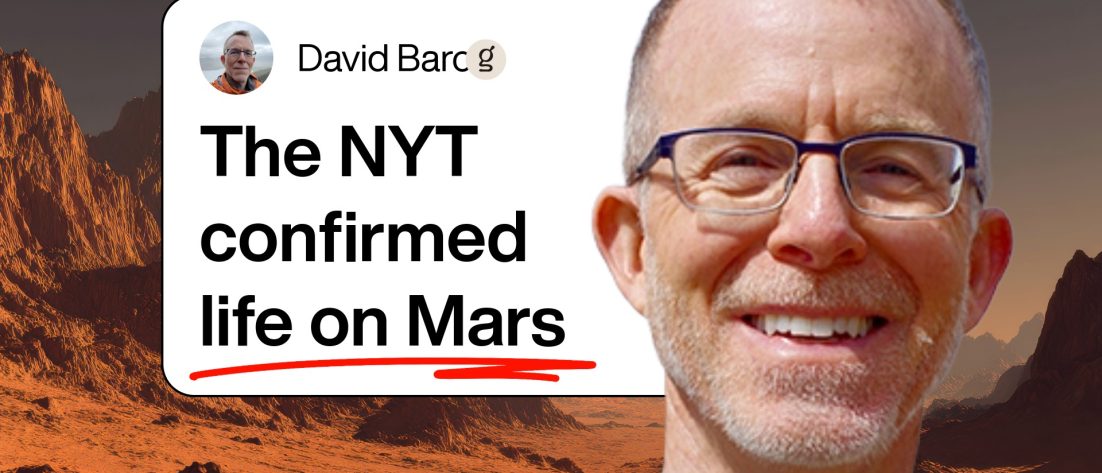
Blaine DeSantis: And I want to start out by that 1906 headline in The New York Times that screams “There Is Life on Planet Mars.” How does this exemplify what Martian mania was all about?
David Baron: That was not an unusual headline. In fact, that’s what really got me into this book was I was fascinated. I’ve been fascinated with Martians since I was a kid. I grew up in the 1960s surrounded by Martians. Marvin the Martian, that character on the Bugs Bunny cartoons. There was a sitcom back in the 1960s called My Favorite Martian that my family used to watch. Martians were in comic books and in science fiction. And I’m now an astronomy writer, and I was interested in where did all that come from? How did we end up so obsessed with Mars and this idea of Martians?
So I started to do research by looking at old newspapers from the turn of the last century. And what I discovered just floored me. That article in The New York Times was hardly unusual. There were articles in all sorts of papers proclaiming the existence of life on Mars, attempts to communicate with the Martians, questions about what we might learn from the Martians. Alexander Graham Bell, the inventor of the telephone, who was by then an old and respected member of the scientific community in America, he said there was no question that the Martians existed. It started in the more tabloid press, but by 1906, even The New York Times, even The Wall Street Journal, the most staid conservative newspapers, had come on board, that the Martians were real.
The European Origins: Schiaparelli, Flammarion, and the “Canali” Mistranslation
Blaine DeSantis: That’s amazing. All the, quote, news, end of quote, that’s fit to print. I loved it. That’s great. Martian mania was all over the country. And your subtitle talks about it being an alien craze in the United States, but it really began over in Europe with a couple of famous Europeans. We have a Frenchman and an Italian. Who are they? What did they discover?
David Baron: It really all started in Italy with an astronomer named Giovanni Schiaparelli, who was a respected astronomer who headed the Brera Observatory in Milan. And in 1877, which was a year when Mars came especially close to Earth, he decided he was going to make a careful study of Mars. He wanted to make a map of Mars. So night after night, he was studying the surface of Mars. And mind you, this is through a telescope on Earth, looking through Earth’s atmosphere, which distorts what you see. So it’s hard to really get a good view of Mars, even at Mars’ closest approach.
But he looked, he kept studying it night after night, and he made a map that showed dark areas and light areas that looked like continents and oceans. But he also, Schiaparelli, also saw these fine lines on Mars that he couldn’t explain. They looked too straight to be natural, and they seemed to connect up the dark areas that he thought were oceans. And he called them canali, which in Italian meant channels. He was agnostic as to whether they were natural or artificial, but he thought they were waterways. And the word canali was mistranslated into English as canals. And that’s where this whole idea of canals on Mars started. And it started with a mistranslation. We’ll talk more about it. It became more than that. So Schiaparelli started it in 1877.
The next person to pick up the baton was a Frenchman named Camille Flammarion, who was the Carl Sagan of his day. He was a well-respected astronomer and scientist, but also a popularizer of science. He wrote bestselling books. And he was convinced that Mars was inhabited. He didn’t know what the canals were, but he was seeing on Mars that the surface features seemed to change over time. He saw things that might indicate that the Martians were trying to communicate with us. And so he also, he wrote a book all about Mars in the early 1890s, proclaiming it inhabited. And then it came to America and it was picked up by an astronomer named Percival Lowell.
Blaine DeSantis: And these guys had it over in Italy and France. They had a cult following. Everybody was following them. Everybody was listening to them, believing them, including one person who sent them some of their shoulder skin. What’s that story all about?
David Baron: It’s a gruesome story. But Camille Flammarion really had a cult following. He, because he wasn’t just an astronomer, he really was a philosopher. He wrote with spirituality. He really thought that astronomy put us in touch with the greater forces of nature. And he very much believed in an afterlife. And he, in a lot of his writings, wrote about Mars being a place where human souls went after we died.
It was a very soothing idea to believe in this afterlife on other planets. And there were people who really revered him, including this young countess who was a secret admirer of his who died of tuberculosis. And before she died, she asked her physician, again, this is gruesome, to take the skin from her shoulders and send it to Camille Flammarion with a request that he use it to bind the next book that would be published after the gift came. And this was a not unheard of phenomenon in the century, of binding books in leather made from human skin. And I actually visited Camille Flammarion’s library outside Paris. He has several books bound in human skin from that donation, but also from other people. I don’t know whose skin that was. It’s bizarre.
Blaine DeSantis: That is bizarre. That reminds me of an author I had on a few weeks ago who we got into the fact that back in Victorian London, they used to have mummy unwrapping parties and they would actually buy the mummies from the British Museum, invite their guests, they’d unwrap the mummies and see what’s in there. My, they were doing a lot of things at that time.
David Baron: We tend to think of the Victorians as very staid and proper people, but they did some strange things.
Percival Lowell: The American Champion of the Martian Cause
Blaine DeSantis: They did some strange things. Well, anyway, it comes to America. This craze starts to come to America. And by the way, as you said, these are two highly respected scientists, astronomers, philosophers, and they’re convinced there’s life on Mars. So Percival Lowell picks this up. Now, Percival has an illustrious career, but tell us a little bit about Percival and what were his qualifications to become a student and studier of what’s going on at Mars?
David Baron: Percival Lowell came from one of the most respected families in New England. The Lowells of Massachusetts were very much involved in 19th-century culture and philanthropy. The money came from the early Industrial Revolution, when these textile factories were erected in what became Lowell, Massachusetts. And so the Lowells made a fortune off of the industry there. But then they started to use their money for good. They gave a lot of money to Harvard, to MIT. They were involved in the creation of MIT. One of Percival Lowell’s cousins was the founding editor of `The Atlantic Monthly`. So Percival Lowell was born into a very wealthy and well-respected family. And he, like many of his forebears, went to Harvard, graduated in 1876. He could have done anything he wanted with his life.
For the first couple of decades after graduating from Harvard, he wanted to be a writer. And he was a writer. He traveled, particularly in the Far East. He spent a lot of time in Japan. He was one of the first Americans to go to Korea. And he was a roving anthropologist. He wrote best-selling books and articles about Asia. And at that time, other cultures were often talked about as alien. That was a word that was used. It was like seeing people from another planet. These other cultures were so different from American culture. And Lowell was fascinated by Asian culture.
And then at around age 40, he read Flammarion’s book about Mars. At the time he was an undergraduate at Harvard, he took some astronomy courses and other science courses. He didn’t go on with that right away, but he always had an interest in science. When he read Flammarion’s book about the possible existence of Martians, he suddenly fixated on this idea that he was going to turn his attention and his money to studying Mars and proving the existence of the Martians. So he, and this was not that unusual at the time. A lot of astronomers were gentlemen astronomers. They were wealthy men, almost all were men, who had had a career in the law or medicine or industry and then decided to turn their passions to astronomy in later years. And so that’s what Lowell did. But with a vengeance. He had the money to found his own observatory in Arizona with one of the largest telescopes built to that time. And he dedicated his career from that point forward to studying Mars.
Blaine DeSantis: Now, before even all this began, he had a situation with Teddy Roosevelt. He was a bit of a strange guy, Percival. Tell me a little bit about that.
David Baron: The Lowells and the Roosevelts were intertwined. And Lowell was, I guess you would say, a cousin-in-law of Teddy Roosevelt. These families were so intertwined, the wealthy families of that time. You had so many members of one family marrying members of another. And Lowell was engaged to a sister-in-law of Teddy Roosevelt. And he, this was when he was quite young in his 20s, and he called off the engagement.
This was something I discovered that it was always known that something had happened. And I’m not the first person to write about Percival Lowell. And there’s always been this mystery about this called off engagement. And I turned up some letters that had never been seen by scholars before. A whole bunch of family correspondence about this incident. And basically, Lowell decided he did not love this woman, `[Could not verify with context]`, in a way a man should, to marry her. But this was so not done in those circles, to have proposed marriage, it was accepted, and then to turn it down. And he was shunned by folks in his social circles.
And one of the things I found in that trove of letters that had never before been seen was a letter from Teddy Roosevelt to Percival Lowell, chastising Lowell, calling him a blaggard for what he had done. And Lowell, in fact, that relates to his going off to Asia, he became so shunned in his Boston social circles that he ran away to Japan and took up a life there for a while. Teddy Roosevelt shows up on a few occasions in my book. I never did figure out what he thought about the Martians, though.
The Great Debate: Canalists vs. Anti-Canalists
Blaine DeSantis: That’s interesting. Well, Percival and the two Europeans were kindred spirits. They believed in this whole thing. But American astronomers seem to be having problems with that. Was that a European-American rift or why was that?
David Baron: The astronomical community did end up dividing into two warring camps that ended up being called the canalists, those who believed in the Martian canals, and the anti-canalists. And I would say there was perhaps a bit more acceptance of the canals in Europe than in the United States, but there were other canalists in the U.S. and there were anti-canalists in Europe. But the thing is that the canals were not easily seen.
Again, as I said earlier, studying Mars through an earthbound telescope was very difficult. It’s not like you look at the planet and you see everything clearly. It goes in and out of focus. It wobbles because of atmospheric distortion. So to see these canals, these fine lines, you have to study the planet for hours on end, days on end. You might get a glimpse of one canal and then you draw it on your map and then you watch for a while and then you’d see another one. And a lot of astronomers just didn’t have the time or interest to study Mars that much. So essentially, it was left to those who were the specialists in Mars to say what they saw. And those who would look at Mars and not see the canals, it was very easy to say, well, your telescope’s not good enough. Your eyes aren’t good enough. You just weren’t looking at the right time. And so the folks who said they saw the canals tended to be believed generally by the public.
Blaine DeSantis: Well, the gentleman from Italy who discovered the canals, he was colorblind. And there’s something, I think, in the book about how that may have influenced him. What was that all about, please?
David Baron: This is a point that’s been made by another historian of astronomy named William Sheehan, who’s written a number of fine books on the history of Mars. And he pointed out that Schiaparelli was colorblind, and that may well have affected the way he saw contrast, the way he perceived the difference between light and dark by not seeing colors the way others do. And so that may have heightened his sense of these lines as being sharp, fine things, whereas others who were not colorblind may have seen more fine gradations.
Searching for Proof: Lowell’s Observatory and the Chilean Expedition
Blaine DeSantis: Wow. Interesting. Mars gets close to the United States or to America, the Earth, every couple of years. And I think that was the impetus for Lowell to build that telescope out there in Flagstaff.
David Baron: Right. So the Earth orbits the sun approximately twice for every one orbit of Mars. So every two years and two months, we will lap Mars going around the sun. It’s called an opposition. That’s the technical term in astronomy. And that’s because when we are closest to Mars, Mars is opposite the sun in the sky. It’s like a full moon. A full moon only occurs when it’s opposite the sun in the sky. That’s an opposition of the moon.
So when we pass by Mars every two years and two months, that’s when it’s closest to Earth. But not all oppositions are the same. Mars’ orbit is not really circular. It’s a bit more elliptical than the Earth’s orbit is. So sometimes when we pass Mars, it’s quite close to us. Sometimes it’s farther away. So every approximately two years, there’s a pretty good chance to look at Mars. We come fairly close to it. And then about once every 15 years, we come especially close to Mars. And those are the really good years to study Mars. So 1877 was one of those really good opposition years, and that’s when Schiaparelli made his first map of Mars. And then 1892 and 1894 were also pretty good years, and that’s when Lowell got involved. He wanted to get his telescope set up in Flagstaff in time for the Martian opposition of 1894.
Blaine DeSantis: Wow. And obviously, he found some canals up there.
David Baron: A whole bunch.
Blaine DeSantis: A whole bunch, a whole bunch. And he has all sorts of theories about it. It’s just fascinating to hear what he thinks they are. But then there’s another time later in the 20th century, I think, where he just does this again. And he takes that telescope down to Chile, if I’m not mistaken. Tell us about that whole situation. My word.
David Baron: Right. So my book and what happened back then had this natural two-year cycle of Mars would come close, there’d be a lot of excitement, and Mars would go farther away and we wouldn’t see it so well. And then Mars would come back. And every time Mars came close, every 26 months, there’d be a flurry of excitement in the newspapers, there’d be more supposed observations from the astronomers that made people think that the planet was inhabited.
But for most of these years, so in the 1890s and the early 1900s, essentially, you had to just trust Lowell or Schiaparelli or Flammarion to have drawn properly what they saw because photography was still pretty young. Astrophotography, that is taking pictures of celestial objects, was very rudimentary. It was very hard to get any kind of picture of Mars that could tell you anything. So it was all based on these drawings.
Well, Lowell decided that one way to prove that the canals were real was to get photographs. And so he had some of his assistants innovate ways to take photographs of Mars. And during the oppositions of, I guess it was 1903 and 1905, he took some photographs from Flagstaff. But Mars, at that point, was not that close to Earth. 1907 was going to be one of these really good oppositions. But at that time, Mars was going to be better seen from the Southern Hemisphere than the Northern Hemisphere. So Percival Lowell, who had more money than he knew what to do with, funded an expedition to Chile where he hired another astronomer named David Todd, who’s an important character in my book. He headed the Astronomical Observatory at Amherst College in Massachusetts.
He hired David Todd to disassemble this seven-ton telescope, pack it into 116 boxes, and carry it down to South America, which at that point, the Panama Canal was still under construction. So he had to take these parts from Amherst, Massachusetts, down to New York, load them onto a ship, go down to Panama, onto a train over the Isthmus, onto another ship, down to Chile, onto another train, way up into the Atacama Desert of Chile, to a remote mining camp, which was in an area with really clear skies, which is what David Todd was looking for. And he reassembled this seven-ton telescope in the middle of the Atacama, to take 10,000 photographs of Mars.
And these were tiny little photographs, a quarter inch across. And I’ve seen the originals. And there’s only so much you can see in a quarter inch photograph. But at the time, that was considered remarkable because you can see the surface of Mars. There are dark areas and light areas. And if you look really hard and use your imagination, you can see some lines. And Lowell contended that this was proof beyond any doubt that the Martian canals were real. And at that point, he had been making this case for more than a decade. He was a very eloquent and persuasive man. He had convinced The New York Times. He had convinced Alexander Graham Bell. He had convinced The Wall Street Journal. And so those photographs from Chile in 1907 were widely believed to be proof positive that the Martian civilization existed.
Blaine DeSantis: What I found fascinating, not that he just disassembled that massive telescope to take it down there, is he wanted to prove this, but he wasn’t going to go down there and be there in person. Why did he go?
David Baron: That’s a good question. He was back in Flagstaff. He had his own observatory there still to observe Mars. He was not opposed to going on grand expeditions. He would go to Europe a lot. He went to North Africa a couple of times. In his earlier years, he went to Japan. But I think he just didn’t have the time to spend the months to go down to Chile at that point.
But I might say a little bit more about these canals. As I said earlier, when Schiaparelli saw the canals, he didn’t really mean canals. He meant channels. It was the mistranslation of canali in Italian to canals in English that first planted the idea of artificial canals in the public’s imagination. But when Lowell came along, he actually said they were canals. He wasn’t saying they were navigation canals, but irrigation canals. It’s quite a complex theory, and I can’t get into all the details in the time we have.
But basically, it was this. Mars, he said, is an older planet than Earth. Mars solidified before Earth did. Mars became habitable before Earth was habitable. If life then evolved on Mars, it got there first. It became civilized there before it became civilized here. So the Martians are in advance of us in terms of evolution, was the theory. Mars, in the meantime, being an old planet, was losing its water. It had once been a lush place, but its water now existed only in the polar ice caps. And in fact, through a telescope from Earth, you can see the polar ice caps on Mars. There are these white caps at the North and South Pole that will grow and shrink with the seasons. Lowell saw them, so he figured, oh, there’s ice on Mars.
And the way the canals appeared to him and to others, they seemed to come into existence in the spring and summer in a given hemisphere on Mars, and they’d fade in the fall and winter. So here was the theory. Mars, being an older planet, had allowed the civilization to thrive. But now the civilization was trying to hang on as the planet was dying. The planet was losing its water. The only way the Martians could survive was by tapping the meltwater coming from the polar ice caps in the North and South Pole. So they had built this global irrigation network to bring this precious moisture down to their desert farms and their oasis cities. And that’s what you were seeing.
And the canals, in order to see the actual canals themselves, would have had to be many miles wide, which was not plausible. What Lowell said was you’re not actually seeing the water, you’re seeing the vegetation greening up along the banks of the canals. And that’s why they would become visible in the spring and the summer when the leaves came out, and then in the fall, the winter, as the leaves died off and the vegetation died back, the canals would tend to vanish. So it was actually a coherent and interesting theory. And I would say in the 1890s, it was seen as that. It was an interesting theory. No one knew what the canals were. This was a possible explanation. But Lowell just kept pushing it and he refused to see any holes in his theory. He kept claiming that it was holding up. And with those photographs that were taken in 1907, he really convinced a good portion of the public that this was fact, that the Martians existed.
H.G. Wells and The War of the Worlds: From Scientific Romance to Media Sensation
Blaine DeSantis: Well, let’s now go to another person who is part of this craze, and that’s H.G. Wells. H.G. Wells is over in England. What does he do to help this situation just bloom and flourish even more?
David Baron: So my book has quite a few characters. Percival Lowell is clearly the main character, but I have lots and lots of really interesting people who come and go, who are a part of this cast. And H.G. Wells is one of them. He, of course, in the 1890s, he became particularly well-known for science fiction. This is before the term science fiction actually had been invented, but he was writing what were called scientific romances. And one of them, he was, as an undergraduate, he studied the sciences. So when he started writing literature, he came at it with this very scientific background.
And he had been reading in the scientific journals about the weird things being seen on Mars. And even before Lowell came along, so again, Lowell founded the Lowell Observatory in 1894. But two years before that, 1892, was also a year of opposition when Mars came close to Earth. And people were seeing weird things on Mars, these strange lights that were being presented in the newspapers anyway, as signal lights that the Martians were using to get our attention. And it got H.G. Wells’ attention, and that actually was a key part of what got him to write the book The War of the Worlds, which came out in 1898. He imagined that these lights on Mars were actually the Martians casting the great guns that they would use to fire their rockets at Earth. And that comes up in the book, The War of the Worlds. But The War of the Worlds was a sensation when it came out in 1898. And it really spurred on the public’s excitement about this idea of Martians.
Blaine DeSantis: Well, what I was unaware of, and I guess I should have been, but I’m not, when America heard about this, and Yellow Press got involved in this, all of a sudden they took this poor guy’s works, I think without asking permission, they brought it to America. Tell them about the serialization of that.
David Baron: Right. So The War of the Worlds was originally published in magazines as a serial, so it was an installment once a month. But it then was picked up by some newspapers here in the U.S. that ended up publishing it in daily installments. And they ended up doing what Orson Welles would do 40 years later. So you probably know in 1938, Orson Welles adapted H.G. Wells’s The War of the Worlds for radio. And he cast it as if it were a news item on the radio, which scared the bejesus out of a lot of people who thought the Martians were really invading.
Well, 40 years earlier, in the late 1890s, some American newspapers had the same idea, and they presented The War of the Worlds as if it were happening. They said that it was fiction, but it was presented in newspapers as if it were happening, and they brought it to America. So in the original War of the Worlds, the Martians first invaded London. When it was brought to America, a New York newspaper had the Martians invading New York, which is what happened later with Orson Welles’ radio broadcast. And there was a Boston paper, the Boston Post, that had the Martians invading Boston. And they did this without H.G. Wells’ permission.
Blaine DeSantis: They localized the Martian invasion. By the way, that H.G. Wells thing is so doggone good. Friends, if you get a chance, you can listen to that. It’s on the internet. It gets to a point where Wells, who’s playing the journalist out at Princeton University, he’s saying that there’s something coming out, boom, boom, boom, boom. All of a sudden, in mid-sentence, he stops. Six seconds of dead silence. And they think he’s dead.
David Baron: And so, that was 1938 that Orson Welles did the radio broadcast. In the radio broadcast, the so-called astronomer in the radio play says that, oh, some people think that there are these canals on Mars and pooh-poohs the idea, which by 1938, it was pretty much pooh-poohed. But why did so many Americans, there were some who literally fled their homes and a lot of others who were worried that this might really be happening, because only 30, 40 years earlier, they were reading in the newspapers that there were canals on Mars and the Martians really existed. So this was very much implanted in the American imagination.
What About Little Green Men?
Blaine DeSantis: Hey, where did we come up with the idea of Martians and little green men? Where did all that come from?
David Baron: Little green men, I’m no expert on that. I believe that the little green men thing came later with the UFO craze. And I’m sure there are plenty of links between the Martian craze that I write about in the 1890s and the first decade of the 1900s and the UFO craze, which is more of the 1940s, 1950s. And I believe there were some people who claimed that the aliens in the flying saucers were little and green.
The depictions of the Martians back in the period I write about, no one said they were green, and they actually weren’t little. They were thought to be quite tall because Mars, it was known, had less force of gravity on its surface than the Earth does. So the speculation was that a creature could grow tall and lean without having all that weight crushing down on its muscle and bone. So beings could grow taller on Mars, and it was thought the Martians probably were tall.
Blaine DeSantis: Friends, you just don’t believe everything you read in this book. It’s just out of this world. For a nonfiction book, you’re like, that can’t be. It can’t be.
David Baron: And let me emphasize, I take my historical writing very seriously. It took me seven years to write this book. I was in archives all over the place. I have thousands and thousands of newspaper articles. I have citations in the back of the book. There’s a lot of the book that’s hard to believe, but it’s all true.
Listening for Martians: The 1924 Military Radio Silence
Blaine DeSantis: It is. Absolutely. It’s just, again, one of the things that’s most amazing is they actually got the U.S. Military to go into total radio silence at one time. Why were they doing that?
David Baron: That was in 1924. 1924 was another year when Mars was in opposition, and it was a particularly close opposition. Mars came closer to Earth than it had been in a century, I believe. And even though by 1924, by then Lowell had died, he died in 1916, and his theory of the Martian canals had pretty well been by then discredited among astronomers, still the public very much held on to the idea that Mars could be inhabited.
And I mentioned earlier David Todd. He was the head of the observatory at Amherst College who took the seven-ton telescope to Chile in 1907. In 1924, he was still obsessed with Mars. And he thought, well, if Mars is coming closer to Earth than it’s been in a century, what a time for the Martians to shout hello to Earth. So if there really are Martians, this would be what they would know. This is when they would try to send radio signals to Earth. And David Todd convinced the American military during that time when Mars came closest to Earth to silence the radios, to not actually send out signals, but to listen in case the Martians decided to try to reach out to us.
Debunking the Canals: How the Martian Theory Was Disproven
Blaine DeSantis: Pretty amazing. Absolutely amazing. Well, it took decades for the astronomers here to really discredit Lowell. And that’s amazing, too, because we were talking about quarter-inch pictures, we were talking about this and that, but they couldn’t really discredit them for the longest time. What was the final straw that showed that it wasn’t like that?
David Baron: It took a while for the Martians to come into existence in the public imagination, and it took a very long time for them to fade away. So there’s what happened with the astronomers, and then there’s what happened with the general public.
When it came to astronomers, it really all came to a head in 1909, which was another year when Mars came very close to Earth. And there was an astronomer in France who actually had earlier worked with Camille Flammarion, who was very much a believer in the canals and in the Martians. But this other astronomer named Eugène Michel Antoniadi, he had once believed in the canals. He drew maps of Mars with the canals, but then he started to wonder if they really were there, and if perhaps it was a matter of the eye playing tricks on the brain, looking at an object so far away, so blurry, so hard to see through the Earth’s atmosphere. Maybe those lines were really optical illusions.
And in 1909, Antoniadi had a chance to study Mars through the largest telescope in Europe at a time when the conditions were just perfect. The atmosphere over Paris for a few hours one night was perfectly still. And he saw Mars. He felt like he was dreaming, like he was sitting on one of the Martian moons looking down on the surface. Everything was that clear. And he, this man who had once drawn the canals on Mars, knew where they were supposed to be. They weren’t there. Where he had seen straight lines, he now saw very natural features. And so the lines disappeared when he had a very clear view. And he went out and tried to discredit Lowell and pretty much did in the scientific press.
So among astronomers, the whole idea of the canals being real and being the constructions of intelligent beings pretty much died out by the 19-teens. But in the public imagination, it took much longer. And even so, there still was this sense that something weird is going on to Mars. And even if they’re not artificial canals, why do people see lines there? And maybe there is something going on. And it wasn’t until the 1960s, when NASA sent its first spacecraft to go zooming past Mars to take close-up pictures, that the canals really vanished. Because then these photographs showed there’s nothing there. There’s nothing that even looks like a straight line where these canals had been.
Blaine DeSantis: Wow. That’s interesting. Hey, if you could ask Percival Lowell one question, what would you ask him?
David Baron: Jeez. That’s a very good question. Talking to Percival Lowell, I think, would be a very frustrating experience. He was a stubborn man, stubborn and egotistical. Fascinating. I think he did a lot of good. He really got the public excited. We can talk a little bit more about this, but there was a lot of good that came out of that Mars craze. But I think it would be very hard to have a real conversation with him. If you doubted what he believed, he would just dismiss you.
But it would be interesting if he—so if I were around back then, I think I would have been intimidated. If he were to come back to Earth now, I’d be very interested to hear if he would acknowledge that he was wrong. If he would look at those photographs taken by the Curiosity and Perseverance rovers on Mars that clearly show no civilization, I would hope he would acknowledge at this point that he was wrong.
Blaine DeSantis: He might not. He really might not.
David Baron: He was something else. And that’s one of the hardest things about writing about him. He was a fascinating but a very difficult character. I think he was very self-conscious. He gave very few interviews. It’s interesting. So we talked earlier about my book, American Eclipse, which, again, it was a similar experience of writing that book. That, too, was a historical tale that involved a lot of research into newspapers and archival collections. One of the main characters in American Eclipse was Thomas Edison. Thomas Edison, of course, was a celebrity. He wrote a lot, but he also made himself available to the press. He loved to talk to journalists. I had no lack of wonderful quotes from Thomas Edison when I was writing my book, American Eclipse.
Percival Lowell, very few interviews, he wanted to control what he was conveying. So he wrote a lot. He spoke a lot. When he spoke, it was from a script. His speaking was very much like written English. He was very formal. And so it was hard to really get a sense. Even his correspondence with friends and relatives had this sense of formality. It was very hard to get inside his head. And it was great when once in a while I would find some glimpses of the real man behind this mask that he would put on.
The Enduring Legacy: How the Martian Craze Influenced Science Fiction
Blaine DeSantis: Fascinating. And you got me thinking, David. Everything since the Martians and since the Martian craze, we’re still putting human characteristics on characters from outer space, being in science fiction, in movies, Star Wars, Star Trek, you name them, they all have some human characteristic. And why do we have that, do you think?
David Baron: Why do the aliens look like us?
Blaine DeSantis: Yeah.
David Baron: I think it’s a lack of imagination in part. But also, what are the lessons of my book? I think there are two contradictory lessons. One is it’s a cautionary tale about how we have to be careful not to fool ourselves into believing things because we so want them to be true. So back at the turn of the last century, people wanted to believe in the Martians. Because we talked about H.G. Wells and The War of the Worlds. In that book and later radio drama, the Martians were these hideous, monstrous creatures that wanted to destroy Earth. But that actually was not the general sense of the Martians. The real Martians, if I could say that, were these evolved, peaceful, moral beings that we should aspire to become. By 1908, you had pastors sermonizing about the Martians, that humans should aspire to be like the people of Mars, who were so cooperative, had learned to get beyond war, that they had been able to create this global irrigation network so they could all come together to survive. So one lesson of the book and the Martian craze is to be careful not to fool ourselves into believing things just because we wish they were true.
But at the same time, imagination is actually a very powerful and positive force that allowing ourselves to imagine the possibility of life in outer space, which Lowell did with a passion and he spread through the public, did a lot of good. It was that excitement that came out of the Mars craze that really created modern science fiction, that inspired the early writers of science fiction, who went on and created this Mars in the fiction of the 20th century. And they actually inspired scientists to want to go to outer space. Robert H. Goddard, who’s called the father of American rocketry, the engineer who created the first liquid-fueled rocket, he wrote a fan letter to H.G. Wells as an adult, explaining that he got into rocketry because he read The War of the Worlds when he was a teenager and thought, geez, I wonder if we really could go to outer space.
And Carl Sagan wrote quite a bit about the fact he became a planetary scientist because when he was a kid, he read the science fiction of Edgar Rice Burroughs, who’s best known for his Tarzan books, but who also wrote a series of bestselling books about Mars and the adventures of John Carter, this Earthling who would go to Mars. Carl Sagan wanted to emulate John Carter and go to Mars. He couldn’t go there bodily, but he could go there with spacecraft. And he helped send the Voyager spacecraft and other spacecraft to Mars.
So getting back to, it’s a long way of answering your question. We project into outer space what we wish were there and what we imagine might be there. And I think that’s great. What we saw on Mars 100 years ago was the Earth, but better. And we imagine the martians as being human-like. They had two arms, two legs, a head, ears, although there was some speculation they might also be ant-like and so sometimes they were depicted with antennae coming off their heads. And I think that’s still true today when we think about outer space, we’re projecting out there both our hopes and our nightmares. True. And I think that’s happening with Mars today. So when we finally find the aliens, they probably will look nothing like us.
Blaine DeSantis: That’s right.
David Baron: But right now, they’re just versions of us that we imagine.
Blaine DeSantis: Wow. Spectacular. I got a whole list of questions. I’m ripping them up. I have no more time. I have so much to ask you and I just don’t have time. But I have one final question. You’ve written two spectacular books regarding astronomy, American Eclipse, and now this one, `[Could not verify with context]`. What’s next? Are we going to see another book coming out?
David Baron: I wish I could give you an answer. First of all, I need a break for a while. It took me seven years to write this book, which is far longer than I expected. But I so enjoyed the process. It’s like going on a treasure hunt, doing historical research. And while there’s a lot available online, there’s a heck of a lot more that you cannot find online. That means physically going to archives, looking through microfilm of old newspapers, that sort of thing.
But finding the right topic, it took me almost a year to find the right topic for this book, The Martians. I would love to write about history of astronomy again, but I need to find a topic that seems relevant today. History is great, but unless it says something about our modern world, I don’t think people, including me, would be that interested. And more than anything, I like to write books that have really good human characters and that just have a wonderful sense of drama. And so to find the right science, the right subject, and the right characters is quite a challenge. But in the next few months, I’ll get serious about figuring out what the next book will be.
Blaine DeSantis: Very good. Very good. Well, David Baron, I want to say thank you so very much for taking time out from your very busy schedule to talk with us here on Books and Looks, and the best of luck in all your future endeavors.
David Baron: Blaine, it was my pleasure. Thanks so much.
Blaine DeSantis: Friends, we’ll be right back in a moment. I hope you enjoyed this fascinating look into our obsession with Mars and Martians and understand how science fiction books and movies to this day are influenced by our earliest thoughts on the inhabitants of the Red Planet. From Star Trek to Star Wars, see how we have put human features and characteristics on what we believe an alien or space creatures are going to look like. Now, you can get David’s book, `The Martians`, wherever books are sold and you will be in for one great read. And so another episode of Books and Looks is now in the books. And on behalf of us here at Books and Looks, as well as our partner, BookTrib.com, I want to thank you for allowing me to be a part of your reading journey. We’ll be back next week with another episode of Books and Looks.