
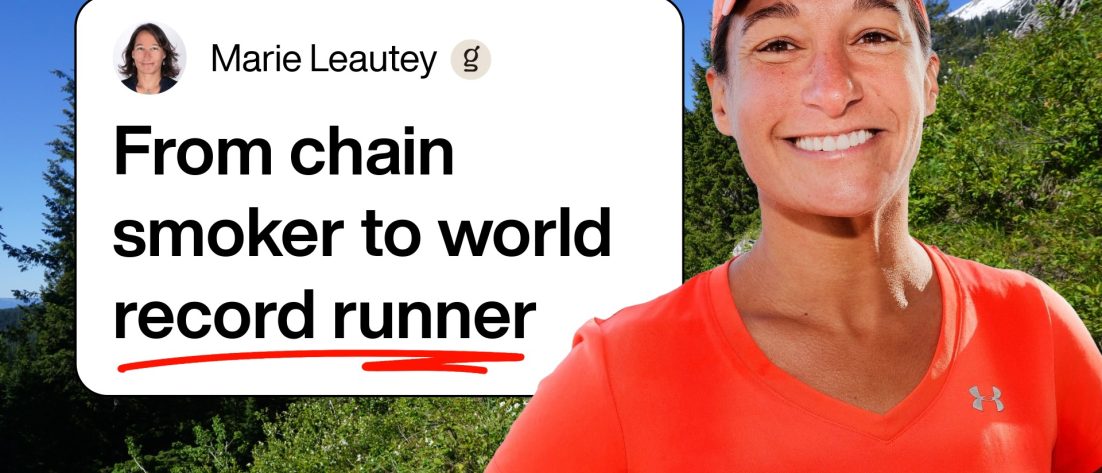
What if you could transform your life from a pack-a-day smoker who gets winded after 500 meters to a world-record athlete? In this episode, we talk to Marie Leautey, the fastest woman to run around the world, who did exactly that. She reveals the incredible story of how an ordinary financial director with no athletic background ran the equivalent of a marathon every single day for 825 days, covering 28,249 kilometers across four continents. How is it possible to endure such a feat without a single running injury, especially when facing a global pandemic, financial strain, and unbelievable logistical challenges?
Marie Leautey shares the unfiltered story behind her book, “Lootie’s World Run.” We explore the official World Runners Association rules that guided her journey, including the requirement to cross a minimum of four continents and pass through two antipodal points. A huge part of her success was figuring out how to avoid running injuries, a problem that sidelines up to 70% of typical marathon trainees. Marie explains her unique “body scan” technique, a mental checklist she performed daily to listen to her body’s signals, rejecting the “no pain, no gain” mentality. This strategy was crucial for running a marathon every day without issue.
The conversation takes a dramatic turn as Marie recounts the moment her journey was halted by the global pandemic. We learn about her experience running during COVID lockdown, where she was forced to pause in Italy, only to find a creative and meaningful way to continue her training: by delivering meals to the homeless on the streets of Paris while pushing her 30kg stroller. Marie also shares unbelievable stories from the road – from a stroller company that rejected her sponsorship request with a legal letter, to a heartbreaking encounter with a grieving mother in North Dakota, a bizarre run-in with a drunken raccoon in Pennsylvania, and a costly mistake involving an onion that led to a $2,600 fine in Australia. This is a profound story about resilience, minimalism, and discovering that the journey, not the destination, is the ultimate reward.
About Our Guest:
Marie Leautey is the author of “Lootie’s World Run” and the world-record holder as the fastest woman to have run around the world. In a remarkable transformation, she went from being a chain-smoking financial director to an elite endurance athlete, completing her global circumnavigation on foot in 825 days. Her story is a powerful testament to human potential and the power of redefining one’s limits.
Learn More From Our Guest / Episode Resources:
Get Marie’s book, “Lootie’s World Run”
Introduction
Blaine DeSantis: Welcome to Books and Looks, where we do a deep dive with authors to help you discover your next great read. What if I told you about a woman, a slightly overweight woman, who was a financial director, who smoked a pack of cigarettes a day, got winded in running less than a kilometer, and yet she went on to become the fastest woman to ever run around the entire world. Marie Leautey reveals how an ordinary woman with no athletic background transformed herself into a world record holder.
She ran 28,249 kilometers across four continents in 825 days. Some people train to run a single marathon. Marie ran a marathon each and every day. This is a great book and a great story about a woman who is so inspiring to each and every one of us. I’m Blaine DeSantis. This is Books and Looks, and today we’re chatting with Marie Leautey about her new book, Lootie’s World Run. Marie Leautey, welcome to Books and Looks.
Marie Leautey: Thank you for having me, Blaine. Nice to be here.
Blaine DeSantis: Very happy to have you. And friends, what a remarkable story Marie has for us today. She is, wow, inspirational to say the least. One of the things that we know is you spent 820 some days running around the world. Around the world. And yet you seem there’s one incident when you’re in Italy, when you’re crossing a river with this stroller. Now, friends, she’s got to go across the river. She’s got to get to the other side. It’s raining. It’s pouring. She’s got to get all her possessions to the other side. She goes across the river. She comes back to get more things. Back, forth, back, forth. And yet you said it made you feel alive. It made you feel so alive. Why is that?
Marie Leautey: It’s because when you are faced with difficulties, and in my case, the difficulty is a river in front of me, and I’ve got no choice but to cross it. It’s frozen. It’s extremely challenging. And when you know you’ve got no other choice than to go through it, it’s exactly like in life. You have to deal with whatever life throws at you. And that’s when you confront it.
In the case of my world run, it’s something very physical. It makes you feel alive in a way that you inhabit every part of your body, every part of your mind, because you need to push forward no matter what. And there is a sense of feeling oneself come alive. That is as best as I can describe it.
Blaine DeSantis: It’s amazing. When I got to that scene, of course, you’re in Italy, my home country. And, of course, there’s nothing. They don’t have a bridge to get you across the road. That doesn’t surprise me. And that was really a fascinating story. What do you do? What do you do? Wow. Well, anyway, now you describe yourself early on as a chain-smoking, slightly overweight financial director. I can’t see you as that, but you said that you were. You then decide to do this. Why are we our misconceptions with regard to doing something as extraordinary as this?
From Chain-Smoker to World Record Runner
Marie Leautey: When I was a chain smoker, overweight, it was up until I was 26 years old. And that’s when I discovered running. I just picked up running as a hobby. I was extremely challenged by it because it was by chance accidents of lives that I discovered I was unfit. Although I was smoking and overweight, I never pictured myself as being unhealthy.
One day, a couple of my friends asked me to go around for a short run with them. And I jumped in saying, yeah, sure, I’ll follow you. And I couldn’t even go around the first 500 meters or so. I was shocked because I didn’t know I was so unfit and so unhealthy. So this is my first shock, really, when I decided to get back to a more healthy way of life.
The idea of the world run came about 14 years later. I was just short of 40 years old when the idea came to me in a moment of serendipity, which I talk about in the book. And I just thought, wow, when the idea comes, and it’s in your mind, and you’re like, what running around the world? I was just taken by it. I thought what a wonderful trip that would be, what a great adventure for my life. And I just I couldn’t think of anything else than that after the idea came to my mind, so I just went with it.
Blaine DeSantis: Unbelievable. That’s just unbelievable. And now to go friends, we all know you can’t run around the world. You can’t go over the oceans and all that stuff. So are there rules for this? What type of rules are there to qualify for being an around the world runner?
The Official Rules for Running Around the World
Marie Leautey: The rules. That’s actually one of the first things I did when I had the idea was to check what exactly is a run around the world. And it helped me a lot that there is actually an association called the World Runners Association, WRA. And they maintain a set of rules. There are about 10 of them. And to date, we’re only seven members in the world. So it’s not much. It must be the smallest running club on earth.
The rules stipulate that, for instance, a run around the world, you have to cross a minimum of four continents from side to side, from ocean to ocean. Except, of course, Europe doesn’t end with an ocean, but Europe ends in Istanbul in Turkey or with the Ural Mountains. So run minimum four, you can run more if you want, in a continuous way. So that means when I’m running daily, wherever I stop my run in the evening, that’s the exact point I’ve got to start my run the next day. So I have a continuous line across the continent. It has to be in one direction. So you choose east to west or west to east and you stick to it.
A funny rule is that you have to pass by two antipodal points. That’s two points that are directly opposite on the surface of the planet. And there are not so many of them because the planet is actually 70% water. So it’s very difficult to find one of these points. Anyways, there were about 10 rules. And they helped me shape this journey, prepare the journey. Because without these rules, I would have been a bit lost as to how do you do it? What does qualify for a run around the world?
Blaine DeSantis: You just don’t start running one day. There’s preparation for this. You have to chart a route I’m assuming in advance.
Marie Leautey: Some people don’t chart the whole thing. They have an idea of where they start on a continent and when they end up, and they do it a bit on the fly. But I’m a very organized and pragmatic person. I like to have a plan. Even if the plan is going to completely explode halfway through my adventure, which it did because of COVID, I like to know that there is a feasible route that allows me to, say, stop in some villages to get some supplies, some water, et cetera.
So I had charted, it took me a long, long time, many, many months. My preparation in total lasted two years before I felt ready to launch. So I had plotted my route. I had figured out the financing because I was self-financed as well. And to be ready physically as well. It took me around about two years.
Blaine DeSantis: Wow. So you just don’t start running. You got to have a plan and you got to get ready and everything else. You’ve got to run some marathons because you’re running a marathon every day. That just blows my mind. You say in your book that 50% to 70% of the people who train for a single marathon get injured training for that marathon. You run 607 marathons and you don’t have a problem. You don’t have any issues really. But then you have something called a body scan, which I think really helped you. Could you explain the whole situation about that?
How Marie Avoided Injury While Running a Marathon a Day
Marie Leautey: Basically, the concept behind is if I was following all the precepts of the concepts in the world of running, I would end up injured just like everybody else. So I really paid a lot of attention to the anatomy, to the physiology, to the biomechanics, to understand how the body is supposed to move and how I can have an acute sense of how my movements, how I can control my movements. I worked a bit with a physiotherapist as well to help me reprogram the way I learned for each stride to make sure it’s efficient and it’s the softest possible impact on my body. By the way, you’re not supposed to hit the ground with the heel, but with the padded bits under your toes which is called the ball of the foot. That’s what is supposed to cushion and that’s if you do it properly you minimize the risk of injury.
So I paid a lot of attention to it and the body scan that you mentioned I developed it. So every day when I was about 5-10 minutes into my run I would start running my scan. And this means mentally saying, okay, how are my toes? Is there something? Is there some chaffing? Is there anything? No? Oh, fine. Okay. Now the underneath of my foot, how is it? And then I would pick every body part from the tip of my toes until the base of my neck and paying attention to any signal that my body would be sending.
The reason why most people who run get injured is that they are told to ignore these signals because of course no pain no gain. Progress means you’ve got to go through some pain and that’s the way of the body of adjusting, which I completely disagree with. If it was to be in pain for two years and a half, I wouldn’t go and run around the world because I don’t have an appetite for pain. This body scan really helped me connect with my body, what it’s sending me, and I would have to adjust to it. If I’m doing, for instance, if I’m running too much on a gravel road or something, my body starts to feel it and feel uncomfortable, then I would go back to the road. Or if there is too much uphill, downhill, whatever, you have to understand what causes the tensions, what causes the body to send a signal and respond to it. And I believe that’s what kept me healthy. How else would I explain 700 marathons without a single injury?
Blaine DeSantis: That just is amazing because I know people who have trained and I know they’ve been injured and it’s like really. And people get excited for a what we call here a turkey trot, which is five kilometers. Oh, I’ve been a turkey trot, okay. And they get injured doing that. And the thing is you weren’t 18, you weren’t 22, you were 40, 42 when you’re doing this. This is amazing. My god, Marie, that’s just fantastic. It’s just amazing. It’s inspirational. But, you start out, you start way the heck out in Portugal. You can’t get any further than you were in Portugal. And you start running across Europe, running with a purpose. And all of a sudden, all of a sudden, COVID hit. The pandemic hits. What happens to your run at that time?
An Unstoppable Run Meets a Global Pandemic
Marie Leautey: I was just like everybody else. I was dumbfounded. And I was in the middle of crossing Italy and Italy became the first country in the world to declare a national lockdown. So from one day to another, 16th of March, 2020, as I checked into my hotel, I’m given a piece of paper that says all the hotels are closing tomorrow. Movement is forbidden. So we advise that you go back to the airport and go back to your whatever, your home country.
I didn’t quite know what to do. So I had to pack and stop the world run. It was completely unexpected. I had been only three months into the world run. So it’s very early in the journey for anything that big to happen. So I ended up relocating to where my parents live in Paris. But of course, like everybody else, I got stuck at home because even in Paris, the lockdown applied just a few days later. And so you’re not allowed to leave your home. You’re not allowed to go outside for training.
And I had to maintain a running form of running a marathon a day. So I tried everything I could. I applied on all the platforms of benevolent work or whatever, thinking if I’ve got a job to do, I will be able to commute. I will be able to move, to run maybe. And I found this job, a non-paid job, of course, whereby my role was to distribute meals to the homeless living in the street of Paris. So I said, OK, I’m taking the job. I will do that. All the lunches and dinner will be delivered. But I’m asking for one thing is that my means of transportation is running and that I carry the meal in my stroller like when I run around the world. They accepted and so I ended up running all day, five, six hours in the street of Paris distributing meals, being completely free and being useful, which was very important to me as well, is to do something useful because I had nothing else. I’m running.
Blaine DeSantis: Did you have to wear a mask?
Marie Leautey: Oh, yeah, of course. Whenever you got the meals, you had to wear the mask, and when you delivered them as well. But in the meantime, when I was running, I was running mask-free.
Blaine DeSantis: Okay. I can imagine that would be very difficult to run with a mask on. Wow.
Marie Leautey: Oh, yeah, impossible, I think.
Blaine DeSantis: I think you’d pass out after a while. Well, that’s really fascinating. That’s the dedication you had for this run. Well, now, when the COVID, they let you go again, did you go back to that spot in Italy or how did that work out?
Marie Leautey: I went back to the exact same spot where I was in Italy and when I had stopped the run.
Blaine DeSantis: Okay. And you continued.
Marie Leautey: And of course, after a few months, I was caught with the second wave of lockdown, which happened in November, December. So I had to put the World Run on hold again. And I continued running. But the difficulty after that became that Europe was puzzled at the time because some countries were in lockdown, some countries were open. So you could cross some borders, some you could not. So I could not go in a straight line anymore. I had to circumnavigate around the borders, around the regulation of the countries that some were open or closed. So instead of lasting six months and a half, my journey across the first continent, Europe, lasted a year and a half at 15,500 kilometers of running. Imagine, after all this running, I’ve just crossed my first continent. And I’m like, Jesus, there are another three continents to cross. What is it going to be like?
Blaine DeSantis: Wow. Wow. Wow. You made it to Istanbul or across somewhere in Turkey. And were you ever supposed to go across Asia? Did this lockdown change things for you?
Marie Leautey: I was supposed to then continue with a bit of Asia and then go straight to Oceania, Australia, New Zealand.
Blaine DeSantis: Okay.
Marie Leautey: And then in a west to east direction, North America, South America, and back to Europe. Of course, Asia was completely closed. So I went back to the rules that said minimum four continents. So I said, okay, fine. So then there will be Europe, Oceania, North America, South America. Unfortunately, that meant I had to give up the bit of Asia that I had planned.
Blaine DeSantis: Right.
Marie Leautey: I wanted to step on more continents than just the bare minimum. But I had to. Asia was closed for so long. And even Australia had to bypass it for a while because it was close for two years.
Blaine DeSantis: Yep, they were really tough.
Marie Leautey: So I had a special exemption to bypass until it reopened.
Blaine DeSantis: Okay. So you end up back in North America next, if I’m not mistaken. Oh, that was brilliant. Yes. Good. Well, now, it wasn’t just you running. You had a companion, a stroller. You took a stroller with you. Now, this is amazing. You carry a stroller. You push a stroller. For two years. That’s amazing. Everything you have is in there. What does that teach you about freedom and all the possessions that we have and how that affects us?
The 30kg Companion: Pushing a Stroller and Embracing Minimalism
Marie Leautey: My life for these two years and a half was lived in a very minimalistic way. I was only carrying maybe three T-shirts for my running, three pairs of shorts and everything, one pair of shoes only, and one clean, like a jean and a T-shirt for when I’m not running, to have my civilian clothes, I called it. And I had a computer on board because I needed to post all my updates and share all my GPS and the satellite location live to verify the run.
So at the end of the day, I’m really living with nothing. I mean, one pair of shoes. And I missed nothing at all. There was not a day where I thought, I don’t know, I missed a pair of shoes or a handbag or a dress. I had more than I needed. I was filled with everything every day because it’s the adventure. It’s this completely crazy run I’m doing. It’s a meeting of people. It’s a discovering of all these landscapes, of all these countries, of all these cultures. This fills you. And when you are filled with all this, anything else becomes irrelevant, unimportant.
Blaine DeSantis: So you pushed this stroller for two and a half years. As a matter of fact, the most significant injury you had was pushing the stroller. Why was that?
Marie Leautey: It’s the only injury I had, not just the most significant. It’s the only one.
Blaine DeSantis: Okay. Actually, that’s very important.
Marie Leautey: Interesting, because we talked about the body scan earlier. And in my body scan, when I was analyzing all parts of my body from my toes to my neck, the only part I was not doing, because I think I didn’t think of it as being part of the biomechanic of running, was my arms and hands. Now, I was running a marathon a day, pushing 30 kilos ahead of me, because the stroller itself is about 12 kilos empty. And plus, I put my bag of belongings, my camping equipment, my water, my food. So, all together, you arrive at about 30 kilos, give or take.
I’m pushing that. So that means I’m grabbing the handlebar, pushing, releasing the handlebar, grabbing again. You’re doing that with 30 kilos all day long, like five or six hours a day. And of course, I didn’t think that it could do any harm. But indeed, I had some problem with my fingers. Now it’s all sorted. But during the run, it became an issue at some point that my fingers, I had too much of it. So I had to find a way to not injure myself further.
Blaine DeSantis: Wow. That’s remarkable. Pushing, not just running, but pushing 30 kilometers a day. Unbelievable. Unbelievable. Well, now, one of the things that you talk about with your companion, the stroller, is that you had to get a certain type of stroller. It had to be able to withstand a lot of heavy duty running. And you write the stroller company about maybe they want to be a sponsor. What’d they have to think about that?
A Sponsorship Story: The Stroller Company That Said No
Marie Leautey: That was so funny. So that was, of course, before I launched onto my world, and I was trying to see if I could get any financial help because I was paying for everything myself, putting all my savings on the line. And some of my friends were like, yeah, you ought to find some sponsors. You know, people ought to be interested in your project. So I wrote to the stroller company saying that this stroller is going to go around the world. What a good advertisement it would be for you to see that your stroller can run tens of thousands of kilometers, that it is so sturdy and solid and everything and reliable and trusty.
I said, on top of that, so it will be the fastest run around the world by a woman. It will be the first stroller to go around the world. I was really trying to wrap it in something quite exciting. And I received an email back from that company, probably written by their lawyer, saying that the use I intend to do of this stroller is not covered by the guidelines of the manufacturer. And if anything happened to me using this stroller the way I do, they declined all form of responsibility. So I was just laughing out loud, thinking, really, you don’t see the magic of running around the world? You replied to me something so stern and so off. And I just laughed at it. And I said, it’s OK.
Blaine DeSantis: Now, did that stroller make it with you all the way around the world? Did you need to get a spare?
Marie Leautey: The first one ended its life after 17,000 kilometers in, I think it was in [Could not verify with context], and it finished its course there because it was all loose and tired. And by complete, by sheer luck, I found another one at the local pawn shop that was for sale and that was brand new. So I got my second one, the replacement one, and it went through to the end with me. But I think 17,000 kilometer for a stroller has to be a world record in itself.
Blaine DeSantis: That might be. Now, that company didn’t contact you after the run was over and say, hey, we think you should come on and be our sponsor? They didn’t say that, did they?
Marie Leautey: Oh gosh, I should have been their ambassador worldwide, exactly.
Blaine DeSantis: Oh my god. Wow. But was it a three-wheeled stroller? So you had the one up front and two in the back?
Marie Leautey: Very strong one. It had shock absorbers on the side. It has very few tires. It was so good. All weather, all terrains. It crossed all the chains of mountains in the U.S., the Rockies, the Appalachian. Wow. It crossed all the chains of mountains in Europe as well. Very good. I could have done very good advertisement for them.
Blaine DeSantis: That’s great. That’s wonderful. Hey, one of the things I found fascinating is that you gave up using a watch. You got your body developed its own internal pace. How did that come about and how does that help you?
Finding an Inner Pace: The Psychology of Running Without a Watch
Marie Leautey: When I was studying why do so many runners get injured, I was going around all the causes that stress our body to get injured. And I think having your run be dictated by numbers is a cause of stress and pushing past sometimes the point where you’re comfortable. If I was going to run for two years and a half, I wanted to disconnect myself from numbers. The only numbers that mattered to me was how many kilometers have I covered so far and today. That’s all. But if you become obsessed with speed and the value of numbers, what happens is that you are getting your reward for your effort, your reward comes in numbers. So some days they are good, some days they are bad. And I didn’t want to have to deal with that. I wanted to enjoy every single day, whatever the pace I’m running at. So I worked on the psychology of that. And I decided early on that I was to be very sure where I get my reward from in this journey.
And in this journey, the rewards are from being on an incredible adventure, seeing new things every day, being on roads I’ve never been on, discovering a new sunset over a new landscape every evening and vice versa in the morning, meeting new people, making connection and discovering the local fauna and flora. With this as my rewards, I was ticking them every day. So my reward box in my mind was full every day even if I’m crossing the Andes and I’m going at 4,000 meter of altitude and of course I’m slower. I’m running up a dumb mountain. So this is not a number giving me feedback, this is the incredible sensation of running in one of the most mythical mountains in the world, crossing it myself. This is an incredible reward.
I discovered that when I do that, I let my body find its own pace because there is no number telling whether I’m fast enough or not fast enough. And I end up running in the most natural way, listening to my body, getting the proper rewards. And yes, it comes without looking at numbers.
Blaine DeSantis: Wow. That’s amazing. And you make a point by saying you were never lonely. You may have been alone, but you were never lonely. That’s fascinating. Explain that theory.
Marie Leautey: I’m not lonely when I cross the world, when I cross countries and continents, because this adventure I am on, it’s not just about the running, it’s not about the running at all. It’s about getting to a new place every day. It’s about making connection with the people who live there. It’s about eating the local food and drinking the local brew sometimes. It’s about having the luxury to take a break in my run because I’m seeing some kangaroos bouncing in the background or to listen to a bird. I have this incredible luxury to be so connected to the world around me. There is no space for feeling lonely, no space for it. My curiosity is aroused all the time by various things and all my senses are capturing the emotions of the world. It fills me. There’s no loneliness there.
Blaine DeSantis: That’s great. That’s really wonderful. You had many experiences, but many people, when you ran, did you ever have to run through any snowstorms or blizzards or anything like that?
Marie Leautey: Especially in Europe. I had my first winter was really, really harsh. And actually, that’s the only time I had snow. But I had some very bad snow in the Ardennes Mountains, which are south of Belgium. And I couldn’t see ahead of me. There was snow on the road. And I was pushing the strollers through. I don’t even know how I made it. And I thought, this day, I remember in the middle of this snowstorm, I thought, but what if I want to stop my run earlier than the hotels I’ve booked or something? But I couldn’t even, the condition was so bad that I couldn’t even get my phone out of the pocket it was in because it was so bad. So I thought, well, I just have to follow the road until I reach the hotels for the night.
Blaine DeSantis: That is something. You ran through all this. And there’s many more questions that you have here, but I want to jump to one, which… The only time you had a physical issue was you were almost near the end if I’m not mistaken and you got yourself, you got COVID. How did you get COVID?
Marie Leautey: This is crazy. I ran through the pandemic and everything and I didn’t even get sick once during this world run. And I’m 10 days from my arrival in Sydney, Australia. 10 days. And I go through this run where I don’t understand how tired I am. I have to stop, lay by the side of the road. I’m like, I’ve been running for two years and a half. I’ve never had anything like that. I don’t get that tired. What’s going on?
And then when I arrived at the place where I was supposed to arrive, I did a test. And it so happened that we had just left Melbourne on the way to Sydney. And in Melbourne, I was staying at somebody’s place. And that lady had informed me that she had COVID and of course she has passed it on to me as well. Fortunately, probably because of the shape I was in or maybe just my DNA, I don’t know, except this journey these days that was particularly hard and tiring, I was able to run without any impact, through to the end. So I was very lucky because if I had been delayed, everybody, my parents were waiting for me in Sydney. They had made the journey around the world to go and see me there. So that would have been a pity to be late.
Blaine DeSantis: By the way, that was neat. That was one of the really neat things in your book. Your mom and dad and your relatives tried to meet you at all these different spots to cheer you on, to see how it’s going. That’s great. Did you know that was going to happen when you first started?
Marie Leautey: I knew that it was going to happen, but I thought it would happen more, to be fair to you, because when I started telling my family that I was going to go on a run around the world, none of them were surprised. They could have said, oh, that’s a crazy idea. And they were all like, oh, yeah, wonderful. So do you know where you are going to run? Where can we meet you for some vacation? They were planning their holidays around my world. I was like, hold on.
So I knew that they were very keen to come and see me here and there. We have four siblings and my parents are still very active. So I was looking forward to it. Unfortunately, because of the COVID situations that developed only three months into my run, I had a lot less visits than I expected. But my parents made the point to try to be there at the end of the continents where they were allowed to do so. So they were there in New York with me. And they were also in Washington, D.C. with me, which was fabulous. And they were there at the end of my world run in Sydney, Australia which was a shared moment.
Blaine DeSantis: Beautiful, no doubt about it. Wow, that’s really great that they were there. And still as we’re talking, something comes in the back of my mind. Something comes to the back of my mind. Wasn’t your grandfather supposed to inherit something in Australia and got into some fight in New York and you just find that… tell us that story. What was that all about?
Marie Leautey: It’s a crazy story. It’s my great-grandfather. He lived, he used to live in, he was living in the [Could not verify with context] part of Italy that is near north of Milan, like Lago di Como and all that. And he went with the wave of immigrants that came around about 1897 I think he came or something like that, just before 1900. So he came to New York by boat. And then he was part of the immigrants working, he went to California and all that. And then he learned that he had an inheritance somewhere.
But for some strange reason, you would have seen that to go to Australia, you would take a boat from California. But he went all the way back to New York and he was supposed to go on board a big ship. And then he was Italian in the worst way, having tantrums. And he had a fight because it was a strike that day in New York where he was supposed to go on the boat. And he ended up being thrown in the water and was picked up by a boat that was en route to somewhere else. So that was the end of his traveling. All the crazy people in the family before me.
Blaine DeSantis: I can’t, that’s what I was trying to figure out. Why did he go to New York? Nothing from San Francisco, L.A.? I don’t know, but hey, back he goes. That’s a neat family story you have there. Wow. Well, most of the time you are running by yourself, but you get a surprise when somebody who you knew, a gentleman of James, asks if he can join you in South America. Why did he want to join you?
From Solo Runner to a Team of Two: A Companion for the Final Continents
Marie Leautey: Well, it was not completely his decision. What happened is that I had been running for two years already completely alone. So crossing Europe and then crossing North America. I was about, I think I was in the middle of the Montana crossing on [Could not verify with context]. And I get the news that my friend James has lost his house in the fires in Greece. His beautiful house completely burned down to the ground.
So I sent him a message to say how sorry I was. And I made a little joke along the lines that you can live a very happy life without any possession. I’ve been living for two years with a little stroller and with almost nothing. And I’m the happiest I’ve ever been. So we start talking like that. And then at some point I said to him, look, you don’t have a house. You don’t have any immediate plans about what to do next. I could use some help because on my next continent, which is South America, I’m going to have to cross the Andes Mountains and run up to 4000 meters of altitude. And if I could do it without having to push my stroller, that would be really, really, really helpful.
And he said, okay, I’m going to need it. Maybe I could do that. Maybe I could come and join you for the crossing of the Andes. I said, yeah, great. And then a few days later, he says, Luke, if I’m going to cross the Andes with you, I want to cross the whole South American continent with you, not just the Andes. So I was taken by surprise, but I said, well, why not? At least this journey is going to be shared with someone. It’s a game changer for me to share it with someone live. So after a few days and nights and runs thinking about it, I said yes, sure, let’s do that. So he came. He came all the way to South America and we crossed South America all together. And then he said, well, now you just have Australia to run. I’d rather as well run and go with you in Australia for your safety. Okay, fine. So he goes to come to Australia.
Blaine DeSantis: Neat. I like that. That’s really fun because it is such a difference going from by yourself to now having somebody you’re working with in a team, almost a partner. And that really helped I think at that point.
Marie Leautey: I thought nothing of being alone. I was perfectly happy being alone. But when suddenly the idea starts forming that, hold on, maybe someone else can accompany me, I started thinking of all the good things that should come with it. Like, oh, then I would have memories of this journey to share with someone else. So when the run is over, we can reminisce about crossing the Andes or Australia or other things.
Blaine DeSantis: Yeah.
Marie Leautey: That’s something I would like, to have somebody to talk to about this thing. Somebody who has a memory of it as well, not just me. And it was brilliant. And it became my partner.
Blaine DeSantis: Well, you have a lot, and this book is loaded, friends, with fascinating stories of kind people, some strange people, but everything that’s going on out there in the world. But you have a few stories that just stick out in my mind and I want you to tell us a little bit about it. You met one lady up in, I’m not sure it was Minnesota or Montana, who comes up to you weeping, weeping and gives you something. Tell us about that please.
From a Grieving Mother to a Drunken Raccoon: Stories from the Road
Marie Leautey: I was crossing, it was North Dakota. I was reaching, I think I was near Jamestown, and a local paper had published a story about me. Sometimes when I go in a small town and they see me coming and somebody informs a local journalist. Anyway, so the story was published about my World Run. And on the front page, I was there with my pink hat, my pink T-shirt and my stroller. So very recognizable. And the next day, there was this car on the side of the interstate that stopped right in front of me. And this woman comes out in floods of tears. And she falls in my arms. She hugs me. She said, thank you, thank you. And I don’t understand what’s going on.
Then she starts telling me her story. This mother, she’s a grieving mother. Her only son died exactly one year ago. So it’s the first anniversary of his death, which is a terrible ordeal for this woman. And she said, I took my car this morning. I didn’t know what to do. I’m so sad. I was looking for a sign that life is worth living. You can imagine my shock. And she says, I read your story yesterday in the paper. I never thought I would see you.
And then she pulled something from her bag, and it’s a little piece of fabric with the name of her son and the date of birth and death. She puts it in my hand and she says, can you promise me that you will take this on your journey through to the end with you? And I said, sure, of course, it will be with me through to the end of this journey. And then she left and she was smiling and she was thanking me.
And then I realized that through this simple gesture, what she did is that she would be able to think about her son, on a wonderful woman who’s going around the world. It sort of shifts where she sees her son. And it was incredibly touching and very moving to this day when I talk about it, I’ve got goosebumps.
Blaine DeSantis: Yeah. And you don’t know her name or anything about her. She just came up to you and gave you this little bit of stitching. That’s amazing. And it went with you the whole way. That’s fascinating. Very neat. Now I want to change from the sad to the bazaar. You’re crossing my old home state, Pennsylvania, and you come across a drunken raccoon. What’s that all about?
Marie Leautey: I know, I had no idea. And especially I’m European, I’m not familiar with raccoons. We don’t have them in Europe. I’ve never seen them. And so I’m running by the side of the road and then I spot this raccoon completely disoriented in the middle of the road. So I go and I try to help him. I’m not sure if it’s a dangerous animal, if I should be scared that he’s going to bite me or scratch me. And so a local guy comes to help me with a piece of compost. We’re trying to move him around. And then traffic starts piling up because, meanwhile, traffic can’t go through because we can’t get this raccoon off the road.
And then comes a local police guy with his police car, and he steps out, and he looks and he says, “Ah, another damn drunken raccoon.” And I’m like, what? And actually, what happened is that the fruit, of course, I didn’t know that the fruit, when they fall off, it was autumn, fall. They fall off the trees and they start the fermentation process which starts creating alcohol and these creatures are so small they eat them and then they get drunk on it. It’s just bizarre. I never heard of that.
Blaine DeSantis: I never heard of it until you tell your story. Wow. I thought that was bizarre. And then you go to Australia and they won’t let you in. They say no. Why did they deny you entrance?
Marie Leautey: They didn’t deny me entrance. They let me in, but I had to pay a fee for it. What happened is that, okay, I cut the short story, but during my travel through South America, so I’m traveling with James, and there is one thing I don’t like about James is that he loves onions, and I am repulsed by the smell of onion. So it’s a little joke between him and I. Every day, he has this little spring onion that is stuffed somewhere in my pack. So sometimes I find it in my running shoes or with my toothbrush or somewhere in my luggage. And always when I find it somewhere, I place it back somewhere in his luggage. So it’s a little prank. Nothing serious. It just travels, the onion travels for three months between his luggage and mine.
Except when we travel to Australia, we have completely forgotten about that onion. But it turns out we go to the border control in Australia and notoriously they ask that you carry no foreign product with you, no meat, no vegetable, no nothing. So we have to fill this declaration and I fill that yes, I believe that to the best of my knowledge, I am not carrying anything. And James says the same. Unfortunately, we are picked up by the biohazard team and they ask us to open our bag. And when I see the security officer opening the top of James’ luggage, it comes back to my mind. I’m like, stop. I know what you’re going to find. You’re going to find a dead onion. And I’m really sorry. And I start explaining the story, except they don’t find it funny at all. And for that onion, I was charged $2,600.
Blaine DeSantis: Oh, my God.
Marie Leautey: For a dead onion.
Blaine DeSantis: A dead onion.
Marie Leautey: There was nothing I could do because it’s either you accept and you pay the fee and the fine or you are not allowed through and I can kiss my little run goodbye. I was very upset because, damn, it was an onion and I was in very good faith. But that person was not an onion.
Blaine DeSantis: Good story. Great story, though. Now, I have so much. I got a couple more questions I got to ask you, though. What was harder, running through the deserts of Australia or up and down those mountains in the Andes?
Marie Leautey: None was hard, but if I have to choose, I would say that probably the desert, but it was not really a desert. No, because crossing the Andes, as physically tough as it was, was so beautiful that it’s actually one of my, if not the best memory of the world run.
Blaine DeSantis: Were you still pushing the cart? Were you still pushing a stroller with you?
Marie Leautey: No, because I had James who was.
Blaine DeSantis: Ah, James. Okay. Yes. Wow. I can’t imagine going up the Andes, pushing 30 kilograms of material.
Marie Leautey: Oh my God. It would have been possible. And the plan was to do it without James anyways, but it was a relief when he offered to help and I thought, it was going to be much better without the 30 kilos.
Blaine DeSantis: Okay. You got to the end of the continent of Australia, which was your fourth continent. You know, North America, South America, Europe, Australia, Oceania. And then you realize you got to go to New Zealand.
Marie Leautey: I didn’t realize. I knew I had to.
Blaine DeSantis: You knew you had to. Okay. I thought it caught you by surprise.
Marie Leautey: That’s part of the 10 rules. I had to run through two opposite points on the planet, and there are not so many. And mine was between Spain. So basically, if you dig a hole in Spain in the town of Ronda and you keep digging through the center of the earth and past it, you will end up in Auckland, New Zealand. So I had to run my final run through Auckland, New Zealand. So I knew I had to do it.
Blaine DeSantis: There you go. Small run. Two continents that you missed. Asia, because you had wanted to, didn’t get there. And Africa. Are you going to go back to try to run those?
Marie Leautey: I think one day I will want to. I’m not in a hurry because I’m doing other things and running at the moment. I’ve got other passions in life to feed. But yes, definitely. And I love the African continent. I’ve been there several times for work. And yes, I think it would be a fun. For me, is it going to be a great adventure? And I think definitely Africa will be a great adventure. Asia, I’ve used to live in Asia. And I know that running through all these different cultures, yes, that also would be a great adventure.
Blaine DeSantis: Okay, that’s what you think. Thank you. So you’re still running, but not as marathony as you were doing it, right? You’re still running?
Marie Leautey: No, no, no. I run to keep in shape and because I like it, obviously. But I’m doing other adventures. I’m doing some adventures on bike a lot. I enjoy cycling a lot, sailing as well. Since I live in Greece, it’s quite ideal for that. So still very much in love of whatever adventure I get to get on with. And enjoying it.
Blaine DeSantis: Well, that brings you to a Greek poem, Ithaca, as a quote about the journey being more important than the destination. Tell us just a little bit about that to wrap this up.
The Ithaca Philosophy: Why the Journey Is the True Reward
Marie Leautey: It’s such a beautiful poem, and it was written by a Greek poet called Constantine P. Cavafy, and it was talking about when Ulysses finishes his journey and he comes back to his homeland in Ithaca, in Greece. The poem starts with, when you launch on this journey, hope that your road is going to be a long one. Because, yes, this is the best part of the journey is being on the journey. And it goes on and it says that you shouldn’t carry your fears with you. Get rid of your fears because your fears are what is going to make it impossible or unenjoyable. So if you carry your fears, the object of it, you’re going to meet.
But if you don’t carry your fears, and look at me, I’ve been two years around the world, I’m still alive, I’ve not been attacked, I’ve not been raped, I’ve not been chased, I’ve not been nothing. The world is a lot safer than we are led to believe, and it’s just feeding the fear feeds this idea that the world is a dangerous place. But if you move away from that, what you get to see is the beauty of the world and the humanity of its people. So he says that and at the end of the poem Constantine P. Cavafy says when you’ve reached Ithaca, don’t expect anything. She has nothing else to give you because she has given you everything by putting you on the road.
And again, it resonated with me because I had put also all my savings on the line for this journey. I finished this journey with empty pockets, not a dime in my pockets. And yet I’m the happiest I’ve ever been. I know I’m going to find a way to bounce back. And it’s the least of my worry. I am so rich of this unique, incredible journey that nobody will ever be able to take away from me. It’s not something that can be even stolen. And I have that for the rest of my life. And I’m the luckiest, richest person on earth. I felt this way. I feel this way. No millions of dollars is going to make me feel happier than my journey. No way. If tomorrow you tell me it’s a million dollars, you go back on your journey. I go back on my journey without hesitation. So this poem for me was epitomized everything, embodied everything that was so great about this journey.
Blaine DeSantis: Great. Well, this is the book, friends. There it is. Lootie’s World Run. It’s time to get some light here. I’m hitting it. But Lootie’s World Run by Marie Leautey. And this is the book. It’s out wherever you can get books. It’s a great book. It’s a simple read. It’s a fascinating read, lots of stuff in it that I took to heart. And I’ll tell you, I think you can take it too. So anyway, Marie, I want to say thank you so much for being with us today on Books and Looks.
Marie Leautey: Thank you very much for having me. Thank you.
Where to Find “Lootie’s World Run”
Blaine DeSantis: Well, if there’s one thing I hope you take away from this conversation with Marie is that transformation isn’t about becoming someone else. It’s about becoming more fully your own self. Her journey from smoking a pack of cigarettes a day to running around the world wasn’t magic. It was a compound effect of showing up each and every day for something that mattered to her.
Her book, Lootie’s World Run, the extraordinary true story of the fastest woman to have ever run around the world. And you can find it wherever books are sold. Again, she’s one of only seven people in the entire world to have ever run around this amazing planet. And with that, another episode of Books and Looks is in the books. On behalf of all of us here at Books and Looks, as well as our partner at BookTrib.com, thanks for letting me be a part of your reading journey. I’ll be back with you next week with a new edition of Books and Looks.