
What’s deadlier: a puffer fish or a great white shark? A tiger or a lion? A beautiful flower or a venomous snake? In this episode, we sit down with PhD entomologist and author Eleanor Spicer Rice to explore the shocking, fascinating, and sometimes gross world of her hit The Deadliest book series. Prepare to have your assumptions challenged as we uncover which creatures are nature’s most lethal competitors—and why the winners might not be what you expect.
This interview is a must-watch for curious kids, parents, and anyone fascinated by the natural world. Dr. Eleanor Spicer Rice, an expert in entomology for kids, reveals the incredible science behind her unique children’s science books, which are formatted like a thrilling game show where animals compete for the title of “deadliest.” We dive deep into the criteria she uses to crown a winner (it’s all about the numbers!) and discuss some of the most surprising contenders from her books on snakes, flowers, big cats, and the upcoming sea creatures edition. Dr. Rice shares why the deadliest flower kills 8 million people a year and why the deadliest sea creature isn’t a shark, but a delicacy people eat on purpose.
Beyond The Deadliest book series, the Eleanor Spicer Rice author discussion covers her journey from studying ants and bees to writing for children. She shares mind-blowing facts, like that the average American eats four pounds of insects a year and that clean houses can contain 100 different species of bugs. We also explore her other work, the Your Hidden Life series, which investigates mind-controlling microbes that can influence your mood and the secret ways your pets interact with the world – like how dogs align with the Earth’s magnetic field when they go to the bathroom. Throughout the conversation, Dr. Rice’s passion for turning fear into fascination shines, encouraging a sense of wonder about the often-misunderstood creatures living all around us.
Introduction
Blaine DeSantis: Welcome to Books and Looks, where we do a deep dive with authors to help you discover your next great read. Now be careful. Don’t touch that. That could kill you. We spend our lives telling our children and our relatives what’s dangerous for them. Now we have a series of children’s books, I guess middle school books, titled The Deadliest, in which the author, Eleanor Spicer Rice, turns her trained scientific eye to such topics as flowers, snakes, spiders, and big cats.
In each of these categories, she has a book, and she categorizes in each of them, in her books titled The Deadliest. This is a superb illustration, and she uses a game show format, where each contestant gives their qualifications, and then she discusses that. And at the end, we have a winner, or maybe it’s a loser. I don’t know. But it’s a great book for the entire family. I’m Blaine DeSantis. This is Books and Looks. And today we’re talking with Eleanor Spicer Rice about her series of books, The Deadliest. Eleanor Spicer Rice, welcome to Books and Looks.
Eleanor Spicer Rice: Blaine, thank you so much. I’m thrilled to be here.
Blaine DeSantis: I am so glad that you’re on and joining us. I tell you what, you have written a wonderful series of science books for children, for kids. I will get into what age this pertains to, but it’s a wonderful book. And here’s one, friends, The Deadliest Flower. We’re here to talk about The Deadliest series. I’m telling you, this is great stuff. Now, I’ve had a lot of people on, Eleanor. I’ve had bridal shop owners turned authors. I had a genetic molecular geneticist turned author, and now I’ve got you, a PhD in entomology. Not etymology, entomology. What is an entomologist?
Meet the Author: Dr. Eleanor Spicer Rice on Her Journey into Entomology
Eleanor Spicer Rice: An entomologist is somebody who studies bugs. Now, sometimes we’ll count spiders in there, but real entomologists don’t count them, or millipedes and stuff, but we could include them. We study bugs. My specialty was ants and bees. Bugs are really important. They’re 80 percent of named life on earth. Most of the world around you that’s named is bugs. 20 percent of life on earth that’s named is beetles alone. So that’s what we study: bugs.
Blaine DeSantis: Did you always want to study bugs, or did you go to college and get fascinated with it? How’d that come about?
Eleanor Spicer Rice: I always liked bugs, and I’m from a small town. So I didn’t know that you could study bugs. You are from the big town of Greenville. That’s a huge city to me. I thought you could be a teacher or a vet. And then when I went to the university, I wanted to study animals and I learned that most of the animals in the world are bugs. So I thought I would get the biggest bang for my buck. If I studied bugs, then I would know the most about things. And it’s worked out because it’s fascinating.
Blaine DeSantis: When you were in your PhD cohort, was there a lot of people there or was it just you? There are a lot of people studying bugs.
Eleanor Spicer Rice: There are tons of us because we’re sneaky, though, because the bugs touch every single thing that you do. One out of every three bites that you eat comes from something that’s been pollinated by a honeybee or a bee. Our crops get eaten by bugs. There are bugs all around our houses. And if you took the bugs out of the world, our entire life would collapse and we would all die. But there are more entomologists than you would think doing sneaky things around in the world.
Blaine DeSantis: I’m going to be checking here. There’s an entomologist here. Don’t see any here right now. They’re sneaking around my house.
Eleanor Spicer Rice: But there are some bugs here.
Blaine DeSantis: There are bugs. Yes, there are.
Eleanor Spicer Rice: Can I give you a little bug fact about your house?
Blaine DeSantis: Go ahead. Give us a bug fact.
Eleanor Spicer Rice: There was recently a study in your house where they found that the average house, clean houses, have a hundred different species of bugs inside their house. Not a hundred different bugs, a hundred different types of bugs inside your house.
Blaine DeSantis: Wait till my wife sees this.
Eleanor Spicer Rice: The more bug species you have in your house, the fewer pests you have in your house. There’s a bug that lives in most of the houses around where I live that’s this tiny wasp. And all it does is fly around and lay eggs in cockroach egg purses and kills baby cockroaches that way. So the wasp’s babies hatch out in the egg purse, it swims around in the egg purse, eats all the baby cockroaches and then hatches out as a wasp. And they live in houses all over the place. And so we’re surrounded by bugs. Plus, you’re never more than four feet from a spider. That’s a real thing, too. You’re surrounded by spiders everywhere.
Blaine DeSantis: Do you know that wasps go into figs and then the fig toxin kills the wasp?
Eleanor Spicer Rice: I don’t know. I know that without a wasp, we would never have figs. Because the fig is designed to only be pollinated by this one type of wasp, which has to climb into the fig. They die in there.
Blaine DeSantis: They die in there. Yes.
Eleanor Spicer Rice: They do die in there after the thing is pollinated. And then every time you eat a fig, you’re eating lots of dead baby wasp.
Blaine DeSantis: My wife’s making fig preserves tomorrow. So I’ll make sure she tries to fish out any little remnants of the wasp.
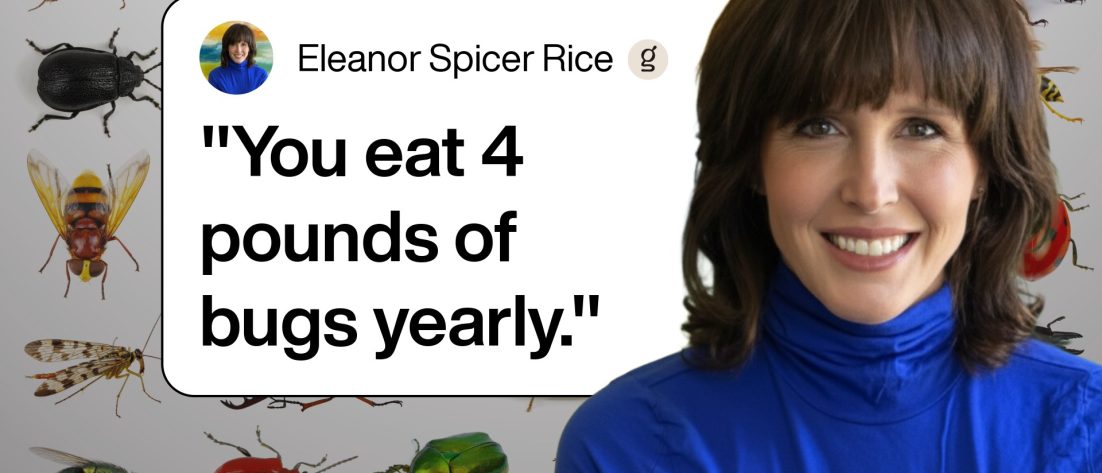
Eleanor Spicer Rice: The average American eats four pounds of insects a year in their food.
Blaine DeSantis: Oh, my Lord.
Eleanor Spicer Rice: If you go through what the USDA allows in your food, it’s one cockroach or one insect leg and two wings per jar of peanut butter. You’re eating tons and tons of bugs every year without knowing it. You’re welcome.
Blaine DeSantis: I told you this interview could go on and on, didn’t I?
Eleanor Spicer Rice: It’s amazing.
Blaine DeSantis: Did you begin your writing career focusing on ants? How many books did you write on ants? And do ants differ from region to region? Is this true?
Eleanor Spicer Rice: I have one that’s a big picture book that you can just look at. This incredible photographer took pictures and he let me write about it for adults. And then there’s one for all ages that goes through California, Chicago, New York, and then all around. And then in that series, there’s also one about spiders. Do you want to know, can I tell you something about that?
Blaine DeSantis: Feel free.
Eleanor Spicer Rice: I had just gotten a PhD in ants. I was hanging out with the biggest—I don’t mean to brag here—but the biggest ant people in the world. Nobody cares about ants, and people do. But I started to write the books and they’re called Dr. Eleanor’s Book of Common Ants. And I asked around and I said, what’s the most common ant living here? What are our common ants? All the experts. Nobody knew. Nobody knew what was common because we rarely look around us to see what’s happening.
So they got people, just everybody, citizens, to mail in their ants to find out what the most common ants are living around us. And they were shocked. We were shocked at what we found that was common. We just had our idea of what the pests were because we don’t think about bugs unless they bother us. But most bugs are not pests. Most bugs are extraordinarily helpful. And it’s the same thing with spiders. We had no idea what the most common spiders were that live around us. But now we do. You can read the books.
Blaine DeSantis: There you go. I know there was one for Los Angeles and there was one for Chicago. Do those ants differ or do you just focus on different ants?
Eleanor Spicer Rice: Well, some of them, there’s some overlap and then some of them are different because they live in different things. In LA, it’s a Mediterranean climate. So there are different kinds of ants that can live there. In my state, North Carolina, we have 250 species of ants that we know about that live here. You in South Carolina actually have a few more species that we know about that can live there. So it just depends on your climate and the types of plants that you have that allow the ants.
But ants are extraordinarily important to the world. They’re one of the most important creatures we have on the planet. If you took all of the bugs away, life would stop. If you took all of the ants away, life would also stop. They turn more soil than earthworms. They operate at every single level of the food web. They’re really, really important to have around. But I understand that they also drive you crazy when they’re hanging out in your kitchen.
Blaine DeSantis: So when I have ants in my pants, there actually may be ants in my pants. You never know.
Eleanor Spicer Rice: There might be ants in your pants. You should say hello.
Blaine DeSantis: Now you switched from ants to writing children’s books. First of all, why did you decide to do that? And then you started out with this series called the Your Hidden Life Series. How did that come about?
Exploring the “Your Hidden Life” Series: Microbes, Pets, and Secret Conversations
Eleanor Spicer Rice: The Your Hidden Life series came about because there’s a National Science Foundation grant from all of these research institutions who were studying mind controlling and behavior altering microbes. And they realized that there was nothing written for children about these things. So the National Science Foundation worked with these labs who worked with me to write a book about it. I did not want to write it because I thought it was going to be boring, but it turned out to be one of the most fascinating.
Microbes control everything. Most of your body is microbes. Our most conservative estimates is three to one in our bodies, microbe cells to human cells. They make the same neurotransmitters that our brains make to talk to each other. So microbes in your stomach can literally make you feel depressed or happy. And you think it’s you, but you’re being controlled by these creatures that are living inside of you. There are tons of microbes. They cover every surface, every piece of your body.
Blaine DeSantis: So that is a children’s book. That is a children’s book.
Eleanor Spicer Rice: It’s a children’s book. It talks about what the microbes are doing to our cicadas, what microbes are doing on our pets, what they’re doing. It helps children to see microbes, these animals that you can’t see. And then after that, the second book in the series, it’s about weird stuff that your pets do that you can learn the science behind it. Can I tell you something weird that your pets do?
Blaine DeSantis: Sure. Absolutely.
Eleanor Spicer Rice: You have a dog.
Blaine DeSantis: Yes, I do.
Eleanor Spicer Rice: So here’s what I want you to do. When your dog goes to the bathroom, I want you to watch it. Because you know how they spin this way and they stop?
Blaine DeSantis: Oh, yes.
Eleanor Spicer Rice: And that way. And then they stop at a random place?
Blaine DeSantis: Yes. Okay.
Eleanor Spicer Rice: It’s not random. When your dog stops to go to the bathroom, they’re nine times out of ten aligning their body with the north-south axis of Earth’s electromagnetic field.
Blaine DeSantis: Can you believe that? Wow.
Eleanor Spicer Rice: It’s real. And they’re doing it because that’s one of the ways that we discover that dogs help navigate their ways on these incredible journeys you see that get home.
Blaine DeSantis: Yes, yes.
Eleanor Spicer Rice: That’s the case, because they’re able to detect Earth’s electromagnetic field, and animals who do that feel more comfortable when they’re lined up with the axis. So they’re just being a little compass needle when they’re going to the bathroom and they stop. So look at the sun next time. See where north is, or east or west, and then watch and see which way they line up. I guarantee you.
Blaine DeSantis: You’re right. I don’t walk the dog because I have some ambulatory issues, but I see my wife walking him. And you’re right. He does do north-south.
Eleanor Spicer Rice: But not to east-west. You don’t want to unless it’s an emergency. Then there might be something wrong with them. But in general, they’ll line their bodies up north-south. So the second book explores that kind of behavior. And then the third book in that series is coming out next year and it’s about all these conversations that are going on around us with animals and plants and stuff that we can’t really hear, but we can tell that it’s going on if we know what to look for.
Did you know that turtles are very vocal? We always thought they were silent until the last five years and somebody finally started listening to them and they talk in infrasound. So ultrasound is too high for us to hear, infrasound is too low for us to hear. Turtles talk all the time in infrasound. They have whole languages between each other now.
Blaine DeSantis: These are kids’ books, friends. These are for those of you out there. These are books that are designed for your children to learn something. And you know what? We learn more than the kids.
Eleanor Spicer Rice: It’s fantastic.
Blaine DeSantis: This woman, she’s an amazing author and writer, I’ll tell you. Well, let’s move on. Now, your books, these are called children’s books. What age do you think they’re appropriate for? It’s not that they’re gross or gory or anything, but the reading and the understanding.
Eleanor Spicer Rice: I would say adults think that they’re gross. Children usually don’t. But I would say an advanced second grader up through sixth grade. Sixth grade might be a little bit old. People call it middle grade books. So third through fifth is the usual.
Blaine DeSantis: Okay, there you go. All right, now we know that. Now you then started your series called The Deadliest. And as I said, friends, I’ve shown you one. I showed you the flower. Here’s The Deadliest Snake. That’s another one we have. There he is. Look at this wonderful drawing, too. We’ll get into all this, but it is great.
Inside “The Deadliest” Series: A Game Show of Nature’s Most Dangerous
Eleanor Spicer Rice: I’m telling you, I have the other two. You want to see the cat? There’s cats.
Blaine DeSantis: And there’s more. Oh my word, there’s spiders and there’s big… yes, yes. How many have come out and been published so far? Tell everybody that.
Eleanor Spicer Rice: Four have come out so far and then two more will come out at the end of the year. So we’ve got spiders, cats, flowers, and snakes. And then at the end of the year, we’ll have insects and sea creatures.
Blaine DeSantis: Can’t wait for sea creatures. I’m really looking forward to sea creatures. I’ll tell you what, tell our friends at W. W. Norton & Company to send one down my way because I love sea creatures. That’s wonderful. Now, things that strike me with your book include the illustrations. Did you pick the illustrator or did Norton?
Eleanor Spicer Rice: Norton picked Max Temescu. I had never met him before and he’s just great. He spent so much time in natural history museums looking, because he’s an artist. He didn’t spend a lot of time looking at nature or science.
Blaine DeSantis: Right.
Eleanor Spicer Rice: So he wanted to get these just right. He would go down to the museums and look at the actual specimens and then watch videos of how they moved and what they were like to make sure it was correct. So he was really good about that.
Blaine DeSantis: Wow. And how did you figure out which ones you wanted to do? Was there a way you wanted to present this Deadliest series?
Eleanor Spicer Rice: I pitched the series using spiders because I know a lot about spiders and I know that spiders don’t really kill people like we think that they do. There’s a lot of misconception. So I thought children would read these books and get reassured by the world. But then I found out that everything else basically kills you. So I had just thrown in a bunch of extra ideas after spiders without researching it. And then it turns out that big cats eat people every year, and sometimes in horrifying ways. The snakes in India alone kill 60,000 people.
Blaine DeSantis: Yes, yes, yes.
Eleanor Spicer Rice: Like whole cities.
Blaine DeSantis: Well, let me just show everybody what everybody’s commented on with this photo because it’s so… This picture here: “Some things make you vomit.” There you go. This is the stuff you find in here, friends.
Eleanor Spicer Rice: Poor Max Temescu had to just take these words and turn them into things for children.
Blaine DeSantis: They’re wonderful.
Eleanor Spicer Rice: And children can handle it. That’s what we found. And it helps them feel empowered to be a part of the world because it tells you not everything’s good. Most stuff doesn’t hurt you. So learn what does, and then you’re fine with all the rest of it.
Blaine DeSantis: Well, now what you’ve done is you’ve made this a format that is just so different, so unique, so spectacular. You make it like a game show. Now, here we are on snakes again. Meet the contestants. I feel I’m watching The Price is Right when I’m looking at this stuff. Come on down, Mr. Black Mamba.
Eleanor Spicer Rice: It’s true. Coming out.
Blaine DeSantis: You thought of this all by yourself?
Eleanor Spicer Rice: I thought it would be fun to have them compete.
Blaine DeSantis: It is so great.
Eleanor Spicer Rice: Well, thanks. And we have a winner. You have to have one.
Blaine DeSantis: We’ll get to that. But yes. And then what you do is you give us the contestants and then they’re so proud to show off why they are the deadliest.
Eleanor Spicer Rice: Yes, they are. And some of them are horrifyingly deadly.
Blaine DeSantis: And yet you get all of this information with multiple pictures and boxes of facts and everything in 40 pages. Is that a hard thing to do, to whittle it down to 40?
Eleanor Spicer Rice: It is. And I wish I could do less. Every book, because I’m a science nerd, has about between 75 and 150 peer-reviewed journals, facts that go into it. So I went back to the original research. Some of the stuff that’s in the books has never been published for popular audiences before. So it was really hard to… every single thing was so cool and so it was hard to not say everything that’s cool. You just had to say some of the cool stuff.
Blaine DeSantis: But I was told last year when talking to, I think it was Sarah Albee who did children’s books.
Eleanor Spicer Rice: She’s so cool.
Blaine DeSantis: Every kid’s book has to be of a multiple of four. So you can’t do 37 pages, got to be 36, 40, 44. You got to have that. That’s what the publisher can do. So 40 pages, concise, informative, tremendous. And then we get to the end of the book. We get to the end of the book and you come up and friends, I got to show this. I’m fumbling there. What are you doing, Blaine? I’m trying to get to the pages. You get in every book, you get to the death-o-meter. At the end. And now, concisely, it shows to you why he thinks they should be considered.
Eleanor Spicer Rice: Yeah, I think, the deadliest.
Blaine DeSantis: Yeah, it tells you how many they kill each year. Exactly. Well, tell me, because I just showed the big cats. And you always have in big cats, well, in all your other books, you have seven. What happened to this one? We don’t have seven in big cats. What’s the story there?
Eleanor Spicer Rice: We have six, all of them. It’s a sixer.
Blaine DeSantis: Why is that? What happened? There are more than six big cats, though.
Eleanor Spicer Rice: There are more than six big cats. So we had to kick somebody out. We kicked the snow leopard out because they’re the smallest and they can’t roar. There are seven big cats in the world. Cheetahs also don’t kill anybody, but people think that they do. And so he got to stay in. The cheetah got to stay in.
Blaine DeSantis: What is a lynx?
Eleanor Spicer Rice: A lynx is a lynx. A lynx is a type of cat that’s not big enough to be a big cat. There’s a size cutoff with these cat people.
Blaine DeSantis: There is. There is a size cutoff.
Eleanor Spicer Rice: There’s a lot of cats. I think there’s 38 species of cats or something in the world. And then there’s only seven that can be the big cats. And so the lynx doesn’t, poor little guy. I think the snow leopard is our smallest big cat.
Blaine DeSantis: Right. Well, now, we eventually in every book, we have a winner. You have to have a winner. If you have contestants, you got to have a winner. Now who chooses the winner? You choose it. Do you have a criteria for choosing the winners?
How is the “Deadliest” Crowned? The Criteria for Winning
Eleanor Spicer Rice: I do. I had to make it across the board what would happen because there’s one thing about being deadly is that some animals could kill you, but they don’t. So I had to pick the winner based on who kills the most people. The snake with the most toxic venom doesn’t really kill anybody because nobody ever sees it. So that’s not the deadliest. The snakes that kill the most people are the deadliest. And it’s the same thing with flowers. The deadliest flower is by far one of the least toxic flowers, but it kills 8 million people every year.
Blaine DeSantis: Yes, I know.
Eleanor Spicer Rice: And the deadliest sea creature… can I tell you what the deadliest sea creature is? Could I ruin this book?
Blaine DeSantis: The book hasn’t come out yet, so feel free.
Eleanor Spicer Rice: Spoiler. OK, so the deadliest sea creature is… do you want to guess?
Blaine DeSantis: I don’t know what you consider a sea creature.
Eleanor Spicer Rice: A shark. Anything that lives from the ocean. No, it’s not even remotely a shark. I put a shark in there to make people feel good because they’re scared of sharks.
Blaine DeSantis: Okay. How about a ray? A stingray, a manta ray, something like that.
Eleanor Spicer Rice: Puffer fish. It’s a puffer fish.
Blaine DeSantis: The puffer fish. Yes, people eat that.
Eleanor Spicer Rice: Because we eat them on purpose. Yes. So the most toxic sea creature is this weird little snail called a cone snail. My word. It’s me being stupid. So anyway, the deadliest sea creature is the snail. He’s very toxic. One snail could kill 700 people with one sting.
Blaine DeSantis: But nobody ever dies from them.
Eleanor Spicer Rice: Because nobody ever sees them. But puffer fish are way less deadly than that snail but they kill up to 50 people every year because we eat them on purpose.
Blaine DeSantis: I was gonna say, don’t the Chinese, Koreans, Japanese, isn’t that a delicacy over there?
Eleanor Spicer Rice: And here in some places. They have specially trained people to know how to prepare them but every now and again they get it wrong and they get this toxin left in the meat from the puffer fish and then the people die.
Blaine DeSantis: My daughter is in Vietnam. They’re right on the sea there. I’m worrying. I’m going to tell her, don’t eat puffer fish if they have any. I don’t know if there’s another way to call them over there. Stay away from the puffer fish. She ends up in Vietnam because she’s a Pokémon Go influencer. She’s been in Thailand, Spain, Romania, Japan, you name it. She and her husband are traveling the world looking at Pokémon.
Eleanor Spicer Rice: That’s amazing.
Blaine DeSantis: Yeah, it is. So that’s my daughter. But anyway, so you do end up with a winner. Now, there is controversy. And I do want to say that, friends. There is controversy.
Eleanor Spicer Rice: There is controversy.
Blaine DeSantis: Because when you get to the big cat, there is controversy. There are two big cats which I think should be the winner.
Eleanor Spicer Rice: Tell me about it.
Blaine DeSantis: Well, I don’t want to give away who it is, but two big cats kill about the same number of people each year. You chose one and not the other. Was that a hard thing to do? Or what was the… when it gets that close, how do you decide?
Eleanor Spicer Rice: Well, I decided because of the math. There’s a lot more of one of the big cats that kills people than there is of the other. So per capita, the winner kills the most people. There are very few of the second one and shrinking. So they kill more people per capita than the other ones. And what I learned from the Big Cat book is how perilous it is for them, for the big cats. They’re just going away, and quick. And one of the main reasons that tigers, for example, are going away is because we eat so much of something called palm oil, which I thought we didn’t eat. It’s in everything. Our demand for palm oil is tremendous. So we keep taking away their houses to build this. And that’s when we come into conflict and that’s when everything falls apart for both of us.
Blaine DeSantis: We’re talking about the big cats. And friends, so you know who we’re talking about here, we have the tiger. And you gotta love this picture. Here he is with sunglasses on. This is so great. It says, “I got style and claws to match. Say hello to the tiger.” And for each one of these, we have the tiger, we got the leopard, there’s the cheetah, we got the cougar, the lion, and the jaguar. And what we don’t have is our dear friend, the snow leopard.
Eleanor Spicer Rice: We don’t have him. He’s just stuck off on the page later, but we explain him.
Blaine DeSantis: Yes, you do.
Eleanor Spicer Rice: We could do a sequel, Blaine, and we could include your snow leopard if you needed us to.
Blaine DeSantis: It’d be wonderful.
Eleanor Spicer Rice: Because they’re so good.
Blaine DeSantis: Medium cats. They are. They’re pretty animals. Absolutely.
Eleanor Spicer Rice: They are.
Blaine DeSantis: Well, that was bringing me to the question. Are there medium cats that kill people?
Eleanor Spicer Rice: Yes, people get killed sometimes from medium cats and small cats. But usually it comes from freak accidents. The big cats are by far the cats that kill people. I bet, and I haven’t Googled this, but I bet more people die from tripping over their cats than most of these big cats.
Blaine DeSantis: Wow.
Eleanor Spicer Rice: Or from the diseases that our cats give us.
Blaine DeSantis: We have a board game night every Wednesday here. We play Catan with our friends, [Could not verify with context], and they have two cats. I’m going to make sure that we do not go to their house because I don’t want to trip over any cats. We’ll be here. I love playing Catan.
Eleanor Spicer Rice: Or just go prepared because forewarned is forearmed.
Blaine DeSantis: Exactly. Now, again, The Deadliest Flower, that was fascinating. It threw me for a loop. And we’re not going to tell people what it is, but it was, as you said, it’s something that we do, which makes it the deadliest. It might not have the most toxin in it, but it’s what kills most people. If you had to pick a second place one, though, who would be in second place? Would it be the Belladonna, the Deadly Nightshade? Where would it be?
Eleanor Spicer Rice: Go with Wolfsbane because people encounter it so rarely, but it just knocks everybody out who takes it. I don’t know who people are that walk around eating flowers, but some people do.
Blaine DeSantis: Yes.
Eleanor Spicer Rice: And so wolf’s bane is highly, highly toxic. So just don’t. Or if you want to eat something, ask somebody who knows. If you ask somebody, they can tell you if it’s deadly or not. I will forage for mushrooms sometimes because I know maybe four mushrooms that you can eat and so people will send me pictures of mushrooms that look similar but not a lot, and those things won’t kill them. They can eat them. So be sure to ask before you eat something out of the wild if you don’t know already.
Blaine DeSantis: You have four out in The Deadliest series, you got two more coming out. Are there more planned after this in The Deadliest series?
What’s Next? The Future of “The Deadliest” and Other New Books
Eleanor Spicer Rice: I have some that I would like to write, but I don’t know if they’ll go for it. I really want to do Deadliest Mushroom because, as you know, Blaine, mushrooms can kill you in some really crazy ways.
Blaine DeSantis: That would really be a good thing. You can tell your publisher to call me.
Eleanor Spicer Rice: And then I want to do Deadliest Bird because I think that’s a little bit of a surprise.
Blaine DeSantis: Oh, wow.
Eleanor Spicer Rice: And I want to do Deadliest Weather, like the types of weather that kill the most people. But I don’t know. They may say, yes, they may say, go away and leave us alone. We’ll find out.
Blaine DeSantis: I am a person who loves even numbers. So you need to get an eighth one in there or whatever it is.
Eleanor Spicer Rice: What do you think it should be?
Blaine DeSantis: I’m going to think about that. I will have to think about what it would be. The birds are a very fascinating thing. Very, very fascinating. I like that.
Eleanor Spicer Rice: There’s really only one or two birds that kill people. We could do the deadliest shark, but sharks really aren’t that deadly.
Blaine DeSantis: No, no. And then they have their whole shows and shark weeks and all that other stuff. No, we don’t need that.
Eleanor Spicer Rice: Something that we need to unnecessarily frighten people over.
Blaine DeSantis: We’ll come up with something.
Eleanor Spicer Rice: Okay. We’ll come up with something.
Blaine DeSantis: You talked about the Your Hidden Life series that had two. You mentioned there’s going to be a third one coming out. When is that going to come out?
Eleanor Spicer Rice: That comes out next year. And we have a picture book through Candlewick also coming out next year about where animals go when it rains. Do you ever think about that when the storms come? Where do the birds go? What are the squirrels doing? So it tells you where they go. And it’s just a sweet little 32 divisible-by-four page picture book about that next year in 2026.
And then I have another picture book coming out that I wrote with Ouray Crowfoot, who is the chief of the Siksika Nation in Canada. And he and I wrote a book about the ways that First Nations, is what they say in Canada, Indigenous America, the scientific advancements or innovations that they have made that we still use today and how their scientific method worked, because there’s more than one way of learning and knowing and doing things. We really focus in on our scientific method, but they come up with some pretty incredible stuff: baby bottles, syringes, aspirin, hammocks, you name it. A lot of the things that we rely on to survive today were innovations that were made by our First Nations people. So he and I wrote a book. That’ll come out in 2027.
Blaine DeSantis: The Deadliest Creatures of the Arctic. There you go.
Eleanor Spicer Rice: Yes. The ones most of us never need fear. I wonder what it would be. You think it would be… well, you could probably put your snow leopard in there again. Do you think it would be a polar bear?
Blaine DeSantis: Could be. It might very well be. I don’t know. Also, I know that when it was global warming, it exposed the permafrost. And when the reindeer were hoofing it through the permafrost, they were releasing all these bacteria that were killing the reindeer and killing people up there.
Eleanor Spicer Rice: I saw this thing last night, this excellent documentary about how we’re trying to save our white rhinos. Oh my gosh, [Could not verify with context] made it for National Geographic. She’s incredible. She’s so amazing. Did you see where they exposed all those mummies from the mass with the El Niño coming through and poor rhinos died?
Blaine DeSantis: They showed a little baby.
Eleanor Spicer Rice: This little baby rhino in her hand. Little babies in her hand. That was awful.
Blaine DeSantis: I felt so badly for the one, the German gentleman whose wife had cancer. His wife was dying.
Eleanor Spicer Rice: Horrible. I know. My children kept looking at me every five minutes and were like, are you crying again? Because there was so much joy and silence.
Blaine DeSantis: And friends, unpaid plug here. If you get Hulu, it’s called [Could not verify with context].
Eleanor Spicer Rice: [Could not verify with context].
Blaine DeSantis: It’s a wonderful show on the northern white rhino. Never knew there was a southern white rhino, but now I know that there is. So that’s a wonderful show on Hulu. And I love watching shows like that. I think that’s the most fascinating thing.
Eleanor Spicer Rice: I think it’s wonderful for us to watch shows like that and to read books like that where we see things that aren’t necessarily tailored to our interests. Because then we really learn wonderful things.
Blaine DeSantis: Right. And that’s what your books do. And that’s why I think this is such a necessary addition to libraries, to kids’ reading, to parents reading to the kids. Because they’re going to be teaching us good facts that we don’t know about, educating us to the world. And I really think this is one of the greatest series of science books for children, and adults, that I have seen. I’ve been raving about this for a long time.
Eleanor Spicer Rice: I really hope that these children will go outside. A lot of these books are about things that don’t live near us. But what I’ve learned through talking to thousands and thousands of children is that the animals that they know most about are the ones that they see on television. And data backs us up on this. They know more about the white rhino and they know more about koalas than they know about raccoons or Carolina wrens. And so I’m hoping that it’ll help children to feel empowered to go outside, start wondering about what’s living right around them.
Blaine DeSantis: You could even do The Deadliest and then pick a continent. The deadliest creature on Australia, the deadliest creature in Asia. And we could go on and on about this.
Eleanor Spicer Rice: I’m learning that Australia and Asia, everybody’s deadly. That’s where people are super, super duper deadly.
Blaine DeSantis: You’re right. You’re right.
Eleanor Spicer Rice: The United States, we’re doing pretty great in terms of…
Blaine DeSantis: Pretty good, yeah. You’re going to have another one coming out in the Your Hidden Life series. Is there going to be a fourth one then in that series also?
Eleanor Spicer Rice: It’s just three for that one series. So Secret Conversations, the bacteria and microbes that control our lives, and then pets and all the weird stuff for pets.
Blaine DeSantis: And these books, The Deadliest series, are all 40 pages. The other ones, how long are the other books in the Your Hidden Life series?
Eleanor Spicer Rice: They’re much longer. I’ve actually got Your Pets’ Secret Lives. It says 215 pages, but they’re about 200 pages. But they’re illustrated by this wonderful illustrator. I can turn to any page in this book and show you something delightful that he has done. His name is Rob Wilson and he is originally a fashion illustrator. Here are some hamsters having a steam. He does beautiful illustrations and we interview scientists who are studying this stuff. So this book you can more hop around to what’s interesting. So that’s wonderful.
Blaine DeSantis: You get a lot of feedback from parents, from libraries, from schools?
From Fear to Fascination: The Impact on Young Readers and Parents
Eleanor Spicer Rice: I do. Parents a lot of times tell me that it’s gross or that they’re frightened and the children tell me that they love it. That’s something that I’ve learned through writing these books that’s been a gift to me. I give talks to adults all the time. I write a nature column for a North Carolina magazine. And so I can give the same talk to adults and children about ants, for example. And I’ve learned that everybody can understand anything.
When I finish the talk about ants, the adults have the same first two questions almost every time, which are, “How do I get rid of them?” and “What good do they do?” And those are good questions. But the children have different questions. The children will say, “Who are its mothers? What do they eat? How do I take care of it? Where do they sleep?” There’s a wonder on this side. And then there’s this pragmatic use on that side. What I’m hoping for, because the parents are very frightened of the deadliest animals and the children are very excited about it, is just to turn our heads back toward the wonder a little bit more and start thinking about things with wonder. Because the world is not that scary. It’s actually wonderful.
Blaine DeSantis: The more you know about it, you’re right. You’re absolutely right.
Eleanor Spicer Rice: The more you know, right.
Blaine DeSantis: Do they still sell those in-glass ant colonies you can get and you see the ants going around?
Eleanor Spicer Rice: They sell them. I read something yesterday that they’re being affected by the tariffs right now.
Blaine DeSantis: Unbelievable. You never know.
Eleanor Spicer Rice: But you can build one yourself with ants in your yard. So just find out what they eat, how they like to live. Pay attention to them and you can bring them on inside, and your parents will kill you.
Blaine DeSantis: That’s exactly right. All right. Well, very good. This has been one of the most informative and fun shows we’ve had. And I want to say just thank you. Thank you so much, Eleanor Spicer Rice, for being with us today. You’ve been a wonderful guest.
Eleanor Spicer Rice: You’re such a joy to talk to. I really appreciate you having me on.
Blaine DeSantis: Thanks, Eleanor, for this highly fun and informative series on The Deadliest. I don’t know about you folks, but I think this is going to be a huge hit with kids, parents, school libraries. This is one of the most unique science series designed for children that I have ever seen. And to be quite honest, it teaches us adults a whole lot that we didn’t know about.
And so another edition of Books and Looks is in the books. On behalf of all of us here at Books and Looks, as well as our partner at BookTrib, we thank you for allowing me to be part of your reading journey. We’re going to begin our fall season in just two short weeks. So come back then looking for a new edition of Books and Looks.