

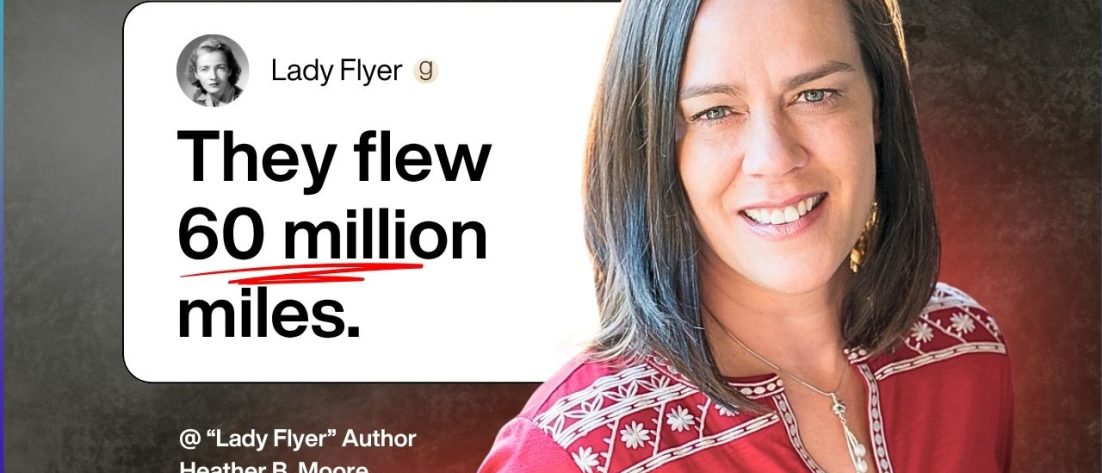
During World War II, a groundbreaking group of elite female aviators flew over 60 million miles in every type of military aircraft, from the P-51 Mustang to the B-17 Flying Fortress. They were the Women’s Air Force Service Pilots (WASP), and after proving that women belonged in the cockpit, their program was abruptly disbanded and their contributions were erased from history for decades. How did this happen? In this episode, we uncover the hidden history of these forgotten pioneers with bestselling author Heather B. Moore.
Heather B. Moore’s meticulously researched biographical fiction novel, the Lady Flyer book, brings to life the incredible story of Nancy Harkness Love, the quiet, lead-by-example director who founded the program. We explore the immense challenges these WWII female pilots faced, not just in mastering dangerous aircraft, but in battling constant bureaucratic red tape, gender bias, and political opposition. This is the story of how over 1,000 women answered their nation’s call, only to be told to go home so men could have their jobs back.
In this deep dive, Heather B. Moore reveals the fascinating details behind the WASP program. We discuss the critical difference between the WAFS (Women’s Auxiliary Ferrying Squadron) and the broader Women’s Air Force Service Pilots (WASP) organization, exploring their 60-million-mile mission to ferry newly built warplanes from factories to air bases across the country. The conversation also delves into the complex and often contentious relationship between the program’s two most prominent leaders: the introverted and highly respected Nancy Harkness Love and the aggressive, self-promoting Jackie Cochran, who ran the training division. Heather shares insights from her extensive research, including stories of unimaginable bravery, heartbreaking tragedy, and the internal politics that nearly grounded the program before it could take flight. We also touch upon the shocking dismissal of the WASP in 1944 and their long, arduous fight to gain official veteran status decades later, a testament to the perseverance of these remarkable women.
About Our Guest: Heather B. Moore is a USA Today bestselling author of more than seventy publications. She is an expert in writing biographical fiction and meticulously researched historical novels that shine a light on forgotten chapters of history. Her works, including Under the Java Moon and the acclaimed Lady Flyer book, are praised for being 90% history, bringing the past to life with compelling accuracy and narrative depth. In this episode, she also gives a sneak peek into her next project about another surprising WWII figure: the French chef Julia Child and her secret work for the OSS.
Introduction
Blaine DeSantis: Welcome to Books and Looks, where we do a deep dive with authors to help you discover your next great read. Now, what if I told you that during World War II, over a thousand women flew every type of combat aircraft in the U.S. Military arsenal, from fighters to bombers, and then were told to go home so men could have their jobs back. I’m Blaine DeSantis, and today on Books and Looks, we’re uncovering the incredible true story of Nancy Harkness Love of the Women’s Air Force Service Pilots, who proved that women belong in the cockpit, only to be erased from history for decades.
Author Heather B. Moore joins me, and she discovered that these women just didn’t fly planes. They mastered every aircraft the military had, from the tiny trainers to the massive B-17 flying fortresses, all the while having to fight bureaucratic battles and prove themselves over and over again. In her meticulously researched novel, Lady Flyer, she brings Nancy Harkness Love’s story to vivid life. While most people know about Rosie the Riveter, few know about the women who were actually flying military aircraft across the country while the male pilots trained for combat.
Well, my guest today is Heather B. Moore, and we’ll be chatting with her about her newest bestselling book, Lady Flyer. Heather B. Moore, welcome to Books and Looks.
Heather B. Moore: Thank you so much for having me. I appreciate it.
Blaine DeSantis: I’m happy to have you back. Heather was with us around a year and a half ago or so with her prior book, which was Under the Java Moon. Wow, was that a great, that was a great effort, Heather. Kudos on that.
Heather B. Moore: Thank you.
Blaine DeSantis: And she’s back now with her newest book called Lady Flyer. Now, I’m going to ask you, can you show us the cover of that, Heather? Lady Flyer.
Heather B. Moore: This is the cover.
Blaine DeSantis: There she is. There she is, Lady Flyer. And that’s out now. When did that come out?
Heather B. Moore: It came out last fall, 2024.
Blaine DeSantis: Okay. And I’m just getting to it now. It’s just one of those things. She’s so busy. I’m so busy. But we finally hooked up, which is great. So anyway, it’s out. If you can get it anywhere, friends, anywhere books are sold, you can get Lady Flyer and you’re going to want to do this.
Now, one of the things I tell you, friends, when I do historical fiction, which is what we’re talking about, is you have to discern between what’s fiction and what’s history. When you read anything that Heather does that I’d be talking about here, it’s 90% history and 10% fiction. That’s the type of research that she does, which is just outstanding. It’s why her books are bestsellers, top of the list. You can’t beat it. They’re just the best stuff. Heather, that’s just great. Kudos on doing that.
Heather B. Moore: Thank you so much. This specific book, Lady Flyer, I would consider it biographical fiction because it is very much based in history. There aren’t fictional characters. There’s no fictional events. All the scenes follow true events. And, of course, you’re adding dialogue and transitions. But I definitely consider it biographical.
Blaine DeSantis: Yeah, yeah. I think the last one, Under the Java Moon, was the same thing also. Was it not biographical fiction?
Heather B. Moore: It was. And that was a little unique because I was able to interview a survivor of the internment camp from Indonesia during World War II. And so I did add in a couple fictional characters but every experience that happened was based on another true story.
Blaine DeSantis: Wow, well it’s great stuff. And before we get into this so folks you understand what we’re talking about, I’m going to ask Heather just give us a little brief overview of the book. Don’t get any real specifics, just tell us what is this all about? What’s Lady Flyer about in a nutshell?
Introducing Lady Flyer: The Untold Story of the WASP
Heather B. Moore: Okay. The story is about Nancy Harkness Love, who was the forerunner of the Women Air Force Service Pilots, the WASP, during World War II. And she was a director of the squadrons. In this story is also Jackie Cochran, who ran the training program to get the women qualified to fly the World War II fighter planes. And basically, it’s the story of creating this program, stumbling through a lot of red tape, a lot of gender biases, a lot of government pushback. And they finally got their dream and they’re able to fly for the Army Air Corps as civilian pilots. And they actually flew over 60 million miles on U.S. soil as they transported bombers from air base and delivered them to where they needed to be.
Blaine DeSantis: Wow. That is some great story. Which no one heard about, okay, until, thank God, you came along. And that’s one of the beauties of this. Now, you begin, though, this story when Nancy is not in love yet. She’s Nancy Harkness. And she’s a 13-year-old girl. She happens to be over in Paris. What happened when she was in Paris?
The Spark of Aviation: Nancy Harkness Love’s Early Inspiration
Heather B. Moore: So she was able to attend the landing of Charles Lindbergh, who had just flown the first transatlantic flight and survived. There were a lot of attempts. And so she saw him land in Paris and it was a major, major world record, major advance in aviation.
Blaine DeSantis: Now, she was there with her aunt and cousin, if I’m not mistaken.
Heather B. Moore: Right.
Blaine DeSantis: Was it planned that they were going to be there for this event? Did they know this was happening or did they just stumble upon it?
Heather B. Moore: I think after reading another biography that was written by Sarah Rickman on Nancy Love, I think they were just there by happenstance. But obviously, because they traveled throughout Europe for several weeks. And so I’m thinking when they heard that this was going to happen in Paris, they probably made their way toward Paris. But then again, there’s a lot of attempts that did not have good endings. And so it was still a risk for them to even go and be there and hope and pray that this actually was successful.
Blaine DeSantis: Yeah, and this planted the seeds. She became a nut about aviation, didn’t she?
Heather B. Moore: Yeah, for sure.
Blaine DeSantis: Yeah, no doubt about it. Well, now, if you had to say that one thing that we get wrong about women in World War II, what would that be?
Beyond the Cockpit: The Forgotten Roles of Women in WWII
Heather B. Moore: I think it’s a little bit of what you brought up is how involved the women were, especially the American women. We hear about women, maybe the Soviet, because the Soviets actually had an all-female flying squadron called the Night Witches. Well, they had an official title, but that was their nickname. And then the British, they also had a female squadron that were ferrying planes to the air bases throughout the UK.
But the American women, they really dug in. If they were home, they were working in the airplane factories as mechanics, they’re working in parachute factories. There were women in every branch of the military serving as secretarial or in intelligence. In fact, my next book is on Julia Child, who we all know is a famous French chef. She actually worked as well during World War II. And she served overseas working for the OSS, which is a precursor to CIA. So a lot of these stories, they stay in families, but they don’t get talked about. They’re not necessarily in history books. You can maybe find a random article on them, but they’re not well-known stories anymore.
Blaine DeSantis: Yeah. Wow. Well, I’ll tell you what, it’s a great story. It’s an inspirational story. And there were a lot of people who were women who were in this and they loved. We’ll get to that. It’s just amazing. When you put the numbers, he said, what, 60 million miles they flew?
Heather B. Moore: 60 million miles, yeah.
Blaine DeSantis: 60 million. These are numbers that are astronomical, Heather, astronomical. And I was unaware of that because we don’t talk about that. And that’s one of the issues that we have found out. Well, now, Nancy had to make a choice between pursuing her dreams or conforming to expectations. I think she pursued her dreams, if I’m not mistaken.
From Barnstormer to Quiet Leader: The Rise of Nancy Love
Heather B. Moore: Oh, for sure. Her first flight that she went on herself was when she was 16 years old and a barnstormer was in her little town of Houghton, Michigan.
Blaine DeSantis: Okay.
Heather B. Moore: And as you probably know, being such a history nut yourself, is that after World War I, we had a lot of plane surplus and they were cheap to buy. And airplane fuel wasn’t necessarily rationed. Gasoline was, but not airplane fuel. And so we had all these pilots after World War I. And if they didn’t have a job flying commercial or flying for the military, they would earn money by doing stunts and doing demos and taking people up in planes. And so this barnstormer pilot came into her hometown and he offered her a ride. Well, basically you pay for a ride. So she went up twice and she just fell in love. She went home and begged her parents to sign her up for flying lessons. And the rest is history.
Blaine DeSantis: Wow, that’s really something. That’s really something. By the way, ever see the movie The Great Waldo Pepper?
Heather B. Moore: I haven’t seen that one.
Blaine DeSantis: Okay, that’s a Robert Redford movie. He plays a stunt pilot, Waldo Pepper, and for the longest time, it was the only Robert Redford movie I like because he plays an average Joe. But I really enjoyed that, the life of the stunt pilot and everything. So that was good. Okay. Well, now, what can we learn today? Do you think there’s a similarity today between what Nancy had to go through and what women are going through today?
Heather B. Moore: Oh, definitely. I think Nancy and the pilots that she worked with, they definitely broke a lot of barriers. And we’ve seen it through the decades of more and more barriers and more and more glass ceilings being shattered. But they’re still, especially in the aviation industry, this is interesting. So my daughter is in pilot training and she is in her twenties and she said, and just Googling this, you can see that about 5% of commercial pilots are women. And so it’s definitely just still very top heavy for the male gender. But there’s been a lot of inroads, a lot of barriers broken through.
Blaine DeSantis: Wow. Well, that’s really interesting. But she rose to actually be a leader in the program. But she had an interesting technique to become that. She wasn’t an in-your-face type of person, was she?
Heather B. Moore: No. In fact, the more I read about her, the more I felt like her personality was more introverted. She definitely had leadership qualities. She believed strongly in leading by example. And so she wasn’t saying, “Oh, women should be able to fly the P-51 Mustang.” She went and qualified on it, and then she could say, “I can fly it. My squadron can fly it.”
But she did work within the structure of getting this program off the ground. She did have a very supportive husband. He was also a pilot. He met her when she was fully qualified and already flying a lot of planes. And so he knew what he was getting into when he met her. There’s no reason for him to change her mind. And her father was very supportive. Her brother was supportive. And she just had this backbone of flying. So she had this passion for it already. And then just knowing that she could achieve these dreams, I think gave her that stronger leadership quality because I believe that when you have that strong passion, that you can definitely help others that have it as well.
Blaine DeSantis: I think you relate a story to talk about her love of flying because everybody who she trained with all thought she was great. But she does something when she’s, and I can’t remember, I’m sorry, she’s either in academy or prep school or college and she buzzed the college or something like that, got into trouble. Yeah, tell us a little bit about that story.
Heather B. Moore: So that was pretty funny. So she did grow up in a, I wouldn’t say extremely wealthy, but a well-to-do family. And so she went to a private boarding school. And this was around the time that the Great Depression happened, and so she ended up not staying there very much longer because of family finances. But her brother Robert was several years older and he came and picked her up just to go hang out and they ended up renting a plane. He was definitely a daredevil, so he dared her to fly over and kind of buzz the academy and she ended up hitting the top of the bell tower. She did get in a lot of trouble. She did not get expelled or suspended, well, she might have gotten suspended, I’m not sure on that, but the reason she did not get expelled is because the school had a policy that women could not drive cars, but they did not have a policy yet that women could not fly planes.
Blaine DeSantis: The loophole, huh?
Heather B. Moore: Right?
Blaine DeSantis: That’s good. I like that. Wow, that’s great. Now tell us, how did you find Nancy Harkness Love and what drew you to her story about this?
The Author’s Mission: Researching and Reviving a Lost History
Heather B. Moore: So I had written, like you mentioned, that World War II novel, Under the Java Moon. And so it was actually a discussion with my publisher talking about what’s another World War II-era novel we could write that is not already done over and over, that doesn’t take place in Europe. Because those stories, there’s still a lot of stories to be told, but to me that was very intimidating to dive into that side of the war. And so we were looking on the U.S. soil and I had read a couple different novels where the WASPs were part of the novels. I read Fight Girls by Noelle Salazar which is excellent, it’s a fun read, and Nancy Love and Jackie Cochran, they make some cameo appearances. But like you said, I was looking more for the real history, not just finding a story I could embellish but what was happening.
And so I actually was looking at a lot of women aviators. You can look online. You can type in World War II female pilots, and this whole list will come up. And it was interesting that there is a lot of things on Jackie Cochran because she had actually written her own autobiography, and she had published a lot. And she stayed in the aviation game through the military the rest of her career where Nancy, she did all these amazing groundbreaking feats and then after the war ended, well actually it wasn’t, the war hadn’t quite ended, but in December 1944, the WASP program was dismissed. She burned her uniform.
She basically went back home. Her husband and her were separated a lot during the war because of their different roles. And she went to the doctor, she found out why she wasn’t able to have children. She had been married for 10 years and she had a minor surgery and she had three daughters. And she did continue to fly privately, but she just dropped out of the public eye. And I thought this woman, she needs her story told.
Blaine DeSantis: Yes, and she wasn’t the only one, because this happened to everybody. This happened to almost all the women, except this Cochran, who when you said, I didn’t know she wrote her own autobiography, but it doesn’t surprise me when you read the book. I mean, she liked to pat herself on the back quite a lot.
Where I found out about this the first time, this is so far back, I read a book by Fannie Flagg. You know Fannie Flagg? She wrote Fried Green Tomatoes at the Whistle Stop Cafe. Everybody knows, right? Even if you don’t know Fannie, you know the title. She wrote a book called The All-Girl Filling Station’s Last Reunion and it was actually about these women who flew these planes in World War II. And it wasn’t nearly as detailed and we don’t find out all the thing, but it’s about how they are not known, respected, didn’t get any money, nothing after they retired. That’s the first I ever heard of it. I completely forgot about that book until I read your book. So fans, if you want to write a fun book, Fannie Flagg’s is a really fun book because that’s the way she writes. She’s just always funny, but it’s a great book, great book. It’s a great thing. Well, how do you balance, because you did a perfect job of balancing her private personal life with her military career. Was that hard to do?
Heather B. Moore: And probably the hard part, not necessarily structuring it because I’ve just done it with several books. But it was hard to decide on the pacing of the story because the story covers almost 20 years. There’s time jumps when she sees Charles Lindbergh land.
Blaine DeSantis: And then.
Heather B. Moore: When she first goes up with the barnstormer and then we time jump a little bit. But I think the challenge and the hard part was to make sure I got the military stuff right. I got the airplane details right. I got the aviation world right. So that was the most challenging thing and very intimidating. And I actually went to Hill Air Force Base, which is in, I live in Utah, it’s in Ogden, Utah, and with a wing and a prayer, I walked in thinking, “Okay, I have to find an Air Force vet that will be willing to read my flying scenes.” Because even though my daughter was in pilot training, she was flying little, small, modern planes. And I need someone that I could talk to about these older planes. And I did. I found a gentleman who read those scenes and he gave me some feedback. And he actually said that his first flight training was by a former WASP.
Blaine DeSantis: Oh, wow. Wow, that’s great.
Heather B. Moore: Yeah, really cool.
Blaine DeSantis: That is. That’s a good story there. Wow, interesting to know. You know, we talk about the research. I always brag about you when I talk to my friends about the research you do. A, how long did you have to research this book, and where did you go to find all these details? Could you tell us a bit about that?
Heather B. Moore: So I am a full-time career author. I usually have about eight months to get a book ready and so I spend maybe six weeks just immersing myself in every book I can find. I’m taking notes, I’m annotating, I’m watching any documentary I can find, and then I start the writing process. But as I’m writing, I’m also still researching. So for this particular book, I found an author, I brought her up a few minutes ago, Sarah Rickman. She’s written I think eight or nine biographies on different WASPs.
She also has a book on the originals, which is the program that Nancy started, the Women’s Auxiliary Ferrying Squadron (WAFS). And then there’s also a book by Katherine Landdeck called, I’m trying to remember, it’s something on silver, Women with Silver Wings. So, The Women with Silver Wings by Katherine Landdeck. And there’s also some other just great biographies. There’s one called American Fly Girl by Susan Tate Ankeny. And there’s actually quite a few books called Fly Girl, that’s a very popular title. But American Fly Girl is about Hazel Ying Lee, who was the first Chinese American female pilot and she was one of the WASPs. And she’s just barely mentioned in my book, but I was able to find, it’s almost like once I opened the door, I couldn’t believe how many non-fiction books, a lot of them are self-published and so that’s why you don’t hear about them that much.
Blaine DeSantis: Of course I find this silly Fannie Flagg book to read. I see you’re reading the good stuff.
Heather B. Moore: I’m reading the fiction. We both end up, I’m doing the research. That’s why, but then I read the fun stuff as well later.
Blaine DeSantis: Okay, good. I’m glad you have some time for fun reading. Well, that takes eight months. That’s a long time to do that and the research and everything else. And you got into flight logs and all sorts of things, if I’m not mistaken. Is that accessible online or did you have to go to different Air Force bases to find this?
Heather B. Moore: It’s interesting. I did go to some Air Force bases. I went to Sweetwater, Texas, which is the home of the National World War II Museum for the WASP. And so everything there is about the WASP. There’s a wonderful archive at Texas Women’s University. Anyone can access it online. They are the home of the WASP archive. So you can see pictures and letters. So every time they would contact the family members of these WASPs or the WASPs themselves before they passed away and ask them for any records, any journals, anything that they had to add to this archive. So it’s a wonderful resource. But I could have spent five years researching this book, so I had to really pick and choose.
Blaine DeSantis: Sweetwater. Is that not the home of Dr. Pepper, where it was founded, if I’m not mistaken?
Heather B. Moore: I don’t know.
Blaine DeSantis: I cruised through there one where little facts I come up with on my trips. But wow, that’s really something with Sweetwater. That’s out in the middle of nowhere, though.
Heather B. Moore: We flew into San Antonio and I rented a car and drove about three hours to get there.
Blaine DeSantis: Yeah. A lot of dust out there. A lot of dust and dirt. Wow. A good place for an aviation area. Now, we’ve been throwing around terms like WASPs and WAFs and all those sorts of things. What’s a WASP and what’s a WAF?
WASP vs. WAFS: Defining the Acronyms of Female Fliers
Heather B. Moore: Okay. So the WAFS, it’s W-A-F as in Frank, S as in Sam. It’s the Women’s Auxiliary Ferrying Squadron. And that was Nancy’s program when they first started. So she got on board 21 fully qualified women or 29 women and then they still had to go through some training and they started within, I think it was 30 days, they’re already flying on missions. But then Jackie Cochran had been in Europe at the time. She was helping with the women’s squadrons over there. And so she came back to the United States and they put her in charge of the training program, which ended up being, it started in Houston, but ended up being at Sweetwater, Texas. And so that was the women detachment training program. So that was a different title. And then a few months into having both of these names, they decided just to call the whole program the WASP, the Women Air Force Service Pilots. So instead of having the squadron name and the training name, they just put it under the one umbrella of the same name.
Blaine DeSantis: Okay.
Heather B. Moore: So it’s a little confusing.
Blaine DeSantis: Yes. Yes. I must admit it is. I keep looking back to the glossary. What does this mean? What does that mean?
Heather B. Moore: Yeah.
Blaine DeSantis: But we get it. Now, and that gets me back to this ferrying service. Now, this is basically, I think, Nancy’s idea. She has this great idea what women pilots can do to help out in World War II. It’s this ferrying service. So what are they ferrying? Tell us all about that.
The 60-Million-Mile Mission: What Planes Did the WASP Fly?
Heather B. Moore: Basically, Nancy and also Jackie, they had been working through their channels to say men were leaving, pilots were leaving to join the British, the Royal Air Force, the British Royal Air Force, the RAF. But it wasn’t a big exodus yet until Pearl Harbor hit. And then once Pearl Harbor was bombed, then that changed everything for the United States. And instead of sending over relief efforts, we were now entering into the war. And so pilots were being trained, if they weren’t trained already, and just going over in droves. And that also upped the manufacturing of these planes. And so suddenly all these planes are now, the manufacturing plants are running day and night.
And Nancy could see the writing on the wall. Jackie could. Many others could see the writing on the wall that if women could transport the plane, that would just save the military so much time. But in order to get a woman militarized, Congress shot it down and it would just be so much red tape and the war would probably be over by the time it happened. So one of the commanders, he came up with the idea of using women as civilian pilots. So that did not have to get approved by the government. So they could start right away. So Nancy was told the summer of ’42, the program’s going to start. We’re basically going to give you the green light to get these around 30 women. And so it happened really fast. It was from the time Pearl Harbor hit to the time they had this program, it was actually about nine months. But as far as Nancy getting noticed, she had already been working on a training manual and all of the steps they had to take.
But so you asked about the planes. Nancy was the first woman to fly the P-51 Mustang, the P-38, the B-17 Flying Fortress, the C-54 Skymaster, the B-25 Bomber. And so all these planes, they had to get them to where the men could then train, and then the men could then take off overseas.
Blaine DeSantis: Yeah. And what amazed me was how many different factories were making airplanes. Yes. Yes. And so Nancy, who was in charge of this, she divided the country up into sections and these women were going flying. You’re in the East, you’re in the West and you’re flying from that factory to that Air Force location. And then you got to go back again, back and forth. It was a Herculean effort to do this and there were in the end there were a thousand women. That’s a number that surprised me.
Heather B. Moore: So they actually had 25,000 apply.
Blaine DeSantis: Oh my word.
Heather B. Moore: And it was 1,074 that were accepted and trained.
Blaine DeSantis: Oh my word. Now let’s go, you started throwing numbers at me. B-17, people what? How many planes, what type of planes were they transporting? Training planes or what?
Heather B. Moore: So these were the actual bombers that would go in and drop bombs in Germany. So they were flying these multi-engine giant planes that you usually had to have two to four pilots to pilot. And the women had to get into physical shape. They’re physically tiring to fly. And another thing too that they did is they kind of hit some barriers because old school military was saying they didn’t want women to fly when they’re menstruating or pregnant, or fly at night, and or fly with a man in the cockpit. They didn’t want a woman to have a co-pilot that was a male. So those are things they had to constantly work through. And there is even a commander that didn’t want, after they delivered the plane, then they would catch maybe a different plane back to the air base or catch a train or something. And they didn’t want the women to fly back with a man back to the air base. So they had to work around that stuff.
Blaine DeSantis: Wow.
Heather B. Moore: So it was complicated.
Blaine DeSantis: It was. And when you’re talking 60 million air miles, there’s a lot of flying back and forth and everything else. And one of the things I think I remember was that one of the ladies, she was short and she had a hard time getting her feet to the, wherever they are, the controls or something. And they had to rig something up for her, if I’m not mistaken.
Heather B. Moore: Yeah. Some of the women, if they were under maybe five-five, they’d have to use blocks. They’d strap their feet to the blocks. And also they’re bringing portable cushions that would put them up higher. Interestingly enough with some of these bombers you can’t look straight out the windshield anyway, so you’re looking out the side windshield as you’re navigating. But there were some men in the military that were also shorter, some Air Force pilots, and so they were able to give those shorter women tips on how to fly better.
Blaine DeSantis: Now, one of the things that got me very upset in this book, very upset, and I mean this in all honesty. Nancy was selected to fly, if I’m not mistaken, the first B-17 from Canada over to Europe.
Heather B. Moore: It was the B-17 Flying Fortress.
Blaine DeSantis: B-17, okay.
Heather B. Moore: Yeah.
Blaine DeSantis: First one. It’s going to be the first woman to send it over, to fly over to Europe. And the night before she’s ready to fly… she gets asked. Tell us about that.
Rivalry and Red Tape: The Internal Conflicts of the WASP Program
Heather B. Moore: So it was Nancy Love and her co-pilot Betty Gillis and they spent several weeks training on this and flying it and they went on a lot of test flights. And so they got it and so they were cleared to transport it to Europe. But up the chain, so they had clearance up the chain of command, but there was another commander higher that when he found out, he just said, “We’re not having women fly across the ocean because if anything happens, if they got shot or bombed, then we’re going to have just a huge mess on our hands that we let women basically fly into combat.” The interesting thing is that they were delayed a day by weather and if they didn’t have that weather delay, then it wouldn’t have gone up the chain as far and they would have been able to take off.
Blaine DeSantis: Oh, wow. Isn’t this the guy who always kept putting the kibosh on almost anything she wanted to do?
Heather B. Moore: It is General Hap Arnold. Yep, General Arnold.
Blaine DeSantis: Who is revered. I mean, when I looked in his biography, and these guys, but boy, when it came to women flying, nope, not for old Hap there. Wasn’t in favor of that at all.
Heather B. Moore: He was, he definitely was their biggest advocate, but sometimes their worst enemy. I think he was just trying to get the program as much success, but also keep within the restrictions of society and that with the military already had. So, there’s definitely a love-hate relationship there.
Blaine DeSantis: No doubt. Now, one of the things that you would assume, now I would have assumed, that this would be a one-for-all, all-for-one type situation, like the three musketeers were all together, and yet you show that conflict between Nancy and Jackie Cochran.
Heather B. Moore: Yeah.
Blaine DeSantis: What’s going on with Jackie Cochran? Tell us about her.
Heather B. Moore: Well, they definitely come from two different walks of life. Jackie, she is a very aggressive and assertive personality, which is great, it’s great in leadership. But because she and Nancy were peers, it did lead to clashing. I think that if Nancy reported to Jackie or vice versa, they would have been able to work a little better together. But since they were definitely on equal footing, they had different goals.
Jackie was really gunning for the women to get militarized, which is a good thing, but at the time it was going against just getting the work done they wanted to get done. And so it was taking the focus away from trying to get this work done they had to do. And anyway, it was interesting because I just thought, well, this is just a thing between Nancy and Jackie. But I went to the Women Aviation International conference in Denver a couple months ago and it was incredible to be around thousands of female pilots, and especially the ones that were in their 60s and 70s because they knew the WASP. So I’m in my 50s, so they were the generation in between me and the WASP were. And a lot of them knew Jackie Cochran and not one person said anything nice about her. I’m like, I don’t know what’s going on, but I guess Nancy wasn’t the only one.
So they were just two different women that had two different philosophies. But like you said, they really both love supporting the women and a champion for women pilots. So they’re both doing great work in different ways.
Blaine DeSantis: But wasn’t Jackie, was she a fashion designer or something? What was the knock against her at the very beginning when she started out?
Heather B. Moore: So she actually had her own makeup line. And she also was very into fashion. She hired a fashion designer to remake their uniform. And Nancy had, I mean, Nancy was not a fashion designer, but she had taken pride in creating the uniform that the WAFs wore and eventually the WASP. And then Jackie came in and changed it up. And that’s the uniform, which is a beautiful Santiago blue, that’s the one that Nancy burned after they were dismissed.
Blaine DeSantis: Wow. Wow. I’ll tell you.
Heather B. Moore: That was her final statement.
Blaine DeSantis: That was it. And now the war comes to an end. And just like Rosie the Riveter, these flying girls, they’re put out to pasture, if I’m not mistaken.
Dismissed and Forgotten: The Fight for Recognition After the War
Heather B. Moore: Yeah. So they just learned, I think it was December 18th would be their last day. And by then, this is 1944. And so the war wasn’t officially over, but it was winding down where they had a lot of male pilots coming back. And it actually was an uproar where the male pilots, they wanted their jobs back and it became a huge media frenzy. And the veterans got in, it was just a lot of articles going back and forth in newspapers. Women were trying to steal the jobs of the men, which wasn’t true. But anyway, it just kind of blew itself out of proportion.
Blaine DeSantis: Wow. Wow. And then a lot of them didn’t get any recognition by the military or the government, that they were even…
Heather B. Moore: No, they were not considered, they were not considered official army, so they didn’t have any military benefits. They didn’t have any veteran benefits. 38 women did lose their lives, whether it was in training or on missions, and so they had to pay, they didn’t get the flag service. They had to pay for their own burials. But eventually, the WASP did get veteran status retroactively and so they were honored decades down the road, but not at the time.
Blaine DeSantis: And you tell one story, it’s a very sad story about a pilot who was flying to deliver a plane and they wouldn’t turn on the landing lights and she crashed and was killed. Tell us about that.
Heather B. Moore: Quite most of those accidents, they were just avoidable issues that didn’t have to happen. So it’s very sad.
Blaine DeSantis: The man didn’t believe it was a woman flying in. He didn’t believe that was a woman coming in. He wouldn’t turn on the landing lights, and she hit either a pole or a line or something and just killed. It was her last, wasn’t it her last flight or something like that?
Heather B. Moore: It was very close to the end. I think it was actually December of 1944, either November or December. So it’s very close to when their job would have been over.
Blaine DeSantis: Yeah, this gets, it’s a very fine book and you can get frustrated with this book too because it shows also where we’ve come. We’ve come a long way, but not all the way. And the women are still out there working and plugging trying to do well. God bless them. Hey, you’d mentioned Julia Child. Now, so you’re saying that’s your next book, something on Julia Child, is that what I’m hearing?
What’s Next for Heather B. Moore? Exploring More Hidden Histories
Heather B. Moore: So I actually have an ARC here. It comes out this September.
Blaine DeSantis: Yeah.
Heather B. Moore: So she served, so the reason that this came up is she also served in the war. But she grew up in Pasadena. She grew up in a well-to-do family. They had a chef, they had a maid, they had a chauffeur. And she was a socialite. And she ended up, as you know, World War II broke out and then Pearl Harbor happened, she volunteered for the Red Cross in her area. She wanted to do more. She wanted to help. She ends up in New York. She gets a job with the OSS doing secretarial work. And then it elevates from there because she’s very detailed. She has a very good memory. She’s very good with languages. These are skills she had no idea she even had. And then she ends up getting a scientist salon, which is now Sri Lanka.
Blaine DeSantis: And so…
Heather B. Moore: She serves there for almost two years and that’s where she meets her husband.
Blaine DeSantis: Paul Child okay, wow. Anyway…
Heather B. Moore: So it does cover the war a little bit.
Blaine DeSantis: So now we have to, now this leads me to two more questions. Number one, will you have your publishing company send me that ARC? I really want to read that ARC. And second of all, if you’re already in the ARC area, which is advanced reader copy, what’s next then? Are you already researching the next one?
Heather B. Moore: Yes. So I write about a year in advance. So I actually have just finished this last week, my next book. And it is, I don’t know the official title. Basically, it’s Eight Women Who Changed America. And there are eight different women in this book. So it’s sectioned out.
Blaine DeSantis: Okay.
Heather B. Moore: And it is women like Mercy Otis Warren, Elizabeth Cady Stanton, Harriet Tubman, Eleanor Roosevelt. So it kind of spans the decades. And each section is on these women and their contributions. So it actually is a combination of fictional vignettes or fictional scenes.
Blaine DeSantis: Wow.
Heather B. Moore: And then we have nonfiction sections as well. So it’ll be interesting to see how it’s received.
Blaine DeSantis: Well, I’ll receive it well. I can tell you that much. Anything you do, I receive well. I love it. Well, I’ll tell you what. We’ve already been almost over 40 minutes. I mean, we’ve been yapping forever, and I think I could go on forever with you.
Heather B. Moore: You’re easy to talk to.
Blaine DeSantis: Well, I don’t know about that, but you are the best. I love it. And, hey, one of the friends. Wait a minute. Friends, friends, friends. Tell us about the book about the paper girls of China. What’s that? That’s another one I read.
Heather B. Moore: The Paper Daughters of Chinatown. So that one is set in the late 1800s, San Francisco, Chinatown. And it’s based on the true story of a woman named Donaldina Cameron who worked at a mission home that was ran by the Presbyterian church. That’s how it was funded. And this mission home was a refuge for Chinese girls that had been human trafficked into California. And so it follows the amazing, there were no child protective services. Chinese did not have citizenship rights. So Donaldina Cameron and her interpreters, they could go right into Chinatown and help the girls that really just were desperately in need of someone. And the mission home was a school. They would teach the girls English. They would honor their Chinese heritage. They would give them skills in order to go out eventually and become independent.
Blaine DeSantis: Wonderful book. Absolutely wonderful. Anyway, Heather B. Moore, thank you so much for being with us today on Books and Looks.
Heather B. Moore: Thank you so much for having me. I appreciate it.
Blaine DeSantis: If there’s one thing I hope you take away from this conversation is that progress isn’t always linear. Sometimes we take giant leaps forward only to be pushed back. And the people who pay the price are often the pioneers who sacrificed everything to prove what was possible. Heather’s book, Lady Flyer. You can get that wherever books are found. And don’t forget our partner, Booktrib.com, for all other things bookish.
And so another episode of Books and Looks is in the books. Thanks for letting me share these incredible stories with you each and every episode. And remember, every time we learn about people who came before us, we honor their sacrifices and maybe find the courage they had to be pioneers. We could be pioneers ourselves. I’ll see you next week for a new edition of Books and Books.