
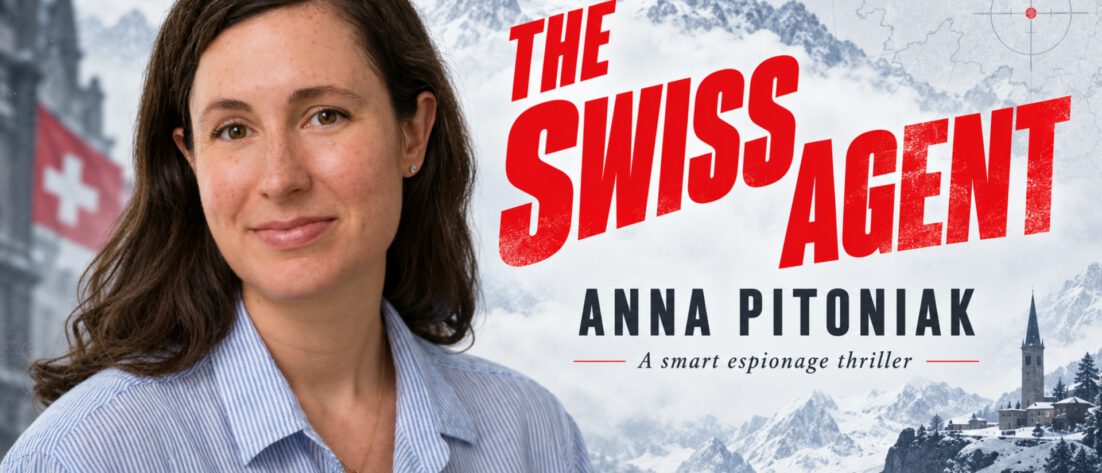
Anna Pitoniak talks The Swiss Agent, her smart CIA thriller of female spies, Russian oligarchs, and Swiss bankers, plus the real research behind it.
- Pre-order The Swiss Agent
- The Swiss Agent audiobook
- Read book one, The Helsinki Affair
- Visit Anna’s website
- Follow Anna on Goodreads
Most spy novels lean on car chases and gunfights. Anna Pitoniak’s The Swiss Agent is built around psychology, atmosphere, and careful detective work instead. Anna joins Blaine DeSantis to talk about her second Amanda Cole novel, a cat and mouse story between two veteran CIA officers, Amanda Cole and Kath Frost, who must work together to stop a Kremlin-backed conspiracy. The catch is that Kath is hiding a secret, and Amanda has to uncover it before time runs out. Anna explains how a murder at a villa on Capri sets everything in motion, and how a single plate of foie gras becomes the clue that cracks the case open.
Many of the book’s strangest details turn out to be true. Anna shares the real story of Margaret Scattergood, the Quaker philanthropist whose Virginia farmhouse became part of CIA headquarters. She also confirms that there really is a hot dog vending machine at Langley. She describes how a trip to Sarajevo shaped the novel’s 1990s timeline, how conversations with Swiss bankers helped her build the character of Julian, and how she and her husband worked out how a Russian oligarch could smuggle billions in Bitcoin out of the country. The answer involves a Ferragamo loafer.
Anna also talks about her path from Random House editor to full-time novelist, and how working with spy fiction master Alan Furst made her fall in love with the genre. She explains why she wanted to write women who drive the story instead of standing beside the hero, and why Kath Frost’s brilliance, arrogance, and sobriety make her such a compelling character. Anna also shares how she keeps three timelines straight, along with what comes next for Amanda, her father Charlie, and fan favorite Bram in the third book of the series.
Transcript
Transcript generated by AI. Mostly accurate, occasionally creative. When in doubt, the audio is the final word.
Blaine DeSantis:
[0:00] Welcome to Books and Looks, where we do a deep dive with authors to help you discover your next great read. If you don’t mind, I’d like to take a second to ask you if you could do me a favor. That’s right, a favor. Whether you watch it or listen to it on YouTube or podcasts, would you mind hitting that little button that says subscribe? Or maybe, uh, I don’t know what they say on the podcast, follow? It would really help all of us if we could see and get more subscribers. More subscribers. We have tons of listeners, but we could always use more subscribers. And you say, why is that? Well, you know what? Publishers look at things like that. Editors look at things like that. Our authors look at things like that. PR people, they only want to go on shows that have good numbers of subscribers and that are doing a great job for their authors. And we’ve done pretty doggone good. Yeah, we’ve missed one or two books because we didn’t have enough subscribers. But you know what? On the whole, I think we’ve done awfully well for the last four years. So could you do me that favor? Could you push the subscribe button or the follow button? Now, on with the show.
Blaine DeSantis:
[1:06] Espionage, one of the most popular topics for novels, but too many of them are filled with unbelievable action sequences that never actually occur in real life. So when a believable espionage novel comes across my desk, I can’t wait to share it with you. I’m Blaine DeSantis. This is Books and Looks, and today we’re chatting with Anna Pitoniak about her realistic, seeking persons espionage novel, The Swiss Agent. Anna Pitoniak, welcome to Books and Looks.
Anna Pitoniak:
[1:36] Thank you so much for having me, Blaine. I’m thrilled to be here.
Blaine DeSantis:
[1:39] Anna, Anna, Anna, I love your books. I love your writing. And oh boy, oh boy, friends, do we have a great one for you today. Anna’s here to talk about her newest book, The Swiss Agent, a super, super book, espionage book. You’re going to love it. But before we get into the specifics about the book, Anna, why don’t you give us the premise of the book and who are some of the main characters we’re going to be following in this book?
Anna Pitoniak:
[2:04] Sure. I’m happy to. And thank you for those kind words, Blaine. I really appreciate it. So The Swiss Agent is an international spy thriller featuring murderous Russian oligarchs and powerful Swiss bankers and a web of political corruption that stretches across Europe. But at its heart, it’s really a cat and mouse game between two seasoned female spies named Amanda Cole and Kath Frost, both veterans of the CIA. They have to work together to solve this ongoing Kremlin-backed conspiracy. But Kath is keeping a secret from Amanda, and Amanda has to unravel what it is before time runs out. So Amanda and Kath are very much at the heart of this book. There’s also a cast of secondary characters, many of whom appeared in the first book in this series, The Helsinki Affair. So there’s some connective tissue that carries over from the previous book to this book, but The Swiss Agent is also absolutely a standalone novel on its own right, if you’d like to read it that way. Right.
Blaine DeSantis:
[3:05] It is a standalone effect, but if they’re like me, I like to be at number one, number two, number three.
Anna Pitoniak:
[3:11] I like to read it in sequence. I get that.
Blaine DeSantis:
[3:14] Now, friends, this is a very unique thing. We have a female author writing about female CIA agents and spies. Is anybody else doing that? I mean, I don’t see that too often.
Anna Pitoniak:
[3:27] It is. It’s becoming more and more common, thank goodness, because I think we’re long overdue for it. But it’s a large part of the reason why I wanted to write these novels and turn to this genre. I’d written a few books previous to writing The Helsinki Affair that played around in a few different spaces. They all had a kind of suspense element to them. But as we were chatting about a little bit off-camera, Blaine, I really fell in love with the whole genre of spy fiction when I was working as an editor at Random House, and I had the chance to work with Alan First, who is an absolute master of the espionage novel. And that’s when I first realized how great these novels could be and how much they could do beyond just action and gunfights and all of that. They could really get deep into psychology and emotion and atmosphere. So starting off with Alan First, I then started reading a lot of John le Carré, a lot of Graham Green, other sort of greats of the genre. But what I realized is that there are relatively few female authors in this space and relatively few female protagonists who aren’t just there as a love interest or a sidekick of sorts. And I always thought, I want a book like this, but where the women are in charge, where they are at the center of the story are none. And at a certain point, I decided if I couldn’t find that book as a reader, I was going to try to write that book as a writer.
Anna Pitoniak:
[4:51] And there are other great female spy novelists out there, some of whom have actually worked at the CIA or in England who worked at MI6. So there are more and more of us each year, I think, but we are still probably overall underrepresented in the genre.
Blaine DeSantis:
[5:08] Well, there may be more, but I only know about you. So you’re number one in my book. Okay.
Anna Pitoniak:
[5:12] Thank you.
Blaine DeSantis:
[5:14] Well, let’s start about the book. You start out. This is an amazing prologue that takes place on the Isle of Capri. And there’s so many things going on, and then somebody dies? Tell us all about that, please.
Anna Pitoniak:
[5:29] Yes. So part of the fun of writing these spy novels has been coming up with a great kind of cinematic opening scene. And I think what’s great about spy fiction is there’s so much action and intrigue in it that you can kind of think of it as a movie in your head as you’re writing it. And I knew that there was going to be this mysterious dinner that kind of goes awry and winds up with a dead body at the end of the night. But I didn’t know exactly how it was going to all unfold from there. So the book really started with that idea as an opening scene. What if this politician had to be intimidated into cooperating by this kind of thuggish Russian oligarch by way of the Russian oligarch demonstrating just how easily he would resort to violence, how willingly he would resort to violence? And it was really fun to imagine all of that taking place in this incredibly beautiful setting where there’s beaches and the Mediterranean and it’s the evening and there’s a beautiful villa. So I wrote that opening because it kind of hooked me into the story right away. It felt like a really fun place for me to start as a writer. And hopefully it’s a fun place to start as a reader, too.
Blaine DeSantis:
[6:40] It was. And the tension that you got from that diplomat, he was starting to say, oh, my God, what’s going to happen?
Anna Pitoniak:
[6:47] Yeah, because he’s in the dark at the beginning.
Blaine DeSantis:
[6:49] He is. He is. And then the whole thing turns on foie gras. That just blew my mind. Foie gras on the Isle of the Brothers. How did you come up with that?
Anna Pitoniak:
[6:59] Well, that was a really fun detail to come up with because, you know, as we move forward from that scene and we switch to Amanda Cole, the CIA officer who’s investigating this, dead body that washed up on Capri and trying to figure out who this person is, who they were working for, what they’re connected to. She doesn’t have a lot of evidence to work with. So I was sort of sitting there thinking, okay, if I’m Amanda Cole, what clues do I have to work with? What clues have been left behind by the evening in question? And the chef, who is the dead body who washes up on Capri, is French himself. He’s French by training. And I liked to imagine that his client, the Russian oligarch, had a taste for French cuisine as well. So even though we’re in Italy and we’re on the Isle of Capri, he’s cooking with French ingredients. And it’s the fact that foie gras is so unusual in Italy that makes it easier for her to start tracing the connections that ultimately tell her who this man is and what really happened that night.
Blaine DeSantis:
[7:59] Well, it gave us a feel of real espionage to try to figure this out and how it leads to things. And also what a real good espionage novel should be about. We should, as the reader… Be able to put ourselves into their character’s place. And, oh my word, look at that. Oh my. And it did it right from the beginning. Yeah.
Anna Pitoniak:
[8:21] Yeah. I think it’s so much fun to be able to sort of think through and solve the mystery alongside the main character. I mean, that’s so much of the pleasure of great, not just espionage novels, but detective novels and murder mysteries too, is the feeling of your unraveling alongside the protagonist.
Blaine DeSantis:
[8:38] Well, now I want to take a little step back now because we say the word think, and that is what your books are. They are a sinking person’s espionage thriller. They’re not shoot them up, bang, bang, things that are unreal. Why did you decide to do this instead of that more popular shoot them up, bang, bang genre?
Anna Pitoniak:
[8:59] In large part, because I was following my own interests. And honestly, the shoot-em-up scenes, the car chase scenes, those scenes of dramatic gunplay, whether in books or in movies, are not admittedly my favorite things to read or to watch. Often I get a little impatient with them, honestly, especially in a movie where a car chase can go on for 10 minutes, 15 minutes. I’m like, okay, these special effects are cool. I’ll concede that, but it’s not stimulating me in any way. It’s not causing me to think. It’s not really causing me to feel anything. And I so much more enjoy it when, we’re getting deeper into a character psychology, when we’re understanding how they move through the world and how their own, sort of specific thoughts and subjectivities and opinions are informing the way that they’re looking at the situation. Which is really the task of any great novel, is to bring us deep inside a character’s head. So I think espionage is an incredible way to do that. You can really get to know a character by putting them in these extreme situations. But the result of that extremity does not have to be someone takes out a gun or a bomb goes off necessarily. Sometimes that happens, but not always.
Blaine DeSantis:
[10:16] But, you know, I really appreciate a book like this where you have to think a little bit. And that’s why I still like that you wrote this, this thinking person’s a novel. Timelines. You have like three timelines in this. You’ve got 1979, you’ve got 92 or 93, 94, some in that neighborhood. You have the present day. What made you concentrate on that 90s period as the real what’s behind this whole thing? What was your thought on that?
Anna Pitoniak:
[10:42] Yeah. So a lot of the inspiration for that sort of center timeline, which takes place in 91, 92, 93, let’s say, came from a trip I took about three years ago now. I traveled with some friends through the Balkans, where I’d never been before, and admittedly didn’t know much about the history of. I had vague impressions of the war in Kosovo and the war in Bosnia, but wasn’t that well versed in the history. And traveling to that region left a huge impression on me. It’s a beautiful part of the world.
Anna Pitoniak:
[11:18] But a part of the world that’s seen a lot of violence, overrun by empires, infighting, it’s still going on. There’s still a lot of instability in that region. But we spent a few days in Sarajevo, and that was particularly moving to me. We did an amazing tour of the city. Our tour guide had been working as a police officer in Sarajevo in the 90s during the war, and he lived through the whole siege and shared a lot of the details at that time. And it really stuck with me because it’s such recent history. I mean, I was alive for that war. I don’t recall it personally, but I think a lot of the people who read this book were alive for it and may remember it well. And the idea that, you know, things that took place then are still, they still have repercussions now. So Bosnia is a country that, as I have in my book, it is in fact trying to integrate itself deeper into Europe because that would allow for a certain safety and stability for the country. But it’s really hard because they’re in a part of the world that, you know, Russia sort of sees as their sphere of influence. So it just presented this really ripe opportunity to sort of explore the parallels between the recent past and the present. And to explore how a character like Kath Frost might have found herself in a questionable moral situation when that war was happening.
Blaine DeSantis:
[12:42] Okay. It really draws us in, and it took us through the whole book. So I thought it was great. Now, one of the characters you mentioned in here, again, I don’t know, Margaret Scattergood. Now, she described it as, I think, a lesbian, a Quaker, and a philanthropist.
Anna Pitoniak:
[12:56] Yes.
Blaine DeSantis:
[12:57] Whose farmhouse is now a CIA conference center. Now, is Margaret Scatterbook a real person?
Anna Pitoniak:
[13:04] She is.
Blaine DeSantis:
[13:05] Really?
Anna Pitoniak:
[13:05] She is. And all of those details, save for what exactly the farmhouse looks like now, because I have not been allowed to lay eyes on it myself. Those details are real. She was a lesbian. She lived there with her longtime partner. They lived in the farmhouse long before, I think long before the CIA even existed. And certainly before the entire sort of Langley campus had been established. This is another detail I learned in research. I wasn’t specifically seeking it out, but Scattergood Manor was kind of mentioned offhand in a book I was reading about the CIA. And then I started digging a little more and just thought it was fascinating. So she lived in this farmhouse in the Virginia countryside. The CIA started buying up all of the land around her acreage to build the headquarters. And my understanding, if I remember this correctly, is that they ultimately signed an agreement that said, when you pass away, because she didn’t have children, she didn’t have heirs. This land and the home will pass to us and you can, meanwhile, like live here. We won’t bother you. All of that. And then when she and her partner did both pass away, it ultimately got integrated into CIA headquarters. And it is used as a conference center these days, which is kind of cool to imagine the legacy of that space.
Blaine DeSantis:
[14:23] That is something. That is really amazing. You had such great details. And just early on in our conversation here, I’m finding that all these details are real. You didn’t make any of this stuff up. That’s fantastic. Well, yeah. But see, now there’s one detail. There’s one detail I’m sure you had to have made up, okay? Apparently, Amanda has to go to CIA headquarters, and she runs into a hot dog vending machine. Now, you say there’s such a thing, and Scott, I would get this right, they’re lukewarm, weirdly chewy, and overly salty hot dogs. Now, does such a thing really exist?
Anna Pitoniak:
[14:55] It does. It does.
Blaine DeSantis:
[14:57] Oh, no.
Anna Pitoniak:
[14:57] And again, my embellishment here is I’ve never actually eaten one of these hot dogs. So I had to use my imagination a little bit as to how they really tasted. But this, again, is mentioned in a couple of books about the CIA. There are a few pieces about it you can read on the Internet. I doubt the hot dogs are particularly delicious, but I think it’s become, you know, just kind of part of the lore of the building. So when I learned, that’s one of those details where when I came across it in my research, I thought I have to find a way to put this in because it’s just too much fun otherwise.
Blaine DeSantis:
[15:30] I wonder how that works. I mean, do they keep them warm in this vending machine? Do they come out in the bun? Who would even?
Anna Pitoniak:
[15:37] I wish I had a picture of it to share with you. I don’t, but I’m picturing like one of those, you know, sort of setups they have at a 7-Eleven or something where the hot dogs are like rotating on those little metal rods, kept warm, and then maybe they slide it into a bun. I don’t know. I’m not sure.
Blaine DeSantis:
[15:53] That’s spectacular. It sounds like a Coke machine or a coffee machine.
Anna Pitoniak:
[15:56] Yeah. Drop down.
Blaine DeSantis:
[15:57] Here comes your hot dog. Oops. Oh, that’s fantastic little details. Now, this book, your first book, The Helsinki Affair, we learned about Amanda. Now, the second book, we’re focusing more on Kath Frost, if I’m not mistaken. At least I read it more as Focus on Kath Frost. Yes, definitely. Tell a bit about her character and her 30-year bout with sobriety and how that all figured into the plot.
Anna Pitoniak:
[16:23] Yes. Yeah. So we sort of get to know Kath a lot better in The Swiss Agent. We met her in The Helsinki Affair, as you mentioned. And part of the reason I wanted to shift the focus to Kath in The Swiss Agent is because she was this unexpected and delightful part of the writing process for The Helsinki Affair. I didn’t necessarily have her in mind as a central character from the beginning of that book. And then I was writing a scene, and she kind of walked on the stage and just totally took it over. I just thought one of those instances as a writer, which is, it’s always very cool when this happens. happens. It’s like, where did that come from?
Anna Pitoniak:
[17:02] Who is this person? And I knew that she was brilliant and incredibly good at her job, but she had this kind of enigmatic energy to her and this mysterious backstory. So in The Swiss Agent, I wanted to go more deeply into that backstory and figure out how the legend of Kath Frost got formed in the first place. So.
Anna Pitoniak:
[17:24] We do learn a lot more about her. We learn about, you know, her childhood, her upbringing, her kind of intellectual brilliance, which gets her far in life and certainly allows her to accomplish so much at the CIA, but can also get her in a little bit of trouble. Because I think when you’re as smart as Cath Frost is, you can become a little bit arrogant and you can think that, you know, whatever I decide to be the right thing to do is the right thing to do because I’m so smart and because I can justify it in some way. And she winds up receiving a posting in Switzerland where she falls in love with this suave and equally brilliant Swiss banker. And she sees the appeal of his lifestyle and the world he moves in. And she starts to wonder if that’s, you know, maybe a path she wants to take too, which then leads to a lot of twists and turns and gets her into some sticky situations.
Anna Pitoniak:
[18:19] But that’s also when she, you know, she kind of pushes herself to the edge vis-a-vis her drinking. And after all of the kind of climactic outcome of her past in Switzerland, which I won’t spoil for this podcast, that’s when she decides to get sober. And so I think for her, the sobriety is really a representation of trying to keep herself away from these temptations that have potentially led her astray in the past. Not just the temptations of drinking, but of, you know, maybe making a lot of money or thinking that she always knows best in a given situation. This kind of this arrogance. Well, so, yeah, she the way she navigates all of that, I think, is really is fascinating to see.
Blaine DeSantis:
[19:03] I mean, in that first book, The Helsinki Affair, I mean, she locks herself in a room and she’s in the CIA headquarters or the embassy, I guess it was. And she’s just doing this work and that work and figuring everything. She got focused. It was a laser focus and she would go for days, it seemed like. So that was fascinating. Very fascinating character. But then you tell us about her love interest, the gentleman named Julian, that he is so completely, he’s a completely passive character. Okay, I like her a lot, but yet he comes up with the solution to the whole plot in this thing. How did that all come about?
Anna Pitoniak:
[19:38] He is, I think of him as quite an interesting character because he is passive for a lot of the plot. And he, maybe more than passive, I would say he’s very deferential, which is to say, you know, when you work as a Swiss banker and your clients are all these powerful billionaires and oligarchs and the like, you’re in a client services business. Your job is to make them happy, to carry out the work for them, to, you know, guide them to maximum profits and financial stability. But you always work for them at the end of the day. Like, if they say jump, you say how high? And this story of the Swiss agent, one of the kind of subplots of it is really Julian learning to stand up for himself and to decide for himself what is right and wrong versus just carrying out the wishes of a client. So I think part of the reason he and Kath fell in love in the first place and get along so well is they are both quite intellectually brilliant, but he, hasn’t yet learned how to deploy that for himself, for his own understanding of what’s right and wrong in the world.
Blaine DeSantis:
[20:44] Yeah, yeah.
Anna Pitoniak:
[20:45] And by the end of the book, we get to see him really figuring it out and kind of thinking for himself in a major way. So I was always interested in him as a character, but it kind of takes the whole book for him to fully blossom, as it were.
Blaine DeSantis:
[21:00] Well, see, and I’m wondering, is that hard to write a person in that type of character? Because it would have been so easy to say, ah, okay, maybe we’ll give him a little bit of the shoot-em-up bang-bang to go out to contrast with Cass and everything. Didn’t happen. No. Was it hard to write something like that?
Anna Pitoniak:
[21:17] It was, and it wasn’t. I knew that Kath would only be attracted to someone who was as smart as her, let’s say. And I don’t think she would respect someone who resorted to the shoot-em-up, super macho tactics, because I think she would see it as a fool’s errand. Like, what’s that really going to accomplish at the end of the day? And I think the harder balance to strike, honestly, was allowing Julian to be in this more supporting role for Kath and to be a sort of quieter, more deferential character without making him completely dull. So how do you strike that balance where someone might be a little bit more, you know, they’re not the person driving the plot of the story, but they still have to remain interesting to the reader. And I think what he represents in terms of his worldview is what I found so interesting. Swiss bankers are very powerful people in the real world, as well as in the fictional world of this book. They’re privy to some of the great secrets of our time.
Anna Pitoniak:
[22:21] They know everything about these billionaires and these royals and these politicians and everyone who’s squirreling away a fortune in Geneva or Zurich. But they have to remain neutral. Switzerland is a neutral country at the end of the day. And what does that really mean? How do you navigate questions of good and evil and right and wrong if you’re committed to this principle of neutrality? And so that’s what I wanted to use Julian as a chance to explore.
Blaine DeSantis:
[22:49] Very good. Well, you certainly did. Now, friends, we’ve talked about details. I mean, there is some stuff in here that just blows my mind. For instance, we end up in this thing. We have a Bitcoin wallet. That is smuggled in a Ferragamo loafer. Are you kidding me? This is top shelf espionage. What type of research did you have to do for some of these things?
Anna Pitoniak:
[23:11] So that was quite a fun part. When coming up with the central conspiracy of the book, which does involve smuggling money out of Russia and into the West via Bitcoin, this is where I get to, geek out a little bit and almost put on my thinking cap as if I were some evil billionaire and trying to figure out how to, how to do such a thing as this right, And one thing I find really helpful to do, because he’s quite technologically literate, is talk it out with my husband. He knows more about crypto than I do. He’s not in crypto, but he’s a little better versed. So I would talk it through with him at the end of a writing day, saying, you know, okay, let’s say I’m a Russian oligarch and I need to get a couple billion dollars out of Russia and I’m going to do so in crypto. Like, what’s the mechanism to actually move the money? And he helped me come up with this idea of, you know, just simply put it on a thumb drive. Like you can actually do that. You don’t have to worry about stacks of cash. And a thumb drive is pretty easy to conceal. It’s small. So then you get to get clever and creative with it and think, okay, how are you going to, how are you going to have it on your person without anyone noticing? So yeah, that’s a, that’s the fun part of the book is coming up with those little details.
Blaine DeSantis:
[24:25] I loved it. That was really, again, this is true espionage stuff. And you know, Well, one person we haven’t talked about, and while he’s not a major person, we have a pretty, oh, let’s say evil diplomat. What’s his story all about? Who is he?
Anna Pitoniak:
[24:39] Martin Bofoy. Yes, he is the deputy secretary general of NATO. And he is one of the hinge points of this conspiracy that involves Russia trying to block Bosnia’s entrance into NATO. And Martin Bofoy is the person whom the Russians target as someone to bribe, someone to influence. And Bofoy was so much fun to write as the villain of this book because he’s pretty slick, he’s pretty suave, but at the end of the day, he really wants to be rich. And if the Russians give him an avenue to getting rich, he is really tempted to take it.
Anna Pitoniak:
[25:22] And I think that’s something that, honestly, you see a lot of parallels of in the real world, which is, politicians or people who work in public service in some way are often surrounded by people who are a lot wealthier than them, who are flying private jets or living in these fancy mansions or. They have these villas on Capri. They’re living the high life. And if you’re a political figure, you’re not actually making that much money in that kind of when compared to those sorts of people. But it’s hard. I think it’s hard for anyone, but certainly it’s hard for a person like Martin Beaufoy when surrounded by that much wealth not to be tempted by it. So that was another really fun thing to explore because, you know, the Swiss agent takes place in these fairly high flying locales. Geneva and Zermatt and Capri and Paris. And there are a lot of moments in which a character like Beau Foy is thinking, why can’t I have some of this too?
Blaine DeSantis:
[26:18] He’s easy to be seduced by that stuff very easily. Now, I’m assuming that as a good writer, you went to all these locations and checked them all out.
Anna Pitoniak:
[26:27] I did most of them. I will confess, I have not yet been to Capri and I would love, you know, I need a little research budget for that. But I have spent, I’ve been lucky enough to spend a good amount of time in Rome over the years, Paris and the Washington area. Zermatt is not somewhere I’ve been specifically, but I have spent a lot of time in the mountains. I grew up in a ski town, so it was a fun chance to kind of evoke the mountain landscape. But I do find it important if I’m going to have more than just a one-off scene taking place somewhere, I find it important that I have been there myself, and know what it’s like to sort of walk around, see the sights, hear the sounds, smell the smells.
Anna Pitoniak:
[27:14] And evoke it in some authentic way. So over the course of writing this book, as I mentioned, I traveled to the Balkans, and I traveled to Geneva and Zurich, and had the chance to connect via a friend of a friend with a couple of people who work in Swiss banking and learn a lot of details from them, which was really helpful. And in Rome, on my most recent trip there, I got connected with the ambassador, and his wife, and they were able to arrange a tour of the embassy for me, which was really fascinating and gave me the opportunity to absorb some of those real-life details, which do make it into the book. The bust of General Ulysses S. Grant that Amanda passes on her way in and out of the station every day, that is a real thing. That does exist in the American embassy in Rome.
Blaine DeSantis:
[28:01] Yeah. And a beautiful mansion they have there. I stayed in a hotel around a block away from that. And wow, that was beautiful. Did you ever get into the CIA? Did you go in there? Or how do you do research on Langley?
Anna Pitoniak:
[28:16] So I have been to the CIA once, actually, several years ago when I was doing the research for one of my earlier novels, Our American Friend, which was the one I wrote just before the Helsinki Affair. And that novel, Our American Friend, was kind of my entry point into spy fiction. It was 50% historical, political fiction, 50% spy fiction, but it did have a plot line concerning the CIA. And the CIA has a press office, basically like their in-house PR shop, where they do work with writers, novelists like me or screenwriters, to help them try and get certain facts correct and help with accuracy. So I got connected with someone in the press office and took a tour one afternoon, was able to meet and have a conversation with one of their in-house psychologists, with one of their former case officers from the Cold War. So I could pepper them with some questions and get a little bit of detail. They’re not going to answer all of your questions, as I learned. You know, there were a number of things I asked and they said, we can’t tell you about that. But they are, in general, striving to correct, you know, common public misperceptions of what the CIA is really like. And to emphasize that, you know, it’s a it’s sort of a massive organization of people who do all sorts of different things. It’s not just what you see in the movies.
Anna Pitoniak:
[29:43] But, yeah, it was a really useful afternoon.
Blaine DeSantis:
[29:47] And the whole time you were there, you never got to go past that pot dog vending machine?
Anna Pitoniak:
[29:51] I never did. I never did. If I go back to the CIA, I’m going to ask specifically that they take me there.
Blaine DeSantis:
[29:57] Oh, boy. You know, I think, doesn’t the CIA have a museum also?
Anna Pitoniak:
[30:03] They do, which was sort of part of the tour. And it’s not a public-facing museum. You can’t just drive up and go there. But they had a number of sort of relics from old operations. Things that happened in the Cold War, a lot of James Bond-esque gadgetry, and more recent things like some of the, weapons that were used during the raid in Abbottabad and the War on Terror and that kind of thing.
Blaine DeSantis:
[30:30] It was maybe the most boring museum tour I watched on C-SPAN this summer, but the one in the CIA museum is like, will you show us something? Please show us something more than this. There’s something on the wall, something on the wall. We’re not going to stand there too long. Keep moving. Exactly.
Anna Pitoniak:
[30:45] Exactly.
Blaine DeSantis:
[30:47] Oh, boy. Now you go through three timelines. You shift chapters. You have Amanda. You’ve got Cass. You’ve got Julian. You’ve got Amanda’s father, Charlie. How do you keep all of this straight? And how do you make it so easy for us to follow?
Anna Pitoniak:
[31:04] Well, I’m thrilled that you think it’s easy to follow because that is my number one goal and a sort of rule I set for myself, which is I never want it to be confusing for the sake of it being confusing. And the way that I keep it followable, I would say, is I’m writing it, I’m writing the whole story in the order in which it flows in the novel. So in other words, I’m not just writing one timeline completely and then writing another timeline completely and another. I’m thinking of them as a braid throughout the whole thing. And so I want the transitions from one scene to another to be fairly seamless and organic. And I always take care to be pretty explicit with like, okay, we’re moving back in time, we’re moving forward in time, here’s where the setting is, etc. Because I don’t like the feeling of being confused when I’m reading someone’s novel. And so I don’t want that for my readers either.
Anna Pitoniak:
[31:58] But in writing this book, and this was different from my process for my previous novels, I actually switched to using a program, which I don’t know if you’re familiar with or your listeners might be familiar with. It’s called Scrivener. It’s a word processor, but it’s a lot more kind of tricked out than just a Microsoft Word or a Google Docs. It allows you to create a kind of table of contents. You can see the breakdown of each chapter and each scene as you’re writing and easily move things around and tag them. And that, just from an organizational logistical perspective, made it so much easier for me to keep track of each character, each timeline, each setting, which I do think led to, hopefully, a relatively clear reading experience at the end of it.
Blaine DeSantis:
[32:44] It does. And it’s funny you mentioned that because I’ve watched, I’m hooked on C-SPAN on the weekends, watching book TV and questions and answers programs. And I’ve noticed a few other authors using that and coming right out and saying, well, it wasn’t for that. I don’t think I’d be able to write this book. Yeah.
Anna Pitoniak:
[33:02] It’s a great organizational tool. I really, it takes a little while to get the hang of it, but I am a big fan of it now.
Blaine DeSantis:
[33:10] Why did you decide to go from the editorial part of publishing to becoming a writer? What was your thought process?
Anna Pitoniak:
[33:18] I had always loved writing and always had that kind of secret childhood dream of maybe becoming a writer someday. But to be honest, when I graduated from college, I needed a job. And the idea of just trying to go make it as a writer and make a living from that sounded way too daunting and frankly not possible. And I’d also worked as an editor on the student newspaper in college and loved that work so I thought being a book editor is a pretty great thing that’s adjacent to being a writer and I did that for a number of years I loved that job but within, the first couple of years of working in publishing I really started to feel the itch you know I still want to write I still want to have something that’s just for me that has nothing to do with my paycheck or my boss or what I have to do between the hours of nine and five. And I was inspired, too, by so many of the writers we worked with at Random House and by learning more about the process.
Anna Pitoniak:
[34:18] I didn’t really know what went into the making of a novel before I worked at Random House. But when I got the chance to work with all of these writers, I realized that so much of writing is actually revisions. And you’re never going to get the book right in the first draft. You have to rework it and rework it and rework it. And that had the effect of making it a little less intimidating for me to get started. I thought, well, I can just, I’m not going to be able to sit down and write a good book right away, but I can write a bad book and then I can try to make it better. I can try to make it better. And so for a few years, I was writing, you know, in the mornings before work and the evenings after work and wherever I could find the time. And it took about three years, but I ultimately finished a draft of my first novel, managed to find an agent, and we managed to sell it to a publisher. And that was really exciting and incredibly rewarding. And for a while, I thought, you know, I’m going to do both. I’m going to keep my job as an editor, keep writing. I managed to write my second book while also working at Random House. But right around the time that I was finishing up that book and we had, again, sold it to a publisher, it was starting to become a little too much, the kind of burnout factor of it all. And I reached a point where I just had to make a decision about picking one lane or the other, the editing or the writing. And as hard as it was to leave that job because it was a fantastic job, a great place to work, and it taught me so much about writing.
Anna Pitoniak:
[35:44] The writing was where my heart was. So that was about eight years ago now, and I moved full-time into writing fiction and feel incredibly lucky to be able to do this as a job.
Blaine DeSantis:
[35:56] Well, you learned those lessons awfully early in life because you’re a very young lady and you’re still putting out killer books at your age. You can have another 40, 50 years to go.
Anna Pitoniak:
[36:05] Oh, God willing. That would be nice.
Blaine DeSantis:
[36:07] Yeah, I’ll tell you. Now, one of the side characters who I love is, I think his name is Bram. He is an IT specialist. He can hot wire card. He sings opera, Fleetwood Mac, off key as he’s driving through snowstorm. This is a fun character. He could have his own book, I think.
Anna Pitoniak:
[36:25] He’s a lot of fun. And he’s someone who I’m definitely planning to bring back in the next novel because I think he’s just got this great kind of vibe and outlook. And he’s really different from an Amanda or a Kath, both of whom, both of those ladies are quite cerebral, I would say. And he’s a little bit more goofy and he compliments them well. So yeah, I’m excited to have him back in the next book for sure.
Blaine DeSantis:
[36:51] Now let’s see, we had our first book, which basically featured Amanda. Book two’s got a lot to do with Kath, but we got Amanda’s father, Tell us a bit about his backstory. And are we going to see a book featuring him in the future, do you think?
Anna Pitoniak:
[37:04] Yeah. So we get some of Charlie Cole’s backstory in The Helsinki Affair. So I think of The Helsinki Affair as a book that’s focused really on both Amanda and Charlie and so much of their relationship as father and daughter, both of whom work at the CIA, but still have secrets between them. So Charlie’s backstory, if anyone’s interested in it, it, can be read at length in The Helsinki affair, but he made some mistakes during the Cold War, which get uncovered in the present day by Amanda, and he has to kind of figure out a way to set it all right. And what we’re seeing in The Swiss Agent is the early phases of that ongoing operation to try and kind of get back at the Russians who screwed him over so long ago. And the next book, the one that I’m like just starting to think about and write early drafts of now, will return the focus more to Charlie and to Amanda and get a little bit into this ongoing deep cover operation he’s involved in. And we’re also going to get a little bit more of Amanda’s own backstory, much in the way that the Swiss agent told us more about how Cath came to join the CIA and what her early years there we’re like, we’re going to see more of that vis-a-vis Amanda in the next book.
Blaine DeSantis:
[38:22] Okay. Now, friends, I don’t have this, either of these books in paper or pie, but here is the cover of The Helsinki Affair. You see that? That’s on my phone. What a great cover. I loved it. And who does your cover art? Do you have somebody who does that or does your publisher have that?
Anna Pitoniak:
[38:37] My publisher does that. Simon Schuster gets all the credit. And I have to say they’ve nailed it on both The Helsinki Affair and The Swiss Agent. In each case, they’ve sent me a handful of designs to choose from, but there’s always been like a clear winner. And I love how the cover art came out on this.
Blaine DeSantis:
[38:53] Well, here we go. Here’s the Swiss affair right here.
Anna Pitoniak:
[38:55] Yeah.
Blaine DeSantis:
[38:55] You see that, friend? We have somebody skiing. We got a helicopter. We’re in a mountain. This is great stuff. This captures your attention as much as that opening scene in Capri. You want to read it. When you sit here and objectively look at things, how many books do you see in this Amanda Cole, Charlie Cole, Kath Ross? Do you see five? Do you see 10? What are you looking at?
Anna Pitoniak:
[39:18] It’s a great question. When I first came up with the idea for The Helsinki Affair, I didn’t necessarily know it was going to turn into a series. But by the end of writing The Helsinki Affair, I thought, wow, I love these characters. I love this world. I want to stay in it for a while. And at that point, I would say I mentally committed myself to at least three books because I kind of wanted enough room to go deeper into each of these characters. And especially with the arc that Charlie Cole is working through his kind of operation against the Russians, I knew that I would need about three books to, resolve that. And my hope is to resolve it in the next book I’m writing. As I begin work on that third book in the series, I’m starting to think, you know, there might be more than three.
Blaine DeSantis:
[40:04] Oh, yeah.
Anna Pitoniak:
[40:05] I don’t have a specific number in mind. I think that you just sort of have to see how it unfolds. And one thing I loved about the way John LeCarré unfolded his career is George Smiley was a character in many of his novels.
Blaine DeSantis:
[40:20] Yes.
Anna Pitoniak:
[40:21] But not every single one. And sometimes he’d write a novel that had nothing to do with Smiley. But then he’d come back to Smiley and he’d take you back into that universe. So I think the idea of writing spy fiction, even if Amanda is not the central character in every single book I write going forward, I can always weave her in and out and come back to her. So I’m going to sort of take it book by book. I wish I had a grand master plan, but alas, I don’t.
Blaine DeSantis:
[40:47] I talked to one gentleman named Will Thomas. He writes Victorian Mysteries. I asked him the same question. The answer was 20. He had 20 books laid out that he wanted to do.
Anna Pitoniak:
[40:56] Wow.
Blaine DeSantis:
[40:56] Oh my God.
Anna Pitoniak:
[40:57] That’s impressive.
Blaine DeSantis:
[40:58] That’s impressive. He’s on 17 already.
Anna Pitoniak:
[41:01] Wow.
Blaine DeSantis:
[41:01] Donna Leon. I don’t know if you’re familiar with Donna Leon.
Anna Pitoniak:
[41:04] Yeah, yeah, yeah.
Blaine DeSantis:
[41:04] 32. 32 books.
Anna Pitoniak:
[41:06] Yeah.
Blaine DeSantis:
[41:06] I’ve only made it to 15 or 16 on that scene. There’s just so many books. I’m amazed that people can keep it up, that they keep finding new and different topics. And there is so much, so much, especially this fertile period now where we have all the sanctions with Russia, yet we hear this and that. There’s a lot going on, a lot going on.
Anna Pitoniak:
[41:25] There is. I think it will happen.
Blaine DeSantis:
[41:27] Anyway, Anna Pitoniak, I want to thank you so much for taking your time, for being with us. I’ve enjoyed the book. I don’t think I gave away any major final plot points. It’s spectacular, but you have been a joy and I really appreciate it. And I hope we have you back again when the third book comes out.
Anna Pitoniak:
[41:42] Great. Thank you so much, Blaine. I really enjoyed this conversation. And yeah, I hope we get to do this again in a couple of years.
Blaine DeSantis:
[41:49] Well, friends, I hope you enjoyed my venture into espionage novels. I can’t think of a better one to start with than Anna Pitoniak’s book, The Swiss Agent. It is a wonderful book. I really enjoyed it a lot. She’s a great young author. I think I’m going to really enjoy her book. So anyway, on behalf of our friends at booktrib.com, this is Blaine DeSantis for Books and Looks saying, may all your leaves be pages in a book.