
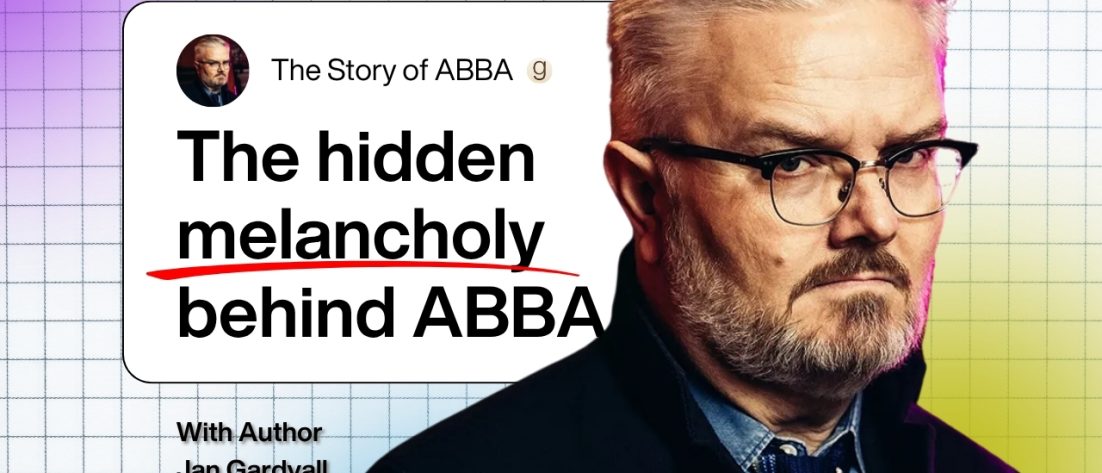
Go behind the music and uncover the secrets of one of the world’s most iconic supergroups. In this episode, award-winning Swedish music journalist Jan Gradvall joins us to reveal The Story of ABBA, drawing from his new book, “The Story of ABBA: Melancholy Undercover.” We explore the fascinating human drama, the cultural clashes, and the surprising musical genius that propelled a band from Sweden to global domination. What is the shocking truth behind their happiest songs? Jan Gradvall, who has interviewed all four members, pulls back the curtain on the legends.
From their formation as two couples who stumbled into a magical sound, to their complex journey through the pop world, this is The Story of ABBA as you’ve never heard it before. We start with their detailed ABBA Eurovision History, from the 1973 competition they lost in Sweden with “Ring Ring” to their game-changing 1974 victory with “Waterloo”—a glam-rock-infused pop track that broke the mold. Jan explains how the band faced intense opposition from the ABBA Progg Movement, a left-wing cultural force in Sweden that despised their commercial, capitalist sound and questioned their art. This deep dive uncovers the core of their unique sound, a concept Benny Andersson calls “Melancholy Undercover.” Learn how the long, dark Scandinavian winters infused their music with a deep Swedish Melancholy in Music, creating a bittersweet feeling even in their most upbeat anthems, a sound rooted in Swedish folk traditions and Benny’s accordion.
Beyond the cultural context, we explore the incredible and often overlooked talent of Agnetha Fältskog, musician. While many focused on her looks, Agnetha was the only member who could read music, an accomplished classical piano player, and a prolific songwriter in her own right. Jan Gradvall shares insights from his personal interviews with all four members, revealing why Björn Ulvaeus can’t remember being on tour and how the rhythm for “Take a Chance on Me” came from the sound of him jogging. We discuss how the band never officially broke up, the 90s revival sparked by the gay community and artists like Kurt Cobain, and the origins of global phenomena like the musical Chess and the stage and film sensation Mamma Mia. This is the definitive inside look at the band’s journey, their conflicts, their creative process, and how they became more popular today than ever before.
Introduction
Blaine DeSantis: Welcome to Books and Looks, where we take a deep dive with authors to help you discover your next great read. Today we are pulling back the curtain on the musical supergroup ABBA. Have you ever wondered what really went on behind the scenes with one of the most iconic bands in history? If you’re curious about the fascinating human stories behind these timeless hits, or how a band from Sweden managed to conquer the globe singing tourist English, you’re in for a treat today on Books and Looks.
My guest today is Jan Gradvall, who is an award-winning writer and widely respected music journalist from Sweden. With over four decades of experience, he is uniquely positioned to tell us this story, having cultivated a close journalistic relationship with ABBA over many years and having interviewed all four members for this book. He has also been instrumental in founding the Swedish Music Hall of Fame. I’m Blaine DeSantis. This is Books and Looks, and today we’re talking with Jan Gradvall about his new book, `The Story of ABBA: Melancholy Undercover`. Jan Gradvall, welcome to Books and Looks.
Jan Gradvall: Thank you.
Blaine DeSantis: We are happy to have you here today and talk all things ABBA. It’s going to be a great time. My understanding is you’ve been in this profession for 30, 40 years as a journalist?
Jan Gradvall: I started out writing about music when I was 16, actually. I did a fanzine back in Sweden. But I’ve been working as a professional journalist for 40 years.
Blaine DeSantis: And you’re still going strong? You’re still doing it?
Jan Gradvall: Yes, I’m still doing it.
Blaine DeSantis: Good for you. Good for you. So even though the hair has gotten a little white or silver, you’re still working harder than ever, huh? Good for you.
Jan Gradvall: Absolutely.
ABBA’s Eurovision History: From ‘Ring Ring’ to ‘Waterloo’
Blaine DeSantis: Over here in the United States, most people know ABBA because of the Eurovision 74 and Waterloo. But they were there in 73. Tell us a little about what happened in 1973, if you would.
Jan Gradvall: ABBA formed in 1972, and they formed as two couples. Benny fell in love with Frida. Agnetha fell in love with Björn. They hadn’t planned to form a group. It happened almost by accident. Björn and Benny wrote the songs, and they recruited their wives as background singers for a couple of tracks for other artists. And then they realized it sounded magical when they sing. So then they formed the group.
They weren’t called ABBA then. They were called `Björn & Benny, Agnetha & Anni-Frid`, which is a very complicated name. They competed in the Eurovision Song Contest in Sweden in 1973 three with a track, Ring Ring. At that time, to be able to go to the international Eurovision, you have to win in your own country. And they only came in third place in Sweden.
The audience who heard the song and saw them on stage thought this is fantastic. But at that time, the TV viewers weren’t allowed to decide who the winner was. It was a jury of so-called experts. And they decided that another track was better than ABBA’s. So they had to try again the next year in 1974.
Blaine DeSantis: So 1974 comes along, and now they’re officially called ABBA, if I’m not mistaken.
Jan Gradvall: Yeah.
Blaine DeSantis: And they must have won in Sweden, correct?
Jan Gradvall: They did this track called Waterloo, and at that time they had changed the voting system in Sweden, so now the viewers had a chance to have their say. And so Waterloo won. There was no competition, really; everyone loved Waterloo.
The interesting thing is, I don’t know how much you actually know about the Eurovision Song Contest, but up until then, it wasn’t a pop contest. It was a contest with ballads, Las Vegas things, men in tuxedos singing, women in fancy dresses. Usually, there was a dramatic ballad, the one from France or Luxembourg. So people didn’t send pop songs to Eurovision. ABBA were the first group to really do that, but to play it safe, they had planned up until the last minute to compete with another track called `Hasta Mañana`.
It’s that kind of typical old-school Eurovision winner, and it has a clever title because it’s `Hasta Mañana`. Now everyone understands that title in Europe. You don’t have to know the lyrics. So that was seen as the safe choice. But wise enough, a couple of weeks before the Swedish competition, they said, no, we change. We really risk this one with this quite loud pop track called Waterloo. And then we know what happened, of course.
Blaine DeSantis: They wouldn’t have won if it was just the British voting. The Brits didn’t like that.
Jan Gradvall: And I think people in the UK are quite ashamed by that because when ABBA competed in Brighton, they were amazed that finally we’re in the UK, the pop country number one. They were very proud of being there. And I guess maybe the expert jury in the United Kingdom felt a certain competition and they gave ABBA zero points. Come on. So I think they’re quite ashamed of that. But fortunately enough, the other countries voted for the right song, Waterloo.
Blaine DeSantis: Absolutely. And then I think I remember one point you said in your book that the person who conducted the orchestra was a person they knew from Sweden. That’s where he came out with that Napoleonic hat on and everything else. It added to it.
Jan Gradvall: It really did. And the way they looked, they were very influenced by this glam rock thing with David Bowie, of course, bands like `Sweet` and Slade. So they dressed like a glam rock band with all these glittery, quite odd clothes. And they understood the importance of the image with having the conductor dressed as Napoleon since the song is about this battle at Waterloo.
Clashing with the Culture: ABBA vs. Sweden’s ‘Progg’ Movement
Blaine DeSantis: Both Benny and Björn were sort of shocked when the people of the Eurovision, the host, made a big deal about why you would sing a song about a battle where 40,000 people died. And there was some backlash against that in that regard. But even the Swedes weren’t too crazy about the song, were they?
Jan Gradvall: I think people in Sweden actually loved the song, and the people of Europe. But that very odd question came from the Swedish television. And Sweden at that time was very left-wing. There was a big left-wing culture in Sweden. And they didn’t like ABBA. They thought ABBA was a commercial group. And they thought people should preach for socialist values in pop music. So in Europe, people just celebrated the song and said congratulations. But on Swedish television, the first question the reporter asked, “How does it feel to make entertainment of a battle where 40,000 people died?” Which was an incredibly stupid question to ask. So that happened in Sweden only.
Blaine DeSantis: And I’ve seen some videos, though, from back in that time period, and there were a lot of younger people who didn’t like ABBA. And came out on camera during some of these movies or films and didn’t like it because there was something going on over there called the `Progg`. Who were the `Progg` and what was it all about?
Jan Gradvall: It goes back, you have to go back to 1968, really. There was a big left-wing movement all across the world. There were riots at universities. There was a sound that we should create a new society. And this left-wing movement was very influential everywhere, even in the United States as well. But in Sweden, they got more power than anywhere else because they really had influence over media.
Those people were the ones who wrote about culture and music, and they hated ABBA. They also had a big influence of the only two TV channels that existed in Sweden, and the only one radio channel who played pop music. They didn’t like ABBA because they thought you should sing in Swedish, you should distance yourself from capitalist pop music in their world, which was all the groups from the United States and the UK. And ABBA did sound like that. They had an international sound. But I think the people in Sweden, they actually loved ABBA, but the media, the elite, hated ABBA.
Before the Supergroup: ABBA’s Roots in Swedish Folk and Rock
Blaine DeSantis: That’s really something. This takes us back to what was the music in Sweden. And we had two groups there, `The Hep Stars` and the `Hootenanny Singers`. Now, who were they? What people from ABBA were in that? And tell us a little about that traditional Swedish folk music.
Jan Gradvall: When ABBA formed in 1972, in Sweden, they were seen as a supergroup. Because all the four members were stars in Sweden. `Agnetha Fältskog` was the biggest female pop solo singer in Sweden. Frida’s career started going a little bit late in the late 60s, but she also became very popular. And this group, `Hootenanny Singers`, which had Björn as the guitarist, singer, and songwriter, they were quite influenced by `[Could not verify with context]`, Pete Seeger, who took American old-school folk music and put it in a pop context.
They did the same thing. They went back to old Swedish culture, old Swedish poets who wrote poems about Swedish nature and the countryside. And they took that and made it into pop music and became incredibly successful in Sweden. So that was Björn’s band.
And `The Hep Stars` was this very loud, you could call them a garage group, who was very celebrated in Sweden by a subculture called `Raggare`, where people drove around in American cars. They looked like Elvis Presley or James Dean. And the `Raggare` loved the very loud, greasy music which `The Hep Stars` made. And `The Hep Stars` organist was a giant, very energetic kid called Benny Andersson, which is quite incredible when you see Benny in ABBA. He’s this Yoda-like figure. But in `The Hep Stars`, he was this loud rocker. So all those four were so famous in Sweden. You could read about them in the papers every day. And it was a big thing when they became these two couples. And then the two couples started ABBA. So in Sweden, ABBA was a supergroup.
Melancholy Undercover: The Swedish Soul of ABBA’s Music
Blaine DeSantis: Benny played the accordion, if I’m not mistaken.
Jan Gradvall: Yes, that’s his first instrument. His grandfather told him to play the accordion in the archipelago in Sweden. And folk music is a big thing in ABBA, Swedish folk music. I called my book, it’s called `The Story of ABBA`, and then `Melancholy Undercover`, which probably needs an explanation. It’s a thing Benny said to me once that even our happiest songs are melancholic at their core. So they almost hid the melancholy there.
When you hear ABBA’s music today, you get excited and happy and also quite sad at the same time. They have this melancholic streak, which comes from Swedish culture, Swedish folk music. Which is a product of these very long, dark winters in Sweden where it’s extremely cold and extremely dark for seven months a year. Benny started to play these very strong melodies, but melancholic melodies on his accordion. Even when he played in `The Hep Stars`, he played an organ, but he took his organ and played it like an accordion because that’s what he was used to.
He always kept that. Even in ABBA when they did live concerts, the last song they played was usually they all four standing on stage and Benny playing the accordion and they were singing together. So the accordion is the most important instrument to ABBA, really.
Blaine DeSantis: And by the way, friends, since we have this, there it is, `The Story of ABBA`, and it’s right there, `Melancholy Undercover`. There it is. A perfect, and there’s `Jan’s cover`. There’s his name there. You want to get this, friend. This is a great book, so I want to get that plug in too. But that’s really fascinating.
Decoding ‘Tourist English’: The Charm of ABBA’s Lyrical Style
But then they start singing. Now we’ve got Waterloo, and they’re doing something called Tourist English. Could you explain to all of us what tourist English is?
Jan Gradvall: In Sweden, very few people or no one else understand what we say. So the English we talk in Sweden is a limited version of the English you talk in the States or in the UK. And it’s the same kind of English that other people actually use and talk when we Europeans meet. We use this limited English where you maybe use 10% of the words. I called it in my book Tourist English, which is English spoken and written by someone who’s not born in an English-speaking country.
And those first songs, you can hear that ABBA are not from an English-speaking country. They don’t know exactly the phrases. It sounds like you could say bad English in a way, but that was part of the charm. It’s the same with other groups in Europe, like German groups like Boney M, Kraftwerk. They also use this limited English. Then `Björn Ulvaeus` developed into a fantastic lyric writer. But I write about this appeal to try to explain that ABBA had this European factor. They didn’t really sound like the pop groups from America or the UK. They have something European in their melodies, the arrangement. And it was very obvious that these people are not from English-speaking countries.
Blaine DeSantis: What certainly resonated with everybody around the world, English-speaking and non-English-speaking countries, we all got the lyrics, we understood it. And it was also the music that Benny wrote. That music that Benny wrote really helped drive everything. It was wonderful, wonderful stuff that they did back then.
More Than an Image: The Overlooked Musical Talents of Agnetha Fältskog
But here’s a little-known fact that you brought out in the book, that when the group formed, the only person who knew how to read music was Agnetha. Is that correct?
Jan Gradvall: `Agnetha Fältskog`, she very rarely gives interviews. He’s seen like the Greta Garbo, Greta Garbo, the actor is also Swedish, this very secretive person in Hollywood. `Agnetha Fältskog` has been seen as the Greta Garbo in pop music. And she doesn’t like to do interviews because in the 70s, people were obsessed with her looks. They only wanted to know about gossip, love affairs, and that sort of stuff. So she stopped doing interviews.
But I managed to have done interviews with all four of them. And I think the reason they opened up, maybe especially Agnetha, was because I’m a music journalist. I’m a music nerd. So I started to ask her questions about music, and she’s an incredibly skillful musician. That’s totally correct. She was the only one and still is the one who can read music. Benny is a musical genius, but he can’t read music. She was an excellent piano player. She can play classical music like Haydn and Bach fluently.
She wrote all of her songs in the 60s, the solo hits in Sweden. She wrote them. And Benny and Björn tried to encourage her to keep on writing during ABBA, but then she was a mother of two young kids and she didn’t have time for anything more than record and tour. And she knows a lot of things about pop music, especially early 60s music. She’s obsessed with Connie Francis, `Sandie Shaw`, those kind of singers, which you can hear influences from in her voice as well.
Behind the Scenes: Interviewing the Members and Touring with a Family
Blaine DeSantis: That’s funny. Like you said, everybody fixated on her, about her looks. One gentleman asked about her posterior. Give me a break. That just was rude and crude over in Australia. But the girl had much more depth than people gave her credit for. And it’s great that you’re able to bring that out and have people realize what she’s able to do. And that brings me into my next question. You talked with all of these, all four members, extensively, extensively. Who was the easiest to talk with and who did you have the most trouble getting stuff out of them? Who was most difficult?
Jan Gradvall: The reason I wrote this book, I did a story 12 years ago in Sweden. This was the first time all four members decided to talk to one journalist. I did this for a Swedish weekly magazine, which was quite a big thing in Sweden. I think all four members sort of started to trust me because they realized I was this music journalist who wanted really to know how they do the music.
Since then, they let me into their world a little bit and asked me to help them on different projects. They did this big `[Could not verify with context]`, like a coffee table book with photos, and I helped them to write that. I think the most easy, the most open members who do all the interviews are Björn and Benny and Frida. Agnetha rarely does interviews, but I think that’s because they say no to them. So I think the scoop in Sweden was that I had done these interviews with Agnetha, which was a big scoop because no one had done that. I would say the most easiest to talk with about music is maybe Benny, actually.
Björn is very open. He’s the media mastermind who always wants to know big things. Frida has this royal quality. She comes from totally something else, but she’s a queen of pop music or a princess of pop music.
Blaine DeSantis: That’s interesting. And I hadn’t thought about this until just now when you brought this up. You talk about Benny and what he’ll talk about. But you brought an issue up that I never knew before. He doesn’t remember a lot of what happened during the concerts, during the shows. He had a memory. He knew he was in Australia, but he didn’t know what happened during the show. I never heard of that. Can you tell us a little bit about that?
Jan Gradvall: That is about Björn actually. A lot of people mix up Björn because they look alike with the same beard, similar names, so that’s a very common thing to mix up. But that is Björn, and he told me that he seems to be such an easygoing guy, but he had a complicated childhood, very bad relations with his father. And when ABBA became successful, he became part of the machine in a way, and just performed. And he realized later that he didn’t actually remember things like going on stage or being on tour.
What he did remember was going jogging in old cities. He became obsessed by running, jogging. That was a thing to clear his mind. Running became his therapy in a way. He told me that when he was running he got his rhythm in his head because that was the way running sounded to him and then “take a chance, take a chance.” So Take a Chance on Me is really the sound of Björn running.
Blaine DeSantis: That’s amazing. But that shows the trust they had in you that he would open up to something about that, which I had never heard of before. And you were able to get that from him. It’s a fascinating look at somebody who you wouldn’t expect that from. We all knew they were married to each other, Agnetha and Björn and Benny and `Anni-Frid` were all married, but the two women had children. How were they able to survive and manage having children and being this popular group that was always on the road?
Jan Gradvall: That’s a really good question. And it is a quite complicated answer because Frida became a mother very early on, long before she married Benny. She got two kids in the middle of the 60s. So when ABBA became big, her kids were 11 or 12 or something. The same with Benny. He also had kids in an early marriage. Benny and Frida married, but they didn’t get any kids. So they had their kids that could stay at their ex-partners’ home.
But Agnetha and Björn married, and they had kids right in the middle of ABBA. So when ABBA performed Ring Ring in Sweden in 1973, Agnetha is visually pregnant. You can actually see that. Their first kid was born in 1973, and their second kid in 1977. So they had these really young kids at home and tried to bring them on tours.
But Agnetha, as I said, she loved being in the studio, singing. She could be in the studio forever, but she didn’t like touring because she wanted to stay with her kids. So I think the world wanted ABBA to tour more than they did. But there were these married couples who really had their careers behind them, in a way. So I think that probably made ABBA the biggest pop group in almost every country except the United States, really, because they tried to make it in the States. They only had one number one in the States, Dancing Queen. ABBA became big long after with the musical, the movies, and the compilation ABBA Gold.
Blaine DeSantis: It’s hard to do when you do that. And as a matter of fact, I just saw a video yesterday of ABBA without Agnetha. I think she had just given birth or something like that. And they went on a TV show or something. And I saw a video of that. Was it just some singer they had?
Jan Gradvall: And I think they’re not proud of that moment. They just tried to make a solution. And ABBA without Agnetha, as ABBA without Frida, is not ABBA. So I think they’re trying to hide that fact, but everything rises to the surface on YouTube.
The ABBA Sound: The Magic of Agnetha and Frida’s Voices
Blaine DeSantis: A lot of people, and I know that I’ve been with people who’ve told me that the two women did not like each other. And they’ll sit there and they’ll say, “Oh, take a look at this. Oh, look at her, she’s looking at her this way. Oh, she’s looking at her this way.” I didn’t get that out of your book. I didn’t get that they did not like each other.
Jan Gradvall: And that’s definitely not true because that was invented by the gossip pages who wanted this rivalry. So they created this rivalry. But they were really, really close and they supported each other. If one of them had a cold, the other one backed the other one up. And if they do look at each other in an odd way, it’s probably because Frida is this born-on-stage character who loved to dance, loved being on stage. And Agnetha was quite reluctant at that time being on stage. So that’s probably why.
I think it is interesting if you try to pin down the ABBA sound, this unique sound, which we can definitely hear when we listen to an ABBA song. When I asked all four of them about this, they all four said separately that what makes ABBA ABBA is the combination of the girls’ voices. Benny and Björn still call them the girls, and they call them the boys, which is quite funny. But when Agnetha, who has this very high, clear, crystal-clear soprano voice, and Frida has a little bit lower mezzo voice, when they sing in unison, you get this totally unique sound, which is the essence ABBA sound. So there were definitely not two songwriters, two male songwriters, and two women singers who were hired as singers. They all four were equally important members who created this sound together with endless hours in the studio.
Blaine DeSantis: And some of those hours had Agnetha singing and recording on her back. That’s interesting. Why did she do that?
Jan Gradvall: That’s interesting. That’s because when she had her second child, she was so pregnant, and she couldn’t really stand up for those kind of long hours. And then she decided that she tried to sing when she was sitting down. Actually, at one time, even lying down. And she discovered she liked that. That did something with her voice. And when Agnetha recorded her latest track three years ago for this whole album, she actually still sits down and she sings because she liked that way her voice… that makes something with her voice that becomes the Agnetha signature sound.
Blaine DeSantis: Everybody has a way they can get the best sound out of them. I was reading about one singer who shall remain nameless in a female band who supposedly recorded naked.
Jan Gradvall: I think in ABBA’s case, since both Agnetha and Frida, they were solo singers in a thing called dance bands in Sweden, which was touring bands who tour endlessly and play music that people dance to. They do three or four hours, like honky tonks in the States. So they were performers every night from when they were 15 and onwards. So they really learned their technical skills of singing. They really had done the hard work before even ABBA started.
A Hiatus, Not a Breakup: ABBA’s Unofficial Split and 90s Revival
Blaine DeSantis: It’s interesting because in the very beginning you mentioned, and I think that Benny says, “We never really broke up. We just stopped recording.”
Jan Gradvall: True, because ABBA, they did what everyone assumed was their last two singles in 1982. One called Under Attack and one called The Day Before You Came. And they weren’t really popular. Those two songs became flops. They had a more ice-cold synthesizer sound, which I love, but the wider audience didn’t get it. And then Frida did the solo album with Phil Collins. Agnetha did the solo album with Mike Chapman from the work with Blondie. Björn and Benny wanted to start writing musicals. So they never sent out the press release, “ABBA has broken up.” ABBA was put on hold for a year, for 10 years, for 20 years, 30 years, 40 years.
And then they did this totally unlikely reunion album with the ABBA Voyage show in London. But I think it is interesting because all four say that they thought it was over in 1982. They thought they had their time from 1972 to 1982. Most pop groups get forgotten, really. And they thought the same thing would happen with them. Then a revival started which ABBA had nothing to do with in the early 90s, where people from the gay scene, who love ABBA, started playing ABBA tracks in clubs. In Australia, there were ABBA cover bands coming. There were movies like Priscilla, Queen of the Desert, which is about the drag queen singing ABBA. In the States, Kurt Cobain started to say that ABBA was one of his favorite groups.
U2 came to Sweden, invited `Björn and Benny on stage`. So there was a revival bubbling, and then a clever person at the record company in the UK did this compilation called ABBA Gold, which was released in the early 90s. Then ABBA became as iconic as we know them now. But they were out in the cold for about 10 years before this happened, really.
Beyond the Band: Björn and Benny’s Theatrical Venture, ‘Chess’
Blaine DeSantis: As you said, Benny and Björn started writing plays, musicals, things like that, including one that’s been coming back to New York, was in the West End, called Chess. Tell me a little bit about that.
Jan Gradvall: Chess was the first. They had actually done on `ABBA: The Album` from 1977, on that album there’s a mini-musical they totally call it, about `The Girl with the Golden Hair`. So there’s four songs connected which becomes a mini-musical. They love musicals, especially Andrew Lloyd Webber and Tim Rice, and they wanted to try to do their own musical. And then they worked very hard on this musical called Chess, with Tim Rice as the lyric writer.
That was a huge success in Sweden but not actually in the UK or the States. It was considered a little bit too slow, but now it’s coming back to Broadway this autumn. So I think the time has caught up with Chess, and it has some fantastic songs on it. As you wrote to me in an email, One Night in Bangkok, which is one of Björn and Benny’s best tracks, is on the Chess album.
Blaine DeSantis: That’s a wonderful track. And as I said to you, a young South Korean girl named `Yoyomi`, she does it. And I think she does a bang-up job. If the guys ever see it, I hope they like her version of it because I loved it a lot.
Jan Gradvall: And do you know Robyn, the blonde pop singer Robyn, Dancing on My Own Robyn? She’s also Swedish, heavily influenced by ABBA, of course, like everyone in Sweden is. But her favorite `Björn and Benny song` is also One Night in Bangkok.
Blaine DeSantis: Isn’t that something? I love that song. And you said something, and I’m reading about, wait, did they write that song? So I have to go back and I’m looking. Oh my God, they wrote it. If you do a little bit of research, it’s amazing what you find out. And that they had written it. That’s really great.
The Mamma Mia Phenomenon: From a Daring Idea to a Global Sensation
Now, we move forward because now we’ve got this phenomenon called Mamma Mia. We’re talking stage, TV, Mamma Mia 2. Did they have anything to do with that to begin with?
Jan Gradvall: That was their own creation because people had wanted to do an ABBA musical. ABBA said no to a deal doing a musical based on their own story. They didn’t want to do that. They wanted a totally different story. And they found this playwright in Bristol, a young working-class woman who had written quite a lot about the experience of being a single mother. And she wrote the story, which became Mamma Mia, about this single mother on an island in Greece, whose daughter is going to get married, but she’s not sure who her father is, because she had this wild and in some parts controversial youth. She had slept with three men but she didn’t know who the father was.
That became Mamma Mia, which was quite a daring thing to do, a musical about. And it became incredibly successful. And ABBA’s only thing was, “we don’t want anything in the story to do with ABBA, but we want our own songs. You can’t change anything in our songs, but please find songs that fit the story.” And then you get some quite deep cuts in the ABBA catalog that became part of Mamma Mia because they fit the story so well.
The musical is, I think it’s one of the most commercially successful musicals ever. It’s still playing in London after, I think it’s 26 years now. It’s coming back to Broadway in August, and I think in Broadway it’s also the ninth longest-running musical ever, and now it’s coming back again. And of course, the musical became the basis for these two Mamma Mia movies, which also helped ABBA to get popular with a newer audience, especially women. So I think Mamma Mia did more for ABBA than any of the albums did really.
Blaine DeSantis: Everybody I talked to, not everybody, but most everybody I talked to said they’re more popular now than they were back then here in America. That just wonderful soundtrack.
Jan Gradvall: And I think that’s so interesting. I think that’s quite unique, actually, because very few bands have this, that they actually became more popular 40 years after the songs were recorded. Queen is the only other band I can think of. This movie, Bohemian Rhapsody, really helped to get Queen songs to a young audience.
And I think the sound, ABBA, is so timeless. If you hear a fantastic track now by, say, The Stones or `Aretha Franklin`, they still sound great. But you can actually guess, okay, this must have been recorded in the 60s or the 70s. But when you listen to The Winner Takes It All, you have no idea when this was recorded. It sounded outside of its time then, and it still does. It has this European super pop futuristic thing about it, which I think also has helped ABBA. People still discover ABBA and see them as their own. And right now, when we’re talking, there are probably 10-year-old girls on TikTok doing their own `ABBA clips`.
Blaine DeSantis: Now, and I’ve only seen the first one. I didn’t see the second one. But in the first one, Benny’s on the dock playing the piano. Was he the only one who agreed to it? Or did they only ask Benny? How did that come about?
Jan Gradvall: I asked him about that. It came about last minute because ABBA weren’t supposed to appear in that, and then they thought last minute, wouldn’t it be fun if Benny was playing the piano in that scene? So there were no big thoughts behind it. And by that time, ABBA didn’t communicate really. They had 25 years after their divorces where they led their separate lives. They didn’t see each other. But I think Mamma Mia, the movies, made them connect again. And now they’re really good friends and are very proud of their legacy. But they had a long period where they went their separate ways, had nothing to do with each other for a long time.
The Enduring Legacy: The ABBA Museum and the ‘ABBA Voyage’ Experience
Blaine DeSantis: Now, if you’re over in Stockholm, Sweden, anybody, you want to go to the ABBA Museum, correct? That’s in Stockholm.
Jan Gradvall: Yes.
Blaine DeSantis: I’m assuming you’ve gone there? Did you help design any of it? Did you give any input into it?
Jan Gradvall: No, I can’t take any credit for it, but of course, I’ve been there. I think it’s a very clever museum. Once again, they did something different. That was mainly Björn’s thing during the museum, and then everyone was very involved. A lot of artists, like `Mick Jagger`, for instance, have been to that museum, and were very inspired when they did the big Rolling Stone exhibitions later. So they did something new, how you can do an exhibition or a museum about a pop artist.
Blaine DeSantis: It’s fantastic. It keeps them in the mind’s eye. Everybody knows that they’re there with the ABBA Gold, with the ABBA Museum. And then there was this other thing, I don’t know this one too much, the virtual ABBA or something like that. Could you tell us about that?
Jan Gradvall: That’s an incredibly big thing in Europe. It opened up three years ago, and they built a special arena in London called the ABBA Arena, where they have this show called `ABBA Voyage`. It was inspired a little bit by the holograms, you have the holograms of Tupac, Michael Jackson, but the technical quality was so-so. So they’ve been working incredibly hard for eight to nine years with George Lucas’ company, Industrial Light and Magic. So the same people who created Gollum for Lord of the Rings or Yoda for Star Wars have created these `ABBAtars` who perform on stage.
There’s a live band playing, a young live band. So it really sounds like you’re at a concert. And then they have the old voices from ABBA with these new shot images of them. You should definitely see it. It’s been sold out for three years in this ABBA arena in East London. So everyone in Europe who likes ABBA have been there and seen it. And people close to ABBA even say that they weren’t this good on stage as they are as the `ABBAtars`. It’s like experiencing the best ABBA concert.
Blaine DeSantis: Now, your book, `The Story of ABBA`, have they had a chance to read it? Has the group read the book?
Jan Gradvall: Yes, it’s not an official biography, because I don’t think they want to, they’re not interested in doing an official biography. But I said, okay, I’m going to do this book, and I got their blessing to do it. So all four of them got the chance to read. I didn’t want any factual errors in it. So they have read it, but it is my book, my story. I have stories in there which you probably wouldn’t have in a traditional biography, like a story about Sid Vicious being a huge ABBA fan. Those kind of stories that I find interesting.
Blaine DeSantis: So they’re still talking to you after the book, in other words, they haven’t cut you off?
Jan Gradvall: Fortunately, they do.
Blaine DeSantis: Tell me, is this the last one you’re doing? Are you going to do any more on ABBA or any other books coming out?
Jan Gradvall: I definitely won’t do another one about ABBA. I think I tried to use everything I’ve learned as a music journalist for 40 years and put that to use in this book. And I think I can’t add anything to this story from my point of view. I maybe will do other books. I’ve done several other books in Swedish, but this is the far, the biggest and most important book I’ve done. And it’s out now, I think it’s in 25 countries, which is fantastic. That’s not thanks to me, that’s thanks to ABBA, of course.
Blaine DeSantis: I tell you, it does a great job. By the way, you mentioned one other group in your book, and I love one of those songs. `[Could not verify with context]`. That’s from a Swedish group, if I’m not mistaken. That song, Where’s Your Mother Gone.
Jan Gradvall: I’m actually not sure about this. When you first told me about this, I haven’t got my facts straight about that one. So I have to pass about that.
Blaine DeSantis: I think that was a Swedish group also that did that. I’m not sure. But you know what? It was a fun time. You got to be there, be with them, have a great time interviewing them. And they’re still alive. They’re still feeling okay. Jan, thank you for being on Books and Looks. And thank you for doing, again, a wonderful story on `The Story of ABBA: Melancholy Undercover`. Thanks for being on the show, Jan.
Jan Gradvall: Thanks for having me, and thanks for great questions.
Blaine DeSantis: What a fascinating dive into the world of ABBA with Jan Gradvall. If there’s one thing I hope you take away from this conversation is that the story behind the music is just as rich and compelling as the songs themselves. Again, the book is called `The Story of ABBA`, written by Jan Gradvall. And you can find it wherever books are sold. And so another episode of Books and Looks is in the books. But on behalf of our partner at `BookTrib.com`, thanks for letting me be a part of your reading and listening journey. I’ll catch you next week with another edition of Books and Looks.