
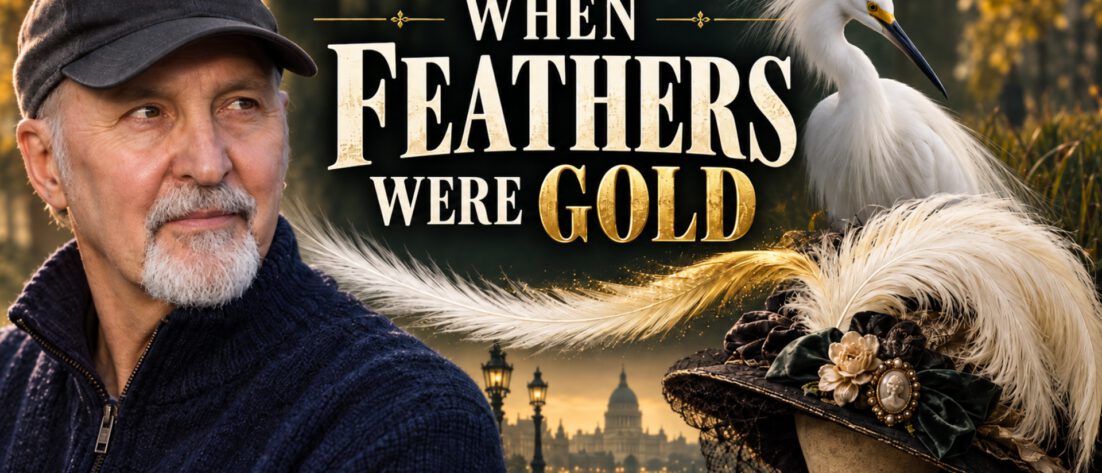
A century ago, the birds at your feeder were fair game. Egrets were shot for their breeding plumes, passenger pigeons were shipped to city markets by the barrel, and fashionable women wore hats topped with whole stuffed birds, sometimes with hummingbird earrings to match. On this episode of Books and Looks, Blaine DeSantis talks with Dr. James McCommons about his new book, The Feather Wars and the Great Crusade to Save America’s Birds, which traces how the country went from hunting birds to protecting them between roughly 1870 and 1930.
The fight wasn’t always polite. McCommons describes rival egg hunters arming themselves with small cannons on California’s Farallon Islands, night riders and burned hunting lodges in the Big Lake and Reelfoot duck wars, and market hunters paddling out with punt guns that could kill as many as 100 ducks in a single blast. He also shares the stories behind the laws that changed everything, including the wormy apple that helped win over a skeptical House Speaker for the Lacey Act, and the bird protection bill President Taft signed on his last day in office after swearing he never would.
Along the way you’ll meet the teenage “shotgun ornithologists” who grew up to lead the early bird protection movement (one of them went on to sculpt the Lincoln Memorial), Tabasco heir Edward McIlhenny, who raised snowy egrets by hand on Avery Island, and Coco Chanel, whose simple cloche hat helped make feathered hats obsolete. Whether you’re a backyard birder, a history buff, or just curious how conservation took hold in America, this conversation is packed with stories you’ve probably never heard.
📖 Get the book: “The Boleyn Secret” by Alison Weir is available now wherever books are sold. Buy it here: https://a.co/d/03qMbBcy
Introduction to The Feather Wars
Blaine DeSantis:
Welcome to Books and Looks, where we do a deep dive with authors to help you discover your next great read. I sat at our kitchen table, and in the past day I’ve seen our backyard filled with finches, goldfinches, woodpeckers, cardinals, bluebirds, pigeons, and doves. A young hawk showed up, as well as an egret that stood at the edge of the pond.
Less than a century ago, these birds would have been under attack, as we hunted them for food, clothing, hats, museums, and in some cases, hummingbird earrings. What changed in this past century? How did we change from a society of hunters to one of conservationists and observers?
Some was thanks to an elected official. Some was actually due to armed conflict, if you can believe this. And what part did Coco Chanel play in this?
I’m Blaine DeSantis. This is Books and Looks, and today we welcome Dr. James McCommons to chat about his marvelous new book, *The Feather Wars*. James McCommons, welcome to Books and Looks.
James H. McCommons:
Thank you for having me.
Defining the Feather Wars and the Conservation Crusade
Blaine DeSantis:
James, I’m very honored to have you today. You have written an absolutely marvelous book, *The Feather Wars*, and I admit to my ignorance that you taught me a whole heck of a lot.
Before we get into the details, why don’t you give us a bit of an overview about what the Feather Wars are, and what years of those Feather Wars do you talk about in this book?
James H. McCommons:
The full title is *The Feather Wars and the Great Crusade to Save America’s Birds*. The Great Crusade to save America’s birds really took place from around 1870 to about 1930. That’s the period where birds were really on their way down.
They were being decimated through market hunting, through what we’ll talk about later, feather hunting, and just a lack of protection for these birds. That was true, frankly, of most wildlife at that time. It was looked upon as being a commodity. There weren’t hunting seasons for many animals.
That decline really happened until around 1900 and even a little after that. But by 1900, there was really an upswell of public opinion, legislation, and then movement through organizations like the Audubon Society, which was organized in the 1890s, and the Boone and Crockett Club, which was organized around the same time, to bring conservation to the people. In a sense, teach people that these wildlife natural resources were not unlimited and that we needed to regulate how we took these animals and when we took them.
In some instances, of course, not hunting some of these animals. So that’s the crusade part. The feather wars part is about the fact that violence did break out in many instances during this period.
You have market hunters often fighting over the resource with sport hunters. They’re both trying to get the same resource, and that resource is diminishing. You also have violence that happened between game wardens and the market hunters—people who were coming in and trying to enforce these new laws, and then the folks who just wanted to keep doing business as usual.
Inspiration and the Roots of Federal Bird Protection
Blaine DeSantis:
It’s something that I don’t think anybody ever has thought about, to call it the feather wars, and there really was a war. So let’s get right into this. What was your inspiration, James, for writing this book?
James H. McCommons:
My previous book was a biography of a man named George Shiras III. George Shiras was a congressman in the early 20th century who was also a lawyer and a wildlife photographer, too.
During his time in Congress, he introduced a bill called the Shiras Bird Bill, and that was to protect game birds. Shiras was a hunter. He was very concerned about waterfowl disappearing and many of these other migratory birds that move from state to state.
He introduced a bill that would allow the federal government to take federal jurisdiction over these birds that move between states. That bill didn’t pass, but that was the new idea coming into the fore in the early 20th century, that the federal government should be taking jurisdiction over wildlife.
Shiras was an important figure during that time, and he appears in my book, *The Feather Wars*. But my initial book was a biography of him, his work as a wildlife photographer, and his work as a legislator. I got really interested in that period and had to learn a lot about the laws and things that were passed during that period, including the presidency of Theodore Roosevelt.
That led me to this book because I saw that there was a bigger story to tell, of which Shiras was only one player.
Blaine DeSantis:
Wow. That was pretty radical when you think about what he proposed. I guess we’re going to get into some of these things later, but that’s pretty radical to have the federal government being in charge of all this. That had never happened before.
James H. McCommons:
No, it hadn’t. There was this whole push and pull, even from the Civil War, about states’ rights and federal jurisdiction over certain things that the states wanted to hold on to.
Some of these states were making a lot of money. There was a business of selling wildlife, of harvesting ducks, for instance, and they didn’t want to change. They also felt that there was a moral aspect to this, that the feds had no business being there.
You saw a lot of that feeling in the South, which was part of the old Confederacy, a hangover from that period. But it was also in the West as well. A lot of the Western states, and the territories that were coming in to become states, were not happy with the federal government setting aside forest preserves and things like that.
Then there were all these businesses. They were making a lot of money exploiting natural resources, and they didn’t want to see regulation either.
The Era of Shotgun Ornithology
Blaine DeSantis:
One of the things you begin your book with is a discussion of shotgun ornithologists and an 1868 photo of three gentlemen. These gentlemen are fascinating individuals. Who are they? While they were big in conservation, they had other jobs too. What did they become?
James H. McCommons:
The three young men were about 15 years old at that time. This was a photograph that I found at the Concord Museum in Massachusetts. There was an exhibit going on there about the life of William Brewster.
William Brewster is one of the young men in the picture, and he is a fascinating character. He had the largest collection of bird skins in the United States that formed the core of the collection at Harvard University.
What shotgun ornithologists were at that time—and this was taken immediately after the Civil War, so in the 1860s, 1870s, 1880s—if you were interested in birds, you went out and you hunted them. All birds.
You brought them back home. You identified them using these big, thick books they had at that time. There were really no field guides that you could take out with you, and there were also no good optics at this time.
Because birds were fleet and hard to see, you could shoot the bird, bring it down, put it in your hand, look at it, take it home, and look it up in these big books. This is how a lot of people, mostly young men, got into what we now call birding. It wasn’t sight ornithology; it was shotgun ornithology.
This picture shows these three young men in New Hampshire on a trip when they’re 15 years old. The one on the left is William Brewster. He’s one of the founders of the American Ornithologists’ Union. He’s also the first president of Massachusetts Audubon. Later in his life, he really does work for bird protection.
The young man in the middle is William Chester French. These guys were all childhood friends from the Boston area. William Chester French became a sculptor, and he is the creator of the Minuteman statue. He’s also the creator of the Sitting Lincoln in the Lincoln Memorial. He became a famous sculptor of Americana.
The other young man to the right is Ruthven Deane. He was a businessman in Chicago, and he later became president of the Chicago Audubon Society. One of the interesting things he did was act as a historian for this early bird movement.
He collected photographs of many of these people that I wrote about in the book. He asked them to send portraits. In the Library of Congress, there is a photo collection from Ruthven Deane of all of these individuals. I was able to go back and look at these photographs, and we use several of those in the book.
The Decimation of the Passenger Pigeon
Blaine DeSantis:
They’re absolutely great. They certainly enhance the writing. It’s wonderful.
Tell us, you said there’s been overhunting and decimation of the bird population, including the passenger pigeon. What happened, and what were all the uses of these birds?
James H. McCommons:
A lot of people consumed wildlife; they ate these birds. Passenger pigeons were very popular for table fare. They were the most abundant bird in America when the colonists first arrived here.
They were an eastern bird. They went from the Atlantic basically to the Mississippi. They would migrate north and south, passing over places in enormous flocks that might take hours to pass over, darkening the sky and sounding like thunder.
I say in the book that it’s a spectacle of nature that we will never see again, because the bird, of course, was hunted to extinction. But it wasn’t just passenger pigeons. People ate woodpeckers back then. They ate blackbirds. They ate all kinds of birds that we would not consider game.
The passenger pigeon was a colonial nesting bird. When it landed in the northern forest, it would land in great numbers. Sometimes these roosts were 20 miles wide and 40 miles long in a river valley. Native Americans had been hunting these birds for a long time; they would go into these rookeries, kill these birds, and eat them.
The white settlers did the same thing. This was like manna from heaven. These birds were very easy to kill. The squabs, the young chicks, were considered a delicacy.
Like a lot of market hunting or subsistence hunting, it happened on a local level at first. But as the 19th century went on, this became an industrialized killing. There were people known as pigeoners who were expert at harvesting these birds.
When there was a large nesting, these hunters of all types would descend on these roosts and kill these birds, often in horrible ways. They would set the trees on fire or chop them down. They would net the birds.
Then the pigeoners or the market hunters would pack these birds into barrels of ice and ship them off by the trainload to the cities. It was not unusual back in this period that you would go down to your local market and buy a duck, a goose, or a couple of pigeons for the table.
The passenger pigeon eventually declined during the 19th century. Some birds survived into the 20th century, but the last passenger pigeon died in the Cincinnati Zoo in 1913. We actually know when that species became extinct because it was the last known individual.
The passenger pigeon was an important part of this story because people thought that this bird could never be reduced. It was one of those natural resources where we could keep killing them year after year in great quantities, and there would still be more left. Why? Because there always had been more.
When the passenger pigeon disappeared—along with the American buffalo, which was another example—it registered with Americans that these things were not limitless. That had a lot to do with the advent of wildlife conservation.
The Lucrative Plume Trade and Smuggling
Blaine DeSantis:
We obviously know a lot about the buffalo that’s been publicized. The beaver was another animal we almost hunted into extinction. But the birds, we didn’t really know much about this until now.
It’s amazing, as we go through your book, you’ll see the surprise in the hunters: “There are no birds left.” Well, no, you killed them all! They couldn’t believe there were none left, and it’s an amazing thing that was going on.
Now, one of the things that you write, and I can’t believe this: egret plumes, the plumes from egrets, were worth more than their weight in gold. Can you explain this whole bird economy, the smugglers of birds wearing pelts, and all the things they were doing with birds?
James H. McCommons:
We talked about market hunting and subsistence hunting. The other thing that came along in the 1870s was feather hunting, and that was simply hunting birds for their feathers.
Why were we doing that? We had used bird feathers in the past for mattresses and pillows and those kinds of things. The settlers did. But in the 1870s and ’80s, it became a fashion statement to have a feather in your hat, particularly a woman’s hat.
Of course, the more colorful these feathers were, the more popular they were. This was a fashion that was not just in America, but was also in Europe. The main trading places where these feathers were brought, traded, and manufactured into women’s hats were Paris, London, and New York.
There was a big trade in feathers for women’s hats, and this went on all the way up until World War I. There were decades and decades where feather hunters were out there killing birds simply for what they called their plumes.
There were many different kinds of birds that were popular, but many of them were the wading birds, particularly along the Gulf Coast and Florida, because the birds were colorful and large. They nested in rookeries in places where they concentrated, which made them very easy to kill.
The egret, the snowy egret especially, would grow this long breeding feather called an aigrette. That breeding feather was highly sought after for these hats. It really was worth more than its weight in gold. The feather doesn’t weigh much, but the fact was the price was very high, and so many of those birds were just wiped out.
It was very cruel. The hunters would go into these rookeries, shoot all the adults, skin them, and then leave the chicks to die. You’re not only killing that one generation, you’re also killing the next generation coming up.
Feather hunting was rampant during this period. They were also killing lots of birds like northern flickers and woodpeckers of different sorts. It really depended on how fashion changed over time as to what birds were the most popular to bring in.
I believe there were around 40,000 people working in New York City in the 1880s processing feathers and making women’s hats. This was a big business. Even when the legislature in some of these states tried to outlaw this, the interests fought very hard against it.
Blaine DeSantis:
You also make a point that somebody was trying to smuggle out belts made of bird-of-paradise plumes, having 150 of those around his waist. Was this a common practice?
James H. McCommons:
A lot of smuggling happened. In the 19th century, there weren’t so much smuggling because this was all done in the open. There were really no laws or regulations to stop feather hunting.
The idea was that these birds were a commodity. If they were being killed for feathers, that wasn’t much different than them being killed for meat.
In 1900, there was a law passed called the Lacey Act, named after John Lacey, who was a congressman and conservationist from Iowa. What the Lacey Act tried to do was to stop the interstate trade of feathers and the interstate trade of birds for meat.
Some of the individual states were passing laws that made it illegal to shoot birds in their state, or they at least had seasons on some of these birds. But if you were a market hunter and poached these birds, then got them onto a train and across the border into the next state, they were legal. You could just take them to the market.
This was the first opportunity where the federal government came along and said, “We’re going to stop the interstate trade, or at least depress it.” It became a very important law.
During that time, there was a lot of smuggling of these animals. Authorities were finding barrels and barrels of birds in cold storage waiting to be moved to different places. People were sending feathers in suitcases not to the manufacturer in New York, but maybe to an apartment somewhere in New York so it could then be taken over to the factory.
There were a lot of ways people were trying to get around this law. People were wearing them when they came back from London or from another state, smuggling them that way.
The Lacey Act and the Wormy Apple
Blaine DeSantis:
You talk about the Lacey Act, and it passed because of a wormy apple. Can you explain what a wormy apple has to do with the passage of the Lacey Act?
James H. McCommons:
That’s a great anecdote. I was doing research on that chapter, and I came across a very old book that was a compilation of stories told by John Lacey, the congressman, and some of his speeches.
Lacey has this story that he was trying to get this bill passed, and Joe Cannon, who was the powerful Speaker of the House at that time, was not a fan of conservation. He was not a fan of Theodore Roosevelt, who was vice president at that time and about to come into office.
Cannon let it be known to Lacey that he was not interested in seeing this law passed. He thought that the federal government was intruding on states’ rights. Lacey knew that Cannon liked apples; he liked to eat apples.
Lacey went out to a market in Washington, D.C., and found some bad apples that had wormholes in them. He brought them into Congress, saw Joe Cannon, and offered him an apple.
Cannon took the apple, looked down at it, and saw that it was all marred up with insect infestation. He looked at Lacey, and Lacey said, “See, this is what happens to apples when we don’t have birds.”
There was a lot of talk at that time about something called economic ornithology: that we need to save birds for all kinds of reasons, but one reason is that birds are the protectors of our crops and forests.
Lacey made the point that day with Cannon that if we had more birds, these apples wouldn’t be so wormy. And of course, that’s why we need birds. That helped convince Cannon to drop his opposition to what became known as the Lacey Act.
The Farallon Island Egg Wars
Blaine DeSantis:
However you can get it done, you get it done, and that was good.
I want to go back a minute to something I’ve never heard of before. Friends, if you’ve heard of this, you’re a better person than I am: the Farallon Island Egg Wars. Where is Farallon Island? What are the Egg Wars? And were people killed in this?
James H. McCommons:
Yeah, they were. That was some of the violence that occurred.
To back up a little bit: why was there an egg war? People ate a lot of wild bird eggs back in the 19th century. People did have chickens and backyard flocks, but there was really no mass production of hen’s eggs at that time, especially in California after the Civil War when California was still booming around the Bay Area with the gold rush.
San Francisco was booming and they couldn’t get enough eggs. Off the shore were these very rugged seamounts, islands called the Farallon Islands. They had a lot of wild bird eggs out there. They were murre eggs, petrels, and western gulls. These seabirds came to these rocky mounts to lay their eggs and raise their chicks.
A pharmacist in town went out and risked his life—I think his brother went as well—and they got these eggs, brought back a boatload of them to San Francisco, and made a lot of money. That inspired other people to go out to these islands, which were difficult to get to and difficult to live on.
They went out there and started to harvest these eggs over a period of years. Those eggs were used back in San Francisco. People ate the eggs, but a lot of it was used in bread and confectionery recipes.
You could make a lot of money doing this, so two or three different groups got together, staked out their places on the islands, and protected them. At one point, there was an egg war, meaning these groups armed themselves with small cannons and other weapons.
They had firefights, and there were some fatalities. That was the Farallon Island Egg War.
Eventually, the U.S. Navy went out there and threw all these people off the island. But by that time, they had pretty much decimated the population of the birds coming there and the eggs. As the resource was declining, there was more conflict to get what was left.
The Migratory Bird Act of 1913
Blaine DeSantis:
Friends, there are so many anecdotes in here, and I have to jump around a little bit because this is so great and I have such limited time.
President Taft passed a Bird Act, which he vowed he would veto, but he passed it. What was the act? Why did he pass it? Tell us a little bit about that.
James H. McCommons:
That was the Migratory Bird Act of 1913.
If you go back to look at the legal theory at that time, the idea was that the states owned the wildlife and the federal government didn’t really have jurisdiction over that. The Shiras Bird Bill was the begging of the idea that through its police powers and interstate commerce, the federal government did have jurisdiction.
Taft was a lawyer. Taft had looked at the Supreme Court decisions up to that point and said, “Look, I believe case law says that the federal government has no jurisdiction, and I don’t like this idea.” He said he would never sign it.
What happened was, as it was going through Congress, they tacked the law onto a big appropriations bill. You have this huge document, and they snuck it into the appropriations bill.
Taft, who had lost the election in 1912, was on his last day in office when the appropriations bill came onto his desk. Who has time to read this? He’s also getting ready to go to the inauguration with Woodrow Wilson. He signs the bill, and that’s how the bill becomes law.
He ends up signing a bill that he didn’t support and had already made clear he wasn’t going to support. But the bird proponents were able to sneak it into this appropriations bill as an amendment.
Edward McIlhenny and Avery Island Sanctuary
Blaine DeSantis:
Where there is a will, there’s a way, and they certainly had the will.
One of the people I found fascinating in this book was Edward McIlhenny. I’ve talked about Edward McIlhenny in other books we’ve done this year, of the Tabasco family. He was a big bird conservation man on Avery Island. What was his part in this?
James H. McCommons:
Avery Island is an area near New Iberia, Louisiana, where the family came up with the recipe for the hot sauce that became so popular. This goes all the way back to right after the Civil War.
E. A. McIlhenny, or Edward, ended up taking over the family business. His father was the one who started it. Edward grew up where Avery Island is, down in the swamps of Louisiana, with lots of wildlife and birds. He was always a hunter, and he also saw plume hunting when he was a boy growing up.
He went away for many years, and then he was called back because his father had died and his brother no longer wanted to run the hot sauce company. When he came back, he saw that there were really no birds.
Wading birds, egrets, herons—all of those birds had been hunted out. He realized what had happened, so he went into the swamps and found chicks of snowy egrets.
He brought them back to a pond in front of his home on Avery Island and raised them. He fed them fish with his hands and gave them nesting materials. The birds built nests, and then they flew off on their southern migration to Latin America and South America.
The next year, several birds came back. He didn’t know if they were the same ones, but he figured they were. He did it again, and they raised more chicks.
This continued for several years. His flock of snowy egrets and other birds on this pond kept enlarging, so he kept making the pond bigger. He put platforms out there where they could nest when they ran out of areas around the pond. He eventually had 100,000 or so birds.
He also moved some of those birds over to Florida to a friend of his, another wealthy individual who put them on his estate.
I tell this story because he didn’t necessarily single-handedly save the snowy egret, but he brought back the bird in enough numbers that they were repopulating that whole part of Louisiana, and in Florida, too. He’s responsible for a lot of the comeback of the snowy egret in the 20th century.
He did a lot of other stuff, too. He was able to buy some wetlands down there that eventually became refuges operated by the state of Louisiana. He convinced Rockefeller to buy some land down there.
On one hand, he’s a conservationist. On the other hand, he was also a big hunter, and he ran game farms and sold wildlife, too. He represents the old with the new in the conservation period.
He is a fascinating character, and Avery Island is a really interesting place. I would encourage anybody to go there and check it out. Take a tour of the hot sauce, and the pond is still there. You can still go there and see these birds that have migrated to the area, built their nests, and are breeding. You can see those snowy egrets with those beautiful breeding feathers that were worth their weight in gold.
The Big Lake and Reelfoot Duck Wars
Blaine DeSantis:
Almost 100 years later, and it’s still being used by the birds. That’s great.
We talk about feather wars in legislatures and with public officials, but as we talked about with Farallon, there were literal gun battles. Two in particular were the Reelfoot and the Big Lake Duck Wars. What were these? Were people really killed in these wars?
James H. McCommons:
They were. To back up just a little bit, there’s an area called the Sunken Lands in northeast Arkansas, the Bootheel of Missouri, and western Tennessee—the area northeast to west of Memphis.
That area is earthquake country. There was an enormous earthquake there in 1812 and 1813 called the New Madrid Quake, and some of these lands sank down. There’s a lot of water down there with the Mississippi River, and it created these lakes and enormous wetlands. It became a great stopping point for a lot of birds during their migration.
There was a lot of market hunting there, and there were a lot of people squatting and living in the swamps. You think about people living in the swamps in Louisiana, the Cajuns; there were also people living in the swamps in that part of Arkansas known as the Swamp Angels.
They were subsistence hunters mostly, but they also hunted and sold some of the wildlife. As happened in other places, as that resource began to diminish from all of these birds being hunted and shipped out in barrels to eastern cities, Chicago, and New Orleans, there were fewer birds.
There was a conflict between the subsistence hunters, the market hunters who were coming in during the migration seasons, and the sportsmen who were coming in trying to establish lodges and hunting areas for themselves.
The Big Lake Duck Wars happened around 1900 into 1913 or 1915. During that period, the sport hunters came in and built lodges, and the Swamp Angels and market hunters went out there and burned down their lodges.
The sport hunters were trying to control lots of this area. They were buying it from the railroads and timber interests. After the timber people cut the wood, they would sell off the stump lands to the sport hunters.
The sport hunting groups put out game wardens. They called them game wardens, but they were really protective police to keep out the squatters and market hunters. Those people were out there armed, and violence occurred as they fought over the ducks.
Reelfoot was a little bit different. Over in western Tennessee, that was also over ducks and waterfowl, but it turned into strange racial incidents. There were night riders, people like the Klan, and vigilantes who were burning down sport lodges and sport hotels. At some point, they were even murdering people who were trying to control the lake.
Finally, the state stepped in at Reelfoot, and it’s now a beautiful state park. Over in Arkansas where Big Lake is, the federal government created a bird refuge. A lot of that land in Arkansas got turned into rice farms.
I went there to see the National Wildlife Refuge and some state refuges. It’s a miniature of what that area used to be; most has been taken over by big agriculture because it was perfect for growing rice.
Lethal Technology: The Punt Gun
Blaine DeSantis:
So many more questions! You talk about ducks. Tell us quickly: what is a punt gun, and what was it doing? That’s fascinating.
James H. McCommons:
We need to put a picture of that up, too.
Blaine DeSantis:
I’ll get a link for that.
James H. McCommons:
There were a lot of ways that market hunters were killing birds, and the weaponry got better and more lethal as time went on. They were out there with double-barreled shotguns, but eventually—and this started over in England, then a lot were manufactured here or homemade—they used punt guns.
A punt gun is probably 10 to 15 feet long. It looks like a regular gun with a stock and a barrel, but really it’s a cannon. The bore is about two inches across.
You would muzzle load it by putting in gunpowder and maybe a pound of shot. You didn’t hold this gun; you mounted it onto a skiff called a punt boat, which is how it got the name punt gun. The entire punt boat is how you aim the gun.
The hunter would paddle out at night on his stomach next to the gun into a raft of ducks. Then he would hit the side of the boat to make the ducks start to fly or look up, and fire.
You could kill 50 to 100 ducks at a time. You would gather up the ducks, go back to shore, reload the gun, and go back out again. Sometimes people did this with two or three guns at a time, working in concert.
There was nothing sporting about it. It was all about killing as many of these birds as possible, and this was an efficient way to kill them.
Punt guns were legal for several years after the Civil War. Eventually they became illegal, and they really weren’t all rounded up until around the 1930s. A few guns were passed down through families of poachers, and they even had names like Big John. The game wardens were out there looking for Big John.
A lot of those guns were associated with the Chesapeake Bay, but they were used in other places as well. They didn’t even have triggers. You poured the gunpowder toward the back and hit it with a hammer, and it would go off.
Sometimes they made them out of high-pressure steam pipes that would rupture and explode, so they were dangerous. But they’re quite something to look at when you actually see one. They’re this weird, weird thing.
How Coco Chanel and Fashion Trends Saved Birds
Blaine DeSantis:
I have two quick questions for you because we’re already hitting 45 minutes. Unbelievable! This is such a great book.
Coco Chanel: they said she sounded the death knell for the millinery business with these plumes. Is that true?
James H. McCommons:
She was definitely part of it. By 1913, the act passes, and you start to see them protecting migratory birds crossing state boundaries. In 1918 comes the Migratory Bird Treaty Act. Birds cross state boundaries, but they also cross international boundaries, so now we needed a treaty with Canada in order to protect all these birds.
All that was happening and really important. But during that period, the Great War, World War I, was happening.
Coco Chanel was a fashion designer in France designing women’s hats. Her hats were very different than the big, ostentatious hats that had dominated fashion for decades.
Women had been wearing petticoats, long dresses, bustles, and these enormous hats with bird feathers and birds on them. In World War I, a lot of women started working in factories and working outside to support the war effort, and they needed clothing that was a lot more practical.
Coco Chanel was known as a woman designing clothes coming up from the street, looking at practicality. She hated these bird hats. She called them bird nests and said, “What brain can think under that?”
She really changed fashion with her cloche hat, which is what you might picture as a flapper hat. You couldn’t have a big pompadour haircut—which was good for holding up large bird hats—under a cloche hat. Women started to cut and bob their hair and wear these cloche hats.
All this legislation came through in both Europe and the United States putting the kibosh on bird hats, but it was also fashion. Fashion changed. It was no longer cool to have these hats; there was something brand new.
I say in the book that fashion brought in this killing of birds for feathers, and eventually the caprices of fashion changed it in the end, making it no longer fashionable to wear these hats.
Wearable Taxidermy and Bizarre Victorian Trends
Blaine DeSantis:
There’s one thing you brought up in the book that I found fascinating, and I have not found a picture of it. Is it true they had such things as hummingbird earrings?
James H. McCommons:
Yes. They started off with feathers in hats. Through the 1880s and 1890s, designers competed with one another, and fashion became more and more ostentatious.
It wasn’t just feathers; now you had to have full taxidermied birds on your hat. These big hats became platforms for all of these birds. Sometimes you’d have natural materials like sticks with a bird sitting on them with its mouth open.
You had wearable taxidermy. That wearable taxidermy also went to earrings with little hummingbird heads, brooches with bird heads, dresses trimmed with feathers, and entire hats made out of just feathers.
Fashion can get very strange, and people were just trying to outdo one another. It was pretty terrible and pretty bizarre.
Conclusion and Final Reflections
Blaine DeSantis:
Friends, there’s so much more I could talk about. As I told James, I had over 30 questions when I began working on this show, and we’ve gotten to around 14. That’s how much there is. There are so many stories of the way it was and the way it’s changed.
He even gets into my hometown area—James and I are from the same basic area—Hawk Mountain, protecting the “bad” birds. When I was a kid growing up, there was the annual Labor Day Hegins Pigeon Shoot up in Hegins, Pennsylvania, in Schuylkill County. That went the way of the dodo; in 1998, they eliminated the Hegins Pigeon Shoot. So that’s going on, too. They preserved the birds.
James, I could talk another hour with you, my friend. You have done a wonderful job. Friends, you have got to read this book. It’s out of this world. I want to say from the bottom of my heart, thank you so much for being with us today on Books and Looks.
James H. McCommons:
Thank you for having me on. I appreciate it, and I loved talking about it.
Blaine DeSantis:
James McCommons, thank you so much for being with us today on Books and Looks.
You’ve written a marvelous book, a book that I heartily recommend to each and every one of you—people who are conservationists, bird lovers, birdwatchers, or even if you only have a passing interest in birds and conservation. This is a book I really think you will enjoy; the stories are out of this world.
On behalf of our good friends at booktrip.com, this is Blaine for Books and Looks saying: may all your leaves be pages in a book.