
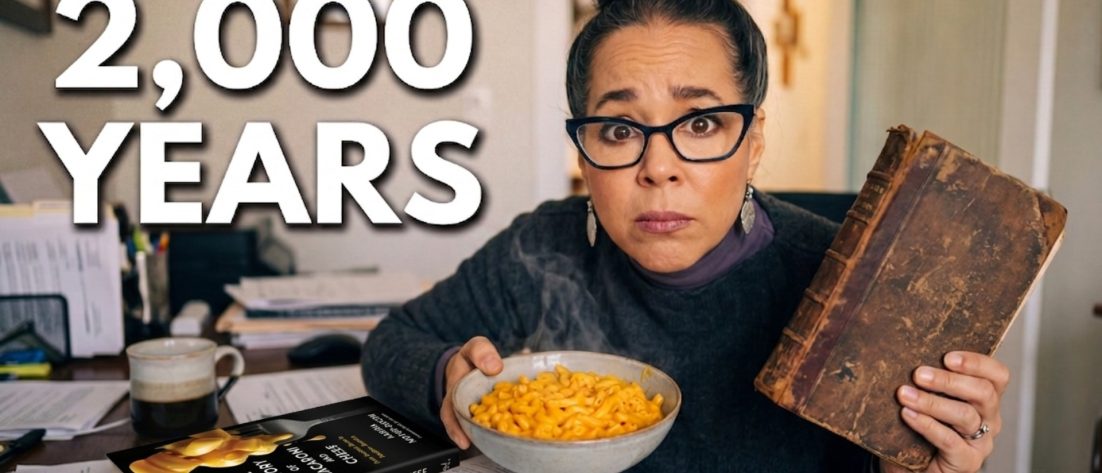
Think macaroni and cheese is just a simple American comfort food born out of a blue box? Think again. In this episode of Books & Looks, host Blaine DeSantis sits down with culinary historian Karima Moyer-Nocchi to uncover the incredible 2,000-year journey behind her new book, “The Epic History of Macaroni and Cheese”. Listeners will discover how this humble pasta dish evolved from an ancient Roman recipe into a highly contested global icon, giving you a completely new appreciation for your favorite nostalgic meal.
Karima reveals how macaroni and cheese served as a clever culinary loophole during strict medieval religious fasting before tracing its sophisticated makeover in the elite courts of France. The conversation dives deep into the fascinating world of food history, exploring the rampant plagiarism found in 19th-century cookbooks and the dramatic, xenophobia-fueled origins of the American pasta industry. We also unpack the fierce historical debates over proper cooking techniques, leaving you to wonder why early Italian recipes called for cinnamon and sugar—and how French chefs ultimately changed the dish forever.
If you enjoyed this delicious deep dive into culinary history, be sure to subscribe to Books & Looks and leave us a review. Check the show notes for a link to grab your own copy of Karima’s meticulously researched book and discover your next great read!
Episode Resources:
- “The Epic History of Macaroni and Cheese” by Karima Moyer-Nocchi
- Recipe and Excerpt for the Ancient Ancestor of Macaroni and Cheese
- Karima Moyer-Nocchi’s Official Website (The Eternal Table)
- “Chewing the Fat” by Karima Moyer-Nocchi
Macaroni and Cheese as the Ultimate Comfort Food
Blaine DeSantis:
Welcome to Books & Looks, where we do a deep dive with authors to help you discover your next great read. Comfort food is its own category of food. What makes something a comfort food? Well, it’s a food that delivers an emotional relief, usually through nostalgia, warmth, and simple, satisfying flavors.
The food triggers something in our brain that is soothing. Foods like meatloaf, chicken pot pie, mashed potatoes and gravy, pot roast, along with grilled cheese and tomato soup. Today we’re going to be talking about the number one comfort food in America.
I’m Blaine DeSantis. This is Books & Looks, and today we’re chatting with Karima Moyer-Nocchi about her new book, The Epic History of Macaroni and Cheese. Karima Moyer-Nocchi, welcome to Books & Looks.
Karima Moyer-Nocchi:
Thank you very much, Blaine, for having me. It’s a pleasure to be here.
Blaine DeSantis:
And Karima is coming to us today from one of the most beautiful regions of Italy. Where is that, Karima?
Karima Moyer-Nocchi:
I live in Umbria. Umbria is the new Tuscany. So if you haven’t been here, it is a wonderful place to visit.
Blaine DeSantis:
She is here to tell us about her new book, The Epic History of Macaroni and Cheese. Friends, there’s no better book cover this year. Look at that macaroni and cheese. I’m ready to eat right now.
From North Dakota to the University of Siena
Karima, you have had quite a life. Tell us a little bit about a girl who started out in North Dakota, went to Ohio, and ended up in Italy. Tell us a little bit about yourself.
Karima Moyer-Nocchi:
I was born in North Dakota. That was just for reasons of where my dad was working for a while; he certainly didn’t like it there. Then we moved to Ohio, which is where I did my undergraduate work before doing my graduate work at UMass Amherst.
While I was in Ohio, I was working at the Toledo Opera and really got a passion for Italy and Italian opera. I thought the Italians were all singing opera arias and had a loaf of bread under their armpit while they were on a bicycle going down a beautiful road. I became very much enamored of that.
When I went to UMass Amherst and continued my studies, I put an emphasis on Italian opera and Italy. I moved to Italy and did some of my studies there. After I finished my degree, I decided to have that standard kind of experience abroad, perhaps a bit extended.
Then I met someone and got several jobs. That may sound like it’s easy to get a job here, but I had several jobs just so that I could keep it together. Little by little over the years, I worked my way into the Italian university and eventually got tenure.
All the while, I had always nurtured an interest in food and in food history. Certainly, being in Italy is the ideal place to engage in that. One of the things that oddly surprised me is that there weren’t other cuisines in Italy. It was all Italian food in a very intense way here.
Because I missed those other things, I went abroad quite often to specialize in other kinds of cuisines, such as Vietnamese, Thai, Indian, and Mexican food. I believed my role in food in Italy was going to be as a sort of ambassador. Blogging was beginning, and I was going to get into that with these other food interests.
My first book was an Italian food history called Chewing the Fat: An Oral History of Italian Foodways from Fascism to Dolce Vita. It was one of those things that really came to me and descended on me. I had the idea and I brought it forth. That’s how I really started gearing myself much more towards Italian food history.
The Genesis of an Epic History
Blaine DeSantis:
My daughter has been over in that part of the world for the past year and loves Vietnamese and Thai food. Now she’s in Malaysia, eating Malaysian food. Food history is fantastic and absolutely amazing. You start out with macaroni and cheese. This book comes out of COVID, if I’m not mistaken. How did that happen and what was the process?
Karima Moyer-Nocchi:
There are a lot of layers to that question. My interest in this topic gradually developed during COVID. Lockdown in Italy was long and extreme, and I needed an intellectual project that was going to keep my mental faculties and my spirit intact in what threatened to be a painfully monotonous period.
I developed and taught an online course on the history of macaroni and cheese, whose main focus was the Italian origins. I think it surprises Americans how often they don’t realize this dish has an Italian origin. Also, Italians don’t realize that the American take on macaroni and cheese, which they kind of poo-poo, is actually part of their history and is deeply rooted in Italy.
In the latter part of the course, I traced how the dish moved outward into France and England and across the Atlantic to North American colonies. That project led to me being invited to speak at Monticello. They wanted me to deepen the aspect of the 18th-century dimension of the story.
I spent several months immersed in that period of time. That research then led to an article co-written with Adrian Miller and from there to a book deal with Columbia University Press. Those are the practical steps of it.
When you’re asking “why macaroni and cheese,” and you’re going to give five years of your life and your intellectual industry, you’re sacrificing your health from long hours of sitting. You’re losing friends because you’re not socializing or you don’t have the energy. Anytime you have free holidays and vacations, it’s all work time.
To sacrifice all of that to a topic, there’s got to be something more than a contract. I distinguish between my job, which is teaching at the University of Siena, and my work, which is research and writing in culinary history.
The more I researched this dish, the more I uncovered connections to the broader unfolding of historical sources: taste, fashion, social pressure, creativity, hunger, reform, industry, innovation, science, religion, and politics. This dish touches all of that.
If you think about the title, An Epic History of Macaroni and Cheese, you have something very serious on one hand and this whimsical idea of macaroni and cheese on the other. It’s that tension that really draws me in as a historian.
Ancient Roman Roots: The Placenta
Blaine DeSantis:
This goes back to something in early Roman times called placenta. I know that sounds nothing like macaroni and cheese, but tell us what placenta is and why it is the ancestor of mac and cheese.
Karima Moyer-Nocchi:
I like that you say “ancestor” because I’m very careful about tidy origin stories. When I describe placenta as an ancestor of macaroni and cheese, I’m certainly not suggesting that the Romans were eating mac and cheese.
What makes this dish significant is that it’s the earliest documentation of a dough preparation that has been shaped into sheets and then combined with cheese. There was also a sweet element to it, which was a bit of honey. But that does not relegate it to the dessert trolley because the honey was actually considered a health-giving thing. It was rare and expensive.
The source of the dish is Cato the Elder and was written about 160 BCE. Why was this included in his book? Because it was a book about getting the Romans to adhere to their traditions. He was an ultra-conservative Roman senator deeply concerned with preserving old-time Roman traditions.
It was not a cookbook, but this preparation appears because it carried cultural weight. That’s the thing we’re combining with our concept of macaroni and cheese. If you’re thinking about a ritual holiday dish, people would have anticipated the taste and remembered who made it well or who burned it.
Recalling previous occasions creates a powerful layering of memory, presence, and expectations. The sensory world of aroma, texture, and the warmth of the food in your hand fuses with a collective gathering and shared meaning.
That’s the panorama that interested me. Food is not just sustenance, but an emotionally charged ritual object where grain, dairy, technique, memory, and the communal experience converge in ways that anticipate the cultural role macaroni and cheese would later play.
The Medieval Evolution of Macaroni
Blaine DeSantis:
As I was reading about placenta, it sounded like it had layers. It almost reminded me of the way we put together our lasagna. Is that correct?
Karima Moyer-Nocchi:
Yes. When it carries through to the Middle Ages, there is a period of time between Cato and the only surviving recipe compilation from the Roman period. After that, we have an 800-year period when there’s kind of nothing. It’s the nightmare of culinary historians.
When the dish reappears at the end of the 13th century, we see it in the form of a layered lasagna. But it’s important to know that macaroni is an umbrella term and it absorbed all of the different shapes that existed at that time, except for vermicelli and ravioli.
Ravioli is a discussion unto itself. It doesn’t necessarily even mean something that’s covered with pasta; it could just be the entity inside that was the original ravioli. What you basically had were sheets about the size of the palm of your hand.
You had noodles, gnocchi, and a rolled-up kind of pasta that was hollowed out by putting a piece of dough onto a metal rod. When pulled out, you have something very similar to what we call macaroni. We need to consider that macaroni is very flexible.
From Italian Origins to French Sophistication
Blaine DeSantis:
Because of the word “macaroni” and the fact that it’s pasta, everybody assumes this is an Italian dish. But Italy didn’t have everything to do with it. There were other countries much more involved in its development. Tell us about that epic journey.
Karima Moyer-Nocchi:
If we were in a court of law, Blaine, I would say “objection, leading the witness” because we don’t want to discount Italy too much. Italy unquestionably establishes the foundation of this dish in substance, technique, ingredients, and meaning. It’s in Italy that the dish acquires its aspirational status and its cultural worth.
History unfolds on a continuum of origin, appreciation, and appropriation. France then becomes the primary arbiter of taste. The scepter passed from Italy to France, and they became the center of culinary culture in Europe. They so generously ushered macaroni and cheese into their inner sanctum, saving it from the “clumsy hands” of the Italians.
They put their own imprint on it. Just as Italian cooks had taken it and made their own changes, it was the kind of dish that you wanted to put your signature onto. When a dish leaves its place of origin, a process of appropriation follows.
The French absorbed the dish into their culinary system while retaining the prestige attached to the Italian lineage. One of the significant changes they made was removing the cinnamon and sugar. Throughout Italian history, the preparation had often included cinnamon and sugar, and it was mostly boiled in a fatty meat broth or milk.
The French decided that broadcasting cinnamon and sugar was just unnatural. They considered themselves the “vrai goût,” the true taste, so they eliminated that. They adopted and reframed an existing tradition within their own authority.
The French took it to elevated, performative heights. You see it encased in beautiful, tall raised pies. England, all the while, looked to France for culinary cues, filtering it through their own value systems and available ingredients. This elite food moved into England as well because French cooks and cookbooks were very important there.
At the same time, the colonists in the North American colonies were following the dictates of whatever the culinary culture was. The colonists were in a diaspora situation, which makes people adhere even more closely to fashion. If you weren’t doing that, you risked your social standing. It would be a kind of social death. There was an umbilical cord still in place between the colonies and Europe.
A Culinary Loophole for Religious Fasting
Blaine DeSantis:
I noticed in the book that macaroni and cheese had some connection with religious symbolism and fasting. Can you explain that a little bit?
Karima Moyer-Nocchi:
Yes, this is one of the aspects of my research that I’m particularly fond of. Religion is one of the crucial strands explaining why macaroni and cheese endured across the centuries. At the height of the Christian dietary calendar, roughly a third of the year was earmarked as meatless.
These were periods intended as mortification of the flesh. You assumed a fuller understanding of Christ’s suffering by giving up something that was materially and culturally important. Meat was enormously important.
In Roman times, meat was the food of sacrifice. The crucifixion itself was understood as a carnal sacrifice. Meat was also thought to stimulate the baser human desires, so abstaining would discipline both body and spirit.
Macaroni and cheese stood at the crossroads of that. Best practices during the Middle Ages and the Renaissance were to cook the pasta in a fatty meat broth for that comfort and umami. But cookbooks always needed to keep in mind days when you couldn’t do this.
The alternative was cooking it in milk, water, or a combination with butter. Instead of meat fat, you had butter. Then it was put together with cheese and “Bob’s your uncle.” This flexibility made macaroni a crossover dish.
On meat days, it could be enriched with broth, but it remained a deeply satisfying dish even on religious days. A creamy, buttery, cheesy dish of macaroni helped stave off abstinence fatigue. The rules about meat were clear, but you couldn’t really regulate sumptuousness.
A dish could be luxurious and rich while technically adhering to dietary laws. It satisfied without violating these laws. People have a natural aversion to suffering, so we all look for loopholes. Macaroni and cheese was that loophole.
Blending Historical Research with Practical Recipes
Blaine DeSantis:
This book is many things: a history book, a food history book, and in effect, a cookbook. I think you have 30 recipes in there. I read that you tried them all. Is that true?
Karima Moyer-Nocchi:
I like to emphasize that the book is not primarily a cookbook. As a culinary historian, I believe that in order to enter into the history fully, you need to exercise what is called “hands-on history.” It is a portal into the past.
I wanted to offer that to the reader. You can, if you want, engage in eating the dish as well. Yes, I did a lot of these recipes to bring them to the reader so they could have both a historical experience and something reasonable where they aren’t grinding their own wheat.
It is not an archaeological study but something that allows you to experience these dishes. A culinary historian needs to experience these dishes in order to do what I call “remapping,” which is what I do on my Instagram account. I remap dishes to make them more accessible without sacrificing historical accuracy.
Blaine DeSantis:
The amount of research you did was out of this world. I don’t know where you found everything, especially during COVID. What a wonderful job you’ve done.
Karima Moyer-Nocchi:
I was very fortunate that there are a lot of digitized sources of historical cookbooks. During my research, I was fortunate enough to get three fellowships because of the value attached to this project.
I did a fellowship at Monticello, which is the basis for Chapter 4, focusing exclusively on Thomas Jefferson and his enslaved chef, James Hemings. I also had a very generous fellowship at the Smithsonian Institution—the National Museum of American History.
It was research heaven being there, also because I was at the Library of Congress a good portion of the time where there is absolutely everything. My third fellowship was at the George Washington Presidential Library.
Plagiarism and Pretentiousness in Early Cookbooks
Blaine DeSantis:
One thing I noticed was that when we got into the era of cookbooks, everybody started putting their own twist on everything and criticizing the other guy. It seemed like everyone felt they were the only ones doing it the right way. Was this specific to macaroni and cheese?
Karima Moyer-Nocchi:
This is human nature when you’re a writer. It’s a wonderful question because it allows us to see how cookbooks functioned as competitive objects in the marketplace. Authors were trying to establish themselves as authorities.
They made their voice matter in their introductions by puffing themselves up, talking about how they cooked for royalty or elite households. Once the 19th century arrived, the idea of being economical came out, and everything was about being more economical than the last person.
At the same time, the 18th and 19th centuries were plagued with intense plagiarism. On one hand, you’re trying to say you’re different from everyone else, and on the other, there is rampant plagiarism with authors copying one another without a word of acknowledgment.
The most vocal critic that comes to my mind is William Kitchiner. He’s very pompous and even lies about his credentials, claiming he’s a doctor with a degree from Scotland, which isn’t true. His book was titled Apicius Redivivus, or The Cook’s Oracle.
He sharply criticized how poorly the English prepared macaroni, despite being English himself. His objection allows me to introduce an interesting piece of history: the salamander. This was a heavy copper plate with a long handle. You put it into the fire until it was red hot and held it over the dish.
He argued this scorched the surface and that the English were serving their macaroni with a burnt topping. He said that ruined the whole thing. Eliza Leslie, writing in 1837, said the top layer should just be the macaroni and not the cheese. I have tried this and it’s relatively unpleasant; it comes out rubbery.
One of the more interesting ones is Eliza Rundell at the beginning of the 19th century. She says you should cook the macaroni, take out half, and push it through a sieve. It becomes a macaroni cream, which you then put back with the rest of the macaroni and add actual cream.
This was one of the most plagiarized recipes, but another author took her to task because it was so wasteful. Macaroni was an expensive import item. Why go to the trouble of pureeing pasta when you can just thicken it with flour? He argued she was taking an expensive ingredient and turning it back into flour. These disputes reflected deeper tensions regarding economy, refinement, and kitchen technology.
The Rise of the American Macaroni Industry
Blaine DeSantis:
America did not have much of a pasta culture originally because we didn’t have the right wheat. In the 1800s, there were claims that you didn’t want the stuff from Italy because it was made by hand in the streets and was covered in flies. But this helped develop our domestic industry along with North Dakota wheat. Tell us about that.
Karima Moyer-Nocchi:
You can’t just make macaroni anywhere, and the Italians knew that. American manufacturing began in the first decade of the 19th century. Even though domestic macaroni was inferior to Italian imports, it possessed a “macaroni allure.” Consumers wanted to be part of something fashionable.
Many Americans had never tasted the import variety, so the domestic versions were considered perfectly acceptable. One of the selling points of the American version was that the imported one took so long to get here that it was often smelling or bug-ridden.
Domestic production in the U.S. increased, but it was a problem because imported Italian macaroni was actually more affordable because of American labor costs. It became economically advantageous for Americans to discredit the foreign product.
Newspapers began muckraking, circulating sensational accounts portraying Italian pasta production as filthy and primitive. Macaroni was depicted as drying in the dusty streets, exposed to flies and handled by grubby children.
This rhetoric was a form of confirmation bias that aligned neatly with broader anti-immigration sentiment directed at Italians who were arriving in large numbers. You also had public health fears during the Gilded Age. When cholera broke out in Italy in the 1880s, people worried they could get cholera from imported macaroni.
Why exactly was American macaroni inferior? Plain and simple: Italian macaroni was made with Durum wheat semolina. American macaroni was made with soft wheat. They tried a coarser kind of flour that was basically like cream of wheat made into macaroni.
The industrialists pressed the government for protection. Tariffs were imposed on macaroni twice before the end of the century to get those imported prices up. Then it dawned on federal officials that macaroni was becoming an important industry. The issue was agricultural rather than commercial.
If the United States could grow its own Durum wheat, domestic manufacturers could produce a pasta comparable to the Italian imports. By the late 19th century, the USDA began a project promoting Durum wheat cultivation in the Dakotas.
What goes around comes around; this helped the Americans push the Russians out of the Durum wheat market. The Russians had been selling their wheat to the Italians, who made the macaroni that was imported into the U.S. The U.S. wanted to sell their own wheat to the Italians and handle production on U.S. territory.
Future Research and Final Thoughts
Blaine DeSantis:
We have been having a wonderful time learning about The Epic History of Macaroni and Cheese. What’s next for you? Are you going to do another food history on a different comfort food?
Karima Moyer-Nocchi:
There’s something I’m involved in that was someone else’s project, but mostly I work organically. When the right project is ripe and ready for me, it will come to me. This project took a lot out of me.
One thing I want to do is a newsletter working on and around the macaroni topic. There are so many things in my bibliography that I didn’t even use because of word limits. There is so much to say about this topic. It is an American culinary icon with so many different facets of regional and community identity.
Blaine DeSantis:
Karima, I want to thank you so much for spending this time with us on Books & Looks. You’ve been a wonderful and informative author. Great job.
Karima Moyer-Nocchi:
Thank you so much. It’s been wonderful talking to you, Blaine.
Blaine DeSantis:
Friends, I hope you enjoyed our journey through history and macaroni and cheese. I never realized the history that goes behind this food. It began way back when with Cato the Elder, and we’re still refining it. People still fight about which is the best recipe.
I hope you’ve enjoyed our journey with Karima Moyer-Nocchi about The Epic History of Macaroni and Cheese. On behalf of our good friends at BookTrib.com, this is Blaine DeSantis for Books & Looks, saying may all your leaves be pages in a book.