
Discover how rebel advantage gamblers used early wearable computers to legally beat the casino for billions. Kit Chellel shares Lucky Devils’ secrets.
Episode Resources:
“Lucky Devils” by Kit Chellel
Bloomberg Feature: The Gambler Who Cracked the Horse-Racing Code
Guide to the Blackjack Ball Annual Gathering
Official Site of the Hong Kong Jockey Club
Beating the house is the ultimate gambler’s dream, but for a secret society of math geniuses and tech pioneers, it became a billion-dollar reality. In this episode of Books & Looks, author Kit Chellel reveals the fascinating hidden world of advantage gamblers who used science and homemade computers to systematically conquer casinos and racetracks around the globe. By tuning in, you’ll discover how a few rogue outsiders outsmarted the gambling industry and why everything you think you know about beating the odds is probably wrong.
Kit unpacks the wild evolution of advantage gambling, tracing its roots from the mental gymnastics of blackjack card counting to 1980s players hiding wire-wrapped, toe-operated microcomputers in their shoes – even when the batteries literally caught on fire. We explore incredible true stories from his new book, “Lucky Devils,” including how betting godfather Bill Benter engineered an algorithmic sports betting syndicate in Hong Kong and intentionally walked away from a $16 million jackpot just to protect his secret. You’ll also learn the mathematical framework behind exploiting biased roulette wheels, but the biggest revelation of the episode just might change how you look at modern betting apps like FanDuel and DraftKings forever.
Don’t leave your next great read up to chance – hit subscribe and leave a review if you enjoyed this eye-opening conversation. Be sure to check the show notes for a link to grab your own copy of Kit Chellel’s “Lucky Devils” and dive deeper into these unbelievable true stories.
Introduction to Lucky Devils
Blaine DeSantis:
Welcome to Books & Looks, where we do a deep dive with authors to help you discover your next great read. Beating the system. We all long to do that, even if that system is the casinos of Las Vegas, Atlantic City, or worldwide.
Most of us feel we can maybe get on a hot streak or get lucky. It doesn’t happen, friends. It doesn’t happen. But what if someone uses computers to beat the system?
That’s what today’s book is all about. Three specific individuals who took on the gambling industry with the use of computers, beginning back in the days when the computers were the size of a suitcase. This is their story.
I’m Blaine DeSantis. This is Books & Looks, and today we’re chatting with author Kit Chellel about his new book, Lucky Devils: The True Story of Three Rebel Gamblers Who Beat the Odds and Changed the Game. Kit Chellel, welcome to Books & Looks.
Discovering a Secret World
Kit Chellel:
Thank you, Blaine. Great to be here.
Blaine DeSantis:
Well, I’ll tell you, Kit, this was one great book. As I mentioned to you, I stopped reading all other books when yours came in. To quote a phrase that I use very often, I just ran naked through this book.
I couldn’t get it fast enough. I couldn’t digest it. Great effort, Kit. Just great. Loved it.
One of the things that I noticed in this book was this code of secrecy involving gambling and the gamblers. How did you uncover this? How could you break through and find this story?
Kit Chellel:
Found out about the world of advantage gamblers, who are the people who do this using science, by accident in a conversation with a friend over a couple of beers. He’d heard a rumor that there were these people using computers to bet on horses in Hong Kong and had made a billion dollars.
That number just sounded insane to me. No one makes a billion dollars betting on horse racing of all things. But I’m a journalist by trade. My job is to find difficult questions and go and get answers.
I was captivated by the idea that someone would even try to do this seemingly impossible thing. I went to try and find these Americans who had gone to Hong Kong, and it took me nine or ten months to get to the name Bill Benter, but I found him eventually.
It turns out the rumor was almost exactly what he had done. He was an early pioneer of using computers to calculate probabilities in gambling on horse racing. He was way ahead of the curve and, all told over the course of his career, he made about a billion dollars. He’s still doing it today.
I wrote about him for Businessweek, and people just seem to love the idea of the secret community of people who are doing this very familiar thing, but doing it better than everyone else. Once I found Bill Benter, I discovered there are versions of him in any betting game that you can imagine.
Roulette, poker, blackjack—pretty much any casino game or sports betting. There’s even a mathematical system for the lottery if you want to give yourself a good chance of winning the lottery and making money. There are professional syndicates who do that, too.
It’s everywhere, but it’s also hidden from view. Most people simply aren’t aware that this exists, and there’s a reason for that secrecy. If you’re a professional gambler and people know you’re winning, they kick you out.
They shut down your account. They take your winnings. You might be harassed, arrested, or worst of all, some other gambler will steal your method and use it to take your advantage away.
So they become very obsessed with confidentiality and secrecy to the point of paranoia. But there’s a good reason for it. They rely on it to do the job they do.
The Three Rebel Gamblers
Blaine DeSantis:
Wow. Well, with that in mind, who are these three individuals that you followed? And how long did it take for them to trust you? Because that’s a big thing about this, to be able to trust you to give you a story.
Kit Chellel:
I wanted three people to tell the story of advantage gambling in its modern form. Advantage gambling in its modern form is the use of computers and technology to superpower the calculations that allow you to get an advantage in a game of chance.
When computers became widely available in the late 70s, it transformed the industry. These were the pioneers of using this method. I wanted to show the broad spectrum.
I didn’t want to just do one story about poker or blackjack. I chose three people who I knew had done remarkable things in their field. We talked about Bill Benter, the horse racing pioneer.
My other two characters are Rob Reitzen, who did remarkable things in poker. He was programming poker bots way back before anyone knew what they were and using them in live poker games.
He was deploying them in digital poker rooms just when the industry was taking off, which was the secret to him making a lot of money in poker. The final guy is Bill Nelson. Bill Nelson was a roulette specialist who spent decades working on systems to beat roulette.
He was also a member of the very first computer-driven sports betting syndicate back in 1980 or 1981. They were using computers to calculate odds on college football games. Between the three of those, you can get a really good sense of how this way of life started.
The Evolution of Card Counting
Blaine DeSantis:
Where did they begin? You said 1981—did they start before then? Or was that around the beginning of everything?
Kit Chellel:
The beginning of everything in the book starts in 1979. But you could pick a day. What we’re looking at is this evolution of card counting.
It’s basically using maths and keeping count in a game of blackjack. It’s just mental arithmetic. It was effective in a casino.
We’ve all seen the movie 21 with Kevin Spacey. It’s that. There was a moment in time when that evolved into something technological and digital. That was around the late 70s and early 80s.
Blaine DeSantis:
I see. Now, card counting—I’m familiar with that. Again, I saw the movie, I’ve read the books, and I know what they’re talking about. Did they start as card counters? Did any of them start as card counters?
Kit Chellel:
Yeah, all three of them started as card counters. The roots of all this is card counting. Card counting is a scientific system for calculating odds in a game of blackjack that gives you an advantage over the house.
It’s the precursor to all these other systems and maybe the gateway drug for a career as a professional gambler. You start with card counting. Now, what most people don’t understand about card counting is that the reason card counting exists is because way back in the 1950s or 60s, Ed Thorp, the father of card counting, had access to an IBM computer.
He used it to run a bunch of numbers about the shifting odds in a game of blackjack. It was that process that led him to discover there are situations where, if you time it right, you can have a significant advantage over the dealer in blackjack.
From that discovery, all this stuff spread. The idea of advantage play and using computers all came from the card counting scene in Las Vegas.
All these young guys with mathematical brains and big ambitions about being pro gamblers came to Las Vegas around this time. They were all card counting in casinos, talking, and sharing ideas. It was from that world that this whole community of advantage players came from.
The Legality of Using Your Brain
Blaine DeSantis:
That’s absolutely amazing. I always thought card counting was illegal, but you point out it’s not really illegal. What’s the status legally of card counting now?
Kit Chellel:
Card counting isn’t illegal. It’s not even against the rules of blackjack. All card counting is doing is keeping count in your head.
You just keep a running count of numbers of the cards that have been dealt. You’re not having to sneak any information or peek at a dealer’s cards. You’re just doing sums in your head.
It’s quite hard to argue in any game that you shouldn’t be allowed to use your brain that way. But casino gambling takes place on private property. The casinos set the rules on their own property.
They get to decide who plays and who doesn’t. Back in the day when card counting was at its peak, there used to be signs outside casinos saying, “No card counters will be permitted in this establishment.”
They get to decide. If they even suspect you of card counting, they just throw you out. But no, you can’t be prosecuted. There’s no crime here.
Pioneering Wearable Technology
Blaine DeSantis:
All right. So then the enforcement is by their own people, not the police or any governmental industry. Wow. That’s really amazing. When they saw me, they never said to stay out. They said, “Come on in, Blaine, you’re welcome.”
Kit Chellel:
What does that tell you about your gambling, Blaine?
Blaine DeSantis:
I didn’t have this shirt at that time, you see. Now I’ve got a lucky shirt. But my gambling was pathetic. It was just oh, my.
But we had fun, and that’s the whole thing. I went to have some fun two or three times and it was a lot of fun. I enjoyed it.
I had a set amount I was going to lose, and I quickly hit that. So off I go walking down the strip. What can you do? Advantage gambling, you know, computers—they were huge when they started using them.
For those of us who are not familiar with how this is done, how would they use computers in the beginning?
Kit Chellel:
Back then, a computer was a substantial machine. I always say the early computers looked like microwaves with keyboards attached to them and a toaster on one side to put the discs in. They were very chunky.
But they were capable of fairly decent mathematical processing. Because that machine didn’t exist in wearable form, the pioneers of advantage gambling had to make their own.
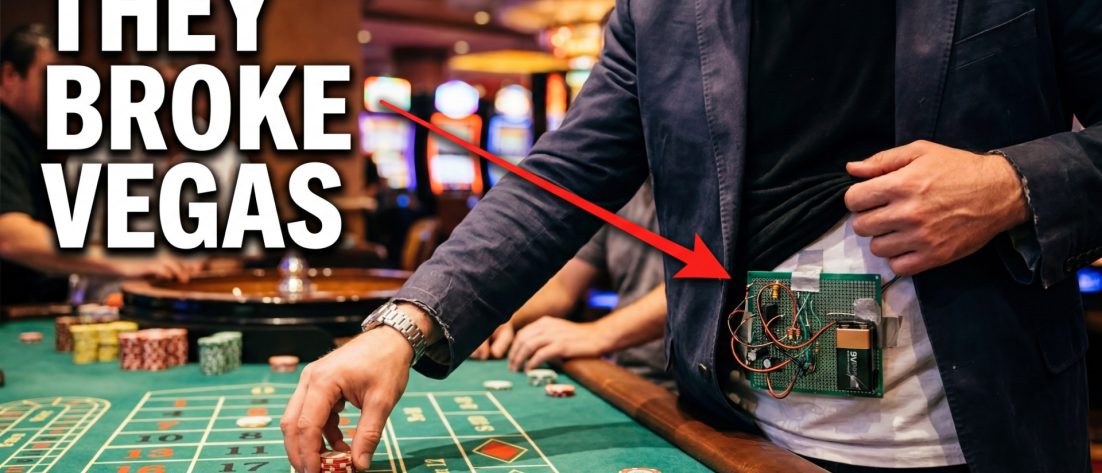
They would make their own microprocessors and circuit boards using something called wire wrapping, literally wrapping wires around nails to make your own circuits. They would buy microprocessors off the shelf from the major producers, program them themselves, seal them in epoxy resin, and then wear them under a pair of bell-bottom trousers or in a pocket and wire them up to switches.
It was all homemade gadgetry. These devices are incredible to look at now. Some of them look modern. People were using stuff from the 1980s that looks like an iPod.
They were years ahead of their time because there was money at stake. If you go to the Barona Casino near San Diego, you can see a bunch of these things on display. They’ve got an exhibit of gambling machines.
The first ones look like suicide bomber bomb belts. These green metal chunks were all around the waist. But very quickly by the early 80s, that tech slims right down. They start looking really good.
Operational Ingenuity and Hazards
Blaine DeSantis:
Did you have a partner to do this? The game doesn’t go that slow that you could sit there and quickly process everything. How did that happen?
Kit Chellel:
It helps to have a partner in any gambling technique. If the person who’s processing and using the computer can just focus on that, it’s easier. But it’s not necessary.
Believe it or not, they could enter information in real time using toe switches that were built into their shoes. They would enter the card that came out of the deck—tap, tap, tap, tap with the big toe.
The machine would spend two or three seconds processing. Then a hidden earpiece would either vibrate or tell you what to do. That could all happen in a couple of seconds.
One person wearing them was ingenious. It took a lot of practice to be able to do this. It wasn’t easy.
A really skilled practitioner could sit there with a hidden computer betting in real time with an advantage, and no one would know.
Blaine DeSantis:
They put something in their shoe and start tapping with their toe. That had to create a problem after a while, didn’t it?
Kit Chellel:
I’ve never used one, but apparently, it does become painful on the toe. It can lead to blisters. When you’re gambling with a system, it’s not instant success.
You don’t go in, make a couple of big bets, and walk out. That’s not how this works. When you’re an advantage player, you’re engineering or finding a situation where you have a slight advantage over the house.
It could be 5%, it could be 10%, or maybe 20% if you’ve got a really good system, but there’s still randomness and variance. The only way to make money is to play a lot of games.
Over a thousand games, your advantage will turn into money. But you have to sit there hour after hour, entering information with your toe and listening to the buzzing earpiece. This is not an easy job.
No one listening to this should think being an advantage player is an easy life. It’s extremely difficult.
Blaine DeSantis:
Well, you talk about some device that got wrapped around their thigh or groin and they got a zap or an electric shock if they hit. What is that? That sounds awfully painful.
Kit Chellel:
Bearing in mind that these things were made in garages and loft rooms by essentially amateurs—although a lot of them worked for big technology companies and did this in their spare time—these devices had a tendency to go wrong.
When they first started getting used in casinos, they would electrocute the wearers and give you a mild electric shock to the crotch. A couple of them would overheat and cause quite serious burns.
Later, when they started using a smaller type of battery, the batteries had a tendency, if not shut down properly, to overheat and literally explode. I heard of people wearing a wearable computer to bet on blackjack in Atlantic City, and the thing starts leaking acid down this guy’s leg.
He had to run out of the casino and sprint into the ocean because he was getting burned. There were attendant risks to using this technology, but it tells you a lot. It didn’t make them stop wearing them.
The profits were good enough and the advantage was exciting enough that it didn’t put the wearers off. They just taped themselves up and went again.
The Gambler’s Mindset and Community
Blaine DeSantis:
You know, these three gentlemen who you talk about, I consider them geniuses in their fields, but they weren’t highly successful when they decided to get into this. They weren’t really big players in poker; they just were little guys who eventually got an idea and started working on this.
Kit Chellel:
They were just kids. They started out in their early 20s or their late teens doing this for a job. They never had time to become a success at anything else.
All three of them identified really early on that they liked the idea of card counting. They liked the freedom of the life of a gambler. They didn’t want to be beholden to a company or work for the man.
They all thought they were smart enough to make a go of this. They all started out in Las Vegas betting quite small. If you want to prove yourself as a gambler, you go to the world capital of gambling.
You come to Vegas, but you don’t start that job with $500,000 in your pocket. You have to earn it.
They each had to build themselves up painstakingly, betting $5 blackjack in off-strip casinos that smelled terrible and were full of drunks. They had to build their bankroll over a period of years to reach what we would consider success.
Blaine DeSantis:
The work that went on is amazing. They met others who were also doing this advantage gambling, and some even took them under their wing. They became partners, friends, and confidants. That sort of surprised me that other people would bring them into the system.
Kit Chellel:
This is a whole subculture. It’s a community that has its own internal morality, its own rules, and its own personality type.
Back in the 1980s, there were hundreds of card counters in Vegas. They were normally young guys, mathematically minded, and quite shy. They knew how to spot each other across the room.
Naturally, doing this job, you were always being pursued by someone. The casinos were after you or the police were after you. There was a kind of camaraderie with these guys fighting a common enemy, which was the casino.
The Art of the Disguise
Blaine DeSantis:
One of the things I wanted to bring up was the fact that they wanted to keep card counters out, so people used disguises. They disguised how they were behaving. There was some guy who went by—one of our three—Neon Leon? What is the Neon Leon disguise?
Kit Chellel:
That’s my favorite disguise. This comes from an established technique for advantage players. Because casinos will throw you out if they think you’re a habitual winner, one of the ways to stop that is to pretend you’re a loser.
That’s called the “big player” technique. Basically, you pretend that you’re rich and careless, or rich and drunk, or you’re a foreign businessman come in to blow $500,000 in one evening. You want to look the part.
Card counters back in the day would wear fake mustaches and all sorts of shonky disguises. Some were better than others.
Bill Benter, the horse racing guy, is naturally one of the shyest people I’ve met. This was never his strong suit. He never had the confidence to play the part of the big player convincingly.
He was thinking about ways he could avoid getting thrown out. He came up with this alter ego called Neon Leon. The idea is that he would act the part of a shady drug dealer with money to burn.
Because Bill Benter is a former boy scout from Pittsburgh, he had no idea what a drug dealer looked or acted like. He had to guess.
For some reason, he thought that he should dye his hair blonde and wear a zip-up leather jumpsuit. He thought that’s what drug dealers would look like. He had a little vial around his neck that he was sniffing.
In this case, it completely backfired because they thought he was a real drug dealer. When he started gambling, they called security and threw him out anyway.
Beating the Roulette Wheel
Blaine DeSantis:
I think you called it the Billy Idol look. It was just like, wow, that actually threw him out. Oops. We’ve talked about blackjack, but one of the most fascinating chapters in this book deals with roulette. And not all roulette wheels are alike. Tell us about how they got an advantage on roulette.
Kit Chellel:
There’s a couple of ways to beat roulette. They all have a long and interesting history. But the simplest way to win, and apparently this still works, is something called biased wheel play.
The method behind it is this: Roulette wheels are manufactured by human beings. Like anything made by a human being, they are imperfect machines. They are not perfect random number generators.
Sometimes they come out of the factory with very small flaws. It might be a pocket that’s unglued or a metal ridge that’s just a fraction of a millimeter higher than any other. They’re not perfect.
Over time, if they get spun 100,000 times a day or more, they start to degrade quite quickly. It can happen after two or three weeks.
The wood in the wheel can warp. If a dealer is using a particular kind of lotion, the lotion can build up on the parts of the wheel the dealer is touching. All these things over time make the wheel essentially faulty.
Any imperfection like that will make the roulette wheel drop more in some sections than others. It stops being completely random and becomes a little bit predictable.
The simple concept behind biased wheel play is you find a wheel that isn’t perfect. You find the section that it favors—it could be 15 or 20 numbers—and then you bet those over and over again until you make money. It’s simple.
Blaine DeSantis:
How do you find that? Every time I go to a casino, they’re spinning that wheel and I have no time to sit there and analyze where this went higher or lower. How do they do that?
Kit Chellel:
It’s data collection. That job got a lot easier in the 1990s when casinos put up these number boards that show you the last 20 spins.
The reason they do that is because they’re exploiting a psychological fallacy where people believe that if a number hasn’t come up in a while, it’s going to come up soon. Of course, that’s not how roulette works.
Every time it starts from scratch, any number is no more likely than any other. But people have this tendency to believe it, and casinos want to exploit and encourage that kind of bad decision-making.
Inadvertently, putting up those boards made it much easier to gather data. Roulette teams would have dozens of employees, or runners, who would go out to casinos and spend day after day recording numbers and identifying the wheels.
I think you need in the region of 10,000 spins to identify if a wheel has bias. They record all that data, and then it’s a simple matter of putting it in a spreadsheet to look for the spikes in those zones.
Amazingly, this technique was effective way up until 2010. This is the era of the mega casino and state-of-the-art roulette wheels. It still worked.
One of the characters in the book in 2010 made in the region of two or three million dollars in one day playing roulette on a wheel that was biased. He sat there for 16 hours playing the same numbers over and over again.
The only thing that stopped him wasn’t casino security or the police. What stopped him was that he was too tired to go on any longer.
The Arms Race with Casinos
Blaine DeSantis:
I’m amazed they didn’t throw him out after all that time and getting all that money. That’s just amazing. For most of us, we don’t even think about that, but these guys analyzed everything. I don’t think there was an aspect they didn’t analyze in casinos or gambling.
Kit Chellel:
One thing I would say is just a note of caution. All these techniques I’m talking about have been exploited for years, and casinos obviously take countermeasures.
When they lose a lot of money to an advantage technique, eventually they notice. It might take them a few years, but eventually, someone wins so much money that they’ll bring in countermeasures.
They’ll bring in a new type of roulette wheel or use automatic machine shufflers in blackjack that make it almost impossible to card count. It’s a constant back and forth between the advantage gamblers and the casino adversary over who has the advantage.
The things I’m talking about now are probably already out of date. The advantage will have long since moved on to new techniques and the casinos will have made these things much harder to do. The game is constantly staying ahead of the casino.
Conquering Horse Racing via Algorithm
Blaine DeSantis:
Well, let’s go to something that does not have a casino in it: horse racing. I’ve got some family members involved in horse racing, so it’s fascinating to me. Who got the idea, and was it Bill Benter? Is that the one who was the big genius in horse racing?
Kit Chellel:
That’s right. He was the inventor and the godfather of this whole scene. Way back in the early 80s, he moved to Hong Kong with three suitcase-sized computers in his hand luggage.
He flew out there having never been to the country. The reason he was there was because it has one of the world’s biggest parimutuel betting markets.
There are two racetracks there that are packed out every week. The number of people betting at those tracks is enormous. He thought it was a good place to try this out, but it had never been done before he did it.
He had to start from scratch, write his own software, and gather his own information. There was a lot of trial and error and many ups and downs along the way. But in horse racing, you can trace pretty much all of it back to him.
Blaine DeSantis:
He had to do this for every horse? You’ve got to trace all the horses in every race. Then you have maiden races where you have never seen a horse run before. Do they even bet on those things?
Kit Chellel:
He had to employ teams of people to buy the big racing books out of Hong Kong, which contain every result going back years. Every finisher in every race goes in these huge doorstoppers.
He had them all shipped over from Hong Kong and paid a bunch of people over the summer to input all that data into his Kaypros. Once you’ve got that data set, you’ve already got an advantage over the average gambler.
You can already start to see patterns emerging, quite simple ones often. You’re already starting to apply scientific logic to what you’re seeing rather than instinct and hunches.
Blaine DeSantis:
But you have to be careful, don’t you? If you start betting too early, you’re going to bring all your odds down.
Kit Chellel:
That was one of the challenges he had to overcome. It wasn’t such an issue in the early days because he was probably the first person on the planet to be doing this. The market wasn’t quite so aware of the possibility of computer syndicates moving the odds.
Being the first mover, it was years before people cottoned on to what he was doing. When that happened, he had to update his model.
He came up with an algorithmic system to spread his bets over multiple smaller bets from different accounts, but also to flood the market at specific times. In Hong Kong, there’s a moment thirty minutes before the starting pistol when the odds boards update to take in the latest action.
He would flood the market about 30 seconds to a minute before that update. When the update happened, it was difficult to tell how much the action was him.
The point was just to disguise from the rest of the betting public that there was a big player betting on a particular outcome. That’s all part of a very sophisticated system. Even if you’ve got a good system for predicting a race, managing your bankroll and getting your money down is all computing power and programming.
Scaling the Syndicate
Blaine DeSantis:
Were these digital bets, or did they have to be somewhere in person to place them?
Kit Chellel:
In the earliest days of Hong Kong, they had what was then a really advanced betting system called Telebet. They would call a call center and place their bets over a landline.
They would say, “Race number four, horse number three, $10,000 Hong Kong dollars.” That sort of limited the amount of action they could do. He had to employ a bunch of call center employees to make his bets over the phone before the race started.
Within a few years, though, he could bet directly. They installed a special terminal in his office so he could bet at the click of a button.
Blaine DeSantis:
He had to employ a lot of people. He could not have inputted all this data himself. How many people did he employ at the height of his gaming there?
Kit Chellel:
Dozens. I don’t know the exact numbers, but he had a big team. He had computer operators, data entry people, and people whose job it was to manage the money.
At one point, he had a guy whose job it was to watch videos of the race after it finished to look for misfortune or things the model needed to incorporate. At another point, he had a math professor from a Hong Kong university working on the specific mathematics of his model.
As I say, it had more in common with a hedge fund than it did with a gambling syndicate. These were very sophisticated operators.
Blaine DeSantis:
Did anybody try to steal his system from him? How do you trust these people?
Kit Chellel:
There was competition among the syndicates and a lot of suspicion. His main rival was his former mentor, which is one of the more interesting relationships in the book.
They were the closest of allies and partners. They moved to Hong Kong together to build the world’s first computer betting system for horses, and then they had a big falling out.
This often happens in gambling. It’s such a close relationship that when it goes wrong, it goes badly wrong. Bill Benter and his former mentor fell out.
His mentor set up his own horse racing syndicate, and they spent the next 10 years competing against each other, but they stopped speaking. I don’t think they ever spoke again.
A Life of Itinerant Advantage Play
Blaine DeSantis:
Is he still in Hong Kong? Did he come back and forth?
Kit Chellel:
He was back and forth. He used to come back to Vegas during the break in the racing season to work on his model. He’s now back in the States and lives in Pittsburgh.
Blaine DeSantis:
And the other two—were they ever based in one location or were they pretty mobile also?
Kit Chellel:
Quite mobile. That’s the thing about being an advantage gambler; you have this kind of itinerant lifestyle. You have to go from place to place.
Even in Vegas, which has dozens of casinos, eventually you get known. Eventually you blow up your spot. Security guards will recognize you.
They put you in the black book, the Griffin Book. You can’t set foot in the casino without being chased out. So you do have to move around.
In the book, the action of them trying to find their advantage takes place all over the world. We’ve got scenes in Monaco, London, the Caribbean, and on cruise ships. They ply their trade anywhere where there’s a casino to be taken.
Blaine DeSantis:
How were they in Macau? Did they get to Macau at all?
Kit Chellel:
I don’t think any of my three characters spent significant time in Macau, but there will definitely be advantage gamblers there. It’s ten times bigger than Las Vegas.
It’s fallen on hard times recently, but if you were an advantage gambler with Chinese language skills, you would go there.
The Mystery of the Unclaimed Jackpot
Blaine DeSantis:
Going back to Bill Benter, he won something called the Triple Trio jackpot and won 16 million dollars, but he didn’t collect it. Why not?
Kit Chellel:
This was an amazing story. At the time, that 16 million US dollars was something like 120 million in Hong Kong dollars. I believe it was the biggest single jackpot in the history of horse racing.
It was a global news event written about in newspapers in France and Australia. They had this bet called the Triple Trio, which is like an accumulation bet. You have to bet the top three horses in three races.
There are billions of combinations, so it’s an extremely difficult bet to win. It’s equivalent to a lottery. When no one wins the Triple Trio, the money rolls over to the next race.
This had happened week after week in Hong Kong, and they built up this world record jackpot. Everyone was excited about it; it was on the front page of the Hong Kong press.
Bill Benter decided to have a go at it. His computer system was really good at these long odds bets because of the complex mathematical interactions.
However, to be a successful gambler, you have to remain hidden, and winning the Triple Trio is a news event. In Hong Kong, they used to wheel out the winner for the cameras to show people it can change your life.
That’s a different story if it’s an American running a computer syndicate in secret from a top-floor office near the track. That’s not good publicity. Benter was worried about being excluded from the market that made him his money.
The Jockey Club had already been giving signals that they were losing tolerance with computer syndicates. He took a risk by playing, but he wasn’t interested in the money.
He wanted to test how good his computer model was on the biggest of all prizes. He couldn’t resist it. He bet on it, but he’d already decided that if he won, he couldn’t collect it.
Of course, his computers were just as good as he thought they were. He did win the jackpot. It was a big mystery in the press afterward as to who had won this ticket and not claimed it.
Bill Benter took a picture with the ticket, had a glass of champagne, locked it away, and then let it lapse. All the money went to local charities in Hong Kong.
The mystery of the winner went on for decades. It wasn’t until I wrote about it years later that there was any public knowledge of who had been behind this.
It shows you how good his model was that he could afford to do this. He could afford to give up $16 million and it didn’t really affect his business. He was making so much money every racing season that he could afford it.
Blaine DeSantis:
That’s utterly amazing. But the winners were the charities, weren’t they? They got all that money.
Kit Chellel:
That’s what he wanted. Bill Benter is a rare gambler in the sense that he’s very civic-minded. He has given an awful lot of the wealth that he’s made back to philanthropy and causes all over the world.
The Psychological Toll of the Game
Blaine DeSantis:
Did these guys ever really have a lot of fun beating the tracks or beating the casinos? It just seemed joyless after a while.
Kit Chellel:
I don’t know if joyless is the right word. It’s certainly a different kind of gambling to what you or I might do. They don’t necessarily feel the thrill of a successful bet in the same way.
That exciting feeling of winning against the odds is something they actively avoid. They detach themselves emotionally from the process of making a bet. It’s more like an investment decision; it’s coldly rational.
They are really good at separating the coldly logical part of their brain from the part that rewards us with dopamine. They are wired slightly differently.
The satisfaction they get isn’t the rush of a hundred-to-one horse coming in. They’re pursuing an edge.
They’re pursuing being the first to come up with a scientific method that works. It’s the feeling of being smarter than the house or the market. That motivates people who are competitively minded, and it’s no different here.
Blaine DeSantis:
How about families? This lifestyle doesn’t give much time for a family to grow and develop.
Kit Chellel:
It definitely strains personal relationships. Having followed these guys’ lives over the last 40 years, I’ve learned that it’s destructive to personal relationships. You’re always on the move.
There’s also a necessary amount of paranoia built in. You are constantly on the lookout for people trying to shut you down, whether it’s competitors, casino spies, or police.
One of my characters was arrested and prosecuted for using a sports betting model in Las Vegas and ended up going to trial. The FBI came after him. It makes it difficult for them to forge really tight relationships.
It’s not impossible; two of them are happily married. It just presents a lot of challenges. One of the gamblers told me he used to struggle to have girlfriends as a young man because he was always thinking, “What if she works for the casino? What if she tells them what I’m doing for money?”
Gambling in the Age of AI
Blaine DeSantis:
Vegas now uses AI and computers. The era of the mafia-owned casinos is over. Is the era of the Lucky Devils over? Do we have a chance to go in and make a killing?
Kit Chellel:
I don’t think the era of the Lucky Devils is over, no. The game has changed, but there will always be a new advantage to be found if you’re willing to work hard enough at it and make enough sacrifice.
There will always be people who do this for a living. These days, I don’t think card counting is as big a deal as it used to be thanks to automatic shufflers.
But I went to the Blackjack Ball, which is a black-tie event for advantage gamblers, and I met people in their 20s fresh out of Stanford and MIT with computing or physics degrees. They were the next generation of lucky devils.
There was a guy who told me about his Keno system that is still effective. Someone at the Blackjack Ball said to me, “The reason it still works is because we work harder.”
There’s some truth in that. When you run a casino, it’s not that hard to make money because people will just give it to you. But when you’re trying to make money in a rigged game, you have to work incredibly hard.
There’s always going to be that 0.01% who have the tools and are willing to sacrifice everything in pursuit of that advantage.
Blaine DeSantis:
You end the book with a fantastic analysis of FanDuel and DraftKings and all these games we can play on our phones. Do we stand a chance in that?
Kit Chellel:
I don’t want to hurt your feelings, Blaine, but I don’t think you do. I know that I don’t, and I think that’s true for 99% of the population. The numbers bear that out.
You’re competing against the Bill Benters of the world. You’re competing against people with state-of-the-art computers who employ dozens of programmers and mathematicians.
Their access to computing power will be greater than yours. Unless you have something similar, it’s really hard to compete, and you are likely to lose money.
Lucky Devils would suggest that the people who are doing it well are those who treat it as a craft and a job, the same way hedge funds do in financial markets. The other reason it’s so hard to make money is that the operators don’t let you.
They have algorithms and AI to detect patterns that indicate you’re using statistics or mathematics to be sustainably successful. If they detect that, they will automatically lower your limits to almost nothing or cut you off.
You can spend a decade building an advanced mathematical model, do all the hard work, and it works, but you can still lose because they cut you off. To anyone thinking of advantage gambling as a career, unfortunately, you probably can’t.
Blaine DeSantis:
I love watching ice hockey. My team’s not that good—the Philadelphia Flyers—they’re mediocre. But every game, all of a sudden, they have the parlay on the side.
If you bet $5 on the Flyers to win, on how many goals are in a game, and who scores a point, you’ll win $28. It’s just everywhere with FanDuel and DraftKings. They’re ruining the sport to me.
Kit Chellel:
It’s ubiquitous. It’s the same watching sport anywhere in the world now. It has become part of modern sport to an unprecedented degree.
Whether it’s ruining it is a matter of opinion, but it is money in the game. The next step in this process is the prediction market.
I don’t think it’s going to be long before we’re watching election night and seeing live prediction market odds on screen as the results come in. That’s just the world we live in now.
Gambling has gone from being a niche or black-market activity seen as shameful to being thoroughly ingrained in every area of economic and political life. It shows no signs of slowing down.
I think advantage gamblers help us understand that world better than anyone. They’ve been fighting this battle for decades and give a genuinely unique perspective on the world we live in now.
Future Projects
Blaine DeSantis:
It’s a fantastic book filled with loads of great stories. What’s next for Kit Chellel? Are you still going to stick with gambling, or do you have another idea you’re attacking?
Kit Chellel:
Unlike my gamblers, I can’t think that far ahead. But I would love to see this book get turned into a film or TV series. We’re working on something.
I think there’s something exciting about the idea of these computer nerds testing themselves in the brutal arena of a casino or sports betting forum. It would make great TV. That would be a cool thing to happen next.
Blaine DeSantis:
Kit, it would be because you had the highs and the lows and all that emotion. Thank you so very much for being with us today on Books & Looks. It’s been a wonderful chat.
Kit Chellel:
Thanks, Blaine.
Blaine DeSantis:
I learned so much from this book. Friends, the stories in this book are utterly amazing. If you are a guy who likes to play FanDuel, DraftKings, or go to the casino to get on a hot streak, it’s not going to get you too far.
These guys have AI and massive supercomputers. All that goes on in the background of the casinos with these people called advantage gamblers is utterly amazing.
It is a fascinating book even for those who might not be inclined to gambling because the world is moving toward more real-time gambling. On behalf of our friends at BookTrib.com, this is Blaine DeSantis for Books & Looks saying, may all your leaves be pages in a book.