
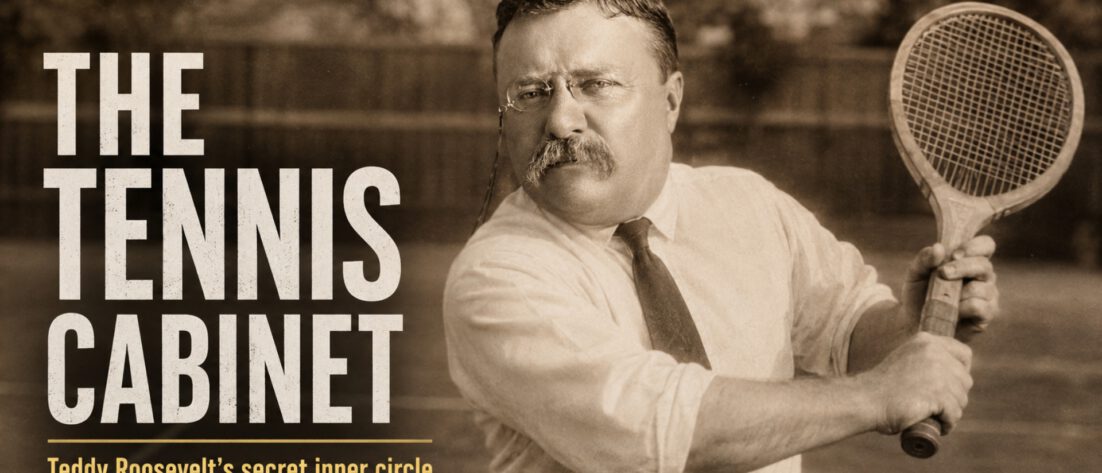
Did you know Theodore Roosevelt’s most trusted advisors weren’t traditional politicians, but a diverse group of tennis-playing frontiersmen, foreign ambassadors, and bankers? In this episode of Books and Looks, Blaine DeSantis sits down with presidential historian Michael Patrick Cullinane to explore his groundbreaking new book, “Theodore Roosevelt and the Tennis Cabinet”. Tune in to discover how this unconventional inner circle bypassed traditional bureaucracy to establish the foundation of the modern American presidency.
Michael reveals how TR’s bipartisan, multi-class network—featuring everyone from “Deadwood” sheriff Seth Bullock to a wolf-wrangling stuntman—became the driving force behind monumental conservation efforts and historical trust-busting. We delve into the grueling physical fitness tests required to gain the President’s ear and explore the striking parallels between Progressive Era administrative politics and today’s government efficiency debates. But what caused the sudden collapse of this loyal advisory group, and why did William Howard Taft literally bulldoze their legacy? Listen closely to uncover how a skinny-dipping French ambassador and a record-breaking wave of executive orders forever altered American history.
If you love uncovering the hidden mechanics of the past, be sure to subscribe to Books and Looks and leave us a review!
Introduction to the Tennis Cabinet
Blaine DeSantis:
Hi, I’m Blaine DeSantis, and welcome to Books and Looks, where we do a deep dive with authors to help you discover your next great read. All presidents have advisors, but none that I’m aware of are as unique as those with Theodore Roosevelt.
So much has been written about Teddy Roosevelt, and yet so little is known about who truly were his advisors. They were a diverse and unique group of individuals. They ran the gamut of politics and ideology, and they all had one thing in common: they all played tennis.
Today we’re talking with presidential historian Michael Cullinane about his groundbreaking new book, *Theodore Roosevelt and the Tennis Cabinet*. Michael Cullinane, welcome to Books and Looks.
Michael Patrick Cullinane:
Thanks so much for having me on the show, Blaine.
Shifting Focus from the Man to the Network
Blaine DeSantis:
Well, very happy to have you here. You’ve written a great addition to the library on Theodore Roosevelt. Before we get into the details, why don’t you tell us a little bit what it’s about and how it differs from all these other books about Teddy Roosevelt?
Michael Patrick Cullinane:
That’s what every author is trying to do, is to find the niche they’re going to be able to fill. I don’t think I’ve really ever written about Theodore Roosevelt; I’ve written around him. My other books, *Remembering Theodore Roosevelt* and *Theodore Roosevelt’s Ghost*, are really about how people had remembered Roosevelt.
There are so many biographies about Roosevelt out there—maybe 400 or 500. We don’t need another biography about him. This book is about the men surrounding Theodore Roosevelt, the ones who were the operatives who had the big ideas and got the job done.
These are the guys who helped enact pure food and drug legislation, did the trust-busting, conserved natural resources, and took on corrupt politics at the heart of American government. I joke sometimes that I wanted to call the book *Not Just TR*. It’s about the rest of the network that helped him get his administration achievements done.
Michael Cullinane’s Work with the Roosevelt Legacy
Blaine DeSantis:
You are eminently qualified to write about Roosevelt. Tell us a little bit about your background with him.
Michael Patrick Cullinane:
I started off writing about American anti-imperialism in the Iraq War period. Theodore Roosevelt was not the protagonist of that story; he was an imperialist. But what I really liked about Teddy Roosevelt was that his relationship with the anti-imperialists was on very good terms.
That seems distant from politics today, where Republicans and Democrats in the 90s and 2000s used to go to dinner together in Washington. Roosevelt seemed like a good character to think about how politics back then compared to today. Roosevelt’s administration had Democrats in it, certainly in the tennis cabinet and the informal clique that circulated around the White House.
He also had people that disagreed with him. He had people that were not traditional political operatives, like Western lawmen Seth Bullock. There’s something rather refreshing about that. I’m always looking for that connection between the past and the present.
Blaine DeSantis:
How many different things are you involved with regarding Teddy Roosevelt?
Michael Patrick Cullinane:
There is the Theodore Roosevelt Association, which is the oldest fan club. They are there to protect, preserve, and perpetuate the legacy of Theodore Roosevelt. They were founded in 1919 and chartered by Congress in 1920, just after TR died.
I am also the director of the Theodore Roosevelt Center, which is a project to digitize everything related to Theodore Roosevelt. We have a remarkable digital library online that has over 135,000 records in it and hundreds of thousands more to go. This is a 100-year-long project.
Then I’m the senior historian for the Theodore Roosevelt Presidential Library, which is opening on July 4th, 2026. It’s going to be an immense project. It’s a beautiful building and museum that is going to help drive the impression of Theodore Roosevelt for years to come.
Blaine DeSantis:
I think it looks out over the Badlands, if I’m not mistaken.
Michael Patrick Cullinane:
It’s a beautiful landscape, quite stark and desolate, but beautiful in that starkness. The library has a breezeway that cuts right through two halves of the building. You walk through that breezeway and the Badlands just open up. It’s stunning.
Parallels Between the Progressive Era and Modern Politics
Blaine DeSantis:
You began this book back around 2015. Some of the things you’re writing about for Teddy in that time period are now here. We’re talking about civil service reform, efficiency commissions, and antitrust stuff. Did the parallels between then and now surprise you?
Michael Patrick Cullinane:
I certainly didn’t set out thinking bureaucratic politics was a sexy idea for a book. Civil service reform, meritocracy, efficiency, and waste have been brought to the fore recently. Government efficiency is one of those things that Democrats and Republicans agree on; they both want a more efficient bureaucratic system.
There are somewhat sexier topics in there, like international diplomacy and conservation. This book tackles who made TR the wilderness warrior that we know him as. There’s also some insider baseball here about secretaries and aides to the president and how they get work done.
We still talk about this today with advisors like Mike Donilon, Valerie Jarrett, or Karl Rove. These advisors have a lot of influence on presidents because their ideas are game-changers. Roosevelt’s inner circle was particularly robust.
Membership and Physical Standards of the Tennis Cabinet
Blaine DeSantis:
How many people were in the tennis cabinet? How did he choose them, and what were the qualifications to be a part of it?
Michael Patrick Cullinane:
Some people would like to be in the tennis cabinet, but there are prerequisites. You have to be a sportsman of some kind and you have to be physically fit. If you played tennis with the president and were not a good player, that wasn’t necessarily a strike against you.
TR was not a good tennis player, but he played with enthusiasm. They played long sets, usually for as long as three hours for six sets, which is more than the men pros play for now. Roosevelt had vigor and vim when he played sports, and the same went for horseback riding or treks through Rock Creek Park.
There were about 35 gentlemen who joined that group. About 30 of them showed up to the White House on the penultimate day of Roosevelt’s administration for a victory lap. We know about them because of a photo snapped at that luncheon.
A few members of the tennis cabinet couldn’t make it to that lunch, like Alford Cooley. He was a civil service commissioner and a really close friend of Theodore Roosevelt’s who had tuberculosis. Unfortunately, they were all men. The tennis cabinet and politics at that time was male and white-dominated.
The Cost of Staying Fit for Politics
Blaine DeSantis:
You talk about his adventures to Rock Creek Park. There was one gentleman who couldn’t keep up and begged for another chance. Who was that?
Michael Patrick Cullinane:
That was Lawrence O. Murray. He was a banker from Addison, New York. When he fell behind on that trek through Rock Creek Park, he realized that he wouldn’t have access to the president and wouldn’t be able to achieve his ambitions if he didn’t get fitter.
He hired a personal trainer, exercised regularly, and then asked for another invitation to play tennis. He was allowed back in and became an important player. He eventually became the assistant secretary of the Department of Commerce and Labor and served on a number of commissions that transformed the way the administration operated.
Blaine DeSantis:
Then there was another guy who, when asked if he played tennis, said he preferred golf.
Michael Patrick Cullinane:
What a huge mistake for him to say that. That was Francis Huntington Wilson, who was an important diplomat in the 20th century. He said to TR that he didn’t want to play. He was never invited back again. He wasn’t completely blackballed, but TR favored other people like Billy Phillips instead. Phillips got to go to the tennis matches and had lasting influence instead of Huntington Wilson.
Bipartisanship and Inclusivity Within the Circle
Blaine DeSantis:
You mentioned that it was a bipartisan, multi-class group. Do you think that helped make Teddy the president he became?
Michael Patrick Cullinane:
I think there is truth to that. TR was a child of wealthy parents, but he was also a rancher out in North Dakota. He had friends on that tennis cabinet who were stiff-collared Boston Brahmin bankers, and then he had wolf wranglers from Oklahoma.
TR’s reputation as a multi-sectional president made him popular. His mom was from Georgia, his dad from New York, and he cut his teeth out West. But what also made him popular was that he trusted these people. They were surrogates for him.
They felt as though they were making a difference, even if they weren’t recognized by history or even at the time. TR instilled that trust in them, and as a result, they were the most faithful and loyal servants of the administration.
Roosevelt’s Complex Relationship with Race
Blaine DeSantis:
You didn’t back away from the fact that Teddy had certain prejudices against both blacks and American Indians. Did that change during this administration?
Michael Patrick Cullinane:
It doesn’t really change. TR’s ideas about racial hierarchies never changed entirely. It was the bedrock of his education. He believed that racial hierarchies were fluid; he thought white men could descend that ladder and that African Americans and Native Americans could ascend, but he didn’t think it would happen quickly.
There is a latent racism to many of TR’s ideas. However, there was a fluidness to it as well that saw all Americans as being equal in the eyes of the law. He believed firmly in reconstruction and civil rights for everyone. He had some notions of social equality because he invited Booker T. Washington to the White House.
On a civilizational level, he believed that Native Americans and African Americans hadn’t achieved the same racial traits that white Americans had. But he never budged in his commitment to civil rights for all Americans.
Profiles of the Tennis Cabinet Members
Blaine DeSantis:
I loved the TV series *Deadwood*. In that, we saw a guy named Seth Bullock, who was the sheriff. He was part of this tennis cabinet. What did he do?
Michael Patrick Cullinane:
Seth Bullock was a U.S. marshal, an entrepreneur, and a gold prospector. In this book, I talk about his role as a forester. He was the forest ranger for the Black Hills Forest Reserve. He deployed many of Gifford Pinchot’s policies around forest management and made it one of the most successful reserves in the country.
He made it profitable and sustainable. He is also responsible for bringing a beetle infestation in South Dakota to heel and saving much of the national forests from that pestilence. We don’t often see him as a forest ranger, but that was his most important role during the Roosevelt administration.
Blaine DeSantis:
Then there was a guy named Jack Abernathy. He was a wolf wrangler. What was he doing with the administration?
Michael Patrick Cullinane:
This guy is begging for a biography. Jack Abernathy figured out that if you punch your hand far down the throat of a wolf, you can actually immobilize its jaw by spreading the jaw bigger than it’s possible to close. He made a big show out of it and showed Roosevelt how to do this.
In 1905, Roosevelt visited Oklahoma and Texas on a wolf wrangling expedition. Jack Abernathy pulled off the stunt right in front of the president. At that time, wolves were seen as a scourge to farmers and ranchers, so they were basically exterminated in much of the American West.
Roosevelt was committed to showing the world that wolves were vicious, and Jack Abernathy was the guy who helped him do that. They even made movies together showing how Jack Abernathy could catch a wolf.
Blaine DeSantis:
Can we watch that on YouTube?
Michael Patrick Cullinane:
There are videos of Jack Abernathy now. They’re quite grainy and old, from around 1907 or 1908. They were filmed in New Jersey using wolves from the Bronx Zoo.
Blaine DeSantis:
Didn’t Teddy Roosevelt get into a written spat with some guy and Jack Abernathy was his backup?
Michael Patrick Cullinane:
There was a literary type named Long. Roosevelt had the best comeback. Long said his experience in the wilderness was one of peace, while Roosevelt’s was one where he was trying to go blasting shotguns at everything that moved.
Roosevelt wrote back that wolves were dangerous animals. When he was asked if he would respond to Long’s second note, Roosevelt said, “He’s too small game to shoot twice.”
Blaine DeSantis:
Every morning, I put Tabasco on my eggs. Now, the Tabasco heir, McIlhenny—other than adding spice to the tennis cabinet, what did he do?
Michael Patrick Cullinane:
John Avery McIlhenny was the second president of the Tabasco Company. He joined the Rough Riders in 1898, and his connection to Roosevelt was cemented in military glory. Roosevelt invited him to join the Civil Service Commission.
Roosevelt wanted McIlhenny, who was a Democrat, to join the commission to bring Southern states up to quota in federal employment. The South still viewed the federal government as the imperial North. McIlhenny persuaded them that these were great jobs and real roots to development.
Quotas were met in every single state. McIlhenny was at the Civil Service Commission for almost 14 years before becoming a financier in Haiti and later trying to run for office. He is another person who deserves a biography.
Blaine DeSantis:
Here’s a name many people have heard: James Garfield. But it’s not the James Garfield who was assassinated. Who is this James Garfield?
Michael Patrick Cullinane:
James A. Garfield was the president who was assassinated. His son, James R. Garfield, was eventually the Secretary of the Interior. It was Edith Roosevelt, the First Lady, who recommended him for the Civil Service Commission. She thought it would be a great idea for the son of the martyred president to take up a job in the administration.
He was successful in that role and then became the first commissioner for the Bureau of Corporations. He’s the guy who sued Standard Oil and broke up the first major monopoly in American history using the courts. As Secretary of the Interior, he saved the government millions of dollars by bringing in efficiencies throughout that massive department.
Personal Aides and Diplomatic Ties
Blaine DeSantis:
I’ve read books on Theodore Roosevelt that are intense tomes, but this is a book you can easily pick up and read. It’s so well written.
Michael Patrick Cullinane:
That is the most gratifying feedback that I’ve gotten, Blaine. Thank you so much.
Blaine DeSantis:
Teddy’s personal secretary and social secretary were part of the tennis cabinet. What did they bring?
Michael Patrick Cullinane:
Roosevelt’s secretary was William Loeb. Not many stenographers could keep up with Roosevelt, but Loeb could. He followed TR to Washington and was really instrumental. Roosevelt saw Billy Loeb first thing every morning to go through the schedule and the mailbag.
Loeb became known as “Billy the Goat” because he was the scapegoat; Roosevelt would allow him to take the blame when the president was late or when the schedule didn’t go as expected. Loeb was the only person who knew everyone in the tennis cabinet.
Loeb was good at making connections and using them to the administration’s advantage. He uncovered that the American Sugar Refining Company was cheating the system by setting scales in the Brooklyn dockyards below the correct weight. He helped prosecute the company for the biggest corporate fine in the nation’s history to that point.
Nighttime affairs were covered by Archie Butt, who was one of the president’s social aides. He dealt with the president and the First Lady on socializing in the White House. He and TR also went on a horse ride across Virginia at speed to test the fitness standards for Army officers. They did all this volunteer work for Roosevelt on top of their normal jobs.
Blaine DeSantis:
Then there’s the French ambassador, Jean Jules Jusserand. What did he do?
Michael Patrick Cullinane:
Jean Jules Jusserand became the French ambassador in 1903. He and Roosevelt made fast friends and fizzled with chemistry. He was also a historian and compared Theodore Roosevelt to Roland, the famous Frankish king.
He was Roosevelt’s consigliere. He helped bring Russia to the negotiating table for the Russo-Japanese War. Roosevelt would actually refer to Jusserand as either the Secretary of State or the Vice President.
There is a famous story that they went for a walk through Rock Creek Park and Roosevelt suggested they go skinny dipping in the Potomac. Jusserand was undressing and forgot to take off his kid gloves. Roosevelt told him he left his gloves on, and Jusserand said, “Oh, so I did. But that was because we might meet some ladies.”
Blaine DeSantis:
I don’t think that would happen anymore. It’s incredible to think a foreign national was in the inner circle.
Michael Patrick Cullinane:
Roosevelt recognized the talent in Jusserand. He helped on a number of levels in both foreign policy and domestic affairs.
Gifford Pinchot and the Conservation Legacy
Blaine DeSantis:
Gifford Pinchot was a great friend of Roosevelt. What was his part in the tennis cabinet?
Michael Patrick Cullinane:
Pinchot, James R. Garfield, and Jean Jules Jusserand were at the White House the most. Pinchot would wake up every morning thinking about what he could do for the administration. By the afternoon, he was either playing tennis or talking to the president while he got his daily shave.
He was the chief forester and brought the national forest system into the Department of Agriculture, making it a sustainable and profitable venture. He was on just about every commission, whether it was the Land Commission, the Keep Commission, the Inland Waterways Commission, or the Commission on Country Life.
Pinchot said Roosevelt was the “most advisable of men” because he took advice from all these people. Some of the greatest insights from the book come from the resources Pinchot saved for posterity.
The Taft Transition and the Destruction of the Court
Blaine DeSantis:
I got the feeling they were rather miffed that President Taft did not keep them on as an advisory group.
Michael Patrick Cullinane:
Roosevelt was disappointed with Taft almost as soon as Taft won. He wrote letters telling Taft not to let reporters see him playing golf. The real disappointment came when Taft didn’t appoint many of the tennis cabinet people to White House jobs.
James Garfield was very disappointed he didn’t get to stay at the Interior Department. Taft didn’t have the same relatability to Washington insiders or the public. Relations soured before Taft even took office.
When Taft came into the White House, he decided to build the Oval Office. He built it right over Roosevelt’s tennis court. Today, there is no tennis court where Roosevelt played. It only lasted about six and a half years before it was demolished by Taft.
Executive Orders and the Administrative State
Blaine DeSantis:
You mentioned in the book how many executive orders Roosevelt signed. Was this because of the tennis cabinet?
Michael Patrick Cullinane:
The tennis cabinet worked in ways outside of traditional executive, legislative, or judicial roles. It was a way to get beyond the constraints of other branches of government. Executive orders were perfect for Roosevelt.
If you add up all of the executive orders from George Washington to William McKinley, they equal roughly the same number that Roosevelt signed in seven and a half years. We’re talking about 1,100 executive orders. Modern presidents don’t sign as many as Roosevelt did. Only Franklin Roosevelt signed more.
Blaine DeSantis:
It’s been going on for over 100 years.
Michael Patrick Cullinane:
The problem with executive orders is that a president from a different party can sign a completely opposite one. Roosevelt signed orders creating bird sanctuaries or national forests, and later presidents could roll those back. Executive orders have an ebb and flow depending on who is in power.
Final Reflections and Future Projects
Blaine DeSantis:
If you were being considered for a position in the tennis cabinet, but had to play doubles, who would you choose as your partner?
Michael Patrick Cullinane:
Gifford Pinchot might be the one. He’s so tall and I am short in comparison. The other would be William Henry Moody. He was one of TR’s top lawyers, Attorney General, and eventually a Supreme Court Justice.
He had a remarkable influence on American federalism. He made the federal government and the administrative state powerful. He tried to create a system whereby agencies and their experts would be part of the civil service for years to come, beyond any administration.
Blaine DeSantis:
Didn’t one of them die on the Titanic?
Michael Patrick Cullinane:
That was Major Archie Butt. He was getting away from the Taft administration because of the stress. In 1911, he didn’t know whether to support Roosevelt or Taft and was going through a mild breakdown. Taft sent him away to England. On the return trip, he was sailing on the Titanic. He was seen saving women and children and getting them onto lifeboats before he went down with the ship.
Blaine DeSantis:
What’s next for Michael Cullinane?
Michael Patrick Cullinane:
I have just finished a manuscript about Theodore Roosevelt and birds. He was a bird lover from youth, yet there’s very little written about it. This book will look at 20 spots around the country that TR either visited or preserved, and we pick a bird at each spot to tell the story. I have a co-author, Michael J. Sacopulos, who is the editor of *Birdwatcher’s Digest*. That should be out in 2027.
Blaine DeSantis:
I can’t wait. I just got a book called *Feather Wars*, which is a spectacular book.
Michael Patrick Cullinane:
It’s a wonderful book. Starlings feature in our book as well because they were introduced into America from the UK by Roosevelt’s uncle, Robert Barnwell Roosevelt. The scourge that they are relates back to the Roosevelt family.
Blaine DeSantis:
Michael, it has been a joy talking with you and finding out about the tennis cabinet. Thanks so much for being with us today on Books and Looks.
Michael Patrick Cullinane:
Thanks so much for having me, Blaine. I hope your wife enjoys the book on her nightstand.
Blaine DeSantis:
No doubt about it. Friends, this is an eminently readable book. You’re going to learn so many things about these people and who helped form the government under Theodore Roosevelt. On behalf of our friends at BookTrib.com, this is Blaine DeSantis for Books and Looks, saying may all your leaves be pages in a book.