
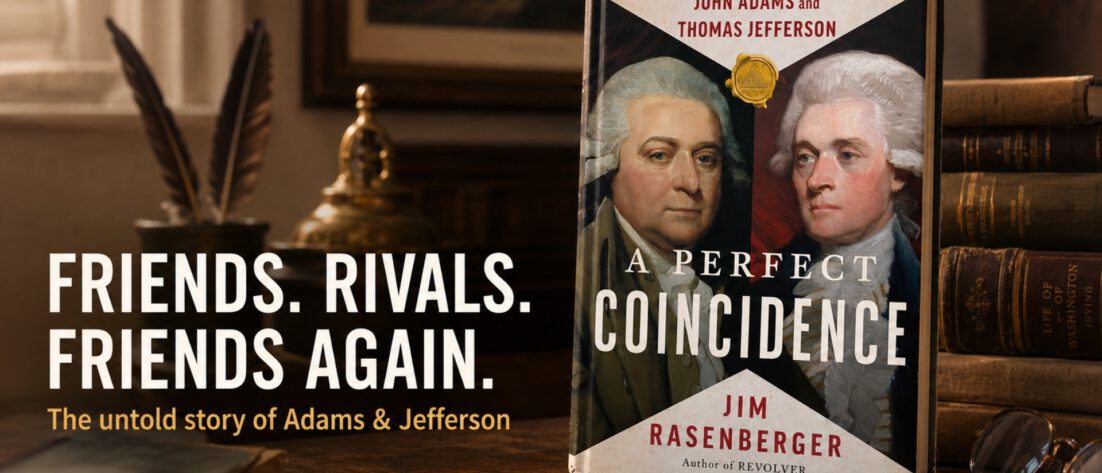
The odds of Thomas Jefferson and John Adams dying on the exact same day—exactly fifty years after the signing of the Declaration of Independence—were estimated at one in 1.2 billion. In this episode of Books and Looks, Blaine DeSantis sits down with author Jim Rasenberger to explore his acclaimed new book, “A Perfect Coincidence”, unraveling the complex, intertwined lives of America’s most famous founding frenemies. Listeners will discover the hidden historical twists, bitter rivalries, and surprising reconciliations that shaped the birth of a nation just in time for its 250th anniversary.
This historical deep dive exposes the realities of the Revolutionary War and the deeply contrasting personalities of our founding fathers, from John Adams’ blunt vanity to Thomas Jefferson’s lavish, debt-fueled lifestyle at Monticello. Jim reveals why the legendary July 4th signing of the Declaration of Independence is actually a myth, how Benjamin Franklin drove Adams to his breaking point in Paris, and the complicated truths behind the Hemings family tree. You will also uncover the mysterious, prophetic dream that finally pushed these two bitter political rivals to mend their relationship after a decade of silence, but you will have to tune in to find out if sheer willpower alone kept them alive to fulfill American history’s most miraculous coincidence.
If you love uncovering the untold stories of our past, be sure to subscribe to “Books and Looks” and leave a review on your favorite podcast platform!
Episode Links:
Transcript
Blaine DeSantis
Hi, I’m Blaine DeSantis, and welcome to Books and Looks, where we do a deep dive with authors to help you discover your next great read.
As we draw near to the 250th anniversary of the signing of the Declaration, much focus comes upon our founding fathers. The two most well-known of these are John Adams and Thomas Jefferson. We think of them almost as one, and yet they are two very opposite individuals.
They came together to draft the Declaration of Independence. They became fast friends, then bitter political enemies. Later in life, they regained their friendship. They both died on the same day, July 4, 1826, 50 years after the Declaration was signed.
This is their story, one filled with many twists and turns that few of us knew about. Today we’re talking with Jim Rasenberger about his highly acclaimed new book, *A Perfect Coincidence*. Jim Rasenberger, welcome to Books and Looks.
Jim Rasenberger
Great to be here, Blaine. Thanks for having me.
Blaine DeSantis
What a wonderful book, Jim. Friends, I’m going to show the book cover here for you. It’s called *A Perfect Coincidence*. It’s about Adams and Jefferson. This is a great book, perfect for the 250th anniversary of the Declaration of Independence. You’ve done another fine job.
Jim Rasenberger
Thank you.
The Significance of A Perfect Coincidence
Blaine DeSantis
For those who might not be aware, what’s the significance of the book’s title? What is it all about?
Jim Rasenberger
The title, *A Perfect Coincidence*, comes from a letter that Thomas Jefferson wrote to Dr. Benjamin Rush. Rush was a mutual friend of Adams and Jefferson. Jefferson was describing his relationship with John Adams in 1776, saying they had a “perfect coincidence of principle and action.”
He meant that Adams and he agreed on the most important thing, which was independence. At this time, many delegates were still very reluctant to declare independence from Britain. But Adams and Jefferson were joined in the idea that the time had come. This is what brought them together.
It is the perfect title for a book that begins in 1776 with this coincidence of principle and action and ends with the most perfect coincidence in American history—the death of John Adams and Thomas Jefferson on July 4th, 1826, the 50th birthday of the Declaration of Independence.
The fact that the chief advocate for the Declaration and the author of the Declaration died on the same day, and that this day was July 4th, just blew people’s minds at the time. It’s still pretty mind-blowing when you think about it.
Blaine DeSantis
Absolutely. I think you pointed out there was only one other member of the founding fathers who was even alive at that time.
Jim Rasenberger
That’s right. Of 56, only three were alive: Adams, Jefferson, and Charles Carroll of Maryland, who lived another couple of years. He was in his nineties.
It was extraordinary enough for a man to make it into his eighties or nineties at the time. The average life expectancy was about 46, so many things had to line up for this coincidence to occur. A mathematician at the time figured the odds at one in 1.2 billion.
Key Dates of the Declaration of Independence
Blaine DeSantis
I’m not sure how he figured that, but it was definitely an extraordinary coincidence. As we approach the 250th anniversary, you throw out three dates early on: July 2, July 4, and August 2. Tell us what happened on those days.
Jim Rasenberger
I’ll put a fourth date in there, too: June 28th. All these dates get conflated under July 4th, but very important things happened on different days. It’s a bit of a complicated story.
June 28th is when the Committee of Five—Jefferson, Adams, Ben Franklin, and two others—present the Declaration to Congress. This is that famous painting everybody’s seen of the Declaration of Independence. They are handing it over on June 28th.
July 2nd is the day Congress actually votes for independence. This is the day John Adams thought was the most important day. July 4th is the day they vote to approve the declaration of that independence. They don’t sign it that day; they don’t sign it until August 2nd.
One of the things I was really struck by was how incredibly dramatic that month was. On June 28th, the British fleet arrived from Nova Scotia and came into New York Harbor. Then slowly but surely, other ships started to arrive.
The entire British Navy starts arriving on July 12th. By the time these men signed the Declaration on August 2nd, there were about 300 ships in New York Harbor that had not been there on July 4th.
It kills the myth of the July 4th signing, but the fact it happened after the British fleet arrived made it far more dramatic because the stakes were so much higher. They really understood the risks they were taking and what they were facing. It was a very heroic act. If the Americans lost this war, they would all be hung for treason, and they knew it.
Blaine DeSantis
Did I read that the only person who actually signed the document on July 4 was John Hancock?
Jim Rasenberger
That’s correct.
Blaine DeSantis
So he signed it and his was the only name on that thing for almost a whole month. Did they go back together again just to sign?
Jim Rasenberger
They did. Most of them came on August 2nd. Again, it was a very dramatic and ominous day. They knew what they were doing and they knew it was risky.
The Concept of Providence
Blaine DeSantis
That leads perfectly into my next question. In the Declaration and throughout the Revolutionary War, we hear the word “providence.” They never said “God helped us” or “it was just luck.” They used “providence.” What is the significance of that?
Jim Rasenberger
Providence is the agenda of God, the governance of God. Some did use the word God, but most of the founders were Deists and almost never used the word. They would talk about the “architect of the universe” or the “great engineer.”
They believed God had made the universe and then was hands-off after that, letting providence run it as if it were perfect software that ran the solar system and the world. The role of providence in American history is fascinating because it goes all the way back to the Mayflower.
There’s a famous speech in 1630 by John Winthrop in which he refers to the “city on a hill.” Through the 17th and 18th centuries, there’s this idea that America is being watched over by Providence and has a special role to play in the world.
After Adams and Jefferson died on the same day, many commentators saw it as further proof that God was indeed watching over the United States. It was a sign of God’s favor.
Adams and Franklin in Paris
Blaine DeSantis
We always picture that Jefferson, Adams, and Franklin were all together and united. But John Adams loved to complain about Ben Franklin. Why would he do that, and what were Franklin’s thoughts about Adams?
Jim Rasenberger
Ben Franklin just drove Adams nuts. After 1776, Adams joined Ben Franklin in Paris. At that point, Franklin was the most popular American in the world other than maybe George Washington. People in France just adored Franklin and fawned all over him.
Adams decided that Franklin was a sybarite and basically debauched. He thought Franklin was living a life of continual dissipation because he woke up late—around nine—while Adams would get up at six in the morning.
It really bothered him that Franklin was having so much fun. For Adams, the definition of virtue was that you weren’t having much fun; you had to be suffering a little bit. It bothered him even more that Franklin was a better diplomat than he was. Franklin knew how to play the game.
Franklin knew how to cajole the ladies and the gentlemen, where Adams was such a blunt person. He could not control his bluntness and was constantly running into difficulty with the French. Franklin realized you catch more flies with honey.
Jim Rasenberger
Franklin was the better diplomat, and I think Adams knew that. Franklin was a tremendously gifted diplomat.
Blaine DeSantis
Did Franklin dislike Adams at all?
Jim Rasenberger
Franklin was bemused by Adams. He thought Adams was “always an honest man, sometimes a wise one, but in some cases, absolutely out of his senses.”
He thought Adams got so wound up in being virtuous and doing things the “right way” that he twisted things around and failed to find the smooth way to get things done. The way Adams dealt with the French was very undiplomatic.
The French had been giving money and manpower and they expected something in return. Adams’ response was that he’d “no rather be in the shackles of France than in the shackles of Great Britain.” There are ways to say no, as Franklin knew. Adams upset the French in a way that was not helpful to the mission.
Blaine DeSantis
At one point, Adams says he could forgive all the founding fathers for not revering him more, except Franklin. Why wouldn’t he forgive him?
Jim Rasenberger
I mentioned how Adams upset the French. Well, Franklin, rather than come to Adams’ defense, wrote a letter to the Continental Congress agreeing with the French ambassador’s complaints and saying that Adams was getting in the way of diplomacy.
It really upset John and Abigail. Neither of them ever forgave Franklin for that. Adams did later work with Franklin on the Treaty of Paris, and they worked together well.
Adams had an admirable ability to put aside his personal feelings for the good of the country. He did that when they were working together on the Treaty of Griffith, and he even paid Franklin several very genuine and sincere compliments about his abilities.
Contrasting Ambitions and Reputations
Blaine DeSantis
What comes out here is a man who is extremely jealous of his reputation. John Adams is constantly worried about what people will think about him. Would Jefferson have any such worries or fears?
Jim Rasenberger
Jefferson seems to have had them, but he was far more subtle. Jefferson was a very ambitious man, but Adams just wore his ambition and vanity on his sleeve. It had always been a big part of his personality.
If you read his journals as a college student at Harvard or as a young attorney, he is constantly berating himself for his vanity. He knows it is his Achilles heel, but he can’t help it. His honesty with himself about his faults is what makes Adams interesting and even charming.
Jefferson was clearly ambitious and cared about his reputation and posterity, but he never would have been as blatant as John Adams. He got things done through agents like James Madison or James Monroe. He could stand back at Monticello and seem to keep his hands off of it.
Blaine DeSantis
One of the problems Jefferson had was his lavish living. He was always bringing in French wine and running up debts to the point where he wanted the English people to forgive his debts because it wasn’t his fault he couldn’t pay them back.
Jim Rasenberger
We can sympathize with some of Jefferson’s debt. When he inherited the estate from his father-in-law in 1774, he inherited quite a bit of debt. As a farm owner with 11,000 acres, if you have a couple of bad years, it’s very hard to make interest payments.
The problem was that Jefferson kept adding to the debt with his indulgences. He lived very well. He called himself a “savage from the mountains,” but he didn’t live like any savage. He had the finest wines and furniture.
When he came back from France in 1790, he shipped over what I believe was the largest shipment of personal goods ever from a foreign country to the United States. He would realize the debt was a disaster, then go back and keep spending the same as before.
It became a moral problem because he said he wanted to emancipate his slaves. But by the time he was an old man, all of his assets were in the slaves. To free them would be to impoverish himself. You wish he had tightened his belt and lived more by his ideals.
The Hemings Family Connection
Blaine DeSantis
That brings us to one particular slave, Sally Hemings. Your book touches upon something I was unaware of: a very close familial relationship between Thomas’s wife, Martha, and Sally Hemings. What was that?
Jim Rasenberger
Jefferson’s father-in-law had Sally’s mother as a concubine. This meant that Jefferson’s daughters were the nieces of Sally Hemings. The entire Hemings family was related to Jefferson’s family by blood.
It was an extremely unsavory part of American history. When a slaveholder had children with a slave, those children remained slaves. In Jefferson’s family, they continued to be slaves and maybe even became concubines again.
Sally turned out to be very light-skinned because her mother was the child of a white man and an African-American woman. Sally was three-quarters white, and her children were seven-eighths white.
Yet they continued to serve as slaves at Monticello. Many people who came to Monticello saw these white young men walking around, and they were slaves because they were the children of Sally Hemings. Later, Jefferson let some of them escape and they blended into white society.
Blaine DeSantis
I can see why historians have a hard time trying to figure out this relationship. I had never heard until your book that Martha and Sally Hemings were half-sisters. They had the same father.
Jim Rasenberger
That’s right.
An Odd Couple on an English Road Trip
Blaine DeSantis
Adams from the North and Jefferson from the South eventually become good friends. They’re over in Europe and even go on vacation for a week in England. Tell us a bit about that.
Jim Rasenberger
They became wonderful friends, and their families became friends. Abigail Adams became very good friends with Jefferson. John Quincy Adams became very close to Thomas Jefferson when they were all in Paris together.
When the Adams family goes to London, Jefferson goes to visit. The two of them go on a road trip into the English Midlands for a week to tour “English gardens.” These were grand estates opened to the public, and they had a wonderful time together.
Because they were in a carriage together, we do not have their letters. But I found tavern receipts that Jefferson had kept, and they were fun to look at because you can chart their course.
You can see the taverns they went to—the Antelope, the Bear Inn—and what they ate: mutton chops, salmon fillets, and custards. I love the idea of this odd couple—Jefferson, six-foot-two and slender, and Adams, five-foot-seven and stout—traveling the countryside in a carriage.
Blaine DeSantis
They also did something with William Shakespeare’s chair. What was that?
Jim Rasenberger
They went to Shakespeare’s house in Stratford-upon-Avon. Apparently, there was a tradition at the time to carve off a little sliver of wood from what was purportedly William Shakespeare’s chair.
They did carve off this little piece and it still exists at Monticello. I have a photograph of it in my book. Adams writes about how we remember Shakespeare and thinks about immortality and fame. I wonder if he was wondering how surprised they would be that here we are talking about them 250 years later.
Political Rivalry and Estrangement
Blaine DeSantis
They come back to America and the rift begins. What caused that change in their relationship?
Jim Rasenberger
It happened rather slowly. Adams becomes Vice President under George Washington, and Jefferson becomes Secretary of State. It’s only then that they realize they have very different ideas of government.
Adams gets lumped in with the Federalists, who believed in a strong national government. Jefferson believed in minimal government. Jefferson leaned toward supporting France, while Adams and the Federalists leaned toward England.
This became explosive when Adams became president in 1797 and Jefferson was his Vice President. Jefferson really starts to undermine Adams secretively. He and James Madison founded the Republican Party.
Jefferson hired James Callender to write a scathing critique of John Adams while he was president. Adams, meanwhile, signed the Alien and Sedition Acts, which put Republicans in jail for saying bad things about the administration. It was a very fraught time.
By the time Jefferson unseated Adams in 1800, Adams felt humiliated. He didn’t even go to Jefferson’s inauguration. He got on a stagecoach at four in the morning and went back to Quincy. The two men have nothing to do with each other for the next decade.
Blaine DeSantis
Adams keeps trying to defend everything he’ve done by writing these volumes and missives. It seems he just makes things worse and people pick on him more.
Jim Rasenberger
He can’t help himself. He doesn’t like how history is being written because it doesn’t give him enough credit. He was particularly upset by the charge that he was a monarchist.
He keeps saying, “I’m not, you misunderstand me,” but he has a very hard time shaking that rap. He doesn’t do himself any favors because he just sounds like a crazy person constantly ranting about how history has treated him. He was correct that history did treat him fairly badly for a long time.
Reconciliation Through Correspondence
Blaine DeSantis
Benjamin Rush comes into the scene. Tell us about the mysterious prophetic dream that helped soothe things over.
Jim Rasenberger
Benjamin Rush was a signer from Philadelphia and a well-known physician. It bothered him that his friends had nothing to do with each other. In 1809, Rush had a dream where he read a book saying Adams and Jefferson had reconciled and then died at nearly the same time.
He wrote to Adams about it, and Adams basically said “dream on.” Rush spent about two years going back and forth. Finally, on January 1st, 1812, John Adams wrote a friendly letter to Thomas Jefferson.
Thus begins one of the great correspondences in American history. It goes on for another 180 letters. They discuss history, philosophy, the Revolution, religion, and their families. It becomes quite touching as they get older and more affectionate toward each other.
Blaine DeSantis
Why didn’t they ever try to meet in the middle, like in Philadelphia, for a reunion?
Jim Rasenberger
Travel was very difficult then. It’s really not until the railroad that travel became easier. Neither man went more than 50 miles from home after their presidencies.
A newspaper in New York City in 1826 proposed that Jefferson, Adams, Madison, and Monroe be picked up and carried by strapping young men to steamboats for a reunion in New York. It was an insane idea. None of them were fit to travel at that point.
Final Days and the July 4th Coincidence
Blaine DeSantis
Tell us how Jefferson almost died while sitting for a life mask a year before he actually passed away.
Jim Rasenberger
An artist named John Henri Isaac Browere was going around the country trying to get “life masks” of the founders before they died. He would put plaster over their faces to capture their likeness.
To breathe, they had to use straws in their nostrils. Jefferson was 82 and in poor health. He started to suffocate, and a slave named Burwell Colbert, who was his valet, came to his rescue.
His family hearing the commotion got very angry with the artist, who had to bang off the plaster using a little hammer. Adams took it a little more easily, although he did complain about having his skull slammed. He said his brains were no worse after than before.
Blaine DeSantis
Now there’s a theory that the deaths of Adams and Jefferson on July 4th were managed by doctors or family. Do you believe that?
Jim Rasenberger
No, I think that’s nonsense. It’s a conspiracy theory with no evidence whatsoever. There is a likely possibility that they themselves willed themselves to make it until July 4th.
Jefferson, on July 3rd, was very close to death and managed to make it to July 4th, but only barely. On July 3rd, he woke up and asked, “Is it July 4th?” The young man by his side said “Yes, sir” because he didn’t want to disappoint him.
Fortunately, he wasn’t caught in a lie because Jefferson did make it. There does seem to be some evidence from studies that willpower can play a role in surviving until a significant anniversary.
Blaine DeSantis
And the rest went from Providence, right?
Jim Rasenberger
And the rest from Providence, that’s right.
Historical Perceptions and Personal Character
Blaine DeSantis
Most people know John Adams from the book by David McCullough or the HBO miniseries. Did McCullough rehabilitate Adams? Is it a good portrait?
Jim Rasenberger
It is a good portrait and a great book. He makes Adams very likable—probably more likable than Adams really was. Adams was extremely complicated and peevish, and his vanity was no joke.
However, Adams was also very approachable. His letters are just wonderful. Jefferson was the better writer for official state papers, but there’s something performative about his writing. He’s putting on a show.
Adams’ letters are direct, funny, and self-deprecating. You feel like you’re having a conversation with him right in the room with you. Adams is an absolutely fascinating character. Jefferson is too, but because he had so many hidden sides and contradictions. Adams just let it all fly out.
Blaine DeSantis
What did Adams do to make money during the last 20 years of his life?
Jim Rasenberger
Farming. He and Abigail lived off their farm. It’s an irony because Jefferson always talked about the yeoman farmer while accusing Adams of being an aristocrat.
Adams was actually out there farming, while Jefferson only did farming from the top of a horse, telling his slaves what to do. Adams never went back to practicing law; he was too old to travel the circuit. But unlike Jefferson, the Adams family was frugal, so they never fell into financial hardship.
Blaine DeSantis
Throughout this entire book, I’m reading about Abigail Adams. She was quite the woman.
Jim Rasenberger
You can’t talk about John without talking about Abigail because they were joined at the hip. They had a very close marriage and thought similarly. She was a tough woman, and she supported him when he did risky or unpopular things.
In 1776, Adams thought a delegate named John Dickinson got cold feet because of his wife and mother. Adams said, “If I had such a wife and such a mother, I believe I would have shot myself.” Abigail was pro-independence every step of the way.
Researching the Book
Blaine DeSantis
How long did this book take to research, Jim?
Jim Rasenberger
It took about three years. I had to read everything. With Adams and Jefferson, so many books have been written and the letters are digitized. It’s a matter of knowing as much as you possibly can and then trying to come up with something fresh and enjoyable to say.
Blaine DeSantis
I’ve learned so much from your book. It was absolutely filled with little tidbits I had never heard before. For the 250th anniversary, I can’t think of a better book to read. What’s the next one coming out?
Jim Rasenberger
I unfortunately do not have an answer for you yet. I’m thinking about a few ideas, but it’s too soon to talk about them. You’ll be the first to know.
Blaine DeSantis
Jim Rasenberger, thank you so much for being with us today on Books and Looks. It was a wonderful look at the lives of Adams and Jefferson.
Friends, this is one book I highly recommend to each and every one of you. On July 4th this year, why don’t you watch the musical *1776*? It’s a great look at Adams and Jefferson through the eyes of Hollywood.
On behalf of our partners over at BookTrib.com, we thank them for all their support. And as I said, may all your leaves be pages in a book.