
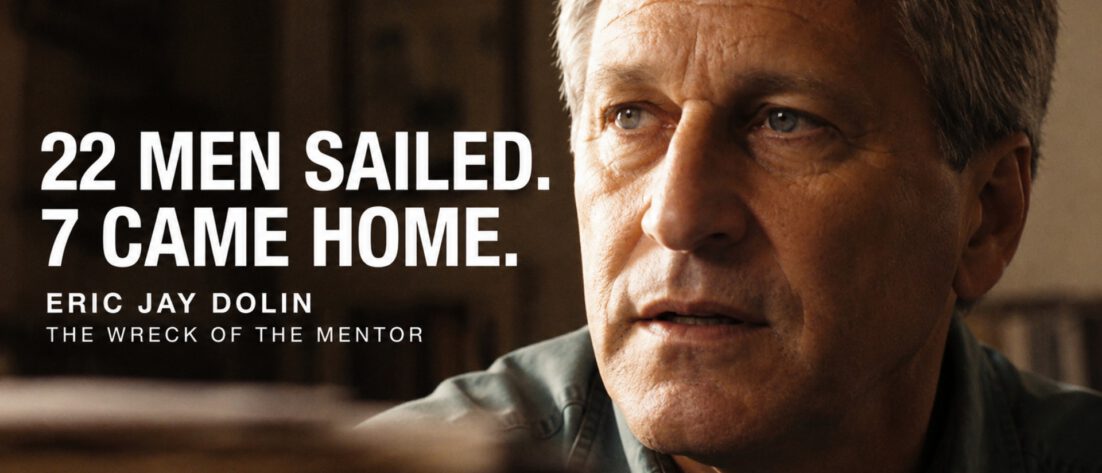
In July 1831, the whaleship Mentor sailed out of New Bedford Harbor with 22 men aboard, hoping to strike it rich hunting sperm whales in the Pacific. They never made it. Caught in a raging storm, the ship smashed into the remote island chain of Palau — and within hours, half the crew was dead.
What followed is one of the most harrowing survival stories in American maritime history. In this episode, host Blaine DeSantis sits down with New York Times bestselling author Eric J. Dolin to unravel what happened to the men who lived: hostage negotiations demanding 200 guns, years of forced labor and starvation on a tiny island just one mile long, forced tattooing meant to absorb the castaways into island culture, daring escapes aboard passing ships, and a naval rescue mission ordered by President Andrew Jackson himself.
Along the way, Dolin pulls back the curtain on the golden age of American whaling — the stench you could smell before you saw the ship, the teenage “green hands” who’d never been to sea, and why most whalemen came home with almost nothing to show for years of brutal work. He also shares how he pieced together this forgotten story from logbooks, journals, Palauan oral histories, and more than 100 rare illustrations from archives around the world.
Only 7 of the 22 men ever made it home. This is their story.
📖 Get the book: The Wreck of the Mentor by Eric J. Dolin is available now wherever books are sold — and it just hit the New York Times bestseller list. If you love true stories of the sea, this one belongs on your shelf.
🎧 Enjoyed this episode? Subscribe, share, and leave us a review. And as always — may all your leaves be pages in a book.
Introduction to The Wreck of the Mentor
Blaine DeSantis: Hi, I’m Blaine DeSantis and welcome to Books and Looks, where we do a deep dive with authors to help you discover your next great read. The sea can be a wild and dangerous place to make a living as a fisherman, as evidenced by all the reality TV shows surrounding that occupation.
Blaine DeSantis: But today we’re going back to 1831 and examining the whaling industry and what happens when things go wrong. Instead of bringing home riches, a ship crashes in a raging storm on the island chain known as Palau in Micronesia. A ship torn apart, and an uncertain future awaits everyone when they abandon their ship.
Blaine DeSantis: It’s an incredible true story and one you do not want to miss. I’m Blaine DeSantis. This is Books and Looks, and today we’re chatting with Eric Jay Dolin about his gripping new nonfiction maritime drama, The Wreck of the Mentor. Eric Jay Dolin, welcome to Books and Looks.
Eric Jay Dolin: Thanks for having me.
Blaine DeSantis: I’m very happy to have you on and what a wonderful book you’ve written here. Friends, if you get a chance to look at the New York Times, it was just featured last week. It’s on the bestseller list, if I’m not mistaken.
Eric Jay Dolin: Yes. It is.
Blaine DeSantis: That’s wonderful. Well now, tell us a little bit about this book, The Wreck of the Mentor, and what type of ship is the Mentor?
Specifications of a 19th-Century Whaler
Eric Jay Dolin: The Mentor was a whale ship that left from New Bedford Harbor in July of 1831. It was not a particularly large whale ship. It was about eighty-four feet long, twenty-four feet wide at a thirteen-foot draft, and displaced about two hundred and thirteen tons.
Eric Jay Dolin: If you’ve seen the Charles W. Morgan whale ship, the last of the wooden whale ships in Mystic Seaport, it was considerably smaller than that. It had twenty-two men on board. They ranged in age from fifteen to thirty-two.
Eric Jay Dolin: The captain was a guy named Edward Barnard. He was originally a Nantucketer, but he moved to New Bedford. He was thirty-one years old, and the men on board referred to him as the “old man,” which makes me feel very old.
Eric Jay Dolin: So it was a typical whale ship of the day. New Bedford, as I’m sure you know, was the leading whaling port by this time. It had outstripped Nantucket probably about five or six years earlier. During that year, 1831, hundreds of whaling voyages left from New Bedford.
Eric Jay Dolin: The Mentor was just one of those. It was designed to go out for a relatively short trip of about a year or two into the Atlantic Ocean, but ultimately Barnard decided to go into the Indian Ocean and then the Pacific Ocean. That’s where the trail led.
Blaine DeSantis: Now, a whaling ship. How does that differ from other cargo ships? What’s the difference?
Features of a Whaling Vessel
Eric Jay Dolin: The main differences are that hanging off the side of a whaling ship are whale boats, twenty-four feet long, with cedar clapboard planks. They’re the little boats that the whalemen row to chase after the whales, harpoon them, and bring them back.
Eric Jay Dolin: You would see these davits off the side, which are wooden arms, and hanging from the wooden arms would be four or six whale boats. Whaling ships, especially purpose-built whaling ships, were a little boxier and broader because they needed to have more storage capacity below decks.
Eric Jay Dolin: The main real difference if you got onto a whale ship were the try-pots. In the center of the main deck there was a platform upon which were these try-pots, very large iron kettles that were encased in brick, and beneath them fires would be roaring.
Eric Jay Dolin: After they cut the blubber off of the whales, the blubber would be pitched into the try-pots. It would melt the blubber, and all the integument, the meat, and the skin would rise to the surface. They’d skim that off and they’d feed it to the fire below to keep the fire going.
Eric Jay Dolin: Sometimes they’d eat that stuff. It’s called cracklings. It was like an early American version of pork rinds. Anyway, the oil would be rendered out and then it would be siphoned out from these large iron kettles into barrels and hogsheads and then stored below.
Eric Jay Dolin: If you saw a whale ship, you’d know it was a whale ship. The main way you’d know is that if it had killed a whale and was processing a whale, the smell was horrific. It was often said that you could smell a whale ship before you saw it.
Blaine DeSantis: Yeah, this whole trip just amazed me. Now, was he always intending to go around Africa as opposed to getting to the Pacific underneath South America?
The Decision to Enter the Pacific
Eric Jay Dolin: No. Originally the voyage was intended to just be in the Atlantic Ocean, but he wasn’t having much luck. He’d only killed a couple of sperm whales, which were the most valuable whale of all because of their clean burning oil.
Eric Jay Dolin: So he wasn’t having much luck in the Atlantic, and a captain of a whale ship is almost always given discretion by the owner of the ship to modify the voyage if they think it can be more successful.
Eric Jay Dolin: He chose to go around the Cape of Good Hope into the Indian Ocean, hoping that the whaling would be better. It wasn’t much better. He finally decided to go to the Pacific Ocean because the Pacific at this time in the 1830s, in the midst of the golden age of whaling, was the number one ocean to hunt whales.
Eric Jay Dolin: It was populated with literally millions of sperm whales. He decided to sail all the way to the Pacific Ocean, but as you know, he didn’t quite make it.
Blaine DeSantis: Do we know if he had ever done that before? Had he ever taken this journey?
Eric Jay Dolin: I am not a hundred percent sure. He was on a number of whale ships before. A couple of them I do know hunted mainly in the Atlantic, but I’m pretty sure that he had been to the Pacific Ocean before.
Eric Jay Dolin: He might very well have gotten there around Cape Horn. Even if he did, there were plenty of charts at this time of the Pacific Ocean and there was some knowledge of sailing there that was shared among whaling captains and other mariners. I’m pretty sure he had been to the Pacific, but I’m not sure if he had gone this route.
Blaine DeSantis: Okay, now he was the “old man.” How old were the people on his crew? Was there an age range for this?
The Composition of the Whaling Crew
Eric Jay Dolin: There were twenty-two men on board and they ranged in age from fifteen. They were called boys at the time. The range was fifteen to thirty-two. The average age was in the low twenties, and that was pretty common for whale ships.
Eric Jay Dolin: It was unusual to have a man in his forties or fifties or sixties, unless they were the captain. Being a master on a whale ship was pretty much a young person’s game. Even more so now in the 1830s, there was already a labor shortage, so a lot of whaling ships had to make do with whoever they could scrape from the ports.
Eric Jay Dolin: They would go into bars and brothels and other places and try to sign people on to the whaling voyage, and a lot of them were young men. What was interesting about this voyage is a number of the men on board, I think it was five or six, were green hands, meaning they had never been to sea before.
Eric Jay Dolin: They probably dealt with massive bouts of seasickness the first couple of weeks out of port. They had to learn how to sail a ship and all the rigging and the lines and what they were called and all the sails. It must have been quite an experience for a farm boy, say from New Hampshire, to get on a whale ship and go halfway around the world.
Blaine DeSantis: No doubt about it. A lot of people said you can get rich or make good money on a whaling ship, but you sort of dispel that. You let us know that wasn’t necessarily the case. Why was that?
Eric Jay Dolin: If you had a greasy trip, meaning that you killed a lot of whales, then even the lowliest person on board the whale ship—the person who had the longest lay—might be in line to earn one one-hundred-and-fiftieth or one one-hundred-and-twenty-fifth of the profits.
Eric Jay Dolin: If you had a very profitable whale ship, even the guy that worked before the mast, the one that went out in the whale boat and actually killed the whales, could make a fair amount of money. The master and the first mate would make a lot of money.
Eric Jay Dolin: But the problem was not every voyage was successful. The average length of a voyage at this time was three to four years. Some whale ships actually came back and earned the people almost nothing, or maybe just a few pennies a day for all of that effort. Everything was dependent on whether or not you killed a lot of whales.
Blaine DeSantis: Well now, one of the things you mention in your author’s note to start the book is that you’ve had to rely almost solely on written Western accounts of this. You didn’t have much at all from the people out there and where it crashed. That was a challenge, wasn’t it? Just writing from one point of view?
Navigating One-Sided Historical Sources
Eric Jay Dolin: It was a challenge. The Palauans didn’t have a written history, but it’s a challenge that every single historian who writes about any adventure in the Pacific during the 1700s or 1800s that interacts with natives has.
Eric Jay Dolin: It’s also the challenge that every historian who has written about America’s sweep from the East Coast to the West Coast has. We displaced Indians left and right and destroyed their culture, and none of those Indian cultures had an extensive written history like the people in the West did.
Eric Jay Dolin: There were oral histories, and I did rely on a couple of oral histories. I also relied on books that were published by the Palauan government, textbooks, and Palauan scholars who have researched it. I tried to get as fair of a perspective as I could.
Eric Jay Dolin: As I said in the author’s note, an historian has one of two choices when confronting history like this. They either decide that some of the people, the Indians or the natives, don’t have an authentic voice so you can’t even write the book, or you write the book and you try to be as sensitive as you can.
Eric Jay Dolin: I think that I was very respectful. I think I put it into context. I know that some Palauans have read the book and they thought it was great. I’ve encountered this issue with a number of my books which deal with the 1600s, 1700s, and 1800s.
Eric Jay Dolin: In particular, a number of my books have extensive sections on the colonists’ or the Americans’ interactions with Indian tribes throughout North America. It is by nature a one-sided source of historical information. Even if there are oral histories, oral histories going back two to three hundred years are usually not that detailed.
Eric Jay Dolin: It’s a variation on the theme that winners write history. Westerners had a very long history of written correspondence and keeping track of what they did in logbooks and journals. That’s where I got most of the information. It is true.
Blaine DeSantis: All right. Well, we mentioned Palau. Exactly where is Palau? Where did it wreck? And how many actually survived this wreck?
The Wreck of the Mentor in Palau
Eric Jay Dolin: Palau is an archipelago of three hundred and forty low-lying volcanic and rock islands. It’s located about 500 miles to the east of the southern tip of the Philippines. Kayangel is the northernmost island in Palau.
Eric Jay Dolin: It’s sort of unfortunate for the men on the Mentor; if they had just sailed a mile or two further to the north, they would have missed Palau entirely and made it to their intended destination, Guam. But it was during a storm and they weren’t quite sure where they were. So they crashed into Palau.
Eric Jay Dolin: There were twenty-two men on board when they crashed. Within a day’s time, there were only eleven left. That’s because ten of them decided to leave right away in the middle of the night on one of the whale boats. They were never seen again.
Eric Jay Dolin: Then Captain Barnard and three other men tried to leave, and their whale boat got smashed to pieces by a wave. They were pitched into the water. Barnard had a rope around his waist, so he was pulled back in. Two of the men were able to swim, so they swam back to the Mentor and they clambered up the side of the ship, but the fourth man drowned. Literally within hours of crashing, half of the crew was dead.
Blaine DeSantis: Wow. Well, they made it to that island. One of the interesting things was they were wondering if they were English or American. Now, why was that such an important difference?
Regional Politics and Hostage Negotiations
Eric Jay Dolin: The island they ultimately made it to is not Kayangel, and there’s an interesting story there, but you have to read the book to find out about why they didn’t end up in Kayangel. They ended up in Ngarchelong, which is a village a little further to the south.
Eric Jay Dolin: The reason that the Ngarchelongese wanted to know if these Americans were British is because of an event that occurred fifty years earlier in 1783. The brig Antelope, a British brig, crashed off of Koror, another village in Palau.
Eric Jay Dolin: The Koror chief gave the men of the Antelope permission to build a ship out of salvaged wood taken from the Antelope that they would use to get to Macau and then hopefully make it all the way back to London. In exchange for this hospitality, the British went to war four times with the Kororese against other villages.
Eric Jay Dolin: They also gave the Kororese guns and ammunition, and then a few years later another British ship came by and gave the Kororese more guns and ammunition as a thank you. One of the villages that the Kororese vanquished with the help of these guns and the men from the Antelope was Ngarchelong.
Eric Jay Dolin: When the whalemen showed up in Ngarchelong, they wanted to know if they were British because the British were their enemy. The British were the ones that armed their enemy. When they found out that the Americans were in fact American, they had no idea what America was. They were just glad that they weren’t British.
Eric Jay Dolin: When they found that out, they welcomed the Americans and they decided to help them build a boat so they could escape like the men of the Antelope. But it wasn’t a purely humanitarian gesture. Just like the Kororese had demanded, the Ngarchelongese said, “Okay, fine, we’ll help you, but you need to give us two hundred guns and ammunition in exchange after you get back to the United States.”
Eric Jay Dolin: To make sure you come back, we’re going to keep three of your men as hostages. So that sets up the story for the rest of the book.
Blaine DeSantis: Wow. A lot of ships were coming over that way back then. Do we know how many actually wrecked there, or did they just stop there and negotiate with people?
Eric Jay Dolin: There weren’t many other wrecks in Palau. The Antelope and the Mentor were the two main wrecks in the late 1700s and early 1800s. Palau is really far away from the traditional shipping lanes, so there wasn’t a good reason for many Western ships to be there.
Eric Jay Dolin: But there were numerous shipwrecks throughout the Pacific. There were thousands of Pacific islands and thousands of reefs, places that weren’t as well known to Western mariners. I am sure there were many hundreds, if not thousands, of shipwrecks during the 1800s alone in the Pacific, Indian, and Atlantic Oceans.
Eric Jay Dolin: I live in Marblehead, Massachusetts. Just off the coast of Cape Cod and the coast of Marblehead, there are scores of wrecks going all the way back to the 1600s up through modern day. Wrecking ships is not a rare occurrence. It’s unusual, but it’s not a super rare occurrence.
Blaine DeSantis: Okay. So we can’t completely blame the captain for this happening?
Eric Jay Dolin: No, no. He was a good captain. He had been on other whaling voyages and his men who returned to the United States—only seven out of the twenty-two men returned—definitely vouched for the character of the captain. One of them wrote a book about his experience.
Eric Jay Dolin: What happened is after the navigation, he could only use a form of dead reckoning and his compass. He thought that he was about a hundred and fifty miles away from any landmass, but obviously he was wrong.
Blaine DeSantis: Not going to be endorsing that compass, will he?
Eric Jay Dolin: No.
Blaine DeSantis: Well, these people eventually make it to an island and I want to make sure I’m pronouncing it right. Is it called Tobi? How do you pronounce it?
Captivity on Tobi Island
Eric Jay Dolin: Tobi. More than three of them made it. There were eleven whalemen left. They left three of them behind in Ngarchelong. They left in this canoe that the Ngarchelongese had built for them and in their whale boat.
Eric Jay Dolin: They had hoped to make it to the Spice Islands, which was about 800 miles to the southwest, but they went off course and they landed right near Tobi. It is a very small island, only a mile long and a half a mile wide.
Eric Jay Dolin: There were eight whalemen on board and three Ngarchelongese who were there to learn more about the wider world. By this point, it was 14 days after they left Ngarchelong and the men were almost dead. They had run out of food and water.
Eric Jay Dolin: They had to pull for Tobi even though they knew it wasn’t the Spice Islands. The natives there met them, pitched them all out of their canoe and their whale boat, beat them about the heads, and destroyed the whale boat down to the waterline because they wanted the iron nails and the wood.
Eric Jay Dolin: They finally took the men, the Ngarchelongese, and the whalemen into their canoes and brought them to Tobi, where a long period of captivity began. Tobi is part of Palau today, but back then when the Mentor crashed, it was not part of Palau. In fact, the Tobians spoke a different language from the Palauans.
Blaine DeSantis: Wow. I gathered the Tobians were not the most peaceful people, it seemed like to me when I read this.
Eric Jay Dolin: They were a little violent. They were less receptive than the Palauans were to the American whalemen, that’s for sure. They were more primitive in the sense that they didn’t even have as many material goods as the Palauans did.
Eric Jay Dolin: They were in a kind of a desperate situation. They were on an island only a mile long and a half a mile wide, and there were four hundred of them. Food was scarce to begin with. When these whalemen and Ngarchelongese showed up, they weren’t really interested in feeding them very well, so the men continued to deteriorate.
Eric Jay Dolin: It was a tough place. Three of the whalemen ultimately starved to death while they were there. One was killed by some Tobians after he was accused of stealing. Two out of three of the Ngarchelongese died while they were on Tobi. As we’ll probably get to, there were a couple of different escapes on passing Western ships that brought more of the whalemen back home.
Blaine DeSantis: Yeah. It was a tough time that everybody had. They climbed the boats, they took the nails, they took everything. That was very important to them. Anything metal was very important for them.
Eric Jay Dolin: Yeah, they had no metal in their society. They weren’t metallurgists, so metal was a very durable, exciting thing—not only for ornamentation and having something of value, but also making better weapons and axes that they could use to cut down breadfruit trees and coconut trees. It was seen as a very useful item to have and it was one of the main things that a lot of Pacific Islanders wanted to trade for with Westerners who came by.
Blaine DeSantis: Did the Tobians ever try to leave their little half-mile by mile island? Was there any thought that they would go somewhere else?
Eric Jay Dolin: Not that I know of, and not in the history books. Basically, the Palauans and the Tobians had a lot of different types of canoes, and they had ocean-going canoes, but they didn’t have a history of traveling hundreds and hundreds of miles on a regular basis.
Eric Jay Dolin: They did have some communication with the nearby island of Yap, which is famous because they’re the ones that created the very large stone money—those circles with holes in the center. There were instances of Palauans taking canoes to some of the nearby islands, but they were not transatlantic travelers.
Eric Jay Dolin: They were happy with their own islands. They went south and north and east and west to visit other villages, to attack other villages, to fish, but they weren’t going thousands of miles away. They weren’t travelers.
Blaine DeSantis: We learn a lot about the whaling industry, but also there’s a lot of anthropology involved in this book and history. It’s a fascinating book. Has that always been something you’ve really enjoyed?
The Research and Writing Process
Eric Jay Dolin: During COVID I wrote a book while I was home. I had nothing else to do, so I finished the book in fifteen months. That was the fastest I’ve ever researched and written a book. It was called Rebels at Sea. It was about privateering in the American Revolution.
Eric Jay Dolin: Typically it takes me about 18 months to 20 months to research and write a book. A lot of my books are on very different topics. This is my 17th book. I’m not a trained historian. My undergraduate, master’s, and PhD are all in biology and environmental policy.
Eric Jay Dolin: Each book I write is on a different topic, even though it’s within the broad realm of maritime history. It’s sort of like getting a master’s degree. I get bored very easily, so I’d better pick a topic that’s going to be exciting to me and keep me going for the better part of two years or else I’m in big trouble.
Eric Jay Dolin: The more variation in the story—not just sailing, but interactions between cultures, survival, trade—the better. It’s just fascinating to me and it keeps me interested.
Blaine DeSantis: Most of the book does focus upon the captain and these two other gentlemen who were there. I think that’s Horace Holden and Benjamin Nute. I’m not sure how you pronounce his last name.
Eric Jay Dolin: Nute. Benjamin Nute.
Blaine DeSantis: Now, where were they located and why was the captain able to eventually leave?
Escapes and Naval Rescues
Eric Jay Dolin: Captain Barnard, Benjamin Nute, and Horace Holden were on the whale boat that arrived at Tobi. About two months after they arrived, a ship appeared on the horizon. It was the Sabina, a Spanish ship. It came close to Tobi and the Tobians, who had traded with Western ships before, loaded their canoes with coconuts and wanted to go out to the ship and trade for iron.
Eric Jay Dolin: The whalemen tried to get on the canoes, as did the Ngarchelongese, but they were beaten back. A couple of them were knocked unconscious. However, Barnard and Bartlett Rollins were very stubborn and they kept trying to get on the canoes. Finally, an old man let them stay on one canoe and another canoe Rollins got on to.
Eric Jay Dolin: They actually went out to the Sabina. They spoke with the captain from the water. The captain sent a boat to take them up. They got on the Sabina and he gave the Tobians some iron in exchange for releasing these two. Barnard pleaded with the captain to go to Tobi and get the rest of the hostages, but he wasn’t going to do that.
Eric Jay Dolin: He only had 12 men, they weren’t heavily armed, and he wasn’t going to put them in harm’s way. The Sabina sailed off, and the people left on Tobi, including Horace Holden and Benjamin Nute, were extremely upset. They were even more upset because when the Tobians came back to shore, they thought that the amount of iron they had been given was woefully inadequate.
Eric Jay Dolin: They took out their anger on the rest of the whalemen and the Ngarchelongese who were still there. Finally, after another year—a little more than a year—only Nute and Holden and one of the Ngarchelongese, a chief named Cobac, were left.
Eric Jay Dolin: Then another ship came by, the Britannia, a bark from England. This time the Tobians let the whalemen get on board canoes to go out to the ship, but not the Ngarchelongese chief. The reason they let the whalemen go out is that Holden had promised his overseer, the family that had control of him, that if he was put on a Western ship, he’d get them a lot of iron.
Eric Jay Dolin: He was true to his word. The captain of the Britannia was encouraged to leave them with a lot of iron and other items from the ship. They left and they ultimately made it to Canton and back to the United States.
Eric Jay Dolin: Finally, there was a naval rescue mission sent by President Andrew Jackson to rescue the whalemen. That arrived in 1835 and took the last two whalemen who were there in Palau and the one Tobian and the one Ngarchelongese who was on Tobi. It brought them back to Ngarchelong and then returned to the United States.
Eric Jay Dolin: After that naval rescue mission came back, finally the last of the Mentor crew to survive was home. All told, seven out of twenty-two men on board the Mentor survived. It doesn’t sound like many, but on the other hand, all things considered, it’s almost a third.
Eric Jay Dolin: There are a lot of stories in maritime history, especially in the 1700s and 1800s, of ships just disappearing and nobody making it back. So they did better than a lot.
Blaine DeSantis: Benjamin and Horace were on Tobi and they were separated. How far apart were they? And were they able ever to communicate with each other?
Integration and Cultural Shifts
Eric Jay Dolin: They weren’t that far apart because it wasn’t a big island. They were a couple hundred yards apart. The overseers of the families that had control of them didn’t want them to communicate, probably in part because they didn’t want them to conspire to do something.
Eric Jay Dolin: They were in such bad physical shape, but occasionally they did see each other. Towards the very end, right before the Britannia came to take them away, Holden did manage to talk with Nute. Nute was in such bad shape that he couldn’t even stand on his own. He just thought, “Just let me die.”
Eric Jay Dolin: Fortunately for him, the next day another ship came by. When he made it to China in Canton, the Chinese Courier, the main English newspaper in Canton, had a big article on Holden and Nute. They quoted the doctor that checked them out as saying, “This guy Nute is not going to make it more than a few days.”
Eric Jay Dolin: He did survive. He went back to the United States, but then he sort of disappeared into the mists of history. Holden, as you know, lived ultimately to be 94 years old. After being in Palau and Tobi for almost five years and being starved for much of the time, he had a strong constitution. He went on to become a farmer in Oregon.
Blaine DeSantis: Well now, these two gentlemen were basically into forced slavery, if I’m not mistaken. Would you call it that?
Eric Jay Dolin: They were sort of incorporated into the population of the village. After a year, certainly there was no expectation that they were going to leave. They actually tattooed the whalemen to make them look more like the Tobians. The Tobians were covered in tattoos, as were the Palauans.
Eric Jay Dolin: A number of the reviews of the book used the word slavery. I didn’t use it just because it’s a loaded word and has a lot of meaning in the United States. I think the slavery conditions here were much worse than what they experienced in Tobi, other than the fact that they didn’t have much food.
Eric Jay Dolin: They weren’t beaten and whipped as far as I could tell from the record. It was just an island on which food was very scarce, and the whalemen were at the bottom of the pecking order. They were forced to work with not much nourishment and they got skinnier and skinnier.
Eric Jay Dolin: At one point, they talked about how when they would rest, their skin was just hanging on their bones, and sometimes their bones would actually pierce through their skin, causing great pain. They were in horrible shape. But yes, it was in a sense a form of slavery. They couldn’t leave and they were required to do what the families that each controlled them wanted them to do. They didn’t have any free will.
Blaine DeSantis: This forced tattooing, that’s another thing that was amazing. Was that a form of incorporating or a form of punishment, do you think?
Eric Jay Dolin: I think it was a form of incorporating. The Palauans and Tobians greatly valued their tattoos. Tattooing was a major part of the culture. When kids became young teenagers, sometimes even a little earlier, they were tattooed. A woman in Palau couldn’t get married unless she had been tattooed.
Eric Jay Dolin: Tattooing was seen as a rite of passage and an honor. It was the same as putting on makeup here or wearing certain clothes. It was part of their culture and they viewed it as beautiful. Only women were allowed to tattoo people and they were paid for their services.
Eric Jay Dolin: Some of the Palauans and Tobians were tattooed head to foot. It was definitely done to the whalemen because they’d already been there for more than a year. They were part of the community. They could speak the language, so they might as well look like the Tobians.
Eric Jay Dolin: Since the Tobians and the Palauans viewed tattooing as something that was almost an honor, they thought that doing it to the whalemen was a positive gesture, not a form of punishment.
Blaine DeSantis: They didn’t want to tattoo their faces. I think the one gentleman wouldn’t allow it.
Eric Jay Dolin: When they decided they wanted to tattoo their faces, the whalemen said they’d rather die than have that happen. They also used the quote-unquote “God card.” They knew the Tobians knew nothing about the Americans’ God, but the Americans told the Tobians that if you tattoo our face, our God is going to come down and bring his wrath upon you. That threat was enough to keep them from tattooing the men’s faces.
Blaine DeSantis: One person who was on the island, he’d bring up this guy’s name—Old Charley, if I’m not mistaken. Was he on Tobi?
The Presence of Beachcombers
Eric Jay Dolin: There was a guy named Old Charley on Palau who was a beachcomber. He had actually learned the language. He had married a Palauan woman and he had become a minor chief in the village.
Eric Jay Dolin: More importantly for the book, he served as a translator between the American whalemen and the Palauans because he could still speak English. He was about 60 years old and barely five feet tall. He had gray hair, no teeth in his head, and he was tattooed just like the Palauans.
Blaine DeSantis: What happened? He died, if I’m not mistaken. Didn’t he drown or something?
Eric Jay Dolin: That’s another guy—Charles Savage. He was another beachcomber who landed in Fiji in 1808. I just used him as an example. He landed there and all the other men that were marooned actually gained passage on another Western ship to go back home.
Eric Jay Dolin: He decided to stay in Fiji and he encouraged the chief of the local village to salvage the guns and ammunition from the wrecked vessel. He used the guns and other beachcombers to assemble a military force that helped that chief become the leading chief in Fiji.
Eric Jay Dolin: For five years he was like the right-hand man for the chief, but then he got into a dispute with some other Fijians about sandalwood. A couple of the guys he was having a dispute with captured him, held his head under the water until he drowned, and then they cut up his body, cooked the parts, ate them, and used his bones to whittle down into needles that they used to sew sails to their canoes’ masts. He had a bad end.
Blaine DeSantis: Where you crashed had a lot to do with whether you were going to survive or not and how you were going to live.
Eric Jay Dolin: Absolutely. You’ve probably heard of cannibalism, of course, and there were some tribes in the Pacific Ocean that did conduct cannibalism. It was way overblown. It was claimed at one point that the Palauans were cannibals, but they most certainly were not.
Eric Jay Dolin: There were some places where if you landed, yeah, you could possibly get eaten. There were other places where the natives were either unfamiliar with Westerners or thought they were the devils, or just didn’t like them because they had had bad earlier interactions with other Western ships.
Eric Jay Dolin: When the next Western ship came by, the islanders had a good memory and they said, “You know, we were cheated the last time, you guys are going to pay for it.” It was very dangerous to get on any kind of ship and go halfway around the world. Not only did you have to worry about shipwreck, but you also had to worry about storms. If you did shipwreck, you had to worry about the natives that you were going to meet.
Blaine DeSantis: One of the things that impressed me was the number of sketches, drawings, photos, and illustrations you use. Did you have to go to Palau for these or where did you find everything?
Illustrating the Maritime Record
Eric Jay Dolin: I did not go to Palau. I would have gone to Palau if I had to go there to write the book, but I had accounts from this time period and I didn’t feel I needed to go there to talk about the culture and what the area was like. I think I’ve been proven correct because some Palauans have read the book and said I did a very good job.
Eric Jay Dolin: I’m a very visual person. I love using illustrations to flesh out a story. Every one of my books has many illustrations; this one has more than a hundred. I got them from the National Museum in Palau, the Library of Congress, and historical societies in the United States.
Eric Jay Dolin: I got them from a museum in Germany because in 1907 there was a German ethnological expedition to Palau and they took tons of pictures. I got them from old books published in the 1800s. I think the images really help tell the story because each image has a caption. I try to make my captions very informative. It doesn’t just say “clam” or “shell.” I try to say a little bit more about what you’re looking at and how it intertwines with the text of the book.
Blaine DeSantis: There’s one I think where you show this bracelet that you wanted everybody to wear, but it didn’t fit the Americans.
Eric Jay Dolin: That was on the Antelope crash. It was the vertebrae of a dugong. A dugong is a relative of a manatee. It looks very much like a manatee, and they had very large vertebrae.
Eric Jay Dolin: When they killed one of these animals, they would take the vertebrae and it would be a bracelet. It was a sign of honor and distinction given only to men who had performed great feats in war or rose to the position of leadership.
Eric Jay Dolin: The chief of Koror decided to give the captain of the Antelope a dugong bracelet. The problem is it’s very hard to get on some wrists. If you couldn’t get it over your thumb, sometimes they’d break your thumb just to get the vertebrae over your wrist. Once it was on your wrist, you were supposed to defend it to the death.
Blaine DeSantis: I’ll tell you, you learn a lot reading this book. I have one question. If you had to sit down to dinner with one person from this whole group from the Mentor, who would it be?
Reflection on a Remarkable Survivor
Eric Jay Dolin: I think it would be Horace Holden, not only because he wrote a book about his experience and he lived to be ninety-four, but he actually played an important role in American history. He was one of the first Americans to go to Hawaii and one of the first Americans to settle the Oregon territory.
Eric Jay Dolin: If I could have a drink with him, I’d probably ask him what kept him going during all those years. What did he think about most often? Was it getting back home? Was it a specific person? Or was it just making it to the next day?
Eric Jay Dolin: I’d also ask why, when he came back and he was tattooed, he didn’t show off his tattoos more. He showed them to some reporters, but there was another guy that came back roughly the same time that had been on another Pacific island and he was tattooed head to foot.
Eric Jay Dolin: That guy decided to make money off of it and he became a showman. PT Barnum hired him at one point. I might want to ask Holden, “Why didn’t you try to capitalize more on some of your tattoos?” I’d like to know more about his later life. He just seemed to be a very composed individual. Clearly he had a sturdy constitution because he lived to be ninety-four years old.
Blaine DeSantis: That was a heck of a life, I’ll tell you. Well anyway, Eric, I want to thank you so much for being with us today. The Wreck of the Mentor—I highly recommend it. It’s a great book. I learned so much about the whaling and this wreck. It’s just a fascinating book. Thank you so much for writing it.
Eric Jay Dolin: Well, thank you for having me on. It was fun.
Blaine DeSantis: Well, everyone, I hope you had an interesting time learning about the Mentor and the wreck out there in Palau and what these gentlemen had to go through—from slavery to forced tattooing and being skin and bones because there wasn’t enough food. What a disaster.
Blaine DeSantis: It was a fascinating book written by Eric Jay Dolin, The Wreck of the Mentor. I highly recommend it. It’s on the bestseller list. You don’t want to miss this one.
Blaine DeSantis: On behalf of all of us here at Books and Looks and our good friends at BookTrib.com, I thank you for listening. I thank you for sharing. I thank you for being subscribers, and may all your leaves be pages in a book.