

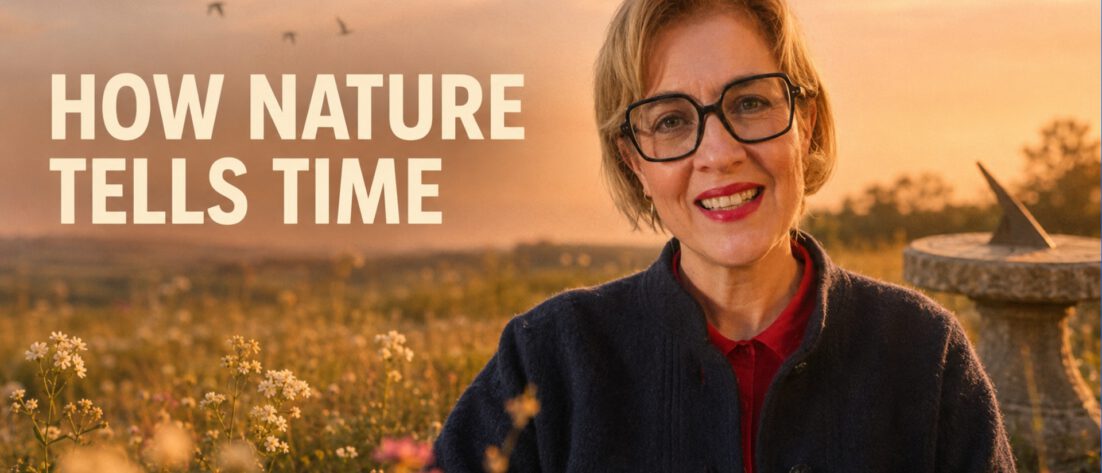
What if you had to tell the time without glancing at a watch, phone, or screen? In this episode of Books & Looks, host Blaine DeSantis sits down with best-selling author Cathy Haynes to explore the forgotten ways humanity once used the natural world to track the hours of the day. Tune in to discover how you can break free from rigid clock-watching and start reading the rhythmic, environmental cues hidden right in your own backyard.
Discussing her Wall Street Journal must-read book, “The Fullness of Time”, Cathy shares captivating historical timekeeping methods, from medieval scratch dials to Icelandic day marks that map the sun’s journey across the landscape. The conversation explores fascinating natural phenomena like ornithological clocks, the rhythmic waulking songs of the Scottish Hebrides, and why observing a sheep’s pupils can accurately reveal the approaching dusk. But can humans actually rely on biological timekeepers like “floral clocks” and circadian rhythms to plan a schedule, or do these blooming plants serve a completely different ecological purpose? Listen in to uncover the surprisingly complex relationship between pollinators, star movements, and the artificial time zones we live by today.
If you enjoyed this peaceful journey into natural timekeeping, be sure to subscribe to Books & Looks and leave us a review!
Episode Resources:
Telling Time with Nature
Blaine DeSantis:
Hi, I’m Blaine DeSantis, and I welcome you to Books & Looks. This is where we do a deep dive with authors to help you discover your next great read.
What time is it? You look at your watch, your phone, or your computer. But what if those weren’t available? Then what? Luckily, nature has a way of helping us tell time.
However, most of us have lost our ability to do that without a watch. Between birds, flowers, sundials, and other methods, there’s a natural way to tell time. Today we’re going to explore nature’s methods of telling time.
I’m Blaine DeSantis. This is Books & Looks. Today we’re chatting with Cathy Haynes about her new best-selling book, *The Fullness of Time*. Cathy Haynes, welcome to Books & Looks.
Cathy Haynes:
It’s so great to be here, Blaine. Thank you for having me.
Blaine DeSantis:
I’m so happy to have you here. I think we started chatting about your book, *The Fullness of Time*, way back in January. And here it is. It’s come out and become a Wall Street Journal must-read for the spring. You must be very pleased with that.
Cathy Haynes:
I was so pleased. That was just brilliant. It was a lovely review. I am very grateful.
The Timekeeper in Residence
Blaine DeSantis:
Very good. Now, before we get into your book, you had one of the most unique jobs. You may still have it, but you were the timekeeper in residence at the Petrie Museum of Egyptian Archaeology. What is that all about?
Cathy Haynes:
I’m a curator and an artist. It was an artistic residency, an art curating hybrid residency, rather than a formal salaried job that already existed. We settled on that title because it was a fun provocation.
My role was to look into how different societies throughout history have modeled the shape of time or the direction of history. We tend to think of the arrow of time or the arrow of progress, but those are relatively modern concepts.
We were looking at lots of different cultural examples, like a snake eating its tail, or in one case, a many-horned beast. These are different ways of representing how time is going to flow.
What is common to that project and all my projects is that I’m collaborating with people in lots of different fields and members of the general public. It’s creative and exploratory. That was fun, but it wasn’t the project that seeded this book.
That came the following year where I was invited to be the artist in residence in Victoria Park in East London. It was a public research project where I suggested we imagine the park is a tiny territory campaigning to become a state without clocks.
If we don’t have clocks on our little island, how else are we going to tell time? I invited ecologists, a bird musician, and an astronomer to help us explore the different rhythms of time you can experience from the natural world, even in the city. That was the spark that lit this journey.
Exploring The Fullness of Time
Blaine DeSantis:
Now your book is called *The Fullness of Time*. Before we get to that, I think you have two book covers that I’d like to see. I have a lot of followers in England. Do you have an English book cover there for us?
Cathy Haynes:
I do. This is your US cover. And then this is my slightly battered UK copy. This is my marked-up one. They’re very different. And the German one is different again.
Blaine DeSantis:
I don’t know if I have as many listeners in Germany as I do in England, including my nephew, Sebastian. I was telling him to go out and buy the book. Anyway, great. Well, that’s *The Fullness of Time*. It’s a great title. Tell us what this book is all about.
Cathy Haynes:
I wanted to know how people in the past, particularly in Europe, told times of day before we came to rely so heavily on clocks. It is my adventure in discovering the answer.
I learned how people told time by the shrinking of their own shadow, the rising of a certain star above a rooftop, the voice of a bird in the darkness, and even by the subtle qualities of the light in twilight.
It covers different ways of reading the world and sensing time and the rhythms of the natural world that would have shaped the day in the past. I went and spoke to experts and rifled through lots of books.
I wanted to experience them for myself. Hopefully the book feels immersive. I want you to feel like you’re listening to the dawn birdsong, watching the stars, and seeing the colors of twilight unfold.
A Pivotal Camping Trip
Blaine DeSantis:
I did feel immersed within your book. I absolutely loved it. Getting back to nature is something which I really like. You start out talking about a 2008 camping trip with your partner, Rosie, who plays a huge part in this book. You said it was a pivotal time in your life. When did you realize something changed within you?
Cathy Haynes:
I’m so delighted that you like it, Blaine. That means a lot. There were lots of triggers for this journey. I grew up on a farm and moved to the city as a young adult.
In my late twenties, I started to realize how detached I had become from the living world around us. Around 2008, Rosie and I got a camper van and went into the countryside in the north of England for pretty much the whole summer.
It rained for 26 consecutive days, but we saw the stars and we lived with the rhythm of the light. Rosie said we started to get sleepy when the light faded and we just went with it.
We would be rocked awake in the morning by an old sheep trying to get her fleece off on the bumper of the camper van. We went out onto the moors and noticed what was happening with the puffins in the sea or the flowers on the moors.
This wasn’t a return to the farm, but it really changed our perspective. The only books I took in this tiny camper van were the little nature guides my mom gave me in childhood.
After that, things changed. We started looking for these signs of the natural world much more in our urban environment. At the same time, I had been exploring different ways that we think about and experience time. Those two themes started to become more and more entangled.
Rosie has such keen senses. She spots things that I’m looking for. If I am searching, Rosie finds them. It’s great.
Telling Time Through a Sheep’s Eyes
Blaine DeSantis:
Well, that’s great. You begin telling us all about a sheep’s eye experiment. You are going up to a sheep and looking into its eyes, and the sheep’s eyes change. What is that all about?
Cathy Haynes:
A “sheep eye experiment” sounds like something lab-based and scientific. My desire was to try and learn something of the ordinary everyday knowledge people would have had in the past, which escapes me.
I came across a marvelous article by Nina Gockerell, a historian, about how people told time without a clock. She mentioned a source that said shepherds in the Carpathian Mountains knew the time on cloudy days when you can’t tell time by the sun.
They knew it was time to bring the flock back to the fold when their eye pupils change from a narrow slit to a round shape towards the end of the day.
I went back to the farm and thought I could find the sheep. It is a very familiar thing to check on the sheep of an evening. That was something we did every evening as children.
We would lean on the gate at the end of the day with mom looking at the sunset. This felt like a familiar ritual, but I had never got close enough to a sheep to notice what happens with their eyes.
Towards the end of the day, they were still narrow. Then I came back about 45 minutes later and they had palpably widened. That was such a surprise.
One of the reasons is that we grew up in a place where sheep aren’t penned in a fold overnight, so you don’t need to get close to them. I’d never seen it, and it was a wonderful thing.
It has been one of those stories in the book that has really surprised people. It wasn’t a scientific experiment; it was trying to notice the things happening in plain sight that past generations would have been familiar with.
Nina Gockerell also says that Polish farmers looked at their cat’s eyes for a sign of the time. Many of us have cats. If they are not around artificial light, you see what happens. We’re all familiar with these signs.
Dægwoma and the Ornithological Clock
Blaine DeSantis:
I can tell you every night around nine o’clock, my dog comes and joins me when I’m watching TV. Almost exactly at nine o’clock. Here comes Babbitt. He comes walking around to the side of the bed and up the little ramp. We watch together. I get this.
I get up early. I’m an early riser. You have a word that I love: dægwoma. What does it mean? And tell me about ornithological clocks.
Cathy Haynes:
It’s an Old English word, dægwoma. It means day noise, or literally day noise. In Old English poetry from more than a thousand years ago, that word was expressive of daybreak and the light.
As the day starts to break in spring, the sound of birdsong rises and can be incredibly intense. There’s another word in Old English I pick up when we’re in twilight: cwieldseten.
It has associations with the quelling or the hushing of the day. There is a sense of naming times of day by a rise in sound and light or a reduction of activity and sound. It is a glimpse of a world where people’s senses were much more tuned in to the living world.
Blaine DeSantis:
Now we’ve got to get to the ornithological clocks.
Cathy Haynes:
I came across an article in several journals from the 1850s and 1860s repeating a piece about a German woodsman who had invented an ornithological clock.
It gave the timings of different species of birds singing in the dawn chorus at half-hourly intervals, as if there is a specific clock-like regime to birdsong. It seems a slightly eccentric idea.
There is a kernel of truth in the sense that some birds typically rise earlier than others. For example, birds with good vision in darkness, like the blackbird, start singing just before light.
Other species come in as it gets lighter. We talk about being up with the skylarks, another bird that tends to rise early. It was a curious Victorian piece.
I wondered if people were compelled by it back then because an urban readership might feel detached and seek that connection with a world of lively rhythms.
If you are living an indoor life run to the clock in industrial 19th-century cities, it is an image of a beautiful, curious idea. Why were people fascinated with this idea back then?
The History of Floral Clocks
Blaine DeSantis:
I don’t think I heard many birds at midnight, so I don’t know if you could do a full 24-hour cycle. But you do hear certain birds at certain times. Now, the next chapter is about flowers and floral clocks. What is a floral clock and does it really work?
Cathy Haynes:
Certain flowers have rapid opening or closing, or put out scent at predictable times of day. In this country, there’s a meadow plant called the goat’s beard, also known as Jack-go-to-bed-at-noon.
*Tragopogon pratensis* turned up in our car park in Central London outside our flat. I filmed it closing at noon and it was so exciting. Other plants do it as well.
*Bellis perennis*, the common European daisy, gets its name from the Old English for “day’s eye” because it would close overnight and in poor weather.
In 1751, the Swedish scientist Carl Linnaeus published a list of over 40 plants that open and close at different times of day. He proposed that similar floral clocks should be made for other climes.
He was talking loosely about the timings because they seem very precise in his list. One of his followers was the first to suggest it should be planted as a clock. Lots of people have tried it.
I spoke to Sylvain Aubry at the Bern Botanical Garden in Switzerland. He and his team tested lots of plants and put together a pretty effective plot in 2022. I asked if it worked, and he said “most of the time.”
It’s rough timing, of course. They used chicory, goat’s beard, and pot marigold. It is much harder to get plants to work through the night. It is a source of massive fascination, but it was incredibly hard work to make it keep rolling from May to September.
Blaine DeSantis:
If you were out in nature and were familiar with the flowers, you could see them and say, “We’re getting towards time to do this.” You don’t need a whole 24-hour clock. You can tell it by what’s showing up at that time.
Cathy Haynes:
Potentially. It’s always going to be loose. In different places and with genetically varied versions of the same plant, you’re going to get different timings.
I found a note in an Elizabethan gardening book that said the *Calendula officinalis*, or pot marigold, was the “husbandman’s dial.” It declares the hours of morning and evening because it opens in the morning, is fully open at midday by the sun, and then closes in the evening.
On a cloudy day, you might go, “Look, it’s starting to close up.” That was my experience when I went on a long walk in the Downs in England. There was a bindweed with lovely trumpets that started to close towards the end of the day. Why wouldn’t you use that as a rough sign?
Pollinator Time and the Giant Water Lily
Blaine DeSantis:
Absolutely. You also talk about flower time and pollinator time. I want to ask you about these giant water lilies in the Amazon. Could you explain the difference in all of this?
Cathy Haynes:
One of the lovely reflections Sylvain Aubry had was that it was “vintage science.” It was a tool for teaching about circadian rhythms in plants and why plants keep such tight timing in response to their environment.
He said the floral clock wasn’t representing human time; it represents flower and pollinator time. Flowers open and close or put out scent when their pollinators are most active.
Here is a living clock sensitive to its environment, so different from our clock which just ticks away standard time zone time that never alters or refers to what’s going on around it.
Blaine DeSantis:
Tell me about the giant water lilies down in the Amazon.
Cathy Haynes:
I went to Cambridge Botanic Garden in the UK and talked to a plant scientist called Alex Webb. We went into this gorgeous hothouse to look at the *Victoria cruziana*, a giant water lily from the Amazon.
There was just a tiny little lily pad, but it grows massive by summer. In the Amazon, there are thousands of them. Around sunset, these white female buds open up and emit warmth and a pineapple scent, which attracts dusk-active scarab beetles.
They come into the flowers and gorge on a starchy substance inside. At dawn, these water lilies close up and trap the scarab beetles, who carry on eating.
The flowers gradually transform into male pink flowers. In the evening, they open up and release the scarab beetles who go off and pollinate some more of the white lilies.
Then the pink lily just sinks into the water. It’s such an amazing example of the reciprocity between flowers and pollinators and the syncing of their timing.
Blaine DeSantis:
The beetles are in there the whole day just sitting in there and munching away.
Cathy Haynes:
As I understand it, they are just cozy inside that plant between dawn and dusk, gorging away.
Blaine DeSantis:
Snug as a bug. Wow, that is fantastic. I’m going to move away from flowers and birds.
Cathy Haynes:
Just to add one more thought: botanical gardens do grow these lilies. Instead of scarab beetles, the keepers pollinate them using paintbrushes. If you want to see one of these things, get to your local botanical garden.
Rhythmic Labor and Waulking Songs
Blaine DeSantis:
Now we’re going to go to waulking. It’s spelled W-A-U-L-K. What is waulking? How do we tell time through waulking?
Cathy Haynes:
I have a chapter exploring how we beat time by the voice or the body. I was captivated by the waulking songs of the Outer Hebrides in Scotland.
This is a remote group of islands where tweed cloth was finished by hand until the 1950s. Shrinking the cloth and getting the right texture to protect someone from the wild weather was done by hand and song.
A group of maybe eight women would come together around a sturdy table and beat the cloth while singing to the beat of their hands. They would be led by a singer, like a coxswain of a boat.
The song helps them keep in synchrony. The songs are incredibly beautiful and often expressed things difficult to talk about, or dreams and documents of their life lived over centuries.
Every task had a song to go with it because tasks were rhythmic. The leader would test the texture and shrinkage and say, “We need to sing for three more songs,” rather than measuring by the hands of the clock.
It is a creative, communal way of being that we have lost touch with. One of the people I talked to is my friend, Jamil. He said, “Imagine if we sung now while we were working as I move my mouse around my desktop.”
It is a beautiful world that’s just one or two generations away. A lot of this has been about trying to record things which are almost within reach that we’ve lost so recently.
Blaine DeSantis:
Pounding and singing at the same time. I wonder how long it takes to do one.
Cathy Haynes:
It could be two or three hours of songs from memory that you’re recalling.
Medieval Scratch Dials
Blaine DeSantis:
That’s as impressive as pounding the cloth. Now, one thing we talk about here: I knew about sundials, but you say there’s something called a scratch dial. What is a scratch dial?
Cathy Haynes:
A scratch dial is a kind of sundial. I wanted to find out how ordinary people told time who didn’t necessarily do it in a mathematically exact way.
Everything under the sun is potentially a sundial because anything casts a shadow. Scratch dials are medieval objects that are easily overlooked. There are a lot of them in England and wider Europe.
They are tiny traces of a fan of lines, usually a hole in the middle that would have held a straight rod. The lines are often brilliantly wonky. They are not always in a regular pattern of 12 or 6.
They are very mysterious objects. It’s thought many were used to tell the time, but they also had symbolic meaning because these were religious sites. Once you start looking for them, every time you get near a village with a medieval church, it’s compulsive.
Blaine DeSantis:
And they’re on the side of the church against the wall?
Cathy Haynes:
Typically you would expect them at head height near the priest’s door on a south-facing wall, but they are not all there. Some are on the north face or even inside the building where the sun doesn’t shine.
Sometimes you get lines above where the shadow of a straight rod won’t go. There are fascinating mysteries about them. Sometimes the stone block has been moved, or perhaps they are a symbolic map of the wheel of the sun. So little is known for certain.
Icelandic Day Marks
Blaine DeSantis:
I can’t skip Iceland because you went to Iceland to look for what they call day marks. What happened in Iceland?
Cathy Haynes:
Iceland is super expensive, and a friend said, “Come and stay with us,” so we jumped at the opportunity. I had always wanted to find out about these day marks.
If you look at the right kind of map, you will see hundreds of sites named for times of the day, like Morning Valley, Midday Hill, Mid-Afternoon Mountain, and Nighttime Waterfall.
They worked by standing in the doorway of your farmstead and looking out at the horizon. There would be landmarks or cairns marking where the sun would be at a particular time of day.
Each farmstead had its own day marks, or eyktarmörk. They were very local. I was talking to an archaeologist called Birna Lárusdóttir who made a brilliant point: when we turn to our clock, we turn inward.
We look at the digits or the hand on the dial. This appears to be a self-contained thing representing an abstract ideal. It’s otherworldly. She simply said the clock becomes our subject, whereas the day marks orient us outward.
I love that. It became emblematic of how I felt about the book. These old ways of telling time make you look up and sense much more beyond our human bubble.
I chose to go in December when the weather was appalling. There was no chance of seeing the sun and the day was short. These day marks just felt like memorials to the sun.
You can tell where the sun is without looking near it. If you want to know precisely, you can tell by your own shadow. People used their shadows to figure out the time, which really connects your body to the cosmos.
Daylight Saving vs. Solar Time
Blaine DeSantis:
We humans move our clocks back and forth twice a year. Does that influence our understanding and interpretation of natural time? Does that whack us out?
Cathy Haynes:
Daylight saving time is a hugely debated subject. Our clocks are a kind of broad time. In London, my clock is the same as Greenwich Mean Time.
If I were in Bristol, I think it is a 20-minute difference. Midday by the sun is more or less the same in London, but 20 minutes different in Bristol. Time zones stretch the relationship of our clock to the sun.
When we jump for daylight saving time by an hour, it completely detaches the clock from the sun. I didn’t really think of the clock as something which had a relationship to the sun and stars. But go back a couple of hundred years, and that is how you set your clock. You would keep it in check by the midday shadow.
Behind the Book: Family and Memories
Blaine DeSantis:
My wife calls it natural time. We go by natural time. I’ve got to get Rosie in. Rosie is your partner and has gone on all these trips with you through snowstorms in Iceland. If Rosie was being interviewed, what would she say about this project?
Cathy Haynes:
You shared this question in advance, so I had a chance to ask her because I feared the answer. Rosie didn’t come on every adventure, but she came on the critical ones.
In Iceland, Rosie was at the wheel driving through a snowdrift in a hailstorm. She was magnificent. A lot of the book is wandering around local streets, looking up from a car park, and Rosie joining me.
She said it revealed to her the extent of my nerdery and how far I will go to hunt down some weird fact. She also said it was a sacrifice for us both. She was a “book widow” for a year.
She did an enormous amount to support me. Ultimately, she said it’s been life-enhancing because the knowledge and experiences have been great. That was a relief.
Blaine DeSantis:
Well, Rosie was a big part of this book and a big helper to you. So does your dad at the end. You’re sitting there with your dad at the hedgerow, and he tells you something about the shadows and where the sun is. He knew it, and you never realized that. How did it make you feel having missed that all those years?
Cathy Haynes:
“Listen to your parents” is the first thing I would say. I lost both my mom and dad while I was in the process of developing the book. It was super tough.
The book became about trying to honor them and how aware they were of their environment. Because they were farmers, they were constantly looking around them and noticing what was going on.
I took that to the art world and the city, but I still have a little bit of it in me. My sister is much better than me. I finally caught on to how the sun moves along the horizon through the years.
Sunrise moves around the horizon, and the farmyard we grew up in appears to be designed around the middle of summer because of how the main coach arch is oriented.
I said this to dad and he didn’t make me feel like an idiot at all. He just said, “Oh yeah. Also, the sun goes behind these hedgerows at different points in the year.” It was a lovely moment of connection. I wish I had the opportunity to ask them so much more.
Stargazing and the Baker Street Irregulars
Blaine DeSantis:
No doubt about it. Last thing, very quickly. Who are the Baker Street Irregular Astronomers?
Cathy Haynes:
The Baker Street Irregular Astronomers meet in Regent’s Park in Central London. They’re a free and open astronomy club where anyone could turn up.
I’d read in a Thomas Hardy novel about a shepherd who could tell time by the motion of the stars, and I wanted to know how to do that. First, I had to learn the absolute fundamentals of basic astronomy.
I’m still a novice, but thanks to them, I learned how the stars move around the North Pole. I can see them even from this brightly lit street. It’s not just helicopters and satellites up there; it’s deep time.
Blaine DeSantis:
Cathy Haynes, you’ve written a wonderful book. It is informative and fun. It’s taught me so much, and I am appreciative of your work and Rosie’s efforts. Thank you for being with us today on Books & Looks.
Cathy Haynes:
Such a pleasure, Blaine. Thank you for your wonderful questions.
Blaine DeSantis:
Kathy, thank you so much. It was a wonderful chat. Friends, this is a great book. It’s about nature and getting us back to understanding nature. I hope you take advantage.
You don’t always have to be tied to that watch or phone to tell you what time it is. You can see it anywhere in nature. On behalf of our friends at booktrib.com, this is Blaine DeSantis saying, may all your leaves be pages in a book.