
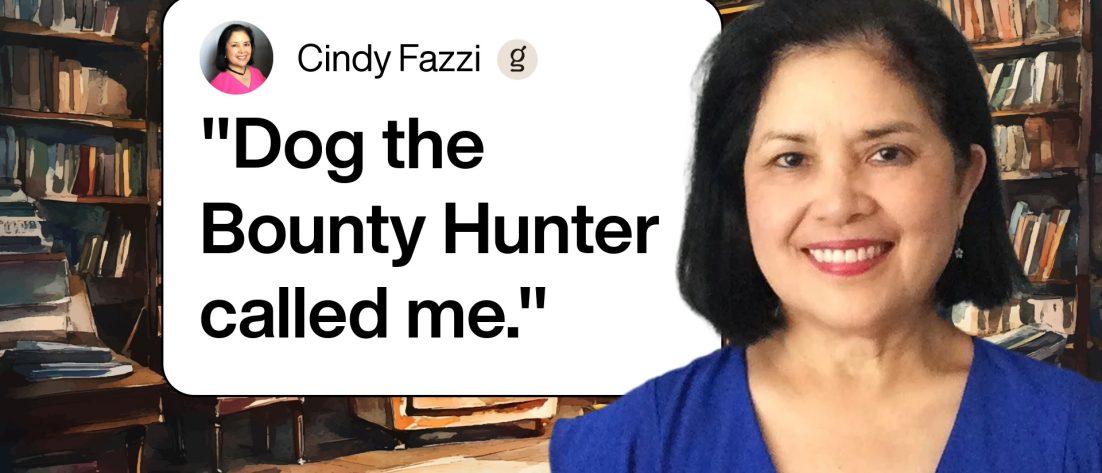
It took 30 years, multiple rewrites, and a publisher going out of business, but author Cindy Fazzi’s groundbreaking story is finally here. In this episode, we sit down with Cindy for an in-depth author interview about her perseverance and the incredible journey behind the Domingo the Bounty Hunter series, a compulsively readable set of novels that turn the hard-boiled genre on its head. How do you tell a thrilling story about the chase while realistically portraying the complex, vulnerable lives of undocumented immigrants?
Join us for a fascinating conversation with Cindy Fazzi as she discusses her unique contribution to the Filipino-American thriller genre. We dive deep into the first book, Danger, No Problem, exploring the decades-long cat-and-mouse game between Domingo, a bail enforcement agent, and Monica Reed, a desperate woman in hiding. Cindy shares the fascinating reason the book was originally titled “Multo” (meaning “ghost” in Tagalog) and why her new publisher, Thomas & Mercer, decided to change it. We discuss the inspired choice to rewrite the story from Domingo’s point of view, which led to the creation of his “handbook for immigrants,” a book-within-the-book that adds incredible depth and humor to the character. This Cindy Fazzi author interview reveals her powerful motivation to create authentic Filipino-American characters and introduce readers to a culture rarely seen in mainstream thrillers.
But the story doesn’t end there. We also discuss the highly unusual strategy of simultaneously releasing both Book 1, the Danger, No Problem book, and Book 2, Sunday or the Highway. Cindy gives us a glimpse into the plot of the second book, where Domingo is hired to find the missing parents of an heiress’s mysterious boyfriend. Throughout our conversation, we touch on the serious themes in her books about undocumented immigrants, her transition from an Associated Press reporter to a novelist, and what’s next for the Domingo the Bounty Hunter series.
About Our Guest:
Cindy Fazzi is a Filipino-American author and former Associated Press reporter. After a 30-year journey of perseverance, her hard-boiled thriller series was picked up by publisher Thomas & Mercer. A passionate advocate for representation in literature, Cindy created the character of Domingo to introduce readers to a captivating Filipino-American protagonist and to subvert the classic bounty hunter trope. Her books, Danger, No Problem and Sunday or the Highway, are celebrated for their tight plots, rich characters, and compassionate exploration of immigrant life in America.
Introduction
Blaine DeSantis: Hi, everybody. It’s Blaine DeSantis here at Books and Looks. And before we begin today’s show, I want to have a little programming note for you. Beginning in the month of September and continuing for the foreseeable future, I’m going to be recording only two shows per month. Yes, I know you got used to almost weekly updates from us and author interviews, but I’m going to tell you what. I’m going to hit 72 this year, and the old eyes are just not what they used to be. I got to tell you that. It’s a lot to read.
In any single year, I’m reading anywhere between 125 and 150 books, and my eyes just can’t keep up with that level of reading. So I’m going to go back down to two shows a month, which is what we initially wanted to do with books and looks, and I think you’re going to like it. And remember, everything you have here with books and looks is evergreen, whether it’s on the podcast, whether you join us on YouTube, everything is available. So you spend a week, 10 days since the show, hey, I miss seeing Blaine or I miss hearing good authors. Just go back, take a look on YouTube or in the podcast. You’ll find it. Go back and listen to one you might not have heard before. I know I go back sometimes to listen to these shows because I find these authors so doggone interesting.
So lots here for you. We’re going to keep this up. And by the way, just so you know, I’ve already got my first guest. That’s right. First guest for 2026 already planned. And wow, let me tell you what. First book, which we will do, which I’ve scheduled already is for March. That’s how far in advance I schedule this stuff. It’s called The Epic History of Macaroni and Cheese. Oh my God, a food history book. This is going to be spectacular. So stick around with books and looks. We’re always bringing you fun stuff here on the show.
Introducing Cindy Fazzi and the Domingo the Bounty Hunter Series
This week, we are going to be chatting with the author of one of the most compulsively readable books I have come across in a long, long time. That’s right. Compulsively readable. Cindy Fazzi is a Filipino-American, has written a superb book about Domingo, the bounty hunter. This novel is about Domingo, who is a bail enforcement agent, whose job is to pick up illegal aliens for deportation. The plot is tight. The characters are well-defined. And this book took me about one day to read. I literally could not put it down.
As I said, compulsively readable. And she talks about people and she talks about things we don’t always hear of every day of the week. And that’s what makes it unique. So anyway, I’m Blaine DeSantis. This is Books and Looks. And today we’re chatting with Cindy Fazzi about her new book, Danger, No Problem. Cindy Fazzi, welcome to Books and Looks.
Cindy Fazzi: Oh my God, I am so thrilled to be here, Blaine. Thank you so much for having me today.
Blaine DeSantis: I could not wait to have you on, and I’m so glad that we are on almost your publication date for this book, aren’t we?
Cindy Fazzi: Actually, it came out on Tuesday, September 9th. Both books, one and two, were simultaneously released by my publisher, Thomas & Mercer.
Blaine DeSantis: Okay. Well, we’re here today to talk about what is considered to be book one, Danger, No Problem. And that’s with my good buddy, Domingo the Bounty Hunter. Love Domingo. What if you had to is this a thriller, a detective? What genre would you make Domingo? What is he?
Cindy Fazzi: It is a thriller. It is considered hard-boiled thriller because there is a professional at the center of the story. So Domingo is a bounty hunter and he’s like a private detective. In both books one and two, the series follows Domingo, who is a Filipino-American bounty hunter, as he looks for the most elusive queries and he discovers explosive secrets along the way.
Blaine DeSantis: Well, this is just some really good book. Like I said, it was hard for me to categorize what it was other than compulsively readable. I couldn’t stop one day to get these books done.
Cindy Fazzi: Thank you so much for your review. I believe you were the first person to review it. I am so grateful for that. And it just snowballed from there. Thank you so much.
Blaine DeSantis: Well, I’m glad I could do any part to help you out with this book. But tell us a little bit now. We know Domingo’s a bounty hunter and he’s Filipino-American. But tell us a little bit about him as well as what is the plot of book one, which is, as I showed before, Danger, No Problem.
Cindy Fazzi: So Domingo the Bounty Hunter, he is 40 years old in book one. Book one, it’s called Danger, No Problem. And in book one, he is looking for the only query that has ever eluded him. Not once, but three times. And that is a lot to say, considering that he is considered the best in the business.
He is looking for an undocumented biracial Filipino woman named Monica Reed, who is overstaying in the United States because she’s looking for her American father who doesn’t know that she exists. And book one pits a dogged bounty hunter against a desperate woman in hiding. They are compatriot. They speak the same language. They are both in the United States in pursuit of their American dream. But their dreams are on collision course.
From “Multo” to “Danger, No Problem”: The Story Behind the Title Change
Blaine DeSantis: Well, it’s quite a collision, I’ll tell you. One of the things that I found fascinating was this book was previously published under the name, the title of MULTO, M-U-L-T-O. What does MULTO mean? Why did you publish it like that? And why did you change the title now?
Cindy Fazzi: I had a really long and tough time. Publication journey. Originally, this book, Danger, No Problem, was called Multo, and it was published by a small press called Agora Books. Multo means ghost in Tagalog, and Domingo calls Monica the mother of all ghosts. He calls her Multo. That refers to her being an undocumented immigrant. She’s very good at hiding, she could disappear like a ghost, but also socially and politically, a lot of people don’t want to see undocumented immigrants. So it is almost like they’re ghosts. You know how some people claim they can see ghosts, but most of us can’t see ghosts. And that is how Domingo looks at Monica or describes Monica and other undocumented immigrants.
Originally, in 2023, it was published as Multo. Well, six months later, Blaine, the publisher, my original publisher, went out of business. I was devastated. I thought it was going to be the end of the books because the publisher was supposed to publish book two in 2024. I got really lucky that Thomas and Mercer, which is a lot bigger, picked up both books. And they said, look, Cindy, your book was out for only six months. So we’re going to treat your book like a brand new book.
They suggested that we change the title. They asked me to change the title and I was happy to do it in order for them to launch it like a brand new book. There were some editorial changes I had to add, the little thing about Domingo’s business card which is where the title Danger, No Problem came from. And that is what happened, that is why the book title was changed.
The Handbook for Immigrants: A Book Within the Book
Blaine DeSantis: Okay wow and I’m hoping that that title changed along with everything else, Thomas and Mercer’s being a little bit larger going to give you good sales for this and people want to pick this up. I really hope so. Oh, yeah. Now, what’s interesting, friends, out here is not only is this a book about Domingo and his plot, but he also, he writes in the book, when he has some free time, he starts writing this handbook for immigrants. This is very, very well done, to put it mildly. What was your inspiration for that? And was that always your intent to have this book within a book?
Cindy Fazzi: No, that really came, that was all Domingo. Believe it or not, I originally wrote this book in 1995, 30 years ago. And originally, I wrote it from the perspective of Monica Reed. I couldn’t sell the book. I got rejected forever, left and right. Nobody wanted the book. They said it was a literary novel that was really uncommercial. So it took me a very long time to realize that I needed to rewrite it. And I rewrote it from the point of view of Domingo, who was at that time a secondary character. He was always the bounty hunter chasing Monica, but he was only in a few chapters. And once I completely rewrote the book, the same story, but from a different point of view.
The book organically became a thriller because Domingo is all about the chase. And Domingo has a lot of opinions about it. He is funny. He’s a wise ass. He sometimes is politically incorrect. He has a lot of opinions. And that is when it came to me, he has to write these things. I couldn’t capture his spirit, his sense of humor from a third-person point of view. And I gave him, since he has a lot of empathy for immigrants, I gave him that mechanism, that tool, that he is writing this book in order to help other immigrants.
Championing Filipino-American Representation in the Thriller Genre
Blaine DeSantis: Well, I’ll tell you what. It blends in beautifully. And the switch from Monica to Domingo is really inspired. I think it really did a lot because we learn about the guy. That’s the person you don’t really hear a lot about. The person who is the bounty hunter. What’s their life? What are they going through? And that was interesting. What also made this extremely interesting is your use of the Filipino Tagalog. And if I said that wrong, I apologize. I always pronounce the Tagalog language. You use words like multo. What’s the other word I had? Bahala na and things like that. How important was that to the book?
Cindy Fazzi: You have to learn.
Blaine DeSantis: Takes a while.
Cindy Fazzi: You said it correctly.
Blaine DeSantis: How was that important to have that as part of this book?
Cindy Fazzi: So one of the reasons that I write fiction is to hopefully add to the Filipino-American literature. There are very few Filipino-Americans in books, and especially in the thriller genre. So that is the reason that I persevered. I had a very good motivation. I want to see Filipino-Americans in books. I want to introduce readers to Filipino-American characters like Domingo and Monica and to introduce Filipino culture. So the words and the food that he mentions, the sayings that he quotes, they’re very important to me. And hopefully the readers would enjoy learning this snippets of Filipino culture.
Blaine DeSantis: It also helped when he would be able to, especially on that first chase of Monica, to be able to come out and speak to her in her own native language. And that was important, I thought, to the book also.
Cindy Fazzi: Absolutely.
Blaine DeSantis: You talk about wanting to bring more Filipino into our reading. Are there many Filipino-American writers out there? I’m not familiar with a lot and I’m sorry I don’t know many. Are there a lot?
Cindy Fazzi: No, not many. Not many. It’s been really hard. That’s why even for me took me a very long time to get published. Publishing is just really competitive. There are what, two million books or something like that getting published every year, especially now there are a lot of self-publishing. And so both traditional publishing and self-publishing, they’re out there in the market. It is really hard. So they’re not, it’s not that you haven’t heard them, it’s just that there are a few of us. And especially in my genre, there are very few Filipino-Americans writing my genre.
Blaine DeSantis: Okay. And that was always your intention to write as a Filipino-American, to write the story about a Filipino-American.
Cindy Fazzi: Absolutely. Absolutely. I think that if I had not immigrated to the U.S., I might not have become a novelist because then I would not have the motivation to write. I felt very strongly that the need to introduce Filipino-Americans to readers because they just didn’t exist as of yet.
Subverting the Bounty Hunter Trope with a Filipino-American Protagonist
Blaine DeSantis: Are there many bounty hunter books? I really… Is there a big genre for that?
Cindy Fazzi: No.
Blaine DeSantis: Okay.
Cindy Fazzi: That is a really good question because a lot of people ask me, why did you choose a male bounty hunter as your protagonist? And to tell you the truth, I tried imagining my protagonist as a female protagonist because, being a woman myself. But really, Domingo was very strong in my mind. I couldn’t change him. But bounty hunters, there are fewer in books right now. And that is why I am so proud to say that Domingo is the first brown immigrant, the first Filipino-American immigrant.
Protagonist in the bounty hunter trope. And let me tell you this funny story. Dog the Bounty Hunter, when my book came out in 2023 in Multo, he actually reached out to me. He was very gracious. I think he was really surprised that there was a book about a bounty hunter. And he wrote to me and we ended up, I called him, we called each other. He was very gracious. He said, if you want to talk about bounty hunting, talk to me, you can call me anytime because like you said, there are very few. The bounty hunter trope is quite established but mostly in films. Think about Clint Eastwood, Unforgiven, and his spaghetti western films when he was a lot younger. He was a bounty hunter in those movies. And then there is Midnight Run, with Robert De Niro, very popular, also a bounty hunter. And then, of course, there’s Dog the Bounty Hunter. So in terms of pop culture, we associate bounty hunting more with films and reality show. And that is why I chose my character. I made him a bounty hunter.
A Decades-Long Chase: The Three-Part Structure of “Danger, No Problem”
Blaine DeSantis: Okay, well, and the funny part is, even though Domingo is, again, a Filipino-American seeking other Filipinos and others, after around 20 pages, I lose that. He just becomes a really interesting character and a really, really unputdownable book. I don’t care that he’s Filipino-American. I care about the story. I care about what he’s doing. Now, this book is really divided into three section. Because as you said, Monica is an elusive and slippery character. So we have three different times that Domingo is trying to find her. Tell us a little about those three sections.
Cindy Fazzi: I did not originally intend to write it that way, but the book essentially shows you the very long publication journey I went through. I said that I first wrote it in 1995. So in the initial version of the book, the first timeline is 1998. And then the second timeline is 2008. And the final timeline is really 2017.
Those were the three timelines I rewrote this manuscript. I originally wrote it in 1995, back when Domingo and Monica were in their early 20s. I couldn’t sell the book. I rewrote it in 2007, 2008. Well, both Domingo and Monica have already aged 10 years later. I still couldn’t sell the book. 2017, I rewrote it again and by the final version of the book, they are now in their 40s. Domingo is 40 and Monica is 44. So that is what happened. It’s like at the back of my mind, these characters have always been there. They’re living their lives and each time I rewrote the manuscript, I was just watching their lives. Like, what are they doing now in their 40s? In my mind, their lives continued from the time they were 20s. They first both arrived in the U.S. in their early 20s. And they just continued to live their lives until they’re in their 40s. It is very weird that way.
Blaine DeSantis: Yeah.
Cindy Fazzi: They’re very real to me. And they have this real lives that I followed throughout the decades.
Blaine DeSantis: Mm-hmm. Mm-hmm. And in each part, each section of the book, there’s a different reason that Domingo is trying to find Monica. It begins as one thing, changes to something in the second section, and then goes to something in the third section. So it really changes. Do you want to talk about any of those changes here with us?
Cindy Fazzi: Yeah, without giving away the story. It has a really dramatic arc. The first time Domingo looks for Monica, it was because Monica’s father, who is a four-star general, wanted to get rid of her. So her father was trying to get her deported. And Domingo, who was also very young and very naive, he was so gung-ho. He could do it and therefore he would do it.
During their first meeting, he is very much touched by Monica’s, her character. She’s just a really nice person and he could tell that this is an innocent person. Her biggest crime is that her father is a jerk. I’m sorry about using that word, who wanted to get rid of her.
That was her only crime. She wanted to come to the U.S. to meet him, to learn about him, and he wanted to get rid of her. Domingo realizes immediately that this woman is an innocent. So that was the first time. And then the second time, a complete reversal of fortune, Monica’s father needed her. I’m not going to say it, but it’s like a life and death situation. So the general has to eat his words and suddenly he is at the mercy of Monica. And again, something happens that Monica gets away, or rather Domingo helps her get away. And then nine years passes by and Domingo is trying to move on with his life. And something else happens. The general is now dead, but his wife is dying and his wife has always felt guilty of how they treated Monica. And her dying wish is to reconcile with Monica. And so Domingo who is now looking for Monica for the third time and as much as he would rather not do this but he has a lot of empathy for Mrs. Reed. And he does it for her. And so he embarks on another search for Monica.
Blaine DeSantis: Yep. Understood. Fascinating. Fascinating. Really well done. Friends, and it’s easy to put this together. They can just seamlessly slide from one to another to another. And it’s just so well done and easy to read. And you started this 30 years ago. My word, you were what, 14 years old back then? I’ll tell you, you were a young girl.
Cindy Fazzi: I am dating myself. Yeah, I’m very old.
An Unlikely Love Story: The Complex Relationship Between Domingo and Monica
Blaine DeSantis: But, one of the things that not just only is this a story about Domingo trying to find Monica, but it’s a love story, too. Domingo is truly, I think, in love with Monica. He might not realize it in the first section, but I think he’s in love with her from the beginning.
Cindy Fazzi: Right. So Domingo is very career oriented. He’s very passionate about his job. And he knows, he learned from his mentor that he’s not supposed to fraternize, to be close to the people that he’s looking for. And I think he really tried to resist, but Monica is beautiful inside and out. She is this person that is so easy to like. And Domingo is just like any other person who meets Monica. He falls for her, but he really resists it.
And yet it’s because she’s like a ghost who keeps coming back to haunt him, he eventually and inevitably falls for her. So it is kind of a sad story that the way that he really cannot act on his feelings for her. First of all, she does have a relationship with someone else. She is in love with someone else. And so Domingo must admire her from a distance.
Blaine DeSantis: Okay. Well, now, Domingo, he’s become a U.S. citizen. Tell us how that happened. Tell me about his mother and how Domingo became a U.S. citizen.
Cindy Fazzi: So Domingo’s story is quite common. He got his citizenship through his mother who married an American citizen. So long before there was Match.com, those online dating platform, in the Philippines there used to be agencies. They’re like job agencies, and their job is to be matchmakers. They match, usually it’s Filipino women with American men, but it could be either way. It could be other nationalities, European men or Japanese men looking for Filipino wives. So that is how Domingo’s mom met her American husband, and the American husband petitioned Domingo and his mother to the United States. So that is how they got their U.S. Citizenship, by virtue of marriage.
Blaine DeSantis: Right. And interestingly enough, he makes some points in his book, in Domingo’s book. He basically tells us, my mom didn’t go for the youngest, best looking. She went for a guy who was stable, was older. And when he died, mom got the house. I became a citizen. I thought that was so interesting. And does that happen a lot? Have you heard a lot of that in your career?
Cindy Fazzi: So I have known one of my friends actually met her husband that way. It was really through an agency. And a lot of them actually end up, it’s just like a dating service. Again, it’s like match.com. Sometimes that is the only way you meet people and you need a little help. And not all of them succeed but I have known at least one person who had a very successful marriage and she came to the United States by virtue of that, exactly that exact same story that happened to Domingo’s mother.
Crafting a Realistic Portrayal of an Undocumented Immigrant’s Life
Blaine DeSantis: Oh that’s nice, good, that’s wonderful. Wait I gotta go back to Monica a minute. You wrote a book about Monica and a character, but this is a person who’s trying to stay off the grid. She’s trying to stay under the radar. How do you make that both realistic and identifiable to us readers? How do you do that?
Cindy Fazzi: Again, I have met a couple of people who are like Monica, and it’s unbelievable. I feel very, very lucky that I didn’t have to go through that. My own immigration story is pretty boring and straightforward. I didn’t have to go through that. But basically, they told me it’s like being a ghost. If you could accept that your safety depends on you not being visible, on you being invisible, then you’re going to do well. And for them, that is success.
If they could just be left on their own and all they are doing is just doing their day-to-day job. They want to be a productive part of this society. They pay their taxes. That’s one thing that a lot of people don’t understand. They actually have to pay their taxes. And they do it willingly because they think that someday when they do get that citizenship, they would show, look, for 10 years, I’ve been paying my taxes. And I have met some of those people. And they’ve told me what it means or how it feels to be in that situation like Monica.
Blaine DeSantis: And again, that’s what makes it realistic. You see, you’ve been able to take those real life situations and put it in the book. And then it does become relatable to those of us. We can understand it because this is not something you just brought in out of thin air. This is something that has happened and we can definitely relate to that and that’s wonderful. I like that a lot. You know, the second part of the book we have General Reed going from just being mean to being monstrous. Wow. Was that always what you intended with that second part of the book or did that just as things started going along, well I can really do something bad with this guy. I can make him a real evil character. How did that come about?
Cindy Fazzi: So actually, yes, I always meant him to be larger than life bad because he’s really meant to be over the top. I wanted him to be a symbol of power, a symbol of all-consuming greed. So he has to be a little bit over the top. And that’s why I made him a general. He was a CIA top dog. I made him all of that in order to symbolize power and also to really to show the contrast, the imbalance of power between the general and his daughter, who is undocumented, in hiding, at his mercy. It’s really that huge contrast between the two of them.
Blaine DeSantis: As bad as the general was, his gopher, or the guy who did all his dirty work for him, I can’t remember the gentleman’s name, he was really the worst. He was terrible. Was it fun writing his part? He was really bad.
Cindy Fazzi: Yeah. I think that Cutter, who is the sidekick of General Reed, is a real match for Domingo. I thought that both of them, head to head, were really good characters to be together. So I really had fun. Whenever they met Cutter and Domingo, I really had a lot of fun with both of them.
Blaine DeSantis: He’s certainly the polar opposite of Domingo, I’ll say that much. But anyway, the ending of the book, which we’re not going to give away, friends, but was that emotionally difficult for you to write that?
Cindy Fazzi: I know it was. I wanted it to be realistic but Monica has a sad story and she has, I really felt for her, but I also wanted Domingo to be that beacon of hope. He is the source of hope at the end of the book. So even though Monica’s life is sad and her story is really sad, but that is where Domingo really shines, and he offers hope. I hope that he was able to shine that way at the end of the book.
Blaine DeSantis: And I think by the end, my own reading of this book was that by the end, Monica realized that he loved her and I thought that she was softening her view towards Domingo as things went along. Just my reading of it, but I thought that was very good because Monica, and I think so many of the illegal aliens are surrounded by so much evil. And I thought you portrayed that so well that people, not of their native culture, but of others are trying to do anything they can do to take advantage of these people. That’s what’s being done. And I thought that was very well done in this book.
Cindy Fazzi: Thank you.
From Associated Press Reporter to Thriller Novelist
Blaine DeSantis: That was, I hope that was an intent because that’s what I got. Now you used to report for the Associated Press. How did that affect how you write fiction because you were used to writing all facts now we’re going to write fiction. Is it difficult to go from one to another?
Cindy Fazzi: I would say no. In fact, I really owe my writing skills to the Associated Press. I went to journalism school. I didn’t get a master’s in creative writing. So I went to journalism school. I learned how to write as a reporter.
And not only that, I learned how to write in a direct manner that would be relatable in fiction. But I also really learned how to look for interesting characters, how to ask questions, how to get the answers to my questions. And that, more than anything else, is the most helpful thing once I started writing novels. Because, for example, writing about a bounty hunter, I had zero knowledge about bounty hunting. But because I was a reporter, I was able to interview a bounty hunter. I was able to find this manual at the Department of Justice’s website. They have a manual called the Advanced Bounty Hunter, which they use to train federal agents, but it is a bounty hunter. And that became my bible when I was writing the book. And so to answer your question, I think that it was a very smooth sailing transition for me from a reporter, from a news writer, to a novelist. It worked really well for me.
A Unique Publishing Strategy: The Simultaneous Release of “Sunday or the Highway”
Blaine DeSantis: Now you have a second book which I’m going to show everybody. Right now, there it is, Sunday or the Highway. They both came out on the same day. Now I’ve never seen that. That’s amazing. Was that your decision you wanted it both to come out the same day or Thomas & Mercer?
Cindy Fazzi: It was Thomas & Mercer’s decision. It is a bit of an experiment. I don’t think they’ve ever done it before. It is not done by other publishers simply because most writers will write book one and then it gets published and then they’ll write book two and then book two gets published and like four years of process along the way. But because of what happened to me, my first publisher went out of business. My two books were ready. I have already written them. It was the publisher that went out of business. And Thomas and Mercer said, well, you have both books ready. We’re gonna simultaneously publish them. And hopefully the experiment succeeds and hopefully people like that they get both books at the same time or one after the other. Hopefully it works well.
Exploring the Plot of “Sunday or the Highway”
Blaine DeSantis: Book two, Sunday or the Highway, again, one more time here. It says it’s a Domingo the Bounty Hunter book, but Domingo’s not bounty hunting here, is he? That’s not his job.
Cindy Fazzi: So he’s still, he is a bounty hunter, but he gets hired by another heiress. This time, a young, beautiful heiress hires Domingo to look for the undocumented parents of a man that she’s romantically obsessed with. So this man saved the heiress’s life when she was eight years old and the guy was 14 years old. And the heiress always believed that they were destined to be together. And so many years later, they’d meet again and fall in love.
But his parents, he’s a very mysterious guy. He is a Mexican migrant who was once deported, and yet he reinvents himself. He becomes a really successful engineer. And he has this relationship with his young, beautiful heiress. But his parents, who are undocumented, are not missing, but he has not been in touch with them. And that is when the heiress hires Domingo to look for his parents, but what Domingo uncovers could get not only him but also the heiress, could get both of them killed. So there is a serious problem about the guy’s identity.
Blaine DeSantis: Wow, that’s really good. I’ll tell you this book, as much as I like Danger, No Problem, this second one really, really grasping. I’ll tell you what. I sort of like that idea of putting both out at one time because you at the end of the one you say, well, I wonder what’s going on with him now. Ah, now we see what’s going on. He’s now doing this. I thought that was really, really well done. For some reason, I kept thinking by the end of the book the heiress was going to fall in love with Domingo also. I don’t know, but I think because they’re always going places together, doing this, go here, this. It’s quite good. This takes us all over. We’re down in Mexico, we’re all over in California. I really like that. And it’s a fast-moving book, well plotted. The characters, that’s the thing, your characters are so believable, but as you said, they’re many times based on real people and real experiences and that’s helped so much. Were there many real people involved in this one? Was the heiress somebody you knew?
Cindy Fazzi: The heiress is…
Blaine DeSantis: Okay.
Cindy Fazzi: Quite easy. I read an article about the owner of In-N-Out fast food chain.
Blaine DeSantis: In California, yeah.
Cindy Fazzi: So I read about the heiress of In-N-Out Heiress, and that partly inspired Tessa Woodridge in my book.
Blaine DeSantis: Okay.
Cindy Fazzi: Yeah.
Blaine DeSantis: Well, I could see that. I could see that, and that was fascinating. And I love that Domingo was always being introduced as a meat provider. How are you going to be bringing in the meat? Okay. What’s he doing here all the time? He’s just bringing in meat. I’ve never seen other suppliers hanging around like this. But you brought in a disabled character also into that book, too, which I thought was very good.
Cindy Fazzi: Tessa’s sister.
Blaine DeSantis: Yeah, tell us a little bit who that person is.
Cindy Fazzi: So Tessa is the heiress. Her older sister, Alice, has cerebral palsy, and so she’s quite vulnerable. And when Tessa brings home her gorgeous, mysterious boyfriend, Julian, Alice really falls for Julian in the sense that she’s really, really rooting for Julian. She thinks that he is the Prince Charming for her sister. And Domingo can see this. But at the same time, Domingo is already very suspicious of this Prince Charming. Because he’s just too perfect. But at the same time, Domingo can see that Alice and Tessa, they’re both really smitten by Julian. So Domingo has the tough job of uncovering Julian’s secrets without breaking the sisters’ hearts.
What’s Next for Domingo the Bounty Hunter and Cindy Fazzi?
Blaine DeSantis: Yeah. Mm-hmm. He devises a very interesting way, which you won’t give away, for the sister to get in touch with him if there’s a problem. It was very good, very well done. Well, now with that in mind, I am sitting here anxiously awaiting book number three of the Domingo the Bounty Hunter series. You’re going to tell me, I’m sure, that it’s coming out next week, right? No? Fingers crossed. Fingers crossed. What’s next, Cindy?
Cindy Fazzi: I hope that readers like books one and two, and I’m more than happy to write book three when that happens. But right now, I am writing a new series. I’m working on a new book contract for a new book series in my publisher. But I am happy to go back to Domingo’s World anytime, Blaine.
Blaine DeSantis: Well, now, this new series, do we go from having Domingo to a female lead, a female character leading the book?
Cindy Fazzi: You got it. Yeah, I have a female lead this time.
Blaine DeSantis: Okay.
Cindy Fazzi: Not a bounty hunter this time, but a female lead.
Blaine DeSantis: Okay. How far are you into that process? Are you writing that already?
Cindy Fazzi: Yeah, I am writing it. It’s probably premature to talk about it. But hopefully I can announce within this year the new project and that my publisher and I will both announce it. I will definitely reach out to you, Blaine, and let you know.
Blaine DeSantis: Thank you so much. Thank you. I appreciate that. I look forward to that. Wow. If it’s as good as Domingo, it’s going to be a real page turner. I’ll tell you what. Well, anyway, Cindy, you have been absolutely wonderfully delightful. I love you. I love your books. They have both gotten five-star ratings. We have the newest one here, well, the second one, Sunday or The Highway, which began with Danger, No Problem. They are great. And I’m going to tell you what, you’ve done a fine, fine job. And I don’t care what series it’s going to be, I’m going to be reading your books because they’re just great. And thank you for being with us on Books and Looks.
Cindy Fazzi: Thank you so much, Blaine. I am so grateful. I can’t thank you enough. Thank you so much.
Blaine DeSantis: Well, Cindy, thank you so much for being with us today here on Books and Looks. I totally enjoyed your work, and our interview was fun for me, and I hope you had as much fun as we did. And readers, I hope you go out and take a look at this book, Danger, No Problem, or her second book, which is Sunday or the Highway. They’re really fine books. And that’s one of the things I pride us on here at Books and Looks, is we bring you quality, quality books by authors you might not have heard of.
Now, this might be quite a first-time author, but she started writing this in 1995, in 30 years until it finally got published by a major publishing house. That’s what I mean. Here we talk about their process of how they get through the book, how they do the book, the perseverance I have to have, and I can bring these books to you that you might not have known about. They might not all be on the top 10 list, might not be covered by the Wall Street Journal, the New York Times, the LA Times, the Washington Post, but they’re covered here. They’re covered here on Books and Looks.
And for those of you who are still listening to me, I hope you are, please come back next week. We have got one of the most important books I’ve ever discussed here on Books and Looks, because next week we’re going to be talking about Radical Sisters. We’re talking Breast Cancer. We’re talking about Breast Cancer Awareness Month. This is a spectacular book, so please, please, please come back next week. And so all of us here in Books and Looks, as well as my partners at [Could not verify with context], this is Blaine DeSantis saying, see you next week on another edition of Books and Looks.