
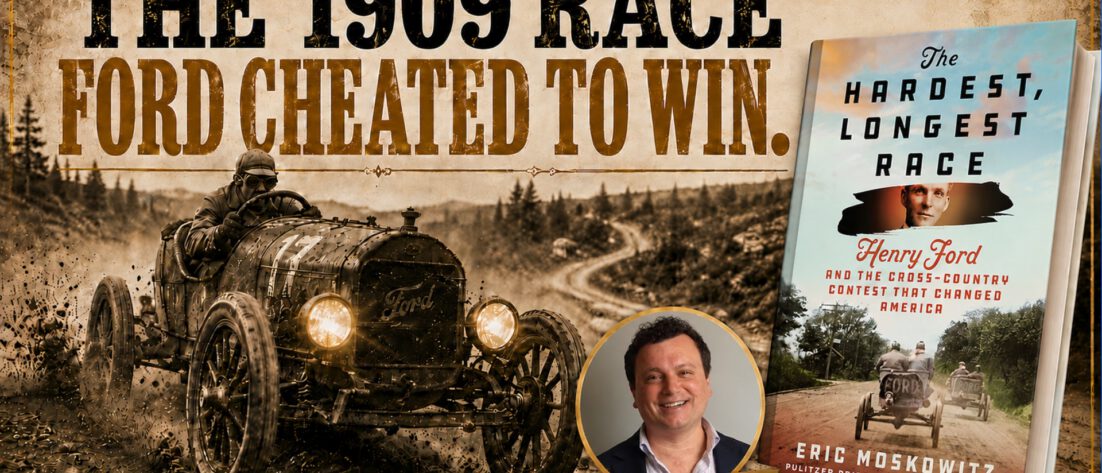
Discover the wild true story of the 1909 transcontinental auto race! Author Eric Moskowitz reveals how Henry Ford cheated to win The Hardest, Longest Race.
Episode Resources:
- “The Hardest, Longest Race” by Eric Moskowitz
- University of Washington’s Alaska-Yukon-Pacific Exposition Collection
- Historical Overview of the 1909 Transcontinental Automobile Race
In 1909, a grueling transcontinental automobile race from New York to Seattle pitted an underdog car maker against a ruthless Henry Ford—and ended in one of the biggest cover-ups in automotive history. In this episode of Books and Looks, Pulitzer Prize-winning author Eric Moskowitz joins the show to unpack the wild true story behind his new book, *The Hardest, Longest Race*. Tune in to discover a hidden chapter of early 20th-century America and learn how cutthroat tactics, rather than superior engineering, helped build the world’s most famous car brand.
As the early American automobile industry was just finding its footing, this 4,106-mile ocean-to-ocean race forced drivers to battle treacherous “gumbo mud,” navigate a roadless country, and rely on explosive acetylene gas headlights. Moskowitz breaks down the bizarre cast of entrants, including a con artist driver, an inventor peddling airless tires, and Ford’s tactical saboteur who literally deployed armed guards at bridges to block competitors. While Henry Ford publicly claimed victory for the Model T to skyrocket his company’s success, you will have to listen to find out exactly how the obscure Shawmut Motor Company exposed the secret mechanical cheating scandal that nearly changed everything.
If you love uncovering the hidden rivalries and forgotten scandals of American history, be sure to subscribe to the podcast and leave a five-star review!
Introduction to The Hardest, Longest Race
Blaine DeSantis: Hi, I’m Blaine DeSantis, and welcome to Books and Looks, where we do a deep dive with authors to help you discover your next great read. America has a love affair with cars, and it dates back to the very first horseless carriage. Today, we’re going back to a time where almost every town had multiple car companies. Hundreds of small businesses were making their own automobiles.
In 1909, in order to showcase all of the U.S. automotive technology, it was decided to have a cross-country race from New York City to Seattle as part of the Alaska-Yukon-Pacific Exposition. Buckle up and come along for a wild ride. Today we’re talking with Pulitzer Prize-winning author Eric Moskowitz about his new book, *The Hardest, Longest Race*. Eric Moskowitz, welcome to Books and Looks.
Eric Moskowitz: My pleasure to be here. Thanks for having me.
Origins of the 1909 Transcontinental Race
Blaine DeSantis: Before we even begin, I’m going to show everybody the book cover. There it is, *The Hardest, Longest Race*. This is one of the great books and one of the great covers. Eric, great work. The title grabs your attention, so tell us, what is this race all about? When did it happen? Give us some of the specifics.
Eric Moskowitz: This is at the dawn of the automobile age. Maybe they would have considered it the adolescence. You’re 13 years past having a working automobile in America. In a very short time, you’ve gone from one in 10,000 people owning an automobile to one in 500. Still pretty rare, but not as rare as it was.
In the summer of June 1909, there was a World’s Fair going on in Seattle. The people organizing the Alaska-Yukon-Pacific Exposition wanted to draw attention to the fair and get tourists to come out. That was a pretty substantial ask given that most of the country lived on the East Coast.
They thought, “What a great idea. What if we have a cross-country auto race from New York City to Seattle where this World’s Fair is?” Everyone would be into the race, they would get attention on the race, and they would also get attention on the terrible condition of America’s roads. There weren’t many roads in many places, and the roads you would find were the roughest possible conditions we could imagine today.
The race went from New York to Seattle with 30 checkpoints along the way, starting June 1st, 1909. The starting gun was fired by Mayor McClellan in front of New York City Hall after getting a signal from President Taft at the White House. He had a special telegraph that sent signals at the same time to New York City and to Seattle, where they opened the fair and started the race at exactly the same moment.
Researching Forgotten Automotive History
Blaine DeSantis: You have uncovered a lot of minute details that I have never seen or heard about. How were you able to discover all this?
Eric Moskowitz: I love research and rabbit holes. I’m a newspaper reporter by training and spent 20 years in newsrooms. No matter what the beat was—covering politics, transportation, or local government—I was often trying to find ways to dig around in the past and find stories that had been overlooked.
I was a history major in college at the University of Pennsylvania, so I was always looking for things like this. This grew out of a story I wrote for The Globe in 2009. I came across this by chance. I know a lot about the history of the Northeast, but I had no idea there was substantial automaking going on in New England and New York at the dawn of the 20th century.
I came across a reference to a little-known company from Stoneham, Massachusetts called the Shawmut Motor Car. Their entry in this 1909 ocean-to-ocean race was sponsored by Robert Guggenheim, a playboy heir to the Guggenheim mining and smelting fortune.
The Shawmut car that nobody had heard of and nobody remembers appeared to finish second in this race. In fact, they’re the rightful winner, but the one that gets all the glory is the Ford Model T. This race was just a few months after Henry Ford launched the Model T. He was looking for a way to get as much publicity as possible, entered this race, and was determined to win by any means necessary.
Blaine DeSantis: This is a very modest man, friends. He has won a Pulitzer Prize. He has put that same level of intensity and research into this book. I read something where you said that without digital, this book might not have been written.
Eric Moskowitz: Exactly. This book would have taken me 50 years and I wouldn’t have gotten anywhere near the level of detail. Every week there would be new materials digitized. Newspapers that you could once only get on microfilm, I would order by interlibrary loan. Anyone who’s ever done research with microfilm knows how tedious it is.
I would sit there in the library, reel by reel, looking for stories, paying for these shipments, and sending them back. Then I would discover weeks later that a paper had become digitized and I could search it from my home office in seconds, finding things I never would have found reading grainy microfilm.
I read tens of thousands of newspaper articles and searched hundreds of digitized publications through Google Books, archive.org, and the Hathi Trust. I reached out to libraries and archives, large and small. Even though Ford cheats to win, the Benson Ford Research Center at The Henry Ford museum has an incredible trove of materials that was a great starting point.
In 1959, at the 50th anniversary of this race, the Ford Motor Company was still trading on their purported victory. They put on a massive caravan where they retraced the route of the race. They got a Model T dressed up like the winning car, a Model K, and a Model A. The 50 millionth Ford happened to be rolled out at that same time. It was a space-age Ford Galaxie because it was 1959.
They put together a whole museum exhibit in a trailer pulled by a Ford truck, stopping in every town of consequence where this race had gone through 50 years earlier. They brought out the old-timers and local mayors, getting keys to the city. They gave out newfangled seat belts to the local police departments and served ice cream.
They were getting the local paper, yet they were not mentioning that even though they appeared to win and got all the glory, they got stripped of the title four months after the race for cheating when no one was looking. Ford was a massive company in 1959 with incredible researchers who gathered a lot of information. They knew what they were gathering, and they also knew what they were leaving out.
That archive exists today at The Henry Ford, and I was able to use that as a starting point. I jumped off in many directions doing genealogical research, digging in every which way, and trying to track down great-grandchildren. For every person who has a set of incredible letters preserved, you have a hundred people who have no idea what you’re talking about. If you like research, it’s exhilarating.
The Yukon Gold Rush and the Seattle World’s Fair
Blaine DeSantis: You mentioned President Taft and the mayor pressing buttons. Taft has Klondike gold and Mayor McClellan has a revolver plated in Klondike gold. What’s going on with all this gold stuff?
Eric Moskowitz: Their fair was themed around the Yukon gold rush and the Klondike gold rush because that is what made Seattle. In the late 19th century, Seattle was a backwater of a couple thousand people. Nobody in the United States had heard of it. Then you had the gold rush in the Yukon.
If you were trying to go out there, you needed supplies. In Canada, the Mounties would not let you come in unless you had months’ worth of supplies and provisions to survive the winter. People got to Seattle thinking they could walk to the gold fields, but they could not. They had to get on a ship to Alaska and then hike in. They stayed in Seattle for months.
Some never even went any further. A whole city basically grew up in service of that. Nordstrom, for example, traces its origins as a Seattle company back to this period. Seattle exploded and became a metropolis, the clearinghouse for the gold, and a shipping port to the West. They held a World’s Fair on the anniversary of the gold rush. That is why Taft pressed a button encrusted with Klondike gold and Mayor McClellan fired that revolver. It’s all very heavy symbolism.
The Skeptical Automakers and the Final Entrants
Blaine DeSantis: At one point they had hoped for a hundred cars in this race. That didn’t quite end up happening. What happened over time?
Eric Moskowitz: You’re exactly right. There were about 250 automakers in America at this moment. That is breathtaking. If you grew up knowing about the Big Three and a few electric automakers, it’s staggering. We know the number because the auto industry was trying to preserve extraordinary tariffs on import cars.
Back in 1908, you had a 45% tariff on automobiles because they counted as metal objects under tariffs written in the 1890s. The auto industry wanted to expand those tariffs to protect domestic production and did substantial surveying. When planning this auto race, Robert Guggenheim thought tons of companies would line up. Because it was tied to the Alaska-Yukon-Pacific Exposition, he thought he would get the best automakers from Europe.
That didn’t happen for reasons they said outwardly and reasons held privately. Outwardly, they were worried that if someone got hurt or killed in a reckless race, it would set back the industry. This was the moment when many state legislatures were first considering speed limits and registration fees. They didn’t want to jeopardize the health of the industry.
Behind the scenes, they were terrified of bad publicity, which is far worse than no publicity at all. There was a famous car called the Thomas Flyer. At the time, the Thomas Flyer was like an automotive celebrity. It tried to go cross-country to chart the course for this race, and what happened to it was staggering.
It took two months to go from New York to Seattle. It didn’t even get there on its own power; it crossed the Cascade Mountains by a freight train. At one point, it got shot at by a farmer who claimed he was aiming for a coyote. They were attacked in a locomotive roundhouse in Wyoming and had all kinds of breakdowns. Other automakers saw this and said, “No, thank you.” As the start of the race got closer, the entry list dropped from 75 to 40, then a dozen. Finally, on the morning of, they only had six entries.
The Unusual Entry of Oscar Stolp
Blaine DeSantis: Six entries, and yet one of them doesn’t even make it to the starting line.
Eric Moskowitz: That is a wild story. The six entries were two Fords. Henry Ford already had two short-lived businesses before the Ford Motor Company was established in 1903. He was less than six years old but already successful. He doubled his odds by entering two of his new Model Ts.
Then you had a little company called Shawmut from Boston. They had nothing to lose because their factory had burned down, so they were entering as a Hail Mary. You had a company from Pennsylvania called the Acme. They were a mid-sized company building great cars, but they had struggled. They believed racing was good for publicity. You had one international entry, an Itala, which was secretly bankrolled by Guggenheim to give the race global sheen.
The last one that didn’t make it was a Stearns car entered by a quirky guy from Brooklyn named Oscar Stolp. The Stearns was one of the prestige automobiles in America, based in Cleveland. They were known for luxury and performance. You pull up in a Stearns and you’re going to impress people. They did not want to enter this race. No good would come of grinding across mountain ranges, mud bogs, and quicksand.
But Oscar Stolp owned a Stearns and had some money from the wire mesh industry. He was an inventor and created an aftermarket suspension that he had patented. He believed if you used Stolp’s patented suspension, you could use airless rubber tires. Pneumatic tires had only been around for two decades. They revolutionized the bicycle and then ended up on the automobile.
They were incredibly expensive and you did not get the life out of pneumatic tires in 1909 that you do today. If you were a regular driver, you were lucky if you got a few thousand miles. In hard conditions, you might get 500 miles out of your tires. They were cumbersome to fix. Oscar Stolp believed if you bought his suspension, you could just slap some thin, airless tires on and you were good to go.
He sent his car to the shop for a tune-up before the race, but when he went to collect it, the car was in pieces. He was convinced this was sabotage because the Stearns Company did not want him to enter. He did not make it to the starting line. He started several days late and didn’t get further than Westchester County. It effectively became a five-car race.
The Acme Motor Car and the Con Artist Driver
Blaine DeSantis: One of those cars is the Acme car. I’m from Reading, Pennsylvania, and the Acme was built in Reading. I don’t know much about the Acme motor car. Tell us about their entry and the controversy about their driver.
Eric Moskowitz: This was one of the pleasures of this research. I also didn’t know anything about the Acme when I started. If you look at the landscape of automakers, out of 250 car makers, about 10 were building 1,000 cars a year. Ford was at the front of the pack, flirting with 10,000.
Then you had several dozen building 100 or more cars. The rest were barely building anything. The Acme was in that second tier. They were building a few hundred cars a year. Their cars were very well regarded but quite expensive. The Ford was not the only affordable car, but cars at this point cost anything from a few hundred dollars up to $10,000.
There is basically a 30X inflation rate, so you’re talking about something costing up to a quarter-million dollars today. The Acme was building expensive cars, but they had trouble in management and ownership. They ended up in receivership and were bought by Herbert Sternbergh, heir to a massive nuts-and-bolts fortune in Reading.
He believed the way to make a name for his car company was to enter races. The Acme was just big enough to have a few dealerships in major cities like New York and San Francisco. In New York, they had a remarkable salesman named Auckland B. Cordner. It’s surprising that his initials were ABC. He didn’t necessarily know cars, but he had a gift for sales from life insurance and mining investments.
Before this race came about, he took a large Acme and introduced it as the millionaire’s Intercity Express, running as a coach daily between the Waldorf Astoria in New York City and the Bellevue-Stratford Hotel in Philadelphia. Today, you get in a coach bus between the two cities and it’s no big deal. That was astonishing in 1909. Nobody climbed into a coach powered by a motor; you went by train.
He grabbed tons of publicity by putting an Acme on this route. When this cross-country race came around, Cordner felt they had to enter. Their crew was mostly people from the Acme factory, but they got a big name as their lead driver: George Saltzman.
If you were reading sporting pages in 1909, you would know the name George Saltzman. He appeared in many races and was the star of the E.R. Thomas Company factory racing team. As far as anyone knew, he still worked for Thomas, but he showed up as the driver of this Acme car. In fact, the guy behind the wheel of that Acme was a con artist.
I determined that he genuinely had the name George Saltzman and knew how to drive, but he was not the famous George Saltzman. He had already run up a massive hotel bill in Philadelphia in the famous man’s name. He caused the bona fide Saltzman a lot of anguish and got into a lot of criminal trouble in the decades to come.
Navigating a Roadless America
Blaine DeSantis: In 1909, there are no superhighways and barely any roads. They had a hard time figuring out how to get there. They were given “Blue Book” directions, which were things like “go over the tracks, turn at the church.” How hard was that to manage?
Eric Moskowitz: The Blue Book was basically worthless. If you were going between cities in the East, it started as a fairly good guide because they took so long to produce it. In the beginning, you had careful lines like “go 0.6 miles here, then turn right.” Very quickly, it became a word salad with no mileage markers.
There were no road signs anywhere. It made sense to give landmarks like the yellow farmhouse or where the road forks by the big maple tree, but if this wasn’t your hometown, good luck. If you made one wrong turn, the rest of it didn’t make sense. Every crew ended up taking on local guides they referred to as pilots.
The car had to be driven continually from New York to Seattle. The crew had to be continuous; if you were a driver taking turns, you had to be in that car as it was moving all along the way. You stopped at checkpoints to prove you were part of the crew. But you could pick up someone to hop in an extra seat for 100 miles who knew the way.
This is where Ford had a massive advantage. For 1909, they already had a considerable burgeoning dealership network. None of the other cars in the race had this. Everyone else was going on an ad hoc basis.
The Perils of Gumbo Mud
Blaine DeSantis: Once you get west of St. Louis, there are no roads. They had something called gumbo mud. Explain all this to us.
Eric Moskowitz: Living in the East, gumbo mud was not something I had heard of. I did not realize that all mud is not created equal. If you have the clay soil in the Midwest, it is very hard when dry. You add water and it turns into a gelatinous goop that clings to everything. It clings to itself and everything it touches.
One writer at the time said gumbo mud clings tighter than a long-lost brother. There was a group of women driving across country around the same time as a promotion for the Maxwell car company. Their lead driver was a woman named Alice Ramsey, a famed chauffeuse from New Jersey. She likened gumbo to mucilage.
They were driving through Kansas in a dry climate where you could usually do well because it is open and flat. But biblical downpours greeted them in Kansas. It was an excruciating journey for these crews, grinding with mud up to the hubs weighing them down.
Acetylene Lights and Mechanical Endurance
Blaine DeSantis: My favorite movie is *My Cousin Vinny*, and when you’re stuck in the mud, nothing moves. It has to be the same for the gumbo mud.
Eric Moskowitz: The course for this race was 4,106 miles between New York and Seattle. That is not a straight line. If you plot this in Google Maps today, it’s like 2,850 miles of interstate driving. The reason they went that far was because there were no good roads.
Additionally, Robert Guggenheim had an uncle who was a senator in Colorado who believed the country should have better roads. They wanted to route the race through Denver, which meant they went through Kansas instead of Iowa and Nebraska. They had it in their heads that Kansas didn’t have quite the gumbo mud that Iowa had. They found out they were wrong.
Blaine DeSantis: One day the Fords are leading, the next day the Shawmut is leading. There were 30 or 36 checkpoints. This is what got me intrigued: Ford had a nationwide distribution network of dealers and repair shops. They could get parts to you that went bad.
Eric Moskowitz: Nobody could touch the network Ford had. They had about 850 dealers. It’s nothing like what they would have in a few years when there were thousands of dealers selling millions of Model Ts, but it was still significant.
When I say dealer, imagine a guy who runs a hardware store who buys one car and likes it. He decides to do a little business on the side and might sell two or three cars a year, taking a horse in trade. In many cases, these early Ford dealers were local. Ford also had branch stores, which were direct-to-consumer stores like an Apple Store today.
Ford had these in the big cities, doing the bulk of their sales in the East, but they had two in the West: one in Denver and one in Seattle. Any of these local dealers were getting their wholesale cars through the branch managers. If you were the Denver branch manager, you were in charge of Ford sales from Texas to Wyoming.
You had a network of people you could call on to be local guides. You could also place parts with them in case they were needed for these cars. They were invested financially and were waiting to hand a Ford over to victory. None of the other cars had this.
Blaine DeSantis: They should have given the other cars a week’s advanced start because they couldn’t keep up. One of the most amazing things I read was that they drove at night. There are no streetlights out West. You have gumbo mud and rain, but you have to have headlights. How did they get the headlights to work?
Eric Moskowitz: I am not a mechanical person. I’m lucky if I can get the hood to pop open. I have taken for granted that you have headlights that work with a flick of a switch. These car headlights were gas-powered. These were not filament light bulbs; they were fueled by acetylene.
Imagine you have a gas tank roughly the size of a fire extinguisher on the running boards. That was connected by tubing to mirrored lanterns mounted on the front. You would turn on the gas, open the front of the headlights, and strike a match. Voila, your headlamp was lit. You had to do this every time.
They were reasonably powerful and certainly more resilient than the filament bulbs of the day, but there were no streetlights. If it was raining, the water droplets were like fireflies pelting you in the face. There were no tops on these cars and no windshields. If you had a windshield in this time, it was a danger because you didn’t have tempered glass. If you got into a crash, shards would fly. You were basically riding on a lawnmower with gas-powered headlights.
Charlie Hendy and Tactical Sabotage
Blaine DeSantis: Despite that, these cars were going through thick and thin. It seems as if a lot of strange things happened to the Shawmut car, including a bridge incident. There was a guy named Charlie Hendy who seemed to have a lot of involvement. Tell us about this.
Eric Moskowitz: Put yourself in the Shawmut crew’s shoes. Everyone had written them off because their factory burned down. What were they going to do if they needed spare parts? There were no Shawmut dealerships lined up across the country to help them. Yet they were still in the thick of it, trading the lead in a dogfight with the two Fords.
Charlie Hendy was Ford’s fixer. He was the Denver branch manager and was very much a Ford figure. He had a real knack for PR and was incredibly shrewd. He had a foot in the Old West and the New West. He was 33, dashing, and a graduate of the University of Nebraska. His dad was a pensioned Indian fighter who was a close personal friend of Buffalo Bill Cody.
Hendy grew up comfortably in North Platte, Nebraska, which was an important railroad town. When this race came along, he was everywhere. He wasn’t just lining up guides; he was getting on trains to hopscotch the cars, talking to the press in every town, and making sure everybody was in place at the right moment. He was also doing everything in his power to thwart the Shawmut.
Imagine this scene: you’re in the middle of nowhere in southern Wyoming at a place called Fort Steele along the North Platte River. There was a railroad bridge built by the Union Pacific and a rinky-dink wagon bridge that got washed out in a spring flood. No cars were coming through. The nearest town was Rawlins, several miles west.
The few cars that did come by knew they could drive over the railroad bridge if no train was coming. The local Union Pacific representative allowed it. Shawmut had a lead coming into Fort Steele and expected to drive across. Charlie Hendy was waiting for them with an armed guard.
They were told they could not cross unless they had express written permission from corporate headquarters in Omaha. The sun was setting and it was the end of the business day. They wired for permission, and it took them all night into the next day to get it. Meanwhile, the Fords came up behind them. Hendy had secured the permits for them to cross, so they went right across. Earl Chapin, the Shawmut mechanic, wrote home that they “put the game on us.”
Blaine DeSantis: Earl Chapin even said that Henry Ford was a “shitheel.”
Eric Moskowitz: I think Chapin said that with a wink. He was a very charming and chatty human being. He was very clear that he did not care for Henry Ford or Charlie Hendy. Interestingly, later on, he did sell some Model Ts. I think he distinguished between the quality of the automobile and the character of the person.
The Quack Medicine of the Automotive Age
Blaine DeSantis: You got all these letters that he sent back to his wife. Tell me about auto-intoxication. What is that?
Eric Moskowitz: One of the characters in the book gets diagnosed with auto-intoxication and has to leave the race. I saw the doctor’s note that caused him to drop out. There was an illness of the day called “automobile face” or “auto face.” There was a feeling that human beings were not meant to move this fast on a rattling contraption and that it could cause a recognizable condition in your face.
What I came to find is that at this moment in history, there was a lot of quack medicine. “Auto-intoxication,” despite all that was being written about “auto face,” was a theory that the body was prone to poisoning itself. The way you would cure yourself was with a good old-fashioned colon cleanse. It was the Kellogg school of thought from the Battle Creek Sanitarium. It had nothing to do with automobiles.
The Disqualified Winner and the Guggenheim Cup
Blaine DeSantis: There’s a big lie associated with this race. Tell us about who wins, who loses, and how that winner managed to win.
Eric Moskowitz: Anyone who Googles the race can see that Ford crosses the finish line first, but they are not the rightful winner. That is because they violated the rules. It took months to adjudicate this. Ford got massive publicity when the lead Model T came into Seattle. 100,000 people lined up to greet them, and there were headlines around the world.
The Shawmut slinks in the next morning with a couple of security guards at the closed fairgrounds. Yet, after gathering evidence, they were able to prove that Ford had violated the terms of the rules. I started out knowing this, and that’s what made it interesting.
In 2009, I happened to get on a listserv for the town of Stoneham. I saw a select board agenda item honoring the forgotten Shawmut Motor Company as the rightful winner of the 1909 Ocean-to-Ocean race for the Guggenheim Cup that Ford cheated to win. I wrote a story for the Globe at the time. A large number of Model T enthusiasts were driving cross-country for the 100th anniversary to retrace the race. They had reached out to the town of Stoneham and connected with the descendants of Arthur Pettengill, the lead driver for Shawmut. I wrote that story and held onto it for many years before returning to it as a book.
Conclusion and Future Projects
Blaine DeSantis: It all had to do with an illegal part being put back in the car. Eric, this book is filled with details and minuscule facts. It’s about a race, yet it’s about America in 1909. Eric has opened my eyes, and I think it’ll open yours. Thank you so much for joining us today on Books and Looks. Do you have anything coming next in the pipeline?
Eric Moskowitz: My wife is very glad that I’m done with this book. It’s been quite a journey. I have a new day job as a staff writer at Harvard writing news and feature stories. It’s a great environment. I’m looking forward to sharing my book with people in person. I am always on the lookout for good stories from the past, so I have a couple of ideas in my back pocket.
Blaine DeSantis: Well, everybody, I hope you had a good time on our cross-country journey from New York to Seattle. This is a great book to help understand what America was like in 1909. On behalf of all of us here at Books and Looks and our friends at BookTrib.com, this is Blaine DeSantis saying may all your leaves be pages in a book.