

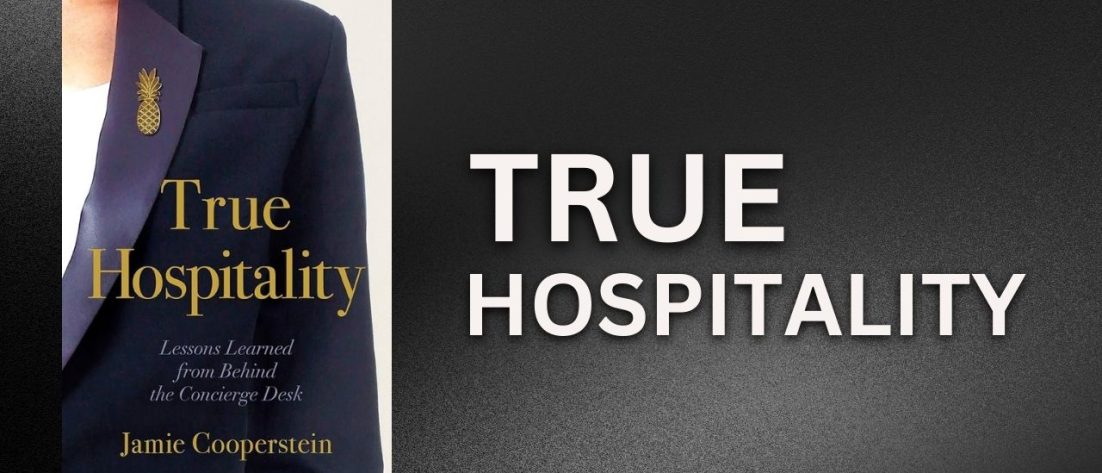
From choosing steak knives for celebrities to outsmarting dawn trash room inspectors, Jamie Cooperstein reveals how rejection from sports broadcasting (“your voice is too local”) led her to discover her true calling behind luxury concierge desks. In her memoir “True Hospitality,” Cooperstein shares how a decade serving Philadelphia’s elite transformed her understanding of human connection and the psychological art of exceptional service. Listen as we uncover why sometimes the uniform we never planned to wear fits us perfectly.
Links:
Transcript
Blaine DeSantis:
[0:00] Hi, everybody. This is Blaine DeSantis, and I welcome you to another edition of Books and Looks. Yes, it’s our weekly views in the wonderful world of books. History, mystery, fiction, and nonfiction, the best that I’ve been reading, brought to you each and every week, along with exclusive, and I do mean as exclusive, author interviews. You can only find it right here. That’s right, right here at Books and Looks. And let’s not forget our good friends over at booktrib.com. I was just looking at that site the other day. So many things, so many books they review and then suggestions for book clubs. And if you’re looking at business books, finance books, this book, that book, they got it all. Anything book is just going to be at booktrib.com. Now, friends, before we start our interview today, I want to talk to you a minute. We have started a website. It’s called booksandlookspodcast.com. Please, please visit that website. I’m asking of that because you know what? We have got a blog there. I put a blog up. I have a newsletter. And even when you’re going just to YouTube or to podcast, please like it, please subscribe, and please share because that’s how I know that you are enjoying it. Do that for me because I’m reading these books. I’m bringing you the best that I can find because, you know, I got to be honest with you. You’re not going to find a lot of these books other places. You know.
Blaine DeSantis:
[1:17] “Custodians of Wonder,” “Sister and Sinner,” how about “The Ride by Paul Revere” last year, you know, “The History of the World in 10 Shipwrecks,” my friend Page McClanahan with “The New Tourism,” these are stuff you’re only going to find here. So all I ask from you is this: go to booksandlookspodcast.com, look at it. If you feel like you want to subscribe to the newsletter, I got a May newsletter that’s going to be coming out in the next couple days. We’ve got that, we’ve got the blog which I start trying to update maybe once a week. And let us know how much you appreciate all we do here, not just me, but my son Nathaniel and the producer, Podcast Studio S. Let us all know that you really like what we’re doing here because we’re doing it all for you. So anyway, I’m Blaine DeSantis. This is Books and Looks. And today we’re talking to Jamie Cooperstein about her new book, her memoir, True Hospitality. Jamie Cooperstein, welcome to Books and Looks.
Jamie Cooperstein:
[2:15] Thanks, Blaine. I am so excited to be with you today.
Blaine DeSantis:
[2:18] Well, I’m very happy to have you here talking about your memoir. You’re almost too young to have a memoir. You look like you should still be in college. My word.
Jamie Cooperstein:
[2:30] And the memoir starts out when I’m age 22. So, yes, and it was a long time ago. Hard to believe I know.
Blaine DeSantis:
[2:37] Wow. Well, anyway, you know, your career amazed me when I was reading this book because you wanted to be like a sportscaster, a sports announcer, you know, and all of a sudden you become a concierge. You got into hospitality. How did that, what made you realize you should go into that? And how did that all come about?
Jamie Cooperstein:
[3:00] So I had thrown all of my eggs in one basket, really thinking that I wanted to be a sports journalist and specifically a sports broadcaster. I wanted to be on ESPN and I didn’t know what to do next. And I turned to my mom for advice and she actually shocked me with her advice. And she said, why don’t you have a conversation with your cousin, Jeff? He works at the Rittenhouse Hotel in Philadelphia. He’s had a wonderful career there and he always is sharing the most fascinating stories about the people he is helping, you know, day in and day out. And I said to my mom, “Mm-hmm. I’ve never even stepped foot in the Rittenhouse Hotel. That’s, you know, such an outlandish idea, but okay, I’ll give him a call.”
Jamie Cooperstein:
[3:44] And lo and behold, on this call with my cousin, he really sold me on this concept of kind of the magical world of hospitality. And he was able to promise me just an interview. I had to be the one to kind of get the job, so to speak. So I went into the interview at the Rittenhouse. I met with the director of front office. And I knew that if I blew this interview, this was my only chance ever at a job in luxury hospitality, you know, at the young age of 22. And I was given the job as a concierge and it changed my life. And pretty quickly, pretty quickly, I realized that this was not just a job, that this was going to be a complete career shift for me. And it just suited my personality so well. And the things that I loved about journalism, which was being able to be kind of innately curious and asking those who, what, when, where, why questions, I was able to do the same as a concierge to really find out exactly the needs of a guest. And I also the curiosity piece of getting to be an ambassador for a city where I was constantly, you know, the city was ever changing. And that was so exciting to get to constantly figure out what was new and wonderful in Philadelphia.
Blaine DeSantis:
[5:08] One of the things that you mentioned, I really got a kick out of this. You wanted to go into broadcasting, and they said, give us a demo tape. And you did. And the response was, you’re too local. What the devil does that mean, you’re too local? I mean, I don’t get it.
Jamie Cooperstein:
[5:29] So, it means a few things. And I don’t think that that would ever be told to somebody in 2025. Again, this was a long time ago. And I think the concept of an internship supervisor being supportive and being a mentor and, you know, the concept of emotional intelligence, those things were not nearly as prevalent back then. But, you know, in my case, being too local, It meant two different things. I really wanted to pursue a career on air where a national audience would be tuning in. And I believe in order to have success as a broadcaster kind of in a national market, you can’t have local appeal or sound like you’re from one particular region. And I happen to be from Delaware County in Pennsylvania. And those of us that are from Delco, as it’s so commonly referred to, there is a certain way you speak. And I’m sure that 22-year-old Jamie had much more Delco to her voice than 43-year-old Jamie today. And this particular producer gave it to me straight.
Blaine DeSantis:
[6:43] I don’t hear anything. Of course, I’m from Reading, so I don’t hear anything. Delco, Montco, Berks Co., whatever it is. No, I don’t hear anything.
Jamie Cooperstein:
[6:50] And the other thing, Blaine, is that now, today, I would not have given that comment any, I wouldn’t have had a reaction. I would have had the confidence to say, that’s your opinion. But back, you know, 22-year-old Jamie, I was so impressionable that that comment, that really changed everything for me.
Blaine DeSantis:
[7:14] Well, along the way, you worked for some Philadelphia sports teams. You worked with the Flyers and you worked with the Phillies. Tell us just a little bit about what you did with the Flyers and the prestigious, which I think, job of the Phillies.
Jamie Cooperstein:
[7:29] Sure. So, and it wasn’t mentioned in the book, Blaine, but I actually have worked for all four Philadelphia professional sports teams, either in a full-time job capacity, part-time job, or in an internship setting. So yeah, I literally, the Flyers, the Sixers, the Eagles, and the Phillies, I’ve worked for all four teams. You are correct, though, being a Philadelphia Phillies ball girl, that was by far my favorite job of all of the jobs I’ve had for sports teams. And to be honest, I mean, it sounds so glamorous working in sports. The Phillies ballgirl job was probably the only one that was truly glamorous. That was amazing. And I got to sit in left field. I worked about 30 home games a season. And I was the ballgirl in the first two years of our new ballpark, Citizens Bank Park. In 2004 and 2005. Sadly, the Phillies were not good back then, but it was still a very exciting time and something I’m really proud of.
Blaine DeSantis:
[8:34] Good. Good. Well, you say work with the Flyers. Let me say this. Let’s go Flyers and let’s go Dornhoefer. You remember that statement?
Jamie Cooperstein:
[8:43] Yes.
Blaine DeSantis:
[8:43] Gene Hart used to say that before every time. Let’s go Flyers and let’s go Dornhoefer. You were selling those ticket packages or something like that at the mall, if I’m not mistaken.
Jamie Cooperstein:
[8:54] Yeah, that was crazy. You know, you sign up for a job thinking it’s one thing. And then the next thing they know, they say, head in your car and head to the King of Prussia mall. We’re going to have a seasonal kiosk and you’re going to be selling Santa sacks. So yeah, that was when I never saw coming that I would have a retail job at the mall, but thinking I was working for the Flyers.
Blaine DeSantis:
[9:16] Yeah. Well, they push them hard on the Flyers broadcast now. I mean, the poor guy who’s the analyst is always pushing for your packs and this and that and everything else. So yeah, quite a thing. Anyway, you know, we now you get this job at the Rittenhouse. And one of the things that you find is there’s a delicate balance between being friendly and becoming friends with the people who were there. Talk to us a bit about that and that boundary that exists.
Jamie Cooperstein:
[9:42] Yeah, so it’s a really delicate balance. And obviously, you’re encouraged to be extremely friendly with everybody. But yeah, you cannot cross over the line of being friends. And there was numerous instances for me where I did feel like I was possibly crossing over that boundary. And probably the best example or scenario I can give is I started about a year or two into my tenure at Two Liberty Place, the residential property I worked at, I started facilitating book club for a group of seven or eight women. And the book club started out taking place in the media room on our amenities floor, but very quickly it evolved to the location of different women in the book club hosting it in their homes. And they would serve wine and they would have cheese and crackers and you’d take off your shoes because that was kind of what their preference was for their home. And you.
Jamie Cooperstein:
[10:45] Next thing I knew, I found myself, although I was still Jamie the concierge, I was also Jamie part of book club, sipping wine, having cheese and crackers, you know, in Marsha’s home, in Susan’s home, in Beverly’s home. So, you know, it was a delicate dance. It was some of my favorite memories of being a residential concierge was facilitating the book clubs for those women. But that is definitely when I started to realize I think I’m becoming one of them. And maybe my tenure as a concierge is coming to an end.
Blaine DeSantis:
[11:22] Okay, that’s very interesting. One of the things you bring up in your book is the fact that when you were at the Rittenhouse, which friends is a five star plus hotel plus plus plus if you ask me, when you were working there you had weddings. And for every person who comes that wedding is special, but for you and your staff, it was the same old same old basic stuff. That’s got to be hard after a while to keep that enthusiasm level up, not just for you but for everybody.
Jamie Cooperstein:
[11:56] It was a bit of Groundhog’s Day in many ways but specifically with weddings. And you had to keep a poker face and certainly never, never ever a million years let that bride and groom know that they were, you know, the third bride and groom you were seeing just that weekend, right? You had to make them feel like they were the only bride and groom you’ve ever rolled the red carpet out for before. So yeah, it was challenging at times to, you know, always be a 10 out of 10, but yeah, I feel like every day you did have to come in with new energy and, and focus and just say, what magic am I going to be able to create today? Am I going to, how am I going to be able to put smiles on people’s faces. And I think for the most part, being a concierge did allow me to leave work at work. So the good news is when I left at the end of my shift and went home, whether it was going out socializing with my colleagues or, you know, doing something with other friends or just going home and reading a book, watching a movie, I was able to not think about work. And that allowed me to kind of have a reset. So then when I would come in the next day for the start of my shift. I was fresh. I was excited and ready to, you know, be the best version of myself.
Blaine DeSantis:
[13:19] Now your shift, what shift did you have?
Jamie Cooperstein:
[13:22] So at the onset, I would work frequently the mid shift as I was training, which meant that I was always overlapping with somebody more seasoned that was coming on in the morning or somebody that would be arriving in the evening. But as I became more capable and as my preference, I’m a morning person. So my preference was that I would prefer to work the 7am to 3pm shift. So I kind of moved into that shift. My least favorite by far was the 3 to 11pm shift.
Blaine DeSantis:
[13:59] I can understand. Hey, did they give you a, did they give you a lunch hour? Do they give you a time off? You’re off your feet a little bit on that seven to three shift?
Jamie Cooperstein:
[14:06] So regardless of what shift you worked, Blaine, you certainly were given a 30-minute lunch break. One little known fact in the hotel business is that the employee cafeteria is staffed by a chef that works on the culinary team. So they are literally cooking a hot lunch for the staff. And sometimes when there’s been catered functions in-house that day, any leftovers, like great pastries from a morning breakfast, they’re always brought into the break room. So if you time it right, you can be dining as if you are the guest and not just a staff member. But the key, Blaine, is that because things are ever moving in hospitality, there would be times where you would go take a break and then your supervisor would call you back mid break because it was too busy. So you kind of had to be adaptable. And it wasn’t always like a leisurely 30 minute break.
Blaine DeSantis:
[15:08] I understand that. Now you initially say you were intimidated a little bit by all this luxury at the Rittenhouse. How do you overcome that? How long does it take to get “Oh, this is the usual. This is the norm.”
Jamie Cooperstein:
[15:21] So I think for me, the shift and my comfort actually happened very, very quickly. And just as a reminder, I was, you know, 22 and I was the person that was excited to go have a meal at Ruby Tuesdays. Like that was a highlight for me with my friends. I didn’t know anything about luxury, but I have a very fond memory. It was actually on a date where I was invited to go to a restaurant called Striped Bass in Philadelphia. It doesn’t exist anymore. But at the time, it was considered the most luxurious and nicest fish and seafood restaurant in Philadelphia. And then that same evening, we went to the orchestra. And that was an itinerary that never in my wildest dreams would I have been doing in my past life, nor would I have enjoyed it. And now only like a year, year and a half into my tenure at the Rittenhouse, I was loving it. I loved that experience at Stripe Bass. I loved going to the orchestra at the Kimmel Center in Verizon Hall. So it happened, the evolution happened really, really quickly. Like fundamentally, I was still the same person, but the exposure I was having, especially to all of the comps that I was experiencing as a concierge, yes, I started enjoying all of these, the finer things in life.
Blaine DeSantis:
[16:44] Good. Good for you. Now you have, you talk about several moments where you have both tragedy and celebration in residents’ life. How does this shape your understanding, and how do you get to go from the highs and the lows?
Jamie Cooperstein:
[16:59] So it was pretty profound getting to experience these kind of intimate moments in people’s lives, especially at such a young age. And the tragedy that you’re referring to experiencing and being part of a few residents passing away, residents that I had gotten to know very well was challenging, especially I was very, very fortunate that up until that point of my life, I had not, touch wood, experienced really any great loss myself, you know, in my family. So I did not really have any experience on grieving or how to address somebody when they were grieving. So I did have to learn kind of on the job very quickly, the art of empathy, putting yourself in somebody’s shoes, even if you could not fully relate to it yourself.
Jamie Cooperstein:
[18:01] And it was interesting. And I think another thing for certain that I realized was that true hospitality was more than just securing tickets for somebody or booking a limousine or getting flowers for somebody’s anniversary. True hospitality was also found in just a gesture that you might be making or a handwritten note to express sympathy. So those were things I was not expecting when I took the residential position. But I am grateful, grateful that I had an opportunity to switch over in hindsight to be a residential concierge because I don’t I don’t believe I would have really experienced those things in a hotel setting. And it really, I grew up because of it.
Blaine DeSantis:
[18:53] Yeah. Wow. Well, now that’s interesting. How long were you in the hotel industry until you switched to the residential concierge industry?
Jamie Cooperstein:
[19:03] So I was at the Rittenhouse for just shy of three years. And then I was at the residences at Two Liberty Place for seven years. So I was in a residential capacity longer.
Blaine DeSantis:
[19:17] You know, during your career, you had a chance to meet a lot of celebrities, a lot of sports people. Was there anyone in particular that stood out and was the essence of true hospitality?
Jamie Cooperstein:
[19:29] So I loved meeting celebrities. And unlike what, you know, most people might suspect, they’re just everyday people, right? And the things that they are doing while staying at your hotel, for the most part, are everyday things, right? So yeah, yes, occasionally there’s a professional basketball team, and that’s not an everyday thing, right? Going and playing a professional sport, or occasionally there’s a rock star going to perform at the Wells Fargo Center that evening. But other than that, it’s mostly people coming to do everyday things. And let me give you an example that was one of my more favorite interactions.
Jamie Cooperstein:
[20:10] So actor Dean Cain, who I had a big, big crush on in high school, and I would watch the Adventures of Lois and Clark, the Adventures of Superman on television all the time. And apparently he graduated from Princeton University, and he was staying at the Rittenhouse Hotel on one particular occasion to go to his reunion at Princeton. And the Rittenhouse Hotel was, you know only about an hour’s drive away from his university and he came up to the desk looking for rental car assistance. He needed my help securing a rental car for him and it was an unbelievable reminder of here is a celebrity standing before me. I’m blushing but he’s just an everyday person needing everyday assistance with a rental car. I had to get it together quickly, you know, ask him for his ID as if I didn’t know who he was and go in the back and, you know, fax in his application to Hertz rental car, get him to sign on the dotted line. And next thing we knew, you know, his requested car was pulling around into the front drive. But it was a great example that you don’t treat the celebrity any different. They’re just like you and I. And the request that they have is exactly the type of request that you and I would have as well.
Blaine DeSantis:
[21:31] I think you also have an instance in there where Hank Baskett came in with his wife, who was a Playboy playmate at one time, and you found out she’s just like everybody else.
Jamie Cooperstein:
[21:40] Exactly. And they they lived at the residences at Two Liberty Place. So I got to have numerous interactions with them and build rapport over the time that they were in residence. And absolutely, you know, who somebody might be right in their movie or their television show or in the media, who you’re perceiving them to be is often completely opposite to who they are in real life. Right. Yes, it was it was quite the wake up call to realize that they’re playing a role.
Blaine DeSantis:
[22:16] Well, let me ask you this question. I just just came to me now. If you had to define true hospitality, what would it be?
Jamie Cooperstein:
[22:24] So true hospitality to me is effortlessly forging an emotional connection with whoever it is that you’re serving. So trying very hard to not make it feel like a transaction, but instead really focused on the connection that you’re making with somebody.
Blaine DeSantis:
[22:43] Okay. Wow. How long, you said you worked in the Rittenhouse for three years, to Liberty for seven. Now, then you left the concierge and hospitality business altogether at that time?
Jamie Cooperstein:
[22:55] So I left being a concierge to start my own consulting business focused on helping companies and their employees making great first impressions, but pulling from all of my experience serving customers and best practices that I’ve learned over that decade.
Blaine DeSantis:
[23:15] Okay. So you’ve been doing that for how long?
Jamie Cooperstein:
[23:18] So I’ve been doing that now for 10 years. So I was a concierge for 10 years, and I am just starting my 11th year of being in business for myself.
Blaine DeSantis:
[23:26] Very good. Very good. And my understanding is you go around the country giving seminars and helping people learn how to do this. Am I not mistaken?
Jamie Cooperstein:
[23:34] Yes. So Blaine, the good news is in the greater Philadelphia area where I live, it’s a big city and there’s a lot of business to be had pretty close to home. So I try whenever possible to focus my efforts on helping businesses in the greater Philadelphia area and just kind of the local region. So I’m not having to be a jet setter every single week, but I do also love getting to go to conferences and hopping on a plane and making an impact that way. I would say when my daughter gets a little bit older, my desire will be to do more of that. But for now, there is just so much work in Philadelphia. And because it’s my hometown and I’m so proud and I still feel like I get to be an ambassador for my great city, it’s fun to help make a difference locally as well.
Blaine DeSantis:
[24:25] Right. Well, now, one of the things you have, you give this luxury service, but you can have difficult individuals, people who no matter how nice you are they’re going to be Oscar the Grouch. That must be hard and how do you handle things like that?
Jamie Cooperstein:
[24:37] So it is the hardest part of the job in customer service is when you have somebody that has big feelings, right, whether they’re disappointed, they’re sad, they’re mad, they’re frustrated, or maybe they’re just to have a difficult personality. And one of the things I had to learn really quickly was, is unlike in a hotel setting where a problem guest will eventually check out and you can kind of go wash your hands of them, in a residential setting, they’re not going anywhere. Right. So you really, really need some best practices in order to remain calm yourself and find ways to continue to engage them and almost look at it as a challenge. Like, how can I be one step ahead of Mr. Wilson today, et cetera? And one of the-
Blaine DeSantis:
[25:32] You almost have to anticipate their needs.
Jamie Cooperstein:
[25:38] Exactly, Blaine. Exactly. To me, I looked at it as a game. Like, there was a particular resident that every morning their first stop was to their trash room, and maybe they really were taking trash out. I believe that they were not always taking trash out. I actually believe that they were stopping there to inspect and then giving us a report on the cleanliness of the trash room. So it became a game. And in this particular instance, that resident will say that they lived on the 43rd floor. So what I mean by looking at it as a game is we would sometimes change our behavioral patterns to play the game as well and beat them at their own game. So where we might have started our inspections on the 40th floor, which was our lowest floor, and then working up, we knew that that particular resident checked first thing and we knew exactly what time he was checking it. So we switched things up and we would start our checks on the 43rd floor and then we would go back to 40 and finish up the rounds. But yeah, sometimes you have to completely be adaptable to change up procedures to make that resident or that customer know that you are trying to make them feel like they’re your only person in the community and it’s not just a one-size-fits-all approach.
Blaine DeSantis:
[27:03] Well, you know, since you started from then till the 10 years and that and even now there have been huge changes in the hospitality business and the industry. And now with these things, cell phones… Do they still require as much attention, the clients, as they used to?
Jamie Cooperstein:
[27:21] So I am so glad that my time as a concierge was in a high-touch era. I actually think that I would have not enjoyed the job nearly as much in this high-tech world that we’re living in. I think the shift, frankly, would have gone a lot slower because you’re right. I think there would not have been nearly as much demand for my services. Yes, people can use the internet and their phone and an app to gather data, but it will never replace the human elements of a concierge. And let me give you an example, okay? So Blaine, you can absolutely pull out your phone right now and make a dinner reservation in whatever city you are going to travel to this summer, okay? But what you can’t gather in that attempt to make a dinner reservation on your phone through an app is you don’t know where the best seat is in that restaurant. You don’t know what their top dish is.
Jamie Cooperstein:
[28:30] You know, if it’s Barkley Prime Steakhouse in Philadelphia, you will not be told about the nuance of that you’re going to get to choose your own steak knife for the meal from a box of five steak knives. So all of those kind of fun extras, those wow factor, that does not come from your app. So for those that are really still looking for that high touch, you need to use the concierge. You need to interact with somebody. And then the last thing I’ll say, though, in today in 2025 in an effort to still really make sure you’re giving five diamonds service and true hospitality. Giving people a choice is critical. So I am not opposed to high tech and allowing somebody to avoid human contact. The key is to give the customer a choice. So as long as you’re saying you can choose, let’s say at a hotel, a keyless entry and bypassing the front desk versus having a human connection, that’s okay as long as the guest gets to choose which path they prefer.
Blaine DeSantis:
[29:43] I’ve never had anybody give me a knife, a box with five knives in it. That’s wonderful. I can choose my knife. Wow. Very good. Hey, one of the things I found fascinating is that you realized, and you started the idea of everybody wearing uniforms and how uniforms actually unified you guys. Tell us a little bit about that.
Jamie Cooperstein:
[30:05] Yeah. So the uniform served quite a few purposes for me back at the very, very, very beginning of my time at the Rittenhouse. I had no confidence. I was very nervous. I was anxious about serving in this really highly coveted role. And my uniform is what gave me confidence. It allowed me to kind of fake it till I made it, so to speak. And 22-year-old Jamie, without a uniform, there is no way I would have had.
Jamie Cooperstein:
[30:40] My chin up and making good eye contact and really winning over guests at the hotel. I needed my uniform. The other thing people forget about when it comes to uniforms, and I’m always scratching my head when you hear a company allows employees to choose their uniform and choose what they want to wear in a customer-facing role, is it forgets about the importance of equity. And what I mean by that is everybody comes from a different background and different means. And you don’t know what type of wardrobe somebody has in their closet at home. If they even own a suit, do they have the money to buy a suit, right? So giving out a uniform literally brought us all united as you spoke. And it did not matter what your background was anymore. It solidified that we were all working together and we were all on one team and representing the brand that was on our uniform, that was on the logo.
Blaine DeSantis:
[31:41] Now, was this at both the Rittenhouse and at Two Liberty or just at one location?
Jamie Cooperstein:
[31:45] So at both locations, we absolutely had uniforms. We had lovely uniforms. I did not get to choose the uniform at the Rittenhouse. That was just assigned to me. But at the residences at Two Liberty Place because I had a leadership role. And because I was there kind of almost in a project management capacity before people even moved in, I got to help come up with the uniform. And that was really exciting to choose what our kind of our brand identity was going to look like.
Blaine DeSantis:
[32:17] Well, that’s great. Friends, I forgot to do this. Here’s your book. I forgot to bring this up here. True Hospitality. Yeah. And there’s that little, I was talking to Jamie, there’s that little pineapple up there, the symbol, I think, of hospitality. How did that come about? Why did you decide to put that on your book cover?
Jamie Cooperstein:
[32:37] So a pineapple is the symbol of hospitality. It dates back hundreds and hundreds of years to the West Indies and it being a pineapple being considered a symbol of luxury and welcome and welcoming gesture. And a pineapple literally was given to dignitaries as a way to welcome them home. So that is why you see a pineapple frequently on the lapel of customer facing folks at certain businesses or it might be in the logo of certain hospitality organizations. I knew that I wanted to include a pineapple in some capacity in the book. I didn’t want it to be overwhelming and obvious. I wanted it to be kind of a subtle, you know, paying homage to the industry. So in addition to it being on the lapel, on the jacket, uniform, on the cover, it’s also found in the book on the various kind of chapter headers. And I’m really, really happy with how it came out.
Blaine DeSantis:
[33:42] Do a lot of people still use that on their lapels or their uniforms? You still see a lot of that in the industry?
Jamie Cooperstein:
[33:49] I see a ton of it. Just a quick example, the most recent example that I’ve seen is my alma mater where I got my master’s degree, Temple University here in Philadelphia. It’s the end of the semester and they’re honoring seniors that are about to graduate and leave the program. And I was watching that they actually give a pineapple lapel pin from the School of Tourism and Hospitality Management to all of those graduating seniors embarking on their career in hospitality, reminding them the power and the symbol of a pineapple.
Blaine DeSantis:
[34:27] Well, that’s wonderful. That’s great. We come in as guests and we don’t get to see what the other side of the desk is like, whether it be the front desk or the concierge desk. And all of you have got issues of yourself. All of you are trying to do the best for all of us. And so often we just don’t think, you know, we just don’t think enough about what’s the other guy experiencing. And as you and I spoke, true hospitality can occur anywhere. One lady at our grocery store, Annette, I mean, she’s always so nice, she’s always talking, always smiling to everybody. That’s what they want, you know, somebody like that. And that’s it, it pays off. It really does.
Jamie Cooperstein:
[35:08] And there’s a lot of books out there on customer service and customer experience from a leadership perspective. I was really excited in my memoir to give the voice and lift up the voice of the hourly worker, the person that’s wearing the uniform, that’s in the trenches, that’s on the front lines, and really giving people an inside look at the perspective of what it’s like to serve kind of day in and day out and be the one that’s making or hopefully making those magical moments happen for others. So I hope I achieve that. I’m proud of the book and the story that I told.
Blaine DeSantis:
[35:49] All right. Last question for you today. Last question. You’re now in your own business. You’ve written your memoir at the lusty age of only 43, which I wasn’t going to say, but you mentioned it so I can say it again. What’s next? What challenges do you have coming in front of you anymore?
Jamie Cooperstein:
[36:07] So a few different things. So I will continue to be doing many speaking engagements and helping employees at various organizations, making great first impressions, pulling from all of the wonderful lessons that I learned from behind the desk. I always touch on kind of the five keys to service excellence, which I learned while serving and wearing a uniform. I hope this book sparks a lot of dialogue, and I’d love to lead a lot of book club discussions. I purposely included 14 discussion questions in the back of this book meant for folks to take this book, and after you read it, for it literally to continue the conversation. And I’m excited to be part of those conversations. And who knows, maybe there’s a second book in the future.
Blaine DeSantis:
[37:01] There you go. I loved it. If it is, I’d love to read it. I’ll tell you. Well, anyway, you know, I can say, Jamie, thank you so much for coming on today on Books and Looks. And tell us a little about True Hospitality, about your life, your memoirs, the ups, the downs, what you’ve experienced. I’ve learned a lot and I’ve really enjoyed chatting with you. So thanks for being on the show.
Jamie Cooperstein:
[37:21] Thanks for having me, Blaine. I loved our conversation. Thank you so much.
Blaine DeSantis:
[37:25] Jamie, thanks so much for being on. You know, it’s a difficult job being a concierge, being on the other side of the desk. And, you know, I hope all of you out there have listened to what she has to say. It’s an amazing job that these people do. I know I couldn’t do it. I couldn’t be happy and chirpy and helpful all the time. It’s amazing. She’s wonderful time. I really enjoyed her. So thanks again for coming up. So anyway, on behalf of Books and Looks, this is Blaine DeSantis saying may all your leaves be pages in a book.