
In 1890s Bombay, a murdered silversmith and his partner holding the bloody knife set the stage for a mystery that unveils colonial India’s soul. Join author Nev March, born in India herself, as she guides host Blaine DeSantis through the cultural labyrinth of “The Silversmith’s Puzzle,” where mixed-race detective Captain Jim and his high-society wife Lady Diana navigate forbidden marriages and rigid hierarchies while racing to save an innocent man from the gallows. Beyond the whodunit, discover forgotten historical gems like the “Bombay dog riots” and the real-life business pioneers who inspired characters. This isn’t just a murder mystery – it’s an intimate journey into a vanished world where solving a crime means understanding the complex cultural tensions that still echo today.
Links:
Transcript
Blaine DeSantis:
[0:00] Hi, everybody. This is Blaine DeSantis, and I welcome you to another edition of Books and Looks. Yes, it’s our weekly voice discovery in the wonderful world of books, the best of history, mystery, fiction, and nonfiction that I’ve been reading, along with exclusive interviews with the authors. You find it only here on Books and Looks. Not only that, we want to say thank you to our good friends over at booktrib.com. You want a book review? You want to see something about a book gift? Maybe items? Whatever. Go to booktrib.com for all your bookish type needs. Well today, friends, we have a mystery for you. That’s right, today we’re going over the 1890s in Bombay, India, where a brilliant young silverman has been found murdered with his own knife.
Blaine DeSantis:
[0:47] And who is holding the knife when they find him? His partner! Oh my! And this plunges his partner and friend into a desperate race to prove his innocence. And once again, as in all books by my good friend Nev March, we have Captain Jim and his clever wife Lady Diana who have to navigate the web of family secrets, forbidden love, and a mysterious criminal mastermind to unravel the truth behind this book, “The Silversmith’s Puzzle.” You’re going to get to immerse yourself under the rich tapestry of the 1890s Bombay colonial India, which is wonderfully portrayed by Nev, and she weaves a captivating tale of loyalty, betrayal, and the lengths which we will go to protect those we hold near and dear. I’m Blaine DeSantis. This is Books and Looks, and today we’re interviewing Nev March about her newest book, “The Silversmith’s Puzzle.” Nev March, welcome back to Books and Looks.
Nev March:
[1:43] Thank you. Such a pleasure to be here.
Blaine DeSantis:
[1:45] Nev, I love your books. They are outstanding. I love what you do. And thank you so much for educating us because that’s what you do in these books. There’s much more education in these books than a pure mystery. So thank you so much for writing them.
Nev March:
[2:00] That’s a pleasure. And I appreciate you saying that. A lot of folks do like the historicals because you learn things you might not come across. But the aim is to entertain. So hopefully it’s a good read, a fun story.
Blaine DeSantis:
[2:14] Very good read. Now, you were born in India. How old were you when you came over to the United States? And then, because your books are in this Victorian era of India, were you always interested in that part of Indian history?
Nev March:
[2:27] Yeah, so I’ve been here about 30 years now. I came in my early 20s. I was a foreign student, so came to study economics. I was actually a teaching assistant at the time. And then I worked for a couple of decades in data analytics in the pharmaceutical industry. But I had always been interested in fiction and particularly historical fiction. I read voraciously, but it’s so strange. There’s lovely books set in India, but there’s very few Indian characters in them. “A Passage to India,” “Kim,” “Indian Summers.” But I wanted to fill that gap a little bit, have more Indian characters as the main character.
Blaine DeSantis:
[3:07] Well, and you do, and that’s great. And it doesn’t bother me. I think that’s perfect for people learning about. It helps you explain the culture when it’s from the inside, as opposed to here are the Brits talking about things or here’s somebody. Okay. That’s, we know their point of view, but here we have the actual Indian individuals. It’s wonderful. Now, when you do read, and this is friends, this is Nev’s fourth book. Okay. And I’m hoping for a whole heck of a lot more. Okay. But when you do research, now, do you have to go back to India to do your research?
Nev March:
[3:37] Not always. I lived there 24 years so I have very vivid memories from there, but I do go back and forth. We have family there so we visit and whenever I’m touring, I ask local people about the stories, the interesting locations. I’m constantly collecting information. Of course a lot of it is done online as well, but I do go back and visit.
Blaine DeSantis:
[4:01] Great, that’s wonderful. Well now, here’s a question I wouldn’t, I don’t know. Your books are popular here. Are they popular back in India also?
Nev March:
[4:11] The first was pretty popular because it’s set in India, “Murder in Old Bombay.” It’s in paperback and all the other forms and did very well there. Now, the second and third book in the series is actually not set in India. They’re set in Chicago. And then the third book is on a steamship. So those are in audiobook and e-book form in India. And now let’s see this fourth one, because it’s back in India. Let’s see if it gets that same kind of interest.
Blaine DeSantis:
[4:38] Good, good. Now do you still have, you say you have a lot of family back there in India yet?
Nev March:
[4:42] My husband’s sister and her whole family and a few aunts and uncles. We have a good number of people.
Blaine DeSantis:
[4:46] Wonderful. Well get them to spread the word. Spread the word, buy Nev’s book. That’s what we need to do. Thank you. Now and before we get into the book and everything, one of the main storylines is the fact that Lady Diana, who I love, Lady Diana has married outside of her caste to a man who might not even be in a caste. I’m not sure. But I don’t fully understand this. Nev, I don’t understand the caste system. And when I thought I understood it, you threw this wrinkle in because now they’re caste within caste. You have gold people, diamond. Could you explain a little bit for all of us?
Nev March:
[5:29] Yeah, definitely. India is home to many religions. Diana is Zoroastrian, so she’s not part of the caste system at all. She is part of the Zoroastrian Parsi community. Meanwhile, the Hindu religion, so the caste system is really the social structure of the Hindu religion. It’s very old, we’re talking about millennia, and it allowed people a way of getting an ancestral occupation. So you have four main castes within Hinduism, you know, Brahmins at the top, then the warriors. So Brahmins, of course, are the priests and the teachers.
Nev March:
[6:07] And then you have the warriors and the kings are usually from the warrior caste, the second caste, not the top one. Then you have tradespeople, sort of all your craftsmen, tradespeople, farmers. And right at the bottom, there’s the Dalits, the people who do the menial work, the labor class, but also people who are in charge of cleaning things. And they’re kind of at the bottom. And frankly, they’re the largest caste. And Gandhi wanted to uplift them and he called them, they used to be called untouchables. There’s a lot of social stigma associated with this hierarchy. He called them God’s people, Harijan. So he’s trying to make it more friendly, really, just to be more accepting of them. Historically, there’s a lot of negativism in the caste system towards the Dalits, towards the poorest. And even now, I mean, Dalit women who are at the bottom of the caste system are frequently preyed upon by the higher castes. And the higher castes are entrenched in politics, they’re the money lenders, they’re the ones with the money, they’re the landowners, they’re the police. So the Dalits don’t always get a fair shake, and particularly women, that’s very upsetting. So can one leave the caste system? So you’re born into a particular caste or a sub-caste, right? Everything is very hierarchical.
Nev March:
[7:34] So people want to marry within their caste, to have a level or evenness between husband and wife. But frequently that doesn’t happen. People fall in love with people who are higher castes or lower castes. And it’s a thing for the families. It’s a thing for the parents to get used to. So pretty much traditionally people would have an occupation that their fathers and their grandfathers have had and got trained in that occupation. The business was their livelihood. Through education, it is possible to have a different job than your father and grandfather or through having your own business. So frequently there might be some quarrel in the family, the youngster leaves and starts his own business. That is not the family business, which is kind of what happens in the silversmith. He’s born into this goldsmith’s family. They have a very high status, but he’s educated. So this is the thing, families also educate the kids because they want them to have a better life. But then that gives them the allure of the West. It gives them social mobility, but then they’re out of place in this hierarchy. And that causes a lot of conflict within the family. But that’s how people can change. They can’t change their caste because it’s tied to their name, but they can change their social status and do something different.
Blaine DeSantis:
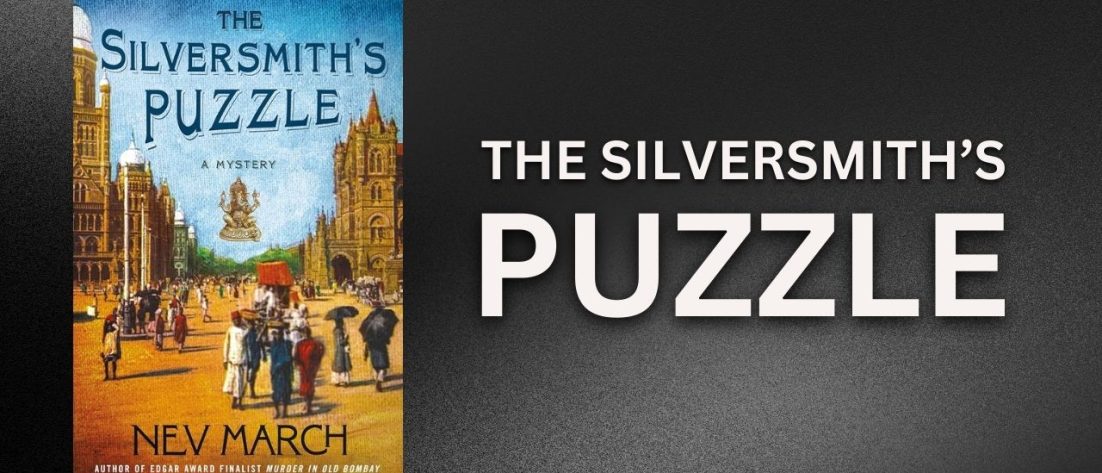
[8:58] Okay. All right. Now, before we go any further, I think you have a copy just hot off the press of the book. Could you show us the book? Friends, it’s “The Silversmith’s Puzzle.”
Nev March:
[9:09] Look at this.
Blaine DeSantis:
[9:10] Look at this. It’s “The Silversmith’s Puzzle.” Wonderful.
Nev March:
[9:14] It’s a beautiful cover. I love it. Thank you.
Blaine DeSantis:
[9:16] Friends, if you’ve never seen any of Nev’s book, just look for the most wonderful covers. They are beautiful. I don’t know who does them, but they are just spectacular. Thank you.
Nev March:
[9:27] I have to give credit to St. Martin’s Press. Minotaur is my imprint. They have a wonderful design team, part of Macmillan. They do a wonderful job in putting together the covers. I do get a lot of opportunity to contribute and suggest different things. So I have a say, a little say in it.
Blaine DeSantis:
[9:50] I get a lot of books from St. Martin’s. They don’t have the covers you have. No, no, no, no, no. You have the best covers I’ve seen. Gosh darn, they’re good. I love them. I love them. Now, let’s give us a little bit. Tell us about what’s in store for us in “The Silversmith’s Puzzle.”
Nev March:
[10:05] This is a rollicking book. It was such a joy to write this book. So the premise is Diana’s brother is in trouble.
Nev March:
[10:13] If you met him in the first book, Adi is this really very decent, upright, honorable guy.
Nev March:
[10:20] And Diana’s his younger sister. They’re very fond of each other. They’re almost like twins. And so when they’re away, they’re not in India at the time. He gets into deep trouble. He’s accused of murder and he sends a cable. That’s the last thing that we hear about in the previous book, that “need help.” It’s like, please help, kind of panic-stricken telegram. And of course, Captain Jim rises to the occasion. It’s his best friend. Adi is his best friend, also his brother-in-law, very, very dear to Diana. So of course, they rush back to try to save Adi. And Adi is just a wonderful character. He’s based upon a real person and someone I really admire, the real historical person. But Diana and Jim have their work cut out for them because they have an interracial marriage, an intercommunal marriage. Captain Jim is a mixed race man and she’s kind of a bit of an heiress. So she broke a lot of rules by marrying him and caused a bit of a furor. So they have to face the music, essentially. They have to approach all of that, try to get help when they are themselves being shunned. So this is quite a rollicking ride, as I said.
Blaine DeSantis:
[11:44] I mean, poor Adi. He’s found over a dead body with a knife in his hand, a bloody knife in his hand. And we jumped to conclusions. Well, not just we, we don’t, but the police do. And wow, it is really a good book. And what I like about it is that you weave historical events with fictional characters. It’s always a sign of a great writer when they can do that. Okay. And you bring in the 1832 Bombay dog riots. Now it’s set in 1890s, but you’re bringing the Bombay dog. Tell us about the Bombay dog riots.
Nev March:
[12:22] It’s hilarious. So in the 1890s, that was the first time we started seeing communal riots in India, Hindu-Muslim riots. And it’s tragic because a riot is a disaster. There’s deaths. It’s very hard to figure out who did what. You have a mob essentially running around killing people. And it’s happened on both sides. Hindus have killed Muslims. Muslims have killed Hindus. But Parsis are the most peace-loving, civic-minded, law-abiding, educated, decent community. And I could not fathom why they would ever riot. It’s like the last thing. They’re lawyers, okay? These guys are educators. They’re philosophers. Riot? So when I read about this, I was just astonished is the right word. And yes, it did happen far earlier, like 60 years before my book is set, but I had to include it. So the reason they rioted was over dogs.
Nev March:
[13:25] The British had this rule that they would round up strays and kill them because they were multiplying like crazy. They were barking and they were nuisances. And yeah, the barking and the crowding, and then there’s scavengers. So it was just a mess. And the Brits had a simple rule, like, okay, there’s a stray. We’re going to hire people and pay them for carcass. So they were going around killing the strays. And Parsis are absolutely pet-loving, animal-loving, and very benevolent and were outraged by this slaughter. So they actually rioted. In reality, they closed up the gates of the cantonment. They controlled all the bread and the food supply. So they stopped all the suppliers going in, starved the army. And they were arrested. They were arrested en masse. It’s very funny because the Parsis wear white, like a white garment, white coat with a white pant. And in the heat, that white dress is sort of a mark of how pristine they want to keep themselves. So here I think about them rioting in their white clothes. It’s just hilarious. But apparently the judge threw the case out and said, look, there’s no political motivation. We will stop this rule and we’ll take the dogs and move them out into the forested areas and let them hunt over there.
Blaine DeSantis:
[14:49] Okay. All right. You also have another gentleman here. And I apologize if I say his name wrong. Ardeshir Godrej? Is that how you would say it?
Nev March:
[15:00] Yes, you said it right. So Ardeshir Godrej was a real person. And my first book is based upon the tragedy of his wife and his cousin. They really did die under very mysterious circumstances. We still don’t know what happened to them. And he was a 22 law student at the time, not even a lawyer yet. But he’s an amazing guy because he, I don’t know how you recover from a tragedy at the age of 22. Your wife is supposed to have committed suicide, but probably murdered. And how do you recover from that? So he did. We never remarried. And he became a serial entrepreneur. He created these multiple businesses that today they form the basis of the Godrej Conglomerate, one of the largest businesses in Asia. So I’ve been reading his biographies. And when I learned that his first business failed and it was a business of making surgical equipment in India, I just had to use that in the story. It was just too delicious. But he’s a real guy.
Blaine DeSantis:
[16:08] We do have that and that’s part of the interesting thing you tell us, you teach us, then that they didn’t want to buy the silver items that were being made by Adi’s company because it wasn’t made in England because it was stamp made in UK or something like that. This wasn’t. That creates a problem.
Nev March:
[16:28] Yeah, no one could believe at that time that Indians could make quality products. And so everything was being manufactured in UK. Raw materials would actually go by ship from India to UK and then come back at 10 times the price, even though they could have been manufactured right there in India. So Godrej was one of the first people to say, we can manufacture quality stuff. And then after this, this venture failed because no one would buy steel equipment. He was, I believe, coating it in silver. But even if that wasn’t the case, they just wouldn’t buy any product without that made in UK stamp. And he refused. He said, that’s a lie. I will not tell a lie. So he refused to stamp and he went bust. The business did not succeed. But after that, he started doing, making locks. He was an inventor so he came up with a method to create very secure locks and then there were safes and then there was almaris, so covers, and then there was other soaps like vegetable based soaps. He went on and on and right then they went to appliances. Right now they’re into construction. They’re in everything. That’s an amazing success story of a family.
Blaine DeSantis:
[17:42] It really is. I don’t know what caste they’d be part of. He does locks. He does soap. He does this. Where would they be there?
Nev March:
[17:50] They’re Parsi, so they’re outside the caste system, so they were not limited to anything, right? But that family solidarity, these families stuck by him and got him through it. And then he didn’t have any descendants. He had no children. So he left everything to his brother’s children. And they’re the ones that now run it today.
Blaine DeSantis:
[18:10] Very good. Very good. Well, you know, you have Captain Jim, who I love, Captain Jim. Not as much as Lady Diana. I would say Lady Diana is the brains behind the whole thing. She’s got the intuition. Yeah. Captain Jim, he’s out there. And he’s captain because he was in the military. OK, friends, that’s why he’s Captain Jim. And anyway, you know, he has to go back and forth between the United States, India, his situation, her situation. You know, does this remind you in a way what you had to go through getting from the east to the west and everything else?
Nev March:
[18:43] Yeah, a little bit. As an immigrant, you end up with having this divided identity where I’ve lived more in America than in India, but I still have a lot of affection, a lot of fondness, and a lot of understanding of the difficulties and the problems that go on in India.
Nev March:
[19:08] It’s very easy to blame the Brits for everything like, “Oh, they occupied India for 200 years,” but India has been independent for 75 years. So if that was the problem, then we should have overcome it easily, but no, we still have endemic problems in India. So I guess I do have a lot of sympathy and that’s sort of why I guess this character emerged, but I’ve also wanted to show the outsider perspective because I’ve been an outsider pretty much all my life. In India, we are a very small minority. Parsis are a minuscule, microscopic minority in India. 40,000 people in a country of 1.5 billion people. So very, very microscopic. But when I migrated here, again, having that outsider perspective, in some ways, there’s a culture shock. There’s a lot that one has to absorb and learn, and especially cultural norms or cultural references. I had to pick up a lot from TV and such, but I think we can see more than those who are born in the culture because they’re used to things. And so I use that as my jumping off point as a writer to hold up a mirror and say, do you really think this is right?
Blaine DeSantis:
[20:34] Yeah, very good. Very good. Well, now we have a lot. You talk about the Parsi and you have a lot of details in this book. OK, more, I think, than even the first book. You know, how do you decide what cultural elements and things you want to put in this book? What do you want to hold back for maybe another book? And are you allowed to put everything in that you want to put in?
Nev March:
[20:56] You have to pick and choose. When I find something just really delightful or meaningful, I try to bring it into my novel as long as it’s moving the plot forward. And each of my books has these Easter eggs. So there are quotes from Holmes, of course, because I love Sherlock Holmes. The character and his stories, Conan Doyle’s stories, just adored them. So there are quotes there from Shakespeare, because I figured, but what would they be teaching at that time? Maybe Dickens was considered pop fiction at that time, a little too sentimental. They would be teaching them the classics or Shakespeare and so on. Captain Jim sort of is self-educated, so he uses things, lines from Holmes and from Shakespeare and others to guide him when he’s floundering. But the Parsi culture is there a little bit in every book. In the first one, there’s a whole issue of intermarriage and such. But in the second book, I want to say, in peril, there’s a moment where Diana is really struggling, and reaches into her own identity and her own bringing. And there’s a translation of an Hashem Vahu prayer in there. So I actually embedded that as a source of strength for her, because she finds strength in that.
Nev March:
[22:24] Now, these are just little pieces. The third book has a delicious practice, an ancient practice that many of my peers have even forgotten, called the Chavi Fair One, or Turning the Key. It’s a ceremony or a practice that helps you to find lost valuables.
Nev March:
[22:45] So read the book and you’ll find. I was very uncomfortable with the ceremony. It’s got this eerie feeling like almost like an ouija board feeling like, “Oh, I don’t know about this.” I mean, it’s really just ceremony. You start with a prayer, you end with a prayer, but it just felt weird, and I tried to capture that feeling in the book because Diana is very reluctant to offer up this solution. It’s interesting as a modern person how you experience these traditional things. I find it fascinating, so I do try to hide these in there, sneak them in.
Blaine DeSantis:
[23:24] Well, that’s okay. Well, tell me, for the readers who might not know the whole background, tell us a little bit about Captain Jim’s background. What makes him so unique?
Nev March:
[23:35] Yeah. So the Anglo-Indians, that term had two meanings. The original meaning was just the British who were in India and they may be born in there. They may have grown up their entire lives, but they always felt home was England. Right. And they call themselves Anglo-Indians because essentially their entire lives might be spent there. A lot of them retired in India. But the pariahs of the time were the mixed-race people. So British soldiers might have had children with Indian women, and they did. And in the 1600s and 1700s, they would actually marry them. But in the 1800s and 1900s, India got independence in 1947. So right up until then, it was considered shameful to have a mistress that was Indian, had children by her, those children were then rejected and were turned into pariahs. And they are essentially the Anglo-Indians, the mixed-race children.
Nev March:
[24:40] Originally, they would be called Eurasian, but that word fell out of use. And then when the Brits all went home, essentially, a few stayed behind. But by and large, they shipped out right after, before independence, 1947. Then the ones that were left behind, they have descendants and such. And they’re typically Catholic, maybe Anglican even. But they form their own community now because they were shunned. And they were, they did not belong anywhere, right? Their mother’s family would reject them, essentially, because it’s a shameful thing to have a child out of wedlock. And then the father, essentially, typically abandoned them and did not claim paternity. So those children had a very hard time. And Captain Jim is one of them, right? So he knows, he finds his mother, I think, towards the end of the first book, he learns that she’s passed away, but he finds out who she is. But he has not found his father. And he knows he’s English because Captain Jim looks English.
Nev March:
[25:45] But essentially he is, in his heart, he’s very Indian. He’s got a lot of personal resources. He’s a boxer. He’s a soldier. He’s accustomed to rough living, interacting with new people. He’s very self-contained and self-reliant, but he’s also got wounds from being shunned and being treated so badly because of the prejudices and attitudes of the Victorian era. Now Diana is very different, right? And she’s spunky and she’s impulsive and she’s younger. She’s 22, 21. So I love that inequality in the relationship, but Captain Jim is fascinating because he’s thoughtful. He’s in his 30s. He’s got a bonanza essentially by connecting with this well-situated family and finding affection. It’s found family, right? Finding affection after being alone his whole life. So that puts the stakes very high for him. He’s got to prove himself in this book, prove himself worthy of their association because now he’s a detective and he’s supposed to solve mysteries and here’s his brother-in-law is going to face the noose. So stakes are high.
Blaine DeSantis:
[27:02] What I found interesting is that by the time they got back to India, the family’s basically being shunned because of this marriage situation. And so we have Jim and Diana trying to face this also as part of this entire book. That is, wow, still going on. Is it still going on now? Do you have that situation?
Nev March:
[27:26] Well, not as much. But up until the middle of the 1900s, for sure, we have some real tragedies in our history. And I wouldn’t say that intermarried women are shunned, but to date, there’s not equality. They do not get the benefits that intermarried men get. A man who marries someone outside the community has pretty much no disadvantages. His children will be included. They will get the benefits. He will get all the benefits of living in the bogs, that is the closed enclaves that are for Parsis only. They’re called charity blocks, but originally they were charity blocks, but now they are essentially enclaves of beautiful greenery in the middle of the cities and for very low rents. They’re rent-controlled apartments. A man would get everything, essentially. A woman would lose the right to even enter the fire temple to attend her parents’ funeral.
Nev March:
[28:30] Her children, yeah. So I just wrote an article that’s coming out in Quillette that documents the legal disadvantages, discrimination against women that exists even today. And many women have taken the trusts to court, the charity trusts that control things. They’ve taken them to court and they have won. But the patriarchy is very deeply embedded. And in this article I search for, well, where did that come from? So yeah, this couple is going to face the music. They essentially have lost some of their support, but also their business gets hurt.
Nev March:
[29:09] And their income, so they have diminished their circumstances. They have had to let go of their staff. And this is also in the middle of a global slump, so they’re losing credit. There’s a lot of disadvantages. But Diana didn’t realize that that would happen because she said, if I leave, I won’t be in their face and everything will be okay. But when they come back, then there’s problems.
Blaine DeSantis:
[29:36] They tried to have a party for him, and everybody wouldn’t come. They said, no, we’re busy. We can’t come because of this, again, because of this mixed marriage. It’s a huge part of this book, along with the dog riot. There’s so much going on here that it’s just wonderful. And we got a mystery, and we got all this stuff. And one of the things, tell me, how were you able to get into the research for the lawyers and the legal system and the police system? So that had to be very voluminous research. Tell us a little bit about that.
Nev March:
[30:09] Well, yeah. So amazingly, there are a lot of documents that tell you how things were done in the 1890s, just before the turn of the century. So police procedures were evolving at that time. You had forensics that was just growing. But they did know about the use of finger marks. They didn’t call them fingerprints at the time. But, I mean, Conan Doyle and others had really shifted things in the 1880s in the UK. And a lot of practices had, of course, made it to India because the Brits were in charge. Whatever they did in England, they tried to replicate in the colonies. So they had telegrams, they had telegraphs, they had houses, had telephones, large houses and business houses, and all government institutions had telephones. But forensics was growing at the time. So I read the Indian Penal Code from 1860, which is extremely dry reading. And it’s essentially about protecting British officials and punishing anyone who revolts, who rises against them, is really what it is. The police came out of the army, right? So they have a lot of the structures of the army. So right after the Indian mutiny, the Sepoy Mutiny of 1857, that’s 90 years before independence, there’s this guy, C.J. Forgette, who was a retired inspector of Bombay police. And he wrote two books.
Nev March:
[31:38] “The Sepoy Mutiny in Bombay” and “Our Real Danger in India.” That’s what his title of his book was, “Our Real Danger in India” and “The Revolt in Hindustan.” Those are the two books. But he was an inspector of police and he did wear disguises and creep around and listen in on people. That’s how he foiled. He foiled efforts by the Sepoys to have a mutiny in Bombay. Bombay was the commercial hub. So two books by him, then multiple memoirs by Cornelia Sorabji, India’s first lady lawyer. She represented women. Now think about that, okay? Early 1900s, 1920s, she represented women who were losing their property when their husband died or because of family quarrels. So if there’s multiple wives, for example, she represented them and she wrote four or five books. So a lot of the procedure, the legal procedure is there. Then there’s this, I mean, there’s some really startling papers, “Slavery and the Household in Bengal, 1770 to 1880,” which talks about institutionalized, sexual slavery. Brothels, essentially brothels. And the army, the army owned some brothels.
Blaine DeSantis:
[32:57] Really?
Nev March:
[32:58] Yep, yep, yep. Then there’s wonderful books by administrators. I’ll name one of them. It’s called “Bombay 1885 to 1890, A Study in Indian Administration” by Sir William Wilson Hunter. These are all now available freely on Gutenberg and other, the PDFs. I can read them on my screen really fast and I take clips all the time. They tell you how the police was structured, how the court system was structured, what those people’s authority was, what their titles, the titles of the names that they use. So much of great, juicy detail right there. So, like I said, it feels like I was there, although I wasn’t alive then. But I get steeped in it, and it’s really quite interesting.
Blaine DeSantis:
[33:48] So I would say if I looked at your book that maybe 10%, 15% is about the legal system and everything else, the police system. And yet you did so much research just for that, I will call it a small portion, not a small, minimal, but a small portion of the book. It had to have taken you a long time to do all this, though.
Nev March:
[34:06] Yeah, I do a good bit of research. I have a stack of books that I plan to cover before I start the outline of my next novel. And you’re right, a little bit might get in there, but that will feel very real and authentic. So in this book, there is a fake witness who shows up and that is straight out of CJ Forgett. He had identified the tree. There was a tree, banyan tree, where people would gather to get paid to give false evidence. This was a business. You could get, essentially somebody fighting a lawsuit, you bring in your witness, you’ve just paid him, basically. If he could withstand cross-examination, he got an anna, like he got a rupee, which was 16 annas. And if he failed cross-examination, you still paid him for his time half the amount. So this was, this is all authentic. It sounds like, what? How is this possible? But lawyers would go to the tree and buy their witnesses.
Blaine DeSantis:
[35:09] And that’s exactly what we have here. It’s wonderful.
Nev March:
[35:13] So this is Captain Jim’s problem is that there’s more and more evidence against Adi and Adi’s clamming up.
Blaine DeSantis:
[35:23] It is really, really well done. I’m telling you what. It’s just it’s a very fine book. And again, we think we’re there. And the thing I like about this book even more is we think we know things. And by the end of the book, there’s still some people who we don’t know about, what happens to them, everything else. Really well done. I mean, very, very well done. And, you know, that’s how should I say this? You have antagonists who are fascinating to us. You have protagonists who are fascinating to us. And when you start doing this, do you know where you’re going when you start the book? Say, well, I’m going to do this or I’m going to have this person. Or does this start creeping up on you as you’re writing?
Nev March:
[36:10] Both, actually. I do over-agonize and create this outline.
Nev March:
[36:15] A pretty detailed outline to start with. That’s my crutch. It’s my safety net. So I need that in order to start drafting. But while I’m drafting the chapters, they do go off on tangents. And then I have to keep updating the outline and adding in pieces. And you’ll see that there are things that happen I did plan, but then there’s things that I did not plan. And some of the shadowy villains, they emerged in the last one-tenth of the book and it’s because as I drew the threads together to wrap them up, I realized that this can’t be it. This is too neat. There’s something else going on. And so right at the end I sort of reveal something that will probably be the basis for the next book. But then there are characters like I knew that there is a poor gardener, there’s a very old gardener, and I knew what he was going to do. I knew the role I had for him. And as I wrote that character, he kind of took over that chapter. I was in tears as I was writing it and I’m thinking, does he remind me of somebody? Have I met someone like this? Like why is this so emotional for me? And I still have to figure that out. I think I need a little bit of psychoanalysis to figure that out.
Nev March:
[37:39] Maybe it’s a type, maybe it’s a type of person that I feel very strongly about that needs to be protected.
Nev March:
[37:46] And so he’s very real and he literally became so much more important than I had planned for him to be.
Blaine DeSantis:
[37:53] Well, his story is fascinating too. I mean, this is a guy who, no matter what they’re trying to do to protect this guy, something happens. Well, let him go. Well, don’t do this. Don’t. And it’s like, he’s always from the fine prime hand of the fire, go back and forth. And he’s just a poor old man, and it’s, you feel badly for this gentleman, feel so badly for him. So, yeah, well now you said a little bit, and this is good. You said, as you start the outline for your next book. So that gets me asking, this book ended and I’m not sure where we’re going because they haven’t left India yet. What’s next? Where are we going? And how many books do you envision for Jim and Diana? How many?
Nev March:
[38:35] Well, at least one more because there are threads I have not tied off. We definitely need to know who Captain Jim’s father is, because in every book it rankles. At some point he guesses, at other points he wants to beat the guy up for abandoning his mother. It reflects on his sympathy for somebody who has been abandoned by their father. So it’s in his psyche, and we have to know who is the guy and why did he walk away from Shanti? That’s Captain Jim’s mother. So there’s that, and it’s a big one, right? That’s something so fundamental to the character. But remember, in at least one or two books, maybe three, Diana has this very…
Nev March:
[39:26] Caring streak, and she wants to be a doctor. And that was in the era when it was very, very rare. There were a few doctors, but it was very, very rare for a woman to have that kind of education. Women were nurses at that point, after the Florence Nightingale thing. Schools of nursing were coming up, but to be a doctor. So there’s that. And I think about, well, what do we do there? Does she get a chance to or what’s likely to happen when Captain Jim keeps moving around for his work? What’s going to happen to her goals? You also have some other pieces like readers keep asking me for adventures to do with Abigail. Abigail showed up in one of the previous books and she’s a very early trans woman. She’s a cross-dresser. I mean she’s a very early trans woman. That word didn’t even exist, right? The word did not exist until 1905 or so. But she’s just such a complicated and appealing character from peril that I might resurface her at some point. And meanwhile, we do have another strange person that showed up in the Spanish Diplomat. And people ask me, they send me emails saying, well, did Anna actually survive or did she die? I did not make it clear because I don’t know.
Nev March:
[40:51] So there’s a possibility that these characters may come back. And frankly, if readers write to me, I’m more likely to bring them in either into a novel or in some short stories. So there’s a lot of threads and we’ll see what happens. At least one more I could promise.
Blaine DeSantis:
[41:13] I like the fact that they had businesses in America. Again, she sets up the business. I love this girl. She’s wonderful. Lady Diana sets up businesses and she’s got rent and it’s amazing what she does. They’re rich characters and the period is such. I’m telling you what, you could go on for a lot more books than one. I’ll tell you, it’s wonderful stuff.
Nev March:
[41:33] There was a lot happening and I think I’m interested because a lot of those things that happened then have an impact on where we are right now. And on the Gilded Age, for example, some of the issues that have to do with women and not just the suffragettes that came a little bit after, but women’s rights. It’s how people saw the role of the woman. But there’s much more than that, even. It’s how America saw itself. At that point in time, it was a small power. It was not a superpower. So there are many factors that today… You know, that they really stem from that era, the turn of the century, the last century. And so it’s fascinating for me to draw those threads out and help people understand why we have the beliefs that we do have, why we have such polar opposites even sometimes in today’s thinking. It fascinates me that these are the origins and we all kind of heard about them in history books, but maybe we don’t understand how much of a role they have to play in our present thinking.
Blaine DeSantis:
[42:49] That’s right, that’s very right. Well, I’ll tell you what, you keep writing, I’ll keep reading. I’ll keep bringing you on. I love your books. I love the mysteries. I love the learning I get from them. They’re just wonderful. What can I say? I can say this. Nev March, once again, thank you so much for being with us here on Books and Looks.
Nev March:
[43:10] It’s been a pleasure. Thank you, Blaine. I’ll be back anytime you want me.
Blaine DeSantis:
[43:15] Once again, Nev, thanks so much for being on Books and Looks. It’s always a fun time when I get to talk with you. Friends, if you’ve never read any of Nev’s books, you know, you could start with this one or you go back to the first book in this series. Captain Jim, Lady Diana, really, really good books. And as I like to say, they’re not just mysteries. They teach me something. They teach me something about a time. Dog riots? They had dog riots in India? I didn’t know that. The caste system sort of explained. Nev explains this to us. It’s a wonderful book. And I hope, hope, hope you really follow this book and follow Nev because she’s a wonderful author. And again, I can’t, I’ll have her on the next time she has a new book. That’s how much I love her. Anyway, hey, listen, on behalf of my good friends at booktrib.com, on behalf of my better friends, even yet, at Podcast Studio X, this is Blaine DeSantis for Books and Looks. Say, may all your leaves be pages in a book.