
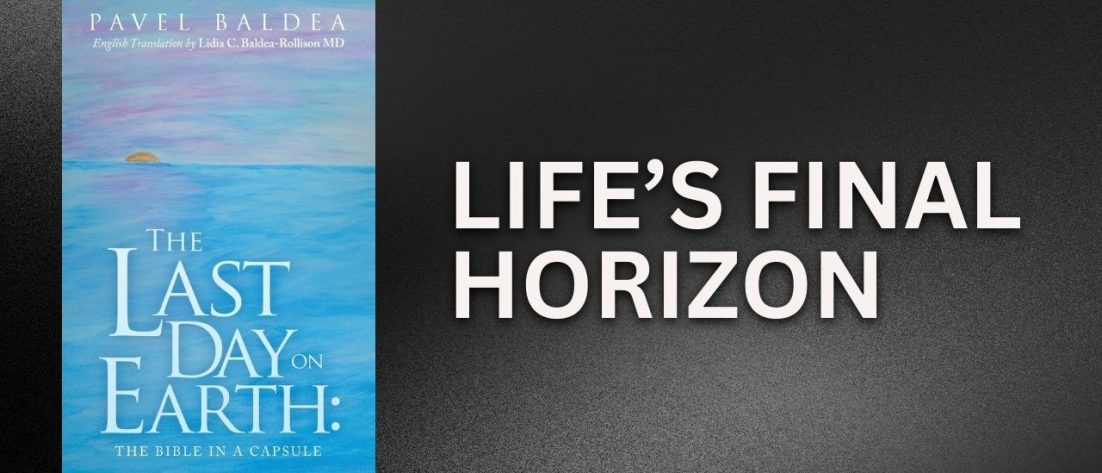
At age six, Pavel Baldea was dragged from his bed at 2AM by Communist police who imprisoned his parents and abandoned their children on the streets. Decades later, after a daring escape across borders to America, this Romanian refugee with a scientific mind has distilled 20 years of biblical study into “The Last Day on Earth,” a book that deliberately strips away theological complexity to explore humanity’s ultimate questions. Join us for this special Good Friday conversation where Baldea reveals why his “Bible in a capsule” intentionally omits chapter-verse citations most religious texts depend on, how his perspective was forged in the crucible of persecution, and what he believes both ancient wisdom and modern understanding tell us about what awaits beyond this life. Whether you’re spiritually curious or deeply devoted, this conversation offers a unique window into how one man’s extraordinary journey shaped his understanding of life’s final horizon.
Links:
Transcript
Blaine DeSantis:
[0:00] Hi, everybody. This is Blaine DeSantis, and I welcome you to another edition of Books and Looks. Yes, it’s our weekly voyage of discovery in the wonderful world of books, histories, mysteries, fiction and nonfiction, books that I’ve been reading, as well as interviews with the authors. Only get it here exclusively on Books and Looks. And let’s not forget, that’s right, our good friends at booktrib.com. You can go there for any sort of book-related items you want, book reviews, book giveaways. You can find my podcast or YouTube there. It’s a great site. They’re great people. That’s booktrib.com. Now, today, friends, we are bringing this episode out on Good Friday because it’s a little bit different from other episodes.
Blaine DeSantis:
[0:41] I’m fortunate enough to have known a few people who are authors, and one of whom is a gentleman named Paul Baldea. Paul is a very devout Christian, and he has written a book, titled The Last Day on Earth. And Paul has been collecting things that he’s been studying for over 20 years to put this book together. And I don’t usually do religious books. I try to stay away from politics also. But I thought Paul should come on and give us his point of view on a lot of things. And there may be a lot of you out there who might be searching for questions or answers, and Paul might have some of them for you. It’s an interesting gentleman. He came from Romania, escaped from Romania, met my wife and my father-in-law over there in Italy. They became good friends. They’re still good friends down here in another part of South Carolina. So we’re very happy to have Paul on to talk about his book, The Last Day on Earth, and I think I really find it interesting. And again, we’re doing this out on Good Friday. So I wish you all a happy Easter. Easter in ours and Orthodox is the same day this year, the 20th. So I think it’s appropriate and we’ll, let’s go right into that interview. Paul Baldea, welcome to Books and Looks.
Pavel Baldea:
[1:57] Thank you very much. Hello. Nice talking with you and helping me out with this book. Thank you.
Blaine DeSantis:
[2:05] Glad to have you on. As I said to everybody in our intro, Paul’s a friend of the family. It’s nice when you have friendly people who know you and they write books, and we can have them on as a guest. So I’m really enjoying this. So I’m real pleased to have you on. And if I haven’t shown it to everybody yet, here’s his new book. Okay, The Last Day on Earth. Here it is. Okay, this is what we’re talking about. And Paul, that brings me to the very essence of my first question. It’s called The Last Day on Earth. Why did you give it this title? Or did you have anything to do with the title?
Pavel Baldea:
[2:42] Well, in the Bible, there are three events that are called the last day on earth. One of them, it’s right before Jesus will come to reign on earth for a thousand years, which is called the millennium. So in that time, He will judge all the people that took the mark of the beast. They follow the Antichrist, and it’s last day for those people. Then another situation is at the end of millennium when God will judge the people that were not raised from the dead, beginning with Adam’s time till present time, present of that thousand year. And another time, it’s mentioned in the Bible, the last time, many times, for the Christians, and special for those that hope in resurrection.
Pavel Baldea:
[3:55] That word in English, resurrection, it’s translated from a Greek word, they call it harpazo, which means caught up. So in all the English translation of the Bible, that rapture, taking up, it’s translated in English as being caught up. But actually, when the Latin was translating the same Greek word, they call it rapturo. And then the English-speaking people took that rapturo to rapture. And it’s never written in the English Bible that way, but that’s the meaning of it. So, because in the Gospel of John, Jesus Himself said it four times in chapter 6, I can give you all the verses, 39, 40, 44, 54, that on the last day, He will bring to life all the people that believe in His sacrifice. So that’s why I call it last day, because Jesus Himself quoted four times, last day, last day.
Blaine DeSantis:
[5:22] Okay, that’s the last day then. Okay, good. All right. Well, that’s very good. Now, I noticed you have an accent. That does my wife. Where are you from, Paul? And tell us a little bit about your background.
Pavel Baldea:
[5:37] Yes, I was born in Romania, in the communist Romania, and my family, they were a lot persecuted by the Communist Party. And I can give you an example of it. When I was six years old, at two o’clock in the night, the police came and took all of us, four children, mother and father, locked the house, locked the gate of the backyard, put him in the car, put him in prison, and left us in the middle of the street. Then you understand how life was there. Even my mother couldn’t go back in the house, and the house was inherited from her parents. But we grew up, and because of the tough life, I was always interested in reading the Bible, trying to understand why we have to grow up with our parents.
Pavel Baldea:
[6:50] Growing up, I always have problems because I didn’t want to join the Communist Party. They don’t believe in God. They are atheists. So being to so many events, at one point I decided to join the United Nations camp in Yugoslavia. And from there, I was accepted to emigrate in the United States. I was very, very grateful for that. And I prayed to God that as long as I have my eyes, hands and feet, don’t let me beg. Let me find work. Then after a few years of hard work, I decided to go to college and pay for it in full. And I have a wonderful career working as an X-ray technologist.
Blaine DeSantis:
[7:50] Good. That’s wonderful. That’s a great story. And it’s in that one camp in Italy where you met my wife and my former father-in-law.
Pavel Baldea:
[7:59] Yes, that’s very true.
Blaine DeSantis:
[7:59] Who’s no longer with us. Yep, that’s right. And he left when Paul left, and I know this is getting off the book, but when Paul left Romania, he left this little girl behind, his wife and a little girl.
Pavel Baldea:
[8:09] Yes, I did.
Blaine DeSantis:
[8:10] Which is our daughter, which is his daughter, Lydia, who is now our family physician. Can you imagine that? It’s just something was in the cards for that. I’ll tell you. Well, anyway. Now. The book, what would you, if you had to give us an overarching theme, we talked about the title, but what is the book really about? Tell us all what it’s about, Paul.
Pavel Baldea:
[8:30] In the shortest word I can tell is that this book is a strong warning against the ignorance, that people have about what will happen when they will pass over the horizon of this life.
Blaine DeSantis:
[8:51] Okay. All right. And so this book is going to tell us a little thing about what you need to do to prepare for the eventuality of death, et cetera. And okay, that’s very good. So that’s a help now, but now who is, who do you think your target audience is for this book? Who are you trying to get this book out to?
Pavel Baldea:
[9:09] I will want that everyone that think about life, even though they get out through hard times, they are seeing that life is fleeting from them. And if someone will get to read this book will want to find the one that has life in itself, Jesus Christ, which is the whole Bible.
Blaine DeSantis:
[9:48] And so that was your motivation, I guess. I mean, all of a sudden one morning you’d wake up and say I’m going to write this book. How did you get that inspiration to write this book?
Pavel Baldea:
[10:00] No, no, no. That’s what happened. Because I told you, I lived in a communist, atheistic society. I always, I have been mocked for believing in God, and surrounding people will come to me with tough questions and opinion about the Bible without ever reading it. So I start answering those questions. Then about 20 years ago, in 2005, I decided to collect those answers. And I say, I should write a little book because in time, my mind will go weaker and weaker and will be heavy hard to go to look for all those answers. So that’s why I put it in the little book.
Blaine DeSantis:
[10:55] Well, no, that makes a lot of sense. You’ve been collecting this stuff. You’ve been accumulating everything. You’ve gotten wisdom over the years. And what I like about this is that, you know, you are a lay person. You know, you never went, I don’t think you went to theology school or anything like that. But through your years of studying of the Bible, you’ve been able to come up with what you think is a pretty simple, again, from this book, pretty simple message. It’s a pretty simple message right here in this book. That’s amazing. Do you think this adds to what has already been written about the Bible? Or you think it’s going to be different from the other books because you’re not a theologian. You didn’t go to divinity school. You use a practicality that they might not have.
Pavel Baldea:
[11:40] No, no, it’s not adding. This book is not adding anything because there are so many books, and this book is not competing with the writing of a renowned pastor or a prolific Christian writer. No way. Those Christian books usually are written and they fill up the libraries of the pastors and the seminary theology students. And guess what? They are used as quotation in appropriate sermons. And it’s true. Lots of them are buy by the Christian to have a better understanding, you know, about what the Bible said. But this book, it’s actually not for Christian because they’re supposed to know the Bible already.
Blaine DeSantis:
[12:45] Okay. All right. Very good. Well, see, now that brings me to this whole, a couple things here. First of all, you brought up a lot of very interesting points. A lot of interesting points. I said, I got to go to my Bible and find that. But I didn’t see chapters and verses. And at least that first 40, 50 pages of the book, I didn’t see a lot of thing, of chapter, verse, you know, the whole thing, book, chapter, verse. Was that on purpose?
Pavel Baldea:
[13:18] Always on purpose, because this work is a concise overview of the major concepts outlined in the Bible. There are already many books on Bible commentary. You know, I have a library of Bible commentary myself that analyze every book in the Bible. When I started writing this book, I gave biblical references for every paragraph, but I realized that the books become very complex and hard to read. So for the simplicity, I decided to put fewer. Actually, I didn’t want to put at all, but the publishing company, they wanted to put some. I wouldn’t put anything. I would like people to go directly to the source, to the Bible. I had no choice. I had to put a few of them for the sake of the publishing company.
Blaine DeSantis:
[14:19] Well, that’s interesting. That’s interesting. Yeah, that you didn’t want to have any or very few to begin with because, like I said, I wanted to go look some things up and check a few things. I said, where did that come from? And I just, you know, yeah, I know the Bible. I did a lot of that. But, you know, sometimes you want to have a specific chapter and verse. But now I understand why you didn’t do it.
Pavel Baldea:
[14:39] I wrote actually, pardon me, I wrote on the end of the dedication of the book that this is not the Bible. It’s just the path toward the Bible.
Blaine DeSantis:
[14:50] That’s right.
Pavel Baldea:
[14:51] It’s not true.
Blaine DeSantis:
[14:53] Right. Right. Now, which gets me back to this thing. You say here, I look at your book and it says, The Last Day on Earth, the Bible in a capsule. Yeah. It’s a capsule, but it only deals with a few books of the Bible, not all the Bible, just a few. How did you decide what was the most important thing to put into this book? Because you use only a few books of the Bible. You don’t use all the books of the Bible. For instance, I don’t see a lot of references to Matthew, Mark, Luke. I don’t see it a lot. There’s nothing to Psalms, Proverbs. How do you decide what we want to use and what we don’t want to use?
Pavel Baldea:
[15:33] Well, this book answered to a few tough questions without going in full detail about in order to make the sincere truth seeker to go to the Bible. So it’s very, very short and doesn’t cover the whole Bible. It’s the main truth of the Bible.
Blaine DeSantis:
[15:59] That’s what I wanted to get to. Right. That’s what I wanted to get to. Do you think this is the essential message that we’re getting out of the Bible? Do you think when we pick this up, this is what everything is really all about?
Pavel Baldea:
[16:11] Well, I will say to this, it’s no book written about the Bible to have the whole truth. A person that will taste the goodness of God will want to know the whole truth. So he will read the whole book, the Bible. For someone that has no access to the Bible itself, this book have enough truth in it that will help a person to receive the salvation of God. Because it’s written, it’s giving them what to do, how to do if they don’t have a Bible. That will help them to do that.
Blaine DeSantis:
[16:53] Okay. Great. Okay. That’s very good. Now, one thing that got me a little confused. Okay. And I’m honest with you. You have a book about Paul’s, a chapter about Paul’s work before the chapter about Jesus’ work. Now, why do you put Paul before Jesus?
Pavel Baldea:
[17:13] Well, in developing the Christian history, we definitely, we see clearly that Jesus is the single possibility for salvation of humankind. But He was sent by God to preach only to His people, to Israel. Jesus’ apostles, and especially Paul, were precious tools in God’s hands for spreading the gospel, the good news of salvation. And God used Paul to bring Christianity to the Gentile world, Gentile, everybody else beside Israel. So that’s why I put it. But he was a tool and he worked very hard. He was in prison many times. He did a very, very good job.
Blaine DeSantis:
[18:15] They are saying, many people will say that Christianity is actually Paul. Paul is the one who invented Christianity. Jesus didn’t do that. But they say Paul is the one who put it all together for everybody. I don’t know if I’m, yes, no, I wasn’t there. I couldn’t tell you. But, okay, well, that’s interesting. Now, a couple of times you referenced to man, okay? You say man’s been here for maybe 6,000, 7,000 years. You use a few numbers in there. Is that what, so that is biblical, 6,000, 7,000 years or nobody before then?
Pavel Baldea:
[18:49] The Bible is very, very clear about creation of the earth. The first sentence in the Bible, people have to read it very carefully, declares that in the beginning, God created the heaven and the earth. To me, that means that the age of the earth is the same of the age of the whole celestial body that are created by God in the heavens. Now, 6,000 years ago, God transformed the earth in order to support.
Pavel Baldea:
[19:32] All life forms that He created on earth. So yes, human beings are only 6,000 years present on this earth. But the creation of the earth is way beyond that. It’s like the whole universe.
Pavel Baldea:
[19:51] And if you watch a little bit on the science, the theories that was before Hubble telescope and James telescope now, what do they do now? They change the theory. You know, theory is something that it’s not verified. So now they go and beyond the age of the world was like 13.8 billions year and the size was billions and billions of light years. Now they are completely confused because of James telescope. It’s very true they are, they have antagonistic theory against each other and if we don’t look carefully we sometime we go mislead in all of this. You know, for me I was a science major, I always like science, right? And I just give you a small example. They teach you that the matter in the end is made by atoms and you have a nucleus and you have in there only positive particles and the electrons that go around and they are negative particles.
Pavel Baldea:
[21:12] So seems kind of easy for them in the beginning if you don’t look careful. The theory is this: like particle charge repel and the different opposite charge attract. So the electrons go around the nucleus and because the kinetic energy they don’t fall on it but they stay close to it. But when you look in the nucleus, you have the like particle, the protons, which are positive. And funny it is that they don’t repel. And they say, uh-oh, what’s going on here? Let’s fix that. So now they come with quantum theory. And in quantum theory, they say when a proton wants to get out of an atom, a particle comes.
Pavel Baldea:
[22:08] And doesn’t let him go out, that proton, and then disappear and go to another one. And a very renowned scientist said, you know what? This, you better believe in God than in this theory. And they call that fleeting particle, God’s particle. Can you believe it? For me, it’s so easy to believe the Bible. And I give you reference Colossians chapter one, verse 17 is written clear that Jesus create everything and holds everything, holds everything in His hands. So that for me, so I better go to the Bible sometimes. I don’t think all the science is a hundred percent truth.
Blaine DeSantis:
[22:56] They go, they find new things, Paul. They keep finding new things. And, you know, it’s amazing. They got all this stuff out there and you know something happens sometime and I can’t figure out how it all beyond me to figure out how everything started began or what happened so anyway. Okay, now you indicate that at the end time there’ll be no more humans. Okay, there’ll be, at the very end we’ll have the last days there’ll be no more human. Will there still be an earth at that time? Or does He get rid of everything?
Pavel Baldea:
[23:29] No, the Bible is very clear. I can give you verses and everything and chapter what it is, but it’s very, very clear that at the end of the millennium, the earth will disappear, in a sense, will be burned up. Peter wrote about this too, that everything will be burned up and God will create new heavens and new earth and new Jerusalem. And the first five verses in chapter 20 of Revelation is describing the life in day. And the major things of life in day, which is the best thing, what it is, people will live joyfully. They’re not going to be even mad on nobody. Can you believe that? Nobody make you angry? I’m thirst for that, to live in peaceful life. And that will be on the new earth that God will create it for the people that will want to go with Him.
Blaine DeSantis:
[24:35] Okay. And then so this earth, as we know it, will no longer be in existence. There’ll be a new earth. Is that correct?
Pavel Baldea:
[24:42] Yes.
Blaine DeSantis:
[24:42] Okay. Just want to make sure I was clear on that. Okay. Well, you know why? It’s interesting you say that because don’t they say, not don’t the scientists, your friends the scientists, don’t they say eventually the sun’s going to blow up and that’s going to consume us also. So it might be part of the same thing possibly. I don’t know. Again, a lot of these questions I don’t know the answers to. And you take it all as a matter of faith when you read the Bible and you’ve been studying it all these years. That’s right. Now, let me ask you a question. You’ve written this book and you started this. You got this book. You started this back in 2005. You started collecting little things. I know you. You collect more than that. So is there another book that’s going to be coming? Do you have some more thoughts that you’re going to give us?
Pavel Baldea:
[25:28] No, no. So as I told you, all my education and my attraction was for science, chemistry, physics. I didn’t have lots of attraction for studying the languages and writing. And so fortunate for me, when I started writing this down, my precious wife, Victoria, she start helping me out to get rid of all those run-on phrases and sentence, then my daughter Lydia promised, look, I’ll help you to put it in English. And then my son-in-law, Jeremy, with his major in English, he helped with proofreading. And finally, in 2024, we decided to publish it. So that was the story of it. The book was dormant 20 years because we didn’t think this is so important. But now since we publish it.
Pavel Baldea:
[26:41] I am assaulted by all kinds of advertising companies. They want to advertise and publish and make me have a wrong impression or I’m not sure. It’s the good, that benign, not going in any difficult, blaming anybody, any church or the world itself, or they want to make money out of it. And at one point, I answered because I didn’t want to talk with these people, but somebody call and say, I have a question. And I thought they want to know something. And I answered. And I said, oh, here, I start answering. He is my boss. And he’s starting giving me all the detail about printing it. And because I mean, advertising it and because I refused to do it, he gave me the guilt trip. Oh, you wanted to spread it only to the Christian church. You don’t care about the rest of the people. So I didn’t want to make this like making money out of this, out of Bible. So I resisted and I’m so happy. You are very nice and you kind of take that guilt off my shoulder trying to put it out there. So I thank you very, very much, and I appreciate the work you do.
Blaine DeSantis:
[28:09] Well, but now you’re not going to do another book. This is it. Is this the only one? No. This is it.
Pavel Baldea:
[28:15] That’s it.
Blaine DeSantis:
[28:16] I don’t know, Paul. You have a lot of knowledge. I know you. You have a lot of knowledge. You could be passing it on. I can’t believe you want to write a little bit more.
Pavel Baldea:
[28:24] Well, what I can do, because if I’m writing, I have to put a heavy load on the trio, my wife, my daughter, and my son-in-law, because they have to help me. And you should see when you’re in the publishing process, they will give so many wrong editing that my daughter say, you know, Dad, don’t come and fix them anymore, because the rapture will come before you publish your book. And I say, wait a minute, look, as bad I am in English, they say the millennium has 7,000 years. We cannot go 7,000 in a thousand. We have to fix, okay, that will fix that. Then look at Brock sent us phrase here. No, leave that alone. So I don’t fix it. So I had to listen to my daughter who live it the way it is.
Blaine DeSantis:
[29:18] It’s very hard to write. You know better than me. I know that, yes, it’s very hard to write. I’ve been stalled on something for three, four years. So I’ve, yeah, I know how it is. So, well, anyway, hey, this has been a lot of fun I’ll tell you. You know, this has been a lot of enjoyment. I’m glad you can come in on. Tell us a little bit about the book. It’s a short, sweet book. Around 105 pages, I think, all together. Short, you know, I’ll tell you one thing I like, Paul. Short chapters. Some people, you read books. They go on and on and on. You had a very good idea. Short chapters, keep it concise. Was that always in your mind when you started? You wanted to keep it nice and short, the chapters?
Pavel Baldea:
[29:58] Well, I look in the society we live today. You go even in a family party. Everybody is with the face and the hands and the phone. We don’t talk anymore. Our time is still by all of this electronic technology. So I wanted to do shorter than this so people might get little time. And I read it and I wake up and don’t be ignorant about this life and the future life. That’s the way I wanted people to do. And, you know, our church, the pastor and everything, we bought 500 books. And we had a good dealing with the company, the publishing company. And this way we got the lowest price for the book. Not what it’s in Amazon and the bookstore. We got a lower price, and now he’s spreading around our church, and he wishes that little by little the Christian church will want to do the same to support the missionary work, not just internationally, but here on the grounds of the United States too.
Blaine DeSantis:
[31:23] Very good. All right. Well, Paul, I want to thank you for taking time out. We recorded this on a Saturday, so I don’t want to tie up your weekend anymore. But I thank you for taking time out of your day, coming on Books and Looks and being part of the show.
Pavel Baldea:
[31:38] I appreciate more than you. Thank you very, very much. You are a very nice person, and I’m very happy and glad to know you. Thank you again.
Blaine DeSantis:
[31:49] Paul, thank you so very much for being with us on Books and Looks. We appreciate your time, your efforts, your energies. And a lot of people are going to take a lot of good news out of this and a lot of learning out of your book and it’s only a short book but nonetheless it’s a very very interesting book and I know I got a lot out of it and I’m sure everybody else will if it takes the time to read it. But anyway, so on behalf of our good friends at Podcast Studio X and booktrib.com, this is Blaine DeSantis for Books and Looks saying may all your leaves be pages in a book.