
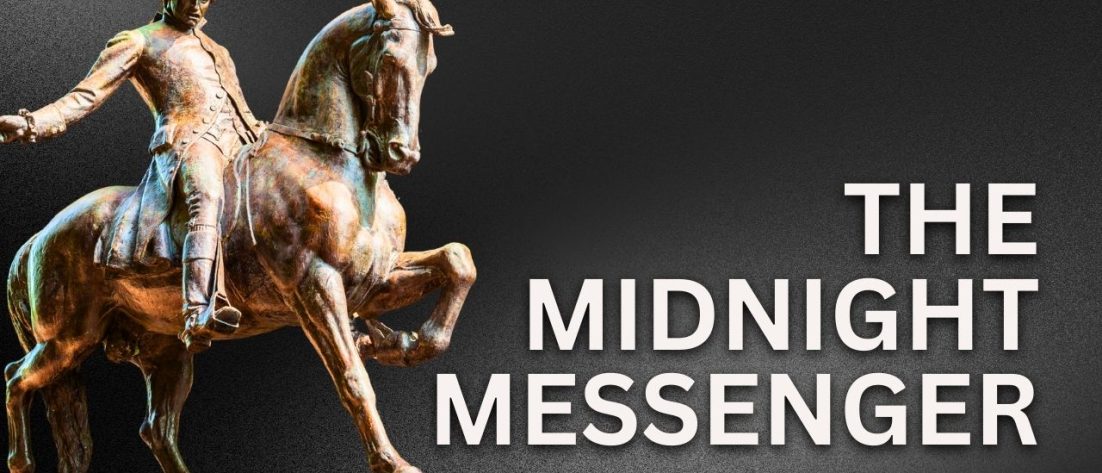
“Had Revere failed that night, America’s revolution might have died before it began.” Author Kostya Kennedy reveals how history pivoted on a silversmith’s midnight journey and the astonishing betrayal by the British general’s American-born wife who may have leaked crucial military plans. On the 250th anniversary of Paul Revere’s ride, “The Ride” uncovers what history books missed: how Revere demanded his own court-martial years later, the massive warship whose timbers still rest in Cape Cod sand, and why a Massachusetts police officer couldn’t bring himself to ticket Paul Revere’s descendant for speeding near Lexington. Listen as Kennedy shares what he discovered climbing the treacherous Old North Church steeple and why Paul Revere was more than just a man on a horse with a message.
Links:
Transcript
Blaine DeSantis:
[0:00] Hi, everybody. This is Blaine DeSantis, and I welcome you to another edition of Books and Looks. It’s our weekly voice of discovery into the wonderful world of books. The best of history, mystery, fiction, and nonfiction all here each and every episode, along with exclusive interviews with the authors of those books. You’ll find it anywhere but here on Books and Looks. And I also want to say a big thank you to our dear friends at booktrib.com. If you want anything to do with books or bookish, go to booktrib.com. I’m going to start with a poem, friends. Listen, my children, and you shall hear of the midnight ride of Paul Revere. On the 18th of April in 75, hardly a man is now alive who remembers that famous day and year. Yes, Paul Revere’s ride 250 years ago this week.
Blaine DeSantis:
[0:53] On the night of April 18, 1775, a solitary rider sets out on a journey that’ll change the course of history. In his book, The Ride, author Kostya Kennedy brings a vivid life to the story of Paul Revere’s legendary Midnight Ride, illuminating the man behind the myth and the pivotal role he played in America’s fight for independence. He blends meticulous research with masterful storytelling and takes our readers on this thrilling journey through the tense and fateful hours leading to the battles of Lexington and Concord and reveals how one man’s courage and determination help spark a revolution. I’m Blaine DeSantis. This is Books and Looks, and today we’re interviewing Kostya Kennedy about his book, The Ride. Kostya Kennedy, welcome to Books and Looks.
Kostya Kennedy:
[1:47] Great to be here. Looking forward to talking with you.
Blaine DeSantis:
[1:49] Well, I’m very, very happy to have you here as we approach the 250th anniversary of Paul Revere’s ride. I think this is perfect timing for a book and for a discussion. So, you know, it’s wonder, by the way, I, before you know the question, I love the book. I gotta be honest with you. I found out so much information in this book. It was out of this world. I’ve been telling people every time I see them, did you know this? Did you know that? No, no one knew this stuff. So thank you for educating us.
Kostya Kennedy:
[2:17] Oh, thank you. And it’s really nice to hear. And, you know, you find, as I think many writers would tell you, you find out a lot of information, a lot of things, and you choose what to bring in. You’re only really including a fraction of what you know. So it was certainly fascinating for me to work on and to learn some of the details and to just sort of be immersed in that time. So I appreciate you saying that.
Blaine DeSantis:
[2:41] I really did like it. Anyway, you open up, it’s a very unique opening to this book. Very unique because you have Paul Revere getting ready to ride, but then you develop a bunch of what ifs, what if this happened? What if this didn’t happen? What would happen to the revolution? What would happen to everything else? What prompted you to make it as that type of an opening?
Kostya Kennedy:
[3:04] Yeah, thanks. You know, it’s, for those who haven’t read the book, it’s not necessarily like, what if, and then I go and look, all follow it for that long. But I just sort of say, what if, what if Revere, essentially, in different ways, trying to say, what if Revere had not been successful on this extraordinary mission, right? Incredibly risky mission with so much riding on it and the bottom line is if he hadn’t been successful and the other riders that he alerted then weren’t also successful, the whole shape of the revolution could have looked very different. If we hadn’t had, if the Patriots hadn’t had success in on that first morning and into the early afternoon and day, everything would looked a lot different. And the reason they had that success is because Revere was successful. So I sort of wanted to remind people what the stakes were. I think that sometimes you think, oh yeah, he ran around said people, hey, come on, it’s time to go and people went and that’s it, but it was a lot more intense than that and it was a lot more riding on it, so to speak, absolutely.
Blaine DeSantis:
[4:16] Yeah, as you brought up, yeah, would we have had the Declaration when it was signed, we had the Constitution, who knows, you know, what would have happened, so very.
Kostya Kennedy:
[4:25] Very fine, and I think I feel pretty comfortable saying it wouldn’t have followed that same timeline, right? I don’t think we’d still be having strawberries and cream at four o’clock now if the British wouldn’t still be running the show over here now, and obviously we were ripe for a revolution at that time, but it’s pretty easy to see that we wouldn’t have followed the same timeline that we did, if not for the success of that ride.
Blaine DeSantis:
[4:51] Very true. Now, anyway, for a lot of my listeners, I got listeners in Romania, England, India, you name it, all over.
Kostya Kennedy:
[4:58] Wonderful.
Blaine DeSantis:
[4:59] A lot of them might not know all about the ride. So how long was the ride? How long did it take to do the ride? And did it accomplish what he wanted to do?
Kostya Kennedy:
[5:10] Yeah. So the ride itself, which includes a short boat ride to get from Boston for those who maybe are all over the world and don’t know the geography, he’s in the north end of Boston proper, and he had to sneak out of town under moonlight at 10 o’clock at night by rowboat, and then began on the far shore in a town called Charlestown, which is part of Boston, but a separate town. And so from there, riding to Lexington, which is where he was going first, where two other leaders of the revolution, John Hancock and Samuel Adams were, that was about 12 and a half miles or so. And then there was another piece of the ride, about three or four miles that he went towards Concord. You know, the whole ride, the ride itself took a couple of hours, three hours, maybe the sort of journey from being dispatched by Joseph Warren, another leader who’s the one who told Paul Revere and one other person to go out.
Kostya Kennedy:
[6:15] Maybe it was about seven to nine hours from then to the dawn at Lexington Green, which is where the Revolutionary War began. The next morning, Revere rode on the night of the 18th, and by the early morning dawnish on the—sorry, He wrote on the 18th, the night of the 18th. Sorry if I misspoke there. And in the morning of the 19th, dawn is when things got underway so that’s the time span.
Blaine DeSantis:
[6:45] Okay, wonderful. Okay, now but what you also did in this book is you took us back in time with Paul Revere. We of course, the ride’s what it’s about, but you go back into his life and you break out so many historical details that I know I wasn’t aware of. I’ll be the first to admit that I didn’t know a lot of this stuff, but you bring up something about him being an express rider.
Kostya Kennedy:
[7:08] Yeah.
Blaine DeSantis:
[7:09] Who hired him to be an express rider?
Kostya Kennedy:
[7:12] Yeah.
Blaine DeSantis:
[7:13] And where did he go? Heading down towards New York, if I’m not mistaken?
Kostya Kennedy:
[7:17] Yeah, and Philadelphia. Okay. So what I tried to include, again, I didn’t want to include absolutely everything. Everything is meant to be in service of the ride itself. So the fact that he was an express rider, as you noticed and are asking about, was very crucial. It wasn’t random that on the night of April 18th, he was the guy who did it. He was the best express rider they had. Now, let me go back and say what express riding is that you’ve asked about. There had been a system of post riders in place, which is essentially a predecessor of the U.S. Postal Service. If you were in Boston and you wanted to send a note to your brother in New York or Hartford or wherever, you’d write a letter and give it to somebody who would go by sulky or horse in carriage, and a week later or two weeks later, whenever, they’d get the letter, and then they’d send it back, and it would be like that.
Kostya Kennedy:
[8:08] As the rebellion began to get cooking and the idea for the rebellion in the early 1770s, Samuel Adams put in place a system of express riding. This was sort of like when it absolutely positively had to get there overnight kind of thing, or even in faster time than that. You had to go and let people know often about red coat activity. It could have just simply been about internal information. But yes, people had to get news quickly and typically it was important news to get out. So as you alluded to, Revere, before the night of the ride itself, had several dozen rides leading up to that.
Kostya Kennedy:
[8:54] For example, at the Boston Tea Party, which was 1773, a little less than two years before the revolution began, it was Revere who rode down to New York and then to Philadelphia to say what had happened. There was no way they would know about the Boston Tea Party and that nobody could call you up or anything. Somebody had to go. So he went quickly down there.
Kostya Kennedy:
[9:20] He went and delivered the Suffolk Resolved, which was close to a declaration of war on behalf of the Patriots, to the Continental Congress, also in Philadelphia. He rode up to Portsmouth, New Hampshire during the winter for a critical ride. Yeah, so he—and he got—.
Kostya Kennedy:
[9:39] He was so good. I mentioned that he was the best one they had, and that’s why he would tap for the most critical of the critical mission. He was clearly good on a horse. He was physically able. That’s important. But he was also very good at delivering. John Adams had this great quote, which maybe has a little more power in context, but he said simply, Paul Revere will give you the news. What he meant by that is Revere, they trusted him. He was reliable. He was going to deliver the news. He’s not going to stop and say, hey, how are your wife and kids? What are you planting this year? He’s going to give the news, make sure you got it, and go on to the next place. And he was really good at that. So all of those things made him an express rider. Last thing I’ll say on that good question is it was a job for him. He clearly, he would have made more money if he just stayed in silversmithing. So he gave up a lot of time for this cause, but he did have five kids and a wife and he had to support himself. So when he went on these rides, he would get paid for his time. He’d put in a receipt for what it costs to rent a horse or several horses, what it costs to stay overnight somewhere. He’s going all the way down to Philadelphia, say.
Kostya Kennedy:
[10:53] So, yeah, so it was work as well. The night of the ride itself, he wasn’t paid. That was pro bono for the cause. Okay.
Blaine DeSantis:
[11:01] Very good. Well, now, you mentioned something we were discussing about New Hampshire. Now, you even make the point that the revolution may have started in 1774 up in New Hampshire, and Paul Revere was a part of that. Could you tell us what happened and how it got to that point?
Kostya Kennedy:
[11:18] Yes, some people sort of make that case that that’s where things really began. So with the winter of December of 74, and the Patriots had found out that the king, King George, had issued a decree that the British soldiers who by then had been in and around Boston, basically since 1768, should take hold of ammunition and stores of weaponry and any kind of military or warfare type stores. And they had gone and successfully done that near Providence in Rhode Island. And there was a key fort, Fort William and Henry, in Portsmouth that the leaders of the Patriot Rebellion believed the British were fixing to go and get a hold of.
Kostya Kennedy:
[12:08] And so Revere rode up there to warn, to say, hey, this is going to happen. And the Patriot resistance there said, all right, well, we’re going to go to the fort and we’re going to take everything out before the British can get there. Now, to be honest, it did belong to the British. They made it, they shipped it over here, they paid for it, but we were not going to let it, the Patriots were not going to let it get into British hands. When they went to the fort, there was a group of about six British soldiers there manning the fort. And that’s all you needed. It was a time of peace. There was no reason to believe there was a threat. But there were about 400 Patriot members of the militia, simply members of the resistance.
Kostya Kennedy:
[12:51] And they poured over the walls of the fort to take a hundred barrels of gunpowder, various cannon, various weapons. And when they did that, the British, and again, to their credit, they were outnumbered, but they were brave, fired on them. They didn’t wound anybody. People may have gotten incidentally wounded by people. You know, falling on each other kind of thing. But nobody appeared to have been shot or killed. But still, the shots were fired by the British on the Patriots during this enterprise. So that’s why people say, hey, that’s really where the revolution began. And the last bit of that, that weaponry and gunpowder was taken. The battle never moved into New Hampshire during the war that came, but those weapons were used in the Battle of Bunker Hill in June of 75, so it was actually a very important mission and Revere delivered that news and came back to report on it.
Blaine DeSantis:
[13:56] There you go, stuff I never heard of before, that’s fascinating. Yeah, I haven’t talked to some people from Boston and they never heard about it either, so it’s a fascinating thing. Well, now one of the things you talk about is how he developed this relationship with people, the trust he established. Was that hard for you to research and to find all of that? I mean, like I said, I never knew about this.
Kostya Kennedy:
[14:20] One of the ways that he did it, yeah, I mean, I guess it’s hard, but it’s what I do and I love doing it. And so other people who enjoy exploring history, if you’re doing something you love doing it, it doesn’t feel so hard, but it can be time consuming going into historical societies and local libraries and things like that. He was a member of the Masons, which was a very important social group in Boston at that time, and obviously still today. He was part of the St. Andrew’s Lodge. There were two primary lodges in Boston. And he had gone there initially as a pretty young man at 25 when he was kind of early on in the silversmithing business, partly to meet people and get word out about his business, and he rose very quickly and put in a lot of time with the Masons, and that’s how he met a lot of people, and there was a very strong brotherhood and commitment to secrecy and privacy among them. That’s where he met and became close with Joseph Warren, Dr. Joseph Warren, who was one of the principal leaders. So by all accounts, and even in his obituary, which hundreds of people came to, came to pay respects to Paul Revere later in the 1800s, he was really a guy who, hail fellow, well-met sort of guy, you know, who got along well with people.
Kostya Kennedy:
[15:47] Respected people, had their respect, and he had it through the Masons. He had it through a very conspicuous business. His silversmithing business was right on the wharf, which was a principal incoming and an outgoing area for that time. He belonged to different caucuses and different groups that were discussing, largely the rebellion but also like just sort of the politics and governmental stuff of the running the time, so yeah, he got to know a lot of people and it was good to see him sort of come to life that way through the research, get more 3D.
Blaine DeSantis:
[16:24] What I found fascinating was that there were two groups of Masons up there. There was the loyalist group of Masons and then there were the rebels, group of Masons. I never realized that.
Kostya Kennedy:
[16:36] So they were, you’re absolutely right that they were essentially that. So, and particularly as things got hot, St. Andrew’s Lodge was from where Revere belonged with primarily people sympathetic to the Patriot cause and the other group was primarily loyalists, exactly as you said, but there was overlap. It wasn’t 100%. And you have to remember that in, you know, 12, 15 years before, they were fighting side by side in the French-Indian War. You know, Thomas Gage, the leader of the British military in America in the 1770s, had fought right alongside George Washington against the French not that long before, and Gage had been injured. So there wasn’t necessarily, there was a disagreement over ideology, there was a disagreement over you know where who should be in control kind of and who should govern the ways of the people, but there wasn’t a sort of a hatred or an enmity to the other side. They knew each other too well, you know, and there were people in the same family who might have different views on the government and so they could mix.
Blaine DeSantis:
[17:48] Well, now you mentioned the name Gage, and yet in your book, you bring up Margaret Kemble Gage. Who is she and what role did she have in all of this?
Kostya Kennedy:
[18:02] Yeah, she was among the most fascinating characters to uncover. And again, everything somehow relates to the ride into that night itself. So just to go back one step, Thomas Gage was indeed the head of the British Army, British military in the United States and took direction straight from the crown. And his wife, Margaret Kemble Gage, who he’d married some years before, was an American and had been born in New Jersey. And grown up here, Gage, as I mentioned, fought alongside Washington. And he was very sympathetic to the Patriots. And in some ways, maybe it made him less effectual than he should have been. He really didn’t want to.
Kostya Kennedy:
[18:51] He wasn’t as aggressive as he might have been. He certainly was very smitten with and loved his wife, and they went on to have a long marriage and children.
Kostya Kennedy:
[19:03] Early on, she said at a certain point, I hope that you don’t do anything that’s going to hurt my countrymen. By that, she meant her countrymen, the Patriots, even though she was married to this man who was taking direction directly from the king.
Kostya Kennedy:
[19:19] Margot Kemble Gage described herself, she compared herself to a character in Shakespeare, Blanche, from the history of King John, who Blanche described herself in the play as being doubly yoked. She has, I think it’s an uncle on one side and a father and father on the other side of a war and saying she’s torn in different ways. And that’s what Margot Kemble Gage felt like. On one hand, of course, she had allegiance to her husband, the father of her children, who was answering to the crown. The other side, she felt really close to the Patriots, who were her countrymen. And within her own family, within the Kemble Gage family, there was division. So there’s good evidence to suggest that a few days before the British set out to march, and same night as the ride, Samuel Adams, out in Lexington, received some information that this might happen. And said that he received it from a woman unequally yoked in politics. And there’s a lot of signs point to the fact that it may have been Margaret Kemble Gage who gave that critical information and helped the Patriots prepare a little bit for what was to come.
Blaine DeSantis:
[20:36] Wow. Fascinating. Fascinating. And then when Gage is relieved, he goes back to England, takes her with him, and they never come back, I don’t think, to America, do they?
Kostya Kennedy:
[20:47] Yeah, well, actually, right after, just another thing, like soon after the war began improper, like a little after Bunker Hill, they sent Margaret Kemble Gage back on her own. So it’s another thing, like why did they do that? But then he joined her and they lived a long life in England and stayed there. And they had gone sort of maybe eight, I have to go back and check, eight or ten years, a long gap between children, but then they had another set of children out there and it’s interesting because they had at one point Gage had bought land in New York thinking that maybe they would settle there, but they didn’t, as you point out, they basically stayed in England and never came back.
Blaine DeSantis:
[21:32] Again, stuff I never knew. Gosh, you did a wonderful job educating me. I don’t know. I tell you, where was I? I don’t know. I must have been listening in school. I don’t know. But anyway, you know, we get to the point about the ride. And there has always been this other point of view that William Dawes, okay? Oh, don’t forget William Dawes. He was an important, just as important as Paul Revere. Tell us about William Dawes, because he’s not quite Paul Revere, was he?
Kostya Kennedy:
[22:08] No, he wasn’t. I do understand that feeling. And, you know, Dawes had a descendant who became vice president of the United States under Coolidge. So there’s a long line of Dawes’ descendants who are very proud of William Dawes in the Revolution and so like to keep his name alive. So on the night of the ride, when Paul Revere went out, sent out by Joseph Warren, Warren sent out one other person, and that’s William Dawes. And Dawes went out by land over the southern side of Boston while Revere went out to the north.
Kostya Kennedy:
[22:49] Equally risky. He could have been killed. Dawes could have been killed just as easily. Revere, both of them acquired a lot of courage. It’s Revere that is mentioned in the Longfellow poems and the Longfellow poem is about Paul Revere, so that’s where people are saying, oh well if he’d just written a poem about Dawes, you know, he would be famous, but in fact the only reason we even know about Dawes’s journey is from Revere’s own deposition. He brought up Dawes as somebody, and what happened, for whatever reason has happened, they both were going to Lexington. Dawes, as I mentioned, went out the southern side. And he got there after Revere got there, even though Revere was slowed by some British soldiers and had to get away from them and take a slightly longer route. He got there considerably after Revere, in fact, was worried that he may have been captured.
Kostya Kennedy:
[23:45] And then when you look at, they have sort of a roll call of the people who were at, who were fighting the soldiers or just the townspeople who were at Lexington and Concord. And of course, it’s not a complete list because it couldn’t be 100% complete, but there’s no evidence of people from the towns that Dawes went through, being there, where the towns that Revere went through and then the outlying towns from there are well represented in that battle. And there’s also stories of other people saying, oh, we saw Paul Revere and he told us what was going on and all that. None of that follows Dawes. So for whatever reason, it may partly be that Revere knew the terrain better or knew people better, knew more people, whatever exactly the reason, Dawes did not seem to have gotten the word out and so he was out there but just was not as effectual for various reasons as Revere was.
Blaine DeSantis:
[24:47] He also didn’t have what they like to call gravitas. He wasn’t really, didn’t have that relationship with people that when he came through people, oh, here’s William Dawes coming. Oh, we got to listen to him. He wasn’t one of those guys, was he?
Kostya Kennedy:
[25:04] Yeah. I mean, very few people were in those days. So Dawes, just to his credit, he was certainly part of the resistance and he helped steal a cannon from the British shortly before this. So he was very much part of the, you know, his passion was there. But Paul Revere was, I mean, they had heard of Paul Revere in London. They’d read about him in newspapers. He was extremely close to the main influences of power in the way very few people were. So yes, when Revere comes someplace, and more people knew what he looked like than Dawes, but even then, even somebody as known as Revere, not that many people knew exactly what he looked like, right? There’s obviously no TV. There’s no pictures in the paper. If you didn’t happen to meet him, you didn’t know him. But still, if Paul Revere says, I’m Paul Revere, you stand up and take note, which is what the British officers did too when they encountered him. They said, oh my God, Revere. Dawes just didn’t have that renowned or, yes, I guess gravitas. He wasn’t doing that kind of express riding over a number of years the way Revere was.
Blaine DeSantis:
[26:14] You know, this is something I don’t think you address in the book and I don’t know if it’s been addressed. Did he ever want to become, did Revere ever want to become part of like the Continental Congress or anything like that? Or was he just happy being up in Boston doing what he was doing?
Kostya Kennedy:
[26:28] There were times when he wanted sort of an administrative political role in Boston that he was denied. One thing about Revere, so the guys that I mentioned here and there throughout this podcast, Samuel Adams, John Adams, John Hancock, Joseph Warren, the real leaders, even James Otis…
Kostya Kennedy:
[26:50] The people who framed and were to mastermind the revolution, these were guys who went to Roxbury Latin School, then they went to Harvard. They were of an intellectual type. They were orators. They were writers. They divided the language. They wrote the language. And many of them, including Dawes, had a long history on the land back into the 1600s, mid-1600s. Revere’s dad came over as an immigrant in 1715, spoke only French, set up a job as a blue-collar silversmith. Paul didn’t go to a fancy school. He was certainly literate. He could certainly read and write, of course, but he went to essentially a trade school, certainly didn’t go to college. And so he never quite… It’s amazing how close he got to those people, and Joseph Warren, in particular, was such a good friend of his. After Warren was killed in Bunker Hill, Revere named his next son, Joseph Warren Revere.
Kostya Kennedy:
[27:54] But he was never really of that pedigree or of that level. So when it came time for people like George Washington to really give out federal, I don’t know if it’s federal, but, you know, the incipient sort of national, I guess, for lack of a better word, jobs and positions. One didn’t go to Paul Revere. Revere remained very active as a businessman and in his life and very influential, but not in a codified sort of political position.
Blaine DeSantis:
[28:26] Good. Now, one of the things that you talked about was that Revere’s ride began with him crossing the river. He went right past the British boat, rode right past the, what was it called? The Somerset, if I’m not mistaken. Yeah. HMS Somerset.
Kostya Kennedy:
[28:40] Yes.
Blaine DeSantis:
[28:41] Like they were sleeping. I didn’t see the guy. Do we know much about the Somerset? Is the boat even around?
Kostya Kennedy:
[28:48] Yeah, it’s a good question. And I got fascinated by this because this boat was a huge warship that had to be what’s called warped into the channel, which means it was so wide it could barely fit. It had to be like kind of towed in there with huge cables and stuff. And it was positioned there specifically to sort of whole city of Boston was in lockdown, essentially after nightfall.
Kostya Kennedy:
[29:14] Specifically to make sure people wouldn’t leave that night, and specifically Paul Revere. And they just, Revere was able to, in a very small rowboat, very quietly, and they literally did muffle the oar locks. They wrapped cloth around the shaft of the oar to prevent it from rattling. Crept past them over the water. So it was a huge failure on the part of the Somerset. That boat stayed in action during the war. It actually fired on the action at Bunker Hill. And then it continued to sort of be used during the first couple of years of the war. It would go up and down Cape Cod. Often they’d get out and kind of ransack the town or try to take stuff. And then it shipwrecked in 1778, just off sort of the end of Cape Cod, if people can imagine that part of the United States. If either people have been there or could just see it on a map, it’s sort of like an arm protruding off the easternmost coast. And it shipwrecked up near the tip of that. The townspeople came out, burned the Somerset down to the waterline, to the top of the ocean.
Kostya Kennedy:
[30:27] Marched all the British soldiers and men who were on there, and women, if they were, back to Boston. And there the boat stayed, the ship stayed, since 1778. Occasionally it would appear when the tide was right, and in 1973, so now 50 years ago, but still about 200 years after it had been there, it appeared out of the water, and the Park Service went down, and they cut it away. They cut away these huge pickup-sized truck pieces of timber. This was a huge, huge boat that could accommodate. It had 400 people as its normal working staff. And at one point earlier before all of this, it captured a boat and took all their 400 members on it. So it was big enough to hold at least 800 people.
Kostya Kennedy:
[31:20] And those chunks of wood, they just put sort of in a warehouse, like a big garage kind of thing. And now when it does appear you just see like a little bit of wood. You can still see it, but it’s been a few years now. Anyway, I went up and saw that. Of course, in doing this book, I went up to see and sit on those timbers which are there. They’re not protected in any way. Bill Burke who works for the Park Service said to me, you know, there’s an argument that the British actually still own this but nobody’s come asking for it, and it’s remarkably well preserved because there’s no treatment to it, but it was, as I said, for about 200 years it was under sand and water, so it got no oxygen to it. And the wood is in great shape. It’s all wood, so they have what’s called tree nails or trunnels, which are about three feet wide. Amazing to see. You can see it and you see the little initials of the boat builders from 1740 in Plymouth, England, so a pleasure to see, yeah.
Blaine DeSantis:
[32:20] Wow. Well, now, we even go after the revolution. You take us after the revolution. Well, maybe it’s part of the revolution. I forget. But we take us after that first beginning and the ride. And you take us to Paul Revere’s involvement in something called the Penobscot Bay incident. What happened with Revere up there? Because that threw some controversy to Revere.
Kostya Kennedy:
[32:45] Yeah, I wanted to sort of say that just because I talk about that incident in part because it showed the sort of confidence, maybe even hubris that Revere had. And I think that if you’ve done what you did on the night like the ride, he was a man of great confidence anyway, and self-possession. And then if you had the success that he had on that night, eluding British captors and setting not only yourself, but others free and all that, you can imagine he might’ve had a healthy sense of self. And what happened in Penobscot, there was a mission that went awry against the British to try to secure the land. It’s too detailed to get into. He was part of the Massachusetts militia. He was a lieutenant colonel, had about 100 men under his command, Revere did. He was not the leader of the expedition, but he was a leader, a sub-leader.
Kostya Kennedy:
[33:39] And the whole thing went awry. And the leader of the mission was cited, and so was Paul Revere was cited for cowardice, and he didn’t take kindliness at all. And it seemed very unlikely that when he looked through it that there was anything cowardly about what he did, but what he may have been is a little belligerent with his people not doing what he wanted them to do. So in any case, it was Revere who sought to be court-martialed, and he had to ask to be court-martialed once, twice, and then again before he actually was because he wanted to have his name cleared. He felt this is just absolutely not true. I’m being falsely accused of this. He kind of said, maybe I didn’t do as well as I should have. Maybe I could have done things differently, but it’s not right to be given this condemnation. And in the court-martial, he was completely cleared of any wrongdoing. It was just an expedition that didn’t go as well as people hoped. And so they were looking to sign blame. So yeah, that’s what happened. And that was his, he’d also fought in the French and Indian War. But in the Revolutionary War, that was his most active engagement.
Blaine DeSantis:
[34:56] Certainly again, there’s another thing I never knew about until I read the book. And it’s certainly, you know, you take a look at this, you say, wow, I didn’t know that happened. And there’s something negative, but the man actually sought a court three times to clear his name. And that’s something else. Well, that’s, you know, you met, I think you met Paul Revere III or something like that, if I’m not mistaken?
Kostya Kennedy:
[35:18] No, you’re exactly right, Blaine. He’s called Paul Revere III. He’s actually about five great, great, great, great grandson. But they weren’t all named Paul, so that’s why it’s III. Yeah, he lives in Massachusetts. He’s a lawyer. He kind of has a little bit of a, looked a little bit like Paul Revere the Patriot. And yeah, so he’s a really interesting person to spend time with, obviously takes very, very seriously or proudly his relationship. You know, he lives in Massachusetts, name is Paul Revere, so you can ask him, you know, what’s it like to have that name, but he doesn’t know what it’s like to not say his name and have people say, yeah, right, you know, you’re kidding, Paul Revere from Massachusetts.
Blaine DeSantis:
[36:01] Yeah.
Kostya Kennedy:
[36:01] Tell me another one.
Blaine DeSantis:
[36:02] You relate a story regarding his father, the second junior, and the policeman. Tell us a little bit. Tell everybody about that story.
Kostya Kennedy:
[36:11] So it is in the 1960s, and it’s on April 18th, where his father was taking part in. So they’ve been associated in the Revere family with the Paul Revere Memorial Association, the Paul Revere House. They don’t run it, but they’ve been sort of consultants and involved. His father was even more so involved. And so it’s coming back from something on the 18th, and he’s near Lexington. I think it was route nine or route 28 anyway, and he gets pulled over for speeding and the officer takes his license and registration and he goes and sits in the car, and for what appeared to be a very long time. And then finally the officer just comes back and he just hands it back to me. He said, look, no ticket. I cannot go back to the station and say, I gave Paul Revere a ticket for speeding in Lexington. That’s not going to happen. And Revere the Third, the one, the man I spoke to said, you know, I always thought that that was a, like just my dad telling a story like, yeah, right, Dad, that’s true, but then I was in court, that Paul Revere the Third is a lawyer, and somebody came up to me on the other side saying, hey, was your dad ever stopped in Lexington? Because this trooper told me this story. So he finally got it verified completely independently, but a wonderful, wonderful story.
Blaine DeSantis:
[37:27] That is. That’s absolutely wonderful. Hey, speaking of which, you actually climbed to the top of Old North Church.
Kostya Kennedy:
[37:35] Oh, my goodness.
Blaine DeSantis:
[37:36] Yeah, tell us about that.
Kostya Kennedy:
[37:38] I’m a person who does not like heights, Blaine. So when I got there, but I decided I really wanted to do it. A lot of, as we talked earlier, a lot of the research was in libraries, in historical societies, but I wanted to get as much sort of live, actual, present-day experience as I could. So I went, I made an appointment to go to the top of Old North Church. And anyone, it’s there in Boston. It’s the same church. The steeple had been blown over a couple of times, but repaired in a similar way. Anyone can go there and go up sort of two stories to a bell ringer’s room. But I wanted to go all the way up to the top. So I had to arrange for the meeting. And before we go up, the guy gives me a sheet to sign. He said, listen, if you fall and land inside the property, we’ll take care of you. But if you land outside the property, you’re on your own.
Kostya Kennedy:
[38:29] So that’s what I was going in with. I signed my name. And we went up. The man leading me up, and first you go up some rickety staircase. You go, the two public staircases, which are fine, and then sort of narrow, rickety, uneven step wooden staircases till you get to where the bells are. And these are the same bells that were there in 1750. And they’re still rung these days at Old North Church, which has an active church service every Sunday, and it’s used for other things, as well as being a tourist stop. But on Sundays, it’s a church proper. And then you’d go up by a series of ladders and it’s dark. I went in January and I went at night or after dark. Cause I wanted to try to simulate as much as I could, what it was like. And you go up a series of ladders and it’s dark and it’s narrow. And then you get to a little platform and you have to turn and go up another ladder.
Kostya Kennedy:
[39:24] At one point, the guy is with me. Julius says like, don’t look down. So I’m like, okay. He said, and don’t look up. So I didn’t look up. I just held on. I was close to tears. I just didn’t. It was really rough for me. When you get, but when you did look up, so it’s very dark, it had a little bit of light on the walls but not much. When you looked up, you could see moonlight coming into the steeple area which would have been what the person who brought the lanterns on behalf of Paul Revere would have seen too. The last stop I’ll tell you before you get all the way to the top is they have windows that have no, they have wire mesh so pigeons can’t get in there which they did back in the 1770s and when Longfellow climbed it there were pigeons, but now so there were no birds but there was wind coming through so all of a sudden it’s even colder and it’s wind is blowing and I just couldn’t bear it so I finally got up to the top, and once I got there, it was incredible to see because, of course, it was nothing like it had been in 1775 when Robert Newman, who was the sexton of the church, went up at Revere’s bidding.
Kostya Kennedy:
[40:34] So I can see cars down below and I can see the light on at the YMCA and a basketball game going and stuff like that. But at the same time, I could also see the same bend in the Charles River where exactly where Revere crossed. You could see Charlestown. You could see the old graveyard, which had been there during Paul Revere’s time in a narrow street. Some of it was very much the same, but it was really powerful. And it reminded me a little bit of, you know, for those who know the poem or know a little bit of what happened through the poem or through a shorthand knowledge where he’s like, hey, go to the top and hang two lanterns, one if by land, two if by sea. And you think, oh, yeah, just run upstairs the way you or I might run upstairs and put the attic light on. But no, you have to, you know, it was a big process with lanterns strapped, heavy lanterns strapped to you, a tinderbox so that you could light it. And then you had to light it when you got up there, hold it long enough to be seen, but not too long because obviously the British could see it too. Anyway, so it was no easy task to do even that.
Blaine DeSantis:
[41:36] Wow. But you were very happy to go down and you made that trip quickly going down the top.
Kostya Kennedy:
[41:41] Yeah, I was so happy to stand on solid ground, I can’t tell you.
Blaine DeSantis:
[41:47] You know, you mentioned the bells. People don’t realize Paul Revere actually made bells, if I’m not mistaking, didn’t he?
Kostya Kennedy:
[41:54] No, you’re absolutely right. He was a very sort of adaptive and industrious worker and businessman. He went on to be, as you say, a very important bellmaker primarily for churches. There are still 150 or so churches today primarily in New England, but in other parts of the country, too, where Bell did, that Revere or Revere’s Bell Company made. He didn’t make all of them himself by hand. Initially, he did, but then he expanded and his son ran a business. So he did that very successfully. He also had a very successful copper rolling business, which provided copper for the War of 1812, which we used to sort of sheath the sides of our ships. And it was very, very important part of the war effort there. So he stayed extremely active in a lot of different ways and kept kind of reinventing himself.
Blaine DeSantis:
[42:46] Wow. That’s really something. Hey, I could talk about this book for a long time, but I want to ask you one other question. What’s next for Kostya Kennedy? You’re going to do another thing like this or you’re going back? Because you wrote a lot of sports books. What are you going to do next?
Kostya Kennedy:
[43:00] I’m not, I don’t know yet exactly what I’m going to do. In my career, my book writing career, I tend to sort of take a pause and gear up, make sure it’s, you know, that it’s the right time. It’s a big commitment that anyone could tell you to write a book, to live with a subject. I have a day job, obviously, that’s important to me. And so you have to find the time and all that. So I’ve got a few things on my mind. I’m not sure exactly what it’s going to be just yet. But I’ll be happy to come back and tell you when I do.
Blaine DeSantis:
[43:29] Oh, I can’t wait. Wonderful books you’ve written. Folks, have you ever read his books? He’s also written books on Jackie Robinson, on Joe DiMaggio. Lots of good stuff out there. I mean, lots of good stuff he puts out there. You don’t want to miss this gentleman’s work. But here we’re talking about The Ride. And Kostya, thank you so doggone much for coming on today and taking time out of your life to spend a few minutes with us here on Books and Looks.
Kostya Kennedy:
[43:53] What a pleasure to be on with you. And I really appreciate your, you know, the smart questions of a good reader. And it makes it very easy to have these kind of conversations with when you’ve done your work as you have. So I appreciate it. Thank you so much.
Blaine DeSantis:
[44:07] Well, as I said, Kostya, you have done a wonderful job. Thank you so very much. This is a wonderful book. It educates us, educated me. Okay, I tell people I’m 71, there’s so much I don’t know and I’m, I’ll be the first to admit that, but I learned so much about Paul Revere, fascinating gentleman, fascinating character, both Paul Revere and Kostya Kennedy. So anyway, I hope you like this. Hey, if you’re with me yet, stay tuned, hey, because I got a little bit of a programming note for you. This podcast comes out on April 15. On April 18, I’m putting out another podcast. It’s Good Friday. I have a gentleman friend of mine who wrote a book about the Bible. He’s going to talk a little bit about his book on Good Friday. I thought that was appropriate. Then the next week, we’re taking a break and we’ll come back on the 29th. Oh boy, I got a great mystery story for you that day. So stay with us. We might miss a week, but once we miss that week, I think we have seven or eight straight weeks of Books and Looks, so you don’t want to miss that. Anyway, on behalf of my good friends at Podcast Studio X, this is Blaine DeSantis for Books and Looks, saying may all your leaves be pages in a book.