

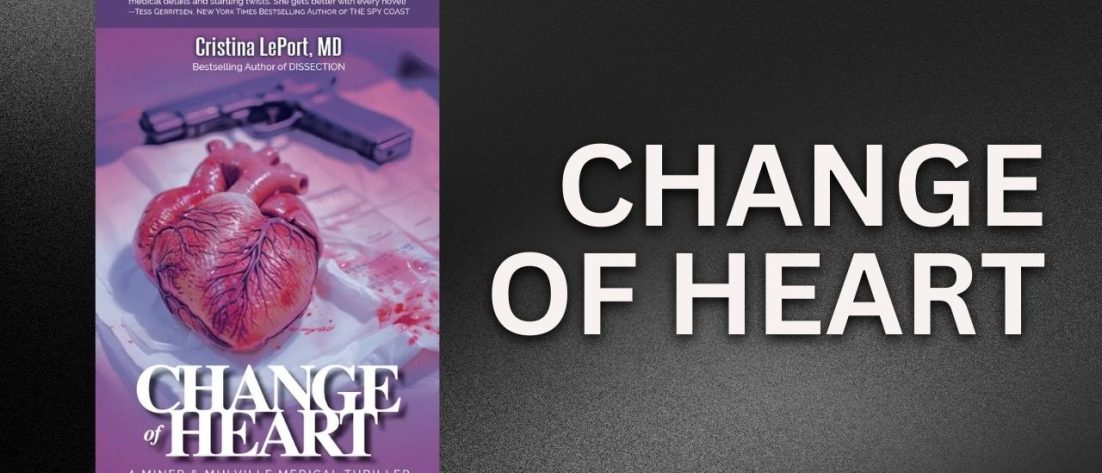
When perfectly executed suicides deliver pristine donor hearts, cardiologist-turned-novelist Cristina LePort reveals the terrifying intersection of heart transplantation and organized crime in her medical thriller “Change of Heart.” Host Blaine DeSantis explores how a mafia don’s cybercrime operation manipulates organ donation networks while FBI probationary agent Charlotte Bloom races to stop the conspiracy – all while hiding that her own heart is failing. Drawing from her medical expertise, LePort crafts a world where the 12-hour “heart box” technology meant to save lives becomes a sinister tool in the wrong hands. As family secrets and questions of identity emerge, the line between savior and predator blurs in modern medicine. Discover how this pulse-pounding thriller exposes vulnerabilities in our healthcare systems that could make anyone question: just how secure is the technology protecting our most vital organs – and our very identities?
Links:
Transcript
Blaine DeSantis:
[0:00] Hi, everybody. This is Blaine DeSantis, and I welcome you to another edition of Books and Looks. Yes, this is our weekly voyage of discovery into the wonderful world of books, history, mystery, fiction, and nonfiction, the best that I can find, along with exclusive interviews with the authors of those books. That’s going to be here exclusively on Books and Looks. Now, I want you to stay tuned after this interview for a very important announcement, please. Okay? Also want to say thank you to our good friends at TheBookTrib.com. Glad we’re partnering up with them. Today, we have a gripping medical thriller for you that blends the high-stakes world of heart transplants with the shadowy realm of organized crime. We have an FBI probationary agent who has to confront shocking secrets about her own identity while racing to stop a twisted scheme. Mm-hmm. Our author today is a cardiologist, and she infuses this pulse-pounding story with vivid realism. She explores ethical dilemmas that arise when cutting-edge medicine collides with the darkest impulses of the human heart. I’m Blaine DeSantis. This is Books and Looks, and today we’re interviewing Cristina LePort about her new book, Change of Heart. Cristina LePort, welcome to Books and Looks.
Cristina LePort:
[1:14] Thank you very much for having me.
Blaine DeSantis:
[1:15] We’re glad to have you here today. I really want everybody to know how much I enjoyed this book. I’ve compared it to those books of Robin Cook, who wrote many medical thrillers, and I love this book. So very, very happy that you could be here with us. And I noticed a bit of an accent. Tell us a little bit about yourself.
Cristina LePort:
[1:35] Yes, I was born in Italy, in Bologna. And I came to the United States after I finished my medical school at the oldest university in Bologna. And I did my training in the United States. And I practiced internal medicine for about 20 years. And then I had a midlife crisis. As an internal medicine doctor, I wanted to do some more. And so I wanted to go into my favorite specialty, which was cardiology. It’s cardiology. And it was very difficult to match a fellowship. So I started to look around and do other things. And that’s when I started to write.
Blaine DeSantis:
[2:16] Wow. So you got your certification in cardiology?
Cristina LePort:
[2:21] Yes, it took me about three years to match.
Blaine DeSantis:
[2:23] And so are you practicing now?
Cristina LePort:
[2:28] I retired from practice a couple of years ago, and now I’m a full-time author.
Blaine DeSantis:
[2:34] Full-time author. Did you write a lot growing up, or what prompted you to become a writer?
Cristina LePort:
[2:39] No. No, I hated writing. In Italy, I hated writing. We had this terrible thing every week that was called the theme, Il Tema. They would give us a title, and we would have to write something for two hours about this. And, and I just, it was a nightmare for me. I just hated it so badly. And so I never really started to write until I was in my mid-forties when I had that, that rest in between. I was trying to get into cardiology and I was looking for other things just to keep my interest. And I read a nonfiction book called The Art of Fiction by the author, Ayn Rand. I mean, the famous author, she wrote this nonfiction book about fiction, which is a jewel. I mean, it’s really a good book. And I realized that if you are an author, you can enter your world, invent characters you want to meet, and then you can make anything you want happen. And so I was just like very, very intrigued by all this. And I decided I was going to start writing novels.
Blaine DeSantis:
[3:44] That’s very good. That’s great. We’re glad you joined the people out there writing novels because this is not your first. You’ve had another in this series. I think the second book in this series, if I’m not mistaken.
Cristina LePort:
[3:55] The second book that is getting published, but I had other books. It took me so long to get an agent and a publisher. It was very hard, one of the hardest things I’ve ever done in my life. And so in those years while I was getting rejection after rejection, the treatment for my rejection was to write more because, you know, you get rejected, but this hasn’t been rejected, this is new. So you write more. And so I, I wrote four novels waiting to get an agent. So now they’re all coming out because my publisher is wonderful. He loves them. So these are two. And then there’s a prequel coming out in 2026 and another novel in October 2025.
Blaine DeSantis:
[4:39] Wow. Okay. Well, we’ll keep our eyes peeled for those. Now, tell us a little bit. Give us an overview of what this book’s about. Tell us a little bit what it’s about.
Cristina LePort:
[4:48] So Change of Heart. In Change of Heart, I wanted to have as a backdrop the worst thing that can happen to you in cardiology, which is your heart is not functioning. They tried everything they can, and now you just need a new heart. If you think about it, that alone immediately is an enormous conflict of interest because you have to hope for somebody to die to give you the heart and for you to live.
Cristina LePort:
[5:18] And so it’s a wonderful backdrop for a medical thriller because there’s a big conflict. And, and so that’s, that’s why I started that. So what happens in the book is that the number of heart transplants is going up in New York and doctors happy because usually they don’t have enough hearts. But now the problem is that the number of suicides is going up. That’s why they have more hearts. And the suicides are committed with precision because the people committing suicide shoot themselves in their head, avoiding the area that is in charge of keeping the heart beating. So the brain gets destroyed, but the heart keeps on beating. And not only that, but they conveniently commit suicide in front of a hospital so that the heart can be harvested right away. And this is the mystery. And of course, you have to read the book to figure out why this is happening, how, and there are several twists and then the final big twist at the end. You got to read the book to figure it out.
Blaine DeSantis:
[6:24] Absolutely. But now, that’s interesting because you talk about them committing suicide in front of the hospital. Has this actually been happening? Is this something that goes on in real life? Have you seen this?
Cristina LePort:
[6:39] No, this was just fiction.
Blaine DeSantis:
[6:40] I didn’t know. Well, I didn’t know if it came from something which you had seen or heard about in your career.
Cristina LePort:
[6:43] No, this was something I invented as a part of the plot.
Blaine DeSantis:
[6:47] Okay. All right. Well, all right. Well, you know, you talk about the ethics of organ donation and transplantation, and why was this the time right now to get involved in this entire, writing this book as opposed to in the past?
Cristina LePort:
[7:03] Well, because I, I am a cardiologist. At the time I was writing the book, I was still practicing. And again, I wanted to write about the biggest thing that can happen to you in cardiology as a patient, which is you need a new heart. And if you think about it, the medical world is a wonderful backdrop for thrillers because we always deal with life or death. We’re constantly under the pressure of time. And there is a big overlap between authors and writers. We both, again, have the pressure of time. The doctor has to find the diagnosis and the writer has to keep up with the pressure of time. Otherwise, the reader falls asleep. And also, both author and writer have to be able to integrate all different clues into a whole, like the doctor to make a diagnosis and the author to create a mystery. And we both have to know how to read people because that’s how you make a diagnosis and that’s how you create characters. So it’s a wonderful backdrop.
Blaine DeSantis:
[8:11] The blending, you could do everything. Yeah, very good. Okay, now the bad guy here is a mafia don whose name is Santo Motopuciano, okay? And you have him behind a bunch of cybercrime. Now, I found that interesting because all we hear about cybercrimes lately comes from Romania, where my wife was from, or from Russia, or from—why the mafia? Why the Italian? That was interesting.
Cristina LePort:
[8:37] Well, I wanted to talk about the mafia because in my prior book, Dissection, the bad guys were terrorists. So I wanted to show that I was an equal opportunity bad guy.
Blaine DeSantis:
[8:53] That’s pretty good. I like that.
Cristina LePort:
[8:54] And since I’m Italian, I figure I’ll go for it, you know, so nobody can criticize me this time because I’m from Italy, so I’m talking about the mafia. That’s one thing. But the mafia, you know, is kind of a little old kind of fashion thing. So I wanted to introduce a new thing, a new crime. I mean, if mafias want to be updated, you know, they have to update their business, you know. And so now they’re updating from the way they do organ traffic is like more specialized, is more fancy. It’s fancier. So now they’re hacking, because hacking is a modern thing. And also, I wanted to point out that as wonderful as these electronic medical records that we’re having are, they’re very vulnerable. While I was doing my research, I found out that just two years ago, there was a million and a half records that were exposed. It was a record of people having to do with heart transplant and organ matching. They were exposed to people who had no business reading these things just because of a glitch in the computer.
Blaine DeSantis:
[10:04] Oh, my word. Oh, my word. I was unaware of that.
Cristina LePort:
[10:07] It’s like a modern mobster business, you know, hacking.
Blaine DeSantis:
[10:11] So this happened actually in the world of heart transplants. Is it also big in other areas of the medical profession?
Cristina LePort:
[10:20] I’m sure it is. I mean, with everything, unfortunately, you can use it in a bad way. Every good thing can be used in a bad way, right? Medical records are wonderful. They permit you to communicate quickly. Now you can read the doctor’s handwriting. You know what the doctors say instead of not. But you know, bad guys can infiltrate and can do bad things with it. So they can mess up organ matching like it happens in this book.
Blaine DeSantis:
[10:53] Well now let’s talk a little bit about your character who I find is the lead character, Charlotte Bloom. I think we follow her more than anybody and she struggles between her personal ambition because she’s a probationary FBI agent. Okay. And also she has a personal health crisis. Wow. Was that always your intent when you began to write this book or did this grow as you started writing?
Cristina LePort:
[11:19] Well, before I start writing, I usually have to have the whole story, at least in my head with the central, obviously the central problem, the subplot problems have to be all integrated. And I have to have the climax, which should solve all the loose threads, all the different problems.
Cristina LePort:
[11:43] And so I had that in my head to begin with. But of course, as I write, things may change, hopefully improve. But it was in my mind to begin with, to have a personal crisis. Obviously, we should try not to give away all the secrets. But it’s actually interesting that you mentioned Bloom because Bloom was a minor character in my first book, Dissection. She helped one of the characters also in Change of Heart. She helped Jack Mulvill, the gruff FBI agent who was almost like a father figure and a mentor, of course, for Bloom. She helped him saving the world in Dissection. And so, and at that time, Jack Mulvill told her, well, if you want a job with the FBI, a real job with the FBI, let me know after college. And so obviously in Change of Heart, she did. And so she became the protagonist. One of my readers sent me an email after reading Dissection.
Cristina LePort:
[12:50] She said, I love the book. And at the end of the book, I was ready to hire Bloom. She’s so efficient. So I hired her for Change of Heart.
Blaine DeSantis:
[12:59] Yeah. No, she is. I mean, she’s, of everybody, she’s the one who I really gravitated towards. I really liked her character. I thought it was well-developed, and I could see the conflict she had. Because like we said, she did have her own medical issues, which she was concerned about.
Cristina LePort:
[13:19] Very concerned.
Blaine DeSantis:
[13:19] Extremely concerned about. Yeah, that would keep her from becoming a full-time FBI agent.
Cristina LePort:
[13:23] Exactly. And the other problem is that she’s falling in love with this heart surgeon. Because in order to solve the case, she has to interact with this heart surgeon. And she has to keep secret her heart condition from a heart surgeon. So that’s kind of a funny, intriguing part of the plot.
Blaine DeSantis:
[13:41] Yes, she did. She tried.
Cristina LePort:
[13:43] She’s intriguing part of the plot.
Blaine DeSantis:
[13:44] Yeah, no doubt. Otherwise, she gets graduated. You know, that gets me thinking about the entire medical procedures and the heart transplants. You get into a lot, but you don’t go into the bloody, gory details of everything. How do you decide what to put into the book versus what you think is just extraneous and the people don’t need to know about all that?
Cristina LePort:
[14:09] Yes, I never really liked to write too gory details or torture and things like that. I’m just not into that particular. Although I write thrillers, I try to do the violent part. There are violent parts, but I try to do it with taste. And I keep a very strict rule because being a professional, like in other people who are professional, I write books. You have to really be careful drawing the line where is, you know, to what the writer is the boss here. This is a novel and it’s done to entertain. It’s not done to teach anything or to convince you of anything. Now, you can come to your own conclusion. It may be about an important topic. But the purpose of a novel is to entertain yourself. You know, you can’t show off my knowledge. You can’t show off my knowledge of procedure and this and that. What is totally gratuitous is going to put the reader to sleep. They don’t care about how the surgery is done. They just want to know the detail they need to know to understand the story, the story, what drives it. And yeah, so you have to really limit yourself to that. I mean, if a reader has to put down your book to pick up a dictionary or to Google what something is, you already lost them sometimes.
Blaine DeSantis:
[15:37] Yes, you do.
Cristina LePort:
[15:38] It’s not what a thriller should do.
Blaine DeSantis:
[15:41] No. Well, that gets me back to this one thing which you call a chain. It’s a chain. It serves as a plot device. So this is a chain which I think matches organ donors with organ recipients. And explain that. And is there such a thing as a chain in real life?
Cristina LePort:
[16:01] There is. There is for kidneys.
Blaine DeSantis:
[16:03] Oh, okay.
Cristina LePort:
[16:04] Yes, there is such a thing as a kidney matching program where you can sign up if somebody needs a kidney, but none of the relatives are a match. You can sign up with a friend or a relative who is willing to donate his own kidney, and then it gets matched throughout the country to another person. Like, you know, the kidney of your donor could go to a different patient who was a match, and then the patient here would get a kidney from another person who signs up with somebody else as a patient and who’s now a match to this particular patient. So I picked up the idea. But the problem, there’s a big trick with the heart because the heart, you have to be dead.
Blaine DeSantis:
[16:58] Let me ask you, you said that you can go there, the heart can be kept alive around three, four hours, is that correct?
Cristina LePort:
[17:05] Now, with the special heart box that we have now, which I describe as a new thing, but relatively new thing, but I describe it in the book, you can keep the heart alive for 12 hours because the box has tubes that inject nourishing and warm liquid into the coronary arteries, the artery of the heart. So the heart starts beating in the box.
Blaine DeSantis:
[17:33] I see.
Cristina LePort:
[17:33] You know, so you have a beating heart inside this box. It’s really incredible. You can look it up on Google. And so this beating heart, instead of lasting four hours, like the heart in the cooler, you know, those red and white things you go to a picnic with, that it lasted only for four hours. But in the box, beating and warm, it lasts 12 hours. So you can match a patient across the country and put it on the plane. And so it expanded the horizon of matching. But the problem with the chain, you know, in the chain, the donor has to be dead if you’re talking about a heart. So it’s a twisted chain, if you will.
Blaine DeSantis:
[18:17] Do you think, Cristina, do you think that a chain will ever come to heart transplants?
Cristina LePort:
[18:24] Well, I doubt it because, you know, it’s kind of… The donor has to be dead. So I just want to, I don’t know. There is no chain for heart. There is an organization which matches dead, obviously dead donor with patients across the country and finds the best match and the heart can be shipped there. But there is no donor and patient joining together, say, I’m going to give you my heart. You know, it’s not like the kidneys that you can just do it and then survive. So that’s why I kind of twisted the chain into the heart.
Blaine DeSantis:
[19:12] One thing that comes through in this book is our dear friend, the HIPAA guidelines. You write a lot. You don’t write about them, but they’re always there, aren’t they? Everything is privacy, privacy, HIPAA, HIPAA, HIPAA. Tell us about that. Because many of us heard of HIPAA, but what does it do?
Cristina LePort:
[19:30] It’s a good thing gone rogue, in my opinion. I mean, obviously, you need privacy. This is a very delicate matter. These are health matters. But I think nowadays we’ve gone a little bit too far. You walk into a hospital as a doctor and there are no lists of patients. In the past, you had a list of your patients on the wall or somewhere. Now it’s like you have to spend time, you know, asking the nurse or finding out, try to find out where your patient is. And just to give you an example, I mean, it’s, I don’t know, it’s a little bit, I think it’s almost interfering with the delivering of health care sometimes, in my opinion.
Blaine DeSantis:
[20:15] So, you know, HIPAA, not only is it for the patient, but all the doctors get caught up in this also.
Cristina LePort:
[20:21] Yes. It’s very time consuming. I mean, again, I’m all for privacy, but I don’t know. There’s got to be a good middle.
Blaine DeSantis:
[20:31] Yeah. Well, that was one of the things they were running up against. They’re trying to find out who’s behind these cyber crimes and who’s getting to the list, who’s getting the heart back and forth. And they’re running into HIPAA, HIPAA, HIPAA. And, you know, you put in a search warrant or something like that. We get this, we get that. But it’s still there. It’s HIPAA, you know. It’s right sitting there. Wow. That was well done. I really enjoyed that. As an ex-lawyer, I enjoyed that part of the book, you see.
Cristina LePort:
[21:10] Thank you.
Blaine DeSantis:
[21:11] Okay. Yeah. But, you know, one of your characters’ name is Kirk Miner. I think I’m pronouncing that right, Miner. He faces a lot of choices between himself, his job, and his family. And keeping them safe and everything else. He was in the previous novel, I think, right?
Cristina LePort:
[21:20] Yeah.
Blaine DeSantis:
[21:20] Did you have that conflict with him and his job and his family in that other novel also?
Cristina LePort:
[21:24] A little bit. In the prior novel, actually, there’s going to be a sequel about, a prequel about him. There is a book preceding, even the dissection, which would be like almost like a trilogy. Kirk Miner in the past was a policeman. And then he became a private investigator because his wife was always worried about him as a policeman. And so he decided to go into private investigation. But he is so passionate about his work that he always ends up in serious dangers, even as a private investigator. And his wife doesn’t quite like that because she’s worried about his well-being. And what’s going to happen if he dies? What’s going to happen to her and their son? So there is this little conflict through the books.
Blaine DeSantis:
[22:21] Yeah. There is a big, I think it’s a big interpersonal conflict. It’s huge. I mean, what do you do? I mean, it’s what every policeman’s wife fears. What’s going to happen, you know?
Cristina LePort:
[22:35] But his wife is also somewhat understanding. They love each other very much. They have a strong marriage. And so, and also there is some other thing about Kirk Miner. He has a special brain. Which happened really in the prequel, which comes out in 2026. It’s called Dying to Remember. He has a terrible accident where his brain gets almost destroyed. He’s basically given for dead. And then he undergoes experimental brain surgery. And when he wakes up, he has special medical knowledge.
Blaine DeSantis:
[23:07] Oh, look at that.
Cristina LePort:
[23:08] That’s why he consults for the police in cases with medical background. And that’s why he’s called in Change of Heart.
Blaine DeSantis:
[23:18] Yeah. Wow. That’s great. That’s nifty.
Cristina LePort:
[23:23] It’s like Sherlock Holmes and Dr. Watson in one head.
Blaine DeSantis:
[23:27] Yeah. Yeah. That’s great. Wonderful. Well, now, one thing I did notice is that while we’re talking about trying to go down this situation with the cyber crimes, the heart, and everything else, you really have spent, I think, a lot of time on two complex female characters, Charlotte and her mother. I cannot remember her mother’s name. But why did you decide to really get into that relationship?
Cristina LePort:
[23:52] Marsha, yes.
Blaine DeSantis:
[23:53] Marsha, okay.
Cristina LePort:
[23:54] Well, I don’t want to give away the spoilers, but I had to do that because, you know, everything that happens at the end and the big twist. But obviously the mother is relatively minor, the character of her mother, but it’s very important.
Blaine DeSantis:
[24:10] Well, if, you know, the mother, I like the mother.
Cristina LePort:
[24:15] It’s very important, yes.
Blaine DeSantis:
[24:16] Exactly. Very important to the book. I thought it was very important to the book. And Charlotte’s relationship with her mother, I don’t know. I don’t know if they had a close relationship because they’re far away.
Cristina LePort:
[24:29] They’re far away, but they have somewhat a close relationship. But, you know, there is that problem with the secret that she has to keep. Her mother is very protective. And Charlotte has to keep her secret. She’s having this heart-fluttering and symptoms. So she has to keep it a secret from everyone, from her mother, from Mulvill, who is her mentor, like a father figure, from the doctor that she has to interact with. Because otherwise her career is on the line. They’re gonna pull her out. The moment they find out she has the symptoms, they’re gonna pull her out and put her behind a desk. So she’s not gonna be able to solve the case. She’s not gonna be able to graduate and become a real special agent. So that’s why the relationship with the mother is not as close as she can have it with, because, you know, she has to keep a secret from her as well.
Blaine DeSantis:
[25:31] Now, does she have, would she have tachycardia, AFib? Is that what she has, Claire?
Cristina LePort:
[25:37] She had arrhythmia. She had ventricular tachycardia.
Blaine DeSantis:
[25:40] Okay. Okay. But then we find she has something additional. This is not going to give away anything, but she had an additional problem. But she had an additional problem, too, with her heart.
Cristina LePort:
[25:50] Well, it is combined. One was the cause of the other. But I don’t want to give away a real problem because, you know, that’s the end. It’s a twist at the end. And it’s part of the spoilers.
Blaine DeSantis:
[26:05] Okay. But let’s ask this question. Is this a real medical condition?
Cristina LePort:
[26:11] It’s a real medical condition.
Blaine DeSantis:
[26:13] Okay. All right. All right. Because if people read it, they say, well, has this really happened?
Cristina LePort:
[26:17] Oh, no, it’s really happening.
Blaine DeSantis:
[26:19] Okay.
Cristina LePort:
[26:19] It could happen for real, yes.
Blaine DeSantis:
[26:22] That gives no spoilers away. It just tells us it’s real. By the way, having AFib and whatever I’ve got, I’ve had a hard time with this book. I kept checking my pulse. Am I okay? What’s going on? I see your background, the cover of the book. I’m looking at the heart. I go, oh, my God, you know.
Cristina LePort:
[26:39] Well, AFib is not as dangerous as what she was having. No. And it’s very common, and a lot of people live very long lives with AFib as long as it’s treated. So it’s in a different category from this problem.
Blaine DeSantis:
[26:53] It’s still worrisome when you have it. It’s still worrisome when you have it. Yeah, when I got to go see a heart doctor every year, I don’t like that. But anyway, wow. Well, that’s really interesting. Now, you know, by the time we get to the end, you know, we get to the end of this book, and you combine so much in like the last chapter or so of this book. I mean, you combine, oh, you talk about family and you talk about the crime and you talk about identity. How did you do that? I mean, that was all very, did it take a while to write that?
Cristina LePort:
[27:30] Well, when you end the book, I always make sure that I tie up all the loose ends. That’s what the climax should do. The climax should bring everything to an end, to a peak, and then, of course, then there is the explanation, so to speak, in the final chapter. Everything relaxes after the climax, and you finish tying up the loose ends with what happened, which comes from what happens in the climax, so it’s very important to do that. I don’t like reading books where you spend all these hours, and then at the end, a lot of things are not solved. It leaves you hanging, really. I don’t like that. So I like when my readers take the money to buy the book and the time to read it, they’re going to have to be satisfied at the end. They will be. With my books, they will be satisfied that everything is taken care of and explained and everything.
Blaine DeSantis:
[28:40] Let me ask this question of you. How long did it take you to write this book?
Cristina LePort:
[28:43] Well, you know, I was working, so it took me probably a couple of years because I was still working. And then, of course, it took longer to edit it and all that.
Blaine DeSantis:
[28:53] That’s what everybody says. The rewrites, the edits, can take longer than the actual writing. Yeah. Yeah. But now, you’ve got, now you’ve tickled us a little bit with a prequel, okay? And now you said there’s also going to be a sequel, too.
Cristina LePort:
[29:07] I have two more books with Kirk Miner and also Mulvill’s, some appearances, also Bloom’s. I fell in love with these characters, so I kind of kept them. But all my books can be read independently, so one can pick up Change of Heart and read it, and it’s nothing to do with Dissection. It’s just that some of the characters are in common. That’s about it. But you can read them independently. But there are other ones coming. There are other ones in the making. There is another book that’s coming in October, which is totally independent from the series. But all the other ones will be in the series. The one coming in October is independent.
Blaine DeSantis:
[29:48] I had one author tell me that when he began writing, he envisioned a series of 20 books. Really? Wow. I said, yeah. And he’s on book 16. So he’s sticking to, so what happens after book 20? He goes, we’ll have to see, you know, he’s having a good time.
Cristina LePort:
[30:04] They’re series and series. You know, there are some series that they’re really interconnected in such a way that you must read them in order. You know, I mean, The Outlander, for example, you can’t read a book in the middle, you know, just to give you an example. But other books, for example, Reacher by Lee Child, you can, in theory, you can read any book because it’s just Reacher doing different things. So these books are more like the Reacher series. They’re independent. They’re similar. They’re the same characters doing different things. So in theory, there could be many. I hope my readers fall in love with the characters just the way I did.
Blaine DeSantis:
[30:48] Yeah, absolutely. And now you’re retired, but you’re also married to a doctor, aren’t you?
Cristina LePort:
[30:54] I am.
Blaine DeSantis:
[30:55] Is he practicing or is he retired as well?
Cristina LePort:
[30:58] He was a surgeon.
Blaine DeSantis:
[31:00] Okay, all right, wow. You got everything covered. You got internal medicine, we got cardiology, we had surgery, we got…
Cristina LePort:
[31:06] Cutting off things.
Blaine DeSantis:
[31:08] Do you have any children who are in medicine also?
Cristina LePort:
[31:12] We have three kids, and none of them went into medicine. The closest one is, well, two of them are in some field. One is a lawyer. One was a physicist, graduated in Stanford physics, and then now is doing genetics. He has a startup called Gordian.
Blaine DeSantis:
[31:34] Wow.
Cristina LePort:
[31:35] He’s doing genetic research. And our daughter started with neurobiology and then ended up in data science. So I guess the Big Bang Theory switched professions in our family. They went opposite. One went from physics into biology and one went from biology into data science. So everybody has to find their own way, you know.
Blaine DeSantis:
[32:01] Before we go, you were born in Bologna. You were born in Bologna. Do you go back to visit every now and then?
Cristina LePort:
[32:06] Every year. My sister is there.
Blaine DeSantis:
[32:07] My sister is there.
Cristina LePort:
[32:09] I have relatives there, so I have to go every year.
Blaine DeSantis:
[32:12] So do I, but every year. I think I went 10 times. And after that, I think they don’t want to see me anymore.
Cristina LePort:
[32:18] Well, my sister is there, so I just need to see her once a year.
Blaine DeSantis:
[32:22] When my grandfather went over, the first time he went over, everybody was so happy to see him. Oh my God, it’s Frank. Oh, here’s Frank. And he took everybody pens, okay? Next time he goes over a year later. Hey, Frank, you got any pens? Oh, yeah. They’re giving out pens to everybody. The third time he goes, oh, Christ, here’s Frank with the pens. Let’s get out of the way. But, you know, it’s fun to go back and visit everybody in the old country. No doubt about it. Very good. Well, listen, I don’t want to take up any more of your time. You’ve been charming and delightful. Cristina LePort, thank you so much for being on Books and Looks.
Cristina LePort:
[33:00] Thank you.
Blaine DeSantis:
[33:01] Well, that certainly was a great interview with Cristina. I’m telling you what, I really enjoyed this medical thriller, and I think you will too. Lots of twists, lots of turns, shocking developments here, there, and everywhere in this book. Hey, what’s the big thing I’m going to talk to you about today? I want to refer you to booksandlookspodcast.com. That’s right. The website is up, booksandlookspodcast.com. You can go there. You’ll see each episode is going to be there. You’re going to see a blog. You can sign up for a newsletter. It’s thrilling, to be very honest with you. I’m having a great time with it. I can’t wait. Thank you. Thank you. Thank you to my son, Nathaniel, and the people at Podcast Studio X for making it all happen. So anyway, on behalf of TheBookTrib.com and the good folks at Podcast Studio X, this is Blaine DeSantis for Books and Looks, saying may all your leaves be pages in a book.