
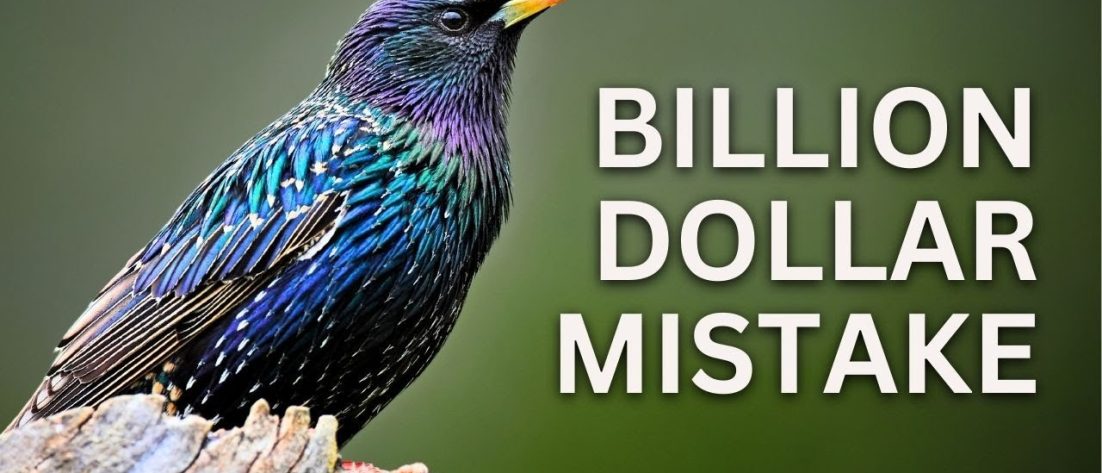
They transform American skies into living art, yet these same iridescent birds represent one of history’s most spectacular ecological disasters—all because one Victorian gentleman released 200 starlings in Central Park in 1890. When Eugene Schieffelin’s well-intentioned birds exploded to 200 million strong, they unleashed agricultural havoc costing billions while pushing native species toward extinction. Author Mike Stark unravels this remarkable saga of unintended consequences, debunking the persistent Shakespeare myth while uncovering forgotten footnotes—from Mozart’s musical pet starling to the bizarre “Starling War” that once rained thousands of dead birds onto Irish streets. As these unstoppable invaders continue their conquest, their story forces us to confront profound questions: When does an invasive species become native? What responsibility do we bear for the ecological disruptions we set in motion? Listen now to this captivating blend of natural history and human folly that will forever change how you view those shimmering flocks dancing across the twilight sky.
Links:
Transcript
Blaine DeSantis:
[0:00] Hi everybody, this is Blaine DeSantis, and I welcome you to another edition of Books and Looks. Yes, this is our weekly voyage of discovery into the wonderful world of books: the books I’ve been reading, the best of history, mystery, fiction, and non-fiction, along with the interviews with the authors who write these books. You’re not going to find that any place other than Books and Looks.
Blaine DeSantis:
[0:22] And let’s not forget our partner, that’s right, our dear friends at BookTrib.com. That’s right. If you want a book review, you want to buy something bookish, you want to look at BookTrib.com. I use it. I use it every day. I hope you do too. And let’s not forget, hit that subscribe button. That’s right. We like to hear from you. You get this every week. You don’t want to miss a week, especially this one. Wow, this is a great book. Anyway, they were released upon America with the best of intentions: to beautify the skies, to fill the air with song. But in the span of just a few decades, these small iridescent birds multiplied into the millions, sparking one of the most intense and futile wildlife wars in our nation’s history. We’re going to dive into science. We’re going to dive into history and the complex relationship between humans and nature. In today’s book, Starlings. That’s right, starlings, the bird. This is going to chronicle the astonishing true story of one man’s folly, the unforeseen ecological consequences that developed from that, and the starlings’ indomitable will to survive. This is Blaine DeSantis and Books and Looks. And today we’re interviewing Mike Stark about his new book, Starlings. Mike Stark, welcome to Books and Looks.
Mike Stark:
[1:36] Thanks, Blaine. Great to be here.
Blaine DeSantis:
[1:38] This is one fascinating book that you have written, my friend. What a great book. I’m going to tell you what. Starlings. A whole book on starlings. When I first saw this, I thought it’d be like 30 pages long. Okay, a little picture book about starlings. I thought 30 pages long. It is great. How did you decide to write a book about starlings?
Mike Stark:
[2:04] Well, I spent a lot of my early career as a reporter, as a journalist for newspapers and the Associated Press. And one of the great things about being a reporter is that it gives you permission to be curious about all sorts of things and to poke your nose into all sorts of corners where other people wouldn’t normally go. So one of the things I covered was wildlife and the environment. And so I was covering this agency called Wildlife Services, which is a federal agency that’s set up to deal with nuisance birds and coyotes and all sorts of things when they get in trouble, when they wander into where people are living. But one of the things they do is they produce a tally every year about how many animals they kill and harass and shoo away. And I was curious who got the most attention from them, and it turns out it was Starlings. And so this agency kills about a million starlings every year. And so that’s about 3,000 every single day. And it also shoos away about 29,000 every day. And so that really got me thinking, who is this bird? Why is it taking up so much of our time and attention? And how did we get here in the first place? So that was kind of the impetus of the book. I wrote an initial story as a journalist. And then I just sort of kept it on my list of things to look into later.
Blaine DeSantis:
[3:24] Yeah, well, that is, that’s amazing, those numbers you’re giving us. But the starlings are amazing in their numbers, so I guess you have to be killing a million a year. That’s it. That’s amazing, just amazing. Well, anyway, this starts with a guy by the name of Eugene, I want to make sure, is it Scheiflin? Is that how you pronounce that? Scheiflin? Okay. So he releases these birds in Central Park and then… So tell us a little bit about Eugene and this thing called the American Acclimatization Society. I never heard of that word, acclimatization.
Mike Stark:
[3:58] Yeah. So Eugene Scheiflin was the son of a lawyer in Manhattan. His family had run a business in New York City for generations. They were in the pharmaceutical business and they also ran a mercantile, but they were a very well-to-do family. And he had a lot of siblings, and a lot of them ended up working for the company. He never made it to the top of the business masthead.
Mike Stark:
[4:21] So he had other interests. He was kind of a man of leisure. So he was a rich guy in New York City. And he was apparently quite a good painter, was involved in a lot of different social clubs, but he was also really into birds and ornithology. And so in the late 1800s, there was this movement called the acclimatization movement. It started over in France, but also came to America and other parts of the country. And basically, the idea was, why don’t we bring animals from other parts of the planet over to where we are? And so sometimes it was livestock, sometimes it was plants, sometimes it was fish, and sometimes it was birds. And so what really inspired the American acclimatization movement, which really Eugene Scheiflin was kind of the head of, he was the president of a local chapter, they really wanted birds that could deal with insects, eat insects, and also bring songs to America. A lot of these people wanted the songs from back home where they were in America. So a lot of immigrants came to America, left everything behind, probably weren’t going back home ever. And there was a sentimentality to it. They wanted to hear the sounds and see the birds from back home. And so Eugene was part of introducing a whole bunch of birds to America. Most of them never took.
Mike Stark:
[5:47] He was part of a movement to bring sparrows, to reintroduce sparrows or to introduce them, to New York. So he did that in the 1860s. And a few times he tried to bring starlings, and those didn’t really take. And then he had a three-year run in Central Park from 1889 to 1891, and he released pretty close to 200 starlings in Central Park. And those were really the birds that bred quickly and marched across the country. And really within several decades, by the 1940s, Eugene’s starlings that had started in New York City were now on the West Coast, causing all sorts of consternation for people.
Blaine DeSantis:
[6:27] Yeah, apparently they are not affected by climate, about altitude. Nothing. Nothing deters these birds.
Mike Stark:
[6:32] They’re amazing, hardy birds that can survive in almost any kind of environment. They really started over in Europe and Asia. This is the common starling. We call it the European starling here. But they’re now found on every continent except for Antarctica. So they’re really amazing survivors, colonizers. They’re able to change their diets, survive in all sorts of environments.
Blaine DeSantis:
[6:59] My wife was just talking to her friend, Claire, who lives over in, who had lived over in Germany and distinctly remembers the starlings. Knew all the issues with the starlings.
Mike Stark:
[7:11] Yeah, I mean, that’s a native bird over there. And so, a lot of people have been with, lived with starlings for thousands of years over there and have had some of the same issues we’ve had here with farms and crops. But also, in a lot of circles, they were a beloved bird over there as well.
Blaine DeSantis:
[7:28] Wow. Well, now, there is a rumor that Scheiflin brought these starlings over here because of his love for Shakespeare. Now, this is a rumor, a myth, whatever. Tell us about what that is. And have you dispelled that myth?
Mike Stark:
[7:45] Yeah, it’s a great story. It’s one that’s repeated every time starlings come up in news media and in discussions and among birders is that, wasn’t that the bird where this crazy guy in New York wanted every bird ever mentioned by Shakespeare to be here in the United States?
Mike Stark:
[8:02] And it’s a great story of sort of human folly and hubris. Unfortunately, it’s just not true. There’s just no evidence to back it up. There was a movement at the time when Eugene was bringing his starlings here to kind of bring Shakespeare back into the public culture after the Civil War. He’d just kind of fallen off. And so there were a group of people that were creating a Shakespeare garden in Central Park. And there had just been a book that came out about all the birds mentioned by Shakespeare. But really, there’s no evidence to kind of connect Eugene Scheiflin with the Shakespeare rumor. It wasn’t until the 1940s where a magazine writer sort of made that connection. And we don’t know if he just kind of got mixed up, conflated some events or what have you, but you can definitely see in what’s written about starlings, everything after that article in the 1940s mentions this Shakespeare-Starling connection, but there’s nothing before that that ever mentions it. And so I looked and looked and looked and never found a connection. And there were some academics as well who did a very deep dive into this very question a couple of years ago, and they came up empty. And it’s basically a story that’s a great story, but it was never fact-checked and it was probably never true.
Blaine DeSantis:
[9:18] Right. And did Scheiflin never leave any notes or anything in his writings?
Mike Stark:
[9:24] It was pretty scant. I mean, we know that he did it. We know he reintroduced these starlings. We know a little bit about why, but none of his writings, nothing ever in the public sphere ever mentioned this thing with Shakespeare.
Blaine DeSantis:
[9:37] Wow. It’s funny because initially you write how Scheiflin is sort of like, oh, wow, he’s a quirky guy. This is really neat what he’s doing. And all of a sudden, oops, Scheiflin, what a nut. Why did he do this to us?
Mike Stark:
[9:51] Right. Well, the law of unintended consequences, and things going out of control. And Scheiflin is looked at as this sort of misguided bird lover. And from our modern perspective, we look at it and say, what are you nuts? What are you thinking? But back then, it was kind of a different world and a different way of relating to wildlife. And I think he was just interested in having more great birds from his homeland.
Blaine DeSantis:
[10:21] Well, now, here in this book, you explore what is truly a tension between our viewing of the starlings and marveling at their, what you call the murmurations, and as well as their singing, but their invasive pests also. And you have to balance this. How do you go about doing that? Boy, your feelings also have to change back and forth on these birds.
Mike Stark:
[10:43] They really do. It’s a really complex question and story and, really, a paradox. I love birds. I love nature and wildlife. I’m crazy about it. On the other hand, you have this bird that’s really not supposed to be here and is not going anywhere now at this point. We’re never going to get rid of it. And so, yeah, part of this question I’m wrestling with in the book is, at what point does an invasive species become a native species? How long do you have to be here to earn your stripes, so to say? And so it’s a very complicated question because obviously they also are tough on native birds and drive out birds from cavity nests. And I love native species. And so my first and foremost thought is, we’ve got to do whatever we can to protect native species. And invasive species are bad. Yes. On the other hand, you do look up in the sky at these murmurations. And it’s poetry up there, watching them fly around and twist and turn. One ornithologist called it a dance in the clouds to the music of the winds.
Blaine DeSantis:
[11:50] For those who have never seen the starlings, it’s like the swallows. They just boom, boom, back and forth, amazing.
Mike Stark:
[11:58] Tens of thousands of them up in the air in kind of this black twisting cloud going from one shape to another. And it’s really extraordinary to witness.
Blaine DeSantis:
[12:06] Wow. I don’t think I’ve ever witnessed that. As I told you, I did see swallows and they seemed to part when I started singing, when I was growing the grass. So I understand that. Well, anyway, these, these, these birds, they are, you alluded to it a little bit. They’re sort of aggressive. They will drive out the native birds. They will, they’ll take their nests. Tell us a little bit about how they do this.
Mike Stark:
[12:30] Yeah, I mean, a lot of times they are opportunists. So they will often kind of keep an eye on one cavity, and if there’s a purple martin or another bird that’s in there, once those birds fly out for the day to go get a snack or something, often starlings will move in and just kind of take over. And when those birds fly back to their hole or their nest and find a starling there, they’ll either fight it out a little bit or just decide, well, okay, you keep that spot, I’ll go find somewhere else. So they will really move in quite aggressively and take over territories of all sorts of native birds. And that’s part of what makes them such a great survivor and colonizer is they can really move in, take over, breed, and then keep moving on again.
Blaine DeSantis:
[13:19] You make a point, one point in the book, which I really liked, where you said that, we always, the dream is to rise to the top. We always want to give credit to that people who started low and rise to the top. But with the starlings, not so sure we want to do that.
Mike Stark:
[13:36] Yeah, it’s tough. I think we can live with that paradox of understanding them as great survivors, but maybe not liking the results still. You can admire their tenacity and their ability to survive and still be sad about what they’ve done to native birds.
Blaine DeSantis:
[13:52] One of the things that you bring up, which I found fascinating, is the great Starling War of 1621 over in Ireland. Tell us about the Starling War.
Mike Stark:
[14:04] Yeah. So, starlings were a European bird, as I said. And so, the stories about starlings really go back thousands of years, even back to Roman times. And there were people in Rome whose job it was to divine what these murmurations were saying in the sky to try to help find some secret message up there. So they’re very well known. And in 1621 in Cork, Ireland, there were two huge groups of starlings, one that came to the west side of the city and one that came to the east side of the city. And over the course of a long weekend, these birds would kind of meet in the middle of town in this huge battle. And so they were pecking at each other and breaking each other’s necks and wings and poking each other’s eyes out. And so you would have these birds that were falling from the sky onto houses and into the river by the dozens and thousands and hundreds. And so this went on for three or four days. Apparently they took Sunday off, say with that what you will, but they took a day of rest and they were back at it on Monday and they fought all day on Monday, these two huge flocks. And then suddenly they vanished. And the whole thing was over before anybody really even knew what happened, except that the whole city was just littered with dead starlings. It’s pretty mysterious.
Blaine DeSantis:
[15:21] That is. And that’s been documented?
Mike Stark:
[15:23] Well, it’s a story that’s been shown to have been told and retold down the ages. So, you have to take all of that stuff with a grain of salt. But it does kind of make sense and goes with the lore for sure.
Blaine DeSantis:
[15:35] I had another one of my wife’s friends. She’s from Wales. OK, she was over and she’s, I told her about this. And she goes, oh, you know the Irish. There’s a bit of the Blarney in what they say.
Mike Stark:
[15:45] Of course.
Blaine DeSantis:
[15:46] Well, I don’t know. Mike made it sound like this really happened. They have newspapers. They have eyewitnesses. They have all sorts of things. But it’s a great story. It really is. These two battling groups of starlings. It’s fascinating. These are fascinating things. One of the things that you did bring out was that every group of immigrants who came to America seemed to want to bring their birds with them. They liked their bird. The Norwegians liked one type. The Italians may have liked another type. And our like of birds rose and fell with the immigrants. Tell us a little bit about that. That’s fascinating.
Mike Stark:
[16:26] Yeah, I think that we all want to have a piece of home when we’re away. And I think that as so many people moved to America, especially in the 1800s and early 1900s, people brought their birds with us. So some of them were hunting different kinds of grouse back home, and so they brought grouse here. Some of them wanted to hear starlings or sparrows or goldfinches or whatever your native bird was from back home. You really wanted to have it here. And so what you had was, in the late 1800s, there was a very intense period of transition for birds in America because you had certain bird species going extinct, like the passenger pigeon. And this was a species that was so numerous, it was four to five billion of them. And so when they passed over, it would darken the sky for several days.
Mike Stark:
[17:20] And so they were being driven extinct at the end of the 1800s, which is an incredible native species. And also a bird called the Great Auk up in New England was being driven extinct. And the Carolina Parakeet, another native species. So all of these were kind of heading toward extinction in the late 1800s, early 1900s. And at the same time, you had this movement of people bringing birds from back home to America. And so it was this really transitional period for the avian life here in America. You had most of these introductions didn’t really take. It’s very hard to bring some birds over in cages where they’re really stressed out and then release them and then expect them to survive in a new environment where they’ve never been, where they never evolved. So most of them really didn’t take, but ones like sparrows and starlings that were really hardy and great survivors were the ones that made it.
Blaine DeSantis:
[18:17] Wow. That’s interesting. Now, hey, there’s another myth, another rumor. I don’t know. Tell us about Starlings and Mozart. Is there a tie-in, a connection between Mozart and the Starlings?
Mike Stark:
[18:29] There is. Mozart, it’s kind of a funny story. He was completing one of his compositions, I think this was in the 1700s. And he had just wrapped up this composition. It was going to be debuted by a piano player a few weeks later. And he walks into town, and walks into a pet store and is whistling this tune that he’d been composing and working on, whistling kind of a line from the song that he had just composed. And he hears this line being repeated to him in the shop, and it turns out to be a starling. So starlings are incredible mimics. And so we know that they can mimic the sounds of other birds. We also know they can mimic music. They can mimic car alarms. If you go onto YouTube and look at that, they can mimic the human voice. So Mozart was fascinated that the starling was picking up his song he had just composed. So he bought it and kept it as a pet for a long time. And there’s more kind of speculation and rumors that there was another piece that may have been inspired by his pet starling. We don’t really know, but we do know it’s been pretty well documented that he did have that pet starling. It was with him for quite some time. And then when it died, he ended up having a funeral for it and writing kind of this great poem about it.
Blaine DeSantis:
[19:50] Huh. You know what? Did that make it into the movie Amadeus? I don’t remember.
Mike Stark:
[19:54] I don’t remember seeing that.
Blaine DeSantis:
[19:56] I’m going to have to go back and watch that movie again. I like the movie, so I’ll watch it one more time to see if the Starling made an appearance.
Mike Stark:
[20:02] Good idea.
Blaine DeSantis:
[20:03] That’s a good show. That’s good. Very interesting. Very interesting. Now, in addition to the birds, okay, we’ve got some pretty colorful characters here. Beginning with a guy by the name of, let me try the name right, Otto Stanky. Stanky? Stanky? Stanky. The Birdman, who went around with a black box claiming he could get rid of Starlings. Tell us about the Birdman.
Mike Stark:
[20:25] What? As with anything, when you have a crisis in public, there are always hucksters going to kind of come along and say they’ve got the solution for you. And so as starlings spread across the country, they really marched like a conquering army from one edge of the continent to the other, expanded and, thousands became millions, became a couple hundred million. And so starlings were really infesting so many parts of the country, especially in cities. And so they were roosting in church steeples and on top of banks and in trees and in public parks. And it really became a nuisance. People really objected to the noise. They objected to the mess they left behind.
Mike Stark:
[21:06] So of course some people saw dollar signs. When people are crying about a problem, somebody is always going to come along and say, Hey, pay me some money and I can help deal with this. And so Otto Stanky was a great entrepreneur. He was a salesman. He had sold Columbia records for a while. He worked for Montgomery Ward for a while. He was kind of a traveling salesman. But he also, once the Starling problem hit, he claimed to have this secret method to drive Starlings away. And so town would pay him a few thousand bucks and he’d show up and he would have this black box, and he would never reveal what’s inside the black box. And then he would also show up with these paddles that he would clang together. And so his method was essentially to go out at night when the starlings were roosting in town and walk around, maybe the black box sometimes it hung around his neck. Sometimes he’d have it in his hands and then he’d be banging these paddles.
Mike Stark:
[22:03] And claiming that he was driving the Starlings away. And sometimes it worked, sometimes it didn’t. Most of the time you end up driving the Starlings from one part of the town to another and from one block to another. But he ended up making quite a bit of money and had a lot of business. For decades, his job was to drive Starlings away.
Blaine DeSantis:
[22:24] Wow. There’s another guy. Joseph Fink, I think is his name. He also made anti-Starling products.
Mike Stark:
[22:31] Yeah, his thing was he created this goo that would go on to trees and he claimed that when the starling stepped into this goo on the tree branches, it made their feet kind of burn and they wouldn’t want to be in those trees anymore. So he had this product called Roost No More. And he also did great, great business. It was great guns going for him. And so one of the things that he was able to secure was every four years for the presidential inauguration, he was hired to go and spray his gunk on all these trees along Pennsylvania Avenue so that people that were watching the presidential parade go by wouldn’t get starling poop on them while they were standing there. So he, I think from Eisenhower all the way through Nixon, he had that gig coming there every four years with the team to spray this goo on the trees. And again, kind of worked, kind of kept the trees clear, not for very long. And often just drove the birds to a different part of the city. Yeah.
Blaine DeSantis:
[23:37] Yeah. They really, they really took over Washington, tops of buildings and everything else. It was terrible.
Mike Stark:
[23:44] Yeah. Yeah, even in the White House, JFK was complaining about the noise outside of his windows. Nixon, same thing. And so there were guys up in the trees around the White House with the cat-o’-nine-tails, those whips with things connected to the end of them. Whipping, rattling rocks in soup cans, spraying water. It was a mess.
Blaine DeSantis:
[24:08] Yeah. I mean, there were so many, so many different ideas how to get rid of these birds, including like sonic booms or something like that, noises. And I can’t imagine, like Philadelphia, they had somebody shooting loud noises for days. Can you imagine living next to that? Yeah, yeah. But then, go ahead.
Mike Stark:
[24:27] Well, that’s part of what I found fascinating was sort of the entrepreneurial spirit that it inspired. So many people thought they had the right idea to get rid of starlings. And so sometimes it was shooting Roman candles into trees. Sometimes it was hanging teddy bears in trees. One guy tried putting his dirty diapers up there. You had fake snakes, you had fake owls, you had real owls. So all manner of explosives and fires and dynamite. And then, yeah, in Philadelphia, there was, for several days, they had these loudspeakers mounted on the back of the pickup truck and they were driving around Philadelphia city hall, blasting these starling distress calls onto the city hall in hopes of driving away the starlings that had been roosting there.
Blaine DeSantis:
[25:12] Wow. There are, these are some amazing, amazing stories. But I don’t think anything can top the bright idea that someone had that said, listen, none of this is working. Let’s eat the doggone things. And then that leads me into this thing called the eradication by mastication movement. Tell us about that, Mike.
Mike Stark:
[25:34] Yeah, that’s one of my favorite things. Again, people trying to figure out how are we going to get rid of these dang things. And truth be told, humans are pretty good about getting rid of species when we have our appetites and our gluttony. People thought, well, maybe this is, maybe this is the weapon against starlings. And so really not long after they came to America and became a problem, people started thinking about what to do with starlings, particularly, if we’re killing all these, should we feed people with them? And so there was a, in the 20s and 30s, sometimes they would kill a bunch of starlings and give them to needy people for food. But really then in the 40s and 50s and 60s, there was this movement. There was kind of a starling supper club kind of concept where, let’s start cooking starlings in different ways and starting to market it a bit more and starting to think about what the right recipes are. And so, in the 70s, there was a big debate within some of the federal agencies about, do we need to start encouraging the public to eat starlings? Do we need to start releasing recipes? And there was some poor biologist in Indiana who took it upon himself to start preparing starlings in different ways to find the best way, the best recipe. So he was barbecuing them and broiling them and boiling them.
Mike Stark:
[27:01] And he eventually tried them seven or eight different ways and just said, it still tastes like a liver that’s been left out on the street for a week.
Blaine DeSantis:
[27:10] Well, I’ll tell you what, it’s again, it’s fascinating because you make the point or someone made the point, but you wrote about it, that our love of game birds as a food source sort of died off as we understood and got more chicken meat. The chickens took the place of game birds. I never realized that.
Mike Stark:
[27:32] Yeah. As our food systems kind of became more industrial and worked at a bigger and bigger scale, they need to homogenize their product a little bit, so it’s consistent. And sometimes game birds, there’s some variety in there. And yeah, so we really evolved from eating the birds that we had killed or our neighbors had killed or somebody locally had killed to eating birds that had been raised somewhere else in a big factory and now end up on our plates.
Blaine DeSantis:
[27:58] Well, in 1939, Rachel Carson, famous environmentalist, writes a defense of starlings. And this starts to change a little bit of the give and take about this. Tell us a little bit about Rachel and what happened with that.
Mike Stark:
[28:17] Yeah. So Rachel Carson, this was in 1939. So she wrote a very famous book called Silent Spring in 1960 that really talked about environment and pesticides. But long before that, she worked for the federal government as a biologist and a marine biologist and also as a writer. And she’s an incredible writer. All of her books are great. Read a lot about oceans and stuff.
Mike Stark:
[28:39] But in the 30s, people were really kind of freaking out about starlings as they took over the country. And Rachel Carson came out with this magazine piece called “In Defense of Starlings” and did a couple of things. One, she said, hey, look, the science shows that maybe they’re not as bad as we think they are. Maybe they’re not eating as many crops as some of our native birds are. Maybe their reputation precedes them a bit more than it should. And so she recognized they had been villainized for a really long time.
Mike Stark:
[29:13] She was also a biologist, and so she was watching not only sort of their habits, but also understood sort of the beauty of these birds. And so her argument was basically, hey, maybe we need to cut them a break, give them a second look. They’re definitely not going anywhere now. They’re here to stay. And so maybe we need to start evolving our thinking about these birds and, A, stop villainizing them, and, B, start looking at what their role might be in our native ecosystems here. And so that kind of kicked off sort of a mini movement of people coming out in defense of Starlings. There were different writers and a few biologists that came out. Certain articles would be published. It was definitely an uphill climb, though, because I think the die was already cast for Starlings. They were already the villains of the sky. People called them flying rats. And so, she did start to change the conversation with that piece, but we’re still all these years later, 70 years later from that piece, I think still living with a bird that’s by and large still considered a villain.
Blaine DeSantis:
[30:21] And do we consider most of these invasive species villains? I mean, the carp, I know they talk about that and other things. Are they really the villains now?
Mike Stark:
[30:33] I mean, I think in a lot of ways they are. Depends on the species. There are things like zebra mussels, which really take over water ecosystems and create havoc wherever they go. And really create these very homogenous environments. And so it’s really bad that they really put the crimp on biodiversity. And so, and you have pythons in Florida that were released there. And so, and they’re kind of wreaking havoc as well. And so some invasive species really, really do transform whatever ecosystem they show up into in really profound ways and drive other species extinct and cause all sorts of problems. But it’s definitely a spectrum of how bad invasive species are, but there’s no question that invasive species around the world are a massive problem, not only for native species, but also for human systems and infrastructure. It’s definitely an issue.
Blaine DeSantis:
[31:33] And it’s not just here in America. It’s all over the world, they’re invasive species.
Mike Stark:
[31:36] Absolutely. I mean, as this world has become more global, the species have moved around either inadvertently or on purpose. And so the roots of that acclimatization movement in the 1800s, while it’s not called that anymore, you still have this transportation of species all over the planet all the time in ships and containers and all sorts of things. And so it’s really tough to get the genie back in the bottle at this point.
Blaine DeSantis:
[32:06] Yeah, it is. You have a chapter called Death from Above, which talks about the 1960 crash of Eastern Airlines Flight 375. Tell us a bit about that and this relationship to the Starlings, please.
Mike Stark:
[32:19] Yeah. So this was in October 1960. There was a flight that was taking off from Boston and within about five or six seconds after taking off, it ran into a flock of starlings that was in the air and was sucked into… all three of their four engines had starlings inside them. And this plane ended up crashing into the Boston Harbor and 62 people were killed.
Mike Stark:
[32:46] And bird strikes have always been an issue with aviation. People sharing the skies with birds. Birds were there first. We’re kind of visiting there. And so it’s always been kind of an issue. So this particular crash, which is still the worst, deadliest collision between a flock of birds and an airplane in the U.S., really caused us to rethink a little bit about our interactions with birds and airplanes. And so one of the things that it prompted was a redesign of some of our jet engines. So they would be hardier and have more of an ability to take in a few birds, especially small birds, and still survive and still keep flying and keep going. And so after that crash in 1960, there was a retooling of some of those jet engines. And also, that was kind of when this movement started around airports to try to keep birds away from runways. And this is work that’s still going on. Wow. There’s often around airports, there’s big banks of grass and there’s water and all these places where prophets were perching birds and not good for birds and airplanes. And so there are now biologists and other people at airports whose job it is to shoo birds away so that airplanes can take off and land safely.
Blaine DeSantis:
[34:09] It is amazing how you see all those airports come in and out of the airport. You’re going over water all the time.
Mike Stark:
[34:14] Yes. Yes.
Blaine DeSantis:
[34:16] The only place I never had that happen was in Rapid City, South Dakota. We landed in the field of cows. Other than that, I mean, it’s always over water.
Mike Stark:
[34:24] Right.
Blaine DeSantis:
[34:24] Right. Yeah. That’s utterly amazing. Utterly amazing. Things you don’t think about and which are done probably in cases of accident or a ditching you have to do, it creates worse problems. It’s fascinating. You know, before I finish this up, I want to ask, you work for an agency. You work for an NGO, if I’m not mistaken, don’t you? You have other things. Tell us just a little bit about that so if people are interested, they can find you guys.
Mike Stark:
[34:48] Yeah, thanks. Yeah, the organization is called the Center for Biological Diversity, and it’s all about saving endangered species and the places they live. And so we advocate for wolves and polar bears and sea turtles, but also fish and snails and all sorts of things. It’s all about keeping biodiversity intact. Without nature and without biodiversity, we can’t really exist. This planet really can’t function correctly. And so all day, every day, we’re focused on trying to save those species and make sure that they don’t go extinct.
Blaine DeSantis:
[35:22] Well, that’s great. That’s really great work. I’m glad you did that. I’m glad we gave a little plug here. But my last big question is you state that Starlings have caused about a billion in agricultural operations annually. That is a huge number. What are we talking about here? What are they doing? Eating grain or what?
Mike Stark:
[35:42] Yeah, I mean, a lot of it is eating food that’s put out for cows at these big industrial cattle operations. So the starlings get hip to where that food is and they flock in and eat the food. They make a mess of farming equipment. So they’ll go and just all of their bird poop will be all over all sorts of equipment. They also love to eat crops like wine grapes and cherries and those kinds of things. And so, sometimes they’ll swoop in and eat entire trees full of a year’s worth of crops. But a lot of it is just their sheer numbers. There were about 200 million starlings in this country, and now there’s about 80 million. So it’s not as many as they used to, but it’s still one of the most populous birds in the country, second just to sparrows. So part of it is just the numbers. And so also in cities, they make a mess on sidewalks and on buildings and windows and all of that costs money to clean up. So altogether, yeah, this is a pretty major cost.
Blaine DeSantis:
[36:48] Yeah, you wrote about one church where they were going up to the steeple to get rid of them and they had to walk on steps that were filled with eight to ten inches of bird poop. Incredible, incredible. Yeah, just the volume. Yes. Yeah. Where will we find most starlings? Where will you find the biggest amount of starlings, Mike?
Mike Stark:
[37:04] You know, it just depends what they… they move around and they’re in almost every state of the country at this point, including where I am in Tucson. But really what they like to do is they like to go to agricultural areas during the day and eat crops and all sorts of other things and then come back to more city environments at night. So they roost in trees and on buildings. And so there’s a ton in the Midwest, there’s a ton in the East Coast, there’s a ton in California, along the West Coast. There’s even some in the Rockies too. And so anywhere where you have big kind of agricultural operations, you’re likely to see starlings at least for part of the year.
Blaine DeSantis:
[37:47] Okay. Wow. You have written some fantastic books. So I want to know what’s next for Mike Stark? What’s the next great book you’re going to be writing about?
Mike Stark:
[37:56] I’m working on a book right now about recently extinct species in America. These are ones that have just disappeared over the last 100 or 200 years. I’m really trying to give people a sense of context. We think that we are always living in the same context as our ancestors in terms of what wildlife was here. And three or four generations ago, our ancestors were looking at a lot of different animals that are no longer here. And so this book project is telling the story of a lot of those species that have disappeared.
Blaine DeSantis:
[38:29] Well, that’s wonderful. When can we look for that? This year, next year?
Mike Stark:
[38:32] Ooh, probably a couple of years from now. I’m in the early stages at this point.
Blaine DeSantis:
[38:37] Okay. Well, it’s a lot of work you got to do too, if they’re extinct, you got to find them. And you don’t know all the extinct animals there are, and you do a lot of research.
Mike Stark:
[38:45] A lot of research.
Blaine DeSantis:
[38:46] I’m going to tell you, I told you when we started, this is a fantastic and fascinating book, and you are one fantastic and fascinating author. I really, really have enjoyed this. And I want to just say for all of us, if you like birds, even if you don’t like birds, you want to get Starlings. You really want to. So, Mike, thank you so much for being with us today on Books and Looks.
Mike Stark:
[39:06] Thanks, Blaine. My pleasure.
Blaine DeSantis:
[39:08] As I said, friends, one of the most fascinating books I have read all year, Starlings, is something that just captivates you. Even if you’re not a bird enthusiast, you want to read this book because it is just wonderful, wonderful, wonderfully written and researched. I learned so much. I’ll tell you, it’s great. Anyway, I thank Mike Stark for being on today. Hey, I’m looking at next week. We’re going to do a little bit of a book that doesn’t fit a category, because when you look at it, it looks like a baseball book. But wait a minute, it also is a sociology book. It’s also a book on localism. It’s a book on nostalgia. Yeah, it’s a book called Homestand, and it takes a look at things up in Batavia, New York, and what happens when a baseball team leaves and the diminishing returns of what happens in the community. It is a fascinating book. You do not want to miss it. So anyway, on behalf of my good friends at Podcast Studio X and BookTrib.com. This is Blaine DeSantis saying, may all your leaves be pages in a book.