
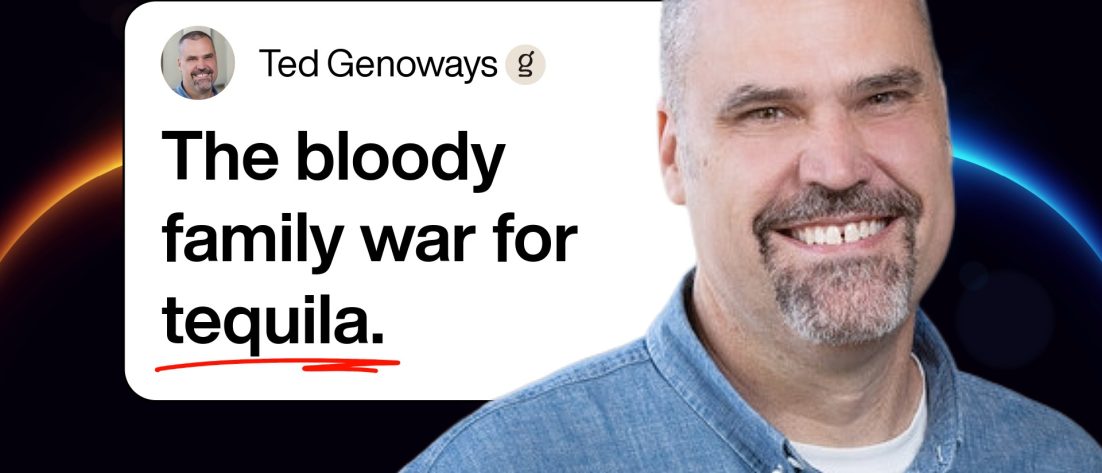
Ever wondered about the real story behind a bottle of tequila? It’s not just about agave and distilling; it’s a dramatic saga of revolution, political betrayal, and intense family rivalries. In this episode, we’re joined by author Ted Genoways to uncover the incredible history of Jose Cuervo, a story that is far more turbulent and cinematic than you can imagine. We’ll explore how one man’s ambition to build a business empire became entangled in a bloody struggle for the very spirit of Mexico.
Join us as we dive deep into the subjects of Ted Genoways’ groundbreaking book, “Tequila Wars.” Discover how the tequila industry wasn’t just a bystander but a central player in Mexico’s national conflicts. We explore the bitter Cuervo and Sauza family rivalry, a competition that shaped not only the business but also the political landscape of Jalisco. Learn about the Porfirio Diaz tequila industry connection, where Cuervo’s own uncle, Florentino Cuervo, was a key figure in the revolution that brought Diaz to power, only to be betrayed later. This complex saga reveals how these families navigated shifting allegiances and constant violence during the tumultuous era of tequila and the Mexican Revolution. From militia leaders running distilleries to the struggle to build modern infrastructure like railroads amidst national chaos, this conversation uncovers a lost chapter of history.
This episode peels back the label to reveal the true story behind one of the world’s most famous spirits. We discuss how Jose Cuervo’s project to rebuild his family’s empire was a narrative of genius and resilience, culminating at the 1904 St. Louis World’s Fair, a pivotal moment that forced the industry to modernize. Yet, just as Cuervo built the infrastructure for a global business, the revolution erupted, forcing distilleries to close and pitting figures like Pancho Villa against American interests right on the distribution lines. The full history of Jose Cuervo is a tale of how a regional spirit survived near-constant warfare to become a national symbol, ironically aided by the era of Prohibition in the United States. Don’t miss this fascinating discussion about Ted Genoways Tequila Wars, a story waiting to be told.
Introduction
Blaine DeSantis: Welcome to Books and Looks, where we do a deep dive with authors to help you discover your next great read. I’m Blaine DeSantis, and if you ever held a bottle of tequila or seen a tequila commercial and wondered about its history—and not just the brand, but the actual human drama, the struggles, the innovation that brought it to life—you’re absolutely in for a treat today.
Blaine DeSantis: We’re uncovering the story filled with escapes, political battles, and intense competition that shaped one of the world’s most iconic spirits. My name is Blaine DeSantis. This is Books and Looks, and today we’re talking with Ted Genoways about his remarkable new book, Tequila Wars, Jose Cuervo, and the Bloody Struggle for the Spirit of Mexico. Ted Genoways, welcome to Books and Looks.
Ted Genoways: Thanks so much for having me. It’s great to be here.
Blaine DeSantis: I’m so happy to have you on. This is one popular book you’ve got out here. Great reviews, the Tequila Wars. Wow, thanks so much.
Ted Genoways: It’s been exciting to have the book out after it’s been a long gestation, so it’s wonderful to finally have it out.
Blaine DeSantis: We’ll get into that a little later, but my goodness gracious, this is a labor of love for you, I think. And maybe over a few glasses of tequila, I don’t know. It’s interesting. Anyway, the subtitle has to do with Jose Cuervo. And you begin your book with Jose Cuervo getting out of Dodge. He’s leaving the area. He’s going over the mountains. And all of a sudden, he stops and he breathes tequila into his horse’s nose. Is this common? Did people do this back then?
Ted Genoways: It is something that I had never heard of except that Cuervo’s niece who grew up with him, she had a number of writings that she printed and shared with family in late life. And she mentions this several times, says that this was common practice for refreshing the horses when they were not near water, that they could simply blow the tequila into their nostrils and that this would a little bit rehydrate them and a little bit just numb them against the pain of continuing on.
Blaine DeSantis: I don’t think he was the only person doing that because I think later on in the book, somebody else was blowing tequila into the horse.
Ted Genoways: It does happen a second time. It’s true.
Blaine DeSantis: Yeah, it’s a serious subject, friend, but there’s a little bit of humor here. I have to be honest with you. I never heard that. It’s just amazing. Anyway, your book is called Tequila Wars. What was the most surprising war that you discovered while doing all your research?
Ted Genoways: Initially, that was a working title. I was thinking of this as looking at the tequila industry as it weathered through a sequence of wars that were national wars in Mexico. What I hadn’t expected going into it was just how completely integrated into those wars the families of the tequila industry were. I had expected that this was really going to be about how the industry collectively survived that time. In reality, it turns out that they were prime drivers and they were really deeply involved in the politics. And then when war would break out, they were enmeshed in the interests of the revolutionary forces or the government forces. And it turned out to be a really interesting challenge. For so much of what I’ve done in the past, I write a lot about food and agriculture.
Ted Genoways: There haven’t been a lot of shootouts in the things that I’ve written in the past. But this time, I got into this and I was like, this is great. There’s going to be gunplay. There’s going to be intrigue. This will help keep things interesting. What ended up being the challenge in the end was how to find some moments of pause and reflection. By the last third of the book, once we’re into the Mexican Revolution and the years that follow, there’s so much chaos and there’s so much constant violence that the trick is really the opposite of how do we find a way to create narrative. So, yes, it’s a different kind of thing for me, for sure.
How “Tequila Wars” Evolved from Family Stories to a Historical Epic
Blaine DeSantis: Did you always expect it to be a book, or was this just going to be maybe a professional essay published in a publication or something like that?
Ted Genoways: Where it started, I sometimes joke that this book was started before I was born. My dad is a bat biologist and in the years before I was born, was doing a lot of work in Jalisco, the state in Mexico where the town of Tequila, Guadalajara are, where the tequila industry is centered. And he was netting bats in and around the town of Tequila all through the Tequila Valley, out in the agave fields. He spent years there working with Mexican biologists. So when I was a kid, many of those people would come to visit us. And naturally, they would arrive with a bottle or two of tequila, and they would sit around and tell stories of being in Tequila and in the surrounding agave fields. So I just always wanted to see it.
Ted Genoways: When I became a magazine freelancer full-time in 2013, this was top of my list of what I wanted to do, was to go and do a story about the tequila industry, which I did for Bloomberg Businessweek. And I thought this was a great trick that I’d convinced a magazine to give me a week in the tequila region. And I wrote a story dutifully. But my initial thought was this is just going to be a way to get there and scratch that itch. Instead, I was there, I don’t know, two or three days before I was like, I love it here. This is something that I’m absolutely fascinated by. And I started thinking in terms of a book really quickly.
Ted Genoways: I convinced some other places, Mother Jones, Men’s Journal, some other magazines to send me to work on some stories. And initially, I thought that I would do something that was on the current state of the industry and focused on these environmental issues like migratory bats as pollinators and the sustainability of the agave harvest. But what I found was that as I started asking people—these are almost all multi-generational family-owned businesses, especially the smaller tequila distilleries—and when I started asking questions of, well, how did your parents or grandparents deal with this generations ago, everyone just kept saying, well, we have stories, we have things that come to us through tradition, but we don’t really know the history. And what everyone kept saying was that the history was lost.
Ted Genoways: At a certain point, as I was working, that became the shift where I was like, well, I could tell a story of the industry now, but the industry is changing all the time. A book about this moment would be outdated in a few years. And really what I was pulled toward was this question of, where did the industry come from? How was the industry as we know it now, founded? And the more I dug into it, the more I tried to unearth sources of various kinds, the more it became apparent that Jose Cuervo was the center of that transformation, which makes a lot of sense in retrospect.
Ted Genoways: And then his largest competitors were the Sauza family. And so I also thought that this is something that would make an intuitive sense to readers that if you know the names of any two tequilas, it’s likely Cuervo and Sauza. And so talking about how those businesses went from being small family-owned, single distillery operations in the mid-19th century to the giant multinational corporations that we know now, that seemed like a story worth telling.
Blaine DeSantis: It’s amazing that the agave was planted and grew in the Tequila Valley. We might be calling it Jalisco or we might be calling it Cancun. Think about it. Of all the distilled spirits, I can’t think of another distilled spirit that has the name of the town, Tequila.
Ted Genoways: There are some precedents. You think about Cognac is named for the Cognac region of France. Champagne is named for the Champagne region. But it is an interesting thing that one of the running, local controversies, like hyper-local controversies, is that the town of Tequila obviously gets the distinction because of Jose Cuervo’s ancestors. They built the distillery La Rojeña starting in about 1812. That distillery is still there on the plaza in Tequila and is a symbol of the industry at this point.
Ted Genoways: But there’s a neighboring village about eight miles away called Amatitan that claims to be the first place that tequila was distilled as we know it now, that the process followed the full process as we think of it. So this is something that the people in Amatitan, especially the tequila makers in Amatitan, take a great deal of pride in. But if you ask anyone in the town of tequila, the answer almost universally is, if the spirit originated in Amantitan, then why is it called tequila? I love that the name of the village and the spirit being the same, being this thing that became so synonymous with them. They are interwoven in that way.
Ted Genoways: I think it’s, as I say, in trying to tell the story, the spirit is named for the village that we think of Jose Cuervo himself as being synonymous with the industry and the spirit. It’s a kind of iconic thing. And yet, when I started, there was just so little known that it was all terra incognita.
The Cuervo and Sauza Rivalry: A Battle for the Soul of Tequila
Blaine DeSantis: While we might like to talk about tequila of the spirit, we have to talk about some other things that went on with tequila, because this is a place that gets into family rivalries, gets into politics—local, national, you name it. It’s there and international. We have the tequila, we had Cuervo and we’ve got Sauza, but there were a lot of other families also. And were they driven out by these two big families or what was the whole situation?
Ted Genoways: Well, there’s still a small group of what I think of as the old central tequila families. And the thing that is probably worth mentioning and just keeping in the back of your mind, is that there was a moment at the end of the fighting in Jalisco in 1917 when the government did a census of the town of Tequila. And at the time, there were maybe 3,000 or 4,000 people who were there. But the government census taker notes that altogether, they account for about 150 families. So you’re talking about these large Catholic families, where there are… Cuervo had more than a dozen siblings, and then their multi-generational families.
Ted Genoways: So when you start talking about how interconnected everybody was, yes, there was the Cuervo family and the Sauza family, but then the other large tequila-making families were the Orendain family, the Martinez family, the Rosales family that was the founder of Herradura, which is still around. But it doesn’t take very long before you’re starting to account for most of the population of Tequila at the time. This was a very small local industry that through Jose Cuervo’s efforts and to some degree the efforts that were undertaken by his rival, Cenobio Sauza, industrialized the production so that there was greater volume of tequila, but also did things like bringing electricity and the telegraph and telephone so that they could communicate, and then railroad so that they could ship all over the country and to North America.
Ted Genoways: It was this thing that was very small, very regional, that then a few people saying, if we modernize, if we make this into something that is produced at volume and distributed at volume, it’s something that we could expand the business. I don’t know that they had this notion when they were starting, but that what they were doing was creating something that would define the national character, would be thought of as inextricably linked with the country of Mexico itself. But they certainly did. And this transformation is undertaken by, yes, a very, very small group of people.
Blaine DeSantis: When we’re talking about the scope of this book, and we’re going to get to the revolutionists, friends, what years are we talking about that are covered in your book?
Ted Genoways: My focus is really on the lifetime of Jose, and he was born in 1869, died in 1921. We go a little bit before that in order to see how his father and uncle founded the business that he partially inherited, although he expected to inherit a much larger business that his father died young and unexpectedly, as did his uncle. But we see this change that happens between the middle of the 19th century and then up through the era of prohibition. And all of these earth-shattering wars that take place in Mexico in between, but ironically, what we end with is how prohibition in the United States really helped the industry rebuild by making their product something that was highly coveted and people were willing to pay a premium for in the United States.
The Porfirio Diaz Era: Tequila’s Entanglement in National Politics
Blaine DeSantis: There’s so many fascinating things here. And as you and I were talking before we started taping, I knew of Pancho Villa. I knew that revolution. I watched the movie Pancho Villa with Wallace Beery, the 1930-something movie. But the revolutions were going on down there since the 1870s, 1880s. And tequila plays this oversized role in this. I can’t imagine this. Tell us a little bit about what was going on in Mexico during that time period.
Ted Genoways: Maybe the biggest surprise to me is that the figure who’s the central fact of Mexican history is Porfirio Diaz. He is involved in key battles that helped to expel the French who had come in and taken over Mexico in the 1860s. And then in the 1870s, he rises to become president through revolution and force and then stays as president of Mexico through 1911. He is this figure who occupies this central role. What I didn’t know and I don’t think has been told really, is that Diaz, when he was taking over the country, he really was operating in the east of the country. He was from Oaxaca, and so started from Oaxaca in the south and moved up toward Mexico City.
Ted Genoways: But at the same time that that was happening, there was a companion military campaign that was happening in the west that eventually took over Guadalajara, the second largest city. And that campaign was led by Florentino Cuervo, Jose Cuervo’s uncle. He is hugely important. He is second maybe only to Diaz himself in this overturning of the government. And then he feels betrayed by Diaz when Diaz becomes president, that he doesn’t feel that he’s given enough position and power. He has suffered a great deal of losses to his tequila business because of it being targeted by the government forces that they were overthrowing.
Ted Genoways: And so he ends up at odds with Diaz. It’s an incredibly dramatic beginning to all of this, that while Jose Cuervo was a child, in the background, his uncle is helping to overthrow the government and bring a new president to power and is then feuding with the new president. It’s a pretty central place in what’s happening in national politics at that moment.
Blaine DeSantis: And that just amazes me because it’s not a large area. Like you said, it’s not hundreds of thousands of people. And yet it plays this oversized role. And one of the reasons is because when Diaz gets in power and they have a constitution, it says either you can’t run or you can only be reelected once, something like that. He doesn’t care about that. He comes up with all these reasons why he should remain in power. And that just keeps churning things.
Ted Genoways: It’s fascinating, too, that because they were at odds with Diaz, the Cuervos insist on the enforcement of the Constitution and wanting the presidency to turn over. Seeing the advantage in supporting Diaz staying in power, Cuervo’s rival, Cenobio Sauza, takes the opposing stance and is like, well, I’ll help Diaz stay in power. And then he becomes central in the same way that Florentino had been. These two outlaw militia leaders that also were major tequila makers become major figures in Mexican politics.
Ted Genoways: In the 1880s as things settle a bit, and everybody recognizes that there are shared goals in trying to get the Diaz government to bring the railroad and those sorts of things, they kind of join forces. And for a time at least, Sauza and Cuervo, they come together on these projects up until Jose Cuervo’s father dies. And at that point, Cenobio Sauza sees an opportunity to take over all of the industry for himself. And so as Jose Cuervo himself becomes an adult, his project is really to rebuild the family empire. And again, I’ll just say from a narrative standpoint, you can’t have a better thing than a young man who feels that his birthright has been stolen from him and that he has to rebuild his father’s empire from scratch against the odds of their greatest rivals.
Ted Genoways: Watching Cuervo as he does that, as he steadily rebuilds and then surpasses the Sauza empire is compelling. To me, it’s a thrilling narrative to see.
Blaine DeSantis: And one of the things that you talk about in your book and is I found fascinating, and we’ll get into research maybe a little later, but there are no records of the town of Tequila for like a 40-year period because the town itself was overrun, burned out, bombed out. Tell us about that.
Ted Genoways: Doing the research on this was decidedly challenging. No question about it. The people who told me at the beginning that there was no history, that that was all gone, they weren’t wrong. So much of the material was burned, and as you say, during the revolution in particular, the town of Tequila was assaulted and burned four times. Guadalajara, where the central archives were, was burned five times. So a lot of material was lost.
Ted Genoways: At the same time, there were efforts all along the way to preserve records to keep them from being destroyed and they were tucked away in odd places. A lot of my research project became going to small out-of-the-way archives and trying to find anything that was available. A lot of that was city archives in places like Tequila itself, but also neighboring villages in Amatitan and Magdalena, and then smaller archives all over Guadalajara. And eventually, maybe the most important archives were the collections that have been kept by families themselves. The Sauza family archive in particular is huge and really, really important, but had never really been used before because the family had always just kept it secret. It was a collection that they had but had not made publicly available.
Blaine DeSantis: This is the thing because it seems like throughout the entire book, families are coming into tequila, the tequila growing family, families are going out of tequila. They’re on the run. Now the other guys are on the run. Everybody’s trying to take over everything. It never calmed down.
Ted Genoways: It’s, and especially, I have to say, especially having now spent a couple of months talking about this book and thinking about the life of Jose Cuervo in this particular way, his time as the head of this business that he ran was essentially 20 years long, and it basically fell into two halves. The first decade was spent tirelessly working, trying to build everything, trying to get every piece of infrastructure built. He had to negotiate for the railroads to be built, the power lines to be laid. And even those sorts of things were not simple. He negotiated to get the dam built to create the hydroelectric power that would run through the power lines.
Ted Genoways: Everything was this remarkably long, sustained project of building. And just exactly at the moment that he had gotten all of the infrastructure built, and then his business partner, Manuel Cuesta Gallardo, got elected to be governor of Jalisco, and Cuervo himself was the speaker of the House of the legislature. All the pieces were in place, and it is literally days before everything unravels under the pressure of the revolution. And he spends the last decade of his life just trying to hold on to everything he’s built, just trying to keep himself alive, his family alive, keep everything from being blown up and destroyed. And so it is a constant struggle. He’s up against major forces at all times.
Blaine DeSantis: No doubt. It’s just utterly amazing. These families would be like, okay, you’re in power. You’re the mayor. Now the next, no, now you’re the mayor. Now you’re going to the governor’s. No, you’re going over there. Oh my God. It was just like, I needed a chart to keep things going here.
Ted Genoways: Well, I understand that problem too. I do.
Blaine DeSantis: Crazy period of time.
Building an Empire: The Critical Role of Railroads in Tequila’s Expansion
One of the things, you talked about the railroads. They couldn’t get the tequila out of tequila because they didn’t have railroads. Why was that such a major problem?
Ted Genoways: Tequila, it’s worth noting that it became better known than other mezcals originally because there was a military road that ran from the Pacific coast to Guadalajara that ran right through the plaza in Tequila. And when that road was built, one of Cuervo’s uncles, who was married to Maria Magdalena Cuervo, built the distillery La Rojeña right on the central plaza. And that became the center of the Cuervo business, but also of the tequila industry. And essentially, any of the military personnel who were moving from the coast to Guadalajara would stop and buy barrels of tequila right out of the factory door. And then if they were going back to the West Coast, they would buy barrels that they would take and distribute all over the Pacific.
Ted Genoways: That became the main way that tequila was distributed. But it was, you’re talking about strapping barrels to the back of a donkey and taking it over a rutted military road. And by the time Jose Cuervo was taking over the business, it had been close to a hundred years and that road had not been especially well maintained. Lupe, his niece, in her writings talks about there being potholes that were large enough that you could disappear into and that there were rocks that were the size of watermelons. So the road was just impassable. And certainly it was not easy to use for large-scale distribution. And so that was the reason that Cuervo and Cenobio Sauza as well recognized that if we’re going to produce at enough volume that we’re going to supply Guadalajara and Mexico City and eventually try to get to the United States, we need to have a railroad. Got to have something that makes mass distribution possible.
Blaine DeSantis: And that’s the thing. Eventually, it becomes very popular up in El Paso, so they have to get up to Ciudad Juarez, and that’s not close to tequila. They got to get another. No, they got to get more. And yet when they finally get the railroads, then the other side, not in power, gets upset because they had, was it the Germans who built the railroads?
Ted Genoways: Yes, that is correct. The Germans. There was always a lot of foreign influence and one of the features of the Diaz government was that he was frequently allowing European and American businesses to come in and build. And essentially saying, we’ll take a 30% cut of the profits that you make in return for this. But what this meant was that the Germans tended to bring in their own workforce, as did everyone else. And so there was a lot of discontent, especially among the people who were engineers and people who had trained to be involved in the development of the technological infrastructure who felt cut out.
Ted Genoways: They become the intellectual leaders of the revolution saying, look, we should have control over Mexican resources and over Mexican development and reap the benefits of that, not just Diaz and his inner circle. So yes, exactly as Cuervo finally gets the railroad to arrive in Tequila in 1909. And the revolution is simmering and starting to boil in 1910. He has just barely gotten the railroad completed after many years of trying at a moment when there’s this massive discontent.
Ted Genoways: One of the people I’m just intrigued by personally in the narrative is a guy named Enrique Estrada, who was one of the people who had trained to be a railroad engineer, who had dreamed of accepting the challenge of trying to build the railroad across some of the steep barrancas that were along the border between Jalisco and Zacatecas, where he was from. And when he felt robbed of that opportunity by the Southern Pacific being given the contract to the American company, his role in the revolution was as the guy who understood how those railroad trestles and bridges and everything were built so that they could dynamite them at weak points and that they would collapse. It is a fascinating thing that this guy who wanted to build railroads, that eventually his reputation was built on his ability to destroy them.
Blaine DeSantis: And he becomes, again, a vital part of this back and forth with the, I guess he was with the anti-government people. 20 years, I think he was doing this, if I’m not mistaken.
Ted Genoways: Enrique Estrada spent a lot of time working. He was involved in anti-government plots for a lot of years, he really was.
Blaine DeSantis: They knew who he was, didn’t want to shoot him. That’s just hey.
Ted Genoways: There was not for lack of trying, they definitely were. But he was also somebody who was, if you came to power or were trying to come to power, he was somebody who was really useful. Alvaro Obregón, who is now thought of as maybe one of the best military minds that Mexico ever produced and was really central in bringing Venustiano Carranza to power and eventually Obregón became president himself, he really understood how to use Estrada’s particular set of skills. The only problem is that, as always seems to be the case, Estrada eventually tried to overthrow Obregón, in part with a plot to bomb the railroad that his train was traveling on at the time. So these guys were not boring. They were out there doing interesting stuff all the time.
Surviving the Mexican Revolution: Pancho Villa and the Fight for Distribution
Blaine DeSantis: Was this revolution basically from the West? We’re looking at Mexico. Was most of this agitation coming from the Western side?
Ted Genoways: It was all over the country. And that’s one of the things that becomes incredibly complex. And for Jose Cuervo, it becomes just untenable that initially, everything is about trying to either overtake Mexico City or defend Mexico City. But then as the revolution goes through multiple cycles and different revolutionary leaders, by 1913, several years into the war, there’s some successful campaigns that are in the northwest of the country. And then Obregón and his people come down the west coast and start moving toward Guadalajara and Mexico City. But at the same time, you’ve got Pancho Villa running around in the north, you’ve got Zapata running around in the south.
Ted Genoways: Once they do manage in 1914 to unseat Victoriano Huerta, who is essentially emplaced by the U.S. government, what happens after everyone had assumed that Carranza as the head of all of these military forces would become the president… in reality, every one of the generals had their own ambitions of running the country. What you end up with is a front in five different parts of the country as everyone’s fighting with each other. For Cuervo, this is especially a problem because there’s fighting right around Tequila in Guadalajara. Guadalajara changes hands five different times in 1914 and 1915. It’s a disaster for them. But even if you could get your tequila to Guadalajara and started toward the United States, Pancho Villa was controlling everything to the north, and you had to run your trains through Pancho Villa’s lines to get to Texas. That is the reason that eventually in 1915, Cuervo made the decision and then others in the industry followed suit to basically close down for almost two years until things settled down a bit.
Blaine DeSantis: That’s, again, another fact people don’t realize that they had to close down. Now, at one point, wasn’t the U.S. president being lobbied to invade Mexico during this whole time period?
Ted Genoways: For sure. And one of the things that you talk about, the corners of history that we tend to forget about, we did invade Mexico during this time period a couple of times and in a couple of ways. There’s the invasion that occurs at Veracruz that’s a naval assault that happens in 1914, but then even larger than that, as Pancho Villa was attempting to—I would still like to have someone explain Villa’s mindset on this to me a little bit better—but as Villa was attempting to try to keep the U.S. from entering on the side of Carranza and legitimizing his presidency, he was attacking the U.S. at various places. And eventually after several of those attacks, the U.S. invaded Mexico, headed after Villa, and invaded with tens of thousands of troops and moved along the northern part of Mexico, ostensibly in search of Villa, but really overtaking and stabilizing that region.
Ted Genoways: Again, a bunch of that is a legacy of what happened under Diaz, that Diaz had allowed the U.S. to be involved in mineral exploitation in the northern part of Mexico. That meant the oil fields that had emerged and become incredibly important on the Gulf of Mexico, and then mines all along the northern part of the country as well. So what we were really doing was trying to make sure that Pancho Villa did not take over these mining and oil interests that were American-owned in that area. And poor Jose Cuervo, all he wanted was to get his tequila through there.
Blaine DeSantis: That’s right.
Ted Genoways: And man, it’s awfully hard to move your tequila from one side to the other if Pancho Villa and the American military… The American response at the end of this was to start closing the border and to build fence and establish the border as we know it now.
From Local Spirit to Global Phenomenon: The 1904 St. Louis World’s Fair
Blaine DeSantis: Wow. One reason it became so popular was at the St. Louis World’s Fair. That was an interesting little slide. Tell us a little bit about that, please.
Ted Genoways: The thing that I think is really intriguing, I mentioned that basically 1900 to 1910, Cuervo’s trying to figure out how to build his business in every way possible. One of the things that he was doing was going to World’s Fairs and to these big industrial expositions that were happening all over the world. In particular, he went to the St. Louis World’s Fair in 1904, which is now remembered as this really important watershed moment, especially in the world of food. It was exactly at a moment where everyone in the world was becoming aware of food safety and looking for ways to pasteurize, to seal, to keep things from being potentially harmful to consumers.
Ted Genoways: It was right in that moment that Cuervo arrives and sees that going on on the one hand. In fact, in the run-up to the fair, the Mexican government had said, okay, no more selling tequila out of barrels. You’re going to have to do individualized bottles that have been inspected, that have been sealed, that there’s a tamper-resistant seal on the bottle. So Cuervo already knew that this was going to be a major change, that now you had to have a business that was connected to bottle makers and that could transport—transporting crates full of bottles is a very different proposition from transporting wooden barrels.
Ted Genoways: He arrives there and already has all of this on his mind when he is going to some of these fair pavilions and seeing all of the new technology that’s on display. Particularly remarkable that the electricity pavilion is personally overseen by Thomas Edison and has selected a bunch of equipment such as the standard bottle maker, a device that fills bottles to standard levels. Cuervo’s looking at all of this and is recognizing, okay, this is the future. We’re going to have to do this if we’re going to be competitive. But what that means is, first and foremost, that they need electricity. So he returns back to Mexico and very quickly gets to work on the hydroelectric project. But it also means that this is the thing that becomes the impetus for the railroad. You’re not going to move a bunch of glass bottles over that pitted military road. You need the railroad. And so the fair becomes this pivotal moment for him.
Ted Genoways: The thing that’s kind of unfortunate, but it’s a wonderful small moment. Cuervo did not take his niece, who ends up being the family historian, because he thought she was too young to travel all the way to the U.S. and back. But she has this wonderful memory of when they came back from the fair and come back on the railroad and they give her this little mechanical egg that you wind up and it dispenses candy. She says that she is looking at this thing and trying to figure out how it works and she makes this comment about realizing that suddenly they had entered this world of incomprehensible machines. And, of course, that was exactly the impression that her uncle had just come back with as well. It’s like this world has just changed on us.
Blaine DeSantis: I must admit, as I’ve watched the movie Meet Me in St. Louis with Judy Garland, I did not see them go to the tequila factory there or the Mexican pavilion.
Ted Genoways: Well, they missed out. They should have gone.
Blaine DeSantis: I’m sorry. And I would definitely have liked it in there.
What’s Next for “Tequila Wars”? Exploring a Potential Film Adaptation
I know you have more things to do. I could go on for a long time, Ted. I really could. But I want to ask you, what’s next? What’s next for Ted Genoways? Are you going back to Mexico for anything? Or are you going to have another project?
Ted Genoways: I’ve got a number of things that are in the works. There have been some exciting possibilities with this book and related projects that I’m hoping to unveil soon. But I think the world of tequila is not done with me. So that’s one side of things. The other is that the journalistic work that I’ve done over the last 10 to 15 years is really focused on the meatpacking industry and has focused very much on immigrant labor. Just to state the obvious, we’re in a moment right now where immigration issues are top of mind and this question of what is going to happen to the industry and to the whole food system if we follow through on some of these proposed policies to remove all people who are here with temporary protected status. So I’m working on those things from not only a journalistic standpoint, but hoping to approach them also as a book, as a film project, as who knows, something along those lines.
Blaine DeSantis: Speaking of film projects, are we going to see a series called Tequila Wars? Are we going to see that?
Ted Genoways: I hope so.
Blaine DeSantis: I do too. I think it’d be fantastic. I’d love something like this. I hope, again, you got the New York Times, the Wall Street Journal, everybody’s writing about it. Somebody from Hollywood, let’s make a movie. Let’s make a miniseries on this.
Ted Genoways: I’ve had conversations, and they are exciting, deeply exciting. But I also have lots of friends who have had these conversations before me. And it always feels like a moonshot trying to get anything actually developed. So I’m excited and hopeful, but not holding my breath, I guess.
Blaine DeSantis: With so many streaming channels out there, someone’s bound to pick it up. That’s the beauty of it.
Ted Genoways: I’m with you.
Blaine DeSantis: If you need somebody to plug you, I’ll be out there shooting with you, okay? Anyway, Ted, you’ve been delightful. I could go on for an hour chatting about this, but I just want to say thank you. Thank you so much for coming on Books and Looks today.
Ted Genoways: Thanks so much for having me. It’s been a real pleasure.
Blaine DeSantis: Wow. What a journey through history. If there’s one thing that I hope you take away from this conversation with Ted Genoways is that the history behind beloved products is often incredibly rich and surprising. It’s filled with human ambition, conflict, and resilience. Ted’s book, Tequila Wars, Jose Cuervo and the Bloody Struggle for the Spirit of Mexico, is available wherever books are sold. And my word has it gotten fantastic reviews. So another episode of Books and Looks is in the books. On behalf of our partners at BookTrib.com, I thank you for taking time out of your busy schedule to listen or watch the show and letting me be a part of your reading journey. And we’ll be back next week with a new edition of Books and Looks.