Tired of conflicting health claims? Dr. Joe Schwarcz helps you spot scientific misinformation and discover the truth behind health trends and nutrition news.
Episode Resources
- Better Not Burn Your Toast (Book)
- McGill Office for Science and Society (OSS)
- NPR: A History of Snake Oil Salesmen
- The Andrew Wakefield Study Retraction (NCBI)
- National Cancer Institute: Acrylamide and Cancer Risk
- The Road to Wellville by T.C. Boyle
We are constantly bombarded by conflicting studies and bold marketing claims about what we should eat or avoid. Dr. Joe Schwarcz joins the show to help us navigate this sea of scientific misinformation and separate actual evidence from clever marketing. As an author of over 20 books, he explains why the “latest study” might not be the final word on your health and how to remain skeptical of loud voices in the wellness space.
The conversation covers everything from the history of snake oil and the rise of phrenology to the modern-day risks of ultra-processed foods. Dr. Joe breaks down how the peer review process actually works and why “burnt toast” might not be the carcinogen you fear. You will also hear the bizarre history of John Harvey Kellogg’s “sanitarium” and why ancient traditions like eating kimchi are still relevant in the age of modern probiotics.
If you are looking to sharpen your critical thinking skills and stop falling for wellness influencers’ clickbait, this episode is for you. You will learn how to balance a health-conscious lifestyle with the simple joy of eating without getting lost in the noise of pseudoscience.
Transcript
Blaine DeSantis:Welcome, everybody, to Books and Looks, where we do a deep dive with authors to help you discover your next great read. Friends, every day we get stories and claims of studies that tell us to stay away from this food or product. And then a month later, another study says something else.
In a world where we are bombarded by mass marketing, we develop sensory overload and don’t know who or what to listen to. Today’s guest has written over 20 books, helping us to try and separate the wheat from the chaff, the sense from the nonsense, the science from the pseudoscience, and the quacks and the kooks who are out there who vie for our attention and our dollar.
I’m Blaine DeSantis. This is Books and Looks, and today we’re talking with Dr. Joe Schwarcz about his new book, Better Not Burn Your Toast. Dr. Joe Schwarcz, welcome to Books and Looks.
Dr. Joe Schwarcz:Thanks a lot for having me, and this should be a lot of fun.
Blaine DeSantis:This is going to be one of the best books I’ve read, and you’re coming to us from up in Canada, if I’m not mistaken.
Dr. Joe Schwarcz:I am. I’m in Montreal at McGill University.
Blaine DeSantis:A fine institution. You’ve been doing this for a long time. You separate sense from nonsense. You’ve put out over 20 books, including this newest one, Better Not Burn Your Toast. That’s a great cover.
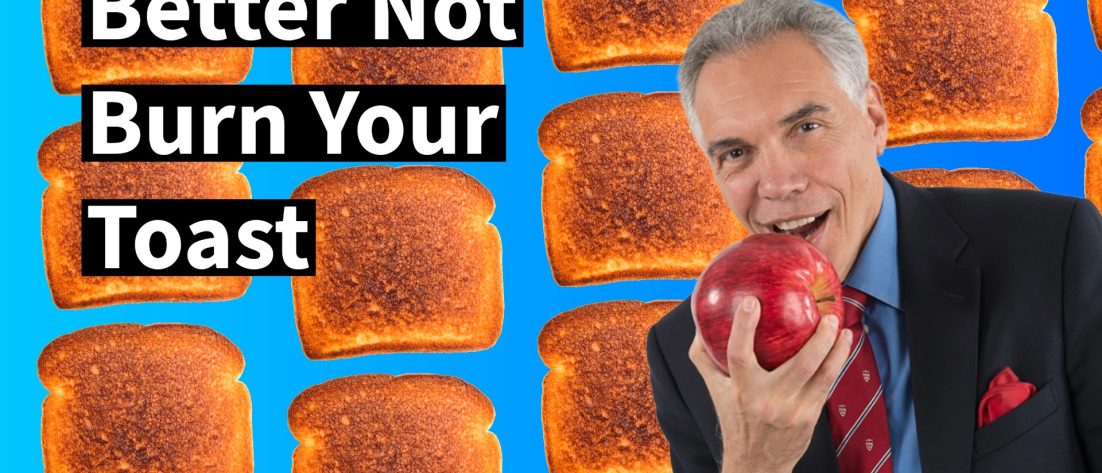
Dr. Joe Schwarcz:I think it’s a pretty good cover. They say that you shouldn’t judge a book by the cover, but the truth is you actually sell it by the cover. The cover is important. We had a graphic artist who gave suggestions and we came up with this.
Combatting Modern Misinformation and Snake Oil
Blaine DeSantis:They did a good job. You’ve been doing this for a long time. What do you think right now is the most frustrating or dangerous piece of misinformation that’s out there? It made you say, “I got to write another book about this.”
Dr. Joe Schwarcz:The misinformation changes almost by the day. Right now, the most current one is Robert Kennedy Jr. No question, he’s the worst of the lot because of the influence that he has. His stand about vaccines is absolutely frightening.
Your country is going to pay for it, both in terms of health and in terms of money, because diseases that could have been avoided are going to come through, and they’ll be very expensive to treat. So I think that’s a big concern.
There are numerous so-called wellness influencers out there on social media with their blogs. Each of them wants to get followers, so they have to click bait. What works these days is to be contrarian and to go against what we know as established science.
They think that they have found this big grid that has been swept under the carpet by big pharma or big food and that all these wonderful potential remedies out there that only they know. You listen to their spiel and at the end there’s always the pitch. Something to buy. It’s going to be a supplement to buy or do something.
We have more snake oil salesmen out there today than we’ve ever had. We’ve always had them. The heyday was in the late 1800s, early 1900s, when they literally sold snake oil, which didn’t really have any snake oil.
The pitch there was that snakes don’t suffer from arthritis because they’re supple. They curve all over the place. So if you can extract their oil, it should be beneficial to humans as well. But it wasn’t. That’s why we use the term snake oil now for any remedy that is claimed to have benefits but doesn’t deliver the goods.
Blaine DeSantis:Every two days my wife gets another YouTube video sent to her by her relatives in Romania pitching these sorts of things. They are out there and it never ends.
Dr. Joe Schwarcz:Believe it or not, Romania is a hotbed for this kind of stuff. There’s an anti-aging remedy of longstanding in Romania called Gerovital, which was put together by a Romanian biochemist by the name of Ana Aslan way back in the 1980s.
It was supposed to be the cure-all for everything. It turned out not to do anything, but it’s still around. It’s still promoted. The reason that some of these things have such longevity is because of the placebo effect.
If you think that you’re doing something to make you better, very often you will feel better. We’re not talking about treating serious diseases like diabetes or cancer with the placebo effect. But when you have symptoms that come and go, like arthritis and minor aches and pains, you take something, whether it was a snake oil in the 1800s or Gerovital now in Romania, and 30 to 40% of the time, people will say that they feel better.
Understanding Peer Review and Scientific Consensus
Blaine DeSantis:One of the things that I get bombarded with are these conflicting claims. This scientific study says this, and this scientific study says the exact opposite. We don’t know what to do. Who do we believe anymore? At one time, you shouldn’t eat eggs. Now, eat them all. Same thing with coffee or other things. How do we make sense out of all this?
Dr. Joe Schwarcz:I can sympathize with that because it is absolutely true that social media pumps out this information on a daily basis about what’s good and what’s not good. In science, we rely on peer-reviewed literature. Perhaps a bit too much. We worship at that altar because it’s not ironclad, but it’s the best method we have to gather information.
Many people don’t understand how science really works. A researcher will do some work in a lab, usually with a group of people. It takes several years until they get something that they can write up that they send in to a journal.
The editor will look at it, send it out to referees who are experts in that field. They weigh in on it. There’s a lot of back and forth about whether it should be published. They ask for more data. They may ask that we redo part of it. Eventually a decision is made on whether to publish it or not.
One important thing to understand about peer-reviewed science is that the referees or the editor cannot redo the work. This is usually the work of many people over years. You have to accept that whatever is written there is what they actually did, and that the data were properly collected and analyzed.
But if someone is going to be fraudulent, you’re not going to find that until someone tries to redo the work, which is exactly what happened with Andrew Wakefield‘s dreadful paper that first linked autism to vaccines. We didn’t realize that it was fraudulent until decades later when people tried to replicate the results. By that time, we had measles epidemics.
It’s not foolproof because people can be fraudulent or they make legitimate mistakes. This is why we never set store by one paper by one publication. What we look for is consensus, but we also look to see how that consensus is put together and where these papers were published.
A paper that is published in New England Journal of Medicine or The Lancet has more weight than the Indian Journal of Homoeopathy, which also claims to be peer-reviewed. Then we also look at the institutions where people come from who have written the research. We also take a look at where the funding comes from.
Just because there is funding from some vested interest doesn’t negate the results. The results could have been properly arrived at. These days funding from government agencies is very difficult to come by. If you’re going to do research on a weight-reducing drug, you’re not going to go to a plumbing company or to a light bulb manufacturer. Obviously, you’re going to go to some company that has the potential of making money off of it.
But just because you get some funding, it doesn’t mean that you dismiss the work. A bigger concern is that when you have funding from a vested interest and you find that your results are not in their interest, you would never publish that. Not publishing negative results is a real problem because it also would tell others, “Don’t bother with doing this.”
Still, peer review is the best possible thing we have. So we look for consensus from reputable researchers published in major journals that have a high impact factor. There will still be some back and forth because science is very hard to do. You have conflicting data, especially when it comes to nutrition because nutritional studies particularly are very difficult to do.
Nobody thinks that if you consume a bit of tetrahydroquinone or whatever food additive you’re talking about, you’re going to drop dead the next day. The concern is what happens if you ingest these things over decades. To do a randomized controlled double-blind trial is almost impossible for that.
What we have to look for is observational studies. You look at populations over a long time. Look at questionnaires that they filled out about what foods they have eaten, and then look at the disease patterns. You assume that the same diet was maintained for decades and that they’re honestly reporting what they ate.
There are all of these pitfalls. You can see that there can be conflicting opinions. But eventually, in science, the truth will out. It’s a self-correcting discipline. Errors are made, but eventually they’re corrected.
The Science of Acrylamide and Burnt Toast
Blaine DeSantis:Well, you’re correcting a lot of misinformation. We got so many things to talk about, including acrylamide. Is that what it is when you burn your toast?
Dr. Joe Schwarcz:It forms naturally in foods. It forms whenever you have certain sugars like glucose reacting with amino acids. Both of those are found in all kinds of foods. Under the right conditions, especially under heat, they will react together and form acrylamide.
Acrylamide in animals has been shown to cause cancer. That always raises an eyebrow, although there are many substances that cause various diseases in animals that don’t do so in humans. A human is not a giant rat, obviously, with some exceptions. Our biology is very different from that of a rat.
With Acrylamide in animals, studies have been done, and in large doses in animals, it is a carcinogen. Therefore, we have some issues with it. But then we take a look at the amounts to which we are actually exposed, for example, in coffee or in your burnt toast. It appears. But the amounts are so small compared to the doses that cause the problem in animals, that we think it’s not a significant issue.
We can’t really prove it. You can’t do the definitive study. You can’t take two groups of people, feed one acrylamide and keep acrylamide away from the other, and do it in increasing doses to see whether or not they get cancer. You can’t do that. But we look at observational studies in humans, and there’s no evidence that the consumption of acrylamide, as it appears naturally in food, is linked to cancer in humans.
Probiotics and the Power of Storytelling
Blaine DeSantis:Good stuff. You’ve got so many great chapters in here. One of my favorite chapters is “Kimchi in Space.” I love watching South Korean TV shows, and they’re always having kimchi, but apparently there’s a difference between the way kimchi was made and the way kimchi is made. What’s that all about?
Dr. Joe Schwarcz:Kimchi is a traditional picnic food in Korea where they use different vegetables. There are many different recipes for kimchi. Whether it’s tomatoes or peas, whatever, they’re locked in jars and they’re allowed to ferment. It means that naturally occurring bacteria in the food will do the job and they will produce various acids and various compounds that are beneficial to health.
These days we talk a lot about probiotics. Probiotics are beneficial bacteria that are thought to be good for our health. Kimchi contains many of those bacteria because over the time that the kimchi ages, these bacteria multiply. There is evidence that probiotics are beneficial.
When there was the first Korean astronaut who went into space, she took some kimchi with her, which made for a very interesting story. I don’t think they learned anything from taking it into space. But that’s the kind of thing that I would use in one of my chapters as a hook to get people interested.
You tell them that kimchi has gone into space and then you go into the science of what it really is. Then it will take you to yogurt and it will take you to kefir because most people in North America don’t eat kimchi. But we get our probiotics from fermented dairy products.
I try to start with some kind of captivating story. Then you don’t even know it, but pretty soon you’re reading science and you’re getting more and more interested in it. As you mentioned, I do have many chapters in the book. It’s considerably more than 30 or 40, but they’re relatively short.
They take you 10, 15 minutes to read because I know that these days people’s attention span is short, which is a problem because science in terms of little bites can’t do justice. I do try to do justice in the length. I don’t trivialize the science at all. I make sure it’s understandable.
I like to do it in form of telling a story because people will remember that. You have to make it somewhat entertaining for them to keep reading. Before they know it, they’ve learned some science. I like to say that you can open up any one of my books at any random page, read it, and you’ll be done with that chapter in 10, 15 minutes.
The next time you go to the bathroom, you take it with you and you open it up another day and learn some more. Before you know it, you’ve learned a great deal of science about chemistry, biology, physics, and biotechnology—connections that you never knew existed.
The Problem with Ultra-Processed Foods
Blaine DeSantis:That’s fascinating. Well, one of the things you brought up is that the kimchi, the way that it traditionally is made versus what they’re doing now with these metal vats and mass production has sort of changed the way things are working with kimchi. It’s not quite the same as it was before.
Dr. Joe Schwarcz:Yes, and this is the case for food supply generally. We are now very technologically oriented. We are more into processed foods. That is because not everyone has a backyard garden where they can grow fresh foods.
Some of the technology has changed. But with kimchi, we’re perhaps not now fermenting it in the traditional clay vessels in the ground. It’s done in jars and in pristine manufacturing places. The essence is still the same. You’re producing bacteria, the probiotics that are said to be good for us.
Setting that particular process aside, the problem is that we do eat a lot of ultra-processed foods. These are the foods that you find in the center of the supermarket, the ones that are in boxes or containers where you have lots of additives. Not all processed foods are a health problem.
You have Fiber One cereal, for example. You take the processed food, but it’s a great source of fiber and low on sugar. You can’t paint all of the processed foods with the same brush. But there are many that, when you look at the ingredients, the first ingredients are sugar and salt and some sort of fat or oil.
That’s the main nutritional problem that we have today—reliance on ultra-processed foods, which also tend to be very cheap. We see a lot of chronic diseases and diabetes in children, which never used to be seen before. We do have to pay attention to improving our diet.
This is one thing where Kennedy is right. Even a blind squirrel sometimes finds an acorn, and Kennedy is as blind a squirrel as there is. But the emphasis on reducing our intake of processed foods, as in the new food guidelines, is a good thing.
The effort to make school lunches better is good. It doesn’t negate the damage that he’s doing with his anti-vaccine stance and with promoting ridiculous alternative treatments. But at least in this area, there is some headway in alerting people to their over-reliance on ultra-processed foods.
The Eccentric Legacy of John Harvey Kellogg
Blaine DeSantis:That’s very true. One guy whose name comes up a lot is Harvey Kellogg. Harvey Kellogg had some really good ideas, and other times he was a bit of a quack.
Dr. Joe Schwarcz:Interesting character. John Harvey Kellogg was actually educated as a physician in the 1800s. But what sort of education did you have in the 1800s in medicine? It was not what we know as medicine today.
He had some very interesting views. He opened up a sanitarium in Battle Creek, Michigan. He actually coined the term sanitarium. This is where people came from all over the world to be cured of diseases they never had. He catered to the rich hypochondriacs.
His ideas were pretty good. He was a dedicated vegetarian at a time when that certainly was frowned upon by most people. In those days, people were eating bacon and whiskey for breakfast. He was a dedicated vegetarian, and today we know that there are a lot of benefits.
I don’t think you have to be a total vegetarian, but we should be moving more towards that. We should be eating more plants, which was his emphasis. Some of his other views were problematic. He thought that meat-eating would drive people to self-pleasure themselves. He was very much against that.
He had some outlandish views and he thought that sex robbed the body of energy. He never consummated his marriage. But on the other hand, they had some 30 adopted children. So he was a good person.
He visited Metchnikoff in Paris. Metchnikoff was the biologist who had won a Nobel Prize for his work on the immune system and was a big proponent of yogurt. Kellogg went there and learned about yogurt, which he then instituted at the sanitarium. Yogurt was served at virtually every meal.
He also had some interesting ideas about other ways to use yogurt, which were depicted in a movie about Kellogg. There’s a scene in the movie where a patient comes into his office and Kellogg talks to him and examines him and then looks to his assistant and says, “Would you please bring in the yogurt?”
The patient says, “But Dr. Kellogg, I don’t like to eat yogurt.” And Kellogg, with a gleam in his eyes, says, “Well, you won’t be eating it.” Kellogg believed in the yogurt enema. He thought that this is where you should introduce microbes. It’s a totally ridiculous idea because when we talk about probiotics, these bacteria that we want in your body, where we really want them is in the colon. It makes more sense to introduce them from the rear end than from the other.
Blaine DeSantis:If friends are interested in that, there is a book by a guy named T.C. Boyle called The Road to Wellville. Then there’s a movie starring Anthony Hopkins as Harvey Kellogg. It is absolutely hilarious. I’m so glad Harvey got into this book.
Dr. Joe Schwarcz:It’s got great music, which was also one of Kellogg’s things. He was one of the first doctors to emphasize exercise. People who came to the sanitarium were made to exercise outdoors to music. That’s the music that they actually play in the movie. I’m sure it can be found on a streaming service. I urge people to have the Wellville.
The Rise and Fall of Phrenology
Blaine DeSantis:Another chapter, because I’ve always talked about science and pseudoscience, is phrenology. Let’s talk about phrenology. What is phrenology?
Dr. Joe Schwarcz:Phrenology was another pseudoscientific practice initiated in the 1800s with the belief that bumps on the head could be used to diagnose what was going on inside of the brain. Phrenologists would rub their fingers on someone’s skull to look for bumps, or they actually invented a device they would put on the head that would measure these bumps.
They would analyze people’s character and even some diseases and give recommendations on what to do. It was absolute nonsense. Phrenologists were popular for a while because they promise simple solutions for complex problems. It was more attractive to people to have bumps on their head analyzed than to undergo surgery or to take some dietary supplement as recommended based upon what the phrenologist found.
It sold because generally these quacks are very good at making pseudoscience sound scientific. The idea that the anatomy of the brain is somehow reflected in the skull—because the skull covers the brain—is not a totally ridiculous concept. You could imagine the skull has to form around the brain, and if there’s any abnormality there, it would be reflected in the skull. Of course, it isn’t. It’s total nonsense.
Blaine DeSantis:Do people still believe in it?
Dr. Joe Schwarcz:I think phrenology is pretty well in a grave somewhere.
Toxicology and the Dose Makes the Poison
Blaine DeSantis:Okay, good. You talk about some people who equate the risk of eating french fries to smoking cigarettes. I can’t quite get my mind about that, but could you tell us about that, please?
Dr. Joe Schwarcz:When you do a chemical analysis of french fries, you can find various substances that are potentially toxic. Acrylamide is one of those. A french fry is a great example where you have amino acids and glucose and high temperature coming together so you can form some acrylamide.
When you do high-temperature cooking, you form some compounds called heterocyclic aromatic amines and polycyclic hydrocarbons, which are known carcinogens. Tobacco is a known carcinogen. It’s actually not the nicotine in the tobacco. What is in the tobacco is the burning leaves, which also form these heterocyclic aromatic amines and benzopyrenes, very much like you would find in french fries.
But you do not eat french fries 20 times a day every day in your life, and smokers will smoke 20 cigarettes a day. It’s just a false comparison. Just because you find the same problematic compound in some food as you find in cigarettes doesn’t mean that eating the food is equivalent to smoking a cigarette.
When you smoke a cigarette, these things go into your lungs, which is quite different from going into your stomach where stomach acid has protective features. It’s just a false equivalence. Nobody will suggest that smoking is good for you, and I don’t think anyone will suggest that eating french fries is a health food. They are not in the same class because of the amounts of the potentially toxic materials that form.
I always come back to Paracelsus, the stage alchemist and physician in the 1500s who first came up with the dictum, “Only the dose makes the poison.” That really is the cornerstone of toxicology. You can’t talk about something being toxic or not without putting it into context. You’ll have some polycyclic aromatics in that french fry. It’s the same ones that you get in the smoke and cigarettes, not to the same extent. Context is very important.
Tomato Myths and the Supplement Industry
Blaine DeSantis:No doubt about it. One of the things I want to ask you about are tomatoes, because apparently at one time there was a notion that tomatoes were poisonous. Where did this come from?
Dr. Joe Schwarcz:It came from the observation that the tomato was in the same botanical family as the belladonna plant. It’s what we refer to as a deadly nightshade plant. Eggplant is also in that category. There is a compound in deadly nightshade called atropine, which is highly toxic.
It is not found in tomatoes to the same extent as in deadly nightshade. There’s virtually no atropine present in tomatoes. But when you analyze tomatoes, you’ll find hundreds of compounds as in any fruit or vegetable. Just because this is in the same botanical family as something that has a high dose of atropine doesn’t mean that the tomato will also have it.
That’s where the myth started. Today we have dispelled that myth. We know that tomatoes are one of the healthiest fruits. It is a fruit by definition, not a vegetable. We now look to tomatoes as anti-cancer foods because they contain carotenoids, which are known antioxidants.
Science marches on. At one time, when people weren’t able to do chemical analysis, they had made observations that consuming any part of the belladonna plant was toxic and that it was botanically similar to tomatoes. You can see how they would come to that conclusion.
Today we do the chemistry. We know what’s in tomatoes and we know that there’s no problem with it. But you can always dig up some study that will tell you that it’s the pesticides on tomatoes now that you have to worry about. You can always dig up some study that is worrisome about the food, and then you can dig up studies that will tell you those foods are the healthiest food to eat.
This is the thing that drives you crazy when you see published papers on both sides of the coin. That’s why you’ve got to look at the whole picture. There will always be more legitimate publications towards one end of the spectrum than towards the other.
Blaine DeSantis:Once it was disproven that tomatoes are not poisonous, someone got the bright idea to make a tomato pill. I’d never heard of that. What is a tomato pill?
Dr. Joe Schwarcz:It supposedly was concentrated in the essence of tomato because that came after we learned of the carotenoids and other antioxidants that are present in tomatoes. People look for simple solutions to complex problems. You can tell them that they should be cooking at home and eating fresh fruits and vegetables, but it’s much easier to pop a pill.
This is why the dietary supplement industry is so large. They’ve been able to sell the idea to people that if you take these supplements, you don’t have to worry so much about what you eat because this will fill in the gaps. Furthermore, it will prevent disease. They will cherry-pick the literature to find some study that shows some sort of benefit and extrapolate it way beyond reason.
What is reasonable and what we know from numerous epidemiological studies is that people who have a diet that is mostly fresh fruits, vegetables, and is mostly plant-based—like on the classic Mediterranean diet—have generally better health outcomes. We don’t know that people who pop vitamin pills have better outcomes. That has never been shown.
Blaine DeSantis:Dr. Schwarcz, it was 2004 and I just bought a new house with my wife and her mom and dad, who were also from Romania, came to live with us. My father-in-law did not bring any clothes, but he had two huge suitcases. In the suitcases were every supplement I have ever seen or heard of, including whale bone and this and that. That’s all he did was supplement, supplement, supplement. That was my first real introduction to supplements. It’s just boomed since then.
Dr. Joe Schwarcz:There’s a hundred thousand dietary supplements that are on the market in North America. There are different versions of the same thing very often, but there’s 100,000 different products. It’s a huge industry. It’s a multi-billion dollar industry.
Obviously they dredge the literature for anything that shows any positive effect and blow it out of proportion. They’ll take some experiment that was done in mice and extrapolate it to humans. There are very sparse proper scientific studies that show benefit.
If someone is deficient in a vitamin, which can happen if someone is totally malnourished, then it makes sense to take a vitamin supplement. But this is not what we have in North America. People are mostly overnourished. They eat too much food. The biggest nutritional problem is obesity. This is why so many people are gravitating to the GLP-1 agonists like Ozempic. This is the real nutritional problem that we have in North America.
It can happen that someone has a diet that’s so awful that they are deficient. Historically, there have been cases like that. In the 1800s in the southern US, when the diet was basically corn, there was a disease called pellagra which was rampant because this is a B vitamin deficiency and corn doesn’t have it. When science came to the fore and we were able to figure out what causes pellagra, giving vitamin supplements to those people solved the problem.
Today we don’t have a diet that’s totally based on corn. This is not to say that I’m against the daily multivitamin pill. If people want to take that, I think it’s totally safe. In some cases, it may actually fill in gaps in their diet. I don’t promote it, but I have nothing against that.
Blaine DeSantis:And you apparently don’t have shark’s tooth in your medicine cabinet.
Dr. Joe Schwarcz:When people make health claims about any dietary supplement that are unsubstantiated, that’s where you run into problems. Not when people say, “Take a vitamin D because you may not have enough sunshine exposure in the winter.” I can buy that.
You always have to look at the science and see where the consensus leads you. That’s what we try to do. The mandate in my office actually separates sense from nonsense. It is very challenging because there’s just so much misinformation out there and disinformation.
Disinformation is people who knowingly spread false information, usually for monetary gain. It’s very difficult to try to steer people on the right track because the truth is that the right track is not the most convenient one. When you tell people that 30 minutes of exercise a day will do more good for them than any dietary supplement that they can take, they don’t want to sweat for 30 minutes a day. They would much rather pop a pill.
Balancing Health with Tradition: The Case of Cholent
Blaine DeSantis:One thing we want to get to is risk versus reward. You have to measure which one you want. You have a great chapter on that dealing with cholent. What is cholent?
Dr. Joe Schwarcz:Cholent is a traditional European Jewish food. Hungary and Romania are the hotbeds of cholent. Basically, it’s a type of bean stew. There are various versions of it. You use some brown beans, you use some white beans, you use some barley.
Meat depends on which kind of meat. For me, the best meat is flanken, which is around the ribs of the animal. This is not the healthiest food once you put all that meat in it. It’s not the worst either because beans and barley and vegetables are in there. I put tomatoes and carrots in there. Those are good.
It’s a pretty heavy food. When you’ve eaten cholent, you’ve dined. There are many different recipes for how people make it. My mother-in-law used to make the best one. Even though I have her recipe book, when I try to do it, it just doesn’t come out the same.
This was the thing in Europe in the early 1900s before processed foods. Everyone was cooking. All women knew how to cook properly. But when they wrote out the recipes, it wasn’t always exact. There was always a little thing that they do in the kitchen that they don’t even know that they’re doing. That’s what’s missing from my mother-in-law’s recipe, because I could never duplicate it. I wouldn’t want to eat cholent every day, but once in a while it’s great.
Blaine DeSantis:You even make the distinction that Hungarian cholent is better for you than the Romanian cholent, which is unhealthier, but you like the taste of the Romanian better. Is that correct?
Dr. Joe Schwarcz:I like both. They’re just different versions of the same delectable thing. One is more soupy and liquidy than the other. The Romanians put potatoes into it and the Hungarians don’t. It’s a question of taste until you’ve tried it. Try to make it yourself.
The Expert’s Personal Approach to Nutrition
Blaine DeSantis:I could go on another hour. Dr. Schwarcz brings in Harry Potter, the Pope, Sherlock Holmes, and Lionel Messi. They’re all here in this book, Better Not Burn Your Toast. It’s a spectacular book. People want to know, Doc, what’s in your pantry? What are you eating that you can teach us?
Dr. Joe Schwarcz:Over the last close to 50 years I’ve been in this business dealing with nutrition, I have changed. I eat a lot more fruits and vegetables now than I did when I was a kid. My parents were Hungarian and Hungarian food is not your healthiest food; there is a lot of fatty stuff.
I certainly have changed, but I have not eliminated meat. I don’t eat red meat very often. I like a good hamburger once in a while. I’ll have a hot dog if there’s a good baseball game in front of it. But I would not make a regular habit of that.
For breakfast, I have my avocado toast. I have blueberries—whatever blueberries are available—but I usually mix blueberries, raspberries, and blackberries. I put Greek yogurt on top of it and Fiber One cereal on top of that to get my fiber and my antioxidants.
I gravitated towards more plant-based foods, but I don’t shy away from eating chicken. I certainly like chicken. I still like the occasional good Wiener Schnitzel. There’s more to life than evaluating every drop of beverage as whether it’s good for you or every bite of food as whether or not it’s good for you.
Life is also there for the living and food is there to be enjoyed. Not everything has to be looked at as “is it healthy or is it unhealthy?” But you do need to look at your overall diet. It’s possible to never eat blueberries and have a healthy diet, and it’s possible to eat blueberries every day and have an unhealthy diet. It’s the overall balance that matters.
Blaine DeSantis:With those words, I think that’s a great way to end today’s interview. Friends, this has been great. Again, I’ve shown the book twice, Better Not Burn Your Toast. It’s one of over 20 books he’s put out.
This man is an expert, I’ll tell you. I love it and you’re going to love it too. Dr. Schwarcz, thanks so much for joining us today on Books and Looks.
Dr. Joe Schwarcz:Well, thanks very much. Thanks for having me.
Blaine DeSantis:Friends, I hope that this interview with Dr. Schwarcz was as fascinating for you as it was for me. His book, Better Not Burn Your Toast, is a great read for everybody.
As he said, short chapters and lots of great information. We learn about so many things and so many people who come up in the world of health and science. You don’t want to miss it.
On behalf of our friends at booktrib.com, this is Blaine DeSantis for all of us here at Books and Looks, saying may all your leaves be pages in a book.