
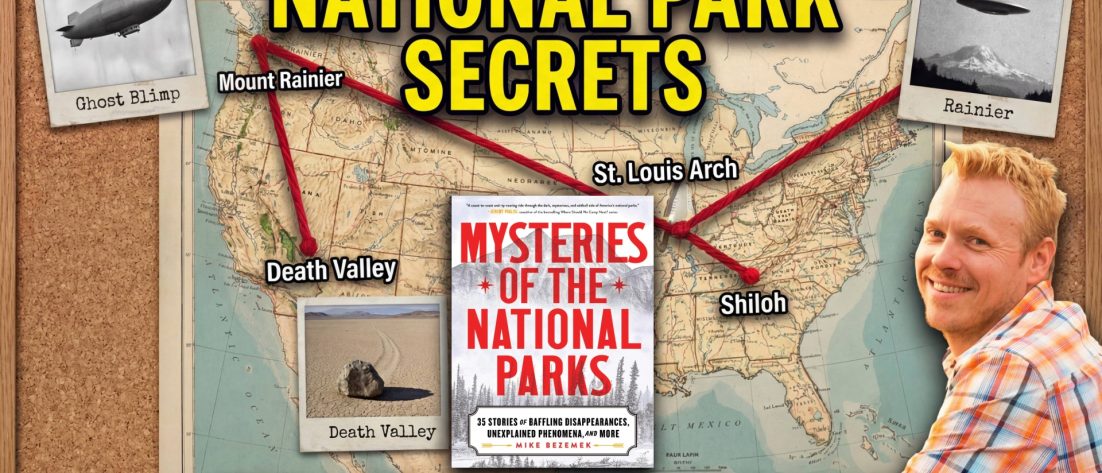
Was the first-ever UFO sighting covered up by the Roswell incident? What really happened to the honeymooners who vanished on the Colorado River? Author and outdoor adventurer Mike Bezemek joins us to uncover the shocking secrets and strange events hidden within America’s most treasured landscapes. In this episode, we dive deep into his fascinating book, Mysteries of the National Parks, exploring forgotten tales that defy simple explanation.
From bizarre crimes to perplexing natural phenomena, this conversation peels back the curtain on the unsolved national park mysteries that have puzzled historians and scientists for decades. We investigate the incredible story of the first UFO sighting in 1947, where pilot Kenneth Arnold witnessed nine mysterious objects over Mount Rainier, an event that predates the more famous Roswell incident. Mike Bezemek reveals why this foundational story has been largely forgotten and shares the plausible explanation behind the Roswell craze that followed. We then travel to Yosemite for the tale of a brazen stagecoach robbery where the bandits posed for a photograph—possibly the only authentic picture of a Wild West holdup in existence.
The discussion covers a wide range of incredible stories, including the tragic Glenn and Bessie Hyde disappearance in the Grand Canyon, where the newlywed couple and their boat vanished without a trace after a perilous journey down the Colorado River. We also explore the eerie phenomenon of the Angel’s Glow at Shiloh Battlefield, where wounded Civil War soldiers’ wounds emitted a strange blue light, a mystery later potentially solved by a high school science project involving bioluminescent bacteria. Other incredible topics include the strange history of the Gateway Arch and its surprising connection to Mussolini, the famous sliding stones of Death Valley’s Racetrack Playa, and the debate over whether Utah’s Upheaval Dome was created by a salt formation or a massive meteor impact. These tales are just a fraction of the 35 incredible cases explored in the book, revealing that our national parks hold more than just beautiful scenery—they hold secrets.
About Our Guest:
Mike Bezemek is an author, outdoor writer, and adventurer whose work focuses on history, travel, and mystery. His latest book, “Mysteries of the National Parks,” is the culmination of decades of exploring the U.S. National Park system, from the grand landscapes of Yosemite to the historic battlefields of the East. His curiosity was sparked during a cross-country road trip that led him to investigate the Lost Colony of Fort Raleigh, inspiring him to collect and document the strangest and most compelling mysteries our parks have to offer.
Links:
Introduction
Blaine DeSantis: Welcome to Books and Looks, where we do a deep dive with authors to help you discover your next great read. Now, look at me. I got a flannel shirt on. I didn’t shave. Wait, what’s going on, Blaine? Are you getting sloppy here? No, no. In honor of our author who’s coming on today, I’m getting ready to go out and look at national parks.
That’s right. Today we’re going to be looking at a great, and I really mean a great book, about national parks and the mysteries that are at the national park. We love the beauty, the landscape, the scenery, the stories. But a lot of these national parks, there are mysteries, things that happen. And we’re not talking about murders. Strike that out of your mind. No, we’re not going into murders.
But there are strange things that are going on here. We had the first official UFO sighting up in Mount Rainier back in 1947. Bet you never heard about that one. No. We got iridescent glow off of bodies in the Shiloh battlefield. There are some fascinating stories that are part of our national parks. And if you’re like me and you love mysteries and you love our national parks, this is a book right up your alley. So I’m Blaine DeSantis. This is Books and Looks. And today we’re talking with Mike Bezemek about his newest book, Mysteries of the National Parks. Mike Bezemek, welcome to Books and Looks.
Mike Bezemek: Hi, thank you for having me. Appreciate it.
Blaine DeSantis: I’m very, very happy to have you on. You’re a busy guy and I know we had a hard time hooking up but we finally got you here and wow. Usually I put on what my wife calls a smart shirt, but today, Mike, gotta have the flannel shirt, didn’t shave, why? Because I’m ready to hike to the national parks. I’m ready to go to the national park, so I’m all right looking the part. So yeah, yeah, I tell you, I’m ready. I’m so excited.
But I’ll tell you the funny thing is, Mike, when I told people that I’m going to be reviewing this book, they said to me, oh, it’s a book about trees. Not really. Yeah. It’s not just about trees and landscapes. It’s about mysteries. Mysteries of the National Park.
Mount Rainier 1947: The Forgotten First UFO Sighting
And you start out with a bang. Right away, boom. A UFO incident. The first UFO incident ever. Tell us about that and where that occurred.
Mike Bezemek: Yeah. So, that’s such a wild story. A private pilot is searching for a crashed military plane. He’s in the skies above Mount Rainier, Mount Rainier National Park. When he sees in the distance, not too far in the distance, but off in the distance near the next mountain, nine bright flashes, shiny objects traveling at incredible speeds, according to him. And they’re somewhat blinding.
He watches them for a while. He notes the silhouette, the shape, their movements, their direction, and eventually they’re gone. And he abandons his search for the military plane and proceeds to his next airport. Meanwhile, he’s calculating the speed that he believes he saw them flying at. And he lands and then he tells people, I just saw something very, very strange.
Blaine DeSantis: Wow. And did others see it, too? Was he the only person who saw it?
Mike Bezemek: Well, he’s the only person that sees this sighting. So continuing that story, he tells people at that airport and they’re very curious. And then he takes off to the next airport because he’s on a business trip and he’s making short hops. And when he gets to the next airport, people are waiting for him with a lot of questions.
Now, this sets off a bit of a frenzy, and he wants to report it to the authorities, but the local, if I remember right, FBI office is closed, so he goes instead to the local newspaper office. The reporter finds this individual, his name’s Kenneth Arnold, to be credible. And he posts an AP dispatch, and that sets off a firestorm of attention. And now it’s becoming a national frenzy. And now more sightings follow. And some are somewhat similar, and some are very different. But it spreads across the country, and it eventually spreads across the world. And yeah, like you said, this is the first UFO, modern UFO report, and the story and the mystery just continues from there.
Blaine DeSantis: Well, now, what year was this, Mike?
Mike Bezemek: If I remember, it’s 1947. I need to double check the date, but I’m pretty sure it was 1947.
Blaine DeSantis: Okay. That’s what I thought, but wow. So right after World War II and the Cold War starting to get started and everything else, and so who knows what’s up there in the sky, but it wasn’t anything anybody ever saw before.
Mike Bezemek: That’s right.
Blaine DeSantis: And everybody thinks Roswell was the first one. It wasn’t.
Mike Bezemek: That’s right. So Roswell actually happens, I think it’s two weeks to the day after the very first sighting. And Roswell is part of that, what becomes known as the 1947 UFO craze or UFO outbreak or later, conspiracy theorists call it a cover up and all that. But Roswell, I think, actually has a very particularly plausible explanation for what happened there. That is in the chapter as well. But the original sighting, while I do believe there is a plausible explanation, that one’s more mysterious. It’s harder to explain.
Blaine DeSantis: Okay. Wow. It says something else. Like I said, that’s what sets this apart. Right away, you come up with a story, a mystery that I never had heard of before. A mystery that people have never heard, most everybody has not heard of before. And that really captures your attention. It’s a great way. And is that why you began with that mystery?
Mike Bezemek: Yeah, and I agree. I think it is a forgotten story. It’s forgotten widely. And I do believe the reason it is forgotten by the general audience is that it is overshadowed by Roswell. Everyone knows about Roswell. And Roswell’s story comes up during the late 20th century conspiracy theory era, whereas the very first sighting at the time is treated as credible. And like you pointed out, this is shortly after World War II, shortly after Nuremberg trials, and it’s right at the start of the Cold War. And so tensions are high. People are concerned. They’re traumatized and so forth. And I think that plays a lot of a role.
Now, the reason I started with this story, it was a really tough decision what to start with. But you made a really good point. This book is not a book that’s entirely just about nature mysteries, animal mysteries, or tree mysteries, ecosystem mysteries. There are some of those. There’s one chapter, particularly on trees. But I was really looking at the national park system as a whole, and I really wanted the mysteries to have a wide range of topics and interests because I was thinking about people like me that spend a lot of time in the parks. And we just often have a really eclectic set of interests when we go to the parks. We’re often talking about a lot of different things. And this story, I thought, it’s super weird.
It’s got all the things I was looking for. There’s a big mountain, Mount Rainier. There’s a search. There’s a lost military transport that later will be found on the mountain. There’s then this outbreak of a story that’s not well known, and it remains mysterious. And the reason it remains mysterious is that out of all these sightings that spawn from this 1947 event, not all of them can be explained. Many of them can be explained. Roswell is one of the easiest, actually, to explain, which is that it was, frankly, a joke. Just an Army PR person’s idea of a joke because he’s watching two weeks of this stuff.
And what they were actually doing at Roswell was sending up balloons for monitoring atomic testing. They didn’t want to admit what they were doing. So when one of them crashes, the guy goes quite cheekily or craftily. He’s like, oh, yeah, it was one of those flying discs, one of those flying saucers. And that captures people’s attentions later. But when you go back to the original story and several of the other ones, there’s a lot of people going, well, wait a second. That first one is unprompted. So it’s not playing off the others. And then some of the others come from very credible sources, a plane captain. Some are proven to be hoaxes, but some they just never can quite figure out. And it all comes from the skies above Mount Rainier National Park.
Behind the Book: Weaving History, Adventure, and Mystery
Blaine DeSantis: All mysteries of the national parks, I’ll tell you. You cannot beat it. Now, one of the things that you do in this book, which sets it apart from other, a pure mystery book, you put in little tidbits. You put in a little bit about the weather or getting there or the history. Again, that’s so unique to this book. What made you want to do that to expand the scope of this book?
Mike Bezemek: Yeah, I was looking for good stories. I wasn’t just looking for unsolved mysteries that just have some case details, but I was looking for good stories that resonate with the national parks. So some of the things I was looking for is, one, there needs to be a core mystery that unites the chapter, and that’s the main story that unites the narrative. But within that, I was also looking for subtopics like adventure, outdoor adventure, hiking, mountaineering, paddling. If there’s orienteering or survival stories, that’s great. If there’s conservation stories, that’s really important with the national parks, so I’m looking for conservation stories.
The other thing is, our national park system is so big. I don’t have the statistic in front of me, but if it was a state, it would be like our fifth largest state. And that’s a lot of area, land and water, where things have happened, whether they’re historical or they’re perplexing or they’re legendary. And so there’s just a ton of crazy, weird things from our national parks. And I was just, I really wanted to capture that breadth of interest.
Yosemite’s Bizarre Stagecoach Robbery: The Only Known Photograph
Blaine DeSantis: Well, it’s very well done. Then we go to probably, I call it obscure stagecoach robberies ever. Now we’re in Yosemite National Park. Yeah. And the stage is stopped. And there’s a robbery. And then they asked this guy, do you want to have a picture taken of it? Tell us about that. And what year did that take place?
Mike Bezemek: Yeah. Oh, man. The year. I would have to double check the year.
Blaine DeSantis: 1880s or something like that.
Mike Bezemek: Yeah. Yeah.
Blaine DeSantis: I think. Yeah.
Mike Bezemek: I think it’s actually early 1900s. It’s just a little bit later, but it’s still within the Wild West era.
I love Yosemite. It was the first national park that I went to. Not the first national park unit, but the first designated national park that I went to. I was brought there as a kid by my parents. And so I loved the park and I knew I wanted to include it. However, knowing Yosemite really well, I knew that a lot of the stories that would be considered mysteries tend to be unsolved murders or kidnappings. That while they’re often really dramatic and traumatic events, they often did not have a lot of story to them.
And I really wanted to not fall into the trap of just covering a bunch of unexplained murders. And so when I got to Yosemite to cover it for this book, I was weighing a lot of options, but none of them really fit the rest of what was going on in the way of this quirky set of adventure and mystery stories quite like this one that I had encountered when researching a previous book I wrote called Discovering the Outlaw Trail. This was in a book called The Atlas of the American West by, oh, I’m blanking on his name, but I had the book here somewhere. But it was just a tiny, couple sentences and it was just like, yeah, there was a photo taken of a robbery. It was on the road to Yosemite. We think it might be the only actual authentic photo.
And that was all that was in there. So I had to start to research. While I was researching the story, I was able to track down all the original news articles. And I was like, okay, this is way more weird than I thought, including just who the guy is, and the fact that he walks away on these fake horse hooves. And then these were, one of them was found and put in the Yosemite Museum. I went to the Yosemite Museum as a kid. And I was like, honestly, I may have seen this thing in a case because it really suddenly was like, it really just struck a kind of memory for me. I was like, huh, this is so weird.
And then the other thing is it is forgotten. It remains an unsolved crime so it did hit that box. And it’s just odd. It’s just such an odd weird story and I was like, this is exactly the type of thing when people are on just like hikes in Yosemite would come up during trail talk. Oh, the only photo of an actual stagecoach robbery happened here at the park. And so that was the idea there. And then it was also a nice short and contained one that contrasted with the first and the one that comes later.
Blaine DeSantis: Yeah and the thing I love about it, it’s not surreptitious. These people in the stagecoach have enough cojones to say, can we take your picture? And he says, okay. Yeah. Now he’s in the background. No doubt about that. I’m not up front, but then he has these stilts on an effect that are shaped like horse hooves or something like that to fake people. This is fantastic. Right away again, boom, you capture my attention and it’s just a wonderful story. And I so appreciate that.
The Author’s Inspiration: A Cross-Country Journey of Discovery
But what got you inspired to get into this stuff? The mystery, what, did you have anything inspired? I think at some point I said maybe the X-Files or something like that.
Mike Bezemek: Well, the X-Files was a show that I loved, and that was definitely something I was thinking about in the approach or the voice. The X-Files, especially in the early seasons when it was still filmed in, if I remember right, Vancouver.
Blaine DeSantis: Yes.
Mike Bezemek: But up in Canada, they’re pretty outdoorsy. There are some hiking ones. And so that was just something I had in my mind. I thought a lot about different books I’ve read. I was also thinking about Into the Wild by Krakauer. That’s another mystery. So I was just thinking about different mysteries that happened outdoors to inform the tone of the story.
But the inspiration for the book, it did happen during a road trip that involved national park sites. I go as an outdoor writer. I do a lot of magazine, outdoor adventure travel and history articles. And so, I grew up out west in Northern California and there I got to go to a lot of those big macro scenery parks, Yosemite, Point Reyes, Death Valley. And Alass and others, Crater Lake and so forth. And then I moved in my 20s to St. Louis, Missouri in the Midwest. And from there, I was doing a lot of road trips in the Mountain West while also exploring the Midwestern park units. And so I was getting a taste of the breadth of the park system. There I’m doing a lot of the national park rivers like Ozark National Scenic Riverways.
And Buffalo National River. I don’t want to botch the names. But and Mammoth Cave is in the Midwest and then also some other units. And then my wife and I had hoped to move back to the West, but we ended up moving to South Carolina so she could take a professor job.
And now we’re getting a new set of units. And really out here, there’s a lot of historical units. So battlefields, national historic sites.
And by now I’ve developed a really comprehensive interest in the park system, state parks as well. And so we did a road trip where we actually went to D.C. And the National Mall, which is a park unit site. And we went to Ford’s Theater. And that’s an NPS site as well. A lot of people forget that. And I was like, OK, this is a cool unit. They’ve done a great job. It’s a national park, historical, landmark, and museum.
Then we went to the Outer Banks. Next, we’re going to the Wright Brothers Monument. We go to Fort Raleigh. And Fort Raleigh, see, I knew that story of the lost English colony, but only vaguely. Being from the West, it’s not a big topic of history. But I was curious. And when I moved out here and I began to look for more units, I go, whoa, the English colony is a national park unit. We got to go to that. We go to it. It’s a great unit.
It’s not as little visited as other places, but it is, I would say under visited and it has trails. It has a reconstructed fort. And I was like, this is a great unit. It’s got a great story. And that story is a mystery. I got to cover this park unit. Then we’re leaving and we’re driving. And actually I found more mysteries on that trip. And as we’re driving away, I’m like, I know a lot of mysteries, outdoor mysteries. And at first I didn’t pick up on how many were national park units. But that winter, as I began to think about it, I was like, well, I know the Death Valley mystery from when I was a geology student. I know mystery stories from around Northern California. I know ones from the Midwest and I know ones from the Rocky Mountains. And I was like, that’s the book. The book is The Mysteries of the National Parks.
The Gateway Arch’s Twisted History: A Surprising Mussolini Connection?
Blaine DeSantis: Well, I love it. And really, you lived this to yourself. Wow. Like going, you said the Midwest of the St. Louis. That brings me to the Gateway Arch in St. Louis.
Mike Bezemek: Yeah.
Blaine DeSantis: There’s mystery there. But what’s more interesting to me was these little things behind the development of the arch. And there’s something with a 13 year old girl and Benito Mussolini gets involved also. Tell us about that. That’s really strange.
Mike Bezemek: I know that one’s a really weird one, the twisted history of the arch. Having lived in St. Louis as long as I did, but being a transplant, I had long known something about the arch that’s kind of interesting to notice, which is that locals tend to have a really sometimes a very poor opinion of the arch and transplants kind of just in the middle. Some might love it, but very few hate it. They don’t have a strong opinion against it. And I was long curious about that.
And over the years, I would learn more things about the arts. And just a lot of it comes from this really enigmatic past and involving a stolen election and a lot of controversies around the construction, the clearing of the neighborhoods, the construction and so forth. But then it gets even more weird, which is that for a long time, that becomes this gravel parking lot. And then they hold a design competition and then the winning design is built. And that’s the arch. But even in the period after the design is chosen, before construction starts, there are some critics that emerge and they go, well, wait a second. We think this was stolen from fascist Italy. This was an idea of Mussolini and they say this was stolen from Mussolini now.
It probably wasn’t actually stolen from Mussolini and just that similar ideas happen. And the arch that Mussolini had in mind was was different, but had some similarities. So it was weird, but it probably wasn’t stolen, only that they had similar ideas. And I think supporting that it probably wasn’t stolen is that other people had had ideas for an arch. And this is where it gets really weird. But in something like 30, 40 years, a high school student in St. Louis, a young woman who’s an artist who’s creating artwork for the high school yearbook. And I forget the exact year right now, but she basically creates an image of the St. Louis of the future. And what’s there? It’s an arch.
It looks so similar to not just the arch that gets designed by the architect Eero Saarinen, and I’m pretty sure I botched his name there, but the architect’s arch. But it also, the arch that the high school student envisions looks really similar to the arch that was designed for Benito Mussolini. So that’s weird too. But you can actually look back and see other people have thought about an arch, and it makes sense because it being the gateway to the West, the arch is being commonly associated with gateways. It does fit and make sense.
Blaine DeSantis: Yeah.
Mike Bezemek: In fact it’s some of the other ideas for the arch also hit that and it’s just that’s just really weird.
Death Valley’s Racetrack Playa: The Mystery of the Sliding Stones
Blaine DeSantis: It’s yeah, yeah, forget the mystery, the background of building the arch is more fascinating to me. I’ll tell you, that was wonderful. I gotta go back out west. I gotta go because people say, well, Blaine, you’ve talked about saying, but what about what about us going out there in Death Valley. Okay. We got something called the mystery of the sliding stones. Wow. Tell us about that. Would you please, Mike?
Mike Bezemek: That was one of the ones, as we were driving away from the lost colony site, I instantly thought of, because I’d known about that one for a long time. So I did an undergraduate degree at UC Davis in geology. And at that time, I was also an outdoor guide and we loved doing field trips.
And so we would go out and study volcanoes or rivers or deserts. And one of the field trips was to Death Valley. And at Death Valley, we get taken by the professors to the racetrack, racetrack playa. And one of the things we were given, and now at that time when I went, the mystery was remained unsolved. So we’re just told the mystery and we’re set free on the playa to investigate it. And then we come back and talk about our theories and what could it be. And so, I knew about that story. That’s a great mystery.
Now, a twist is that, later, a very compelling theory gets developed about that by some NASA-funded scientists. And perhaps I don’t want to ruin it for readers, but I’ll just say that they were able to use modern technology to observe the sliding stones move. I guess I should mention just a little bit about that. But the basic thing about Racetrack Ply and why it’s such a cool place to visit is you get out there, and there are these large stones. And they’re sitting on a very flat mud flat that has dried. It’s got all those mud cracks and whatnot, but running away from the stones are trails in the mud, these tracks. And what it shows is that the stones move at times and they tend to move in directions of the prevailing winds.
However, winds are not strong enough to move these stones, some of which can weigh tens if not hundreds of pounds. And so that was the mystery. And that’s what we would go out to look at. And that’s the story. And really, that was another one that I wanted to turn into a story where I wanted to really trace it back to when it was first spotted, which is by a prospector who brings his wife out. And then after that, it’s just like open season from observers, visitors, and scientists trying to figure out how did these stones slide across the…
Blaine DeSantis: Yeah. I think something sticks in my mind, but isn’t there a similar thing down in the Atacama? Isn’t there a similar sliding stones in another desert-like condition that I can’t remember?
Mike Bezemek: I’ll need to look into that. It does happen elsewhere in the West. As far as I know, now I’ve only really looked at the U.S. examples just because these are places I can get to. And I’m very focused on U.S. Parks and whatnot. But I will definitely look into that because that’s very interesting. But nowhere in the U.S. where it happens does it happen with such frequency as Death Valley, and that was part of the mystery. They’re like, well we could find one or two others but why is it here that it happens so much in Death Valley? And later these scientists do come up with a pretty good theory for why that is now.
Vanished on the Colorado: The Disappearance of Glenn and Bessie Hyde
Blaine DeSantis: I got, I want to go over a couple more of these individual ones. There are 35 mysteries, friends, 35. We’re going to get around five or six. But here’s one. Here’s one we got to talk to. What happened to Glenn and Bessie Hyde on the Colorado River? Now you’ve rafted, or you’ve done the Colorado River, if I’m not mistaken.
Mike Bezemek: Yeah.
Blaine DeSantis: But these people did, and they disappeared all of a sudden. What do we know about them?
Mike Bezemek: Yeah, so this story I knew about for a long time because I was a raft guide starting in college, Whitewater Raft Guide. I didn’t make it to the Grand Canyon until later, but eventually I did make it, and I’ve been lucky to row a raft three times on three different private trips. Now, when I row with my friends, we have rubber rafts and we have plastic kayaks. When Glenn and Bessie went in the 1920s, they did not have that technology. That technology does not come until after World War II. And so at the time, people rode wooden boats. And Glenn and Bessie come from the Salmon River where there’s a type of boat called a wooden sweep scow. This boat has a big oar at the front and a big oar at the back.
Blaine DeSantis: Oh, yes.
Mike Bezemek: And so that’s different even from the boats that John Wesley Powell and later another river runner named Galloway use where they have side ores.
And the sweep scale works pretty well in the rivers in Idaho. I’ve been lucky also to run several rivers in Idaho, including one just this past year, where the rivers are pretty continuous and there’s not a lot of major rock obstructions in the middle of the river. But Glenn and Bessie, they show up in Green River, Utah, in the fall, and they purchase some lumber and they start building their scow and then they start down the river and things go really well at first. And they go through the canyons that are now part of Canyonlands National Park. They go through Cataract Canyon. They are the first river runners to run through Cataract, which has class four or five rapids at certain water levels. And they run through those rapids successfully without any cordages. They’re the very first river group to do this and it goes really well.
And so now they go down through Glen Canyon. This is pre Lake Powell. And then they get down to the Grand Canyon. The Grand Canyon is proving to be harder than they expected. The rapids are somewhat different. They’re not so different than Cataract, but they are somewhat different, different enough. There are mid river rocks and things, and they’re just, they’re having some struggles and they go up to resupply at the South Rim where they meet with another river runner, the the Kolb brother. I forget which one.
Blaine DeSantis: Yeah.
Mike Bezemek: And then they head back down. That’s pretty much the last time they were seen other than one other thing is they get back down to Phantom Ranch and they meet a wealthy adventurer who, his story is kind of cool because he was a pilot who had learned to fly planes from the Wright brothers. And he says, Hey, I’ll buy you guys groceries if I can come along for a few days. He goes along and he’s like, okay, whoa, this is pretty reckless. And then he walks out at Hermit Rapid, his assistant brings the groceries, and then they wave goodbye to Glenn and Bessie, who go down the river, turn the corner, and then they’re never seen again.
Their boat will be found. It will be found by the Kolb brothers who, at the urging of the father of Glenn, he will convince the Kolb brothers to undertake a search. There will also be a search by plane. And between those, they will identify the boat floating in the lower canyon. I forget the number, the mileage number exactly. It was like 230s or 240, mile 230 something, I think. And it’s just floating there.
Blaine DeSantis: There’s no damage to it, just floating. That’s right.
Mike Bezemek: There’s some water in it. It’s a little bit canted. So there’s just some water in it. I think the line is a little over the side. It’s stuck on something, maybe an underwater rock. And that’s it. The couple’s gone now. There’s evidence on board and that’s their journal which notes how the trip is going and then some photos. And they develop the film and they look at the photos and they go, oh well they were doing pretty well in most places. Yeah, so what happened? Yeah, it’s really, there are theories but it’s a mystery.
Blaine DeSantis: Including an old lady. I think I found that mistake. There was an old lady involved in maybe one of the theories. So I’m not going to give that away. But this is fascinating stuff. Friends, I’m going to tell you what. The other week I did a show on the best books for your Christmas wish list. Obviously, I had not interviewed Mike by that time. Get this book. This is what would make the Christmas wish list. This is a great book about national parks and mysteries and stuff you never heard of.
Mike Bezemek: Thank you.
Angel’s Glow: Solving a Civil War Mystery at Shiloh Battlefield
Blaine DeSantis: Spectacular. Here’s one. The eeriest one that I can think of are these glowing bodies at Shiloh Battlefield after the battle in the Civil War. What was that all about, Mike?
Mike Bezemek: Yeah. So, in my efforts to really widely cover the national park system, I wanted to make sure I covered at least a battlefield park or two. And so I went out. I could visit these parks as well. Sometimes, the story might be well known from civil war documentaries or books, but this is a really kind of odd mystery that I thought works really well for this book in that Shiloh is a very bloody battle and many wounded and dying soldiers are left on the battlefield after the battle ends on that first day. And then it rains and so they’re lying in the cold and the wet and they’re moving them to the hospital tents as fast as they can.
Now, years later, it said that those that survived were said to have been in the dark, a strange kind of blue iridescent glow would come from their wounds. And those that had this became called the angel’s glow. Those that had the angel’s glow were said to survive at a higher rate. Now, this was often really disputed because it wasn’t really documented at the time. It kind of came out later. And so it lingered as this persisting myth.
Many years later, I think we’re now in the early 2000s, and a mom brings her teenage son and his friend to Shiloh Battlefield. They tour it, and they read one of those NPS signs about this angel’s glow. Well, it turns out the mom was a biologist who studied bioluminescent algae. And the son goes, do you think that could have been responsible for the angel’s glow? And the mom suggests, well, why don’t you guys do a science project about this? And so they do the science project and they come to a conclusion that it is possible, based on the conditions that were reported, the temperatures and whatnot, that it’s possible in those puddles of mud there was some bioluminescent bacteria that got in the wounds. And maybe that somehow played a role in helping them survive. Perhaps it slowed down the infection.
So this one’s a really interesting, to me that was an ultimate national park mystery because there’s science, there’s history, it involves visitors to the park getting involved in the mystery and that was a really fun one. Fun, it’s a civil war story, but it was still a fun mystery. Sure it is.
Blaine DeSantis: These are all fun stories. These are really great stories. So who was the first one to report this angel glow? Do we know where that came from? Was it a great surgeon or a doctor or anybody who was there?
Mike Bezemek: No, I believe it was survivor accounts.
Blaine DeSantis: Survivor? Okay.
Mike Bezemek: Yeah, yeah. Later, I think at some point after the Civil War ends and it switches to documenting it, survivors gave accounts that they saw this.
Blaine DeSantis: Okay. But what I found fascinating, Mike, was it was never on any other battlefield, did this get reported? And there’ve been some bloody battles as I know.
Mike Bezemek: I’ve gone to.
Blaine DeSantis: Many of these battlefields and muddy conditions whatever but just Shiloh. That’s fascinating.
Mike Bezemek: Yeah, yeah. And I think in the science fair project they looked at the temperature that’s necessary for the bioluminescent algae to actually survive. And so the cold temperatures of Shiloh, perhaps the duration of how long the soldiers were left there. Those were the things that they said went into making it plausible. Now they, no one’s ever gone and said, okay, for sure this thing happened. It was really just the science fair project that determined there is a plausible explanation for this mystery. So instead of people dismissing it and going, well, that’s just hearsay. That’s just some kind of weird legend that came about surrounding a traumatic battle, there is a possible explanation. And maybe someday someone will study that again and push this theory further, or maybe there are stories of this happening in other wars or battles or injuries. And there’s more to come on this topic.
The Making of a Mystery Book: Decades of Research and the ‘Case File’ Approach
Blaine DeSantis: Well, I hope people who read this book will go out and do that as those studies. It’s not just here. Think about all that mud and gunk that over in World War I and the Somme and everything else. God almighty. You look at the temperatures, the conditions, the mud, the whole thing. Just a fascinating, fascinating thing. I never even heard of this before.
Now, you have 35 mysteries in here. Now, this research, this has been your whole life, basically. It’s not like it took two years. You’ve been doing this since you were a little boy almost.
Mike Bezemek: That’s a good point to make. A lot of these stories I learned about over the years, traveling around, going to these parks. And so, the work on the book from when that idea happened, I think that was the fall of 2021 or 2022 when we go to Fort Raleigh, to the publication of the book. Looking at about, I think, three something plus years, but finding the stories that goes back much further. I first would have gone to Yosemite when I was like five or something probably. And I went to death Valley, probably age 21 or two. So, it’s a lot of accumulating stories or sometimes it’s also been just I remembered something that I heard at a park. I don’t know for sure if it’s a mystery. I was like, I remember there was something odd. Let me go whether it’s back to my notes or start poking around research to see what there might be.
Blaine DeSantis: You go to those ranger talks in the parks.
Mike Bezemek: I’ve gone to a number of those and sometimes I also just talk to rangers, but especially at the ancestral Puebloan park units, Mesa Verde, Hovenweep, Chaco Canyon, which is actually called Chaco Culture National Historical Park. I’ve been to a lot of the ranger talks at those because there’s a lot of interpretation that’s needed to understand those parks. And then also a lot of times when I’m just out in the parks I just meet people who are also interested in the parks.
And an example was at Hovenweep. That’s a chapter in the book. When I first went there, I just, I’d heard about Hovenweep. It was in the area I was exploring a lot, but when I finally made it, I think my wife was with me, I might have been alone, I don’t quite remember, but I encountered just a visitor who, he might have been from England, who was a photographer who’s just fascinated with the mystery of those towers. And I just end up hanging out with him for an hour or so going around looking at it because he’s just like, why would they build them like this? What was going on here? What do you think? And I was like, this is great. And he was such a cool guy. And that one comes from me just hanging out with other park goers and just starting to think about, yeah, these towers are a mystery and a great one.
Blaine DeSantis: I think I’m gonna go back and reread this over Christmas. I want to read them again. That’s how good they are. One thing at the end, we’re running out of time shortly, but so many questions here. At the end you have something you call your case file. So friends, most people you get an index, boom, boom, boom, and this is on this page. No, Mike goes chapter by chapter. That was an—and you documented everything so well with that. Had you ever seen that done before in the way you did it?
Mike Bezemek: Yeah, I had. So, there was some discussion between me and the editor about should there be blind endnotes or should there be these, or my idea was these case files. And the reason why I was leaning toward the case files was that I took a really interdisciplinary approach. And so some of these were stories, they come from visits or I’m using photos, historical photos or maps. I’m using a lot of historical research material as well, but I’m cobbling things back together try to create a story, a narrative.
And so I had actually seen a couple of books that did this where they do essays about the sources because some of the sources have disputed provenance. And one book actually I use in the Calamity Jane chapter and I can see it within sight, but I can’t quite see the author’s name, but he talked about how there’s so much misinformation about Calamity Jane that he wanted to be, to discuss a little bit the fact that, well, can you really use this source? Can you not use this source? And that’s what I went with, because there are.
In this book, I call upon witness accounts. Well, the witnesses may be believable or they may not be believable. There may be some exaggeration by individuals telling their stories or there could be outright lies. And so this approach gave me an opportunity to discuss the way the stories were assembled.
And point out when personal experience or map reading or photos, my photos, historic photos, whatever is being used to just reassemble, construct these mysteries into stories.
Upheaval Dome: A Meteor Impact or a Salt Formation?
Blaine DeSantis: Very good. I got two more questions. We’re running up against the time limit here, but we got two more questions for you. First of all, if you could go back in time to witness this and see what was the mystery and how it, what really happened, which one out of this book would you go back to?
Mike Bezemek: So, yeah, this, I thought there’s a great question. I really like the chapter about Upheaval Dome. And in fact, I just was back in Upheaval Dome only a couple months ago doing the really hard hike that I mentioned in the book.
This is such a wonderful mystery. It’s in one of my favorite national parks, Canyonlands National Parks. It’s a very bizarre feature. It’s a crater that looks like a bullseye that was long theorized to be a salt dome. So in that scenario, gradually salt deforms it. And the gradual movement of salt from the paradox formation is what’s responsible for creating the arches at Arches National Park, which is nearby, and many of the contorted shapes throughout the Canyonlands region in Utah.
But when it comes to Upheaval Dome, a theory came about in the latter half of the 20th century from early impact scientists that it might be a meteor crater. And I trend toward the meteor theory, and I try to present the mystery from both sides in the chapter. But what I would really love is like in some weird Star Trek archaeology spacecraft to float in orbit and to see the impact, if it was an impact, that created Upheaval Dome. Now if it was actually salt, and I don’t think it was, but that would be really boring because that takes millions a year. So I would not want to watch that.
But I would love to see, the theory is just this meteor comes in and hits thousands of feet of sediments above what is there now and just instantaneously excavates this cavity, deforming the region that becomes Canyonlands and then leaves something that wouldn’t even look like what’s there now. But then through time and erosion, flash flood erosion and slowly excavates that canyon. And now it’s the hardest hike in that district, the Island in the Sky District. And I just love it. I just love it in there. I think it’s so cool. I love this mystery. And I think it’d be amazing to just see it happen.
Blaine DeSantis: And I’ll be honest with you, if I could go back, the one we didn’t talk about today, the ghost blimp. I love the ghost blimp chapter.
Mike Bezemek: Yeah.
Blaine DeSantis: That was fantastic. I’m not going to give it away, friend. You got to sit there with the ghost blimp. But that is really what the dickens happened. That was actually during World War II. And the people in the blimp were looking for Japanese submarines or something that could be attacking America. I’m going to leave it at that, friend.
Mike Bezemek: Okay.
What’s Next for Mike Bezemek? The Hunt for More Mysteries
Blaine DeSantis: Leave it at that. Great, great chapter. I wish I knew what happened there. What’s next, Mike? There gotta be more, there gotta be more mysteries. What are you going to be doing next? Another book on mysteries in the national parks? Are you going to go somewhere else?
Mike Bezemek: I’m not sure yet. I’m working on a couple of things, and it’s not sure what will come next. I do have the mysteries to do a sequel, and we are chatting about that. Sourcebooks and I are chatting about that. I’m also working on some other things because it’s hard to know what will happen next.
But I will say this, that I would hope at some point there will be a sequel to Mysteries of the National Parks. Because I have now been, what is this, almost for now almost like four or five years, I’ve been actively hunting for these mysteries. And I’ve been all over the country in that time. I found a lot more and I think that the ones that I’m finding are just as good as the original ones.
They’re getting harder to find. Because the first set I found over many decades of exploring and now I’m going back. There were a few that didn’t make the first book that I know of. And then now I’m actively going out and I’m like, are there any mysteries around here? I’m looking around and I’m finding things and they’re good. So, I do hope, I do hope if it’s not the next book, it might come after that, or maybe it’ll come before that. That’s what I’m trying to figure out now.
Blaine DeSantis: All right. Now you talked and I just wanted to get a bit of plug-in for you. You did one on the Outlaw Trail. That’s one of your prior books on the Outlaw Trail.
Mike Bezemek: Yes.
Blaine DeSantis: And show the other one you got about the outer space. You have one there. You showed me earlier. What is that?
Mike Bezemek: I know. I have a pile of stuff here. Yeah. So this was a book that I did.
Blaine DeSantis: Space Age Adventures. Okay.
Mike Bezemek: Yeah. I’m really interested in any topics that just are mistrust.
And the book Space Age Adventures happened before Mysteries of the National Parks. But I was rowing the Grand Canyon. I get off the river. And then I was looking for a camp near Flagstaff. I have a base near Moab. And I didn’t want to make that drive after the trip because we had a really long trip. We’d been on the river for 17 days and floated out overnight. And I just need a campsite. And I ended up in an area outside of Flagstaff that used to be a NASA astronaut training site. And it just looked like a bombed out craters of the moon type of place.
And then I looked into it and I was like, oh, wait, it is NASA bombed this place to recreate the sea of tranquility. And I was like, huh, I’ve been to a lot of these astronaut or space age places, whether they’re museums, but also outdoor sites. And this book’s a little different in that it’s kind of half the stories of the space age and then half a guide to all the space sites around the country. So you could go to them and it’s a little more segmented, but it’s similar to the mysteries of Nash Park. And then I give you the stories and then I tell you, well, you can hike this trail that this mystery happened on, or you can go to this lookout that looks out on the crash site that Kenneth Arnold was looking for when he has his UFO sighting. And so that was a similar idea there, just on a slightly different adventurous topic. One is space exploration and the other one, mysteries in our national parks.
Blaine DeSantis: Mike, you’ve done it. You’re an outdoor guy. You combine knowledge, different types of knowledge you got. You got books that are coming up, this, that, and the next thing. I love them. I love your work. I’m going to tell you what. I’m a big, big proponent. I’m going to go out and buy the other one on the space age explorations and everything. I really, I’m fascinated. Mike, I want to say thank you. Thank you genuinely from the bottom of my heart for taking time out to be here with us today on Books and Looks.
Mike Bezemek: Thank you so much. I really appreciate it. And it’s so great to hear that you enjoy the books. That does mean a lot to me. And thank you.
Blaine DeSantis: As I said, friends, this is a great book. And if you haven’t, I told you about my Christmas wish list. If you haven’t bought your book, consider this one, because this is a really good, good book about what’s going on and what went on at the national parks. And it covers a broad area. It covers the entire country. It covers minute facts that you may have heard about, might not have heard about. The fact that the Gateway Arch in St. Louis resembles the Victory Arch of Benito Mussolini, how’d that happen?
And so many little things that are out there. We have a ghost blimp story that’s fascinating, my favorite of the whole book. Yeah, stuff that takes place on the Colorado River, stuff that places in Death Valley, Yosemite, you name it, it’s all there. So anyway, this is a great read. I want to thank Mike Bezemek for coming on and talking with us. So on behalf of all our friends and our good partners at BookTrib.com, this is Blaine DeSantis for Books and Looks. Say, may all your leaves be pages in a book.