
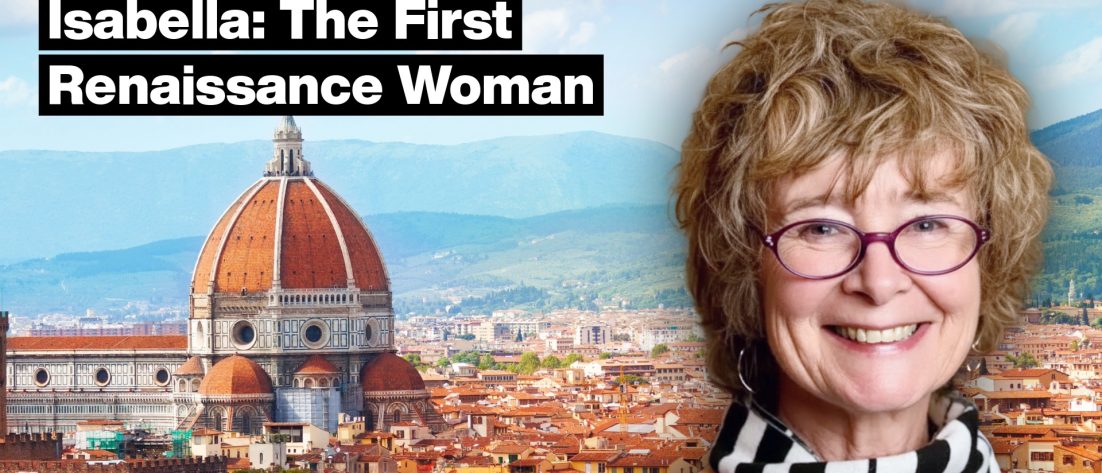
Was the Italian Renaissance only for men? While history remembers the names of Michelangelo, Leonardo, and the Medici, one woman’s story of power, art, and ambition rivals them all. In this episode, we uncover the life of Isabella d’Este, the First Lady of the Renaissance, with acclaimed historical novelist Sarah Dunant. Discover the incredible true story of the woman who ran a state, built a world-class art collection, and navigated a dangerous marriage—all while a secret disease swept through Europe, changing her destiny forever.
Join us as celebrated author Sarah Dunant, a fellow of the Royal Society of Literature, discusses her groundbreaking new novel, The Marchesa. Dunant shares how a simple question from her teenage daughter—”Where were the women?”—sparked a two-decade journey to uncover the forgotten stories of Renaissance women. This episode reveals the fascinating life of Isabella d’Este, a political mastermind and fashion icon who was brilliantly educated in humanist culture. From an early age, she was a force to be reckoned with, known for her sharp intellect and unshakeable confidence. Dunant explains how Isabella became a pioneer of female art patronage, commissioning works from the greatest artists of her time and building a collection that was the envy of popes and kings.
We dive deep into the thousands of letters preserved in the Mantua archive, which provide an unprecedented look into Isabella’s mind. These documents reveal her cunning diplomacy as she ran the city-state of Mantua while her husband was away at war.
We also explore her intense rivalry with her notorious sister-in-law, Lucretia Borgia. In a particularly captivating part of the interview, Dunant sheds light on a shocking and little-known aspect of the era: the history of syphilis in Italy. She details how the “French pox” arrived from the New World and secretly ravaged the European aristocracy, revealing a stunning discovery from her research that suggests Isabella knew her husband had the disease and took control of her own fate. Finally, hear about the author’s own journey to publish Sarah Dunant The Marchesa, a beautifully illustrated hybrid of history and fiction that she was so passionate about, she decided to publish it herself.
Links:
Transcript
Welcome to Books and Looks, where we do a deep dive with authors to help you discover your next great read. And today, friends, I am honored to be chatting with probably the most highly decorated and respected author who has ever been on our show. She is a 1994 Silver Dagger winner by the Crime Writers Association of England. Her entire career changed during a trip to Florence, Italy, where she became enthralled with unknown and forgotten women of the Italian Renaissance, where she has written six historical novels on five different women. She is a fellow of the Royal Society of Literature. She’s been a presenter and a contributor on BBC Four and BBC Two. She’s been a professor. She is an outstanding author, writer, human. I love her. You’re going to love this interview today.
I’m Blane DeSantis, this is Books and Looks, and today we’re talking with Sarah Dunant about her new novel, The Marchesa.
*
Blane DeSantis: Sarah Dunant, welcome to Books and Looks.
Sarah Dunant: Thank you very much Blane, it’s a pleasure to be here.
Blane DeSantis: I am so honored and privileged to have you on our show. You are so highly decorated. You are such a wonderful author. I love all your works. I have all your books. They’re spectacular. I just love you.
Sarah Dunant: Ha ha ha. Thank you. Gosh, thank you.
Blane DeSantis: We’re here to talk about your most recent book, Sarah, called The Marchesa. There was a change in your writing style back in the early 2000s. You stopped writing mysteries that were highly acclaimed and you started writing about the Italian Renaissance. What happened? Why the change?
Where Were the Women? Sarah Dunant’s Journey to the Renaissance
Sarah Dunant: How long have you got? I cut my teeth as a writer on thrillers. They’re a great way to tell a story, to keep people turning the page. But inside that thriller writer, there has always been a history nut. I loved history as a child. I studied it at university. I was really well taught. And I was also taught about history of art.
And then in the year 2000, I found myself in the city of Florence on my own for a brief period of time without my children for once. And as anyone who’s ever been to Florence knows, that city is, although it’s very touristy now and has modern elements, it still has an umbilical cord to the past. And that past is that moment when a volcanic explosion of changed culture took place in the 15th century when having been certain about God and their civilization, they suddenly decided that it would be a great thing to look back to other civilizations like Greece and Rome. So anyway, I did a lot of research, I absolutely enjoyed myself, and I was thinking that it would be really interesting to write a book about that moment, i.e. when all of these new ideas was the shock of the new, because Florence was just alive with ideas.
And then my children came to join me and they were young teenagers at the time. And they were both girls. This is important to the story. And so the first day I took them out on the streets and I said, I’m going to show you all over this city and you’re going to learn what happened when this cauldron of cultural revolution took place. And my elder one who was 13 at the time turned and said a phrase that’s now famous in our house, which is, “I’m sorry, mum, but I think you should know I don’t do culture. I just do shopping.”
And the younger one, whose job it was to get up her nose said, “That sounds really interesting. I’ll come with you.” And as I started to walk them through the streets, I started to realize that I had a really hard sell on my hands because absolutely everything I was going to show them had a man’s name attached to it. All the painters, all the architects, all the scholars, all of the priests or the politicians, were all men.
And I started to ask myself a really simple question: Where were the women? Did women have a renaissance? And it was that that took me back into history. Now, as you will know, we’ve had a revolution in history over the last 40 or 50 years. And “where were the women” is something that a lot of scholars have been looking at. But they’ve been producing scholastic books or papers, which was never going to get out to a popular audience. So I started to research what they were doing.
And as a result of that, I found details and new history, which when I put it together with fantastic art that was all over Florence, I could start to create stories of a young woman who wanted to be a painter or a woman who was a courtesan in Venice or a woman who was a nun living in a convent. And so that was how I came to rediscover the Renaissance 25 years ago now.
Blane DeSantis: Well, that first book, The Birth of Venus, was spectacular. I got that in hardback when it came out and I’ve loved it. I’ve read it twice and a very, very wonderful book. You learn so much. Funny you mentioned about your daughter.
Sarah Dunant: Well, Blane, that’s the trick. I was going to say that’s the trick because you learn so much, but hopefully you never feel you’re being taught because you do it through story. And that’s the difference between being the historian and being the fiction writer.
Blane DeSantis: Exactly. Very true. Going back to Florence, completely off the tangent, we’d been to Florence numerous times. We were going to live there for a year. But after around the third trip, we went back a fourth time, and my daughter said to us, “Where did all these shops come from? I don’t remember all these shops here before.” She was so young, she didn’t look into shopping or anything like that, but all of a sudden, she found them and that was it. There with the credit card, ching ching ching.
But anyway, it’s wonderful. And that’s one of the things you do here. You have a wonderful knack of telling us a story and teaching us at the same time. And this continues. You write five other books. You talk about all these women and now you come up with The Marchesa, Isabella d’Este. How did you discover Isabella? And what made you want to write about her?
Introducing Isabella d’Este: The First Woman of the Renaissance
Sarah Dunant: Well, if you’re Italian, we wouldn’t have that question because it would be a bit like saying, “Do you know Shakespeare?” Because the Italians all know Isabella d’Este. She is in a sense the one woman who puts her head above the parapet, her along with Lucretia Borgia, who’s been very much maligned and I’ve written about her too. And for a long time, I didn’t want to write about Isabella because I wanted to write about people we didn’t know. I wanted to tell stories that we didn’t know.
But everywhere you go at this period, this extraordinary woman is present. She is the first female art patron and collector of the Italian Renaissance. She’s born in a tiny little city state in the northeast of Italy. She marries into another state nearby and right from the get-go, she wants to collect art. And she’s an amazing character. She’s very clever.
She’s brilliantly educated because at this time you could educate your daughters in this new humanist culture. And she’s very confident. So if I were to tell you that one of the first things you learn about her is at the age of six, the neighboring state sends an ambassador to see if she’d make a good wife for their growing up young Marquis. She tortures him by reciting an entire letter in Latin by Cicero that she has memorized. So I think you start to really see that this is a woman who loves learning, is good at it, and is not a shrinking violet.
And what’s interesting about this, Blane, is she’s the first born into this family. Now, normally, when you only have a girl to begin with, you get a bit worried because you really need the boy. But in this case, there is something about Isabella’s personality that seems to have entranced both her mother and her father. And I think that’s one of the things that the post-Freudian historian in me thinks gives her real substance and confidence. She knows that she’s loved, she knows she’s clever, and those two things follow her through life.
Blane DeSantis: Now, that emissary, was that from Milan or was that from Mantua?
Sarah Dunant: No, it’s from Mantua, which is a city-state near to them. And both of those city-states are vulnerable at this time. They’re small city-states. They’re very artistically powerful. They’re punching above their weight artistically. But they’re quite close to Venice. And Venice is always greedy for land. So they need to come together in order to form a phalanx against Venice.
It’s like all these unions during this period of time, nobody or very few people marry for love. They marry to keep the dynasties intact and to keep the politics rolling. And so she and her husband, who’s eight years older than her, don’t really have a love affair, but what they have is a partnership and a partnership that means that both of their city-states can benefit from it.
Blane DeSantis: What’s fascinating is that her sister eventually marries Ludovico Sforza up in Milan. Wasn’t it at one time, didn’t they think she, Isabella, would be the one who would marry him?
Sarah Dunant: It’s a classic little story, actually. Isabella’s very, very smart and everybody knows it. And so she’s almost immediately, she’s only six years old, she’s immediately affianced into Mantua, so they’ve got a good political union. And then Ludovico Sforza, who isn’t yet the Duke, he’s only standing in for the Duke, hears about Isabella and sends to Ferrara saying, “I think I’d be interested in marrying her.” Well, now her dad’s got a problem.
He doesn’t want to offend Mantua because they’ve already accepted her. He certainly doesn’t want to offend Milan. So because he’s a smart cookie, he says, “Well, Isabella’s taken, but I’ve got this great younger daughter called Beatrice. Would you like her instead?” And then suddenly those two Este girls are both in Milan and Mantua. Her dad is a very good politician.
Blane DeSantis: Obviously. Wow. What helped this book along is a treasure trove, and I literally mean a treasure trove of documents in an archive in Mantua. Tell us a little bit about that. That’s amazing.
Uncovering History in the Mantua Archive
Sarah Dunant: It’s in Mantua, which is the city which she goes to. Mantua is not very far from Ferrara. It’s a day’s ride by boat and she goes by golden barge. And like all of these little city states, it will have its own government for a long time in the name of the family. She comes from the Este family and she marries into the Gonzaga family. And as soon as she marries into the Gonzaga family, all of her correspondence will go into an archive, which is a local archive.
But then when Italy becomes a country at the end of the 19th century, in the 1860s, suddenly Italy really needs to centralize all of its archives so it can write histories about the whole country. So they move the archive of the Gonzaga from the Ducal Palace, where it’s been mouldering in chests for centuries, to a new archive, which is now very old, but then it was new and it was an unused convent and a deconsecrated church. It’s a great story for historians, actually, because they move all of this stuff and then discover that they don’t have enough room for it all. And so they have to decide what they’re going to keep and what they’re going to get rid of. And historians at the time decide, “Well, we’re not going to use all of these household accounts.” So they burn them all and they go off in smoke.
Now, a century later, there’s the wailing of economic historians going, my God, no, that’s exactly the kind of documents we want to have so we can work out how courts existed, how trade existed. But the great thing about Isabella is Isabella is both a writer—so she writes something like 13,000 letters during her lifetime, and they are kept in this archive along with the letters that she receives back. So every letter that she dictates goes into a copy book and then they keep the one she gets back.
And she’s also a shopper. So we have a record of all of the things that she buys. So she’s great for economic historians. And she’s also great if you want to study this determined, extraordinary, often bolshy and very talented woman. What you basically have is the bureaucracy of state as controlled by Isabella, who often is running the state while her husband is away fighting.
Blane DeSantis: Lots to go through. Are you a good translator? Could you read all those? Did you have help with all those letters?
Sarah Dunant: I had a lot of help with all those letters. I can do the shopping and I can hold a conversation in contemporary Italian. It is extremely hard to read the tiny little script in ink, which is often smudged out by time of 15th century Italian diplomats. So I did have help. And this is where America comes in, because America has a couple of really cracking historians when it comes to Isabella D’Este.
One is a woman called Deanna Shemek who lives in California and she has translated a lot of the letters and she and I worked together and she checked some of my history as I was writing this book because the historian in me wants to get it right. So I could use her letters and then when I finished a very early draft of this I could send it to Deanna and she could actually make sure that I wasn’t making it up because although some of the stories are so great that you might think people have made them up, you might as well stick to the facts because the facts are greater than anything that you could invent yourself.
Blane DeSantis: Absolutely. We’ve grown up hearing the words, “He’s a Renaissance man.” You never hear anybody saying, “She’s a Renaissance woman.” And there were Renaissance women. And Isabella, maybe the first, maybe the premier Renaissance woman, loved the arts. Tell us a little bit about her art collection, if you would, please.
Isabella’s Art Collection: The First Female Art Patron
Sarah Dunant: First off, she grows up amid great art. We’re in the middle of the 15th century. She’s born in 1474. And by then the city she lives in, Ferrara, has already got some fantastic pieces of art. If you go to Ferrara, you can walk into one of the palaces and see a whole room that’s been brilliantly frescoed. So she knows her art and her mom is a bit of a collector too. And she is determined as soon as she goes to Mantua that she wants to collect her own art.
She hits in Mantua a great painter who is the court painter there, a man called Andrea Mantegna. We now think of the Renaissance and we think of Michelangelo and Leonardo and Raphael, probably because we can spell them all, but there are a whole load of other brilliant painters out there at this period of time and Mantegna is one of them. So she has a fantastic court painter. She doesn’t get on with him very well because she’s a very bolshy 16 year old and he is 60 plus and busy trying to finish a masterpiece, which is nine huge panels of the triumph of Caesar, which we now have in England in Hampton Court Palace. But she can also get in touch with other people. So she’s writing to Perugino. She has a connection with Leonardo da Vinci. She is always looking for great art.
And she’s also looking for old statues. This is the moment when in Rome, because they become interested in Roman classical art and because there’s a lot of money in Rome, every time they stick a spade in the ground, they hit something that has been under the earth for 2,000 years. And so the popes are finding these huge statues and keeping them for themselves. Isabella doesn’t have quite enough money to put on the table what the popes or cardinals can do because the church is very rich. But what she does is when she finds a great statue, maybe the Laocoön or something, what she does is to employ a bronze sculptor to make her a perfect little miniature copy of them. They’re now worth a great deal of money, these miniature copies. So along with art, she also has these beautiful little statues and she collects coins and medallions and she collects musical instruments. Collecting was quite a big deal during this period of time and she is really the first woman to both patronize and make her own collection and have a place where she can put it.
Blane DeSantis: She also had a good nose, from what I remember reading. She was a perfumer?
Sarah Dunant: She was. It’s an interesting thing, isn’t it? If you think about the past, it would have smelled a lot different to the present. You’re living in a period of time where personal hygiene and sewage and a whole lot of things were different. So perfume was extremely important. And Isabella runs her own distillery. And so she makes perfumes for lots of other people.
And it gave me a very good way to get into her because when I was writing the book, I imagined that the ghost of her was still in the archive, still in all of these thousands of letters, which are kept in this really quite decaying archive. Some of these letters do look 500 years old. And I imagined that she would come out of the letters when a scholar came in to look at her. And I imagined that one of the senses she would have kept was smell, so she could smell the decay around her. And when she arrives on the scholar’s desk, she knows exactly the kind of perfume that the scholar is using.
I think that’s one of the things I really love about working in history is it is a lot of fascinating facts. It is a lot of great art, but it’s also what did they sound like? What did they smell? What was the touch of material like? How did the music sound? Because our senses are one of the ways in which we really appreciate the world. And so it’s something I’ve always worked on. And Isabella’s sense of smell, having a good nose, was one of the ways in.
Blane DeSantis: You know, we talk about Renaissance women and Italian Renaissance women, and this is not in the book, but what was the state of the Renaissance woman, if there was such a thing, in England and France? Were there Renaissance women like Isabella over there?
Sarah Dunant: There’s nobody like Isabella, actually. It’s partly that at this time, the Renaissance really hasn’t hit either England or France properly. The Renaissance happens in Italy very early. We’ve still got the War of the Roses here. We still haven’t even got Henry VIII when she’s born. So, I think that Italy works so well for the Renaissance because it’s not one country. It’s a whole load of little city states and each one of those states is controlled by a particular family.
Now they may have clubbed and stabbed their way into power, but once they get their feet under the table, they’re quite interested in being shown to be as cultured as those big guys, the Medici in Florence or the Sforzas in Milan or in Venice. So you start to see a lot of great art and a lot of great patronage emerging from these little cities. You go to Mantua and Ferrara now and boy, you really should because they’re beautiful little cities. You won’t find a great deal of the art still in place because it’s all been dispersed, but you will find these fantastic buildings and you will find a sense and feeling that once these were remarkable little city-states. So they’re still extremely rich even though they’re not very well known.
Blane DeSantis: I really liked that. She did not care for her sister-in-law, Lucretia Borgia. She didn’t really care for Lucretia too much to the point where, when she was going to meet her, she created a headdress or something to outshine Lucretia. What was that relationship like?
A Rivalry of Style and Power: Isabella d’Este and Lucretia Borgia
Sarah Dunant: Well, it’s a difficult one. Lucretia Borgia has been much maligned by history. It suits everybody to call her the evil, tempestuous, poisonous, sexually voracious, etc. In a sense, that is only because the victors wrote the history and the Borgia family lost. So when other people came into power, it suited them to slander them. They’re not good guys, but nobody is good guys in this period of time. There’s a lot of stabbing and clubbing going on here.
But by the time Lucretia comes to marry Isabella’s brother, she has got a reputation which is a bit slanderous. Now, I don’t think much of it is true, but nevertheless, Isabella will know it. She’s also the illegitimate daughter of a pope. Now, Isabella comes from a very classy aristocratic family and she’s a bit of a snob. So she really doesn’t want Lucretia Borgia as her sister-in-law. I think the lack of affection is mutual between them. But when she goes for the marriage, she has to, like some people do when you go to weddings, try and upstage the bride, which she does partly by designing this new headdress.
Isabella is getting rather large at this period of time, and the rather famous Este double chins are beginning to appear. So she needs something to take your mind off the bottom part of her face. So she designs this fabulous headdress. She’s a real fashionista, this woman, which is made up of a turban of fake material and fake hair and jewels. And it sits on the top of her head. And such is Isabella’s power as a designer in fashion, that if you go and look at almost any picture of women during Venetian art over the next 50 or 60 years, you’ll see them wearing the same headdress. So she’s very, very good at designing herself.
Blane DeSantis: You’ve written two books about Lucretia. Did Isabella make her way into those books?
Sarah Dunant: Yeah, she made her way into the second, In the Name of the Family. And I didn’t really like her because Isabella, of course, doesn’t like Lucretia. But I was very aware when I saw her that this was a powerful woman and that she deserved me to bring her into the spotlight. And I don’t always like her. When I’ve spent four years in her company, I know her almost better than my partner. But I have come to admire her because I do know how difficult it was to do what she did 500 years ago.
It is almost impossible to overestimate the change that has taken place in the condition of being female. It was not a good sex to be born into 500 years ago. No birth control, women dying in childbirth, women marrying people they didn’t love, women having no power. So Isabella’s achievement, which is to partly run the state while her husband’s away—and she’s a good diplomat, she’s smart—Isabella’s achievement in collecting and having a collection which could rival some of the men’s, Isabella’s achievement in having writers come to her court who then write beautiful pieces of work is really extraordinary.
And not all extraordinary women are necessarily likeable, just like not all extraordinary men are necessarily likeable. So my job was to bring alive a woman who you couldn’t help but admire, and for her to know that history would find some of her unpalatable, but she wants to explain her story to you. And that’s what the relationship between her and the scholar in the book is about.
Blane DeSantis: And you have her basically being the narrator and she actually gets involved. If she thinks somebody was coming in and maybe not doing the right thing, she would blow a page or she would have a wind come in and knock somebody’s hat off or turn off the light or something. That was a fascinating way you use Isabella as a ghost as part of this research. Tremendous.
Sarah Dunant: Yeah. Well, I also wanted to do something else, which is going to sound a bit pompous if I say it, but I believe in it really powerfully, which is that the present is very good at saying, “We’re the present, we’ve got it all right, we know exactly what the right moral values are, and the past, well, that was dreadful. That was really very bad.” So when we go back into the past, we’re always looking for ways to criticize them. But I wanted to say, what happens if the past talks back to the present?
There is a moment in the book, for instance, where Isabella gives birth after six years in marriage, she needs an heir, and she gives birth to a second baby girl. And she writes a letter, which begins with the words, “Not to please you, but to do my duty.” She’s writing to her husband, “I have to tell you, I’ve given birth to a baby girl. And the chill that has come over me and the whole house, I leave to your imagination.”
Now if you read this as a woman now or indeed as a man now it’s a rather shocking thing to read. And so what I do at that moment is I have Isabella saying to the scholar who’s reading it, “Hold on, before you condemn me, come into my world, know what it’s like to be six years on in a marriage and not having produced an heir and how precarious that makes your position and the fact that this little baby is probably not going to live.”
And it was a wonderful way for me to get the past and the present to talk to each other a little bit. Because as a novelist who writes in history, I think the most important thing is not that you go back into history to say you know better, but that you go back into history to do a bit of imaginative work, to try and truly sink yourself in to what it might have been like to be them then. And that seems to me the one thing that fiction is really good at. And some of historical fiction, I think, plays fast and loose with the facts. And I don’t agree with that because I’m a historian. But I think if you get the facts right and sometimes they’re uncomfortable, then the reader now has to think, wow, okay.
I’ll give you a quote. And it’s from a very good book by a British writer called L.P. Hartley. It’s a book called The Go-Between. It begins with a single line: “The past is a foreign country, they do things differently there.” And that really sums up what I think about history and what I’m trying to do in the way that I’m writing these books.
Blane DeSantis: It does a fantastic job. Did you always intend for Isabella to be a ghost or did that happen as you were writing and researching?
Sarah Dunant: I always intended it. Books begin, for me anyway, with just a sliver, an image of thought. So when I was writing about nuns, the book began with the idea of a young woman screaming in a convent after lights out because she’d just been put in there against her will. So that was an audible beginning to the book. When I went and saw the archive in Mantua and when I saw the number of letters in their tattered folders, I had an image of Isabella existing in those and lifting out of them as you opened up the folder to read the letter. And sitting on top of your shoulder as you read it and thinking, “Come on now, are you going to read this properly? How well are you going to deal with me?” So that was always there in my mind.
Blane DeSantis: Good. Wonderful. This had to weigh on this woman because her husband basically ceded all the power and the diplomacy to her and it had to be hard because she bore eight children. I think six lived. And she also is trying to be a diplomat and an art collector. Did she have difficulty handling all these roles?
Sarah Dunant: I don’t think she did. We talk now about the power of women multitasking. And I don’t think it was any different then. I think the argument then is that Isabella had both the energy and the will to do all these things. She’s not the only woman who will run a state or at least try and control the state while their husband is away because lots of these little city states, the man running the state will be a mercenary soldier. So he’ll have his own army, which he will send out to other people, and that’s how he’ll make his money or some of his money.
And her mother indeed had done the same thing. But Isabella had a nose for diplomacy, because she was very smart. She liked politics, she liked manipulation. And she had a husband who was a good soldier to begin with, but really liked to blow his own trumpet. And when he had one success in war, he just wanted to talk about how brilliant he was. So he was always at risk of giving away state secrets of the city of Mantua. And so her job as a diplomat was always to try and curtail him and make sure that nobody knew their business. And that means that her letters are often really interesting. So if you read all her letters as a diplomat, you start to see that, they’re very charming. They’re full of guile, but underneath there’s a sword of steel there.
And she’s always looking at the larger picture. And indeed, when he is imprisoned by the Venetians for a time and they don’t want to ransom him off, the Venetians say to him, “I don’t think she wants you back, actually. She’s just enjoying ruling too much.” So Isabella has a reputation outside of Mantua for being the one who wears the trousers. And that phrase, “the one who wears the trousers” is in one of the letters.
Blane DeSantis: No doubt. That’s great. Also in addition to being a soldier he was rather a profligate. He liked to see the women when he was out battling and he eventually had syphilis, her husband. You don’t just mention it, you go into pretty much detail about that time period when she had him basically quarantined. Did you know he was that ill and did she realize what his problem was?
The French Pox: How Syphilis Shaped Isabella’s Marriage and Destiny
Sarah Dunant: I knew about syphilis because I’d been studying this period for a period of time. And it is a fantastic moment of history when it comes to medical history, because syphilis is very new. It basically comes from the New World. In 1494, which is exactly the time period we’re in, Columbus goes to the Americas. He takes with him and with his soldiers and sailors two diseases to which we have some immunity, but they don’t, and those two are smallpox and measles and they will destroy the Americas.
But in a kind of tit for tat, some of those soldiers and sailors sleep with some of the native women and they bring back in their loins a disease to which those inhabitants of the Indies have got a reasonable immunity, but we’ve never seen here properly, which becomes called syphilis. It doesn’t have that name now. It’s called the pox. The English call it the French pox, the French call it the English pox. And basically we know that some of those soldiers and sailors from Columbus come into Italy in an invasion of Naples. And we know that out of their playing around with prostitutes in the brothels in Naples, syphilis explodes.
And it explodes and it moves so fast, Blane. It explodes in the spring of 1495. We are closing public brothels in Scotland two years later. That’s how fast it moves. And of course, these men who may be married to noble women are not married to women who they necessarily love. This is not meant to be faithful. Obviously, the women have to be faithful because they’re females and they have a chaste way through history. But the men can do what they like, more or less, and obviously a number of them do when they’re away.
And so he’s not the only one to contract syphilis. And for a long time, they don’t know what it is. My God, this new disease, you get pox marks all over you, you’re in agony. And then it goes away. So you think you’re cured, but then it comes back and you’re still sexually contagious. So the big mystery of Isabella’s story is did she know her husband had syphilis? She writes about syphilis in the letters because she knows that this disease exists, lots of people have it. And that was the great moment in my research, which is I did find one letter that made me realize that Isabella did know that he had syphilis. And that would explain why they have eight pregnancies and around the time of that eighth pregnancy, which is when she’s absolutely certain he has syphilis, no more children happen.
So I think that she somewhat took control of her own destiny here. Whereas for instance, I’m pretty damn certain that Lucretia Borgia, whose husband also had syphilis, dies of the disease in childbirth when she’s only in her late thirties. We can’t know this for sure because we can’t open their bones and check for it. But it was an amazing disease. And for four centuries, we didn’t have a cure. It’s only when penicillin comes in the 1940s that we can control it.
Blane DeSantis: It’s fascinating over here in the States. All we hear about is Columbus brought over all these diseases, smallpox, etc. But no one ever talks about what went back over to Europe in return. And that’s a fascinating subject. Wow. This is a hybrid book. It’s part history, it’s part novel, it’s part art history, biography. Is that a hard thing to write for you? Is it a challenge to write a book like this?
The Marchesa: A Hybrid of History, Biography, and Novel
Sarah Dunant: Not for me. I’ve been doing this for 20 years now, and it’s probably true to say that my books have slightly shifted. When I say more history, all I mean is that I get the history right, really. I do know that the trick of writing a good novel, because for years in my life before I started writing, I was a cultural journalist. I worked in television and radio here. I do know that the trick of a good novel is people need to turn the page. People want to know what happens next. So I always have the bones of a really good story and Isabella’s life is a really good story.
I also know that if I put in too much information, which I know to be true, your eyes will go glazed as you’re reading it. So very often on my last read of a book that I’ve written, I will think, God, that’s a fascinating fact. Too many fascinating facts, Sarah. Take it out. You need somebody to want to turn the page. So I try to be very careful in the balance between getting the history right and not overwhelming you with it. And to do that, I think you need to find the right personalities in the books to hold the story. And in this case, Isabella is such a strong personality that of course you want to stay with her. Of course you want to know what happens next. And not least you want to know what happens next in that marriage.
Blane DeSantis: Yep, no doubt. I’d like to know if you’re the researcher in the book, or did you pattern that on somebody else?
Sarah Dunant: I certainly… my friends would say, well, first of all, I am not a young woman anymore. So that fits in with the researcher. I have a lot of curly hair that fits in with the researcher. And my friends would say I have a flamboyant dress sense and I don’t wear particularly expensive perfume. So if you can nail me on those four, it’s probably me. And I was in that archive for the best part of two weeks. Unfortunately, I do not have the ability that that archivist does to read everything in the original, but I really did do my time in order to get to know her. So yeah, I think I am.
Blane DeSantis: How long did it take you to write the book?
Sarah Dunant: It took such a long time. I was in the archive just before COVID. So that already tells you the problem. When I left the archive in the beginning of February 2020, there was already COVID in Northern Italy, although we didn’t know it at the time. I get back to England, there’s lockdown. I can’t get back into the archives for the best part of two years. I then write the book, and the balance isn’t right between the scholar and Isabella.
The Author’s Own Battle: The Journey to Self-Publishing The Marchesa
I then write the book and I’m really keen to have illustrations. We haven’t talked about that, but the book is illustrated. Some of this great art is in the book. And when I finish the book, I take it to my usual publishers who published me for 30 years and they don’t want it because it’s got illustrations and that makes it expensive and they’ll say it’s not a novel. So basically I decide to publish it myself, which is what I have done, which is why if people are listening to this and they go into Barnes and Noble and say, “Where is it?” They will not necessarily have it on a table. They will have to order it or they will have to get it off one of the many websites you can get it off.
And there was nothing I could do about that. I was determined to get this book out. I was determined to get Isabella’s story out. And I was determined that you see some of the great art too. So that’s what I’ve done. I’ve also gone on to read the book myself because I couldn’t leave it to anybody else. I know Isabella really well by now. So it’s an audiobook, it’s a Kindle, but all of that took time.
Blane DeSantis: She wouldn’t like that. Now see that peeves me. I have to be honest, that’s one of my favorite words, peeves. This peeves me that your publisher wouldn’t publish it because of the illustrations, because the illustrations are so great and a part of this book.
Sarah Dunant: Yep. Well, I get it to a certain extent. It’s not cheap. I wanted some color illustrations. So I go ahead and I publish it myself. And then to my supreme shock, I discovered that I don’t really earn very much money every time I sell a book because the printing costs are high. But nevertheless, I’ve written a lot of books in my time and I had a really good career. I really wanted Isabella out there. And if you really want to do something in the same way when Isabella really wanted to do something, she did it. I took my lead from her and I thought if I have to do it this way, then I’ll do it this way. At least she’s out.
The best news for me is that the Italians have taken it and are publishing it this year in Italian. Now, the Italians are very sniffy about other people writing their history. So the fact that they’re willing to take my version of Isabella from an English writer makes me feel that I’ve probably got something right.
Blane DeSantis: Absolutely. I sit there and I think, is this a definitive work on Isabella? Can anybody do any more about Isabella’s life? I really don’t know.
Sarah Dunant: Every generation asks different questions. So there have been novels about Isabella in the past. It’s not my Isabella, she doesn’t speak to me through them. So I put it this way, Blane, I don’t think I’ll be alive when the next one comes out, so I won’t know about it.
Blane DeSantis: Okay. Won’t know about it. Don’t care. All right. That leads me to one last question. What’s next? I certainly hope you found another woman. I certainly hope we have another book coming out.
What’s Next for Sarah Dunant?
Sarah Dunant: I don’t know what’s next. After a book comes out for a long time, I don’t know what I want to write. In fact, after a book comes out, I know that I never want to write again because it’s all been such hard work. So when I say I’m not writing another book, were my children here, they would say, “Yes, mum, that’s just like the last book when you weren’t going to write another book.” I have an idea. I’m not going to tell you about it, because if I tell you about it, it may disappear. I’ve done some research.
Now comes whether or not I’m willing to do the really hard part, because I love the research, which is sit down and watch the words appear on the screen. And whichever way you play it, that takes time and it takes energy and they’re not good enough and you have to rewrite them. I live in the middle of the country now in England. The weather is awful. It’s winter. I have some time where I’m not allowed to go outside, so maybe this is the right time to start a book. I don’t know.
Blane DeSantis: Will it be an Italian book? Does it deal with Italy?
Sarah Dunant: Most certainly. It’ll be about an amazing event that takes place in the middle of the 1520s when a huge army filled with Lutheran mercenaries attack the city of Rome and take the Pope captive and destroy convents and murder people and torture people. And it’s a piece of history that people don’t know. So I would absolutely love to write about it.
Blane DeSantis: I hope you do. May it be a long winter, a hard winter. Stay inside, research, write. That’s what we want. Sarah, you have been an absolute delight. I am so happy that we got a chance to talk and I so appreciate you taking time. I know you’re going to a lecture very shortly. So I don’t want to take any more of your time. But again, from the bottom of my heart, Sarah, thank you so much for being with us today on Books and Looks.
Sarah Dunant: Thank you for having me, Blane. It was a real pleasure.
*
Blane DeSantis: Well, friends, I hope you enjoyed Sarah’s interview as much as I did. This is her first and only podcast YouTube here in America. And we’re so honored that she would choose Books and Looks to be that outlet. We appreciate her efforts. I hope you do too, because she has written wonderful books, books on women, there’s history, there’s biography, there’s art. Some have to deal with people in a convent. Some have to do with Lucretia Borgia, super stuff. So Sarah Dunant, you want to get her books, friends. You want to get her books.
And friends, for those of you who are keeping track and following us week to week, you know what’s coming up. If you don’t, I’m going to tell you right now. Our next show is the third annual Christmas wish list. That’s right, the third annual Christmas wish list is coming out in a couple weeks. Everybody’s starting to reference this thing. Even other websites are referencing this. Follow along. We’ll be back in just a couple of weeks on behalf of our good friends at BookTrib.com. This is Blane DeSantis for Books and Looks saying, “May all your leaves be pages in a book.”