
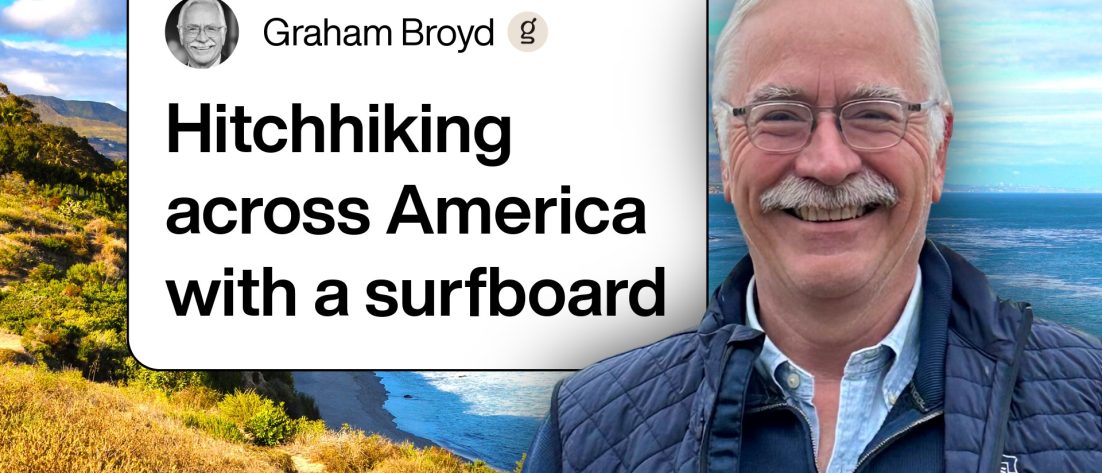
In 1980, a 20-year-old Graham Broyd turned a prestigious six-week scholarship to Washington, D.C. into the adventure of a lifetime. He traded his ticket for a flight to Los Angeles with a dream of surfing in Malibu and a wild plan to hitchhike across the country. In this episode, Graham shares the incredible story of his journey, a tale he revisited in 2024 to see how the country and he had changed. This is the ultimate story of hitchhiking across America then and now. What happens when you have just $600 to survive for six weeks, relying on your wits and the kindness—or danger—of strangers?
This sprawling conversation, a must-listen for fans of incredible travel stories, is like a living “Backpack, Jacket, Surfboard” book review. Author Graham Broyd sits down with Blaine DeSantis to recount his unbelievable journey. We hear tales of extreme budget survival, like his method for turning a single Big Mac into a three-course meal, a story that comically landed his book in the “cooking humor” category on Amazon. Graham shares the unwritten rules and etiquette of the road, offering a fascinating look into the lost art of hitchhiking. This Graham Broyd travel memoir comes to life as he discusses his disastrous first attempt at surfing in Malibu, how he acquired an eight-foot surfboard as a travel companion, and the frightening night he spent alone in the desolate expanse of Death Valley.
The episode explores the stark difference between America in 1980 vs 2024, contrasting the past with the present through Graham’s retraced journey. He shares thrilling and sometimes chilling stories from hitchhiking America, from navigating an unwelcome advance near the Grand Canyon to the bizarre experience of ending up in Tijuana, Mexico on a trip to Malibu—a mystery he still hasn’t solved. We learn how a single smart jacket gave him access to the high-rolling casinos of 1980s Las Vegas and how a chance encounter in a youth hostel led to a stunning interview with Senator Howard Baker about the Panama Canal Treaty. This detailed look at hitchhiking across America then and now culminates in a tale of unexpected benevolence on the gritty subways of New York City, proving that adventure and humanity can be found where you least expect them.
Learn More From Our Guest & Episode Resources:
Introduction
Blaine DeSantis: Welcome to Books and Looks, where we do a deep dive with authors to help you discover your next great read. When you’re young, many times you get an opportunity that turned into something special. Back in 1980, Graham Broyd turned a six-week scholarship trip from England to Washington, D.C. into a flight to Los Angeles and a cross-country hitchhiking experience that fills us with awe, wonder, learning, and humor.
And then he went back in 2024 and decided to go back and revisit these same places. This is one of the most amazing stories that we have read and that you’re going to see. It’s just great. This man’s hiking across America. I’m Blaine DeSantis. This is Books and Looks. And today we’re chatting with Graham Broyd about his new book, Backpack, Jacket, and Surfboard. Graham Broyd, welcome to Books and Looks.
Graham Broyd: Thank you, Blaine. It’s great to be here.
Blaine DeSantis: Graham, you have written a wonderful book. I don’t know if I call it a biography, a memoir, a travelogue. I don’t know how to put it into a certain little genre. It’s an amazing book. Amazing, my friend. Just great job.
Graham Broyd: Thank you. Thank you. It doesn’t neatly fit a genre. And it’s been interesting, because I’m finding, as people have read it and review it, that a lot of different people take different things away from it, which has been very interesting. Such a joy for me, too.
Blaine DeSantis: And I think that’s one of the things is that I took something different than a lot of people because I spent a lot of time out in California and I was with you the whole time. I’m doing this. Oh, did you go there? Did you do that? Boom, boom, boom, boom, boom, boom. It brought back so many memories for me. And I think it’ll bring back memories for so many different people. They’ve had these experiences.
But, friends, this is a great book because at age 20, I think it was, Graham decided or got a scholarship to come to America. It didn’t end up like he thought it was going to work, the university thought it was going to be. So I want to let him set the scene for us. Tell us about what happened back then when you were 20 years old.
From a D.C. Scholarship to a Cross-Country Hitchhiking Adventure
Graham Broyd: I was at university in England and I won a scholarship to go study at the Library of Congress in Washington, D.C., which was a big deal back then. Six weeks of study and a flight out and a flight back and enough for a cheap hotel while I was out there. But I was 20. And so I sold my ticket to Washington, D.C. and bought one to Los Angeles because I wanted to go surf Malibu Beach in California.
I thought, I’ll just surf for a week. Not really knowing American geography, I’ll hitchhike across from LA to DC in a week. And then I’ll study for four weeks and go home. And so the book follows that trip that did not go as planned. And then as I went to write those stories down last year, I realized some of it made no sense to me. So I went back and revisited those spots in 2024. And that’s really the core of what the book is.
Blaine DeSantis: I got a big chuckle when you early on in the book said you didn’t quite realize how wide America is. A little bit bigger.
Graham Broyd: I think it’s a classic European issue. You sit in England and you can reach the coast from the center of England in an hour and a half in all directions, and that didn’t quite translate to my naive mind back in 1980.
Blaine DeSantis: It happens. But you had a trip planned that was out of this world to get this scholarship and to work at the Library of Congress and to study there, and you made it a better trip. You made it a memorable trip. And so, friends, we’re going to start out with Graham. I’m amazed that they would let you sell the ticket and buy a cheaper one to Los Angeles. Is that right?
Graham Broyd: It’s basically the same price. And my university didn’t know that. They sent me the ticket in a brown manila, or a manila envelope, large one. I still remember it. I can see it on our dining room table. And I looked at the ticket, really not for long. And I just thought, I’m going to call the airline and change this ticket.
Blaine DeSantis: Pretty good. Pretty good. And friends, he got a grand total of $600. Back then, $600 were worth a lot more than it is now, but you have to make that stretch for six weeks.
Graham Broyd: Basically, $15 a day. As a 20-year-old in England, $600 seemed like quite a lot of money until you tried to work out how it was going to get you all the way across America in that time.
Blaine DeSantis: At one point in time, friends, Graham made an entire meal out of a hamburger, a three-course meal. Just touch upon that a minute, please.
Surviving on a Budget: The Three-Course Big Mac Meal
Graham Broyd: And what is funny is my book shows up in the Amazon bestseller list under cooking humor. I was like, what? It’s not a cooking book, but it’s because of what you just mentioned. I ran out of money, and this was in the days when I didn’t have a credit card. I didn’t have a smartphone. There was no ability to… when you ran out, you ran out. I arrived in New York with six days before I flew back and enough money to buy one Big Mac a day was going to be my food.
Breakfast, lunch, and dinner consisted of one Big Mac a day. And so in order to make the most of it, I broke that Big Mac down into a full three-course meal. I would start with the bread course, the two buns, which I would then put either some mayo or some mayonnaise on to give it a little flavor. I would take my time over eating the bread course.
Then I would have the salad course, and I’d take the lettuce and the tomato and the onions and chop them up and eat my salad course. And then, of course, I would have the main entree, the meat, and I would sit and eat the meat. You can only imagine what other people in McDonald’s would think. I would literally take 45 minutes to do that because I was very hungry while I knew I had to make it last to help with my hunger pangs. Most other people would eat that in under two minutes. So it became a famous meal. Knife and fork, knife and fork, very English, and I’d eat my three-course Big Mac in about 45 minutes every day.
Blaine DeSantis: Every day. Pretty good. Pretty good. Wow. Anyway, you make it to LA and from LA, you got to get to Malibu, which is north, but you end up in Tijuana somehow. How did you end up in Tijuana?
A Detour to Tijuana: Retracing the Steps 40 Years Later
Graham Broyd: This is the main starting reason why I went back in 2024. I had 24 photographs from that original trip. The first one was of the air traffic control system at Los Angeles Airport, which I took from the window of the airplane when we landed. So very much the first photo. And my last photo was me standing on Liberty Island with the World Trade Center in the background in New York, seven weeks later.
I kept those photographs in my attic for over 40 years. And when I went back to them, I realized my intent was to fly to L.A., as you say, get to Malibu Beach to surf. Malibu is, as you know Blaine, about 30 miles due north up the coast of California. My second and third photographs in that album were of me in a bullring in Tijuana, Mexico. I remember being at the bullring in Tijuana, Mexico; it’s not only the photographs, the photographs match my memory of being there.
When I went to sit down and start writing these stories of my trip, I thought, what the hell was I doing in Tijuana, Mexico? It makes absolutely no sense. I thought about it and thought about it and thought about it. And there were some other parts of the journey that made no sense either. So I thought I’d go back. And the idea of the trip in 2024 was to go back and replicate the 24 photographs, try and take the identical photograph 24 times. I thought by doing that, I’d be standing in the spot and I go, oh, that’s why I was in Tijuana. Now I’m here. It all comes flooding back.
So I went on that trip. I flew out to LA and made my way down to Tijuana, Mexico. And two things happened. One, I generated a whole new remarkable story of what happened in 2024, as good a new story as the original stories of that trip back in 1980. And secondly, after I completed that trip, I suddenly realized I still had no idea what I’d been doing in Tijuana, Mexico back in 1980. I have none. I’ve gone back. Did someone really pick me up in LA and say, yeah, I’m going to Malibu, but first of all, we need to stop off in a different country, in a different direction, just briefly before we bring you back to Malibu? I have no idea how that happened, and I’ve just decided to leave it as it is. It was a wonderful experience in 1980. It was a wonderful experience in 2024, and I’m leaving it right there.
Blaine DeSantis: There you go. And unfortunately, that bullring is no longer there.
Graham Broyd: That’s correct, but they have replaced it with a new one, which was a wonderful experience.
Blaine DeSantis: That was. You have trepidation when you go down to Tijuana, we all do. I’ve been there numerous times and you’re always wondering what’s it going to be like. And you had wonderful experiences down there. You had no problems, you met some wonderful people, accommodating individuals.
The Risks and Rewards of Engaging with Strangers on the Road
Graham Broyd: I think it’s one of the key themes of the book. Sure, here’s 20 funny, remarkable stories of me hitchhiking from the west coast to the east coast of the United States. Out of there come some pretty big themes, and one of them is engaging with strangers and you never know what good things that come from that. Another thing is the risk of travel. As I always say to people, the most dangerous thing you do every day is crossing the street in your local neighborhood.
Blaine DeSantis: Yes.
Graham Broyd: But we are bombarded with messages of how dangerous everywhere else is to go.
Blaine DeSantis: Yes.
Graham Broyd: And here I was last year going across the Mexican border into Tijuana, but into an area of Tijuana where there not only was a U.S. warning about Elm, there was a Mexican state warning about going to that particular area because of kidnapping, drug cartels, and the like. You are warned to not go into that area. And there were moments when I thought, Graham, this is really a stupid thing to be doing. But we went, we followed, we made it, we found the old bullring. And I ended up bumping into the son of the major bullfighting matador from 1980. And here was his son who had rebuilt the stadium, which was opening in a couple of months time in his father’s honor.
Blaine DeSantis: Look at that.
Graham Broyd: So 44 years later in a parking lot out the front of the bullring in 2024, I bumped into this stranger and said hello and told him what I was doing.
Blaine DeSantis: Wow.
Graham Broyd: And we are now Facebook friends. It’s great. It’s wonderful. It was a wonderful outcome from taking a little less risk with your travel and engaging with people who otherwise you’d probably feel you should just walk by.
Blaine DeSantis: Absolutely. Wow. Well, you finally did make up to Malibu. And how was the surfing?
From Disastrous Surfing to Acquiring an Unlikely Travel Companion
Graham Broyd: The best word to describe it was disastrous. I was English and living in cold, wet, dreary England back then. And the fantasy—California, beaches, surfing waves, surfboards—that was just blazoned in my dreams and my expectations. And so I’d done a little surfing in England and in France. And it was nothing like waves in those days. Malibu Beach, which was the world headquarters then, isn’t now, but was the biggest place you could go anywhere in the world to go surf. So I was happy I went. I almost got killed. And I fell in love in Malibu. I fell in love with my eight-foot yellow surfboard.
Blaine DeSantis: There you go. Did you rent that or buy that?
Graham Broyd: I arrived there wanting to surf. It was the main purpose of my trip. I hadn’t taken a surfboard with me, for heaven’s sake, on the plane. And I didn’t have enough money to buy one. That just wasn’t in the budget. And so I went to a Coast Guard, Life Guard, in a Life Guard hut. And bless him, he said, “Oh, man, we have surfboards that wash up every night when people leave and the surfers have got disconnected to.” He said, “We’ve got a bunch in the back. Go pick one out and you can use it.”
And so I did. And when I brought it back at the end of the day, he said, “What am I going to do with this? It’s just another surfboard I’m going to put in the back. No one’s claimed it. It’s yours.” And so I became very attached to that surfboard to some extent. It felt like this was the new California Graham. And so that surfboard stayed attached to me as I hitchhiked all the way from Malibu to San Francisco. Multiple stops, multiple nights with my surfboard by my side. And drivers driving past going, “Do you really think I’m going to pick that guy up with an eight-foot yellow surfboard?” Thank you. But enough people did and we made it to San Francisco.
Blaine DeSantis: Interesting. Now, you talk about hitchhiking and not only did you go up to San Francisco, you went across the country. Basically, are there rules about hitchhiking, etiquette, and did you have any problems with fellow hitchhikers while you were on the way?
The Unwritten Rules and Etiquette of 1980s Hitchhiking
Graham Broyd: There were, I wouldn’t call them as strong as rules, but there were ways of doing things. Younger people probably have no idea what I’m talking about. Basically, you would find your way to an entrance ramp to a road going in your direction and stick your thumb out with a sign for where you wanted to go and then hope someone would pick you up and take you some of the way or all of the way to that destination.
When you were hitchhiking, you didn’t hitchhike together. People didn’t join up because everyone had a different purpose, different direction they were going. You had to stand in the right order. Don’t jump a line. If you’ve been standing there for half an hour, a new arrival does not get a lift before you do. And you need to keep a certain distance from people to make sure that a driver understands that’s you and that the other person is not with you and is another ride. I would always have a British flag, a Union Jack on the back, and that encouraged, I think, some people to pick me up. I guess the people who thought that was a bad idea just drove straight by. So I never met them. But that seemed to help.
Blaine DeSantis: Wow. That’s pretty amazing. It really is. You never know who you’re going to pick up and you never know who’s going to pick you up. It’s always something different. Now, you went from LA to Tijuana, back to Malibu, up to San Francisco. How much time did that take to do all of that?
Graham Broyd: I was down in Tijuana for a couple of days, and then Malibu to San Francisco was about four days, probably about six or seven different hitchhiking pickups to make it to San Francisco.
Blaine DeSantis: So you basically used 15% to 20% of your allotted time just trying to get to San Francisco, Washington, D.C.
Graham Broyd: My scheduling and time allotment was not well pre-planned.
Blaine DeSantis: You end up hitchhiking to Death Valley. Wow. You spent the night there. Tell us just a little bit about that, spending a night in Death Valley.
A Frightening Night Alone in Death Valley
Graham Broyd: It was, it’s probably still to today, and I’ve had a lot of adventure in my life, it was probably the scariest night I’ve ever had. And amusingly, I had two friends of mine who read the book a week apart and call me to say, at one point, they weren’t sure if I was going to come out of Death Valley alive. And then they realized, oh, hold on, he wrote the book. He must have survived.
I was actually on my way from Yosemite National Park, next stop, Las Vegas, in my wild geography crossing the United States and thought I could make it in a day. But the day had gone slowly and I got picked up in a little saloon town right on the edge of Death Valley, late in the afternoon, by someone. And Death Valley is about 250 miles across. And I thought, here’s my last shot again across. So he picked me up.
But then after a little while, he advised me that he was not going across the valley, that he actually lived in a home, really in the middle of Death Valley, on his own. And he also advised me that I was not coming back to his home. And so he would be dropping me off. And he said, “You can get another lift across the rest of Las Vegas.” Unfortunately, he only took me less than 20% of the way across. And night was coming, and the chances of me getting another lift across were pretty minimal and turned out to not happen. So I got stuck in Death Valley, the hottest, driest place in the world where temperatures, highest temperatures anywhere in the world have been recorded. Out of the shade, which is how your temperatures are usually taken, 154 degrees. You could literally boil an egg on the ground, not on your car, on the ground. And in a bare and foreboding space with an appropriate name.
Blaine DeSantis: No doubt about it. And then you had to camp out there.
Graham Broyd: Yes, I did.
Blaine DeSantis: Oh, boy. And there’s some stories about that you won’t miss. By the way, everybody, friends, hold on. It’s behind Graham, but here it is: Backpack, Jacket, and Surfboard. And we’ve got the backpack already. We read a little about the surfboard, but the jacket is fascinating. You have a limited amount of space, and yet you pack a jacket, which becomes instrumental in helping you out. Why did you pack a jacket? Just fortuitous? Or how was that?
The Power of a Smart Jacket in 1980s Las Vegas
Graham Broyd: And you’re right to point it out. It was an odd decision. That’s why it made the title in the book. I lived out of a relatively small backpack for seven weeks. I had a small two-man tent, a sleeping bag tucked on the outside, and then all my clothes and all my other needs in the main compartment that I was carrying with me every day. And in there I included a jacket. Not a lightweight rain jacket, a Smartwool, lapelled jacket that you would wear out to a nice dinner in the evening, which took up probably a quarter of my backpack in space.
Very odd decision. But somehow I knew I was going to the Library of Congress, which is a very formal place. Somehow I just thought having a smart jacket would be a good idea. And it turned out to be absolutely the right idea and was really transformational in the trip in its odd and quirky way.
Blaine DeSantis: Yeah, it certainly was. And to go the opposite way, you were able to utilize your jacket to be accepted a bit there in Las Vegas. I went with my family in a minivan back in 2003. We pull into Las Vegas, having just come… my kids are four and six years old. We have bags. We’re just carrying bags into the hotel. After around five minutes, security comes over. “Would you mind moving over to the side out of the way, please?” Okay, what am I supposed to do? That’s what I have. We’re carrying bags. So I can see why that would help you in Las Vegas. Big thing.
Graham Broyd: And it’s also an interesting time capsule of America in 1980. I was in Vegas not long after the days of the Rat Pack, Frank Sinatra, Sammy Davis, and the rest. They were all in suits. And I have a picture, a photograph, just one from Vegas, and people on the street are dressed smartly. It’s not how it is today. You can go in anywhere in shorts and a T-shirt.
But in those days, I could not have got in to a casino dressed as a hitchhiker and they would have been turned away at the door. But I dumped my backpack, I put my best shirt on, I’m still in jeans, but I put my smart jacket on and buttoned the middle button, combed my hair, and they ushered me into the casinos and turned other people who had looked like me the previous day away. That was the first of a couple of enablers that that jacket helped with.
Blaine DeSantis: That’s great. My wife and I, one of the things I enjoyed is the fact that you have a Kodak Instamatic camera, you get 24 pictures. That’s all you can take. I read that to my wife. My wife can take 500 pictures of me standing somewhere or her, and we take so many pictures. You have to really decide, what am I going to take? Was that an issue as to how you would document where you wanted to be? Were there too many things or what?
Capturing a Continent: Documenting the Journey with Just 24 Photos
Graham Broyd: Again, the time capsule issue. Just think about that. Not only no credit card, no smartphone. One little camera, a little Kodak Instamatic with a reel in it with 24 photographs in it. That was it. I couldn’t afford anything more than that. And at the time, I don’t recall it being an issue because that’s what we were accustomed to, to take one photograph. Think about this today. One photograph, I don’t know, every three or four days.
In hindsight, when I go back and look at those photographs, I’m amazed not only at my ability to take the photographs, but how disciplined I must have been because I took the 24th photograph, as I mentioned earlier, on my last day in New York City.
Blaine DeSantis: That’s amazing.
Graham Broyd: And so I don’t remember desperately trying to manage that process, but I did because that’s how you did things back then.
Blaine DeSantis: And you didn’t worry about blurry, fuzzy or anything. You got one shot. That’s it. Make it work.
Graham Broyd: Yep.
Blaine DeSantis: Wow. Well, now on the whole, you found most of the people picking you up were decent enough people, but you had one really friendly guy, real friendly guy going up… I think we were going to the Grand Canyon, if I’m not mistaken.
Navigating the Dangers of Hitchhiking in America
Graham Broyd: That is correct. And I had the difficulty in Death Valley with the person who dropped me off as well. And it’s also worth mentioning for context that there had been a number of really bad things that had happened to hitchhikers in the previous three to five years, particularly in California, mostly to young girls.
Blaine DeSantis: Yes.
Graham Broyd: And that had been prominent in the news in the United States. So I wasn’t unaware of some of the risks that I was taking as you stepped into a stranger’s car on your own in a foreign country. To some extent, every moment when you open that door and said, hello, was an important moment and where you were taking some risk and things could go wrong.
And as you mentioned, in the Grand Canyon, I bumped into an interesting situation. A guy probably in his late 40s, early 50s who was hitting on me. And his basic proposition was, “Hey, come back to my apartment/house, stay with me and we’ll get your laundry done.” It was probably a recognition that I probably didn’t smell too good, and my clothes were pretty grimy by that time. By the time I got there, we were probably at least three or four weeks into the trip.
Someone jokingly said to me the other day, “Word association. You want to do word association, Graham, with your trip? If someone were to say Grand Canyon, what would you say?” I would say “laundry detergent.” Because I had a guy who was quite eager to take me aside somewhere. And I found out afterwards, actually in speaking with other hitchhikers, that this was almost a standard thing. There were a group of these people who were driving up and down that route.
Blaine DeSantis: Really?
Graham Broyd: And of course, a lot of youngish, naive Europeans mostly were hitchhiking up to Grand Canyon. One road you could get up to, so, good place to go pick them up.
Blaine DeSantis: No doubt.
Graham Broyd: And so I got one of them and I was able to… my clothes did not get washed.
Blaine DeSantis: Good for you.
Graham Broyd: And I took my way out of that situation pretty quickly and safely. Thank you.
Blaine DeSantis: Well, now we got a motor across the country. And one of the things I hadn’t talked to you about or written to you about was, but I found fascinating was you basically almost ran out of money in New Orleans. And you came up with some ideas how to make money. I love the one in the street corner with the boxes. Tell people about that.
Resourcefulness in New Orleans: Reciting JFK for Cash
Graham Broyd: I made it to the Grand Canyon and I was way behind my schedule to get to Washington, D.C. and the Library of Congress. This is, I thought, my one time in America. And I’d heard all these fantastic stories about New Orleans and what a unique place it was. Its Superdome for its football team and the French Quarter and Bourbon Street and the jazz. I’m like, I got to go to New Orleans. I have to go to New Orleans. I know it’s not on the route.
And it was a long way away. And so I thought I’d get a cheap flight, and I spent basically a week’s worth of money on a flight to New Orleans, which meant I was really short of money and wasn’t really quite sure also how the hell I was going to get from New Orleans to Washington D.C., which I had to do because I was meant to be studying at the Library of Congress.
So I was in New Orleans and I was being introduced to Bourbon Street, and all that kind of huskers and buskers and entertainment on the street. And I was just interested in watching that. And some of these people were pretty good and were getting pretty decent money. People would drop in, in those days, not only change and dollar bills, but $5 bills and sometimes $10 bills. I’m like, wow, $20 or $30 could really go a long way for me here. Maybe I need to work out what I can do. I don’t really play a musical instrument. I can’t dance or anything. And I’m not a card shark. So I tried to think what I could do.
And you remember, this is 1980. I came up with a really bizarre plan that I was going to stand on a small box and recite John F. Kennedy’s speeches. “Ask not what your country can do for you, but ask what you can do for your country.” “Ich bin ein Berliner.”
Blaine DeSantis: You know.
Graham Broyd: And I was a student of international relations. Kennedy and his speeches in particular had been very prominent in the media and in the zeitgeist of that time period. And he was, for a lot of people, embedded in the American psyche and well-regarded. So I thought I’d find a way to build a little box that I could stand on just to elevate me off the ground a little bit to make sure people didn’t think I was a ranting lunatic, to make it look like I was actually performing something and that I would recite these speeches. And it sounded like, to me, once I’d made that decision, an extremely intelligent and well-thought-through idea and I had great expectations of making enough money to fund the rest of my trip at that point. It did not work out as I…
Blaine DeSantis: Well, it doesn’t matter. The ever-resourceful Graham Broyd makes his way up to Washington. Another amazing thing.
Graham Broyd: Read the book and you’ll find out what happens.
Blaine DeSantis: Exactly. We can’t tell everybody these things, but you make it up to Washington, and all of a sudden you’re in the offices of Senator Howard Baker, who was one of the big people with the Panama Canal Treaty, which you were going to study. How did that come about, Graham?
How a Chance Encounter Led to an Interview with Senator Howard Baker
Graham Broyd: Really, and to me, it’s the most consequential story of the book and still resonates with me to date. I’m a hitchhiker. I am five weeks into my six-week trip, and I haven’t even got to the Library of Congress yet, and I bump into, in a youth hostel, an Australian journalist, Jake, the Australian journalist. And as I say in the book, probably not a very successful journalist. He’s staying in a youth hostel.
I tell him, “I’m meant to be studying the Panama Canal treaties in the Library of Congress for six weeks. And I’ve only got a week left.” He thought it was hilarious. “Oh, this is so funny. You’ve really screwed up here.” But he knew about the treaties. They were important and they’d only been signed three years previously. So they were prominent in the news cycle. And he just said to me, “I’m a journalist. I think I’ve got Howard Baker’s office number.” Now, Howard Baker was the most important person after President Carter in the Panama Canal treaties because he was the Republican majority leader in the Senate. And he was supportive of the Panama Canal Treaties. The Republican Party was not. So the only way that the Canal Treaties were going to get passed was if Baker could gather enough votes out of the Republic in the Senate to pass the legislation. And he did.
So his belief in the treaties and how he got that done was extremely significant for the research that I was meant to be doing, and of course, that I hadn’t done. And so this journalist in the youth hostel says, “Oh, President Carter’s away. You need to speak to Senator Howard Baker.”
Picture me, right? Red backpack, probably smelling a little bit, dirty clothes. I had one pair of jeans and two pairs of shorts. Oh, and I had a very smart jacket.
Blaine DeSantis: That’s right. That’s right.
Graham Broyd: And so he looked through his little black book and he said, “Here it is. Here’s Howard Baker’s office number.” So we called him. It was the end of August. He would be away. He was a senator from Tennessee. He was there. He was there. And someone picked up the phone and said, “Look, he’s busy all day tomorrow, but if you’re willing to come by and sit and wait, there’s a possibility he could get a cancellation and we could sneak you in.” By the way, the person who took that call and who I met on that day, I was in contact for over 30 years afterwards because he really helped me land that.
Lo and behold, I went and sat in the Senate office building with my dusted-off shoes, trainers, and my… I washed them last night and they’re still damp jeans, and my smart jacket as a non-American, non-voting, not from Tennessee. And he took the time. He had got a cancellation. I got into his office, which was awe-inspiring, and he treated me like I was the most important person that he’d met that day. And I interviewed him on his role in the Panama Canal treaties, which, you can only imagine when I got back to my university, they were like, “Oh my goodness, look at this. You should publish this.” This was direct insight firsthand from the major protagonist of the subject that I was meant to be studied, better than anything I could get out of any book in the Library of Congress.
Blaine DeSantis: Spectacular. And you did publish that book. Your treatise eventually became published. It’s out there on Amazon also, it’s available. And I’ve got to get that one of these days. It’s very interesting. And so now we finish up, you go to the Library College, you do your stuff, you’re eating Big Mac meals, you get up to New York. You gotta get to New York and we all hear this, be careful of the people in New York. You end up, you live a charmed life, my friend, a charmed life. You end up with two people who basically took you in and helped you out. Just give us a brief talk about that.
Unexpected Kindness: A Final Stop in New York City
Graham Broyd: New York City subway, at night, and it’s 1980, heavily graffitied, terrible reputation for safety. And two guys, two gay guys who again I thought were trying to pick me up, took me to a party with a bunch of their friends, all male. And I was on high alert for safety. I had almost no money, as I already said, just enough to eat one Big Mac a day, and I was flying out in six days’ time.
And they, having just met me two hours before, took me down to one of their apartments in Little Italy. They said the two of them were going to be staying together in the other one’s apartment, and therefore, would it be okay for me if I used this apartment for the rest of my stay in New York City before I flew back the next week. I was handed the keys and gave me the instructions only that when I left to put the keys in an envelope with the lady downstairs and to enjoy my time in Manhattan.
Blaine DeSantis: Pretty amazing. Pretty amazing.
Graham Broyd: Engaging with strangers and never underestimate the impact that they can have on your life if you do that in a thoughtful way. And certainly, their benevolence, as I call it, was really life-changing for me with my time in New York City.
Blaine DeSantis: Amazing. Friends, this is one of many of the stories, but there’s so many stories in this book. One question I did want to ask you, did you find America in 2024 nicer or more quizzical or questioning? How do you find this compared to 1980?
America Then and Now: A Love Letter to a Changing Nation
Graham Broyd: So the way the book is written, it’s very easy thing to say, oh, it was wonderful in 1980 and look what the things that are going wrong in 2024. But the way I’ve tried to write the book is to allow everyone to take their own conclusions. So I tell stories. I tell stories of what I did in 1980, and I tell stories of what I did in 2024. As I mentioned earlier, news stories that happened in 2024 added to it. And I allow, hopefully, people to take away from it their own views of the shifts and changes in the people.
It very clearly, as some of the reviewers have said, was a love letter to America in 1980. I found the country dramatic and remarkable and beautiful, overwhelming almost. And a number of people have said, not thinking just about 1980, that they have forgotten what an incredible country America is.
Blaine DeSantis: Absolutely.
Graham Broyd: They missed how much, and not only the way it looks, its geography, its sites, its culture, its people, and the good still today that people do and you can share with them. So that’s very much the way the book is written. And I found that different people with different backgrounds and different experiences take different conclusions. Do enjoy that comparison of, as we say in the subtitle, of America then and now.
Blaine DeSantis: I think with that, we’re going to call it a day. Lots of good stories, a great book. I’m going to tell you why. Just got released over in England. If it’s here in America, it’s anywhere you want to go. You’ve got to find this. Wait a minute. I think, Graham, I hear there’s another one coming out. What is it? I hear.
Graham Broyd: We have two more, which are underway. I hope to have one released next year and another one the year after.
Blaine DeSantis: Great. Very good. I’ll follow you along your trips. They’re wonderful. All I can say, Graham, is it’s been a great time chatting with you. I’ve had a wonderful time. I know my listeners are going to enjoy this. So thank you so much for being on Books and Looks with us today.
Graham Broyd: Thank you, Blaine. It’s been a great pleasure.
Blaine DeSantis: Graham, once again, thank you so very much for being with us. Friends, this is one great book. It’s not a biography. Is it a memoir? Is it a travelogue? What is it? I don’t know. As you said, we can’t figure out a genre if it fits in. Maybe it’s a cooking genre. I don’t know, but I’m going to tell you why. It is filled with experiences about America in 1980 and 2024, and a young man who had $600 and six weeks to study in Washington and ended up going across country hitchhiking. Wow. Again, I’m filled with awe and wonder when I listened to this man and what he did.
Anyway, listen, on behalf of our friends at BookTrib.com, we want to say thank you so much for tuning in each and every show. Listen to all these episodes. We’re going to come back again in a few weeks with another episode. Okay. So don’t stop. They’re here all the time. If you don’t see us next week, don’t worry. You’ll find this other one, but Graham will be up next week.
Anyway, I want to say thank you so very much from all of us here at Books and Looks, not just me. There’s a whole thing behind it, including my son, Nathaniel. Okay. And we work hard to bring this out to you each and every week or each and every episode. So on behalf of all of us involved in this, this is Blaine DeSantis for Books and Looks saying, may all your leaves be pages in a book.