
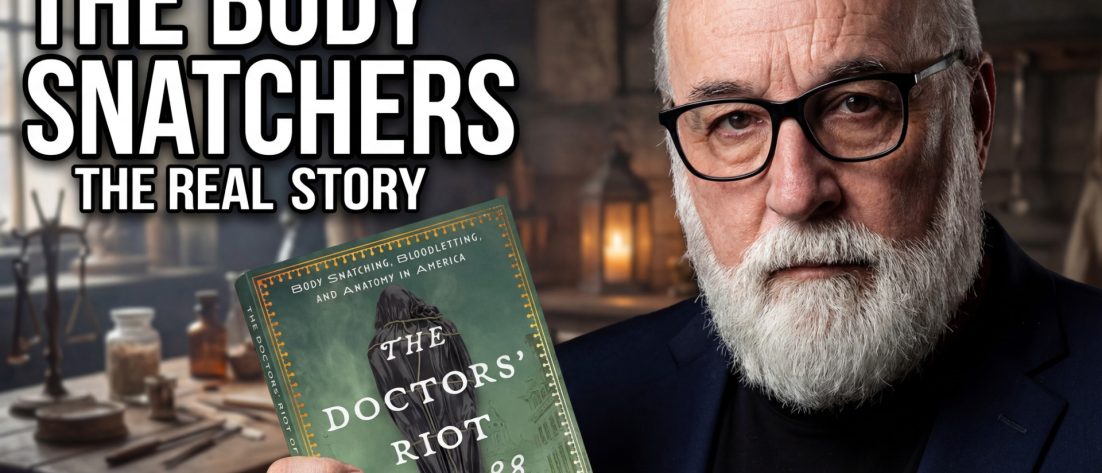
Discover the Doctor’s Riot of 1788 and the grim history of body snatching. Learn about 18th-century anatomy riots and the shocking modern-day black market for body parts.
Episode Resources:
- Get your copy of “Doctors’ Riot of 1788: Body Snatching, Bloodletting, and Anatomy in America” by Andy McPhee
- Connect with Andy McPhee
In 1788, a furious mob stormed the streets of New York, not over taxes or tyranny, but over stolen corpses. This was the Doctor’s Riot of 1788, a violent clash that exposed the grim underworld of 18th-century medical science. What drove medical students to dig up fresh graves in the dead of night? In this episode, we’re joined by author Andy McPhee to discuss his book, The Doctor’s Riot of 1788, and uncover the shocking history of body snatching, a practice that, in some forms, continues to this day. We explore the central dilemma: how could medicine advance without access to the one thing society refused to give?
The history of body snatching in America is a dark and fascinating tale of science, ethics, and social class. Author Andy McPhee details how, five years after the Revolutionary War, New York City was a tinderbox of tension. Medical students at New York Hospital, desperate for cadavers to study anatomy, regularly stole bodies from the “Negroes Burial Ground.” While the city’s Black population protested, their pleas were ignored. The situation exploded only when students began taking bodies from the white Trinity church graveyard. The riot was sparked by a medical student, likely John Hicks, Jr., who taunted a young boy by dangling a dismembered arm from a window, claiming it was the boy’s recently deceased mother. This single act ignited days of chaos, pitting a mob against founding fathers like John Jay and Baron von Steuben, who tried – and failed – to quell the violence.
This episode delves into the legal and moral gray areas of the time, explaining the critical difference between body snatching and grave robbing; one was a minor offense, the other a serious crime. This legal loophole allowed “resurrectionists” to flourish, supplying medical schools across the country. McPhee reveals that the Doctor’s Riot was not an isolated incident but one of many “anatomy riots” that occurred at medical schools across the young nation, from Baltimore to Vermont’s “Hubbardton Raid.” The conversation then takes a startling turn to the present, revealing the horrifying reality of modern body snatching. We discuss the case of “Masterpiece Theater” host Alistair Cooke, whose bones were stolen and sold after his death, and the recent Harvard Medical School morgue scandal involving Cedric Lodge, showing how an unregulated “body broker” market continues to exploit the dead for profit.
About Our Guest:
Andy McPhee is a historical nonfiction author and the writer of The Doctor’s Riot of 1788. In this interview, he shares his meticulous research process, which involved diving into digital archives like HathiTrust, archive.org, and Newspapers.com to piece together this forgotten chapter of American history and verify sources from a time when journalism was notoriously biased.
Timestamps / Chapters:
(00:00) The Shocking Story of the Doctor’s Riot
(01:33) How the Author Discovered This Forgotten History
(09:11) Body Snatching vs. Grave Robbing: The Critical Difference
(10:42) The Unbelievably Mild Penalties for Stealing a Corpse
(16:04) The Spark: John Hicks Jr. and the Arm in the Window
(20:09) Founding Fathers vs. The Mob: How Hamilton & John Jay Faced the Riot
(28:37) The Barbaric State of 18th-Century Medical Science
(31:53) Racial Tensions and the Unwritten Rules of Body Snatching
(35:45) Modern Body Snatching: The Alistair Cooke & Harvard Morgue Scandals
(41:39) “Mary’s Ghost”: A Haunting Poem from the Era
Introduction
Blaine DeSantis: Welcome to Books and Looks, where we do a deep dive with authors to help you discover your next great read. Thanks for joining us for our fourth season here on Books and Looks, and thanks to our good friends at BookTrib.com. Friends, today we start with a book called The Doctor’s Riot of 1788. Now, this is an amazing look at a riot that took place because of dissection of a body up in New York, I guess, in 1788.
It’s a book that deals with anatomy, dissection, body snatching, grave robbing, what was going on. It’s amazing, and the author today tells us a great background about the state of medical science in America back in that time period, which basically was pretty doggone bad. This went on. Body snatching might be a little much for some people, but it did happen, and things are still going on today. We’re going to learn all about that. I’m Blaine DeSantis. This is Books and Looks. And today we’re talking with Andy McPhee about his new book, The Doctor’s Riot of 1788. Andy McPhee, welcome to Books and Looks.
Andy McPhee: Thank you very much, sir.
Blaine DeSantis: Andy, we are happy to have you here because just a few days ago, your book was reviewed by the Wall Street Journal and it’s on the tip of everybody’s tongues. Doctor’s Riot of 1788. Good stuff. Andy, before we get into the actual book, could you tell us, how did you stumble upon this? Where did you find out about this Doctor’s Riot?
From Online Search to Historical Non-Fiction: Uncovering the Riot
Andy McPhee: I think probably a number of historical nonfiction writers actively searched for topics, and I was one of those. I had finished my first trade book, Donora Death Fog, and I had been looking for a new topic. I was searching online and the doctor’s riot popped up. I had looked for riots, I think, in the U.S. or something along that line.
I looked at a whole bunch of topics, but that one was very interesting. I could sense putting a wrapper around that event, a historical wrap around that event, talking about medicine and anatomy over the years. And it seemed to fit. In the end, it all did. It was through an online search for my next topic.
Blaine DeSantis: The thing is the sources you had to access because it’s about the doctor’s riot here in New York of 1788, but there were all these other riots. What type of sources did you have to use for that?
Andy McPhee: All the same sources. I did buy a few books, absolutely, but by and large, there were two or three main content aggregators. One of them is called HathiTrust, H-A-T-H-I Trust. And HathiTrust contains a wealth of books online, many of which can be downloaded as a PDF for free, many of which are not, but you can view them online for 24 hours or however long you need. And that proved to be extremely helpful.
Another one is archive.org. Of course, it’s a huge archive of books. Library of Congress. Newspapers.com was enormously helpful. Newspapers.com aggregates, as you would think, newspapers from the country over a great deal of time. So those kinds of resources were enormously helpful, but then I also reached out during the writing of the book to various experts to get their opinion and insight into whatever issue I was writing about then. So it’s a wide variety of resources.
Blaine DeSantis: Great, and this is one of the things that amazes me that we have a whole group of really wonderful writers, I include you in that, Andy, who now seem to get a lot of their information from the internet. Is that basically where you get most all your things?
Andy McPhee: No, without question. If I showed you my little office here, I don’t have books and papers and newspapers lying all over the place. I remember seeing photographs of David McCullough’s office when he was writing, and he had a little outhouse out back, and it was a mess. Now, my office is a mess. Don’t get me wrong. But it’s not filled with papers.
For my first book, I used to print everything out. Then I had a hard time finding what I wanted to find even though it was organized. So now I basically PDF everything because PDF is completely searchable. I can remember a term or an author or a name or something and search through PDFs and find it much more easily than boxes of printouts. The internet is enormously helpful.
Blaine DeSantis: I say thank you to the internet. I moan about it a lot of times, but boy, for writers and authors and just generally good knowledge, it can be a great source. And you use it well here, Andy.
Andy McPhee: Absolutely. You just have to be careful, pardon me for interrupting, with verifying the information. Thinking back to something in the 1700s and 1800s, the newspaper writers, the journalists, were often biased and wrote in a very biased way. So you have to be careful with that.
Anything updated, anything written about within the last 20 years, and they’re reflecting back something that happened a long time ago, is often wrong. You have to double check with as many original sources or at least old-time sources that you can get, because so many misstatements and misunderstandings get passed through the writers over the years. You have to be careful with that. But otherwise, it’s a fount of information on the internet.
Blaine DeSantis: Well, that’s great. Well, now this book, Andy, The Doctor’s Riot of 1788, this deals with a riot in New York. The doctors didn’t riot, but they were the cause of the riot, in effect, because we’re talking about anatomy, dissecting, et cetera. What was this all about?
The 1788 Doctor’s Riot: Anger, Anatomy, and a City on Edge
Andy McPhee: Remember, this is five years after the Revolutionary War. Medicine was horrendous back then. There were a great number of communicable diseases. And the country itself was really fighting for its own survival, even after the war, trying to, as one author says, unbecome British. There was also in New York City, there had been anger building up from blacks in the city.
And also from the poor people to an extent, because that’s where most of the bodies came from. Most of the bodies that these anatomy students at New York Hospital, before it was even a hospital, came from what they called the Negroes Burial Ground at the time, what is now the African Burial Ground National Monument. And a group of blacks, led by a gentleman called [Could not verify with context], had written to the paper, gently, gentlemanly asking the city to do something about the body snatching that had been occurring. If you get into the letters, you can see there’s an undercurrent of anger there, but he was very, very soft-spoken.
A student that we came later to learn was a gentleman named John Hicks, Jr., wrote back, basically saying, “You’re an idiot. This is what we need to have. We have to have bodies to learn anatomy.” So that was in a very popular paper at the time, the New York Packet. And they had a point-counterpoint discussion. So the city itself was very aware of what was happening. The problem came when the students started taking bodies from the Trinity church graveyard, Trinity church. It’s almost completely white at the time. Blacks had to sit out back and they had their own burial ground, but these students stole white bodies and that didn’t go over well once it was found out, which is what started the riot.
Blaine DeSantis: I see. Okay. Well, now, one of the things which we throw terms around, and they’re distinguishing things. We have body snatching and grave robbing. They’re two completely different things I found out. Could you tell us the difference, please?
Body Snatching vs. Grave Robbing: A Legal and Moral Distinction
Andy McPhee: Very different. Sure. Body snatching is grabbing the body from a grave. You dig down into the grave, head of the coffin open, and you drag the body out by the shoulders or the neck, as the case may be, take it to an anatomist, sell it, and then go on your merry way.
Grave robbing, however, is taking items of personal possession: jewelry, rare stones, whatever they were, clothing. Anything that was buried with the deceased remains property, whereas the body itself, and this is over centuries, was not property. It was just the body. Property died when the person died. So a very incongruous thought, to be sure, to take the clothing that they were buried in, or special jewels, rings, necklaces for the women, things. No, that’s all property forever. But the body itself, which is really all the body snatchers were interested in, the resurrectionists, not property. No laws to protect it.
Blaine DeSantis: That leads to the question of what were the penalties for the two, for body snatching versus grave robbing?
Andy McPhee: Body snatching, really, until you get into the very late 1700s and into the mid-part of the 1800s, very mild. They generally didn’t get caught. If they did get caught, they’d have to pay a fine. Really nothing very much. Even after laws started to change after the riot, they didn’t have any teeth in them. Why didn’t they have any teeth in them? Because society knew that they had to have these guys. They had to have bodies snatched so that the anatomy students in a growing population of medical schools could learn on actual humans because you couldn’t do that on a live body. You would not want your gallbladder taken out just so the students can learn. That didn’t go.
They were well aware then of the difficulty in stopping body snatching without a recourse for anatomy students. And Europe did the same thing. They went through the same thing. The body bills, they’re called bone bills later on. The bone bills didn’t make any difference. So there wasn’t very much. But the people who robbed the grave of property, they can be sanctioned, jailed, fined. Absolutely. They go after those guys, which is why the resurrectionists would try to put the clothes back in the grave, leave the jewelry, leave all that stuff and make the grave site itself look as if it’s never been disturbed. That was the goal so that the family would come along the next day. They had graveyard watchers to alert the families for that. Sometimes they got paid off to look the other way, absolutely. But the property that was in the grave, the resurrectionists didn’t want any part of that because they didn’t want to get jailed. They wanted to keep making their money. Very interesting, really interesting thing.
Blaine DeSantis: I found probably the most unique change in law about this whole situation of getting bodies for dissection and anatomy was up in Vermont. Vermont passed a law that banned it from, you couldn’t grave rob or body snatch in Vermont. But what else could you do?
Andy McPhee: Indeed, what else could you do? And there was a riot in Vermont that’s known as the Hubbardton Raid, which is a very interesting story. Have you heard of that?
Blaine DeSantis: No.
Andy McPhee: No. So in Hubbardton, and I hope I’m pronouncing that right, a body was taken and the head was removed. You would assume that it was to prevent identification. But in any case, the body was found, the rest of the body was found, and the residents were up in arms. And they all met at a house one day. The police or the sheriff said if they get the head back, they’ll be okay, basically.
A medical student snuck out, went to get the head, placed it in a barn next to the house, and then they found it. Everything was fine because they wanted just to have the body together so they could bury it. Again, there’s that understanding of the need for cadavers to study on and as well as the dignity after death kind of thing that the families struggle with. But that’s the only, and it wasn’t so much a riot as a whole group of people, descending upon individuals and saying, “Hey, this isn’t right. Fix it.”
Blaine DeSantis: I get it. What I liked about Vermont was they said, “You cannot body snatch anybody here. But if you want to bring them in from New York or Massachusetts, that’s okay. We don’t care about that. Just don’t take our bodies.”
Andy McPhee: New York was a main spot to take bodies. And they gathered them. People in Georgia. The Medical College of Georgia in the late 1700s, they hired somebody, a man named Grandison Harris, to go and get their bodies. He was a slave, basically, but a former slave. And they hired him, and he would go up to New York and bring bodies back. Eventually, they just would ransack local cemeteries.
There’s a photograph in the book of him with a large group of Medical College of Georgia graduates or medical students in any case, and way at the upper right-hand corner is a guy waving, like, “This is fun, here I am.” Fascinating photograph. So they would get, New York supplied bodies all over the country from Maine and Massachusetts all the way down to Georgia. It was a big, because the smaller places ran out of people who died.
Blaine DeSantis: Yeah, that’s true.
Andy McPhee: What are you going to do?
Blaine DeSantis: Now, what can you do now? You tell the story and no one really knows if this is right or wrong about John Hicks Jr. But basically John Hicks has an interaction with somebody, which is the spark for the riot. Tell us a little bit about that.
The Inciting Incident: John Hicks Jr. and the Boy at the Window
Andy McPhee: It is indeed. And historians believe it was a kid named John Hicks, Jr. Most of the students at that time, medical students, learning anatomy, were teenagers, mid to late teenagers. He couldn’t have been more than 20, 21, because he would have been out on his own by then. But in any case, the typical story is that he was waving an arm out a window at the back of the New York hospital when it was being built. They allowed some physicians to use their labs, their rooms.
That didn’t make sense to me. I saw it over and over and over again. What are you waving an arm on? That arm is precious. You’re going to learn on that. Plus, there’s a physician in there with you. That’s a serious thing. Even back then, it wasn’t a playtime.
More likely, which is what a couple of the sources said, more likely the arm was hanging out a window, drying. Perhaps it had just been washed off. Perhaps they’d just drained it of blood, and it was just sitting outside. And obviously, a group of boys playing below on the grass would have been intrigued. So a couple of the boys threw a ladder up there that a workman had left outside. And one of the boys climbed up and looked into the lab. And then this student, purportedly John Hicks, Jr., and that’s very consistent throughout historical accounts, if that was the name, said, “Hey, this is your mother’s arm. I just dug it up.” The boy’s mother had in fact just died. He ran home, told his father, who was a Mason working on a building in the area.
His father was like, “Well, that can’t be right.” Now, you can assume he would have known about it, although he wasn’t a laborer, but he’s a mason, a skilled mason. So he probably didn’t know about it. He got some friends. They stormed the school, break everything up in the lab. They don’t find Hicks. They don’t find anybody they can really grab because by the time they get there, the mayor has been alerted, and he arrives with some other officials. He takes the students and sequesters them at the jail, at Bridewell Prison, to get away. And that was the spark of the riot, really. This arm hanging out the back of an anatomy lab at a not-complete New York hospital.
Blaine DeSantis: Did they ever find out, was this the young man’s mother? Had they taken her body?
Andy McPhee: It apparently was, because the rioters took her body, and also there was another body on a table, I assume. A black gentleman, and there was a third body in a barrel or container of some kind soaking in acid to dissolve the tissues, but not the bones, so that they could have a skeleton. That was commonly done for a couple hundred years, and then hang the skeleton or leave certain bones out on the table so the students could study them. Very, very common.
So the assumption is, never proven. None of this can be proven. There were newspaper accounts at the time, but not very many. There are a few, and I think it was because there was some embarrassment over what the students did and what the rioters did. So they covered it, but the name of the woman whose body was found, the name of the boy, the name of the father, the name of the… None of those names have survived, as far as I could find, or many other historians could find. I’m not a historian, but you know what I mean. People who really get involved in that period of time can’t find them.
Blaine DeSantis: Pretty amazing. That is also coincidental. And well, now this riot, this was like a day or two, if I’m not mistaken. And you detail a lot of historical figures who start and founding fathers, leading people who were trying to stop the riot. Didn’t do too well, did they?
Founding Fathers and a Mob: The Escalation of the New York Riot
Andy McPhee: No, they didn’t. It was fascinating. I found out where Hamilton lived, where Governor Clinton’s office was. Governor Clinton lived outside the city. He would often come into the city and stay two, three nights, whatever he needed to conduct business. The mayor’s house, Mayor Duane, was close by. They were all kind of clustered, all these guys. So they had to talk to each other. It is said that Hamilton went to Columbia College, which was King’s College, and tried to tell people not to do this. It didn’t work, obviously.
But eventually, at the jail, you have a collection of the governor, Governor George Clinton, the mayor, James Duane. Obviously, Alexander Hamilton probably was there. I’d like to think probably because he was very interested in everything New York. But also, he was writing at the time, he was finishing up the Federalist Papers. So, we’re not sure.
The other big person, it was Baron von Steuben. He is the gentleman, you may recall, who was a Prussian officer who came over and whipped up the troops at Valley Forge into great shape. And he was a very well-known figure after the Revolutionary War. Everybody knew of him. So you have these dignitaries, plus a whole bunch of other local and city dignitaries who are collected at this jail trying to tell these rioters who had worked their way up by them not to do this.
Let’s take it back. Sunday, that was a main riot. The mayor comes up. He takes the students and tells the rioters to disperse, and they do. Very polite. The next day, the word has spread, and many more people are up and off. You can assume that many of them had family members who were also taken. One person asked me on a podcast I did, “Do you think any black people were present at the time?” And I suspect they were not. If they were, they were way in the back, watching. Because at that time, and for many, many, many decades after, whites did not tolerate blacks. Certainly they didn’t at that time. So probably not.
In any case, the next day, a growing number of people went looking for doctors and students, and John Hicks especially. They went to all the doctors’ homes over that Monday and the following Tuesday, because the riots started on Sunday. And they went to doctor after doctor after doctor to try to find these students very calmly. In one instance, they went up to the doctors’ homes, a whole bunch of people outside, a ton of them, banged in the doctor’s door. The doctor lets in two or three envoys, so to speak, of the rioters, allows them to search the house. Off they go.
One doctor’s house was searched and they even went up on the roof to look. And apparently at that time, John Hicks was on the house next door, hiding behind a chimney. Never found him. And they actually never found him at all. So they search doctors’ houses, and then they work their way up Broadway toward the jail. Bridewell Prison was located in the northern part of the city at the time, which is now way downtown.
Throughout that time, Clinton and Duane were walking along with some of these groups of rioters and pleading with them not to do this and why. And it just fell on deaf ears. When you get that anger in a mob, it becomes very difficult to calm it. Even then, when they get up to the jail… Then the rioters are trying to break down the doors, which they never could. Nobody was killed. Nobody was beaten up.
I’m thinking there’s, let’s say there’s three, four, 500 people against a few dignitaries who were probably in their 40s and 50s, old by that time, and they couldn’t overwhelm them. No, they didn’t. So even then, there was a reluctance on the part of the rioters to really get violent. And I think that was an important point throughout. The next day, they kept searching the doctor’s homes. But by that time, you had mounted militia roaming the city. So nothing else happened after that third day.
Blaine DeSantis: So there were no burnings. Nobody was killed. No doctors. There’s a lot of frustration for the rioters, but nothing that really happened physically.
Andy McPhee: The only thing that happened was when they started throwing stones and bricks and sticks and whatever they had, brickbats, kind of a collect-all term, and they started throwing that at the dignitaries. And when Baron von Steuben was struck, as was John Jay, I forgot to mention him, he also was down there. John Jay was the first Supreme Court justice of the United States and a founder, I should say, not a framer, because he was gone by then. So he was up there, and he got struck in the head with something, as did von Steuben.
When von Steuben got hit, he had been telling Duane and Clinton, “Calm down, don’t fire on these people.” He didn’t want a war. This is a guy who was in war in Europe, in Prussia, in France, and then comes over and he’d just gone through the Revolutionary War. “I don’t want to do this again. Let’s not have any killing.” But when he got hit in the head with a brick, that kind of changed his mind. And he told Duane, “Fire, Duane, fire,” at which point the militia that were with them fired over the heads of the rioters. And when that didn’t work, they fired directly into the crowd. And several were killed. There’s no accounting of how many. Certainly a number of them were wounded. And that’s what finally got people to disperse.
Blaine DeSantis: Okay.
Andy McPhee: They worked their way downtown, back downtown, looking for doctors. But there were people killed, but it wasn’t until the violence started. What was the violence? Throwing stones. I don’t mean to downplay this. I mean to say that even then, these rioters—they didn’t want to kill people, the rioters. They just wanted their measure of justice. They might have wanted to beat the crap out of and possibly kill John Hicks and the other students, but not the dignitaries. They just wanted at the students. So very much of conflicting feelings, I think, throughout that riot.
Blaine DeSantis: Okay. Now, dissection, however, was allowed during this time period, if I’m not mistaken.
Andy McPhee: In the U.S., they were. That’s very interesting. Over history, let’s look at the Catholic Church. The Catholic Church, for a long period of time, outlawed dissection. It was illegal. Not a lot happened to the dissectors, but. But then at one point in the 1500s, a pope died unexpectedly, Pope Leo X. They decided to dissect his body, and they found evidence of him being poisoned. So thereafter, any pope who died of any cause was dissected. I don’t know how long that lasted. It sort of gone back and forth. But at the time of the riot, dissection itself was not illegal. The body snatching was to an extent, but it really was more grave robbing than anything else.
Blaine DeSantis: And you do a good job documenting the sorry state of medical science in America. Most of these doctors who got any knowledge were trained over in Edinburgh in Scotland and there were only a few medical schools in the U.S.
Andy McPhee: [Could not verify with context], yeah.
Blaine DeSantis: Right. How do you get knowledge to kids unless they can actually see the inside of the body? It’s a dilemma.
Anatomy Riots and the Grim Realities of 18th-Century Medical Science
Andy McPhee: Back then, the doctors, as they were called, treated trauma, tried to fix bones and sew up cuts and things like that. But they did nothing internally, really, other than potions and things. And anybody could hang their shingle out for many years until medicine became regulated in the 1800s. So you had a bunch of people who had no training at all or very minimal training, hanging out shingles and being called doctors.
You’re right. Edinburgh and London were the two main places where the U.S. kept doctors, although there are a number of other schools in Amsterdam, Germany, Italy, France, who trained physicians. But most of ours came from Great Britain. And they brought over that learning. What did they learn over there? They learned body snatching. As students, they body snatched. So when they came over here, they taught the same thing. And it was very much medicine of the time. As we look back on it, it was barbaric. But at the time, that’s all they had.
So what are you going to do? If you really wanted to get better and you wanted to become a surgeon, you had to operate on, you had to find bodies to learn on. And it was only after that that you could say, “Oh, now, this is a liver. I wonder what this does. I wonder what the stomach does.” Learn how to set bones better. So even though medicine at the time was literally barbaric, it was the only way they could learn. Medicine has come a long way, obviously, since then. The Civil War helped much, much more with medicine than anything else. But even the Civil War without anesthesia, phew. Taking off a leg. No, it’s not for the weak.
Blaine DeSantis: No, no. So I think at one point you said there were a series of 15 maybe riots in America, not just all in New York. They were throughout the country. They were rioting. Was it all about the dissection and the body snatching?
Andy McPhee: Absolutely. They were called anatomy riots. There was another one in 1788 in Baltimore. I want to say October. They ransacked a school anatomy lab. There were others in Louisiana, New Orleans, Ohio, Vermont, Massachusetts. There’s one author who’s done work in body snatching who said that just about every medical school in the country had an anatomy riot at one point or another. None of them were fatal, so far as we know. But everybody had them because people, no matter where you were, you had this dichotomy of thought between the morality of it and the reality of body snatching and learning anatomy. So it happened all over the place.
Blaine DeSantis: What I found fascinating is it appears that this riot was maybe never going to happen had they just stuck with bodies from pauper’s fields and black burial grounds. When they got to a white person, they didn’t like that too much.
Racial Tensions and the Unwritten Rules of Body Snatching
Andy McPhee: Oh no. Absolutely. They had been stealing bodies without thinking about it at the time. And regardless of what the former slaves and the Africans in New York, and they all came from Africa, regardless of how much of a stink they put up, it didn’t make any difference because they weren’t real people. Just the whites were real people.
The problem with that is that the students and the faculty especially, oh, they loved to have black bodies, excuse me, white bodies. Why? At the time, with all the diseases, with all of the accidents and other traumas that blacks and poor suffered, the malnutrition, the diseases over and over again, tuberculosis, ran rampant, all these other diseases, they had an effect on those bodies. So the students learned those effects, but they didn’t. It was harder for them to see a normal body, inside, I’m talking about, than many of the white bodies.
Blaine DeSantis: You uncovered this fascinating debate, I think was in the Daily Advertiser, between a person called Humanio and another person called a Student of Physic. It was like a toxic social media thread. Tell us a bit about what was going on with that.
Andy McPhee: It absolutely was much more, much slower in its revelations. Humanio was probably, we believe, [Could not verify with context]. [Could not verify with context] was a black man who owned a free black man who owned a cemetery, basically in his black backyard, for his fellow black citizens. And the Student of Physic was almost certainly John Hicks Jr.
Blaine DeSantis: There he is again.
Andy McPhee: When he changed his name to Abductio. Yeah. There he is again. So Abductio, it’s like if you remember SNL a long time ago, the point-counterpoint debates they used to have. It was very similar to that. And similar to somebody putting something out there. [Could not verify with context] wrote a letter. This is the one I referred to earlier, asking the city council to please do something about students stealing bodies from the graveyard, from the Negroes burial ground.
That request to the city council just kind of went away. I’ve never heard from it again. The city council received it. We know that. But we know there was no action taken on it. But it came up, obviously, among the populace. And it was reprinted in the paper. Abductio, our friend John Hicks, Jr., Student of Physic, wrote back. And he blasted the letter writer in not gentlemanly terms, saying that they didn’t know what they were talking about, that this is how they learn and what else you expect us to do. “Would you rather have somebody who doesn’t know the body like we do taking care of your poor, invalid wife?” It was that kind of a sarcastic approach. And then Humanio responded and then Abductio responded. It was back and forth. And it’s like a letters to the editor in newspapers now or social media. Don’t look at the comments. It’s basically what it was back then. But everybody looked at the comments back then.
Blaine DeSantis: That’s interesting. Let’s bring it up to date. Modern day, we still have a lot of this, although it’s not body snatching per se. It’s more like organs and tissues and stuff like that. And Alistair Cooke of Masterpiece Theater, tell us about that situation.
The Disturbing Persistence of Modern-Day Body Snatching
Andy McPhee: Alistair Cooke, for the listeners who don’t remember, the younger ones, was a host of Masterpiece Theater for many, many years. He also hosted a BBC radio program for a long, long time. And he was extremely well-known, very articulate. Well, he died at age 96, and his body was sent to a funeral home. That funeral home happened to be working with and part of a network of a man named Michael Mastromarino. He obtained bodies, and then he would remove the bones, the heart, the heart valves, the stomach, whatever he could remove, and replace the bones, at least, for the casket viewing with PVC pipe and then send the body back to the funeral home.
That went on for quite a few years. He was eventually caught and sentenced to prison, and he actually died in prison from bone cancer. And I’m sure the irony is not lost on him. He was an oral surgeon by trade.
There have been a number of other, I call this modern body snatching. It’s a different way of doing the same thing. And just as it was in the 1800s and 1700s, there’s no consent from anybody. He never got consent. There was a gentleman in Las Vegas who had a funeral home in a strip mall in Vegas. And bodies he would take in, he would dissect them as well, remove whatever he could. And if they were going to be cremated, that was especially good because then he could sell a shoulder. He could sell knees. He could sell torsos. He could sell heads for dental research, whatever he needed to sell, and then just give some cremains back to the relatives. How are you going to check that? They’re cremains.
That’s gone on more than you’d like to see. There’s no regulation of that market. And I don’t say tissues. Our whole body is made of tissues. Skin is a tissue. Muscle is a tissue. Bone, they’re all different types of tissue. But tissue has, when you think about a tissue bank, you think, “Oh, there’s just a few cells under a microscope. Just little bits of tissues.” So I learned from one of my contacts, call them body parts because that’s what they are. And there’s money to be made in body parts. Everybody makes money except the donor, basically.
Blaine DeSantis: All right. Well, I’m going to show you something you never saw. I have it. Two weeks ago, the headlines in the Reading, Berks County, where I used to live, paper. And it says here that a former morgue manager was sentenced to prison for selling stolen body parts. And one of those came from Berks County.
Andy McPhee: Pennsylvania.
Blaine DeSantis: Yep, that’s Reading, Pennsylvania.
Andy McPhee: Oh, my God.
Blaine DeSantis: And this was a guy from the Harvard Medical Morgue or whatever he was. His name, former manager of the Harvard Medical School.
Andy McPhee: Yes. Cedric Lodge was just sentenced to eight years.
Blaine DeSantis: And then someone else was, his wife was sentenced to 12 months, and now they’re going to start talking about the people in Reading and other locations, how much prison time they’re going to get. But it’s going on. And I opened the paper. Boom. It hits me right in the face. I put it on, I don’t like going on Facebook but I do have some friends from high school that I knew and they’re on Facebook so I put this down. No one had read the story. Everybody was horrified about it. It just goes on and no one knows about it. Terrible, what can I say.
Andy McPhee: It’s not for lack of trying. I think NBC News several years ago did a story on modern day body snatching. It’s called “Body Brokers.” It’s a terrific series written and there was also a movie done about it. So it’s not for lack of trying. I don’t think people want to hear about that. There’s something about it that just makes them feel very uncomfortable.
“Could my relative who died, could they have been broken up?” “Oh, I don’t want to think about it.” It’s that kind of thing, I believe. And it’s a tough road to hoe because, as I say, there’s no national registry, governmental oversight of any kind of the body broker business of body parts. And it’s a huge business. We need bodies. You need bodies for surgeons to practice a new technique on a shoulder or a hip. You need knees for the same kind of reason. The military needs their torsos, let’s say, to see how a new weapon reacts. Oral surgeons need heads, jaws to practice on.
There’s a very valuable need for this. Many donor programs are completely legitimate and they tell the family members what could happen. But because there’s no oversight, it really is up to the family to ask questions or the individual who’s giving the body to ask questions and make sure they all get answered.
Blaine DeSantis: Last question. It’s not really a question, but you include the full text of a fascinating poem called “Mary’s Ghost,” which was written back, I think, in the 1800s. Could you just read us those last few haunting lines about Mary and her ghost?
“Mary’s Ghost”: A Poetic Look at the Fate of the Snatched
Andy McPhee: Yes, I’d be happy to. “The body snatchers, they have come and made a snatch at me. It’s very hard, them kind of men won’t let a body be. Don’t go to weep upon my grave and think that there I be. They haven’t left an atom there of my anatomy.” It was a poem written by a poet and writer and satirist, actually, back in the day, named Thomas Hood. The whole poem is from “Mary’s Ghost, a pathetic ballad.” And he was quite famous, although the poor guy died at 46 from dropsy, which we understand today is probably severe heart failure. I read that and I said, “Oh, man, that hits the nail on the head, doesn’t it?”
Blaine DeSantis: The whole poem goes on and says, my head went to this doctor, my heart went to this. This was like that. And at the very end, there’s not an atom.
Andy McPhee: Not an atom left of my anatomy. All gone.
Blaine DeSantis: Andy McPhee, our time is gone also. I want to say thank you for being with us today on Books and Looks. It has been most enlightening, quite enlightening. I love the topic. I love the book. Thanks for being on, Andy.
Andy McPhee: Thank you very much. I very much appreciate your kind words and for having me on. It’s been a pleasure.
Blaine DeSantis: Andy, thanks so much for being on today and enlightening us about the state of body snatching, dissecting, anatomy, et cetera, not just in 1788, but the fact that it’s still going on today. A fascinating look at medical history. And to be honest with you, we might not like it, but how else were we going to get bodies and corpses so kids could study and become the next great physicians out there? It is a dilemma.
The riot that happened in 1788 was as much a racial thing as it was anger over dissection. And you heard that from Andy. It’s a very interesting story. Hey, thanks so much for being with us today on Books and Looks. And we look forward to coming back with you next week. On behalf of all of us here at Books and Looks, may all your leaves be pages in a book.